
Eventually, oil’s well that ends well?
THE NATIONAL Energy Emergency is real. From all we hear on the news — locally or globally — and what we see and read on social media, you cannot escape the sense of hysteria that has riveted the attention of people everywhere. An elevated level of anxiety has pervaded halls of government, boardrooms, C-suites, mid- and small-sized business outfits, households and, inevitably, individual lives.
Some feel that what we are experiencing is a redux of the COVID-19 pandemic. Arguable, I would say. Yes, it is similarly and critically disconcerting and a cause of grave global concern. Unlike COVID, though, we know exactly how and when this “contagion” started. Presumably, we would also know how to end it, albeit in an overly simplistic scenario such as ending the conflict in the Middle East (As we go to press, the US and Iran have just agreed to a still-confusing two-week ceasefire. — Editor). Yes, there is an urgent rush to find a remedy to our circumstances as with the pandemic. In this current crisis, though, the “vaccine” is a known three-letter word: OIL. Where production of the COVID vaccine was undertaken in large-scale pharmaceutical labs and factories, this time it is pumped out of the ground in certain parts of the world — mainly the oil fields of the Middle East — and shipped through unsettled sea routes.
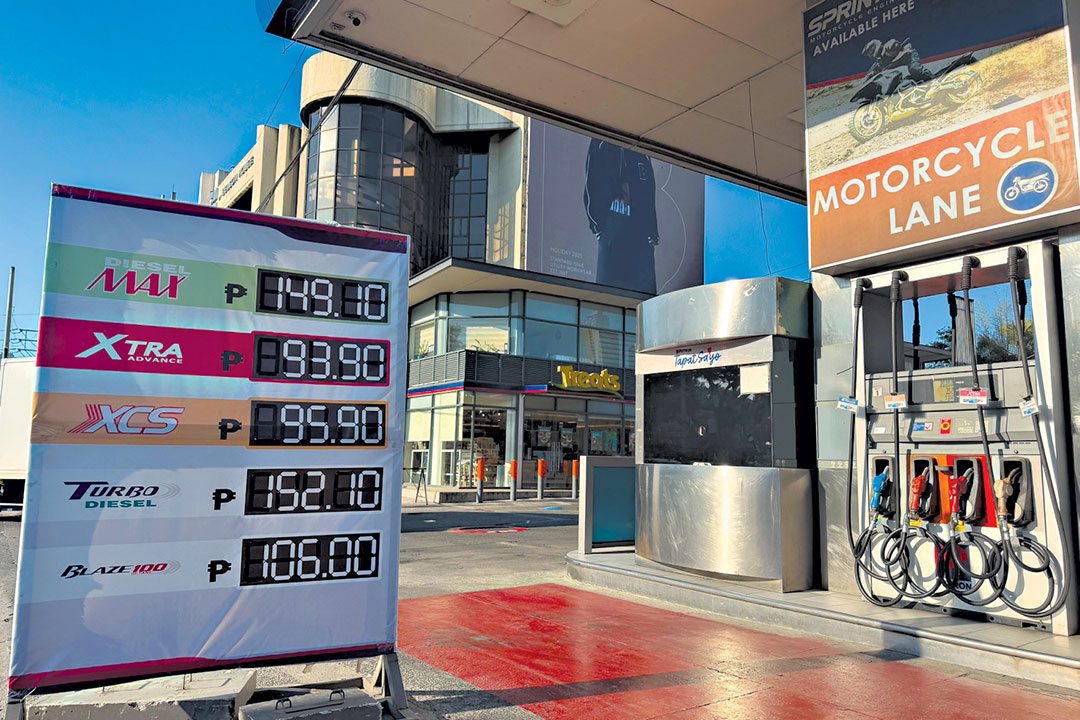
And, yes, there is a threat to the constriction of mobility in both instances. But where it was mandated previously through lockdowns, this time it will likely be a voluntary move on people’s part to mitigate the impact of rising fuel pump prices on their daily drives. For now, the impact of increased oil prices has not fully cascaded onto other daily essentials such as food, electricity, and transport fares. However, the inflationary pressures are surely building up as the oil-price shocks work themselves up the supply chains.
Logistics are experiencing the immediate shock wave. A report by Agence France-Presse (AFP) said sources in the shipping industry have cited dramatic increases in costs since the US and Israeli armed forces started bombing Iran last Feb. 28. Ship charters for tankers were reported to have risen by three times. The AFP quoted freight pricing specialist Peter Norfolk at Platts, part of S&P Global Energy, as saying that “from US$46 per metric ton at the end of February, the cost of shipping crude from the Gulf to China on a giant VLCC-class tanker nearly tripled in a few days, then eased to stand at around US$64 at the end of March.”
Meantime, the spot reference price to ship a 40-foot container has risen by 20% to 25% on the main routes from East Asia to Europe and the US West Coast, according to consultancy firm Maritime Services International. AFP reported that “the price of the bunker fuel that powers ships nearly doubled after the war broke out, peaking at US$1,053 per metric ton on March 20.” Also, war-risk insurance was mentioned as potentially running in the tens of millions of dollars for a single trip through the Hormuz Strait, with ships and cargos worth hundreds of millions.
When logistics costs rise, these increases are almost certainly passed on to consumers. It will not be long before the price of everyday living soars in tandem, especially if we also consider the weakening value of the Philippine peso. Inflation, which stayed at below 2% in recent months, will likely start rearing its ugly head again. In fact, for the whole of 2026, the Bangko Sentral ng Pilipinas (BSP) updated the annual forecast from 3.6% to as much as 5.1% — well above the government’s 2%-to-4% target range.
In my mind, however, the biggest threat to the economy is uncertainty. The fear of what is not known and, at times, the unfounded actions that it leads to can be more debilitating than the unfolding crisis itself. This is especially true in view of the many varied reports about the bottom-line situation of our oil and gas supplies.
Unfortunately, outside of having to negotiate new oil-supply contracts and arranging safe passage for shipments, oil-storage capacity in the country is also a significant challenge. I should very much hope that the Department of Energy has a high-level information nexus that business establishments can rely on for prompt, correct, and verifiable information. This line of communication should also be the repository and source of factual information from oil importers and distributors as well as other related agencies and organizations such as the Energy Regulatory Commission.
In the meantime, there are some things that we can borrow from the COVID years. Bicycling and active mobility solutions worked then; why not now? Shuttles and carpooling reduced the number of vehicles on the road — and saved gas. The heightened resort to public transport kept private cars home. Daily travel movements were well-considered, leading to more efficient mobility. Face-to-face engagements were dialed down in favor of alternative communication platforms. I recall that one of the best outcomes of the pandemic was less traffic, cleaner skies, and a robust coexistence of multiple mobility solutions.
Undeniably, we are in a state of economic disruption. Supply destruction is potentially — if not already — headed our way. Consumer confidence is eroding and demand destruction (hopefully gradually rather than abruptly) will heighten as supply distortions seep into the market. Business is in crisis management mode. It is updating and activating business continuity plans fluidly. Scenario planning is kicking into high gear. Management needs to inform and gain the support of their stakeholders, especially their employees. Correct and timely information is crucial. If the government provides proper and organized transactional information, businesses can do the heavy lifting in setting countermeasures and backup plans in motion. It is what business organizations are primed to do: survive and thrive. Without adequate information though, businesses will be cast adrift, with their actions either leading them in the wrong direction (i.e., unproductive speculation) or being too late to matter.
Resilience has indubitably seen us through many crises. COVID was life-threatening and it thrust us into completely uncharted waters, but we pulled through with sheer grit and persistence. The crisis we are enduring today is a war of choice. Viruses morph in countless ways over unpredictable timelines. Wars are geography-specific and time-bound. There are precedents and there are playbooks to manage our way out of them.
This is not the first oil crisis we have experienced. The oil shocks created by the Arab oil embargo and Iranian Revolution in the 1970s may not have been nominally as high, but it had far more significant economic repercussions. In 2011, the Arab Spring saw Brent oil prices rise to US$127 per barrel. The Iran crude embargo in 2012 kept oil prices over US$100 per barrel for around two years until 2014. The Russian invasion of Ukraine sent Brent up to US$139.13 per barrel. The previous record, though, was in the commodity boom of 2008 when nominal Brent oil prices hit US$147.50 per barrel due to falling stockpiles in the United States, strong Chinese demand and unrest in key OPEC members Iran and Nigeria. When adjusted for inflation, the 2008 price peak is estimated to represent a real cost of above US$200.
For now, let us focus on the short game of mitigation but we must also keep our other eye on the inevitable recovery that follows. Let us avoid shortsightedness and steady our aim on the long game. Facts show that after every oil price surge, they sink to record low levels due to the corrective economic recession that follows. After Brent oil prices peaked at US$147 in July 2008, they sank to US$36 by December 2008. Stability and recovery inevitably return. That is my fervent hope — that the cycle of growth repeats itself.