Home Blog Page 995

PSEi climbs to 6,400 level before inflation data

The lobby of the Philippine Stock Exchange in Taguig City, Sept. 30, 2020. — REUTERS

PHILIPPINE SHARES climbed for a second straight day on Tuesday as expectations of cooling inflation boosted investor sentiment.

The bellwether Philippine Stock Exchange index (PSEi) rose by 0.94% or 60.20 points to close at 6,412.86, while the broader all shares index went up by 0.73% or 27.54 points to 3,770.95.

“The local market extended its rise as investors continued to draw optimism from the expectation that inflation remained below the government’s target last May, giving the Bangko Sentral ng Pilipinas (BSP) more leeway to cut rates,” Philstocks Financial, Inc. Senior Research Analyst Japhet Louis O. Tantiangco said in a Viber message.

“Philippine shares broke past the 6,400 market once again, driven by broad market optimism ahead of Thursday’s inflation report from last month,” Regina Capital Development Corp. Head of Sales Luis A. Limlingan likewise said in a Viber message.

The Philippine Statistics Authority will release May inflation data on Thursday (June 5).

A BusinessWorld poll of 17 analysts yielded a median estimate of 1.3% for the May consumer price index, slower than the 1.4% in April and 3.9% in the same month a year ago. This is within the central bank’s 0.9%-1.7% forecast for the month.

If realized, this would be the lowest headline inflation print in more than five years or since the 1.2% in November 2019.

“Hopes that the leaders of the US and China would have a productive talk this week also helped the market,” Mr. Tantiangco added.

US President Donald J. Trump and Chinese leader Xi Jinping will probably speak this week, White House Press Secretary Karoline Leavitt said on Monday, days after Mr. Trump accused Beijing of violating an agreement to roll back tariffs and trade restrictions, Reuters reported.

The call between the two leaders will be closely watched by markets, which have been roiled by tariff-induced trade tensions between the world’s two largest economies that continue to simmer.

Almost all sectoral indices ended higher on Tuesday. Property climbed by 1.63% or 36.80 points to 2,282.32; holding firms increased by 1.48% or 79.30 points to 5,411.01; industrials rose by 1.2% or 107.19 points to 8,996.76; mining and oil went up by 0.8% or 79.51 points to 9,969.59; and services added 0.74% or 16.08 points to end at 2,182.38.

Meanwhile, financials inched down by 0.06% or 1.53 points to 2,398.57.

“Bloomberry Resorts Corp. was the day’s index leader, surging 12.27% to P4.94. BDO Unibank, Inc. was at the tail end, falling 2.04% to P158.70,” Mr. Tantiangco said.

Value turnover fell to P5.99 billion on Tuesday with 739.36 million shares traded from the P7.08 billion with 617.85 million issues exchanged on Monday.

Advancers narrowly beat decliners, 103 versus 102, while 52 names were unchanged.

Net foreign buying went down to P168.63 million on Tuesday from P418.29 million on Monday. — Revin Mikhael D. Ochave
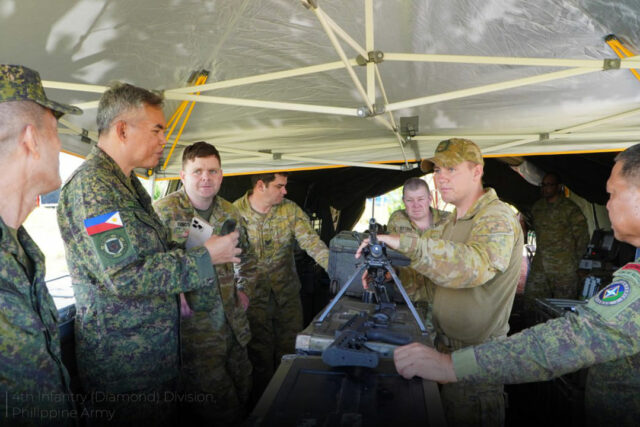
PHL, Australia hold drills in south

PHILIPPINE Army and Australian Army senior officers closely monitor the mid-phase of Exercise Kasangga at Camp Kibaritan in Bukidnon on May 30, 2025. — PHILIPPINE ARMY

THE PHILIPPINE and Australian armies held joint combat exercises in the southern Philippines last week, bolstering military cooperation between the nations as tensions persist in the contested South China Sea.

In a statement, the Philippine Army said it conducted “practical combat” drills alongside their Australian counterparts in Bukidnon province to help foster interoperability in urban and rural warfare, including tactical maneuvers under “high-stress conditions.”

“Philippine Army troops and their Australian counterparts focused on the real-time evaluation of their interoperability, operational readiness and tactical capabilities in conducting the said drills,” it said on Monday.

“Training contingents also sharpened their combat skills by conducting small-unit maneuvers, counter-ambush drills and tactical coordination in both urban and rural settings to assess their adaptability and unit cohesion,” it added.

The combat drills are part of the broader Exercise Kasangga — Filipino for ally — that would see Filipino and Australian troops rehearse in war-like conditions amid regional security concerns due to China’s increasing assertiveness in the contested South China Sea and beyond.

Manila is seeking to expand its security ties with other western countries and regional allies as it counters Beijing’s sweeping claims over the disputed waterway that overlap with the Southeast Asian nation’s exclusive economic zone.

China claims more than 80% of the South China Sea based on a 1940s map, which a United Nations-backed arbitration court in The Hague voided in 2016 for being illegal.

Australia has also grappled with China’s naval presence near its waters. The People’s Liberation Army Navy earlier this year conducted live-fire drills in international waters within the Tasman Sea, more than 8,000 kilometers away from Hainan Island, China’s nearest major landmass, which separates Australia and New Zealand.

Filipino and Australian soldiers also performed combat casualty care simulations during the drills, helping their forces develop expertise in first-aid operations in warfighting situations.

“Training participants also conducted a series of practical medical exercises such as battlefield triage and casualty evacuation under fire and treatment of critical injuries,” the Philippine Army said.

Also last week, the Philippines’ top security adviser met with a US Congress delegation in Quezon City, where they highlighted the need to foster deeper security ties amid regional challenges.

National Security Adviser Eduardo M. Año talked with the US delegation led by Michigan Rep. John R. Moolenaar, reaffirming their commitments to work together in advancing their countries’ mutual interests in the Indo-Pacific region, the National Security Council said.

“The US delegation expressed continued support for the Philippines’ efforts in safeguarding sovereignty and upholding a rules-based international order,” it said in a Facebook post on Tuesday.

The Philippines and US maintain a decades-old alliance buoyed by a mutual defense treaty and strong economic ties, and both countries have sought to strengthen security cooperation and enhance force interoperability in response to China’s growing assertiveness in the region. — Kenneth Christiane L. Basilio

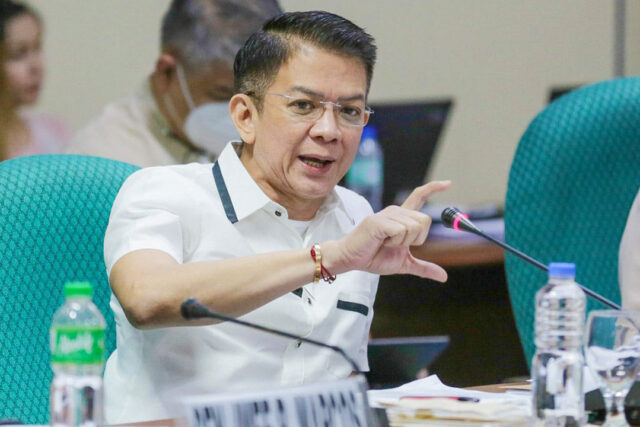
Senate chief told: Begin Duterte’s impeachment trial immediately

PHILIPPINE STAR/GEREMY PINTOLO

A COALITION of civil society groups urged the Senate on Tuesday to promptly begin the impeachment trial of Vice-President (VP) Sara Duterte-Carpio, citing concerns over repeated delays in the proceedings.

“We… express great alarm over recent delays in the impeachment proceedings of Vice-President Sara Duterte,” the group, which consists of priests, academics and youth leaders, said in a statement.

Senate President Francis Joseph “Chiz” G. Escudero last week deferred the scheduled presentation of charges against Ms. Duterte to June 11 from June 2, citing the need for the chamber to prioritize pending bills and act on presidential appointments.

Mr. Escudero added that it would also be up to the Senate plenary to decide on the schedule of the VP’s impeachment trial.

“Is he afraid of Sara Duterte?” Party-list Rep. Percival V. Cendaña said in a separate statement, warning the Senate chief that his “continued delay” in convening the impeachment court could be tantamount to betraying the chamber’s constitutional mandate.

“This is not Paris Fashion Week,” he said in mixed English and Filipino. “Convening the Senate as an impeachment court is a solemn constitutional duty, not a seasonal accessory you put on or discard depending on the political weather or one’s personal agenda.”

A verified impeachment complaint endorsed by the House of Representatives will serve as official charges against an impeachable official, according to the 1987 Constitution, requiring the Senate to convene “forthwith” and begin trial.

“It would be a great disservice to the nation if the impeachment trial will not proceed as mandated under the Constitution, despite the overwhelming evidence presented against the Vice-President,” the group said.

The Senate President said he will adhere to what is right under the law, regardless whom it favors or undermines.

“And that kind of comment clearly comes from a camp opposed to VP Sara and is in favor of her impeachment. Let them carry their opinion and perspectives,” he told reporters in Filipino.

“As the Senate President, it is my duty to keep things fair, just, and in accordance with the law.”

The House impeached the Vice-President on Feb. 5, alleging secret fund misuse, unexplained wealth, acts of destabilization and plotting the assassination of President Ferdinand R. Marcos, Jr., his family, and the Speaker of the House. Ms. Duterte has denied any wrongdoing.

“The impeachment trial has been effectively delayed for about 4 months now and risks further delay and legal uncertainties,” the group said. “The delays go against the Constitutional provision that the Senate trial shall commence ‘forthwith.’”

Mr. Cendaña said the impeachment trial could still be held in the 20th Congress, which would convene in mid-July. “The impeachment process is a constitutional mandate, not a legislative bill that expires at the stroke of midnight.”

“Once the House transmitted the Articles of Impeachment, the Senate is constitutionally bound to convene as an impeachment court — no ifs, no buts,” he added.

Senate Majority Leader Francis N. Tolentino earlier said the impeachment case is “functionally dismissed,” arguing the 20th Congress cannot take any action because its jurisdiction is within the 19th Congress.

Meanwhile, nine of 10 Filipinos believe that Ms. Duterte should face the impeachment charges against her, according to a WR Numero Research poll in April, with half of all respondents saying that Senators should base their decision on the evidence that would be presented.

“When asked about the trial’s potential outcome, the public is divided,” the pollster said in a Tuesday statement.

One in three Filipinos said Ms. Duterte should be convicted on charges ranging from misuse of alleged secret funds and plotting the assassination of the President. About 23% said she should be acquitted, with the remaining 43% unsure about how the Senate should rule on the trial. — Kenneth Christiane L. Basilio

Senate urges Marcos to create Cabinet cluster for education

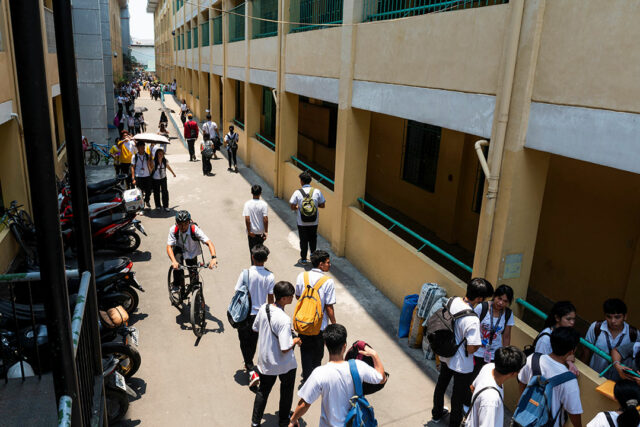
Students walk inside the campus of a high school in Quezon City, April 18, 2024. — REUTERS

THE PHILIPPINE Senate on Tuesday adopted a resolution urging the President to create a cabinet cluster for education that could ensure proper implementation of the country’s educational policies and measures.

“This cluster will provide strong oversight of all education agencies, ensuring that our laws, policies, reforms, and regulations are carried out in a cohesive and coherent manner,” Senator Sherwin T. Gatchalian, who co-authored the resolution, said before the Senate plenary.

“This is one critical step in addressing the education crisis that our country is facing,” he added.

Through Concurrent Resolution No. 21, the Senate called on President Ferdinand R. Marcos, Jr. to create a cabinet cluster that will facilitate “seamless and coherent” implementation of local education laws, policies, reforms, and regulations across all government agencies.

The resolution also calls for the formation of a long term integrated national education and workforce development plan. This would address the country’s coordination challenges and gaps in the strategic planning of the education sector.

“By aligning efforts and holding agencies jointly responsible for outcomes, we can guarantee that every centavo spent directly benefits our learners,” Senator Lorna Regina “Loren” B. Legarda said in her co-sponsorship address.

The Cabinet Cluster will include the heads of the Department of Education (DepEd), Commission on Higher Education (CHED), Technical Education and Skills Development Authority (TESDA), Early Childhood Care and Development Council, among others.

Mr. Gatchalian said that the agencies will ensure that education reforms “are not only well-intentioned but also well-coordinated and effectively implemented.”

It will be headed by an existing cabinet secretary that has a direct stake in the education sector or a designated presidential adviser.

Senator Emmanuel Joel J. Villanueva, also a co-author, said that the creation of the cluster will enhance the collaboration between DepEd, TESDA, and CHED.

“Our recent legislative efforts highlight the necessity for these agencies to share not only goodwill but also information, resources, and capabilities,” Mr. Villanueva added.

Additionally, Senator Alan Peter S. Cayetano said that without the coordination of education agencies, country’s education system “will keep struggling with fragmented leadership and disconnected reforms.”

“After three decades of a divided system, we need one that moves as one, from early childhood to employment,” he added.

Last year, the President had “approved in principle” the creation of the Cabinet cluster, citing the urgency to fast-track the implementation of education reforms, following the recommendation of the Second Congressional Commission on Education (EDCOM 2). — Adrian H. Halili

DSWD to integrate subsidized rice initiative in food stamp program

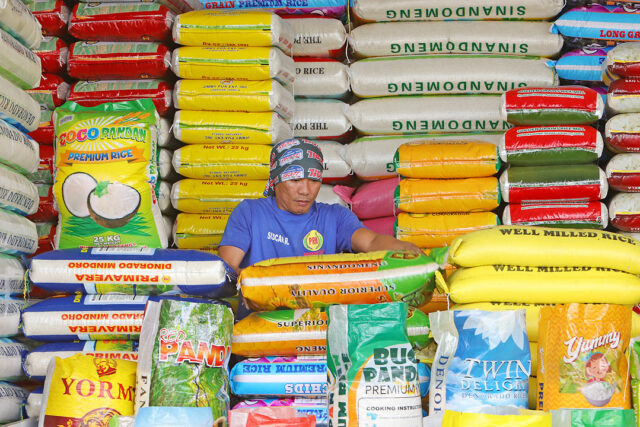
PHILIPPINE STAR/WALTER BOLLOZOS

THE Department of Social Welfare and Development (DSWD) is set to expand its food stamp program to integrate the government’s P20-per-kilo rice program for the poorest Filipinos, following new data that shows nearly half of enrolled poor households still experience hunger despite intervention.

DSWD Secretary Rexlon T. Gatchalian, in a briefing at the Presidential Palace on Tuesday, said the DSWD had submitted a list of accredited food retailers to the Department of Agriculture (DA) last Monday, which will begin supplying poor Filipinos with low-cost rice.

The rice will be available to food stamp recipients using their monthly P3,000 in food credits under the Walang Gutom Program in accredited small agricultural cooperatives, as well as micro, small, and medium enterprises (MSMEs).

Beneficiaries receive monetary assistance in the form of an Electronic Benefit Transfer card, amounting to P3,000 per month, to purchase a select list of food commodities from accredited stores.

“The small agri-coops where our food-poor beneficiaries redeem their food — that’s where they will now be supplied. They will be given a supply of the cheap P20 rice so that with their food credits, they can buy more,” Mr. Gatchalian said in Filipino.

This comes after a survey found that the proportion of households experiencing hunger stood at 44.6% in December 2024, albeit declining from 48.7% in October 2024.

It also revealed that hunger incidence among non-beneficiaries rose by 6.1% over the same period.

The survey, conducted by Social Weather Station (SWS) and telco giant Globe Telecom, studied the incidence of hunger among the poorest Filipino families in two waves.

The first wave, which surveyed 2,011 respondents, was conducted from Oct. 7 to 18, 2024. The second wave followed from Dec. 1 to 10, 2024, with 1,980 respondents.

The Walang Gutom 2027 program, launched in 2023, currently covers 300,000 of the poorest Filipino families and aims to reach 750,000 by 2026.

While the government is encouraged by a decline in severe hunger, Mr. Gatchalian acknowledged the need for stronger interventions and faster exits from the program.

“There are job fairs that [the Labor department] will hold for our beneficiaries, purely for our beneficiaries to match the type of companies that will be going to the job fair so that we can ensure that they are suitable for the skills and capacities of our beneficiaries,” he added.

The government’s next goal is to help these individuals achieve self-sufficiency through employment opportunities and skills development with the Technical Education and Skills Development Authority (TESDA).

TESDA will provide training programs to equip beneficiaries with the necessary skills to enter the workforce. “It’s important now that you’ve eaten that you should join us in the productive workforce so we can work,” Mr. Gatchalian added.

The P20-per-kilo rice scheme, one of President Ferdinand R. Marcos, Jr.’s signature campaign promises, is expected to stretch the value of food credits of DSWD beneficiaries and ease food insecurity in program areas. — Chloe Mari A. Hufana

Labor dep’t to head ILO panel

BW FILE PHOTO

THE Philippines has been elected to chair an international committee that seeks establish new international labor standards and promote decent work, according to the Department of Labor and Employment (DoLE) on Tuesday.

“This will be the first discussion of the proposed conclusions aimed at formulating and establishing new international labor standards to promote decent work in the platform economy,” DoLE said in a statement, following the country’s participation in the International Labor Organization’s (ILO) International Labor Conference in Geneva.

The agency said that Labor Undersecretary Benedicto Ernesto R. Bitonio, Jr., who is also the Philippines’ head of delegation, was elected as the committee’s chair.

Mr. Bitonio said that the platform economy has experienced exponential growth across countries and regions since the coronavirus pandemic.

“There is a broad consensus for an international instrument or instruments that will collectively guide ILO member states in optimizing the opportunities and mitigating the threats that the platform economy presents, especially in the aspects of work and employment relationships,” he was quoted as saying.

Platform economies are businesses that use digital platforms as intermediaries, connecting users and service providers to facilitate the exchange of goods, services, or information.

The committee is set to meet until June 12. — Adrian H. Halili

SC updates plea bargaining rules

PHOTO BY MIKE GONZALEZ

THE SUPREME COURT (SC) ruled that prosecutors in drug cases must raise all their objections at once when an accused seeks to plead guilty to a lesser offense or risk forfeiting those objections entirely.

The decision stems from the case of a man who was convicted by a Dumaguete court for the illegal possession of drug paraphernalia.

He had initially been charged with both selling and possessing methamphetamine, but moved to enter a plea bargain for a lesser offense under Section 12 of the Comprehensive Dangerous Drugs Act of 2002.

The Regional Trial Court (RTC) allowed the man’s plea, convicting him of the lesser crime, even as the prosecution only agreed to the plea bargain for the possession charge. The Court of Appeals later annulled the RTC’s judgment.

The high court disagreed, invoking its People v. Montierro ruling, which stated that objections based solely on Department of Justice policy are insufficient if the proposed plea complies with the judiciary’s official framework. In the decision penned by Associate Justice Japar B. Dimaampao, it was clarified that courts retain discretion to accept or reject objections based on valid criteria, such as noncompliance with SC guidelines or indications that the accused is a habitual offender.  

The ruling noted that fragmented objections, those raised piece by piece rather than all at once, would now be treated as waived under the Omnibus Motion Rule.

“Thus, any time and effort ‘saved’ by the plea-bargaining system is effectively rendered nugatory as the trial court must again reopen the case and receive the prosecution’s evidence,” it added. “This is undoubtedly anathema to the chief virtues advanced by plea bargaining, that is, speed, economy and finality for the accused, the offended party, the prosecution, and the court.”

To avoid such delays, the SC issued additional clarificatory guidelines. Among them: trial courts must address all objections raised, and appellate courts can remand cases only if there’s insufficient information on whether the rules have been properly applied. — Chloe Mari A. Hufana

BoC seizes P15.8-B fake goods

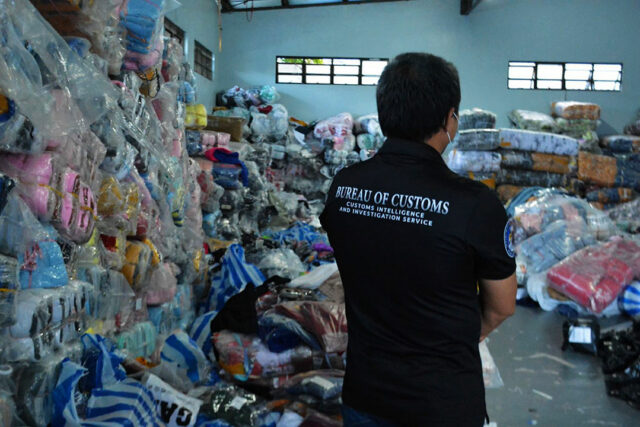
MEMBERS of the Bureau of Customs-Customs Intelligence Investigation Service inspect various counterfeit shirts, perfumes and other luxury goods at a warehouse in Las Piñas City. — PHILIPPINE STAR/MIGUEL DE GUZMAN

THE Bureau of Customs (BoC) reported it collected P15.8 billion worth of counterfeit goods in the first four months of 2025.

In a statement on Tuesday, the BoC said it recorded P15.8 billion worth of counterfeit goods seized “in coordination with brand representatives and partner IPR enforcement agencies.”

“Protecting the intellectual property rights of innovators and brand owners remains central to our overarching objective of cultivating a fair, secure, and dynamic trade environment,” BoC Commissioner Bienvenido Y. Rubio said.

Last year, the BoC reported P34.698 billion in seizures, making it the leading contributor to the overall confiscation of intellectual property rights-infringing goods.

This accounted for the bulk, or 85%, of the total P40.99 billion seized by the National Committee on Intellectual Property Rights. — Aubrey Rose A. Inosante

CAAP readies Iloilo airport upgrade

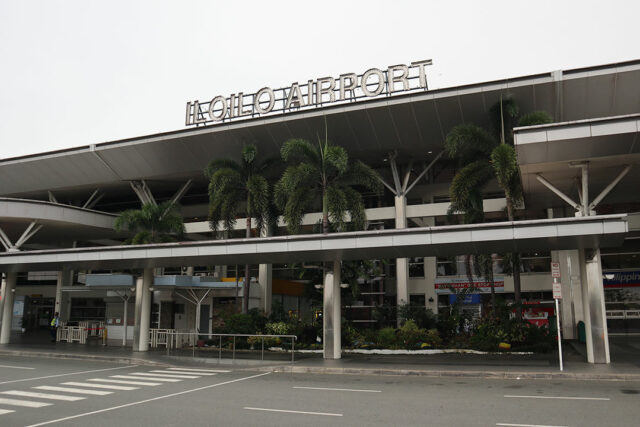
PATRICKROQUE01-WIKIPEDIA

THE Department of Transportation (DoTr), through the Civil Aviation Authority (CAAP), is set to implement upgrades for Iloilo International Airport.

“CAAP and DoTr remain fully committed to enhancing the travel experience of every passenger by ensuring that our airports are safe, efficient, and passenger-friendly,” CAAP Director General Raul L. del Rosario said in a media release on Tuesday.

The rehabilitation of Iloilo International Airport is part of its priority infrastructure projects, CAAP said, noting that major upgrades for the airport are valued at P190 million and will be sourced from the general appropriations act 2024.

The project will focus on rehabilitation, expansion, and modernization of the passenger terminal building. CAAP said this major upgrade will expand the airport’s passenger terminal capacity to 675 domestic and 407 international passengers.

At present, the airport’s passenger terminal building can only accommodate 367 domestic and 360 international passengers.

Further, Iloilo International Airport is also one of the airports in line for privatization.

Prime Asset Ventures, Inc.’s (PAVI) unsolicited proposal for the operations and maintenance of the Iloilo International Airport has successfully completed negotiations, according to the Public-Private Partnership (PPP) Center. — Ashley Erika O. Jose

Ukrainian strikes cut power to Russian-held areas

UKRAINIAN SERVICE MEMBERS of the 25th Sicheslav Airborne Brigade fired a BM-21 Grad multiple rocket launch system towards Russian troops near the frontline town of Pokrovsk, amid Russia’s attack on Ukraine in the Donetsk region on April 19, 2025. — REUTERS

UKRAINIAN attacks triggered power cuts over swathes of Russian-controlled territory in Zaporizhzhia and Kherson regions in Ukraine’s south, leaving hundreds of thousands of people without electricity, Russia-installed officials said on Tuesday.

Officials said there was no effect on operations at the Zaporizhzhia nuclear power station — Europe’s largest nuclear facility which was seized by Russia in the weeks after Moscow’s February 2022 invasion of Ukraine.

Russian officials running the plant said radiation levels were normal at the facility, which operates in shutdown mode and produces no power at the moment.

Russia-installed governors in the two regions, which are among the key areas that Moscow demands that Ukraine give up in order for the war to end, said the Ukrainian attacks prompted authorities to introduce emergency measures to preserve power sources.

As of Tuesday morning, more than 600,000 people in nearly 500 settlements in Zaporizhzhia were without electricity, after shelling by Ukraine’s forces damaged high-voltage infrastructure, Russia-installed Governor Yevgeny Belitsky wrote on Telegram.

“As a result of shelling by the Ukrainian Armed Forces, high-voltage equipment was damaged in the northwestern part of the Zaporizhzhia region,” Mr. Belitsky wrote.

The attacks came hours after Russian and Ukrainian delegations met in Turkey for peace talks where Moscow said it would only agree to end the war if Kyiv gives up big new chunks of territory and accepts limits on the size of its army.

The Energy Ministry of Zaporizhzhia region has been instructed to conserve sources of power and healthcare sites have been transferred to reserve power sources.

In the adjacent Kherson region, farther west, Russia-appointed Governor Vladimir Saldo said debris from fallen drones had damaged two substations, knocking out power to more than 100,000 residents of 150 towns and villages in Russian-held areas. Emergency crews were working to restore power quickly, he said.

There was no immediate comment from Ukraine. Both sides deny targeting civilians in the war that Russia launched in February 2022. But thousands of civilians have died in the conflict, most of them Ukrainian.

For many long months in the winter, it was Ukrainian towns and villages that endured repeated electricity cuts as Russian attacks focused strikes on generating capacity.

Each side has repeatedly accused the other of launching attacks on the Zaporizhzhia nuclear plant and running the risk of a nuclear accident.

The United Nations nuclear watchdog, the International Atomic Energy Agency (IAEA), said last week in response to a Ukrainian complaint that it saw no sign that Russia was preparing to restart the Zaporizhzhia plant and connect it to the Russian grid.

The IAEA has stationed monitors permanently at Zaporizhzhia and Ukraine’s other nuclear power stations.

Meanwhile, Russia’s overnight attacks killed one person in Ukraine’s northeastern region of Kharkiv and injured several more in the northern city of Chernihiv, regional Ukrainian officials said on Tuesday.

A private enterprise was hit in the small town of Balakliia in the Kharkiv region that borders Russia, killing one employee and injuring several others, Vitali Karabanov, the head of the town’s military administration, said on the Telegram messaging app.

“A massive UAV (unmanned aerial vehicle) attack on the town,” Mr. Karabanov said, without providing details of the scale.

The attacks came hours after Russian and Ukrainian delegations met in Turkey for peace talks where Moscow said it would only agree to end the war if Kyiv gives up big new chunks of territory and accepts limits on the size of its army.

Ukraine has repeatedly rejected the Russian conditions as tantamount to surrender.

Falling drones on streets and residential buildings in the northern city of Chernihiv sparked several fires, including at residential houses, Dmytro Bryzhynskyi, the head of the city’s military administration, said on Telegram.

Four people were hospitalized, Bryzhynskyi said. Ukraine’s State Emergency Service said another 20 people, including eight children, received medical assistance at the site.

The service posted photos on its Telegram account showing firefighters battling blazes in the dark and medics attending to a group of children.

In the southern port city of Odesa, Russian overnight air attacks damaged residential buildings and civilian infrastructure, but there were no injuries, Mayor Hennadiy Trukhanov wrote on Telegram.

The full scale of the overnight Russian attack on Ukraine was not immediately known. There was no immediate comment from Moscow and Reuters could not independently verify the Ukrainian reports. — Reuters

HRW: Rwanda-backed rebels in Congo killed civilians Human Rights Watch says

MEMBERS of the M23 rebel group stand guard as people attend a rally addressed by Corneille Nangaa, Congolese rebel leader and coordinator of the AFC-M23 movement in Bukavu, eastern Democratic Republic of Congo on Feb. 27, 2025. — REUTERS

RWANDA-BACKED M23 rebels in the Democratic Republic of Congo executed at least 21 civilians over two days in February in the eastern city of Goma, Human Rights Watch (HRW) said in a report published on Tuesday.

The report covers incidents on February 22-23 in a Goma neighborhood, offering a snapshot of the violence during the latest escalation of the decades-long conflict.

“Commanders and combatants who directly ordered or carried out abuses should be held criminally accountable,” Human Rights Watch said in the report.

M23 rebels have seized eastern Congo’s two largest cities, Goma and Bukavu, in an offensive that began in January. The unprecedented advance has killed thousands of people and forced hundreds of thousands to flee.

The 21 slain civilians included six men and one woman shot in the head near Katindo military camp in Goma on February 22. HRW said M23 were responsible, citing a witness.

In a separate incident, M23 killed people and dumped their bodies at a construction site less than 100 meters away from the camp. These included a 15-year-old who was taken from his home and later found dead at the site, HRW said, citing a relative and a neighbor.

Goma’s Kasika neighborhood was targeted because it had previously housed Congolese army barracks, HRW said.

The violence continued in the neighborhood a day later on Feb. 23 when M23 rounded up around 20 young men at a nearby sports field.

A witness told HRW the rebels accused the young men of being members of the army. Three that tried to run away were shot.

An M23 leader said the group would look into the allegations and publish the findings.

“HRW gives us an opportunity to mirror ourselves. We respect this organization despite its past accusations which proved to be false,” M23 leader Bertrand Bisimwa told Reuters.

The overall toll in Goma is likely to be higher, HRW said, with medical workers reporting that over 50 bodies were collected from the Kasika area over the two-day period.

Other organizations have previously reported grievous crimes committed in eastern Congo since M23 seized swaths of territory.

Amnesty International in March said rebels had raided hospitals in Goma for wounded Congolese soldiers and taken 130 people including caregivers. Many were tortured and some are still missing.

UNICEF reported a five-fold surge in rape cases treated across 42 health centers in eastern Congo, in February, describing it as the worst sexual violence seen there in years. Almost a third of the victims were children, UNICEF said.

In one example, a mother reported that her six daughters, the youngest just 12 years old, were raped by armed men searching for food.

The conflict in eastern Congo is rooted in the spillover of Rwanda’s 1994 genocide and the struggle over Congo’s vast mineral resources. Rwanda denies U.N. allegations that it backs the M23, saying its forces are acting in self-defense against Congo’s army and allied militias. — Reuters

Iran poised to dismiss US nuclear proposal, Iranian diplomat says

A 3D-printed miniature model of Donald Trump and the US and Iran flags are seen in this illustration taken Jan. 15, 2025. — REUTERS/DADO RUVIC/ILLUSTRATION/FILE PHOTO

 – Iran is poised to reject a U.S. proposal to end a decades-old nuclear dispute, an Iranian diplomat said on Monday, dismissing it as a “non-starter” that fails to address Tehran’s interests or soften Washington’s stance on uranium enrichment.

“Iran is drafting a negative response to the U.S. proposal, which could be interpreted as a rejection of the U.S. offer,” the senior diplomat, who is close to Iran’s negotiating team, told Reuters.

The U.S. proposal for a new nuclear deal was presented to Iran on Saturday by Omani Foreign Minister Sayyid Badr Albusaidi, who was on a short visit to Tehran and has been mediating talks between Tehran and Washington.

After five rounds of discussions between Iranian Foreign Minister Abbas Araqchi and President Donald Trump’s Middle East envoy Steve Witkoff, several obstacles remain.

Among them are Iran’s rejection of a U.S. demand that it commit to scrapping uranium enrichment and its refusal to ship abroad its entire existing stockpile of highly enriched uranium – possible raw material for nuclear bombs.

Tehran says it wants to master nuclear technology for peaceful purposes and has long denied accusations by Western powers that it is seeking to develop nuclear weapons.

“In this proposal, the U.S. stance on enrichment on Iranian soil remains unchanged, and there is no clear explanation regarding the lifting of sanctions,” said the diplomat, who declined to be identified due to the sensitivity of the matter.

Araqchi said Tehran would formally respond to the proposal soon.

The White House encouraged Iran to accept the deal.

“President Trump has made it clear that Iran can never obtain a nuclear bomb. Special Envoy Witkoff has sent a detailed and acceptable proposal to the Iranian regime, and it’s in their best interest to accept it,” White House spokeswoman Karoline Leavitt said in a statement. “Out of respect for the ongoing deal, the Administration will not comment on details of the proposal to the media.”

Tehran demands the immediate removal of all U.S.-imposed curbs that impair its oil-based economy. But the U.S. says nuclear-related sanctions should be removed in phases.

Dozens of institutions vital to Iran’s economy, including its central bank and national oil company, have been blacklisted since 2018 for, according to Washington, “supporting terrorism or weapons proliferation.”

Trump’s revival of “maximum pressure” against Tehran since his return to the White House in January has included tightening sanctions and threatening to bomb Iran if the negotiations yield no deal.

During his first term in 2018, Trump ditched Tehran’s 2015 nuclear pact with six powers and reimposed sanctions that have crippled Iran’s economy. Iran responded by escalating enrichment far beyond the pact’s limits.

Under the deal, Iran had until 2018 curbed its sensitive nuclear work in return for relief from U.S., EU and U.N. economic sanctions.

The diplomat said the assessment of “Iran’s nuclear negotiations committee”, under the supervision of Supreme Leader Ayatollah Ali Khamenei, was that the U.S. proposal was “completely one-sided” and could not serve Tehran’s interests.

Therefore, the diplomat said, Tehran considers this proposal a “non-starter” and believes it unilaterally attempts to impose a “bad deal” on Iran through excessive demands.


NUCLEAR STANDOFF RAISES MIDDLE EAST TENSIONS

The stakes are high for both sides. Trump wants to curtail Tehran’s potential to produce a nuclear weapon that could trigger a regional nuclear arms race and perhaps threaten Israel. Iran’s clerical establishment, for its part, wants to be rid of the devastating sanctions.

Iran says it is ready to accept some limits on enrichment, but needs watertight guarantees that Washington would not renege on a future nuclear accord.

Two Iranian officials told Reuters last week that Iran could pause uranium enrichment if the U.S. released frozen Iranian funds and recognized Tehran’s right to refine uranium for civilian use under a “political deal” that could lead to a broader nuclear accord.

Iran’s arch-foe Israel, which sees Iran’s nuclear program as an existential threat, has repeatedly threatened to bomb the Islamic Republic’s nuclear facilities to prevent Tehran from acquiring nuclear weapons.

Araqchi, in a joint news conference with his Egyptian counterpart in Cairo, said: “I do not think Israel will commit such a mistake as to attack Iran.”

Tehran’s regional influence has meanwhile been diminished by military setbacks suffered by its forces and those of its allies in the Shi’ite-dominated “Axis of Resistance”, which include Hamas, Hezbollah, the Houthis in Yemen, and Iraqi militias.

In April, Saudi Arabia’s defense minister delivered a blunt message to Iranian officials to take Trump’s offer of a new deal seriously as a way to avoid the risk of war with Israel. – Reuters