Home Blog Page 9870

Zamboanga City transport route plan gets LTFRB approval

ZAMBOANGA CITY’s Local Public Transport Route Plan (LPTRP) has been approved by the national regulatory board and will now be included in the ongoing study for a comprehensive transport and traffic management masterplan. Land Transportation Franchising and Regulatory Board (LTFRB) Chairman Martin B. Delgra III awarded on Monday the notice of compliance to the city’s LPTRP team, which was formed in 2018. “With the granted notice of compliance, the city government is to enact an ordinance adopting the said LPTRP indicating the routes, authorized modes and number of authorized units,” the LTFRB notice states. Local government units are mandated to draft an LPTRP under a 2017 directive from the Department of Transportation and the Department of Interior and Local Government. “Zamboanga City is one of the growing urban centers in Mindanao, and like other highly urbanized areas in the country, it is experiencing a significant increase in population and consequently traffic congestion due to the increase in the volume of road traffic users and limited road capacity,” Mayor Maria Isabelle Climaco-Salazar said in a social media post during the LPTRP team’s creation. The route plan, drafted with support from the Western Mindanao State University’s College of Engineering-Extension Services, will be made part of the Comprehensive Transport and Traffic Management Plan (2019–2033) that is being prepared by the University of the Philippines-National Center for Transportation Studies (UP-NCTS). The UP-NCTS, commissioned by the city government, led a transport summit in January in preparation for the plan. — Mindanao Bureau

Davao de Oro orders remaining small-scale miners in Mt. Diwalwal to relocate

THE DAVAO de Oro Provincial Task Force Naboc River aims to complete the relocation of small-scale gold processing operators in Mt. Diwalwal, also known as Mt. Diwata, this month to pave the way for the full implementation of the river’s rehabilitation plan. The Department of Environment and Natural Resources (DENR) issued a cease and desist order (CDO) on the mineral processing plants in Mt. Diwalwal in Monkayo effective March 15 last year. “The Provincial Naboc River Rehabilitation Masterplan serves as our framework in reviving the river. We need to execute first the CDO as we cannot implement the plan if there is still mercury and cyanide that will flow in the river,” Provincial Environment and Natural Resources Officer Chamberlain J. Babiera said in a statement last week.

TOXIC
The processing plants, which use carbon-in-pulp and ball/rod mills, discharge toxic wastes directly into the river. “It is not only the miners and residents of Mt. Diwata that are at risk, but also farmers downstream who source water for irrigation of the rice fields… in Compostela,” said Monkayo Mayor Ramil L. Gentugaya. The government has a designated processing zone in Mabatas, which has a tailings containment facility. It was built in 2003 when then President Gloria Macapagal-Arroyo issued an executive order for the transfer of the processing plants. Data from the Mines and Geosciences Bureau (MGB) show there were about 300 ball mills in the area. Davao de Oro Governor Jayvee Tyron L. Uy, in his State of the Province Address last month, reiterated his commitment to the Naboc River rehabilitation, which DENR Secretary Roy A. Cimatu declared as one of his priority programs last year. Davao de Oro has one of the biggest gold deposits in the world at 36,328,699 metric tons based on a 1998 report by the Mines and Geosciences Bureau. Mindanao Bureau

AirAsia flies to GenSan

PHILIPPINE AirAsia Inc. President Ricky P. Isla (standing) officially announces that the budget airline will start flying between General Santos City and Clark, Cebu, and Manila by March this year during a meeting on Tuesday with stakeholders at the office of GenSan Mayor Ronnel C. Rivera (seated at the head of the table). The mayor said the service “will not only benefit the passengers but the growing GenSan economy.”

Nationwide round-up

Senator Dela Rosa maintains loyalty to Duterte over VFA termination


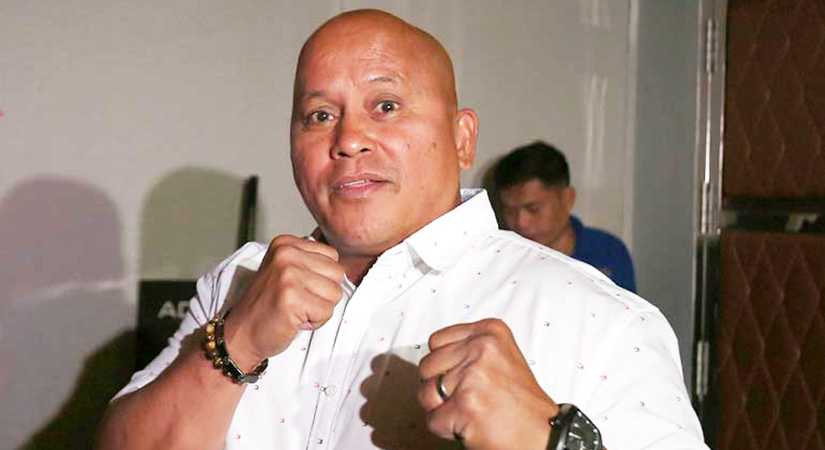
DUTERTE-ALLIED Senator Ronald M. dela Rosa is not supporting the Senate leaders’ plan to question before the Supreme Court the termination of the Visiting Forces Agreement (VFA) with the United States without the Senate’s concurrence. “I’m not supporting it,” Mr. Dela Rosa said in a briefing on Tuesday. He argued that while the 1987 Constitution provides that the chamber must concur in the implementation of treaties and agreements, it did not state the same is required in its withdrawal. “Kailangan pa ba ang interpretasyon ng (Do we need the interpretation of the) Supreme Court, kung mabasa natin sa Constitution hindi nakalagay d’on (if we can read in the Constitution that it is not indicated there)?” Senate President Vicente C. Sotto III said the chamber is seeking clarification whether the withdrawal of treaties should pass the Senate or not. Mr. dela Rosa said there is a “considerable number” of senators who likewise do not support the filing of the petition. Mr. Dela Rosa abstained from voting in favor of adopting the Senate resolution asking President Rodrigo R. Duterte to reconsider the VFA abrogation while the chamber conducts a review of the agreement. Charmaine A. Tadalan

Espenido’s inclusion in narco-list ‘black propaganda’ and intelligence ‘flaw’ — Panelo

PRESIDENTIAL SPOKESPERSON Salvador S. Panelo on Tuesday defended Lt. Col. Jovie Espenido’s inclusion in the watchlist of officers allegedly linked to the illegal drug trade, saying it could have been partly due to failure in intelligence gathering as well as “black propaganda” by his enemies. He said Mr. Espenido, who has been at the frontline of the administration’s controversial drug war, still has President Rodrigo R. Duterte’s full trust. “The President says that’s black propaganda as far as he’s concerned. Biktima siya (Mr. Espenido is a victim),” he said. “It’s not unexpected that there may be some flaws in intelligence gathering. That happens. Sometimes they’re even intentional, you are being fed with the wrong info coming from those who are against a particular officer,” he added. — Gillian M. Cortez

Nation at a Glance — (02/19/20)

News stories from across the nation. Visit www.bworldonline.com (section: The Nation) to read more national and regional news from the Philippines.

Nation at a Glance — (02/19/20)

[B-SIDE Podcast] Art fair affairs

Follow us on Spotify BusinessWorld B-Side

The emergence of the art fair as a validating institution and its effects on art-making deserve a conversation beyond how much was sold and how many people went. Artist Lyra Garcellano, whose practice spans about 20 years, remembers a time when artists had to eke out their own spaces. The “exhibition economy,” as she calls it, looked different: there were no art fairs and galleries paid scant attention to fresh graduates, favoring established masters instead. Contemporary art in the Philippines wasn’t the sexy thing that it is today. The art fair as a prevailing form of distribution, circulation, and education has “its own harsh effects” said Ms. Garcellano, who knows of what she speaks since she has participated in Metro Manila’s two major art fairs: ALT Philippines and Art Fair Philippines.

In this episode, Ms. Garcellano and BusinessWorld associate editor Sam L. Marcelo hash out the consequences of a market-driven approach to art-making.

Recorded on Jan. 8 and 14 at the BusinessWorld Studio. Produced by Nina M. Diaz, Paolo L. Lopez, and Sam L. Marcelo.

Follow us on Spotify BusinessWorld B-Side

Remember this when you decide to pursue love as a career

I did it. Last year, I took the leap of faith and quit my full-time corporate marketing job to do what I considered to be more purposeful creative work. It’s been a hilly journey since making that choice. I mean, there were definitely a couple of things I had to unlearn the hard way and others that I still need to learn more about. But the people I’ve met through working with The Spark Project have inspired me to write and share more of this type of story: of people blazing a trail.

It’s nice to know that it isn’t just me who’s challenged by what comes with choosing to forge our own paths. Even with the joy and fulfillment we get when we pursue what we love, the pursuit itself is hard. It entails a lot of sacrifice and work. But, from what I’ve observed in my experiences and of those I speak to, it’s important to constantly ground ourselves in this love we have and open ourselves up to how much we can grow through it, and overcome the different challenges we face.

Now, for this first feature, I wanted to share what I picked up from getting to know Rio Estuar, the founder of RIOtaso.

At a young age, her love for fashion inspired her to start “Kalye RIO,” her own streetwear brand deeply rooted in Filipino culture. As she grew and became more mindful of the waste she and the many in the fashion industry produced, she felt the need to change our relationship with fashion. Her love for designing and creating fashion pieces remained, but it was transformed and strengthened in another way.

Love is a big enough word.

Rio could have stuck it out with her streetwear brand. At the time, business was good. But because it wasn’t good for the environment, it wasn’t good enough.

Since Rio’s love for fashion couldn’t blot out her love for the environment, she decided to say ‘yes’ to both. Despite Kalye RIO still being on the upswing, Rio switched gears and drove towards taking better care and conservation of the environment. And so she arrived at “RIOtaso,” an up-and-coming sustainable fashion brand that upcycles scrap fabric into conscious options.

Rio is mightily proud of this new business of hers. But, like in all things, there are drawbacks to saying “yes” to love in business. The fashion industry today is not designed for environmentally conscious brands, and the prevailing business model reflects that. But where Rio loses in quick wins, she gains in fulfilment. As with all other relationships in life, it’s true–love triumphs even through struggle.

For young and aspiring entrepreneurs, Rio advises that you always be genuine with your intentions and never forget your “why”, your purpose.

And I hope you remember to grow with the love you have for what you set out to do.

—————

Regina Victoria is in the business of enkindling love and light. Currently, she is the Community and Communications Manager at The Spark Project. You can follow them on Facebook to learn more about Crowdfunding and the creative and social enterprises (like RIOtaso!) they work with.

Overseas Filipinos’ cash remittances (December 2019)

MONEY sent home by overseas Filipino workers (OFWs) reached a record high in 2019 despite global uncertainties as higher inflows from other countries offset a decline in remittances from the Middle East. Read the full story.

Overseas Filipinos’ cash remittances (December 2019)

Remittances reach record in 2019

MONEY sent home by overseas Filipino workers (OFWs) reached a record high in 2019 despite global uncertainties as higher inflows from other countries offset a decline in remittances from the Middle East.

Cash remittances grew by 4.1% to a record $30.133 billion in 2019 from the previous high of $28.943 billion in 2018, data from the Bangko Sentral ng Pilipinas (BSP) released on Monday showed.

Overseas Filipinos’ cash remittances (December 2019)

The growth in cash remittances last year was well above the three percent projection of the BSP for 2019.

Inflows for December alone also grew by 1.9% to $2.902 billion from $2.849 billion in the same month in 2018. The month’s level likewise surged by 22.34% from the $2.372 billion recorded in November.

Meanwhile, personal remittances, which include inflows in kind, climbed 1.9% to $3.216 billion in December from $3.157 billion a year ago. The whole year saw personal remittances expand by 4.1% to $33.467 billion from the $32.213 billion logged in 2018.

“Notwithstanding pockets of political uncertainties across the globe, cash remittances in 2019 remained strong,” the BSP said in a statement.

“This is evident in inward remittances from Asia, the Americas, and Africa, where inflows grew annually by 12.3%, 10.6% and 4.8%, respectively. The growth of inflows in these regions more than made up for the 9.8% decline in remittances from the Middle East.”

Cash remittances from both land and sea-based OFWs went up by 3.5% and 6.5% last year to $23.6 billion and $6.5 billion, respectively.

The BSP said bulk of remittance inflows in 2019 came from the United States, which comprised more than a third or 37.6% of total inflows. This was followed by Saudi Arabia, Singapore, Japan, United Arab Emirates, the United Kingdom, Canada, Hong Kong, Germany, and Kuwait, which collectively were the source of 78.4% of the total cash remittances.

An analyst said strong growth in the US helped propel OFW remittances last year.

“This growth may be attributed to the consistent economic growth of the US, which accounts for about 37.6% of total remittances in 2019 and that has continuously experienced economic expansion since 2010,” UnionBank of the Philippines, Inc. Chief Economist Ruben Carlo O. Asuncion said in an e-mail.

VIRUS MAY AFFECT INFLOWS
Analysts said remittances this year may be affected by the outbreak of the coronavirus disease 2019 (COVID-19) from Wuhan, China as it remains uncertain when the spread can be contained.

The BSP expects remittances to climb 4% this year.

“The coronavirus is particularly worrisome as nearly a quarter of remittances come from Asia, with around one in six of total remittances coming from Macau and mainland China alone. As of now, remittance growth risk hinge on the duration and containment of COVID-19,” Security Bank Corp. Chief Economist Robert Dan J. Roces said in an e-mail.

ING Bank NV-Manila Senior Economist Nicholas Antonio T. Mapa said the virus has forced people into quarantine, which could hit consumption patterns and, in turn, affect the services industry, where most OFWs are employed.

“The recent plight of the cruise ships around the world will likely put pressure on cruise liners and the hospitality industry as a whole, making it difficult for Filipinos to send home remittances should their salaries be curtailed or they lose their jobs altogether,” Mr. Mapa said in a note sent to reporters.

He, however, noted that OFW remittances have remained strong over the years even amid global recessions or events that have affected Filipinos’ host countries.

“OFWs are deployed across the globe in several jurisdictions and in several diversified services professions, making them more able to sidestep economic downturns,” Mr. Mapa said. “Case in point, remittances from the Middle East, a mainstay source of OF remittances, have remained in contraction for last year and yet overall remittance flows have remained largely positive.”

Meanwhile, UnionBank’s Mr. Asuncion said the impact of the virus will likely be minimal as remittances from China are “relatively small compared to other source countries such as the US and Saudi Arabia.”

“The biggest downside would be the decline of inflows coming from Singapore, that has a bigger portion of inflows contribution among hosts economies. But, overall, the impact may be minimal and recovery may be quick,” Mr. Asuncion said.

He, however, warned of other risks to remittances, such as geopolitical turmoil in key remittance sources and a slowdown in US growth due to trade issues. — L.W.T. Noble


International tourist arrivals hit 8.26 million

INTERNATIONAL tourist arrivals reached 8.26 million in 2019, exceeding its 8.2 million full-year target, the Department of Tourism (DoT) reported on Monday.

However, industry stakeholders are bracing themselves for a decline in international tourist arrivals this year as many have canceled or are putting off travel due to fears over the continued spread of the pneumonia-like coronavirus disease 2019 (Covid-19).

In a statement, the DoT said the annual tourist arrivals figure was 15.24% higher than the previous year’s 7.17 million.

“Almost all months, except January, registered double-digit growth rates, the largest of which was August at 27.54%, while December recorded the highest volume at 776,798,’’ the DoT said in a statement on Monday.

The country hosted the 2019 Southeast Asian Games from Nov. 30 to Dec. 11, a sporting event that attracted athletes and tourists from neighboring Southeast Asian countries.

DoT Secretary Bernadette Romulo-Puyat said annual tourist arrivals breached the eight millionth mark, thanks to the department’s “convergence programs with other government agencies, particularly in improving access as well as product development and marketing initiatives with local government and private sector.”

“These gains we hope to sustain even as we face global challenges,” Ms. Puyat was quoted as saying in a statement.

“This is a high point for Philippine tourism as it depicts our solidarity and commitment to make tourism work and prove its full potential as a sustainable and inclusive economic activity,” she added.

South Korean tourists continued to flock to the Philippines, as DoT data showed a 22.48% annual increase to 1.98 million. South Korea has been the top source market since 2010.

Chinese tourist arrivals surged 38.58% to 1.74 million in 2019 — the fastest pace among the 12 visitor markets cited by the DoT.

United States was the third-biggest source of visitors with 1.06 million, up 2.90%. This was followed by Japan with 682,788 arrivals (up 8.07%), and Taiwan with 327,273 arrivals (up 35.01%).

Australia ranked the sixth-biggest source of visitors with 286,170 (up 2.27%), followed by Canada with 238,850 (up 5.48%), and the United Kingdom with 209,206 (up 4.06).

On the other hand, tourist arrivals from Singapore and Malaysia slipped by 7.68% and 3.69% to 158,595 and 139,882, respectively.

The country, however, appears unlikely to surpass or even match last year’s record-breaking international tourist arrivals figure, as the Covid-19 outbreak continues to dampen global travel.

Ms. Puyat earlier acknowledged the tourism industry could lose P42.9 billion from February to April — P16.8 billion this month, P14.11 billion in March and P11.98 billion in April.

Despite this, she said the DoT is still targeting to attract 9.2 million international visitor arrivals this year.

Tourism Congress of the Philippines President Jose C. Clemente III said it is “too early” to determine how the full-year tourist arrivals target will be affected by the COVID-19 outbreak.

“(For the first quarter) definitely, it’s going to be affected. Sabihin na natin na it’s safe to say it will probably be down by about 30%, just to be safe about it, from [the first quarter] of the previous year’s arrivals,” Mr. Clemente, who is also president of Rajah Tours Philippines, Inc., said in a phone interview.

The Philippines has three confirmed cases of COVID-19, including one death, all involving Chinese nationals. More than 400 people have been checked for infection, more than half of whom had been confined, according to health authorities. — Arjay L. Balinbin

Tourist arrivals up 15.24% in 2019, breach target

Tourist arrivals up 15.24% in 2019, breach target

INTERNATIONAL tourist arrivals reached 8.26 million in 2019, exceeding its 8.2 million full-year target, the Department of Tourism (DoT) reported on Monday. Read the full story.

Tourist arrivals up 15.24% in 2019, breach target

EO imposes price cap on 133 medicines

PRESIDENT Rodrigo R. Duterte on Monday signed the executive order (EO) placing cap on the retail prices of 133 medicines, including those for hypertension, diabetes, cardiovascular disease and some types of cancer.

EO No. 104 sets a maximum retail price (MRP) and maximum wholesale price (MWP) for certain drugs, particularly those that “address the health priorities of the general public, especially those that account for the leading causes of morbidity and mortality.”

Also included in the list are drugs that have high price differentials compared to international prices; have limited competition in terms of lack of generic counterparts; and where the innovator product is the most expensive, yet most prescribed one in the market.

“(An) MRP and/or MWP were determined and are now imposed on select drugs and medicines totalling to 86 drug molecules or 133 drug formulas,” the EO read.

The EO listed medicines for hypertension, diabetes, major types of cancer, cardiovascular disease, chronic lung diseases, depression, pain relief, psoriasis, among others.

A 160-mg vial of Trastuzumab Emtansine, a drug used for breast cancer treatment, will have a MRP of P146,888.25 and a MWP of P104,908.18.

A film-coated tablet of 850 mg of Metformin and 50 mg of Sitagliptin, which is taken by diabetics, will have a MRP of P32.14 and MWP of P24.68.

Vortioxetine, a medication used to treat depression, will have a MRP of P99.08 and a MWP of P61.83.

Oxycodone, an opiate analgesic used for pain treatment, will have a MRP of P175.39 and a MWP P115.69 for 10 mg controlled-release tablet.

While the Pharmaceutical and Healthcare Association of the Philippines (PHAP) said it will comply with the EO, it urged the government to keep a close eye on its impact on the industry and the public.

PHAP, which has opposed price control, said “global experience had shown that artificial measures result in market inefficiencies and lack of supply.”

“If reasonable profits are not realized, pharmaceutical companies would review the sustainability of its operations in the Philippines, including the possible downsizing in the number of employees. The Philippines would also lose its attractiveness to investments. The billions of taxes they pay would also be lost,” PHAP said.

The EO will take effect once it is published in a newspaper or the Official Gazette.

“With a non-extendable period of 90 days from the effectivity of this order, existing inventory stock shall be allowed to be disposed of at prevailing prices. Thereafter, regardless of the status of existing inventory stock, MRP and MWP under the order shall be strictly implemented,” the EO said.

The list of drugs under the EO will be reviewed by the Department of Health and Department of Trade and Industry every six months.

All public and private retail outlets, including drugstores, hospitals, convenience stores and supermarkets, are required to follow the MRP of the drugs and medicines included in the EO.

Wholesalers, traders, distributors, among others, should follow the MWP of the drugs and medicines. — GMC

ADVERTISEMENT
ADVERTISEMENT