Home Blog Page 986

Watsons teams up with Novo Nordisk for preventive healthcare

Executives from Watsons Philippines and Novo Nordisk seal their partnership to advance diabetes awareness and expand nationwide access to healthcare. From left: Geraldine Perez, Market Access and Business Development Director, and Wei Sun, General Manager, both from Novo Nordisk; Joweeh Liao, Director for Health Business Unit, Finance, Property & Store Development, and Sharon Decapia, Senior AVP for Marketing, PR & Sustainability, both from Watsons Philippines

Obesity is a growing health challenge in the Philippines. According to the Food and Nutrition Research Institute, 39% of Filipino adults — or nearly 4 out of 10 aged 20 to 59 — are obese. This condition is closely linked to serious illnesses such as heart disease and diabetes, both of which continue to place a heavy burden on Filipino families and the healthcare system.

In response to this urgent health issue, Watsons Philippines, the country’s leading health, wellness, and beauty retailer, has partnered with global healthcare company Novo Nordisk to offer free obesity screenings in select Watsons stores. The initiative aims to promote early detection, raise awareness, and provide guidance on managing obesity and its related health risks.

The in-store activation will run for three months across 18 Watsons branches, offering free clinics every Saturday from 11 a.m. to 6 p.m. Screenings will be conducted by trained healthcare providers who will be on-site to conduct assessments and provide expert advice to customers. For the complete list of participating outlets and the detailed schedule, customers are encouraged to follow Watsons Philippines’ official social media pages.

“At Watsons, we believe good health should be within reach for every Filipino. Partnering with Novo Nordisk strengthens our commitment to making preventive care more accessible and affordable. By offering free obesity screenings in our stores, we empower families with the knowledge and tools to take control of their health and live healthier lives,” said Joweeh B. Liao, Watsons Philippines director for Health Business Unit, Finance, and Property Development.

Joeweeh Liao, director for Health Business Unit, Finance, and Property Development of Watsons Philippines

Beyond this initiative, Watsons continues to strengthen its role as a health partner for the community. With over 1,200 stores nationwide, many with extended hours and an expanding number of 24/7 outlets, Watsons ensures access to care anytime, anywhere. Customers can also order through the Watsons online app, opt to pick up in-store, or avail of the 2-3 hour medicine delivery for added convenience. Alongside these services, Watsons offers a wide range of medicines and tools for ght management, obesity, and diabetes care, supporting busy individuals and families in managing their health on a daily basis.

For Novo Nordisk, the collaboration is aligned with its global ‘Truth About Weight’ campaign, which promotes awareness, combats stigma, and supports science-based approaches to obesity care. “Obesity can greatly affect a person’s quality of life, which is why we at Novo Nordisk, in partnership with Watsons Philippines, are committed to raising the awareness and understanding of the public about obesity. Through the screening initiative, we aim to make screening for obesity more accessible, provide a more comprehensive assessment of a person’s obesity risk, and guide them in taking control of their well-being,” said Wei Sun, Novo Nordisk Philippines general manager.

Watsons Philippines and Novo Nordisk representatives affirm their shared commitment to empower more Filipinos with free screenings, expert guidance, and accessible health services through their newly launched partnership.

This partnership reinforces Watsons’ goal of being a trusted health partner and the go-to destination for the wellness needs of Filipinos. More than just a retailer, Watsons provides education, support, and services that uplift communities. Guided by its brand promise — Look Good, Do Good, Feel Great — Watsons remains committed to empowering every Filipino to live a healthier life.

Download the Watsons App today on the App Store or Google Play and enjoy amazing health and wellness deals, offers, and discounts. From health essentials and pharmacy services to expert advice, Watsons, your trusted health and wellness partner, has everything you need to stay on top of your health, beauty, and wellness goals.

Make every purchase count with a Watsons Club membership! Sign up today and gain access to exclusive perks, member-only promos, and special privileges that bring even more value to your wellness journey. It’s the most innovative way to shop for products and services that help you look good, feel great, and live a healthy life every day.


Spotlight is BusinessWorld’s sponsored section that allows advertisers to amplify their brand and connect with BusinessWorld’s audience by publishing their stories on the BusinessWorld Web site. For more information, send an email to online@bworldonline.com.

Join us on Viber at https://bit.ly/3hv6bLA to get more updates and subscribe to BusinessWorld’s titles and get exclusive content through www.bworld-x.com.

Fed lowers interest rates, signals more cuts ahead; Miran dissents

A sign for the Federal Reserve Board of Governors is seen at the entrance to the William McChesney Martin Jr. building in Washington, D.C. — REUTERS

WASHINGTON – The Federal Reserve, goaded by the risk of rising unemployment, reduced interest rates on Wednesday for the first time since December and indicated more cuts would follow to halt any slide in a labor market already experiencing higher joblessness among Blacks, a declining workweek, and other signs of weakness.

The decision moves in a direction called for by President Donald Trump, but falls far short of the steep cuts in borrowing costs that he has demanded – and which were apparently penciled into projections submitted by new Fed Governor Stephen Miran, who cast the only dissenting vote.

Fed Chair Jerome Powell, speaking in a press conference after the US central bank lowered its benchmark interest rate by a quarter of a percentage point to the 4.00%-4.25% range and indicated more cuts would follow at meetings in October and December, said the softening job market was now top of the mind for him and his fellow policymakers.

“There are no risk-free paths … It’s not incredibly obvious what to do,” Powell told reporters at the end of a two-day policy meeting. “We have to keep our eye on inflation at the same time, we cannot ignore … maximum employment.”

Powell said he believes the recent pace of job creation is running below the break-even rate needed to hold the unemployment rate constant, and that with businesses doing very little hiring overall, any increase in layoffs could quickly feed into higher unemployment.

“You see minority unemployment going up. You see younger people … more susceptible to economic cycles … in addition to just overall lower payroll job creation that shows you that at the margin, the labor market is weakening. … We don’t need it to soften anymore,” he said.

Powell’s comments cap a steady shift in tone that began over the summer as Fed officials concluded that the higher import tariffs imposed by the Trump administration would not lead to persistent inflation, with faster price increases expected through the end of the year but price pressures also expected to fade after that time even as monetary policy becomes looser.

At the same time, signs of job market weakness began to accumulate, with payroll growth nearing stall speed.

MEETING MARKED BY POLITICAL DRAMA
The decision to cut rates came with no shortage of political drama, with Trump trying to fire Governor Lisa Cook in a so-far unsuccessful effort to open another seat on the Fed’s Board of Governors for him to fill, and appointing Miran, who is on leave from his job as head of the White House’s Council of Economic Advisers, to an open position that may only last until the end of January.

Miran was sworn in on Tuesday before the meeting started, and dissented against the policy decision in favor of a larger half-percentage-point rate cut. He also seems to have submitted a year-end rate projection implying he supports further half-percentage-point cuts in the meetings ahead, with the policy rate dropping below 3%. The interest rate “dots” are not associated with policymakers by name, but new projections showed one forecast far below the others that analysts promptly attributed to Miran.

Concerns that Trump’s interference with the Fed – through constant criticism over its rate policy, the appointment of a White House insider to the Fed board and the president’s effort to fire Cook – would yield signs of outsized political influence appear to have been overblown for now.

Two other Trump appointees to the central bank’s board – Fed Vice Chair of Supervision Michelle Bowman and Governor Christopher Waller – joined the wider consensus after dissenting just one meeting earlier.

Waller in particular has been arguing for greater focus on the job market since the summer, a concern that others on the Fed’s policy-setting committee have come to share as data indicated weaker hiring and which is now reflected in the policy statement.

“It’s deeply in our culture to do our work based on the incoming data and never consider anything else,” Powell said in response to questions about the Fed’s ability to maintain its independence in setting interest rates. “There wasn’t widespread support at all for a 50-basis-point cut today.”

‘WEIGHTING THE LABOR MARKET MORE’
Even with inflation expected to end the year at 3%, well above the central bank’s official 2% target, Fed policymakers “deemed that the downside risk to employment has increased, and therefore it would seem that they are weighting the labor market more than the higher inflation that they noted in their projections,” said Ellen Hazen, chief market strategist at F.L. Putnam Investment Management.

Powell said it was not so much the initial cut that will matter to the economy, but the broader sense of a rate path that moves slightly faster to a stopping point about a quarter of a percentage point lower than officials communicated in their projections in June.

The rate-path views are not commitments, Powell said, with higher inflation still a risk and the central bank now in a “meeting-by-meeting situation” when it comes to further rate reductions.

But “I do think the Fed will ultimately keep moving towards neutral,” even at the expense of slightly higher inflation through 2026, said Christopher Hodge, chief US economist at Natixis.

New economic projections released by the Fed showed policymakers at the median still see inflation ending this year at 3%, well above the central bank’s 2% target, a projection unchanged from the forecasts in June. The projection for unemployment was also unchanged at 4.5% and the one for economic growth slightly higher at 1.6% versus 1.4%.

Stocks briefly rose after the release of the policy decision and projections before turning lower and closing mixed, while the dollar was modestly higher against a basket of major trading partners’ currencies. Treasury yields were little changed and rate futures markets saw more than a 90% probability of another rate cut at the Fed’s next meeting in late October.

Among those voting in favor of the policy decision was Cook, who attended the meeting despite Trump’s effort to fire her and after two courts supported her challenge of his attempted dismissal. — Reuters

DPWH cuts 2026 budget by P255B

DEPARTMENT of Public Works and Highways (DPWH) Secretary Vivencio “Vince” B. Dizon — PHILIPPINE STAR/RYAN BALDEMOR

THE Department of Public Works and Highways (DPWH) slashed around P255 billion worth of locally funded flood control projects from its proposed 2026 budget.

We are revising the agency’s budget for 2026. We have removed complicated projects, overlapping projects that are still receiving funding or that have been allocated funding for 2026,” Public Works and Highways Secretary Vivencio “Vince” B. Dizon told the House Appropriations Committee on Wednesday

He said the DPWH had reviewed the initial proposal and removed P255.53 billion worth of duplicate or completed projects in next year’s budget.

The DPWH’s proposed budget for 2026 has now been reduced to P625.78 billion, 28.9% lower than the original proposal of P881.31 billion.

Mr. Dizon said the allocation for 2026 is the DPWH’s lowest since 2023 when it had a budget of P718.35 billion.

“We have exerted our best efforts, within the very limited period allotted, to ensure that the issues raised in the previously submitted budget, such as the funding of completed and duplicate projects, are adequately addressed,” he said, adding that P15.77 billion worth of foreign-assisted flood control projects were retained for next year.

Of the P625.78-billion proposed budget for next year, P482.32 billion was allocated for road projects, while P15.77 billion was allotted for foreign-assisted flood control projects such as payments to multilateral agencies like Asian Development Bank and Japan International Cooperation Agency. It allocated P94.16 billion for other items.

The reduction of DPWH’s budget is in line with President Ferdinand R. Marcos, Jr.’s directive last week that the agency must conduct a “sweeping review” of its 2026 proposed budget following alleged anomalies in flood control projects.

“We would also like to convey the President’s recommendations to Congress that the fiscal space made available by the reduction of P255 billion, be instead allocated to programs and projects in agriculture, education, healthcare, housing, labor, social welfare and information technology,” Mr. Dizon said.

The DPWH chief said the agency is still reviewing flood control projects and reports. He said three more cases related to these anomalous projects will be filed soon.

The DPWH has submitted a list of over 9,000 projects completed between July 2022 and May 2025. Of these, 160 projects have undergone validation, with 15 reported as missing or unlocated.

On Tuesday, the DPWH also lifted the two-week suspension of auctions for locally funded projects, citing the need to fast-track the rollout of key infrastructure.

‘SMALL AMOUNT’
Meanwhile, Budget Secretary Amenah F. Pangandaman said the proposed P255-billion cut in locally funded flood control projects in the DPWH’s 2026 budget is unlikely to dampen economic growth and infrastructure spending next year.

“The P200 billion? That’s just a small amount. Our infrastructure budget is more than a trillion, right? It’ll just be reduced a bit,” she told reporters on Wednesday.

“What’s important is that we still get to implement key projects like school buildings, hospitals, and infrastructure that supports our agriculture sector. Hopefully, everything continues smoothly.”

The Budget department had submitted to Congress a proposed P6.793-trillion National Expenditure Plan for 2026, which is 7.4% higher than this year’s national budget and equivalent to 22% of the country’s gross domestic product (GDP).

The government has set a target for public infrastructure spending of 5%-6% of GDP annually.

Ms. Pangandaman said all legitimate obligations to government contractors will not be affected.

“I think (Mr. Dizon) is reviewing all existing contracts. Some were halted, but it’s part of the cleansing and review process,” she said. “For those that are clean and properly implemented, they should continue.”

Nigel Paul C. Villarete, senior adviser on PPP (public-private partnership) at the technical advisory group Libra Konsult, Inc. said that there should also be a thorough review of the DPWH’s budget cut to really ensure that the rollout of the needed infrastructure projects will not be affected.

“I believe there has to be a deeper move on this issue. Flooding is real and is disastrous to many places and many communities of our country. True, the acts of corruption in these flood-control projects are real and detrimental to our country and people, but we can’t solve the problem simply by just eliminating flood control,” Mr. Villarete said. — Ashley Erika O. Jose and Aubrey Rose A. Inosante

Infrastructure spending unlikely to be affected by budget cuts, probe — DBM

Men are working on a construction project in Manila. — PHILIPPINE STAR/RYAN BALDEMOR

By Aubrey Rose A. Inosante, Reporter

GOVERNMENT infrastructure spending is unlikely to be significantly affected by the ongoing probe on anomalous flood control projects, the Department of Budget and Management (DBM) said.

“There could be some effect if irregularities are detected in specific projects, since it would not be prudent to continue while those projects remain under investigation,” Budget Secretary Amenah F. Pangandaman told BusinessWorld in a Viber message on Tuesday.

The Marcos administration has intensified its investigation on public works projects, particularly in flood mitigation projects that were nonexistent or uncompleted despite billions in funding.

Ms. Pangandaman said there should be minimal or no disruption in ongoing and compliant projects even with the creation of the Independent Commission on Infrastructure (ICI). The ICI was tasked to investigate anomalies in flood control and other infrastructure projects, with authority to recommend criminal, civil and administrative charges.

“In fact, the ICI mechanism is designed to reinforce transparency and accountability in the system, which ultimately supports more efficient and credible public expenditure,” she said.

Data from the DBM showed expenditure on infrastructure and other capital outlays rose by 6.5% year on year to P148.8 billion in June, following the lifting of the election spending ban in early May.

This brought first-half infrastructure spending to P620.2 billion. The full-year infrastructure program is set at P1.51 trillion, or 5.3% of gross domestic product.

Department of Economy, Planning, and Development (DEPDev) Undersecretary Rosemarie G. Edillon said infrastructure rollout will proceed unless suspension orders are issued.

“Unless there’s an actual suspension, otherwise the utilization will drop. I’m not sure how they’ll manage that,” Ms. Edillon said on the sidelines of a House briefing.

Nigel Paul C. Villarete, senior adviser on public-private partnerships at Libra Konsult, Inc., said the ICI’s creation may momentarily slow down project execution, but will not dampen overall infrastructure spending.

“Improving transparency and resisting delays caused by mismanagement and/or corruption is beneficial to the overall infrastructure development of the country, both locally, and ODA (official development assistance)-funded,” Mr. Villarete said.

DEPDev earlier warned that the country’s ODA partners are closely watching how the government addresses corruption in flood control and other infrastructure projects.

Pantheon Macroeconomics Chief Emerging Asia Economist Miguel Chanco said the ICI’s mandate may cause hesitancy in new infrastructure spending in the short and medium term.

“(This is) due to the fact that these will soon be under the microscope for any potential allegations of corruption. While the ICI’s task is very much welcome and long overdue, it could stifle economic activity in the interim,” Mr. Chanco said in an e-mailed statement.

Aside from the ICI, separate investigations are being conducted by lawmakers, the Bureau of Internal Revenue and Anti-Money Laundering Council.

Telcos urged to boost digital infrastructure as new law opens PHL to more players

A teacher checks computers at a school in Manila in this file photo. — PHILIPPINE STAR/EDD GUMBAN

By Ashley Erika O. Jose, Reporter

INCUMBENT telecommunications companies are expected to ramp up their investments in digital infrastructure as competition is likely to heat up with the implementation of the Konektadong Pinoy law.

“Konektadong Pinoy Act will lower barriers for new entrants and encourage more players in the market. Incumbent telcos need to invest aggressively in infrastructure like 5G, fiber, and satellite. They need to focus on customers and improve services to be at par with Association of Southeast Asian Nations countries,” Samuel V. Jacoba, founding president of the National Association of Data Protection Officers of the Philippines (NADPOP), said in an interview on Wednesday.

The Konektadong Pinoy Act, or the Open Access in Data Transmission Act, lapsed into law last month. It streamlines the licensing process for new entrants, boosting competition in data transmission.

Ronald B. Gustilo, a national campaigner for the Digital Pinoys organization, said telcos must embrace consumer-centric innovation while also improving their network reach, particularly in underserved or geographically isolated and disadvantaged areas.

“Competition will no longer be won only on price but on quality of service. They must also prepare for stronger regulatory oversight on affordability and accessibility,” Mr. Gustilo said.

PLDT Inc. Chairman and Chief Executive Officer Manuel V. Pangilinan said the company is preparing for the entry of new players.

“It is a complicated subject. We have to be ready, I suppose,” Mr. Pangilinan said on the sidelines of an event last week.

Information and Communications Technology Secretary Henry Rhoel R. Aguda said the implementing rules and regulations (IRR) of the Konektadong Pinoy Act will be released by the first week of October.

“We are still doing the IRR consultation meetings. We are working to complete it before the end of the month,” Mr. Aguda said in a Viber message to BusinessWorld on Wednesday.

The Department of Information and Communications Technology has invited the country’s major telecommunications and internet providers for their inputs in the IRR, Mr. Aguda said previously. He has said that some foreign players like Elon Musk’s Starlink have also signified their interest in helping craft the IRR.

PLDT and Converge ICT Solutions, Inc. have previously indicated their readiness to take part in drafting the IRR of the Konektadong Pinoy Act, with Converge saying the company wants stronger regulatory authority in the IRR.

For its part, Globe Telecom, Inc. is preparing for new market players by ramping up its technology solutions and fiber offerings to stay competitive amid the growing demand for data and reliable internet connections.

For NADPOP’s Mr. Jacoba, incumbent players still have the leverage as they know how to navigate the market more than the new players.

“Incumbent telcos can introduce more customer-centric services and launch affordable plans to capture budget-conscious consumers. Over time, competition will likely push prices downward, but not drastically, unless new players bring disruptive business models or global economies of scale,” he said.

The threat to incumbent telcos will not be immediately felt despite the law explicitly opening the door for new internet service providers, Mr. Jacoba said.

“As new entrants challenge incumbents, telcos will likely introduce more diverse packages — from affordable data bundles to more flexible postpaid and prepaid options. While price reductions are possible, we think consumers should watch for value-added services,” Mr. Gustilo said.

Adel A. Tamano, chief revenue officer of DITO Telecommunity Corp., said security and data privacy should be the focus of the Konektadong Pinoy Act’s IRR.

The company said that the law should be lenient or open towards new entrants as the main goal of the Konektadong Pinoy law is to attract more players into the industry.

Earlier, the Philippine Chamber of Telecommunications Operators said some provisions of the law undermines regulatory oversight and threatens fair competition, as the law only requires entrants to secure cybersecurity certification after two years of operations.

For Digital Pinoys’ Mr. Gustilo, the lowering of barriers for players will reshape the market away from “near-duopoly” towards a multi-player competition.

“Incumbents should differentiate on quality by delivering faster, more reliable internet where it matters most such as urban centers and key growth corridors. In parallel, they should expand to underserved markets ahead of new players, leveraging their existing scale,” Mr. Jacoba added.

Hastings Holdings, Inc., a unit of the PLDT Beneficial Trust Fund subsidiary MediaQuest Holdings, Inc., holds a majority stake in BusinessWorld through the Philippine Star Group.

Marcos signs law amending RoW Act

A MAN WORKS at a construction site in Navotas City. — PHILIPPINE STAR/RYAN BALDEMOR

PHILIPPINE President Ferdinand R. Marcos, Jr. signed into law a measure that amended the Right-of-Way (RoW) Act, which would allow the government to acquire more land for big-ticket infrastructure projects.

Palace Press Officer Clarissa A. Castro confirmed the development on Wednesday through a Viber message to BusinessWorld.

“The President signed and approved the bill,” she said, without elaborating.

A copy of the signed law has yet to be released.

Right-of-way issues have hampered the rollout of government infrastructure projects, such as the Metro Manila Subway Project.

The Accelerated and Reformed Right-of-Way Act is one of the Marcos administration’s priority legislations, as it is expected to facilitate easier land acquisition for National Government infrastructure projects.

It amended Republic Act No. 10752 or the Right-of-Way Act, expanding its scope to cover all projects undertaken through public-private partnerships.

Michael L. Ricafort, chief economist of Rizal Commercial Banking Corp., said the new law would help address RoW issues more effectively and expeditiously as these have delayed the completion of infrastructure projects.

Nigel Paul C. Villarete, senior adviser on public-private partnerships at technical advisory group Libra Konsult, Inc., said he fully agrees with the new law.

“While we do uphold the sanctity of private property rights in the framework of our representative democracy, there remains the overarching principle that the good of all and for all must supersede individual rights,” he said.

“While a representative democracy underscores the inherent right of an individual, there has to be a tradeoff when such rights are weighed against the rights of the society or community in general.”

The law also applies to private firms engaged in public services that are granted the power of eminent domain under their franchise or other laws, covering sectors such as electricity, petroleum, water pipeline, ports, telecommunications, and irrigation.

It also amended the existing law on government access or expropriation of land for infrastructure projects by clarifying provisions on subterranean or underground rights-of-way.

It covers roads, bridges, power and water pipelines, telecommunications facilities, airports, seaports and irrigation projects, among others.

It also requires agencies to prepare a Right-of-Way Action Plan before acquiring property, which must include a census of affected persons, an inventory of assets, compensation estimates, an implementation schedule, and records of consultations with stakeholders.

Property valuation will be based on the system and market schedules under the Real Property Valuation and Assessment Reform Act, ensuring compensation for land, structures, crops, and other affected assets. — Chloe Mari A. Hufana

Aug. transmission rates up as cost of power reserves rises

PHILSTAR FILE PHOTO

POWER CONSUMERS will have to pay higher transmission charges in their electricity bills this month, due to increased cost of power reserves, the National Grid Corp. of the Philippines (NGCP) said.

“The reason for the increase is mainly due to the increase on the AS (ancillary services) rates, particularly from the reserve market,” Julius Ryan D. Datingaling, head of business and regulatory development at NGCP, said at a briefing on Wednesday.

The overall rate for August, which will appear in September electricity bills, climbed by 7.09% to P1.4171 per kilowatt-hour (kWh) from P1.3233 per kWh in July.

AS charges, or power reserves deployed by grid operators to support the transmission of power and to maintain reliable operations, rose by 13.4% to P0.6659 per kWh from P0.5872 per kWh a month earlier.

Mr. Datingaling said the increase in AS rates was due to spot quantity, or the amount of reserve capacity traded in the reserve market.

“That was due to market forces because it’s market-driven, so the rules on supply and demand will apply,” NGCP Spokesperson Cynthia P. Alabanza said.

Meanwhile, transmission wheeling rate — or what NGCP charges for its primary service of delivering electricity — inched up by 0.8% to P0.597 per kWh from P0.5923 per kWh.

Other charges included universal charge, feed-in tariff allowance, and value-added tax on transmission and AS charges.

“NGCP does earn from AS and does not benefit from changes in AS prices,” the company said.

Transmission charges reflect the cost of delivering electricity from power generators to the distribution system. These charges usually account for around 9% of a consumer’s electricity bill.

Meanwhile, the grid operator said it has implemented the necessary preparations and precautions to minimize the impact of Tropical Depression Mirasol on transmission operations and facilities.

“Preparations include ensuring the reliability of communications equipment, availability of hardware materials and supplies necessary for the repair of damage to facilities, as well as the positioning of line crews in strategic areas to facilitate immediate restoration work,” NGCP said.

Through its Integrated Disaster Action Plan, the company outlined procedures to ensure the readiness of all power transmission facilities expected to be affected by weather disturbance.

Ms. Alabanza said that the company upgraded its facilities to withstand 300 kilometers per hour (kph) of wind speed, from old facilities that were only able to withstand 180 kph winds.

Tropical Depression Mirasol is forecasted to move northwestward within the next 12 hours while traversing northern Luzon. It was set to exit the Philippine Area of Responsibility on Thursday morning or afternoon.

The NGCP officially started operations as a power transmission service provider in 2009. Under a congressionally granted 50-year franchise, the company has the right to operate and maintain the transmission system and related facilities. — Sheldeen Joy Talavera

Slow Food conference heads to Bacolod

BIG THINGS are coming to Western Visayas: after Iloilo was declared a UNESCO City of Gastronomy in 2023, another city in the region gets another nod from the global food community. Bacolod City in Negros Occidental will host Slow Food’s first regional food conference outside Europe, Terra Madre Asia and Pacific which will take place on Nov. 19 to 23.

Its parent conference, Terra Madre Salone del Gusto, is usually held in Turin, Italy, and the biennial conference attracts thousands around the world. In a statement, Slow Food said that this Asia-Pacific event is expected to welcome over 2,000 delegates from over 20 countries, including, Japan, South Korea, Australia, New Zealand, Indonesia, Sri Lanka, Thailand, India, and Pacific Island nations.

“This milestone event marks the designation of Bacolod City as the Slow Food Hub in Asia and Center for Sustainable Gastronomy and Negros Occidental as the Organic Capital of the Philippines. Modeled after the long-running Terra Madre Salone del Gusto in Italy, this regional edition will highlight the culinary traditions and food systems of Asia-Pacific while connecting them to the wider global movement,” said the statement.

During its launch on Sept. 9 at the North Forbes Pavilion in Makati, Paolo di Croce, Director General of Slow Food International, said, “Our goal is to think about the future of food, the future of the planet. And you cannot think of the future of the planet without thinking of Asia. You can’t think about the future of food without thinking of Asia. Not only because it’s the continent with the majority of the people. There is an unbelievable richness, diversity that we don’t have to risk that what is coming from the so-called Western World is better.”

“You have to be proud about the diversity that you have in this continent,” he said. As for the specific Philippine location, he said, “The Philippines: I think that you are the perfect example of what food wants to do in protecting and giving value to diversity. Every little island has a cultural heritage to protect.”

He added about Bacolod, “It’s not simple to find many different protagonists, from the institutions, to the private companies, to the people, the chefs, the farmers — they are united by the dream of making something good.”

The Slow Food movement — founded in Italy as a response to fast food (specifically, the resistance then of opening a McDonald’s near a beloved Roman landmark in the 1980s) and all that it entails (industrial instead of artisanal production, among other things) — now shares on their website that their goal is “acting together to ensure good, clean and fair food for all.” Their priorities include defending biological and cultural diversity, educating, inspiring, and mobilizing, and influencing public decision-makers and the private sector.

“We are so happy that we will have a chance to open an international office hub here in the Philippines, in Bacolod,” said Mr. Di Croce. “The event will put Bacolod, the Philippines, on the global map. But it’s once every two years. The challenge is to do Terra Madre every single day.”

Philippine participants include Kevin Navoa and Thirdy Dolatre of Hapag; David Amoros of El Born Manila; Angelo Comsti of Offbeat Bistro; Tina Legarda of Kumba & Bamba Bistro; Pat Go of Your Local and Lanai; Charles Montañez of Liyab and Mamacita; and Dedet de la Fuente, the Lechon Diva of Pepita’s Kitchen; along with mixologists Arkadius Rybak of Toma Toma; Kalel Demetrio of Agimat at Ugat Foraging Bar & Kitchen, Alab Distillery and Lanai; and Ken Alonso.

Ramon “Chin Chin” Uy, Jr., Slow Food Councilor for Southeast Asia, talked to BusinessWorld about the chosen participants: “These chefs are in the part of their life that they want to work with our local ingredients — rather than caviar, or truffles — we have so (many) ingredients here that are actually undiscovered.

“We really wanted for chefs and farmers to work together,” he said.

These chefs served some of their samples at a buffet featuring Ark of Taste ingredients (Slow Food’s international online catalog of endangered heritage ingredients).

Mr. Di Croce said that next time, perhaps the menu cards and such could include the names of the farmers and producers who grew the food served. “We forget that if we really want a different world, we need farmers,” he said. “One of the goals is to make farmers and food producers stars.” — Joseph L. Garcia


Who’s who at Terra Madre Asia Pacific 2025

International and local chefs will flock to Bacolod in November to participate in Slow Food’s Terra Madre Asia Pacific conference.

International chefs include:

• Johanne Siy of Singapore and the Philippines (named Asia’s Best Female Chef 2023 by Asia’s 50 Best),

• Wes Kuo (owner-chef of Embers, a Green Michelin Star chef known for terroir-driven tasting menus),

• Hafizzul Hashim (a Green Michelin Star chef at Fiz Singapore),

• Lordfer Lalicon (chef-owner of Kaya, the first Filipino restaurant in Florida to earn a Michelin Green Star, and a 2024 James Beard Awards finalist for Best New Restaurant),

• Christina Rasmussen (co-founder and head chef at Singapore’s FURA),

• Melissa Miranda (the chef-owner of Musang in Seattle, named Food & Wine Best New Chef of 2022),

• Romy Dorotan (veteran chef of Purple Yam and co-author of Memories of Philippine Kitchens, which won the IACP Jane Grigson Award),

• William Wongso (described as Indonesia’s culinary ambassador),

• Ross Magnaye (co-founder of Serai in Melbourne), and

• Ardika Dwitama Tjandra (pastry chef at August, the Jakarta restaurant named Asia’s One To Watch 2023 by Asia’s 50 Best Restaurants)

Representing the Philippines, the list includes:

• Jordy Navarra (Toyo Eatery — consistently on Asia’s 50 Best list — and Panaderya Toyo),

• Thirdy Dolatre and John Kevin Navoa (Hapag and Aya),

• Miko Calo (Taqueria Franco and Tatler Dining PH Chef of the Year 2022),

• Chele González (Gallery by Chele — also on Asia’s 50 Best list — and Asador),

• JP “Jepe” Cruz (Inatô, Tatler Best Restaurant of the Year 2025),

• Stephan Duhesme (Metiz and Automat, listed among Asia’s 50 Best Restaurants),

• Yuichi Ito (executive pizza chef at Crosta Pizzeria in Makati, which is ranked 2nd in Asia-Pacific and 12th worldwide in the 50 Top Pizza World 2024 list),

• Don Patrick Baldosano (Linamnam),

• Tony Boy Escalante (Antonio’s Group: Antonio’s, Balay Dako, Breakfast at Antonio’s; 2015 Asia’s 50 Best alum),

• Aaron Isip (Balai Palma; earned the Gault&Millau’s Trophée Espoir Île-de-France in 2015),

• Patrick Go (Your Local and Lanai by Fresh Start),

• Angelo Comsti (Offbeat Bistro and bestselling food writer),

• Rhea Rizzo (Mrs. Saldo’s),

• Bettina Arguelles (first Filipina executive chef of a five-star hotel in the Philippines and formerly Culinary Operations Director at Sofitel Manila),

• Tina Legarda (Bamba Bistro and Kumba),

• Ines Castañeda, Filippo Turrin, Daan Overgag, Marina Castañeda, and Ricardo de Sousa (Kaos Siargao),

• Charles Montañez (Mamacita and Liyab),

• Datu Shariff Pendatun III (chef, writer, and heritage-cuisine advocate focusing on Muslim Mindanao),

• David Amoros (El Born and La Pastisseria),

• David del Rosario (CEV: Cevicheria + Tacos),

• Dedet de la Fuente (Lechon Diva behind Pepita’s Kitchen),

• Erwan Heussaff (Winner of the 2023 James Beard Media Award for Social Media Account) and the FEATR team,

• Miguel “Cabel” Moreno (Palm Grill),

• Waya Araos-Wijangco (Gourmet Gypsy Café),

• Gerald Montelibano (Executive sous chef at Cibo di Marghi),

• Andre Malarky (Wild Siargao), and

• Rhea and Jayjay Sycip (chef and owners of The Fatted Calf

Zeroing in on the region, there are Negros Occidental-based chefs joining the fray:

• Don Colmenares (SAUMA in Hinigaran, a destination which has a hyper-local tasting menu built almost entirely on Negros produce),

• Nico Millanes of Bacolod (chef and Portiko Café founder, invited by Raffles Hotel Singapore to its Regional Hawker Series), and,

• Mark Lobaton of Enting’s in Negros (a second-generation kinilaw artist — local raw fish “cooked” in acid, like ceviche — carrying on the Lobaton family’s celebrated raw seafood tradition).

Funding for PHL startups falls 55% to $86.4M in first half

STOCK PHOTO | Image by from Freepik

By Beatriz Marie D. Cruz, Reporter

PHILIPPINE startups secured $86.4 million in equity funding in the first half of 2025, down 55% from a year earlier and lagging most of its Southeast Asian neighbors, according to a report by Kickstart Ventures, Inc., the corporate venture capital arm of Globe Telecom, Inc., and Singapore-based business news platform DealStreetAsia.

The Philippines raised about P4.91 billion from 15 disclosed deals in the six-month period, lower than the P10.86 billion ($191 million) recorded in the same period last year.

By deal value, the country trailed Singapore ($1.21 billion), Vietnam ($275 million), and Malaysia ($196 million).

It only surpassed Indonesia ($78 million) and Thailand ($10 million), while Cambodia did not disclose figures.

Across Southeast Asia, startup equity investment fell by 20.7% year on year to $1.85 billion, the lowest in six years.

Joan Yao, general partner at Kickstart Ventures, said funding deals slowed after digital activity peaked in 2021 and 2022 at the height of coronavirus lockdowns.

“I think to some extent, as the effects of COVID died down… [digital] activity became more balanced between online and offline,” Ms. Yao said during a media briefing on Wednesday.

Philippine startups had raised $456 million and $481 million in the first halves of 2021 and 2022, respectively, before declining sharply as global investors scaled back.

Ms. Yao cited the tight monetary policy in the United States, when the US Federal Reserve hiked interest rates from March 2022 through July 2023 to curb inflation.

“A lot of the global investors that were coming to invest in the Philippine market or Southeast Asia pulled back a little bit from their investment activities because of the higher cost of capital,” she said.

The report said investors have become more selective, favoring companies with stronger governance and clearer paths to profitability.

The financial technology (fintech) sector accounted for the largest share of deals at 49.1%, led by neobank Salmon Group Ltd., which raised $28 million — the biggest equity deal in the Philippines during the period.

Other sectors that attracted funding included human resources technology (20.8%), food and beverage (20.6%), healthcare (8.1%), and electronic commerce (1.4%).

Most of the deals were in their early stages, totaling $86 million, while no late-stage transactions were recorded during the period.

Despite the slowdown, Kickstart said the Philippine startup sector remains supported by a growing middle class, young and digital-savvy consumers, and rising household spending.

“Philippine consumers are looking for new goods and services that cater to their evolving tastes and this is a good opportunity for many startups,” Ms. Yao said.

Opportunities for investment include addressing challenges in financial inclusion, healthcare, and climate resilience, she added.

A World of Wine lands in Naga City

THE Naga Wine Showtime featured a wide array of premium wines from France, Chile and Australia.

NAGA — In a groundbreaking celebration of global viticulture, wine lovers in Bicol’s Naga City were treated to a first-of-its-kind event that pitted premium wines from three countries against each other in a thrilling blind tasting showdown. Hosted by Golden Wines, Inc., the experience was not just a tasting — it was a revelation.

Held at the Villa Caceres Hotel, in the heart of Naga City, the event marked a bold step forward for wine education and appreciation in the region. With no labels, no biases, and no preconceived notions, guests were invited to taste and judge purely on the merits of aroma, flavor, structure, and finish. The wines were poured anonymously (thus “blind”), allowing participants to explore their palates without influence. All wines were selected from top wine-producing nations of France, Chile, and Australia.

This wasn’t just about sipping wine; it was about trusting one’s own taste palate and fighting label, wine country, and price biases. It was about challenging assumptions, celebrating diversity in winemaking, and showing that great wine can come from anywhere.

THE CONCEPT AS IMPLEMENTED
There were two wine flights, and a bonus sparkling wine flight that pitted an Australian sparkling wine against a French champagne.

Each flight was introduced with minimal fanfare — just numbered glasses and blank tasting sheets. Guests were encouraged to jot down their impressions, compare notes, and ultimately guess the origin of each wine. Two of the most popular red wine varietals, namely the Syrah (or Shiraz as Aussies call it) and the omnipresent Cabernet Sauvignon were chosen for this exercise. The best representative wine region of these respective wine varietals from France, Chile, and Australia were the wines chosen for this blind tasting exercise.


THE SYRAH SHOWDOWN
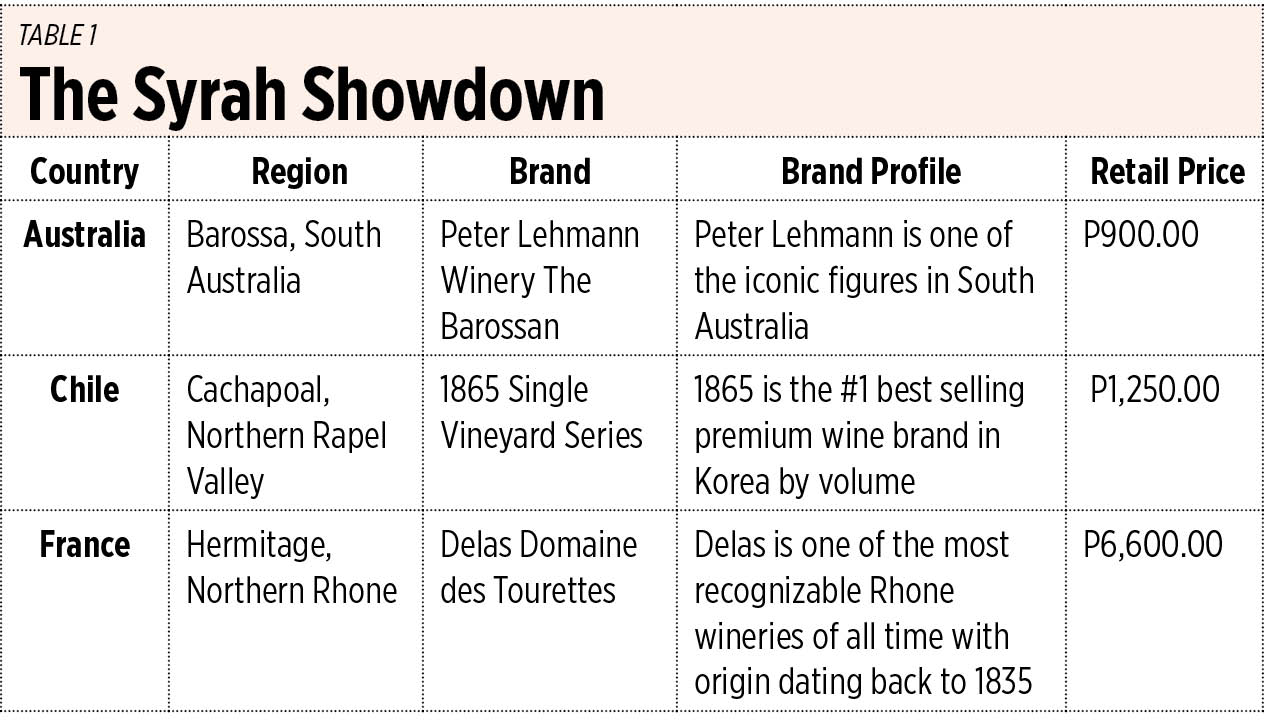
The best Syrah is arguably from the Rhone Valley, France, especially the region of Hermitage in northern Rhone. In fact, the Hermitage region was the inspiration for Australia’s most prestigious wine of all time, the Penfolds Grange, which was called Grange Hermitage since its first vintage in 1951. The name “Hermitage” was removed from the label since the 1990 vintage onwards following complaints by the European Union authorities on the use of a French wine region name by an Australian winery. Having said this, Hermitage was the region chosen to represent the Syrah varietal for France in this blind tasting.

As for Australia, the most famous Australian wine region of Barossa was used. Barossa is also where most of the Penfolds Grange grapes are from. And for Chile, Calchapoal Valley was chosen, though Elqui Valley would have been a better choice.

The brand and region representing this Syrah blind tasting showdown are seen in Table 1.

THE CABERNET SAUVIGNON SHOWDOWN
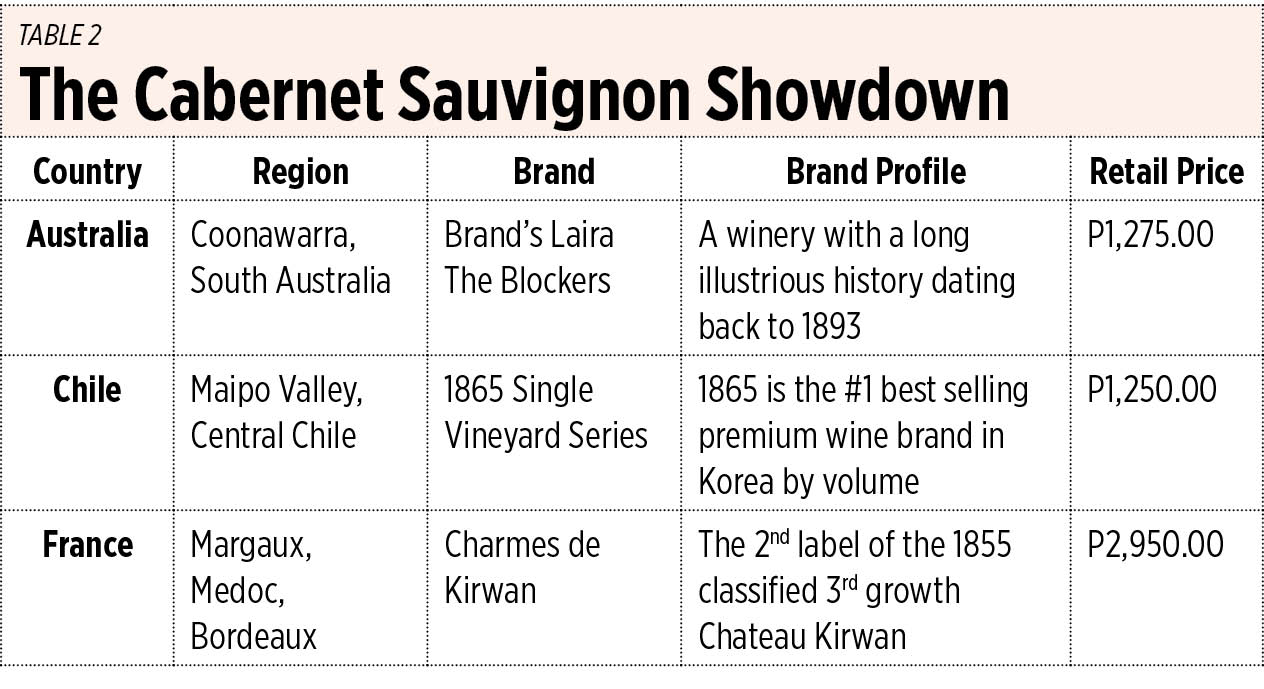
Cabernet Sauvignon, the king of red wines, has its roots in Bordeaux, France. But while French Bordeaux best exemplify this varietal, most of the New World wine regions are doing extremely good versions of Cabernet Sauvignon, including those from Napa Valley, California, USA, the Coonawarra region in Southern Australia, and the Maipo Valley in Chile. Australia’s most iconic Cabernet Sauvignon, the Penfolds 707, sources the majority of their grapes from the Coonawarra region. On the other hand, grapes for Chile’s most prestigious Cabernet Sauvignon, the Concha y Toro Don Melchor, are also sourced from the Maipo Valley.

The brand and region representing this Syrah blind tasting showdown are found in Table 2.

Each wine flight ended with the wine reveal, and because the wines chosen were already prime examples of the varietal and region, the reactions during the reveal were priceless. Many got it wrong, but it was nevertheless educational and exciting.

Golden Wines, Inc. plans to expand the Wine Showdown series to include other varietals and regions, with future events featuring sparkling wines, Cabernet Sauvignon, and even ros. Each edition will continue the blind tasting format, ensuring that impartiality and discovery remain at the heart of the experience.

The exercise was about personal choice — it was not about reputation, image, or even preconception. Instead, it was about personal taste, personal preference, and the amount of money each one is willing to shell out for a bottle of wine. In occasions like this, there is no wrong or right answer, and it is as personal and discretionary as one can get. After all, we do not have that dirty money connected to the flood control scandal, but just our hard-earned money to splurge on wine on occasion with no guilty feelings!

For corporations, associations, and clubs that want to experience this kind of wine event can e-mail Golden Wines Inc. at info@goldenwines.com.


Sherwin A. Lao is the first Filipino wine writer member of both the Bordeaux-based Federation Internationale des Journalists et Ecrivains du Vin et des Spiritueux (FIJEV) and the UK-based Circle of Wine Writers (CWW). For comments, inquiries, wine event coverage, wine consultancy, and other wine-related concerns, e-mail the author at wineprotege@gmail.com, or check his wine training website https://thewinetrainingcamp.wordpress.com/services/. Also check out his YouTube channel www.youtube.com/@winecrazy.

SM Prime readies 2 Tagaytay projects for turnover

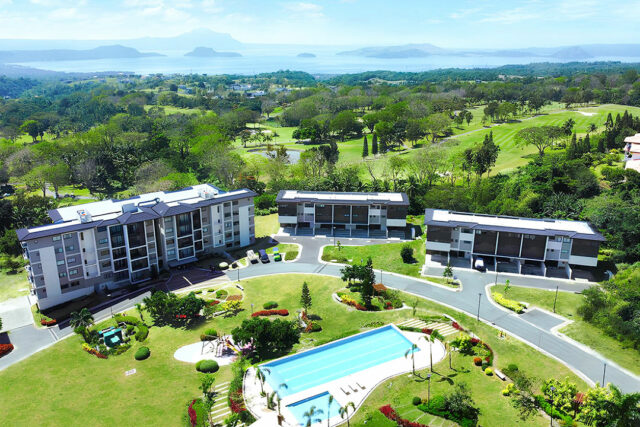
FROM LEFT TO RIGHT: St. Andrews Condominium, Sunnyvale Villas, and Glendale Villas at Horizon Terraces in Tagaytay Highlands. — SM PRIME HOLDINGS, INC.

LISTED property developer SM Prime Holdings, Inc. said its unit SM Leisure Resort Residences is set to turn over two residential projects in Tagaytay City, citing demand for premium secondary homes outside Metro Manila.

In a disclosure to the stock exchange on Wednesday, the company said Scottsdale Villas will be ready for turnover by December this year, while Redstone Condominiums is scheduled for turnover by March 2026.

Both projects form part of Horizon Terraces, a 3.2-hectare hybrid residential enclave within the Midlands district of Tagaytay Highlands in Cavite.

The community combines townhome and condominium formats, with 70% of the land dedicated to landscaped gardens and open spaces.

“Tagaytay Highlands is known for its carefully curated communities and low-density planning, which have supported steady property appreciation,” SM Prime said.

“Horizon Terraces builds on this foundation, underscoring its exclusivity, scenic nature views, and the enduring strength of the Highlands brand to sustain a premium positioning,” it added.

Within Horizon Terraces are three-storey Garden Villas, which include Scottsdale, Glendale, and Sunnyvale, with sizes ranging from 139 square meters (sq.m.) to 172 sq.m.

It also features Garden Suites, one- to two-bedroom low-rise condominium units sized from 35 to 103 sq.m., located in the St. Andrews, Glenview, Westchase, and Redstone buildings.

Horizon Terraces is situated 800 feet above sea level, offering views of Taal Lake, Mount Makiling, and the Tagaytay Midlands Golf Course.

It also includes a one-hectare Central Garden with resort-style pools, pocket gardens, and recreational areas.

The townhouses and condominium units are fully furnished through partnerships with brands such as Crate & Barrel and Our Home. — Beatriz Marie D. Cruz

Robert Redford, star actor and champion of independent film, 89

ROBERT REFORD in a scene from 1975’s Three Days of the Condor

ACTOR, director, and producer Robert Redford, who was both the quintessential handsome Hollywood leading man and an influential supporter of independent films through his Sundance Institute, died on Tuesday at the age of 89, his publicist said.

Mr. Redford passed away at his home at Sundance in the mountains of Utah surrounded by his loved ones, Cindi Berger, chief executive officer (CEO) of the publicity firm Rogers & Cowan PMK, said in an e-mail to Reuters. Ms. Berger did not disclose the cause of death.

Once dismissed as “just another California blond,” Mr. Redford’s charm and craggy good looks made him one of the industry’s most bankable leading men for half a century, and one of the world’s most recognizable and best-loved movie stars.

Mr. Redford made hearts beat faster in romantic roles such as Out of Africa, got political in The Candidate and All the President’s Men and skewered his golden-boy image in roles like the alcoholic ex-rodeo champ in The Electric Horseman and middle-aged millionaire who offers to buy sex in Indecent Proposal.

He used the millions he made to launch the Sundance Institute and Festival in the 1970s, promoting independent filmmaking long before small and quirky were fashionable.

He never won the best actor Oscar, but his first outing as a director — the 1980 family drama Ordinary People — won Oscars for best picture and best director.

Yet he remained best known for the two early movies he made with Paul Newman — the 1969 western caper Butch Cassidy and the Sundance Kid, and The Sting (1973), both of which became classics.

Despite their chemistry and long personal friendship, Mr. Redford was never to team up again with Mr. Newman, who died in 2008.

Butch Cassidy made blue-eyed Mr. Redford an overnight star but he never felt comfortable with celebrity or the male starlet image that persisted late into his 60s.

“People have been so busy relating to how I look, it’s a miracle I didn’t become a self-conscious blob of protoplasm. It’s not easy being Robert Redford,” he once told New York magazine.

Intensely private, he bought land in remote Utah in the early 1970s for his family retreat and enjoyed a level of privacy unknown to most superstars. He was married for more than 25 years to his first wife, before their divorce in 1985. In 2009, he married for a second time, to German artist and longtime partner Sibylle Szaggars.

Mr. Redford used his star status to seek out challenging film projects and to quietly champion environmental causes such as the Natural Resources Defense Council and the National Wildlife Federation.

“Some people have analysis. I have Utah,” he once remarked.

Although he never showed an interest in entering politics, he often espoused a liberal viewpoint. In a 2017 interview, during the presidency of Donald J. Trump, he told Esquire magazine that “politics is in a very dark place right now” and that Mr. Trump should “quit for our benefit.”

DREAMS OF BEING A PAINTER
Born in the Los Angeles beach city of Santa Monica on Aug. 18, 1937, to what he described as a “lower working class family,” Mr. Redford landed a college baseball scholarship but lost it after spending too much time partying.

Deciding he wanted to be an artist, he moved to Italy and later New York to study painting. He enrolled in drama school to try his hand at theatrical set design (“Acting seemed ludicrous to me,” he recalled) but was persuaded to take to the stage and by 1959 he was a full-time performer on Broadway and later found work on television.

He made his movie debut in 1962 in a low-budget film called Warhunt, but first won attention in Barefoot in the Park (1967), opposite Jane Fonda.

He turned down the role taken by Dustin Hoffman in The Graduate (“I never did look like a 21-year-old college student who’d never been laid,” he said later) and held out for Butch Cassidy and the Sundance Kid. The 1970s brought The Way We Were and The Great Gatsby.

From the 1980s he devoted more time to producing films and to the establishment of the Sundance Institute — a year-round workshop for aspiring filmmakers — and the Sundance Festival, which has become one of the most influential independent film showcases in the world.

In 2001, he won an honorary, or lifetime achievement, Oscar.

Mr. Redford remained active in films as an actor and producer right up to the end of his life. In 2017, he reunited with Ms. Fonda for the Netflix drama Our Souls at Night, a romance between a widow and widower.

“I live for sex scenes with him,” Ms. Fonda told journalists when the film premiered in Venice. “He’s a great kisser so it was fun to kiss him in my 20s and to kiss him again in my almost 80s.”

Mr. Redford said at the time that it would be one of his last films as an actor and that he was planning to focus more on directing and his first love — art.

INDEPENDENT FILMS
In 1981, Mr. Redford launched an experiment when he invited the makers of 10 low-budget movies to what film critic Roger Ebert described as a “cinematic summer camp” in the Utah mountains.

Four decades later, Mr. Redford and the annual Sundance Film Festival that he founded are being celebrated as the foremost champions of independent films.

“I can think of no other human being that has had an impact on independent film and storytelling, and cinema in the independent film world, than Robert Redford,” said Tori A. Baker, CEO and president of the Salt Lake Film Society.

“Nobody did what Bob did,” added Ms. Baker, who is also vice-chair of the Cinema Foundation. “He looked around and said ‘it’s not just about my art and the film I’m making and story I’m telling.’ Instead, he turned that outward and said ‘how can I help you make your story, and how can I support the story?’”

He used his Hollywood fortune to launch the nonprofit Sundance Institute, a workshop for aspiring filmmakers named after his role in Butch Cassidy and the Sundance Kid.

His goal was to nurture artists who were making movies that were not the traditional fodder of the big Hollywood studios. Mr. Redford invited filmmakers to spend time with him and other established directors, writers and editors who helped guide their projects.

The Sundance Film Festival debuted a few years later. Typically held in January and February, it earned a reputation as a showcase for creative risk-taking and a pathway to distribution for low-budget films to reach broader audiences.

“Sundance showed that you could create a community around independent films that was discrete from Hollywood, and that Hollywood wasn’t the only thing American cinema had to offer,” said Eric Kohn, artistic director for the Southampton Playhouse in New York and a former journalist who attended Sundance.

The festival grabbed Tinseltown’s attention when Hollywood’s Miramax studio bought Steven Soderbergh’s Sex, Lies and Videotape in 1989.

“The next year, all of these buyers were coming, looking for the next version of that movie,” Mr. Kohn said.

Filmmakers who came through Sundance included Quentin Tarantino, Darren Aronofsky, Paul Thomas Anderson, and Chloe Zhao. Clerks, Reservoir Dogs, Donnie Darko, The Blair Witch Project, and Oscar best picture winner Coda are among the films that debuted there.

“Our film Coda came to the attention of everyone because of Sundance,” actor Marlee Matlin wrote on social media on Tuesday. “And Sundance happened because of Robert Redford. A genius has passed.”

Ms. Baker, who worked for the Sundance Institute in the 2000s, said Mr. Redford personally took part in the organization’s work and often read scripts and met with directors.

“We always knew when Bob was around, because his motorcycle was always parked out in front of the offices,” Ms. Baker said.

Mr. Redford told Reuters in 2016 it was “a tremendous thrill for me” that Sundance had succeeded in its objective, which he said was “to make some kind of contribution to the industry that would keep diversity alive by supporting other artists, and particularly nurturing artistic freedom of expression.”

The Sundance Film Festival became so big that organizers announced this year that the event was moving out of Park City, Utah, to Boulder, Colorado, in 2027. — Reuters

ADVERTISEMENT
ADVERTISEMENT