THE World Bank (WB) is preparing to approve about $500 million worth of loans to the Philippines in the second quarter, funding projects that will boost the government’s ability to respond to natural calamities and mitigate disaster risk.
According to World Bank documents, the multilateral lender is poised to lend the Philippines $500 million under the Third Disaster Risk Management (DRM) Development Policy Loan (DPL), for release in a single tranche.
The World Bank’s Board has set an estimated approval date of May 21, 2020.
The World Bank said the Philippine government asked the bank for a disbursing Development Policy Loan (DPL), instead of the initial plan for a DRM DPL with Catastrophic Deferred Drawdown option, “following a highly unusual series of disaster events in late 2019 and early 2020.”
“Through this, the government will be able to strengthen institutional capacity to implement the reforms at the national and local levels. This operation provides timely engagement as the government is in the process of enhancing the institutional framework for DRM through the creation of a new department for disaster risk management and climate resilience,” according to the document.
The Department of Finance will be the implementing agency for the facility.
The World Bank noted that the Philippines’ vulnerabiity to natural calamities poses a risk to its poverty reduction initiatives and could negatively affected economic growth and debt stainability.
It said by enhancing the disaster preparedness of local governments through improved planning, financing and implementation programs, the government is expected to speed up its response and recovery efforts following a natural disaster.
“The government has shown strong leadership in pursuing the DRM agenda and the country has already achieved substantial results, with the support from the two DRM DPLs with a CAT-DDO 1 and 2 (Catastrophe- Deferred Drawdown Option Program). — Beatrice M. Laforga
THE government’s income from port operations grew 31% to P7.28 billion in 2019, significantly exceeding the P4.94-billion target amid increased automation and the deployment of more efficient port equipment.
In a statement Wednesday, the Philippine Ports Authority (PPA) said it posted a 2019 net income of P7.280 billion, well above the 2018 result of P5.553 billion.
“As against the target, the actual amount is 47% higher than the target of P4.941 billion,” it added.
PPA said Port Management Offices that turned in “strong performances” last year were South Harbor, Batangas, Davao, Surigao, and Bataan/Aurora.
“The positive deviation comes mainly from lay-up fees, ro-ro fees, domestic dockage fees, pilotage, the utilization of the Vessel Traffic Monitoring System, and other income,” it said.
The port regulator added: “Combining all the growth percentages in the first three years of the current administration, the PPA net income is growing at an annual rate of 17%, the highest revenue growth percentage in any of the last 15 years.”
PPA General Manager Jay Daniel R. Santiago attributed this growth to “various changes” being implemented in the agency.
“The changes range from manual to automated processes, installation of sophisticated, effective, and higher-productivity port equipment, compliance with the world’s best port management practices, and most especially, the shift in the outlook of employees to public service with reliability, integrity, and accountability,” he said.
PPA also disclosed that it will have to revisit its first-quarter performance targets in the next few days “in consideration of the current global concerns,” including the continuing coronavirus disease 2019 (Covid-19) outbreak, the exit of the UK from the European Union, maritime disputes with China, and some safety and environmental concerns, among others.
“Even with the continuing threat of global concerns, ‘business as usual’ is not an option but reducing the risk of these threats coupled with management anchored on best practices and public-service committed government personnel, our gateways connecting to the tourism and trade centers of the world, will remain competitive and responsive to any current global demands,” Mr. Santiago said. — Arjay L. Balinbin
THE wage board in Region 12, known as Soccsksargen, set a new minimum wage which will take effect on Sunday of as much as P4,000 a month for domestic workers, the Department of Labor and Employment’s (DoLE) regional office reported.
The Regional Tripartite Wages and Productivity Board of Region 12 (RTWPB-12) released Wage Order No. RB XII-DW-02 on Jan. 21 calling for a new minimum wage for domestic workers in the region. The order was published on Feb. 8.
The new minimum wage will be P4,000 in cities and first class municipalities, up from P2,500 previously, and P3,500 for other municipalities, up from P2,000.
The last wage order took effect on Dec. 10, 2017. Wage boards cannot issue new orders for one year after the last order.
DoLE Region 12 said in a statement dated Feb. 10: “The new wage order will take effect on Feb. 23, 2020 or 15 days after its publication.”
The wage order covers “domestic workers, whether under stay-in or stay-out arrangements, such as but not limited to general househelpers, babysitters (yaya), cooks, gardeners, laundry persons, and any person who regularly performs domestic work in one household or on an occupational basis” in Soccsksargen.
Family drivers, service providers, and the like who do housework sporadically are not covered by the order. — Gillian M. Cortez
THE Department of Budget and Management (DBM) said P2.489 billion has been allocated this year to support city governments rehabilitating public open spaces, with the Calabarzon region and National Capital Region (NCR) receiving the biggest share.
The Local Government Support Fund-Assistance to Cities (LGSF-AC) fund requires city governments to use the funding for projects that will develop new or enhance current public space on government land.
The spaces must be free and accessible to the public, and are viewed as important to maintaining sustainable, liveable, and resilient cities.
DBM issued the statement through local budget circular No. 13, dated Feb. 17.
“The eligible types of public open space projects that can be funded under LGSF-AC are parks, plazas, waterfronts, institutional spaces, streetscapes and a network of public open spaces combining types of public open space,” according to the circular.
The DBM said cities should submit requests, along with other requirements, to the DBM if the have any proposals.
NCR funding is P355.27 million, Calabarzon (Region IV-A) P331.287 million, Region VII P265.61 million and Region VI P260.68 million.
DBM warned local governments against using the funds for other purposes which have their own sources of funding, or for financing personnel services.
Earlier, the DBM released guidelines for the P4.875-billion LGSF-Financial Assistance to local government units, with preference declared for infrastructure projects under the “Build, Build, Build” program. — Beatrice M. Laforga
On Feb. 25, businesses, schools and government offices will be closed in celebration of one of the most significant events in Philippine history — the People Power Revolution. It commemorates the day when Filipinos gathered along EDSA, a major public road and a historical stage for those who rallied to restore democracy in the Philippines and end decades of dictatorship. For millions of Filipinos, the protest in EDSA was a reclamation of liberty long denied.
A similar feeling of independence may have been felt by some taxpayers when the Bureau of Internal Revenue (BIR) issued Revenue Memorandum Circular (RMC) No. 10-2020 on Feb. 6. This circular suspends the issuance of the Permit to Use (PTU) for Computerized Accounting Systems (CAS), Computerized Books of Account, and its components. The PTU is required before a taxpayer can use computerized accounts in its business operations. Unauthorized use would be subject to penalties.
In prior years, Revenue District Offices (RDOs) could process and issue PTUs. However, due to concerns with the approval process at the RDO level, the BIR decided to centralize the evaluation of PTU applications at the National Office in 2015. Subsequently, PTU applications at the BIR National Office started to pile up.
CAS applications start with the submission of complete documentary requirements. The application will then be assigned to a Technical Working Group (TWG) for a system demonstration that involves a walk through of the CAS. The BIR representatives will test-check if the CAS is compliant with the BIR rules (e.g., invoicing requirements and mandatory fields in the books of account). If any issues are noted, the BIR proposes adjustments to the system, and the applicant-taxpayer is given time to make the necessary rectifications. The BIR may also request for another walk through, if necessary. It is only upon satisfaction of these requirements and procedures that a PTU can be issued. Considering the lengthy procedures and the voluminous number of applications handled at the BIR National Office, the evaluation and release of a PTU could take more than a year.
Finally, in late 2018, the BIR allowed the advance issuance of a PTU number to taxpayers who have substantially complied with the application requirements and can justify the immediate need for deployment of the CAS. Notably, however, this procedure was not covered by a formal BIR circular or memorandum. However, there were taxpayers who successfully secured advance PTU numbers and deployed their systems.
Now, with RMC 10-2020, the pending applications (including those which have undergone system demonstration) for PTU will be handed over to the RDO where the taxpayer is registered. In lieu of a PTU number, taxpayers will receive an Acknowledgement Certificate with Control Number within three days from the submission of documentary requirements. The documents mainly consist of sample print copy of system-generated books of account and principal/supplementary receipts or invoices and a sworn statement with attached summary of system description, commercial invoices/receipts/ document description, forms/records and reports specification executed and signed by the taxpayer or company’s authorized representative/s.
The above requirements are not new to the applicant-taxpayers because most of them should have been included in the original application submitted to the BIR National Office. At most, the applicant-taxpayer may only need to adjust the format to comply with the prescribed sworn statement. Notably, however, the sworn statement under RMC 10-2020 is almost similar to the sworn statement required by the BIR when it allowed the issuance of advance PTUs in 2018.
Unlike before, where the release of the PTU number technically marks the end of the application, the applicant-taxpayer would now be subject to post-evaluation checking, which may be done simultaneously with a regular tax audit under a Letter of Authority.
The BIR is set to issue separate guidance implementing the circular, which would include detailed procedures for the post evaluation checking. Hence, we may expect more detailed guidance, especially since there are items needing clarifications. For instance, the BIR needs to clarify the specific coverage of RMC 10-2020. This is important because new applicants are confused whether they should follow the new documentary requirements and procedures for securing an Acknowledgement Certificate with Control Number given that the RMC suspended the issuance of PTUs. In addition, taxpayers with approved CAS applications but where the PTU is just pending release, are now concerned whether they will be classified as “pending applications” whose docket would be transmitted to the RDOs where they are registered.
On another note, the BIR National Office also needs time to transmit all pending applications to the respective RDOs. It must therefore also be clarified whether RDOs will start accepting and processing the documentary requirements under the RMC even if they haven’t yet received the relevant docket from the National Office.
Many taxpayers have waited a long time to finally get permission to use their CAS, with a few delaying their business plans until approval from the BIR is received. Ease of doing business was promised back in 2018 when Republic Act No. 11032, or the Ease of Doing Business and Efficient Government Service Delivery Act of 2018, was enacted. If ease of doing business is indeed the main driver for the issuance of RMC 10-2020, it is reasonable to expect that the BIR will provide positive responses to address the afore-mentioned matters as no taxpayer would want to wait another year or two to deploy their system.
The views or opinions expressed in this article are solely those of the author and do not necessarily represent those of Isla Lipana & Co. The content is for general information purposes only, and should not be used as a substitute for specific advice.
Donabel M. Villegas is a tax manager at the Tax Services Department of Isla Lipana & Co., the Philippine member firm of the PwC network.
PHILIPPINE SHARES advanced on Wednesday to join its regional peers in attracting buyers due to the flight of money away from highly-affected markets of the coronavirus disease 2019 (COVID-19).
The bellwether Philippine Stock Exchange index (PSEi) added 74.05 points or 1.01% to 7,396.94 yesterday, while the broader all shares index picked up 21.11 points or 0.48% to 4,362.09.
Regina Capital Development Corp. Head of Sales Luis A. Limlingan said investors have placed their money in the Philippines amid a decline in US and Chinese markets.
“Some investors have given the country a chance for bargain hunting as new COVID-19 cases in China continued to fall with markets less focus on the outbreak,” Mr. Limlingan said in a mobile message.
The Dow Jones Industrial Average and the S&P 500 indices both closed lower on Tuesday at 0.56% and 0.29%, respectively, while the Nasdaq Composite index inched up 0.02%.
In China, both the Shanghai SE Composite and the CSI 300 indices fell by 0.32% and 0.15%, respectively.
For AAA Southeast Equities, Inc. Research Head Christopher John Mangun, the improvement of the PSEi is also due to some foreign inflows.
“A lack of selling pressure allowed regular buying to take prices of blue-chip issues higher than usual,” Mr. Mangun said in an e-mail. “This may be because we have been seeing foreign inflows in the last couple of days.”
Foreign investors remained buyers on Wednesday with inflows reaching P62.97 million, although lower from Tuesday’s net foreign buying of P187.65 million.
However, Mr. Mangun said most Asian markets gained due to the slight decline in new COVID-19 cases: Japan’s Nikkei 225 and Topix indices improved 0.89% and 0.37%, respectively, as Hong Kong’s Hang Seng index added 0.46% and South Korea’s Kospi index climbed 0.07%.
In Southeast Asia, Bangladesh’s DSE Broad index and Vietnam’s Ho Chi Minh Stock index gained 0.37% and 0.09%, respectively.
“More foreign inflows in the coming days may lift the general sentiment as heavy foreign selling in the last six months has taken a toll on our market. We may see the PSEi test the 7,475 resistance before the end of the week,” Mr. Mangun said.
Sectoral indices at the PSE all improved on Wednesday. Holding firms rose 83.64 points or 1.17% to 7,229.99; services jumped 16.92 points or 1.16% to 1,471.68; industrials went up 103.40 points or 1.15% to 9,061.88; financials rose 9.95 points or 0.57% to 1,737.25; property climbed 18.69 points or 0.47% to 3,946.66; and mining and oil added 26.41 points or 0.37% to 7,103.79.
Some 621.16 million issues valued at P6.49 billion switched hands on Wednesday, higher from Tuesday’s 503.90 million issues worth P5.33 billion.
Advancers outnumbered decliners, 101 against 91, as 48 names ended unchanged.
THE PESO rebounded on Wednesday after two straight days of decline on the back of profit taking and amid positive sentiment in other Asian markets.
The local unit finished trading at P50.54 against the greenback, strengthening by 10.5 centavos from its P50.645-per-dollar close on Tuesday, according to data from the website of the Bankers’ Association of the Philippines.
The peso opened at P50.63 versus the dollar. Its weakest showing for the day was at P50.65 while its strongest level was at P50.52 against the greenback.
Dollars traded inched up to $998.3 million from $933.9 million on Tuesday.
A trader said the local unit’s strength came on the back of profit taking from investors.
“The peso strengthened from cautious profit taking ahead of the release of US Federal Reserve policy meeting minutes overnight,” the trader said in an e-mail.
Meanwhile, another trader attributed the peso’s gains to better stock performance in Asian markets.
“The peso followed ’yung (the) gains from Asian markets pati narin sa (and also in the) local stock market natin,” the second trader said in a phone call.
Reuters reported that Asian shares as well as US stock futures inched up on Wednesday, with investors going beyond their worries about the coronavirus disease 2019 (COVID-19) outbreak.
MSCI’s broadest index of Asia-Pacific shares outside Japan recovered from a shaky start to rise 0.4%. Chinese shares erased early declines to trade 0.6% higher.
At home, the Philippine Stock Exchange index inched up by 74.05 points or by 1.01% to end at 7,396.94 on Wednesday, while the broader all shares index rose by 21.11 points or by 0.48% to end at 4,362.09.
The National Health Commission of China reported on Wednesday that 1,749 cases of COVID-19 have been confirmed on Tuesday, down by the 1,886 cases seen on Monday and the lowest since Jan. 29.
For today, the first trader gave a forecast range of P50.50-P50.70 versus the dollar, while the second trader sees the peso playing around a wider margin from P50.45 to P50.80. — L.W.T. Noble withReuters
I am sure many people have shifted to cashless payments a long time ago, starting with doing credit card bill payments online. And then there came bills for household utilities like electric, telephone, water, cable TV and/or Internet service. In my case, in the last 20 years, I have found electronic and online payment to be a convenient and efficient mode of paying for personal bills.
It all started with payroll, of course, when in the early 1990s more and more companies started paying their employees through bank accounts with cards for Automated Teller Machines or ATMs. In my case, it was with BusinessWorld in 1993. Prior to the ATM era, the employees still lined up at the cashier to receive their pay slips and pay envelopes.
Soon after ATMs came phone banking, and I recall having to call an automated phone system just to check on bank balances and other transactions. Then came the online banking system, which was very convenient. That is, if you had a stable internet connection. Back then, in the 1990s, many of us were still using dial-up access and had to contend with snail-paced linkages.
Along with steady (but not necessarily profitable) employment as a newspaper reporter, and then later as a newspaper editor, and a regular paycheck, came credit card use for me. I remember my first “international” credit card in the mid-1990s, issued by a foreign bank, having a credit limit of only P20,000. My first “local” credit card came with a limit of only P5,000.
About 25 years since, much has changed in the environment for personal financial transactions. Nowadays, people use all sorts of payment modalities — credit cards, pre-paid cards, beep cards, RFID tap cards, and G-Cash and PayMaya systems among others via mobile phones. All this, in a way, have limited people’s use of a checking account for paying bills and purchases. It has significantly reduced the amount of cash I carry on my person, even when traveling.
This is, I believe demographic driven as well. Younger generations are more inclined to use electronic or online mode of payments than people older than 60, for instance. Teens and those in their 20s and 30s are also more comfortable doing online purchases and payments, and more through their mobile phones than personal computers.
Whether we like it or not, the cashless era is here. And, I believe, sooner than later, more people will be using modes other than cash to make payments or purchases. Personally, I notice that I have been carrying and using less cash of late, opting to pay via other modes when available. For one, it makes my financial transactions easier to track. And, I don’t have to contend with the lack of coins or loose change.
I recall during our first trip to Ho Chi Minh several years ago, we encountered some difficulty with communication, currency, and transportation. Not many people knew how to speak English, and it was difficult to give directions to taxi. Thus, in future trips, data connection became a must. The mobile phone with internet connection was necessary for Google maps.
We also used Uber for going around, where you set the destination and pick up, and paid via card. So, no need to “communicate” with the driver or pay in cash. We also booked ahead a rental for airport service. We also used Google translate to communicate with locals. But the nice thing with Vietnam is that as you leave, at the airport, you can return whatever local currency you have left and they will change it to your currency of choice.
So it wasn’t a surprise, at least to me, that a recent study from Citibank Philippines showed that local credit card users “are becoming more at home with digital transactions, with more of them accessing online services for big services like travel and lodging.” BusinessWorld quoted Citibank as reporting that “more than 50% of our customers that are coming into credit cards are coming through digital channels, and more than 70% of our loans are now acquired through digital channels.”
The paper also reported that the Bangko Sentral ng Pilipinas (BSP) is targeting to have 20% of the total volume and 30% of the total value of financial transactions in the country done digitally in the short-term. The mid-term aim is to get 50% of transaction volumes done digitally by the end of mid-2023.
Only recently, the Bureau of Internal Revenue (BIR) said it was expecting to grow the volume of taxes paid online after launching a 7th electronic channel through e-wallet service PayMaya. BusinessWorld quoted BIR Deputy Commissioner for Information Systems Group Lanee C. David as saying that electronic filers (e-filers) have increased over the years after the opening of various digital platforms, noting that the number of e-filers nearly tripled from 2015 levels to 1.796 million, including 60% of the bureau’s business taxpayers.
She was also quoted as saying that PayMaya could expand the taxpaying demographic particularly for its client base of individuals and the unbanked, since the platform does not require users to have a bank account. The other six electronic payment systems in use for tax payments are electronic filing and payment system (eFPS), Globe GCash, Development Bank of the Philippines’ PayTax Online, the e-Tax Payment System (eTPS) of the Land Bank of the Philippines, and Union Bank’s Online Tax Payment facility.
She also said around 84% of all taxes collected by the bureau in 2019 were received through online portals, most of which were from large taxpayers such as businesses, with the remaining 16% collections were received over the counter. Total amount of tax payments processed online surged 92% to P1.2 billion in 2019, according to the Department of Finance. The number of electronic tax payments also increased to 446,753 total transactions, up 60%.
There is another distinct advantage to doing electronic or online financial transactions. Money, undoubtedly, can get very dirty. In fact, a lot of germs and bacteria can get transferred from one hand to another as money — bills and coins — change hands during purchases particularly in markets and other public places.
In China, for instance, the South China Morning Post has reported that the Guangzhou branch of China’s central bank would “destroy all banknotes collected by hospitals, wet markets, and buses to ensure the safety of cash transactions as the country battles a coronavirus outbreak.” It added that financial news outlet Caixin has reported that officials at the People’s Bank of China’s (PBOC) branch in the southern city ordered that all paper currency from sectors with high exposure to the coronavirus be withdrawn for destruction.
Commercial banks in the province were ordered to put banknotes from these sectors aside, disinfect them, and hand them in to the PBOC. The central bank reportedly uses high temperatures or ultraviolet light to disinfect cash, and store the currency for more than 14 days before putting it back in circulation.
In today’s setting, I believe the spread of disease is a major consideration in doing electronic or online financial transactions. In the past, merchants used to say, “credit is good, but we prefer cash.” Soon, I hope, they will start thinking that electronic money is just as good if not better than credit or cash.
Marvin Tort is a former managing editor of BusinessWorld, and a former chairman of the Philippines Press Council.
Entrepreneurship is one of the vital engines of economic growth in the Philippines as it stimulates production and innovation. Our country is regarded as one of Asia-Pacific Economic Cooperation’s fastest-growing economies, with a projected 6.7% GDP growth rate heavily relying on micro-, small-, and medium-enterprises over the next two years.
ICONICBESTIARY / FREEPIK
Despite our projected GDP growth, we are still behind our neighbors such as Singapore and Malaysia, which have stronger entrepreneurship ecosystems, according to the Global Entrepreneurship Development Institute (GEDI), a research organization that seeks to advance knowledge on the relationships among entrepreneurship, economic development, and prosperity.
GEDI’s Global Entrepreneurship Index (GEI) measures the quality and dynamics of entrepreneurship ecosystems at national and regional levels. GEI data are culled from the Global Entrepreneurship Monitor (GEM) Adult Population Survey and from various agencies. The GEI has three sub-indices that serve as a platform for the 14 pillars of the entrepreneurial ecosystem: entrepreneurial attitudes, abilities, and aspirations. GEDI’s website (https://thegedi.org/tool/) shows GEI results in three ways: 1.) a country’s GEI results per sub-index, with colors indicating which quartile the score falls into; 2.) the spider chart, which shows country performance compared with to up to three benchmark countries; and 3.) a table that provides a guide for policy formulation and answers the question “Where should a country put its resources to improve its GEI score?”
GEI results show that the Southeast Asian (SEA) nations that had higher 2018 GEI scores than the Philippines, such as Singapore, Brunei Darussalam, Malaysia, Thailand, Indonesia, Myanmar, Lao PDR, Vietnam, and Cambodia, are also stronger in human capital and process innovation (except for Brunei) than the Philippines. Except for Singapore, the common weakest point among SEA nations is technology absorption, which reflects the technology-intensity of a country’s start-up activity. Technology absorption is an entrepreneurial ability that has to be honed and invested in. Our entrepreneurial ecosystem needs to be developed in terms of not only institutional regulations and policies but also entrepreneurial attitudes, abilities, and aspirations.
GEI distinguishes between small business owners who replicate what others are doing from entrepreneurs who innovate. The Filipino social entrepreneur respondents in the 2015 GEM Social Entrepreneurship Report classify themselves as innovative value creators who gain access to large markets by identifying opportunities, developing products, satisfying clients, motivating staff, handling distribution, and managing pricing in unfamiliar contexts. This report also shows that the average rate of innovativeness of social entrepreneurs globally is 1.6%, with variations from an estimated low of 0.1% in Iran and Bulgaria to a high of 4% in the Philippines and Israel.
A social entrepreneur seeks to maximize social impact, usually by addressing an urgent need that is being mishandled, overlooked, or ignored by other institutions. In contrast, a traditional or business entrepreneur strives to maximize profits or shareholder wealth, or to build an ongoing business that provides value to customers and meaningful work to employees.
Both business and social entrepreneurs, despite their differing main objectives, should address their customers’ increasing demand for innovative products and services. Thus, the new breed of entrepreneurial and innovative value creators — whether traditional or social — has to be recognized so that these entrepreneurs can share their stories and encourage other young people to also contribute to nation-building and economic development.
To help do this, the Ramon V. Del Rosario College of Business (RVRCOB) of De La Salle University co-launched with Phinma and the Junior Chamber International Manila last year the RVR-Siklab Awards, a nationwide search for young individuals who are both leaders and change makers. Last year’s awardees were Clarissa Isabelle Delgado, co-founder and CEO of Teach for the Philippines; Edgar Elago, founder of Project Scholar, Cooltura Couture, and Project ADAMMS; Gary Ayuste, founder of Beengo Farm; Melissa Young-Yap, founder and executive director of Got Heart Foundation; and Jan Bernard Tan, co-founder of iVolunteer Philippines and The Good Store Philippines.
Outstanding youth leaders for this year’s search can be nominated online at bit.ly/RVRSiklabAwards2020 until March 31. To be nominated, the person should be a Filipino citizen or a Philippine passport-holder whose work has made a positive impact in a community in the Philippines. He or she must be between 25 to 40 years old; not have been charged with any case nor have any pending case in any court; possess a significant leadership role in his or her organization for at least three years; demonstrated a positive impact on a community in the Philippines; and exemplify entrepreneurial spirit, impact of business or social enterprise, corporate citizenship, and social responsibility.
Dr. Emilina R. Sarreal is the Dean of the Ramon V. Del Rosario College of Business of De La Salle University.
On Feb. 5, I attended the lecture by Dr. Dennis S. Mapa, National Statistician and head of the Philippine Statistics Authority (PSA), and Professor at the UP School of Statistics (UPSS). His talk was “Poverty in the Philippines: Evidence from the 2018 Official Poverty Statistics,” sponsored by the Department of Economics of the Ateneo de Manila University. I was invited by Dr. Majah Ravago who used to teach at UP School of Economics (UPSE) and recently migrated to Ateneo.
The 2018 poverty data is significant because the Family Income and Expenditure Survey (FIES) 2018 on which it was based, has a huge sample size — 180,000 households, responding to a questionnaire of 81 pages long (50 on expenditures, 24 on income including entrepreneurial activities, and seven on sociodemographics), and the average interview time is four to six hours — Wow! FIES is done every three years.
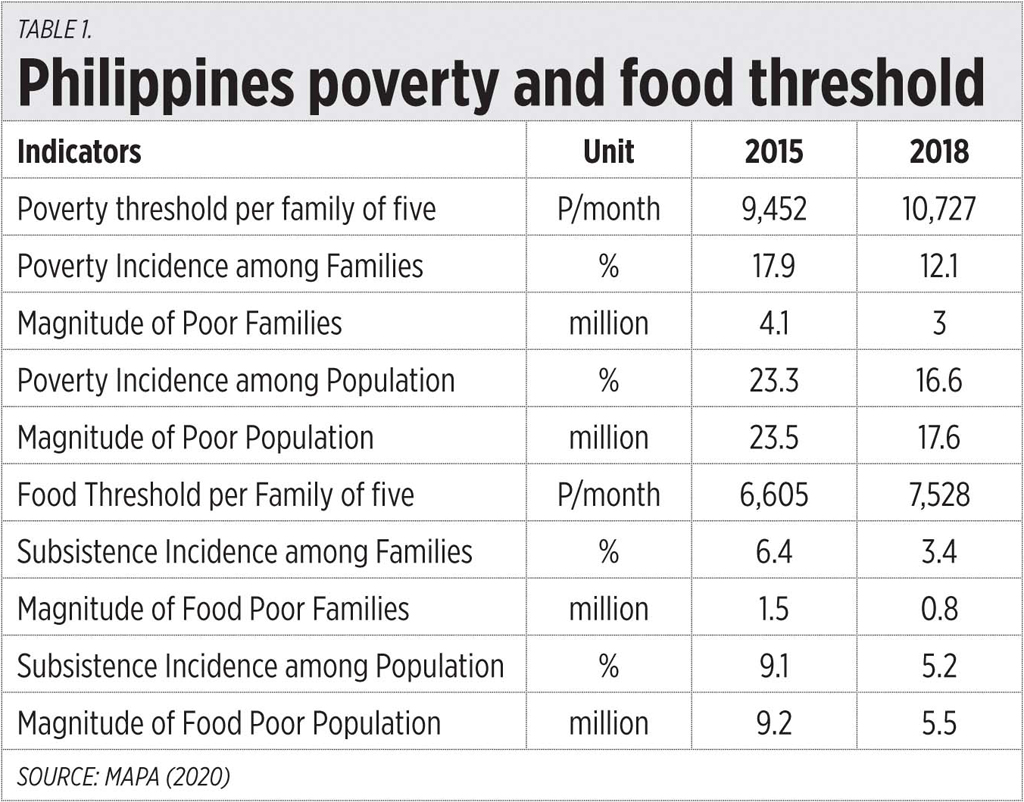
To summarize, poverty incidence among families has declined from 18% in 2015 to only 12% in 2018; poverty incidence among individuals declined from 23% in 2015 to 17% in 2018 (see Table 1).
I have observed since many years ago that poverty incidence in the country has been declining and previous poverty data would be exaggerated. Before, the poor would ride bicycles or horses, now they ride motorcycles, e-bikes, second- or third-hand cars. Before, the poor used slow mail to communicate, now they use smart phones and communicate via Facebook, Instagram, e-mail, and SMS. Before, farmers used carabaos or hand tractors to plow their field, now they use or rent rotor tractors and harvester + thresher machines that significantly reduce the time and cost of harvesting their crops.
Credit goes to continuing market competition and technological innovation and modernization in cars and mobility, consumer electronics and agriculture machinery. The pessimists of “the poor getting poorer” just fan emotional slogans that are not based on hard facts on the ground.
After Dennis’ lecture, PSA and Ateneo signed a Memorandum of Agreement (MoA) that will allow the university’s faculty, staff, students, and researchers access to the public use files (or anonymized raw data) of the various census and surveys being undertaken by the PSA. I assume that University of the Philippines School of Economics (UPSE) and other colleges will have a similar privilege soon.
This week I saw the paper by Dr. Epictetus E. Patalinghug, “Too Much and Too Fast? A Look at the Philippines’ Infrastructure Build Up Program,” UP Professor Emeritus Research Paper July 2019. Dr. Patalinghug was my teacher at UPSE in early 1980s before he transferred to teaching at the neighbour building, the UP College of Business Administration. He was also among my wedding godfathers along with another former UPSE, Prof. Ruperto Alonzo (RIP).
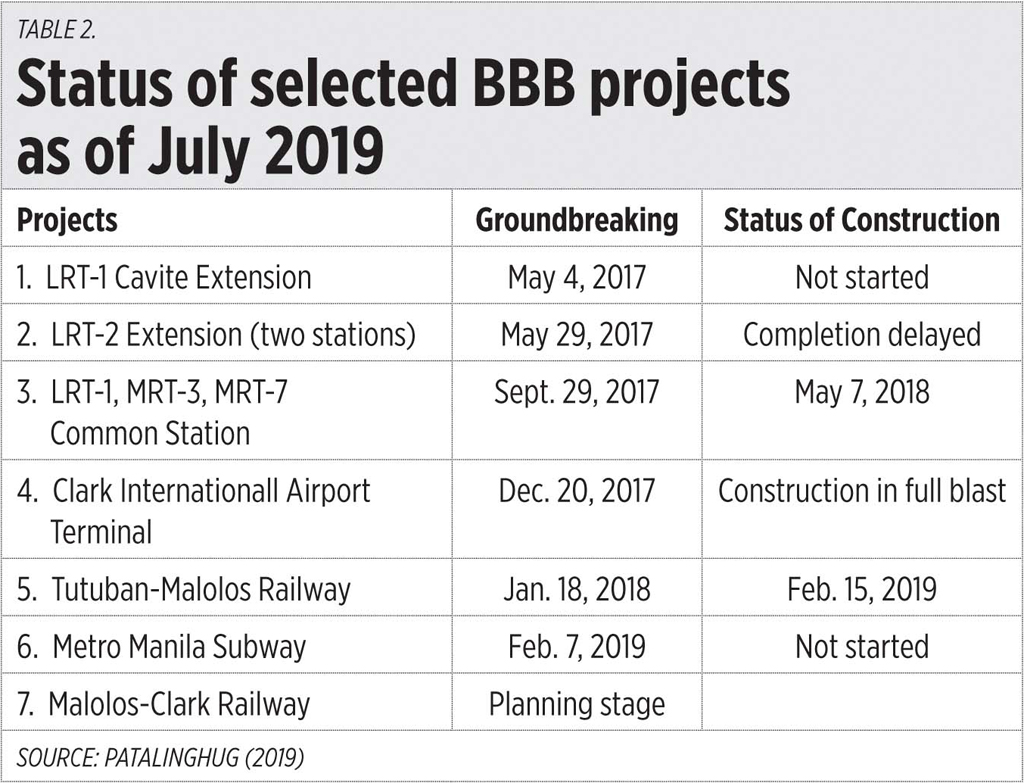
Among the data he presented was about these huge build-build-build (BBB) projects of the Duterte administration and the promises of early completion that do not coincide with their delayed construction (see Table 2).
The paper is 15 pages long, including four tables and references. The Duterte BBB team of the Department of Public Works and Highways, the Department of Transportation, the Department of Finance, the National Economic and Development Authority, etc. should read it. Dr. Patalinghug concluded his paper with this note:
“… absorptive capacity constraints has created implementation bottlenecks in the BBB program and has reduced the success rate and impact of individual projects… Given the current pace of project implementation, most of the BBB projects will be completed beyond 2022. The next administration will experience several ribbon-cutting ceremonies, as much as the current administration has experienced several ribbon-cutting ceremonies on projects initiated by the previous administration.”
Recall also the paper by another former teacher of mine at UPSE, Dr. Emmanuel de Dios, published on Feb. 10 (see https://www.bworldonline.com/waste-and-means/) where he observed that “investment during the first half of Duterte’s term has been the least efficient in producing growth. The ICOR (incremental capital-output ratio) of 4.7 for 2017-2019 is the highest it has been over the past 15 years.”
A high ICOR means high waste in public investments. Like destroying not-so-ugly roads and building new roads on the same spot and flaunting this as BBB spending.
The administration’s BBB are mostly under “hybrid PPP” schemes and hence, would require lots of tax-tax-tax and borrow-borrow-borrow. Bad policy considering that the original integrated PPP scheme would optimize private investments’ construction plus O&M later, with no need for more taxes and borrowings.
Bienvenido S. Oplas, Jr. is the president of Minimal Government Thinkers.
THE SEARCH COMMITTEE formed by the Businessman’s Lunch Restaurant (BLR) is tasked to review candidates for CEO to replace the retiring incumbent. He has expressed his wish to have someone “continue his legacy,” mostly in reducing flagrant tipping, especially from suppliers. It’s no secret he is in favor of the head waiter taking his place. He is always photographed with him even when taking siestas.
The chair of the search committee feels that for the succession plan to work, the incumbent must stay in the sidelines and not meddle in the vetting process. Anyway, he says he is looking forward to his retirement and the chance to rest even more, and try different Chinese restaurants, especially those with promos and lots of seafood. It may be a good time for him to give his jet skis a spin.
Qualifications for the new CEO are presented by the chair. These include skills in talent management and team building, work experience in heading a 24-hour operation, familiarity with supply chain management, selection of winning bids for projects outsourced to contractors (without constantly reviewing awarded contracts), media relations (yes, he must meet them now and then), and attracting investments in new stores.
The secretary of the committee confirms that these are indeed the qualifications agreed upon, and that there is already a short list of possible candidates to be interviewed. It is important to screen them for that last step to see if there is a need to move forward on these applicants.
The chair reminds the members to be forthright as there will be no records of this meeting. She enjoins the committee not to take notes.
The first candidate is surging in the survey among the stakeholders. He is an outsider but already well-known. He has come out in billboards but not for any food business, but mostly for facial scrubs and denim outerwear. He is young, some say too young, to head a culinary empire. He understands social media and will be well placed to spearhead digital marketing of the menus for the week. Does he understand food? He has a small cart-based snack operation that has given him some appreciation on how food spoilage can bring up overhead and why leftovers need to be properly accounted for.
If charisma is a required attribute to please the stakeholders, some candidates, like Candidate B (favored by the incumbent), fail in this first screening. The head waiter — although he is supposed to have consistently charmed his boss enough to always accompany him in conferences and visits to wounded waiters — except for reading moods and opening doors, he may need to be reviewed for performance in his designated job. He is known to be good with his foot massage, especially for the caressing of the big toe, and digging out ingrown toenails.
The search committee has agreed to disqualify relatives from the list. One or two of the offshoots seem to have a high profile and even spout the tough talk of the present CEO. (Let’s admit all aliens who want to eat here even if they have a hacking cough.) While these relations may be good working behind the scenes, as in the ousting of the maître d’ and the replacement of the restaurant audio system with smaller speakers, their appeal to the stakeholders still need to be tested.
The last candidate is the Vice-President of BLR who seems to be the frontrunner as the current second-in-command. In her last assignment on investigating the status of the salad supply and other leaves, she lasted all of three weeks as she employed the restaurant’s PR apparatus to leak findings on the salad suppliers using genetically altered plants with the knowledge of the supply chain manager, and even the CEO. The two never really hit it off and the incumbent is known to express his dissatisfaction with his deputy — she talks too much.
Since retirement is still more than a year away, the search committee is in no hurry. The field of candidates seems too narrow. Who knows if developments in the next few months will bring out a new food icon, recognizable even with a face mask on?
The chair feels that there is a need to widen the search and get more candidates. They don’t even need any food experience, just a willingness to run the business of cooking and being cooked. But, is there still enough time?
EVERYTHING that we are, everything that we believe in and most everything that we are drawn to is influenced by good stories. Stories that we heard on the laps of our grandparents, stories our parents shared, and stories of and by people we loved and looked up to.
The really smart businesses across the world know this to be true. Notice how global corporations, community leaders, and people promoting their own faiths use them. They use them lavishly and, sometimes, lethally.
What happens to us when we listen to a story instead of bullet point-riddled business speech?
Take into account the Triune Brain theory of physician and neuroscientist Paul D. MacLean and simplify it a bit like I have done in my book, the HeART of the CLOSE. The human brain has taken eons to evolve into what it is today. The brain has evolved in three major stages. There is the old Reactive Brain which mostly runs many of our unconscious bodily functions and is also the seat of fright, flight or fight. It is always overcautious, easily gets addicted, and, of course, has very little ability at delaying gratification. Then comes the mid or the Romantic Brain, the seat of our emotions, hopes, ethics and the like. Lastly we have the new, Reasoning Brain which is the seat of analysis, rationality, and short term memory.
When we hear a story, a story that sinks in and settles deeper than most speeches, at least five things happen:
One, the Reasoning Brain takes a back seat and lets the words, the pictures, pass easily through its objective and analytical police work that it usually does. It goes, people go, “it is nothing but a story and what harm can it do? It looks nicely packaged in roses, rainbows and rhythm. It is just fun, light stuff, open the gates of head!”
Two, the Romantic Brain sits up and says, “Wow, are we talking people, places, pictures, poetry here? I have here within me so many experiences to share, feelings to feel and dreams to dream. I wanna’ dance, I like what I am hearing, seeing and sensing. This is good. Let’s party!” It then begins to conjure up its own stories and begins pump out dopamine, oxytocin and feels engaged and happy.
Three, the deeper, Reactive Brain finds no cause to be afraid, to run away or pull out its fangs to defend itself or the human that houses it. He thinks if those two juvenile idiots think it is okay to let these sensations come in then it must be okay. Anyway they seem to having fun. So it puts its head down and returns to its daily grind and holds back the cortisol from running amuck.
Four, when these three brains are in alignment and in harmony there is peace among the millions of neurons that live in our heads, hearts, and our guts. When these neurons are calm and quiet they take in all the new data eagerly and store them into our long-term memories. Thus any and all important interpretations and messages that stories bring in with them get stored in us as our belief systems and values.
Thus, stories really are roses, rainbows, and rhythms which gently package our personal and societal values. Try asking yourself why you believe in honesty and chances are your response will be, “because a long time ago when I went shopping with Dad…” You will recall a story.
Five, when you as a leader tell a story to a group of people, not only are they leaning in deep into your story, their mirror neurons rise to the occasion and recall incidents and experiences and compare the beliefs and the values held within them with yours. It is synergy and inclusion in action. No, in fact it is dynamic interaction.
Ergo, whenever you have to make a speech, deliver a status report, hold a town hall meeting, build a team, or influence your world authentically for a longer time, then tell a story over a speech. We will all then be living a happily ever after life.