Home Blog Page 9755

Dashboard (03/16/20)

MG is official car of Miss Universe Philippines 2020

MG Philippines has inked a pact with Miss Universe Philippines (MUP) to be its official car. This year is an especially significant year for MUP since, for the first time in Filipino pageant history, a locally produced Miss Universe competition will entertain the bids of all aspiring Filipina aspirants to the crown. The MUP competition will be recognized as the venue that will identify which Filipinas will represent the country in international competition. MG Philippines expressed its honor to be able to partner with the Filipino-led organization that celebrates the modern Filipina. It will provide the organization with its British heritage cars for use by the MUP organization as they travel for various pageant requirements. Furthermore, the very first Miss Universe Philippines will drive home a brand-new MG ZS Alpha Crossover SUV. In photo are executives of MG Philippines led by President and CEO Atty. Alberto Arcilla (fifth from right) with MUP National Director Shamcey Supsup-Lee (fourth from right) and MUP Creative Director Jonas Gaffud.


Suzuki drives with Doraemon

SUZUKI PHILIPPINES teams up with the popular Doraemon, the robotic cartoon cat character loved by many generations — particularly in the Philippines. The fun, carefree, and inspirational character who promises to make everyone’s dream come true has proven to be an influential brand to this day — evidenced in Doraemon-themed merchandise and events.

Meanwhile, Suzuki Philippines knows that purchasing a vehicle is one of the most memorable moments in a family’s journey. Customers visiting any Suzuki showroom nationwide will see the “Shall We Drive” campaign evident, with loveable Doraemon memorabilia. The campaign ensues until February next year.

BDO Unibank not spared by last week’s massive sell-off as investor fears prevail

By Mark T. Amoguis
Assistant Research Head

INVESTORS, spooked by the coronavirus disease 2019 (COVID-19) pandemic, prompted massive sell-offs, making BDO Unibank, Inc. one of the most actively traded issues last week.

A total of 19.81-million BDO shares worth P2.57 billion exchanged hands on the trading floor from March 9 to 13, data from the Philippine Stock Exchange (PSE) showed.

Shares in BDO declined by 10.2% on a week-on-week basis to P127 per share last Friday from P141.50 apiece last March 6. The stock has fallen by 17.5% since the start of the year.

The largest lender in terms of assets was “just swept off” by the overall market sentiment to sell, according to Rachelle C. Cruz, senior equity analyst at AP Securities, Inc.

“It’s the fact that [BDO] belongs to the top five largest companies in the PSEi (PSE index) and given what was happening worldwide… Whenever there’s a worldwide sell-off, expect the ‘glamor index stocks’ will be the first ones to be sold down…,” Ms. Cruz said in a phone interview.

Wendy B. Estacio, senior equity research analyst at Philippine National Bank’s Research Division, shared a similar assessment, adding it was cushioned somewhat by BDO’s earnings performance in 2019.

“[T]he stock slightly outperformed the PSEi’s and financials index’s (week-on-week) decline of 14.4% and 11.3%, respectively. In our view, this was due to the bank’s strong full-year 2019 performance, which exceeded its net income guidance,” Ms. Estacio said in an e-mail interview.

Last Wednesday, the World Health Organization (WHO) declared COVID-19 a pandemic. It was first reported in late December in the city of Wuhan in China’s Hubei Province and has since spread to 123 countries and territories, killing more than 4,000 people and affecting nearly 133,000 more.

In the Philippines, there are 111 detected cases as of March 14, with eight fatalities due to the disease.

WHO’s announcement sent the local bourse on Thursday to a nearly eight-year low finish of 5,736.27 — a level never before reached since Dec. 18, 2012’s 5,636.59 close.

PSEi likewise recorded its biggest single-day decline that day at 9.71%, the lowest in at least 12 years or since the 12.27% drop on Oct. 27, 2008 at the height of the global financial crisis.

That day also triggered the circuit breaker — the second time it was activated since the global financial crisis — which is activated when the PSEi slumps by at least 10%, after the main index declined by 10.33%. This prompted a 15-minute trading halt.

This circuit breaker was triggered again last Friday after the PSEi dropped 10.43% during the morning trading session.

Meanwhile, BDO’s net income jumped by more than a third to P44.17 billion last year, exceeding its P38.5-billion profit forecast amid “strong performance of its core recurring income sources.”

The lender’s total assets went up by five percent to P3.19 trillion last year as loans and receivables increased by 7.4% to P2.23 trillion.

“Despite strong 2019 results, we think that the investors’ fear may prevail while waiting for the full impact of COVID-19 to its operations in [the first quarter of 2020],” PNB’s Ms. Estacio said.

“For the banking sector, focus risk areas are borrowers with the following linkages: tourism, shipping, travel, OFWs (overseas Filipino workers), and SMEs (small and medium enterprises). Banks are currently conducting rapid portfolio review and are preparing for the likelihood of slower loan growth and possibly higher NPLs (nonperforming loans),” she added.

Ms. Estacio expects BDO to book a P43.9-billion net income this year, “driven by slight improvement in net interest margin due to lower cost of funds.”

She clarified, however, that this projection has not yet accounted for the COVID-19 impact.

AP Securities’ Ms. Cruz said that the impact of the COVID-19 to BDO’s loan portfolio this year is not that big.

“The banking sector might see higher bad loans if the virus spread persists. But we don’t see it severely affecting the balance sheet of the banking sector as a whole, especially in terms of capitalization. They’re very much resilient compared to the 2008 global final crisis,” she said.

“The banking sector itself, especially BDO, is very well prepared for this kind of scenario,” she added.

Ms. Cruz pegs BDO’s support and resistance levels at P99 and P130 this week.

“[W]e expect the higher than normal share price volatility to continue because of the overall panic in the market,” Ms. Estacio said.

For Tag Heuer, smartwatch is ‘additional business’ beyond core

AS MAJOR events were getting canceled across the US, and New York was banning gatherings of 500 or more on March 12, the Swiss luxury watchmaker Tag Heuer hosted a final shindig in honor of its new Connected Watch.

At the Caldwell Factory in New York’s trendy West Chelsea district, guests played with the new smart timepiece, which comes in four variations to retail from $1,800 to a steep $2,350 — making it one of the most expensive, serially produced, connected watches on the market.

“The new Connected Watch combines high-performance digital experiences with our new TAG Heuer Sports App and fine watchmaking,” says Frédéric Arnault, the company’s chief strategy officer and digital officer. “With the steel bracelet and interchangeable straps, the dynamic dial designs that are inspired by our mechanical watches, and the case design, especially with the ceramic bezel, it looks like you are wearing a mechanical watch.”

The Connected Watch — crafted in stainless steel or titanium — features a ceramic bezel that improves the communication for the sensors underneath to align with the app. In previous generations, a steel bezel interfered with the sensors, so the watch construction was a bit bulkier. (The molecules of the ceramic allow for better transmission.) The new watches are thinner and lighter in weight, as well as more ergonomically designed to fit the wrist. They are also highly intuitive for the user because instead of being a total touch-screen device, functional crown and chronograph pushers are installed on the case side. They can be used to start and stop programs, return to original menu screens, and more.

Tag Heuer, still a traditional watchmaking company focused on mechanical watches, views the connected business as a new revenue stream, not a replacement for existing categories. “We continue to invest heavily in the mechanical watch space; it is what we stand for, and our core values are in the mechanical watch world,” says the Mr. Arnault, 24, whose father Bernard is chairman of Tag’s parent company, LVMH. “The smart watch is additional business, and it increases our consumer base.” In fact, the connected watch business nourishes the mechanical business, according to Mr. Arnault: Some people who start with a smart watch go on to buy mechanical TAG Heuer watches.

How much additional business can the brand expect from the new Connected Watch? The smartwatch market “is really booming, with very high double-digit growth year over year, and it’s just the beginning. It is only four or five years old, and there is more coming, especially since the true use is health and fitness, where we have positioned ourselves,” says Mr. Arnault. “So we have strong ambitions and believe the volume can reach several hundreds of thousands of watches. We think this could reach 20 to 30%of the business in the years to come.”

While the Covid-19 coronavirus pandemic could slow initial sales as people delay big-ticket purchases, the Tag Heuer Connected Watch is a multipurpose purchase, especially with the Sports App that tracks not just walking, but jogging, running, and even golf. (A separate digital team was created in Paris to work on this app, created over the course of 18 months.)

According to Mr. Arnault, the next sport to be tracked, with updates coming in the next few months, will most likely be swimming. Currently, the watch has interchangeable rubber straps and metal bracelets and is water resistant to 5 ATM, which means it’s ready for the pool.

“The tactile sense of the watch, the functional pushers, and crowns make it very easy to use,” says Mr. Arnault. “We wanted the user interface to be intuitive and fluid; that was a high priority. The [previous model’s] heavy reliance on touchscreens bothered us. If you have wet fingers and can’t move the screen, for instance, it is a problem. With this watch, even a mechanical watch user feels very comfortable.” — Bloomberg

Tea and cocoa-loving Nigerians finding new thirst for coffee

LAGOS — Businessmen in the Nigerian city of Lagos typically broker deals over cognac or champagne. But, on a sunny afternoon in the city’s upmarket Victoria Island business district, a clutch of men celebrated with steaming coffee that cost 35,000 naira ($114) for a three-cup brew.

Jamaica Blue Mountain, the gourmet variety they imbibed, is coveted around the world for its superior quality.

Ibrahim Samande, owner of the Mai Shayi Coffee cafe that sold the drink, knows not everyone can afford the splurge. But he believes cachet and ceremony, and attractive spaces to enjoy a cup, will lure more of Nigeria’s 200 million people to drink coffee.

At present, Nigerians drink only a tiny amount of coffee. Tea or cocoa are the hot drinks of choice, and are forecast to account for close to 40% of Nigeria’s non-alcoholic drink spending by 2023, according to research body Fitch Solutions. By contrast, spending on coffee is seen only at 2.5 percent.

Samande is among a new breed of entrepreneurs hoping to cash in on coffee. They are betting that wealthy Nigerians will cultivate a cafe culture that can also spur consumption of locally grown crops.

“Nigeria is a very aspirational society,” Mr. Samande said. “And it’s very easy for things to catch on.”

Consumption is rising; the retail value of coffee sold has nearly tripled since 2010 to $29 million last year, according to Euromonitor.

But it is still a market in its infancy. Kenya, with a quarter the number of people as Nigeria, consumes close to the same amount of coffee, and spent $11 million more on the drink last year. Meanwhile South Africa consumed more than six times as much coffee as Nigeria and spent 9 times as much.

In a country where the majority live on less than $2 a day, most Nigerian coffee-drinkers opt for bitter cups of instant coffee that street vendors hawk for 100 naira, just a few cents.

International coffee shop chains have yet to enter the country significantly, although there are a few domestic chains. Nigeria’s Café Neo has several locations in Lagos, and Happy Coffee also aims to bring coffee to the masses.

Mr. Samande, whose grandmother roasted her own beans with cardamom and ginger, believes that brewing with imported Italian Moka pots, Japanese siphons and American Chemex coffeemakers can convince Nigerians to drink higher-quality coffee.

Coffee is one of the world’s most-traded commodities, he said. “I think there’s room for us to plug into that sort of supply chain.”

He buys Nigerian beans from Kim’s Coffee, a roaster around 1,000 kilometers (621.37 miles) to the north of Lagos. Kim’s founder David Dayi said strong demand saw them roast 3 tonnes of locally grown coffee last year — triple the 2017 level.

Dayi said Nigeria could easily grow more coffee — and that local consumption could help spur this. — Reuters

Coronavirus fears push gov’t debt yields up as bondholders prefer cash

By Carmina Angelica V. Olano
Researcher

YIELDS ON government securities (GS) rose almost across-the-board last week as market players sold off their bonds due to the spread of the coronavirus disease 2019 (COVID-19) in the country.

On average, GS yields went up by 28.8 basis points (bps) week on week, according to the PHP Bloomberg Valuation Service (BVAL) Reference Rates as of March 13 published on the Philippine Dealing System’s website.

“Bondholders reduced risk and chose to hold on to cash given the uncertainties surrounding the COVID-19 pandemic,” Kevin S. Palma, peso sovereign debt trader at Robinsons Bank Corp., said in a mobile phone message.

“It has been an extreme roller coaster ride for the financial markets and the rest of the world [last] week. As the local stock market entered the bear market, government bonds followed suit and experienced a sell-off of its own,” he added.

Security Bank Corp. Chief Investment Officer for Trust and Asset Management Group Noel S. Reyes shared the same view. “Because of the community quarantine, [people] prefer to hold cash. The growth of spread in terms of COVID-19 patients in the Philippines escalated fast. The overall market sentiment was de-risking,” he said in a phone call.

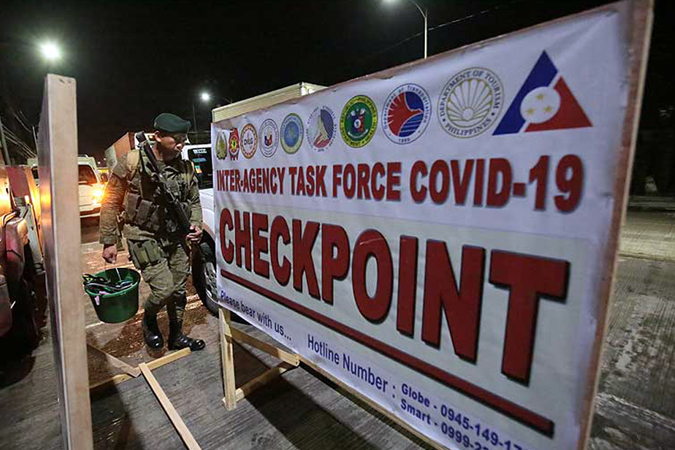
Amid the increasing number of COVID-19 cases in the country, President Rodrigo R. Duterte announced on Thursday that the National Capital Region will be placed under a 30-day “community quarantine” wherein travel by land, domestic air and sea to and from Metro Manila will be banned from March 15 until April 14.

There were 111 confirmed COVID-19 cases in the Philippines as of March 14, with eight fatalities recorded.

Meanwhile, last week also saw sell-offs in the equity market, with the Philippine Stock Exchange index’s nearly 10% plunge last Thursday to its lowest since 2012 amid deepening fears over COVID-19.

At the secondary market on Friday, yields on Treasury bills (T-bills) rose from week-ago levels, except for the 364-day T-bill which saw a 6.5-bp decline to 3.654%.

The 91- and 182-day T-bills went up 6.6 bps and 2.4 bps to fetch 3.124% and 3.391%, respectively.

At the belly, yields on the two-, three-, four-, five-, and seven-year Treasury bonds (T-bonds) went up by 39.1 bps (4.122%), 44 bps (4.264%), 45.6 bps (4.351%), 45.2 bps (4.410%), and 42.8 bps (4.512%).

Yields on longer-term debt papers likewise climbed, with the 10-, 20- and 25-year T-bonds fetching 4.673%, 4.906%, and 4.896%, up by 45.2 bps, 27.5 bps, and 24.6 bps.

“[For this week,] yields might fluctuate as investors rush to raise cash due to risks to growth and weakening sentiment. Doubts on the efficacy of policy responses amid escalating coronavirus cases drove the sell-off for the past few days and is expected to put market on a defensive stance,” the First Metro Asset Management, Inc. said in an e-mail.

“Despite the recent pullback, we think that the BSP will take a proactive measure and further cut rates by another 25 bps in its upcoming meeting which should support renewed fall in yields from current levels,” it added.

Security Bank’s Mr. Reyes said to expect more market sell-off and volatility if the growth of infected cases continues to rise.

“On a positive note the BSP will continue to apply cushion to help stimulate the economy,” he added.

For Robinsons Bank’s Mr. Palma said, “Local yields may inch higher as selling pressure for local bonds may prevail…, but we may already see some bargain hunters cautiously come in once any developments come to light.”

As monetary authorities continue to assess the impact of the outbreak, Bangko Sentral ng Pilipinas (BSP) Governor Benjamin E. Diokno has said he “is not totally ruling out” cuts worth 50-75 bps this year, with a 25-bp cut on the table this week. The BSP’s Monetary Board is set to meet virtually on Thursday to discuss policy.

How PSEi member stocks performed — March 13, 2020

Here’s a quick glance at how PSEi stocks fared on Friday, March 13, 2020.


Fear and Trembling

I anguished over the creeping amnesia when it comes to our wrenching from the dictatorship 34 years ago. But Filipinos have no sense of history, my dear confidant and most patient mentor said. And Manong sent me a copy of Søren Kierkegaard’s Fear and Trembling, to re-read and ponder in my mature years what had perhaps gone over my head in my college Literature classes.

“Anguish is a dangerous affair for the squeamish, so people forget it,” Johannes de Silentio, Kierkegaard’s pseudonym in Fear and Trembling says to the reader. “Silentio,” meaning “quiet.” To remain quiet would be the easier alternative than the painful existential self-examination of anguish and doubt, and the conflict of intuitive responsibility versus selfish detachment. “Silence is the snare of the demon, and the more one keeps silent, the more terrifying the demon becomes.

“(But) people do not know what they ought to say but only that they must say something.” Yet notwithstanding the philosopher Descartes’ conviction that “I think, therefore I am,” the quality of thought declines with age because of the alterations and compromises suggested by experience, the author says. “For life has divided what has been united in the child’s pious simplicity… Is (your) heart still young enough not to have forgotten the fear and trembling that disciplined (your) youth, and which, although the grown man mastered it, no man altogether outgrows?”

If you have been tested like Abraham in the Bible, you will never forget how you feared for yourself and for your loved one, but more than fear, how faith in your God and in yourself should not have made you fear at all. In a four-scenario exegesis of Genesis 22:1-18, Johannes as Conscience monologues on the anguish of the patriarch Abraham, who was asked by God to kill his beloved son Isaac at the altar of sacrifice. Abraham stoically proceeds to obey God’s orders until God stops him in time and rewards his devotion.

Kierkegaard says, “Infinite resignation is the last stage before faith, so anyone who has not made this movement does not have faith, for only in infinite resignation does an individual become conscious of his eternal validity, and only then can one speak of grasping existence by virtue of faith.”

I have not forgotten the fear and trembling of my youth, Manong. What Kierkegaard calls “the shudder of thought” shakes us all still — history has been battered with conflicts of universal principles, with global wars and horrible terrorism. Thoughts and emotions are more complex than can ever be conjured by the allegorical scenarios of Johannes Silentio of the sacrifice of Isaac by his own father. Is it time for the sublimated resignation to Fate, while hoping, in the realm of the existentialist Absurd, that it will not be Humankind who will be the final victim of sacrifice in all these? To be truly absurd, who else can it be?

In our country, a peaceful revolution that restored democracy is being denigrated as an event that lacked follow-through. Six presidents after ousting the dictator Ferdinand Marcos — are we back to where we were before 1986?

Gross Domestic Product (GDP) rose like a phoenix from the ashes of a -7.31% GNP growth in Marcos’ last year to 3.42% in 1986, the first year of Corazon Aquino, by default the icon for democracy, by being the widow of the slain Senator Benigno Aquino, Jr., whose murder in 1983 triggered the public protests against the dictatorship. From 1986, GDP rose and fell parallel to world measure according to fluctuations in the global economy, growing with the ASEAN region to levels of 6-7% ,and averaging about 5% in the last 20 years. Not a bad recovery for a country plundered by an autocracy.

But for the yet unrecovered and now seemingly unrecoverable plundered wealth of the country, the people must be most jealously zealously for honesty and integrity in government and in private life, and most consciously fighting for human rights in the fear and trembling memory of the atrocities in martial law. “Life can only be understood backwards; but it must be lived forwards,” Kierkegaard exhorts.

Transparency International’s 2019 Corruption Perceptions Index has ranked the Philippines 113th of 180 countries least corrupt (meaning 67th most corrupt), a 14-notch fall from its standing of 99th place in 2018 and a 28-notch plummet from the much-better 85th rank in President Benigno Simeon Aquino III’s term. Shall we dubiously console ourselves that anyway, the Philippines “improved” from its lowest rank of 141 in 2008, at the height of the Gloria Arroyo corruption scandals? We ranked 36th in 1995, when Fidel V. Ramos was president.

The Human Rights Watch (HRW) 2019 World Report cites the Philippine Drug Enforcement Agency’s (PDEA) own report of 4,948 suspected drug users and dealers killed in police operations from July 1, 2016 to Sept. 30, 2018 in President Rodrigo Duterte’s War on Drugs. But this does not include the thousands of others killed by unidentified gunmen, the HRW says. According to the Philippine National Police (PNP), 22,983 such deaths since the “war on drugs” began are classified as “homicides under investigation.”

The HRW website lists prominent human rights defenders, oppositors to Duterte’s Drug War, red-labelled activists, some vocal journalists and critics against the administration who have been arrested and detained, ousted and/or had cases filed against them. Rappler’s Maria Ressa with other journalists under siege in their respective countries has been recognized as Person of the Year for 2018 for “for taking great risks in pursuit of greater truths, for the imperfect but essential quest for facts, for speaking up and for speaking out,” Time Magazine declared. Perhaps the most chilling attack on press freedom has been the surprise quo warranto case filed by the Solicitor General Jose Calida on the ABS-CBN network, which has raised dust in the circus of investigations-in-aid-of-legislation for the tight-rope renewal of its franchise to operate.

The sovereign rights of the Filipino people have been gravely compromised in the blatant disregard of a UN Arbitral ruling that had already and finally decided that the West Philippine Sea belongs to the Filipinos and that China’s “nine-dash line” is invalid, according to the Permanent Court of Arbitration. Yes, China is very much in the picture, as the 1998 US Visiting Forces Agreement was terminated by Duterte last month. With fear and trembling we realize the country is now very much dependent on China who, ironically, will be the most immediate and proximate protector of our boundaries in case of attack. And the Chinese illegal entrants or specially admitted “tourists” (generally believed to be about 300,000) who operate and use the online gaming operations (POGOs) seem here to stay, with Duterte’s blessing, because POGOs “help the economy,” suspectedly inclusive of money-laundering activities.

“At last, Senate asks Supreme Court to define limits of Duterte’s power,” Rappler gasps in an article on March 9. This is the first time since July 2016 that the Senate as a body is challenging a Duterte policy before the High Tribunal, clearly asserting the almost-doubted separation of the executive, legislative, and judiciary powers in the Constitution. Duterte cannot unilaterally decide to terminate the VFA agreement, and not to renew the ABS-CBN franchise.

But just as soon as the fear and trembling of the nation relaxed in anticipation of the resolution of tensions and anxieties, Duterte faced the people on March 12 to announce the “lockdown” (his words) of Metro Manila amidst the COVID-19 pandemic. Metro Manila’s mayors will impose a curfew from 8 p.m. to 5 a.m. for social distancing under the “community quarantine” status.

“I do not have the time to think of whether the lockdown can be a prelude to the declaration of martial law; right now I can only think of the virus,” a writer-friend says. Kierkegaard writes the existentialist conclusion: “for one who does not understand that the whole power of the spirit is required for dying, and that the hero always dies before he dies, that man will not get so very far with his conception of life.”

Faith saved Abraham and Isaac from hurting each other. God will save us too.


Amelia H. C. Ylagan is a Doctor of Business Administration from the University of the Philippines.

ahcylagan@yahoo.com

COVID-19 and collective action

The Lancet, the most accessible peer-reviewed medical journal, discusses the COVID-19 crisis in stark terms. Read Roy Anderson et al., “How will country-based mitigation measures influence the course of the COVID-19 epidemic?” (March 9, 2020). The authors state that “we calculate that approximately 60% of the population would become infected.”

It comes nevertheless with a qualification that this is a “very worst-case scenario.” There are uncertain factors like the transmission in children and remote areas. Mitigating measures like forced and voluntary quarantine will significantly reduce transmission.

The COVID-19 crisis has been likened to a world war, and rightly so. But this is not a war between nations, not an ideological war, not a political war, not a class war, not an imperialist war. It is a war pitting humanity against the pandemic. In this war, we will be learning warfare through warfare.

Precisely because the world is suddenly confronted with a novel coronavirus, the response, too, has to be novel. The world has to act despite being severely constrained by unknowns and uncertainties. It is thus understandable that countries and policy-makers are groping their way to resolve the crisis.

Even the most advanced economies like Europe, Japan, and South Korea were caught unawares. Norway — the utopia for many, an example of the much-envied Scandinavian model of development, featuring a strong public health system — has recently imposed a country lockdown.

Without a vaccine, and it will take more than a year to develop one even as the transmission grows exponentially, the best that societies can do is to slow down the spread through draconian measures. The jargon is “flatten the epidemic curve.”

Perhaps, we can learn from China, which has taken extreme, aggressive measures to flatten the curve. But then, many countries, even those with current authoritarian leaders like the Philippines, do not have the system that China has.

Take note of the commentary of an analyst Adam Wren in his article “China stopped the coronavirus. Your country won’t” (medium.com, March 9, 2020):

“In the early days of the outbreak there were videos of people being seemingly kidnapped from the streets or marched out of apartment buildings and into vans by Chinese government officials.

“These were people being taken away for mandatory testing because they had been in contact with somebody that had been confirmed infected.

“How many governments have police or military forces capable of collecting hundreds of thousands of people for mandatory testing?”

PHILSTAR/MICHAEL VARCAS

This is tokhang! But Philippine-style tokhang won’t work.

China, notwithstanding its becoming a market economy, still maintains the structure of a command economy that can produce 1.6 million test kits per week. The Philippines relies on the market, which has panicked, and the essential medical supplies have vanished.

China has an effective tracking and tracing system because it controls the information and the apps. The Philippines still has to put in place a national ID system and the registries of the basic sectors are outdated and spoiled.

The citizens of China are trained to follow rules; the principle of “democratic centralism” applies not only to the Communist Party but also to the whole of society. The organized citizens of the Philippines associate united action with civil disobedience.

Worse, Philippine-style tokhang will only result in more deaths — including extra-judicial killings.

But what is undeniable is that collective action is essential and urgent. It is surely difficult to undertake collective action when society itself is fractious and its institutions are weak. But the existential threat of COVID-19 will compel us to do collective action.

The Lancet article says: “Individual behavior will be crucial to control the spread of COVID-19.” But the individual behavior we desire will run afoul without collective action. Amid the crisis, stories abound regarding panic buying, hoarding, non-compliance with rules, and selfishness all around. This is human impulse that nevertheless leads to a herd behavior that creates systemic risks.

We need a positive kind of collective action. This will however involve extraordinary and even draconian measures. It will necessarily involve the whole society.

Government must provide all the relevant information and communicate it well. It must be transparent and encourage discussion and debate.

Society, the private sector in particular, should allow government to intervene in solving market failures. And civil society should step in not only to help provide the essential services but also to address governance failures.

Remember, this is humanity against COVID-19. COVID-19 threatens everyone. COVID-19 does not choose its victim whether one is a capitalist or a worker, a Dutertard or a Yellowtard, a communist or a liberal, a Democrat or a Republican, a Christian or a Moro, a Tagalog or a Bisaya. We all have to act as one.


Filomeno S. Sta. Ana III coordinates the Action for Economic Reforms.

www.aer.ph

Of pandemics past and COVID-19’s economic impact

As mass hysteria over COVID-19 reaches its peak, it would be interesting to look at the history of pandemics and how much havoc they have wrought throughout the ages.

The first pandemic was recorded in 460 BC when a severe outbreak of typhoid fever decimated the inhabitants of Athens while the city was under siege by Sparta during the Peloponnesian War. In 1346, the Bubonic Plague reduced Europe’s population by a third, killing as many as 75 million people.

There have been 10 influenza pandemics since the early 18th century and three in the past 100 years — in 1918, 1957, and 1968. All were caused by mutations of one strain of the influenza virus. The Spanish flu of 1918 was the deadliest on record, causing 80 million deaths during its two year rage. Its death toll was more than that of World War 1. In 1957, the Asian Flu Pandemic killed nearly two million people. In 1968, the Hong Kong flu killed four million people over three years.

Southern China has always been an incubator of flu viruses due to its high population density and the residents’ practice of living in close proximity to domesticated animals. Making matters worse is their fondness for ingesting wild animals, either for food or perceived medicinal value. Wild animal markets are aplenty in Southern China and this makes the residents vulnerable to contamination with mammalian, avian, or reptilian viruses. The Asian and Hong Kong flus originated in China, as did SARS. It’s hardly surprising that COVID-19 originated from China too.

COVID-19’s virus, SARS-CoV-2, is a new strain. It is similar to the ordinary flu in the sense that both are respiratory illnesses. They even share the same symptoms. Unfortunately, those who have had previous exposure to the flu do not develop a natural immunity against this particular coronavirus. Worse, carriers can infect others before they show symptoms, making it more difficult to control the spread.

But flu pandemics like COVID-19 are tamer compared to other infectious diseases like HIV-AIDS, and those caused by the Marburg virus, and the Zaire-Ebola virus. These viruses kill anywhere from 43% about 90% of those infected. (The death rate for HIV-AIDS has fallen drastically with the use of antiretroviral drug cocktails in recent years. — Ed.) Based on our four months of experience with SARS-CoV-2, we know that only two to four percent succumb to the disease, the rest recover fully.

Experts do not see the corona virus’ death toll to be in the millions like past pandemics. Vast improvements in international cooperation, pandemic management, and medical advances have made us more resilient against infectious diseases. Still, even one death on the back on COVID-19 is one death too many. As I write this, 3,073 people have already succumbed to the virus and a vaccine is still one year away from becoming commercially available.

How will it affect the global economies?

Many think that COVID-19 is similar to the SARS epidemic which disrupted our lives for just a few months. SARS-CoV-2 is different in that it is more infectious and more aggressive. It will have more devastating effects on economies worldwide. SARS started in Guangdong in 2002 and recorded 8,000 cases. During that year, China’s share of global manufacturing output was only 9%. SARS-CoV-2 has already infected more than 100,000 as of this week and China’s share of global manufacturing output has ballooned to 28%. In other words, from just 9% in 2002, nearly one-third of all goods manufactured on the planet originate from China today. China has become so important to global supply chains that should its manufacturing engine cease, the industrial world as we know it would grind to a screeching halt.

China’s lockdown has caused factories across the globe to cease operations. One by one, factories are already running out of inventories of China-made parts and components. Those without alterative suppliers will have no choice but to shut down causing sales and profits to plummet and relegating millions to unemployment. Fiat-Chrysler, Samsung, Apple, Pharmac Pharmaceuticals, and Hyundai have already announced temporary stoppage in production. All things told, COVID-19 is said to reduce global output by $1.38 trillion or 1.5% of GDP.

Nouriel Roubini (the same economist who predicted the subprime crisis), said that the effect on global economies will be more severe than we think. He believes stock markets will crash by 30& to 40% this year.

The Philippines will not be spared. Our export sector will be badly affected as it is reliant on China-made components. Exports of tropical fruits and commodities like iron ore and copper will plummet too as China is our biggest customer. A blood bath in the tourism and airline sector is already upon us. Infrastructure projects using Chinese made suppliers and Chinese financing will also be delayed. Tax revenues will decrease due to less import taxes from China (which is already down by 44% since January).

Making matters worse is that hysteria and panic have caused a decline in demand for travel-related services, hospitality, and discretionary consumption. Sales of restaurants, hotels and consumer goods are plummeting, affecting millions of Filipinos who work in these industries

The National Economic and Development Authority (NEDA) previously projected that growth would be slashed by 0.2% if the virus would not be contained within a quarter, up to 0.4% if it drags on until the 1st half of the year and 0.07 percent if it last for an entire year. However, central bank governor Ben Diokno said that NEDA’s assumptions were based on effect of SARS 16 years ago, which grossly underestimates the effect of COVID-19. The impact on the economy today will be much worse. Experts agree that it can slash close to 3% of GDP growth this year.

The year of the metal rat is proving to be a horrible year for humanity. COVID-19 has affected every aspect of our lives and its economic consequences are worse than the 1957 Asian Flu, the 1968 Hong Kong flu, and SARS, put together. Lets hope a vaccine is developed soon.


Andrew J. Masigan is an economist.

This is the way the world shrinks

The coronavirus pandemic — yes, they’ve finally called it that — is the latest challenge to globalization. Perhaps even the final one.

The widening scope of lockdowns and restrictions on travel and local movement — all to contain the virus — have delivered a rare and empirically interesting sucker punch to both supply and demand in the world’s economy. Because Chinese workers were unable to report to work, global supply chains have everywhere been disrupted. Meanwhile the world’s buyers (many of whom are the Chinese themselves but now the rest of the world as well) are immobilized by quarantines and their take-home pay decimated by illness or enforced idleness. Result: shops closed, zombie airplanes flying empty, and the opening of Mulan postponed. Both supply and demand shocks — but especially their still unknown duration — have cut drastically into expected future earnings of companies and caused an epic rout in the stock markets. The Wall Street collapse will in turn have the expected wealth effects on the heavily stock-invested US consumer, further worsening the blow to consumer spending and to firms’ profits. The last Jenga block to be pulled out may be a crisis of the financial system and seizing up of lending. Huwág sana (Let us hope not).

All this is happening when interest rates are still at all-time lows (even negative) and most governments are already running large deficits. Only imagine: you’ve pushed the gas pedal down to the floor but the engine is still stalling. With any luck, the world may yet see its worst recession since 2008-2009. (The direction of impact for the Philippines was ably tackled earlier in this column by colleague Romy Bernardo — I would only revise the size of the hit — so we can skip that exercise.)

But taking a longer and more reflective view (easy to do when stuck in community quarantine), the larger question is whether this coronavirus crisis is the watershed moment (or not) that finally ends the globalization trend that powered many of the world’s economies into greater or lesser wealth since the late 1960s. Beginning with the Kennedy Round of GATT, that trend probably reached its peak with the formation of the European Single Market with its audacious attempt at open borders for goods, services, capital, and, most of all, people. All of which seems long ago and far away. The exuberant picture of young people cheering atop the Berlin Wall as it fell contrasts sharply with the dystopian images of our time: masked men in hazmat suits spraying the deserted streets of Wuhan and flying drones barking warnings at stray elderly citizens to stay indoors.

This pandemic is itself an offshoot of globalization. The ease, speed, and low cost of travel that facilitated the spread of the virus are shining achievements of technological innovation and economic efficiency. The liberal movement of persons across and within borders is a concomitant of a frenetic search for bigger markets — for tourists, students, workers, and new business — as well as evidence of newfound prosperity among a rising global middle class. In an interesting negative feedback loop, however, a consequence of globalization is itself threatening globalization.

At the very least, the current crisis exposes the vulnerability of modern patterns of production and consumption based on scale and cost. A fundamental rethinking may be in order. Global supply chains have hitherto achieved the highest productivity and profits based on an extreme degree of specialization, concentration in the cheapest locations, intensive resource-use, and just-in-time deliveries founded on efficient logistics. But firms must now consider that easy profit must be balanced against resilience in such systems amidst the uncertainty “black swan” events such as pandemics, natural calamities, terror events, and political upheavals. Firms, for example, may increasingly have to maintain redundant capacity and excess inventories and diversify suppliers, all of which impact profits. After this major supply disruption, Taiwan’s Foxconn (the supplier of Apple among others) will doubtless speed up its plans to diversify out of China (sorry, to Indonesia, not the Philippines). Even Trump’s red-in-the-face demands for re- and onshoring of services and manufacturing may find a more favorable response.

Similarly, the viability of consumption patterns based on simultaneous mass consumption may be due for a re-examination. The vivid example is the cruise liner industry and mass tourism more generally. “Overtourism” was already a problem even before the coronavirus struck. Giant cruise ships were already being banned from the Venetian Lagoon, and destinations from Amsterdam to Bhutan to Yosemite were already imposing taxes on short-term tourists or severely limiting visitor numbers. The continuing flight of empty planes (emitting huge amounts of greenhouse gases in the process) in the midst of the pandemic also speaks to a deeper irrationality not easily captured in a company’s bottom line. The serious spread of infection during pandemics and the growth of human activity beyond the carrying capacity of natural environments will put question marks on the indefinite growth of such industries. For both production and consumption, the larger question is whether the human footprint has not already become too large in its present form for the natural and cultural environment to accommodate. If we cannot cut off our toes, should we at least change our shoes?

But the further threat to globalization from this crisis is not just economic but also political, particularly if the US suffers another deep recession that causes it to withdraw further from a rules-based political and economic order.

The bald fact is all hitherto known episodes of expanding trade, travel, and exchange of knowledge and culture have been associated with great-power dominance: Pax Romana (27 BCE–14 CE), Pax Britannica (1815-1914), and Pax Americana (1949-?). (Some scholars also recognize a Pax Mongolica (1200s-1300s) for Asia. In all these past periods, some hegemonic power always provided a guarantee of international order and stability (no matter how skewed in its favor) that left just enough room for some lesser countries and peoples to insert themselves in crannies of economic prosperity and intellectual flowering. In their turn and under various hegemons, America, Germany, Japan, Korea, and the NIEs, and now China have all historically benefited from this externality. Nor is the principle anything new: order and security promote exchange; greater exchange promotes specialization and productivity (Douglass North meets Adam Smith).

A significant difference in our time, however, is that the position of the current hegemon is under threat with no replacement in sight (Pax Sinica still exists only in a mayor’s dreams). For all the Trumpian bluster, the fact is America has been on its back foot since at least the Great Recession — its finances precarious, its social consensus fractured, and its foreign stance diffident. “America first” and MAGA are not the rants of a kingpin; they are pleas of the beleaguered. Rather than standing behind a rules-based order where it can prosper from a position of strength along with others, the US has withdrawn from its treaty obligations (e.g., on climate, human rights, defense), waged trade wars and imposed sanctions solely on its account, and half-folded its deterrent umbrella. This has de-legitimized international and multilateral organizations and provided an opening for demagogues, tin pot tyrants, and plain terrorists to hatch their own plans to disrupt or withdraw from the discipline of international rules in order to victimize their own peoples. In a remarkable example of unintended consequences, it was the halfhearted US intervention in Syria and Libya that caused the surge of immigration of refugees into Europe which in turn provided the opening for racist and nationalist movements to arise in many countries — in the UK most notably leading to Brexit. The same hegemonic equivocation or absence permitted Russia’s annexation of Crimea and China’s occupation of Panatag. The result overall has been an environment of greater uncertainty in security, trade, investment, and migration.

With a global recession now in the offing, with a likely further weakening and self-absorption of the current hegemon, and patterns of production and consumption under question, globalization at the moment must be adjudged a PUM (persons under monitoring). Self-quarantine will be the metaphor for the fate of countries that must survive without the benefit of international rules of conduct.


Emmanuel S. de Dios is professor emeritus at the University of the Philippines School of Economics.

A new hope for our police

In times of panic and market free fall, in an era where corruption pervades and killings persist, a spark of light and a glimpse of new hope comes from our men and women in uniform, our police force. It is ironically one of the last offices in government where we, the citizenry, can expect change or pin our safety and well-being despite its long standing motto “to serve and to protect.”

In 2019, the specter of ninja cops (https://www.bworldonline.com/ninjas-in-our-midst) became the cause for fresh and untainted leadership in our Philippine National Police (PNP). A deep restructuring was quietly undertaken. A new unit, christened as the Integrity Monitoring and Enforcement Group (IMEG), was activated.

As its name indicates, its principal objective is to go after erring PNP personnel. For how long and in how many ways have we witnessed, heard, and experienced police abuses, incompetence, and criminality? In the classic criminal justice formulation, who polices the policeman who is not only astray but is the criminal himself!

In less than a year, a series of simple and effective police actions from IMEG, led by Colonel Ronald Lee, resulted in a string of cases.

In faraway Agusan del Sur, two PNP personnel belonging to the Highway Patrol Group were arrested for extorting the sum of P3,000 from a female driver who was operating a motorcycle with a student permit. Her motorcycle was impounded, the release of which money was demanded. She, a fearless millennial, promptly reported the incident to the IMEG Mindanao office.

Up north in Pangasinan, a police sergeant was arrested in an anti-illegal cockfighting operation together with two others. The policeman was carrying live ammunition.

Nearer in Pasay City, at a KFC outlet in fact, another sergeant who was previously dropped from the roll of police was arrested for extorting money from PNP personnel who wanted reassignments. Found on her were PNP documents purporting to be transfer orders.

In the Visayas office, a police major and chief of the Criminal Investigation and Detection Group (CIDG) of Bacolod City was arrested for asking for weekly protection money from a KTV joint. To think that the CIDG is the premiere investigation unit in the PNP and its head of unit was actually the culprit.

In my hometown of Cebu, a police captain was arrested for being involved in a robbery. He was in possession of six handguns. A few hours south in Argao, in an operation reported in mainstream news, two females under police study were found in the bedroom and office of a chief of police.

In a separate news report from Bulacan, a police captain was arrested for using a person deprived of liberty as his driver.

Reading such verified information can bring the most jaded Filipino to tears and energize the weariest civilian. These are small but significant victories that should be celebrated. In a way, such incidents should not be happening in the first place but are because of the lack of leadership at the top and elsewhere and plain mismanagement of the police corps.

The “broken windows” theory in policing also affirms that if seemingly harmless but wrong behavior is tolerated, it only leads to graver crimes by the perpetrator and more lasting damage to the institution.

From yet another perspective, it is a demanding task to be operating against people with similar training who took the same oath. It is also sad that it should take a police unit to cleanse their own ranks — it means that for the personnel in the IMEG, each success means another scalawag in the service exposed, another uniformed personnel unmasked.

Local Government Secretary Eduardo Manahan Año supported the creation of the IMEG recognizing the limitations of the long running Internal Affairs Unit of the PNP. And this is a recognized best practice in the fight against corruption — the establishment of a core team of dedicated men and women with impeccable credentials whose only task is to watch over the operational units and field offices that are most vulnerable to corruption — those that interact with the public.

If only all departments and agencies set up their focused units to police their own, we will have no need for the Ombudsman or the Sandiganbayan with its delays. After all, prosecutors dread a call from the Secretary of Justice; engineers are wary of being summoned by the Secretary of Public Works; and Bureaus of Internal Revenue and Customs personnel are afraid of their Commissioners — that is, if their bosses are straight and strict.

In the meantime, let us strengthen our resolve, increase our vigilance and report police wrongdoings to the new hope in the PNP, the Integrity Monitoring and Enforcement Group.

No delay in April 15 tax deadline

Bureau of Internal Revenue (BIR) logo

THE Bureau of Internal Revenue (BIR) cannot delay the April 15 deadline for filing and payment of income tax returns (ITR) because the date is set in law, Finance Secretary Carlos G. Dominguez III said, and urged taxpayers to use electronic channels instead to avoid crowds and minimize exposure to COVID-19.

“We can’t move it because the April 15 deadline is in the law,” Mr. Dominguez told reporters in a Viber message Sunday.

However, Mr. Dominguez said the authorities could waive interest fees on ITR amendments if the increment of income tax payable does not exceed 25%.

“We can allow amendment of returns without payment of interest, subject to certain conditions like no variance of more than 25%. This will be in line with the SECs (Securities and Exchange Commission) extension of deadline of filing of audited FS (financial statement) of 60 days,” he said.

Taxpayers are required to file ITRs on or before April 15. Failure to file by the deadline will result in penalties, including a 25% surcharge on the tax due, 12% interest per annum.

Separately, Deputy Commissioner Marissa O. Cabreros has urged taxpayers to file ITRs well in advance or use e-filing and e-payment facilities in order to achieve the recommended social distancing.

“We encourage the public to do it early and it can be done in the convenience of their own homes because of the e-filing facility. The BIR expanded online payment options, now including Union Bank and Paymaya. This is in addition to options (via) Development Bank of the Philippines, Land Bank, Globe GCash and credit cards,” Ms. Cabreros said in a mobile phone message.

Mr. Dominguez has said that the Department of Finance has not firmed up plan yet for tax relief measures for affected businesses.

BIR Commissioner Caesar R. Dulay said the government’s largest tax-collecting agency is considering targeted relief for businesses severely affected by the outbreak, though he provided no details. — Beatrice M. Laforga

ADVERTISEMENT
ADVERTISEMENT