Home Blog Page 966

Saudi Arabia is losing its appetite for oil

STOCK PHOTO | Image by Tawatchai07 from Freepik

By David Fickling

YOU KNOW that horror movie trope where the babysitter gradually realizes the crazed killer is phoning, not from some distant location, but from inside the house? Something similar is happening in the oil market.

That’s because Saudi Arabia, the world’s biggest net exporter of crude, is using renewables to drastically reduce its petroleum consumption. The threat to the kingdom’s producers isn’t coming from the heartlands of electric vehicle adoption in Shenzhen, Oslo, or San Francisco — it’s right inside the house.

This is an extraordinary reversal. Since the start of the 21st century, Saudi Arabia’s oil consumption has increased more than any other country barring China and India. It’s doubled to 2.3 million barrels per day, greater than the incremental demand from Africa, Latin America, or the former Soviet Union.

Between a quarter and a third of the country’s consumption goes into crude- and fuel oil-fired generators that provide electricity to ride out summer heatwaves. The government wants to replace all of that with renewables, with a target of 130 gigawatts by 2030 — roughly equivalent to all the solar power in India. Such a switch could represent the single largest decline in oil demand over the next five years, according to the International Energy Agency.

It’s not news that the country has such ambitions. One of the cornerstones of Vision 2030, the program announced in 2016 to wean the kingdom’s economy off hydrocarbons, was to switch the grid to an exclusive gas-renewables mix.

However, such bold pronouncements are typically heavily discounted where Saudi Arabia is concerned. This is a country that’s been working on an unfinished one-kilometer (0.62 mile) skyscraper since 2013, and recently called in consultants to review the feasibility of The Line — an implausible science fiction city being built to house nine million people inside a 170-kilometer-long tower.

Kpler, a data company that tracks commodities flows, reckons only 14.8 GW of the planned 130 GW will be online by 2030. Such a serious shortfall would be enough to sustain crude in power generation well into the future.

It might be time to start reevaluating whether that skepticism is warranted, however. There’s certainly a huge gap between promise and execution where the kingdom’s megaprojects are involved. Still, when it comes to building humdrum energy infrastructure (as opposed to, say, a cube-shaped hollow tower as tall as the Empire State Building), one of the world’s biggest petroleum producers has a decent track record.

That’s now finally showing up not just in wells and export facilities, but in renewables, too. After years in which the only major solar project connected was a relatively modest 0.3 GW plant in the deserts between Jordan and Iraq, generators are now being plugged in at a rapid pace.

Since the start of 2024 alone, ACWA Power Co., the country’s biggest electricity and water developer, started commercial operations at four solar facilities totaling about 4.9 GW. Roughly the same amount is due to start up by the end of next year, the company told investors recently, shortly after completing a 7.125 billion riyal ($1.9 billion) capital raising. Last month, it signed deals with Saudi Arabia’s main utility to build another 15 GW, to be delivered by the middle of 2028.

The broader plan is for ACWA to hit 78 GW by 2030, sufficient on its own to provide all the electricity that Saudi Arabia generated from oil last year. Much more is in the pipeline from other developers.

With ACWA giving investors detailed timelines of further near-term completion dates, the onus is increasingly on the skeptics to explain why the recent run of successful project execution is going to be broken. Thanks to abundant sunlight, Saudi solar plants deliver electricity at less than half of the cost of the grid. Arrays of panels also tend to be much more simple, in engineering terms, than the petroleum extraction, transport, and refining complexes in which the kingdom has long excelled.

Getting those renewables built is also crucial for the country’s overriding obsession: its position in the oil market. One justification given by Saudi Arabian Oil Co. President Amin Nasser for cutting back maximum output capacity last year was that removing crude from the domestic grid would boost exports as effectively as drilling extra wells. The plans to eliminate oil from the grid by 2030 are still “on track,” he told Aramco investors last week.

Saudi Aramco’s competitors might want to reflect on that. For Nasser, the country’s transition is reason enough to trim investments intended to meet hypothetical future demand. The kingdom’s grid uses more oil than all the cars and scooters in India. If such an enormous consumer of the world’s crude is going away by the end of the decade, an already oversupplied market risks heading still deeper into glut.

BLOOMBERG OPINION

Linya-Linya turns humor into political statement and sales

@LINYALINYA

By Almira Louise S. Martinez, Reporter

@LINYALINYA

CLOTHING and content brand Linya-Linya is expanding its reach while tapping into Filipinos’ political and social sentiments through its shirts and online content.

“If you notice our shirts, they also express the same disgust, and people want to express that feeling,” Ali T. Sangalang, co-founder of Linya-Linya, said in an interview. “There are people who want to express their feelings but cannot do so. So, through our shirts, they create a starting point for conversations.”

The brand began in 2012 on Tumblr, where Mr. Sangalang posted memes about everyday Filipino life.

“I was the class clown from grade school to high school,” he said. “I was really fond of idioms, comedy and humor, until I learned how to write poetry and literature in college.”

In 2015, he started printing comedic artwork and catchphrases on shirts with the help of NGO Yabang Pinoy, encouraging Filipinos to “wear the words they cannot speak.”

“Filipinos don’t just laugh, they’re also angry, sad, or alone,” Mr. Sangalang said. “It’s like we became more empathetic. We also feel what our audience is experiencing, so that’s why our tagline is ‘Gets ka namin’ (We understand you).”

Filipinos’ wit and humor play a role in how they process challenges, according to We Thrive Consultancy and Wellbeing Services, Inc.

“It is common for Filipino citizens to turn a trending social issue into memes to lighten the mood or make the problem easier to take,” it said on its website.

Mr. Sangalang cited the Sept. 21 rallies in Luneta and EDSA, where protesters carried funny placards to express frustration about corruption in multibillion-peso government flood control projects.

“They’re using humor to express their disgust, but that doesn’t mean that when they’re laughing, they’re happy,” he said. “Instead of just saying bad words, we’re saying it creatively.”

Mr. Sangalang said blending humor with political expression helps strengthen community and business.

“I’m more confident that Filipinos are smart and we all share the same feeling,” he said. “We know the risks and we’re affected by it, but why would you keep quiet? If you keep quiet, it means you’re OK with what’s happening.”

He added that small businesses remain among the most affected by the country’s political climate.

Linya-Linya now has more than 900,000 followers across social media platforms and aims to reach a million by the end of the year.

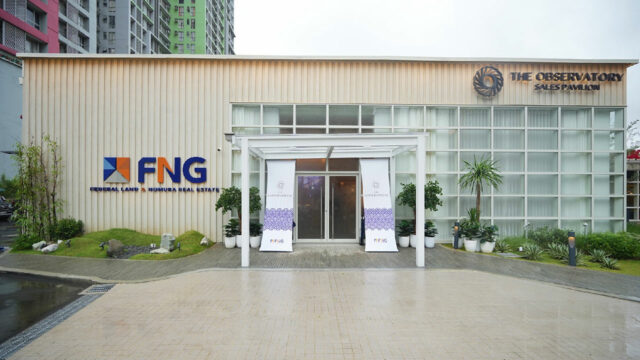
FNG plans to launch second tower at The Observatory by mid-2026

FEDERAL Land NRE Global, Inc. (FNG) said it plans to launch a second residential tower at its Mandaluyong township by mid-2026, following sales from the first tower.

“The launching of the second tower should happen within the first half of 2026,” FNG Vice-Chairman William Thomas F. Mirasol told reporters on the sidelines of an event on Tuesday.

The 36-story SORA is the first of nine towers within The Observatory, FNG’s 4.5-hectare mixed-use township along Pioneer Street in Mandaluyong City.

Since its launch, the SORA tower has sold 60% of its units. Construction is scheduled for completion by 2030.

Sora, which means “sky” in Japanese, will have 692 units ranging from studio to three-bedroom units.

The studio units measure 28 square meters (sq.m.) to 30 sq.m., while one-bedroom units range from 45 sq.m. to 60 sq.m.

The property will also have two-bedroom and three-bedroom units sized between 65 sq.m. and 150 sq.m. Unit prices start at P290,000 per sq.m.

The Observatory will also feature retail spaces on its lower floors, with the first phase targeted for completion by 2028.

The retail segment will cater to the needs of residents, including a supermarket, drugstore, health and wellness establishments, and a mix of local, foreign, and Japanese restaurants.

“The people are beginning to really recognize the potential of Mandaluyong, especially the Japanese market,” FNG Sales Group Head Maria Margarita Saenz-Resurreccion said.

He added that the development of The Observatory aligns with Robinsons Land Corp.’s upcoming mixed-use project, The Jewel, which is expected to reinforce Mandaluyong’s position as an urban hub.

“When Robinsons finishes their development, and we finish our development, I think we’re going to see this whole area start to come alive and bloom,” Mr. Mirasol said. “It’s going to change in the same way that BGC (Bonifacio Global City) changed.”

Also on Tuesday, FNG unveiled its 1,700-sq.m. Sales Pavilion, which features model unit viewings for The Observatory.

The model units come in one- to three-bedroom configurations, offering prospective homeowners a glimpse of Japanese-inspired living. — Beatriz Marie D. Cruz

Visa bets on stablecoins to speed up businesses’ cross-border payments

REUTERS

VISA said on Tuesday it will start testing a new way for businesses to fund international payments by allowing them to use stablecoins instead of pre-depositing cash in local accounts.

The move signals growing acceptance of these digital tokens among major businesses, who have been emboldened by the United States passing the Genius Act, a law that set clear rules for stablecoin issuers.

“The Genius Act changed everything. It made everything so much more legitimate. Before that regulatory clarity, all the big institutions were sort of on the fence,” Mark Nelsen, head of product for Visa’s commercial and money movement solutions, said in an interview with Reuters.

The company is working with some unnamed partners and plans to expand the pilot program next year, it said.

The pilot initiative will allow banks, remittance firms and other financial institutions to pre-fund accounts with stablecoins instead of traditional currencies.

Such a move could make cross-border transactions faster and free up cash, as companies often have to lock funds in multiple currencies worldwide to cover local payouts.

Stablecoins are digital tokens designed to keep a constant value. They are often backed by traditional assets such as the US dollar or Treasuries.

Their utility in moving money quickly across borders has fueled concerns that they could erode the market dominance of some payment companies and regional banks.

“Stablecoins are moving from crypto gimmick to financial plumbing. It’s one of the reasons we launched an inverse regional bank exchange-traded fund as I think the regionals are in trouble,” said Matthew Tuttle, CEO of Tuttle Capital Management, referring to a fund designed to profit when regional bank stocks decline.

Visa’s pilot program, however, highlights how some incumbents are focusing on collaboration instead of competition, turning stablecoins into a tool to reinforce their own infrastructure.

“The amount of software and technology that’s been deployed globally for payments is hard to recreate. So it seems more likely to just incorporate stablecoin technology into existing flows,” Nelsen said. — Reuters

Arts & Culture (10/01/25)


Photography workshop at Yuchengco Museum

THE Yuchengco Museum will host a special photography workshop with multi-awarded travel photographer George Tapan who will share practical techniques for capturing landscapes, culture, and everyday life with depth and detail, whether one uses a camera or mobile phone. The workshop will be held on Oct. 4, 2-5 p.m., at the Y Space of the Yuchengco Museum, RCBC Plaza, Makati. The workshop fee is P1,200, with Senior Citizens, PWDs, students, YGC, and Embassy employees in RCBC Plaza getting a discounted rate of P1,000. Participants are encouraged to bring their cameras or mobile phones.


Last call for entries to MSO Concerto Competition

THE Manila Symphony Orchestra (MSO) Foundation is holding the 2025 MSO Concerto Competition. Entries are being accepted until Oct. 8. It aims to give gifted young instrumentalists the chance to shine, grow in their artistry, and experience the joy of performing as a soloist with a professional orchestra. Winners from each level will be announced on Oct. 10. Each winner will perform the same concerto movement submitted during the competition. A total of nine winners will be selected. For more information, visit the Manila Symphony Orchestra social media pages or website.


Cinemalaya 21 to have 3 book launches

TO CELEBRATE the works of Filipino filmmakers, a series of book launches are slated for Oct. 8, 9, and 11 as part of Cinemalaya 21. The books are: Manong: The Life and Works of Gerardo de Leon by Dr. Nicanor G. Tiongson on Oct. 8, 5 p.m.; Letters from the Future, 35 Years of the Gawad CCP para sa Alternatibong Pelikula at Video, published by the Cultural Center of the Philippines through its Film, Broadcast, and New Media Division, on Oct. 9, 3:30 p.m.; and Agaw-Tingin (Stolen Glances) and Pinilakang Tabing (Silver Screen) by National Artist for Film and Broadcast Arts Ricky Lee on Oct. 11, 5 p.m. All launches will be held at Shangri-La Plaza’s Red Carpet Cinemas.


The wrong.orchestra performs at UP

THE WRONG.ORCHESTRA will deconstruct the orchestra and the symphony on Oct. 11, 7 p.m., at the Vargas Museum at UP Diliman. In a statement, they say: “For our first performance, The Evening Garden, we paint a landscape of sound as we complete four unfinished symphonies in real time through a DIY, barebones setup and hyper-improvisation by select composers and players.” Tickets come in the form of museum memberships, with all proceeds going directly to the UP Vargas Museum and its programs. The P600 is an annual membership fee, inclusive of free access to wrong.orchestra, three complimentary museum visits, and a 10% discount for one paid event from the UP Vargas Museum of one’s choice. Admission is free for existing members, and a special student rate is available. The evening is organized by wrong.institute and et alt, and supported by the Goethe-Institut Philippinen.


Concert in honor of Basilio Manalo

THE Filipino String Teachers Association, in cooperation with the National Commission for Culture and the Arts and the Metropolitan Theater, will present MAESTRO: Basilio Manalo’s Music and Legacy, a tribute concert celebrating the life and artistry of Basilio “Sir Billy” Manalo. The concert will be held on Oct. 21 at the Metropolitan Theater at 6 p.m. Admission is free, with registration required through http://tinyurl.com/fsta-bmt-reg. The concert will feature performances by Mr. Manalo’s students, colleagues, and fellow musicians. Mr. Manalo’s career spanned leadership roles in the Manila Symphony Orchestra, the Hong Kong Philharmonic, and, most significantly, the Philippine Philharmonic Orchestra, which he helped reorganize in the 1980s. He devotedly cultivated future generations of Filipino musicians through initiatives such as the Philippine Research for Developing Instrumental Soloists (PREDIS), the Philippine Youth Orchestra (PYO), and later the Manila Youth Symphony Orchestra (MYSO). The program includes Bach’s Brandenburg Concerto No. 3 in G Major; and two works of Vivaldi, among several others. A short video documentary on the late Maestro’s life will be shown.


MPO to hold rock symphony concert

THE concert MPO ROCKS! — Rock Anthems, Reimagined, will be held on Nov. 29 at the Samsung Performing Arts Theater at Circuit Makati. Fresh from the sold-out success of their 25th anniversary concert, the Manila Philharmonic Orchestra will hold the one-night-only rock-symphonic experience which will blend the grandeur of orchestra with the energy of rock. The guest lineup includes singers Bituin Escalante and MiG Ayesa, and the world-renowned Philippine Madrigal Singers. Part of the proceeds will support The PARC Foundation’s PARC Aralan program, which provides underprivileged scholars access to music and the arts.


Rockwell, 9 Works Theatrical to stage A Christmas Carol

ROCKWELL and 9 Works Theatrical have announced the staging of the musical A Christmas Carol, set to open in November. Directed by Robbie Guevara, with music by Alan Menken, lyrics by Lynn Ahrens, and book by Mike Ockrent and Lynn Ahrens, A Christmas Carol will be the second musical to be held at Rockwell Makati’s new Proscenium Theater. It is the musical adaptation of Charles Dickens’ story about Ebenezer Scrooge, a prosperous ill-tempered man who believes that personal wealth is far more valuable than the happiness and comfort of others — until the ghosts of Christmas Past, Present, and Future teach him a lesson. The heartwarming musical aims to “breathe new life into the classical tale of family, charity, and generosity.” Tickets and other details will be announced soon.

National Government Outstanding Debt

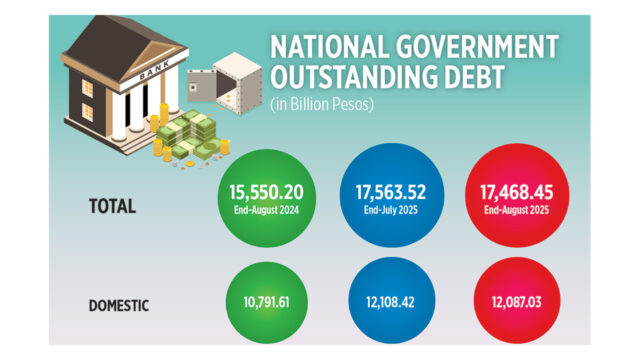
THE NATIONAL GOVERNMENT’S (NG) outstanding debt slipped to P17.47 trillion at the end of August, but still remained above the full-year projection, data from the Bureau of the Treasury (BTr) showed. Read the full story.

National Government Outstanding Debt

Streamlined land transactions through the Transaction Ready Program

STOCK PHOTO | Image from Freepik

The Land Registration Authority (LRA), which is mandated by law to preserve the integrity of land transactions, including the registration process, protect the Torrens System and improve its role as the repository of records relative to registered and unregistered lands, had implemented the Title Ready Program through LRA Circular No. 15-2020, later renamed to the Transaction Ready Program (TRP) under the LRA Circular No. 08-2021.

WHAT IS TRP?
The TRP is a service from the LRA that allows registered property owners or their representatives to request the search, location, and retrieval of their titles from the Registry of Deeds in advance of a transaction. The TRP aims to more quickly convert paper titles to scanned images which shall be uploaded in the LRA’s Computerized System, and ensure a faster processing of future requests for certified true copies.

The TRP is part of the government’s efforts to modernize land registration through e-Titles and computerized systems, to maintain online information on titles as current, complete, and accurate, which safeguard titles against tampering, destruction, and deter substitution or insertion of questionable data; it likewise protect titles from loss due to fire, theft, natural disasters, and the normal ravages of time. The TRP facilitates the faster processing of requests for Certified True Copies (CTCs) of land titles from the various Registries of Deeds, including processing of transactions or registrations of deeds and instruments affecting the titles. Through this program, transactions involving titled land shall be faster and the conduct of due diligence becomes easier, which in turn aims to avoid fraudulent transactions concerning titled lands.

HOW TRP WORKS/IMPLEMENTATION
TRP may be requested by the registered owners, or their duly appointed representatives, by visiting the Registry of Deeds having custody of their land title.

Alternatively, TRP may also be requested by sending a text message to 0917-847-0598 for Globe subscribers or 0919-066-5327 for Smart subscribers, or by e-mail through clrp@lra.gov.ph.

The TRP may also be initiated by the various Registries of Deeds in the Philippines.

To encourage the processing of titles under the TRP, the Registries of Deeds around the Philippines are mandated to inform the public to request for their titles to be processed, so that the titles will be readily available for any future transaction.

Notably, all TRP requests shall be processed without fees or charges.

The Records Officer shall compare all covered titles with the title database of the Registry of Deeds and determine the appropriate action/s to be taken, including to electronically tag as having undergone the TRP process, to update the title image in the LRA’s Computerized System, or to issue a report to the LRA Central Office if the paper Government Copy is not available.

UPDATING AND TAGGING OF TITLES
Based on the request/s, the Records Officer of the Registry of Deeds shall process the scanning and uploading of the images of not only the title subject of the TRP request but also all other “active” titles that are part of the volume containing the title requested for.

When the process is successfully completed, the updated scanned image shall be electronically tagged as a “TRP,” and the phrase “Processed under the Transaction Ready Program” shall be printed on the Certified True Copy of the titles as a watermark.

EXCEPTION HANDLING
Should the LRA, through the TRP process, likewise discover that the Government Copy of the titles may no longer be found in its possession despite diligent search, it shall accordingly inform the requesting party so that the appropriate legal remedies may be resorted to replace, and/or reconstitute such title, as may be appropriate.

BENEFITS OF THE TRP
The conduct of due diligence and the request for CTCs become easier and more streamlined through the TRP. The TRP helps manage the flow of requests and transactions involving titled lands and thus increases the efficiency of the service provided by the LRA and the various Registries of Deeds. Consequently, prospective buyers of titled lands will have an easier way to determine in the records of the Registry of Deeds the veracity of the titles of the lands marketed to them and thereby avoid fraudulent transactions. The program ultimately enhances the core tenets of indefeasibility and the reliability of registered titles in our legal system.

The TRP also complements the other programs of the LRA such as the eSerbisyo Portal, (this service allows the online request of CTCs), the Anywhere to Anywhere (A2A; this service enables one to request a CTC from any computerized Registry of Deeds in the Philippines to retrieve titles/documents from another Registry of Deeds), and the Transaction Preview Notice (this service allows registered owners a chance to correct data in the entry and encoding stage of their transaction, and thus minimizes user errors and eliminates the tedious process of correcting typographical errors in the titles).

This move from a largely paper-based to a largely paperless system offers increased security and reduced costs to Filipino landowners by minimizing risks like loss, damage, and fraud associated with paper titles. It significantly improves efficiency through faster processing, reduced administrative burden, and better data accuracy and exchange.

The views and opinions expressed in this article are those of the author. This article is for general informational and educational purposes only and not offered as and does not constitute legal advice or legal opinion.


John Frederick E. Derije is a senior associate of the Angara Abello Concepcion Regala & Cruz Law Offices (ACCRALAW), Davao Branch.

(6382) 224-0996;

jederije@accralaw.com

Visa, PhilGuarantee partner to widen MSME credit access

STOCK PHOTO | Image by Aleksandrs Karevs from Unsplash

PAYMENT technology firm Visa has partnered with the Philippine Guarantee Corp. (PhilGuarantee) to help micro, small and medium enterprises (MSME) gain wider access to credit and financial services.

In a statement on Monday, Visa said they signed a memorandum of understanding to explore credit guarantee schemes that would support MSMEs in securing loans from partner financial institutions and adopting digital solutions.

“[MSME] deserve to have access to financial products and solutions that are responsive to their needs,” Visa Country Manager Jeffrey V. Navarro said in the statement. “Our collaboration with PhilGuarantee reiterates our support for the government’s vision of expanding financial inclusion.”

Under the deal, Visa will provide support through Visa Government Solutions, which includes services such as disbursement programs, payment acceptance and financial education initiatives.

PhilGuarantee, a state-run company, offers guarantee systems for priority government sectors, including MSMEs that often face barriers in accessing formal credit.

Many small businesses rely heavily on informal lenders due to insufficient credit history, exposing them to predatory lending practices.

A Visa study found that 44% of MSMEs in the Asia-Pacific region identified cash flow as their biggest challenge, while more than half reported cash reserves that would last less than six months.

Despite their importance to the economy, less than 10% of corporate loans in the region are extended to MSMEs.

Data from the Bangko Sentral ng Pilipinas showed that as of end-June, loans to MSMEs grew 10.8% year on year to P540.92 billion, or just 4.59% of banks’ total loan portfolio worth P11.78 trillion.

This fell short of the minimum 10% mandated under the Magna Carta for MSMEs, which requires banks to allocate 8% of their portfolio to micro and small businesses and 2% to medium enterprises.

Beyond credit guarantees, Visa has also invested in programs aimed at small businesses. The Visa Foundation launched a $100-million small business accelerator to expand financing opportunities for SMEs in the region including the Philippines.

It also runs the Practical Business Skills program, which trains entrepreneurs in cash flow management, digital payment integration and financial planning. — Aubrey Rose A. Inosante

How PSEi member stocks performed — September 30, 2025

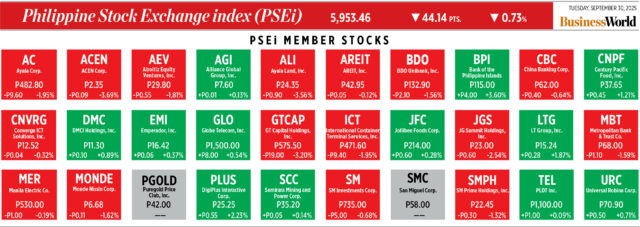
Here’s a quick glance at how PSEi stocks fared on Tuesday, September 30, 2025.


Philippine stocks slide for seventh straight day

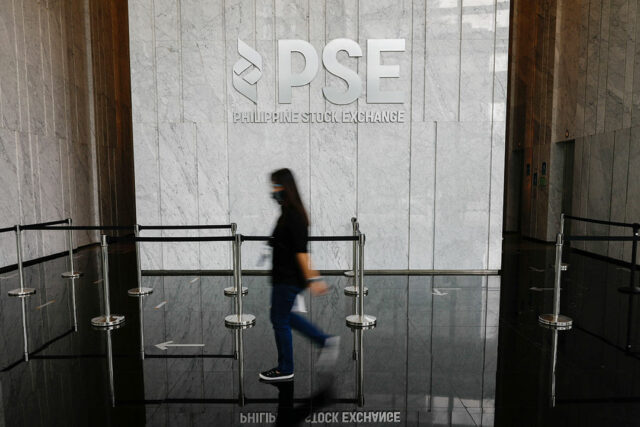
The lobby of the Philippine Stock Exchange in Taguig City, Sept. 30, 2020. — REUTERS

PHILIPPINE STOCKS slid for a seventh straight session on Tuesday as selling persisted due to worries over corruption issues and the peso’s weakness against the dollar.

The benchmark Philippine Stock Exchange index (PSEi) sank by 0.73% or 44.14 points to close at 5,953.46, while the broader all shares index dropped 0.42% or 15.55 points to 3,620.79.

This was a fresh near six-month low for the PSEi as this was its worst close since it finished at 5,822.85 on April 7. The bellwether last posted losses for seven consecutive days in mid-December last year in the lead-up to a US Federal Reserve policy meeting where it was expected to adopt a hawkish tone due to concerns over growth prospects in the world’s largest economy.

“The Philippine market remains in the red after seven consecutive trading days. Selling pressure across the board persists as investors remain cautious about the overall state of the market,” Regina Capital Development Corp. Head of Sales Luis A. Limlingan said in a Viber message.

Net foreign selling surged to P2.01 billion on Tuesday from P405.93 million on Monday

“The local market extended its decline to a seventh straight day as dismay over the Philippines’ corruption issues continued to weigh on sentiment,” Philstocks Financial, Inc. Senior Research Analyst Japhet Louis O. Tantiangco said in a Viber message.

The peso’s continued decline against the dollar also continued to affect market sentiment, both analysts said. The local unit sank to a fresh two-month low of P58.196 per dollar on Tuesday, down by 5.10 centavos from the prior day.

“Finally, the lack of a positive catalyst added to the market’s decline,” Mr. Tantiangco added.

The majority of sectoral indices ended in the red on Tuesday. Property declined by 2.02% or 47.15 points to 2,278.19; services retreated by 1.12% or 24.51 points to 2,152.39; holding firms went down by 1.03% or 50.93 points to 4,880.73; and industrials sank by 0.42% or 37.42 points to 8,777.65.

Meanwhile, mining and oil climbed by 1.45% or 183.84 points to 12,837.50, and financials went up by 0.31% or 6.37 points to 2,053.54.

“Bank of the Philippine Islands was the day’s top index gainer, climbing 3.6% to P115. ACEN Corp. was the main index laggard, falling 3.69% to P2.35,” Mr. Tantiangco said.

Value turnover increased to P9.09 billion on Tuesday with 1.57 billion shares traded from Monday’s P4.72 billion with 1.37 billion shares changing hands.

Decliners overwhelmed advancers, 129 to 79, while 45 names closed unchanged.

Caution prevailed in world markets on Tuesday, with the dollar and equities slipping and gold hitting another record high amid fears a US government shutdown could delay key jobs data, Reuters reported. US Vice-President JD Vance said the government appeared “headed to a shutdown” after little progress in budget talks between President Donald Trump and Democratic opponents. — A.G.C. Magno with Reuters

PEZA approves nearly P49B worth of investments in Sept.

THE Philippine Economic Zone Authority (PEZA) said it approved P48.87 billion worth of investment proposals in September, helping it exceed 60% of its approvals target in the year to date.

The September total is 9.8% lower year on year, it said. The 36 approved projects are expected to create 10,312 jobs and generate $1.113 billion worth of exports.

Of the total, 16 are manufacturing projects, while nine are information technology and business process management (IT-BPM) projects.

Five of the approved investment pledges were economic zone (ecozone) developments, three are to develop facilities, two are logistics projects, and one is a domestic market enterprise.

Eighteen of the projects approved in September plan to locate in Region IV-A, while others selected sites in the National Capital Region, Region VII, Region III, Region I, Region V, and Region XI.

Approvals in September brought the nine months’ total to P154.7 billion, up 33.5% from a year earlier.

These comprise 215 projects which are projected to generate 50,430 jobs and $4.49 billion in exports.

“These approvals demonstrate enduring investor confidence in the Philippines,” PEZA Director General Tereso O. Panga said in a statement on Tuesday.

“Backed by sustained momentum and robust investment activity, we are on track to attain our P250-billion goal and strengthen our standing as a leading investment destination in Asia,” he added.

He said that he expects the approvals to further increase in the last quarter amid the agency’s “expanded regional engagements.”

Of the projects approved so far this year, 98 are manufacturing projects, 55 are IT-BPM projects, 18 are domestic enterprises, 17 are ecozone developments, 16 are facilities projects, seven are logistics projects, and four are utilities projects.

“The manufacturing sector remains the backbone of PEZA’s growth, with notable gains in electronics, automotive and auto parts, and food processing,” PEZA said.

“These industries collectively contributed more than P42.4 billion in approvals from January to September, reinforcing the Philippines’ position as a vital hub for advanced and diversified manufacturing in Asia,” it added.

JAPANESE INVESTMENTS
Investments from Japan led the foreign investment approvals in the first nine months, worth P14.778 billion, or 9.55% of the total.

“This rebound firmly puts Japan back on top as PEZA’s leading investment partner, reaffirming its long-standing role as a driver of Philippine industrial growth and innovation,” PEZA said.

These approvals include a P9.1-billion project of a domestic market enterprise that will manufacture food products and processed foods inside the TARI Estate, which will cater to both domestic and export markets.

“Japan’s return as our leading partner reflects the fruit of our investment missions and strong collaborations with stakeholders,” said Mr. Panga.

“With nearly 10% of this year’s total project approvals coming from Japanese companies, we see undeniable proof of the Philippines’ standing as a trusted and highly competitive hub in Asia,” he added.

Meanwhile, P13.142 billion came from the Cayman Islands, P10.765 billion from South Korea, P6.322 billion from China, and P6.105 billion from the US.

“Given the robust interest and caliber of projects underway, we are not merely on track to meet our goal; we are positioned to deliver even bigger economic wins for the country and our people as we achieve our 2025 investment targets,” he added. — Justine Irish D. Tabile

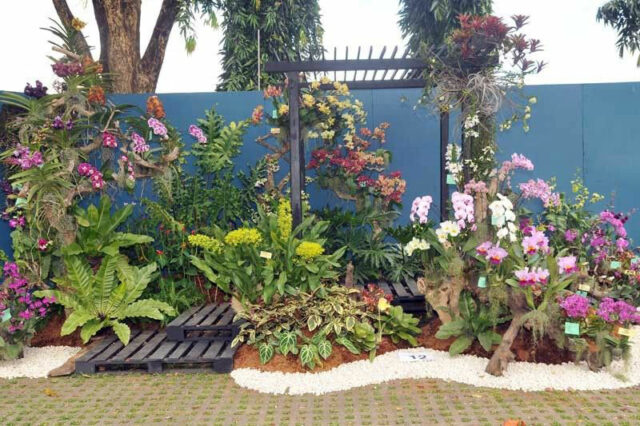
Ornamental plants seen as potential growth pillar for agriculture industry

PHILSTAR FILE PHOTO

ORNAMENTAL PLANTS are being touted as a potential growth driver for agriculture according to participants at the 2nd annual Philippine Horticulture and Urban Agriculture Summit, also known as Pagsibol.

Roger V. Navaro, agriculture undersecretary for Operations and Agri-Fisheries Mechanization, said horticulture or garden cultivation, as well as urban agriculture are potential “pillars of national strategy” if backed by proper investments.

Urban residents make up around 49.3% of the population, Mr. Navarro said.

Antonieta J. Arceo, agriculture training institute director said the drive for profits must be balanced “with protecting biodiversity and safeguarding our ecological heritage.”

Nevertheless,” (We must) hold fast to our vision of agriculture as a profitable investment and a viable and modernized career for Filipinos,” Ms. Arceo said in a speech.

The International Association of Horticulture Producers valued the global industry at $70 billion in 2024. — Andre Christopher H. Alampay