Home Blog Page 9569

Nationwide round-up

Over 14,000 OFWs tested for COVID-19

MORE than 14,000 repatriated overseas Filipino workers (OFWs) have been tested for coronavirus disease 2019 (COVID-19) while in isolation, the Philippine Coast Guard (PCG) reported Monday. In a statement, PCG said 14,418 land- and sea-based OFWs underwent reverse transcriptase polymerase chain reaction technique test for COVID-19 as of May 10. On Monday, 1,674 were tested by the Sub-Task Group for the Repatriation of OFWs — 1,118 in quarantine facilities in Metro Manila and nearby provinces and 556 at Palacio de Manila. All returning OFWs are required to undergo a 14-day quarantine. “Rest assured that once necessary clearances are issued, the Department of Transportation (DOTr) will coordinate their transport so they may finally go home to their families,” it said. Among the quarantine facilities being used for OFWs are the Eva Macapagal Super Terminal in Pier 15 and two 2GO vessels that have been temporarily reconfigured. — Vann Marlo M. Villegas

PEZA asks gov’t to cover COVID-19 testing of ecozone employees

THE Philippine Economic Zone Authority (PEZA) has requested government to cover the coronavirus disease 2019 (COVID-19) testing of ecozone employees as a form of assistance to locators that continue to operate during the lockdown. PEZA Director General Charito B. Plaza, in a phone interview on Monday, said she had written the Department of Finance requesting for free testing for employees. “(Industry workers) are the backbone of the economy… it’s important that the people working (be tested) so they can be healthy. This is also help for the investors who are badly hit. Instead of them spending for the testing, this is our assistance for them,” she said in English and Filipino. In the meantime, PEZA is assessing testing service providers as it will be requiring all registered companies to have their employees undergo either the rapid test, which checks the presence of antibodies, or the polymerase chain reaction (PCR) test, which determines the presence of the virus. She said implementing the tests, starting with the current skeleton force then the work-from-home employees, will pave the way for allowing 100% operations. Ms. Plaza is also discussing with private ecozones the possibility of setting up dormitories for workers that can be used during crises. — Jenina P. Ibañez

Peso climbs vs dollar

THE PESO appreciated against the greenback on Monday on positive market sentiment about the possible gradual easing of lockdown measures and amid market expectations of another rate cut from the US Federal Reserve.

The local unit finished trading at P50.30 per dollar on Monday, stronger by 12 centavos from its P50.42 close on Friday, according to data from the Bankers Association of the Philippines.

The peso started the session at P50.45 per dollar, which was also its weakest showing for the day. Meanwhile, its intraday best was its close of P50.30.

Dollars traded rose to $474.22 million on Monday from the $433.2 million seen on Friday.

Improved risk appetite on the possible easing of lockdowns boosted the local unit, according to Rizal Commercial Banking Corp. Chief Economist Michael L. Ricafort.

“The peso was also stronger amid some optimism in the global financial markets about preparations for re-opening many economies from lockdowns, including the Philippines, in the coming days,” Mr. Ricafort said in a text message.

The government is expected to announce this Monday a decision on the enhanced community quarantine in some areas of Luzon including the National Capital Region after May 15.

Mayors of Metro Manila cities have recommended three scenarios, including the full extension of the ECQ until the end of May, a general community quarantine and a combination of ECQ and GCQ depending on the containment of the virus’ spread in their respective areas.

Meanwhile, a trader attributed the peso’s strength to market expectations of easing from the US Federal Reserve.

“The peso appreciated amid increasing expectations of future US rate cuts to negative policy rates following the spike in US unemployment data last week,” the trader said in an e-mail.

Reuters reported that the US Department of Labor said on Friday that the unemployment rate surged to 14.7%, going beyond the post-World War II record high 10.8% in November 1982.

For today, Mr. Ricafort gave a forecast range of P50.20 to P50.45 while the trader expects the local unit to move within the 50.15 and 50.35 band. — L.W.T. Noble with Reuters

Learn from home

By MICHAELA TANGAN

Where to take free online classes during the COVID-19 lockdown

We each have unique ways of coping up with the current global health pandemic. Some slow down, recharge and take this time to break away from the toxicity of the ‘hustle’ culture. Others choose to work doubly hard or broaden their skill set in the hopes of finding better opportunities after the lockdown.

Thanks to modern technologies, we can come out of this pandemic better and more equipped. When the coronavirus disease 2019 (COVID-19) forced us to stay home, several organizations and learning platforms have opened their doors by providing free online access to their training courses and programs. The step enabled millions of people at home to pursue knowledge despite numerous hurdles.

Check out these educational platforms and discover what suits your interests or supports your career advancement goals:

Coursera

The online learning platform has been providing free learning opportunities even before the COVID-19 broke out. However, on March 25, it launched new, free resources and course collections to help millions of learners across the globe, including the Philippines.

In partnership with leading institutions such as Caltech, Columbia University, Google, and IBM, Coursera currently offers courses on mental health and well-being, career development, technology, public health and COVID-19, as well as data science, people skills and gaming industry. There are also free courses for high school and college students.

Where to access: 

www.coursera.org, Apple App Store, Google Play Store

edX

Founded by Michigan Institute of Technology (MIT) and Harvard in 2012, it has now partnered with over 140 leading universities, non-profits, NGOs, and corporations to provide wide-ranging classes for free.

The platform mostly offers computer science, business and management, engineering, social sciences and humanities courses and programs but has now expanded with epidemics courses. Learners may deepen their understanding of pop culture, parenting, happiness, law, design and languages.

Where to access: 

www.edx.org, Apple App Store, Google Play Store

Kadenze

For those who are geared towards the arts and creative technology, Kadenze is the digital learning platform to access first.

The subjects they offer include music, design, creative computing, music technology, fashion, web development, animation, photography, videography, architecture, and performing arts, entrepreneurship and more.

These classes are moderated by highly-regarded institutions, including Columbia University, Sydney Opera House, National University of Singapore, Princeton University and Paris College of Art.

Where to access: www.kadenze.com

Khan Academy

The Khan Academy offers personalized learning resources for all ages — from pupils in preschool to students in elementary, high school and early college — despite school closures.

For parents at home, the Khan Academy Kids can be installed for free. It enables adults to sit down with kids and guide them through classes on reading, writing, math, handwriting practices, social-emotional learning and more.

For advanced level learning, Khan Academy publishes thousands of exercises, videos and articles on grammar, government, math, science, economics, humanities, and history and more. The activities can be downloaded or bookmarked for offline access.

Where to access: www.khanacademy.org, Apple App Store, Google PlayStore

The Culinary Cook

For aspiring chefs and cooks (or those wanting to learn new skills), The Culinary Cook is designed to develop needed skills to thrive in the culinary industry (or cook like a pro in the kitchen).

Through published articles, aspiring chefs will learn everything from spices, flavorings, stocks, broths, pasta, soups, meats and fish to knife handling, baking, cooking techniques and choosing culinary schools.

Where to access: www.theculinarycook.com

TESDA online program

The Technical Education and Skills Development Authority (TESDA) launched an online program to encourage Filipinos to develop new skills and learn new crafts while in quarantine.

Students may freely access classes on finance, fruit growing, massage therapy, beauty care services, housekeeping, bread and pastry production, cookery, food processing, solar night light assembly, software development and android programing.

Enrollees will have to learn from video learning materials and pass quizzes to get a certificate of completion. A national certification, on the other hand, will be given when the COVID-19 situation normalizes, as it requires assessment tests at technical schools.

Where to access: www.e-tesda.gov.ph/course/index.php

Udemy

From meditation, goal setting, fitness, and personal productivity to web development, entrepreneurship fundamentals, investment and game development, the online learning portal offers various classes that help learners find their niche.

It also provides free access to COVID-19 Toolkit for Nonprofits and Ministries course, which guides leaders on how to respond to the current pandemic effectively.

Where to access: www.udemy.com/courses/free

WHO 

It’s clear that industries, especially the health care sector, will have to embrace the new normal. While the world is still ironing its strategies against the new virus, we have to amplify our preparedness efforts on COVID-19, especially when the lockdowns are lifted.

For frontliners and those who are planning to pursue a career in affected industries, the World Health Organization (WHO) has launched a section dedicated to COVID-19-related online training and simulation exercises.

Some online training modules on the website discuss proper ways to put on and remove personal protective equipment, standard precautions, hand hygiene, and infection prevention and control for COVID-19.

Where to access: www.who.int/emergencies/diseases/novel-coronavirus-2019/training

The COVID-19 may have stopped us from holding graduation ceremonies, shaking hands, hugging and high-fiving, but it can never stop us from developing new skills, pursuing knowledge, enriching ourselves and moving forward, especially with modern technology up our sleeves.

PBA finding ways to engage fans amid COVID-19

LIVE staging of games rendered impossible right now with mitigating protocols because of the coronavirus disease 2019 (COVID-19) pandemic up, the Philippine Basketball Association is finding ways to continue to engage fans.

On Sunday, Asia’s first play-for-pay league launched its online show, PBA Kamustahan, geared towards touching base with the league’s fandom which has to bear for two months now not seeing their hardcourt heroes in action.

First episode of the Kamustahan had PBA big men Marc Pingris (Magnolia), Poy Erram (TNT), June Mar Fajardo (San Miguel), Beau Belga (Rain or Shine) and Asi Taulava (NLEX) as featured guests. PBA Commissioner Willie Marcial also came on board during the broadcast which was moderated by league barker and radio broadcaster Noel Zarate.

From the comforts of their homes, the guests shared their various experiences while dealing with the enhanced community quarantine, thoughts on the league’s return and their stints with Gilas Pilipinas, among others.

As expected all the players said they miss playing in front of the fans but recognize that safety of all league stakeholders is primary at this point.

For now, they are enjoying their time with their families while also doing training on their own to keep in shape and stay sharp.

They said they are hoping that they get to return to action at the soonest possible time just as they noted that the return to some form of normalcy would take time.

“The guys will be excited to be back with their teammates for sure. But definitely we would not be able to get back to what we used to do. It would take time to normalize,” said Mr. Taulava.

He was seconded by Mr. Belga, saying, “Thing will gradually go back to normal. Basketball will always be there and am sure the fans would love to get it back.”

League officials said it remains to be seen if the season would continue this year as COVID-19 remains a growing concern but they are hopeful that by August they will have a definite decision on the fate of PBA Season 45.

Mr. Marcial said the first episode of Kamustahan was only the start and that they intend to get more players participating in the online show to give fans something to turn to during these uncertain times.

The PBA in March decided to suspend its ongoing season after the government declared a state of public health emergency and put the entire Luzon on ECQ as a means to mitigate the spread of COVID-19. — Michael Angelo S. Murillo

Durant won’t play if NBA resumes season

BROOKLYN Nets star Kevin Durant will not play if the National Basketball Association restarts the season, ESPN’s Adrian Wojnarowski reported Sunday.

The Nets are determined to let the four-time scoring champion rest until next season rather than risk reinjuring his right Achilles tendon.

“Kevin Durant’s not coming back to the Nets this year,” Wojnarowski said during “The Woj Pod” podcast. “That’s not happening. … They’re not playing him.”

Earlier this month, Brooklyn general manager Sean Marks said he wouldn’t rule out Durant returning to the court if the league resumes the 2019–20 campaign. Play has been suspended since March 11 due to the coronavirus crisis.

“He knows his body better than anybody,” Marks told Newshub of New Zealand. “Our performance team and training staff have done a tremendous job getting him to this point, but I just don’t know how coming out of this pandemic will affect anybody, let alone Kevin.”

Durant, 31, was injured during Game Five of the 2019 NBA Finals as a member of the Golden State Warriors. He signed a four-year, $164-million deal with the Nets as a free agent in July.

The 10-time All-Star forward was the league’s Most Valuable Player in 2013–14 as a member of the Oklahoma City Thunder. He was a two-time NBA Finals MVP with the Warriors. — Reuters

UFC: Criticizing safety measures could be costly

UFC FIGHTERS who took part at the UFC 249 event in Florida could lose their purses and bonuses if they publicly criticize the fight promotion’s health and safety precautions for COVID-19, according to an event participation agreement seen by Reuters.

With sporting events cancelled around the globe due to the coronavirus disease 2019 pandemic, the Ultimate Fighting Championship is staging three cards in eight days in Jacksonville, Florida.

Before competing, fighters who took part in the UFC 249 event on May 9 were asked to sign an eight-page event participation agreement.

A non-disparagement clause in the undated agreement states that “the Participant will not suggest or communicate to any person or entity” that the events “have been or will be held without appropriate health, safety or other precautions, whether relating to COVID-19 (coronavirus disease 2019) or otherwise.”

The agreement goes on to say that if a fighter does breach this clause, “the Company may revoke all or any part of any prize monies or awards won … including, but not limited to, purses, win bonuses, other fight-related bonuses and event-based merchandise royalties.”

Though signed exclusively to the promotion, UFC fighters are independent contractors rather than employees, and purses and bonuses form a major part of the income of almost all of the fighters on the roster.

A UFC spokesperson declined to comment on the clause and the possibility of penalties being imposed on fighters, instead referring to comments Dana White gave to Yahoo in which the UFC president said that fighters would not be punished for airing their opinions about the health and safety arrangements.

“If a fighter says something that isn’t true — if he says we didn’t test anyone for this — that would (violate the agreement). But if he said something that was true, his opinion, then that is different,” White said.

In recent weeks, one fighter has expressed reservations about getting in the cage during the COVID-19 pandemic.

Heavyweight Greg Hardy, who suffers from asthma, said in a news conference on Thursday that he was “terrified” of the virus, but he went on to compete on the UFC 249 card and scored a decision victory over Yorgan De Castro. — Reuters

Players worried about Premier League restart — union deputy chief

BENGALURU — Players have genuine concerns about their health as the Premier League considers resuming fixtures amid the COVID-19 pandemic, players’ union deputy chief Bobby Barnes has said.

The league’s “Project Restart” envisages a return to play in June at neutral venues, once given the green light from the government, but players are worried about transmission when sharing the pitch with others in a contact sport.

A British government study said black people are nearly twice as likely to die from COVID-19 (coronavirus disease 2019) than whites and Barnes said young black players were apprehensive.

“There are players who have voiced genuine concerns,” the Professional Footballers Association’s Barnes told the Times.

“You’ve got players who’ve got young children, players with pregnant partners, people with underlying health conditions.

“Some of the young black players I’ve spoken to have read what’s in the press and want answers to that (government study). ‘Am I more affected in my demographic and if so why?’

“My stance with the Premier League from day one has been it’s all very well those of us in suits saying what our opinions are but we’re not going to be out there on a Saturday afternoon and we’re not going to be going back to our family.”

A third first team player at Brighton & Hove Albion tested positive for COVID-19 over the weekend, sparking fresh concerns about the league’s proposed restart.

Clubs are due to meet later on Monday to further discuss how to complete the remaining 92 matches of the season. — Reuters

Shopee and BillEase offer seller loan program for MSMEs

FDFC, the fintech company behind digital credit app BillEase, and Shopee have launched their Seller Loan Program to help Micro, Small and Medium Enterprises (MSMEs) registered on Shopee as they struggle through the country’s continued quarantine.

The year-long program aims to help Filipino MSMEs cope with the adverse effects brought about by the COVID-19 outbreak and enhanced community quarantine (ECQ).

Interested Shopee sellers must have been operating for at least six months and ramping up their working capital. If they fulfill these requirements, they can then apply on BillEase for Business, BillEase’s financial service platform for small business lending, based on their sales record prior to the ECQ. Successful applicants can avail of P20,000 up to P2 million commensurate of their sales transactions, an extra one-month grace period for the loan repayment, and up to 12 months maximum loan term.

The loan program comes after Shopee’s announcement of its P200-million Seller Support Package, which will help up to 80,000 MSMEs. FDFC also has a tie-up with Lazada that offers interest-free financing, this time for consumers.

“We understand that Shopee sellers are still navigating the effect of ECQ and they are looking for partners that would look after their business financially,” said Georg Steiger, CEO of FDFC. “Our Shopee Loan Program will help these sellers who are either producing essential goods to continue operations amid the increasing demand or those preparing to recover after the quarantine.”

Shopee sellers can apply through this link.

[B-SIDE Podcast] Helping hospitals get ready for the second wave and beyond

Follow us on Spotify BusinessWorld B-Side

The enhanced community quarantine is set to be lifted. And with the lifting of the lockdown comes the potential resurgence of COVID-19 cases—the dreaded second wave we keep hearing about.

How ready are our hospitals to deal with the probable influx of patients needing urgent care?

In this episode, SparkUp multimedia reporter Patricia Mirasol speaks to Equilife Medical founder Abetina Valenzuela about the allocation and management of life-saving equipment—such as ventilators—during a pandemic. There’s a lot of room to grow and improve medical services, and make care accessible. The pandemic has only accelerated the pace at which innovation must take place. Recorded remotely on April 23. Produced by Nina M. Diaz, Paolo L. Lopez, and Sam L. Marcelo.

Follow us on Spotify BusinessWorld B-Side

How MAD Travel is tackling tourism in the time of COVID-19

Travel is often hailed as the ultimate cathartic experience. Whether we see it on the silver screen or read it between the pages of a book, we’ve heard some tale of an individual finding themselves and their purpose by embarking on a journey. But for some, this is more than just a tall fantasy. Just ask Thomas Graham and Rafael Dionisio.

Travel is universally held as the ultimate cathartic experience. Across films and books, we find countless examples of journeys that begin and end with characters exploring foreign worlds and, in so doing, find themselves. For avid travelers Thomas Graham and Rafael Dionisio, that passion for exploration paved the way to a shared adventure in the form of a startup, MAD Travel. And, fittingly, that journey began when they happened to meet on a trip.

Graham, a journalist from the United Kingdom, and Dionisio, an entrepreneur in the tourism industry, first crossed paths in 2013 on a volunteering trip for Gawad Kalinga. Dionisio had been setting up hostels across various provinces in the Philippines, but wanted to do something more meaningful. That piqued Graham’s interest.

“We thought, ‘Why not pull together our expertise?’,” Graham said. “Mine was really in storytelling and giving the outsider’s perspective on how much we have to learn from these amazing communities that we were, at the time, volunteering for. [Dionisio] obviously brought more local expertise and the community development side of what we do.”

And so Make a Difference (MAD) Travel was born.

Setting direction

Graham and Dionisio started Make a Difference Travel as a tourism platform offering tours to local destinations such as Zambales, Bataan, and Rizal.They work with marginalized communities, such as the Aetas in Yangil Village, in creating authentic experiences– from storytelling with the tribe to learning their traditional music and dances.

The firm takes a clear stance on what they mean by authentic. They take extra efforts to ensure the worlds their travelers experience aren’t just “different”, but true to the experiences of the communities they meet.

“Everything we do is aligned with their own values and vision for their community. We never dictate… ‘You should always dress in your Aeta wear because it looks more authentic for photos.’” said Romina Naňagas, communications manager. “We consult our partners and they have the right [to] say no.”

They also incorporate long-term initiatives within the tours that help foster inclusivity and sustainability among their partner communities, such as growing farms and forests in their Zambales and Bataan programs. “This is all in the backdrop of massive deforestation in the country… and the massive exclusion of countryside communities from better education, localized racism against them, [and lack of] access to water or electricity,” said Dionisio.

If it sounds like an ambitious set of goals for a tourism startup to tackle, that’s because it is. But it’s precisely the transformative role that Graham and Dionisio see travel playing in people’s lives that they feel confident in taking them on. Through MAD Travel, the two believe they can exponentially grow their advocacies through the travelers that join their programs.

Chef Chele Gonzalez, known for his acclaimed restaurants such as Gallery by Chele, started sourcing ingredients directly from some of MAD Travel’s partners. Artist Issa Barte founded Fund a Forest, a reforestation effort for Philippine forests, after being inspired by the tour’s reforestation activities. Even some members of MAD Travel’s team were former tourists, including Naňagas, who left the advertising industry to help the company.

“There are so many things that we know theoretically, and yet we don’t [understand them] until we know it on an experiential level,” said Graham. “Don’t just read about the communities, or hear a nice speech, or donate some money, but come be part of it.”

Off the beaten track

But, as with nearly every business in the tourism industry, the current COVID-19 crisis saw many of MAD Travels’ projects come to a grinding halt. Faced with the responsibility of sustaining not just their team but also their partner communities, MAD Travel has had to pivot their services—all while keeping them aligned with their vision.

Over the past few weeks, they launched a number of new programs based on the advocacies towards caring for local communities in their network. These include Feed the Farmers Today, Fund Tomorrow’s Forest, a global crowdfunding project where each purchase of a tree pays for an Aeta’s labor of planting it.

There’s also MAD Market, an online delivery service that sources produce directly from farmers and communities in areas like Benguet and Davao. They’re group is even offering an e-learning program called MAD Courses which offers training into topics such as sustainability and social enterprise.

“We identified some time ago that… we’re a platform that connects people,” said Graham. “When you look at it more broadly like that… then you see that even when tourism has dried up and we all remain pretty slow for let’s say the next six months at least, we’re now looking in a broader sense at our mission. We still believe that there’s something very special in our communities and our community partners.”

While these may not be the original services that MAD Travel planned out, the team is confident that they’re delivering on their promise of affecting change through authentic experiences—albeit through a different kind of experience.

BUSINESSWORLD INSIGHTS: The ‘new normal’ businesses should brace for

By Adrian Paul B. Conoza
Special Features Writer, BusinessWorld

A ‘new normal’ is anticipated to take place once the coronavirus disease 2019 (COVID-19) crisis ends and the enhanced community quarantine (ECQ) is relaxed. As businesses brace for this, understanding what it means for them is worth considering before they welcome such transitions.

The second leg of the Phase 1 of BUSINESSWORLD INSIGHTS has further shed light on this ‘new normal’ that the Philippines is set to encounter.

Moderated by BusinessWorld‘s digital platform editor Santiago Arnaiz, the online forum held last May 6 gathered interesting thoughts from Anthony Oundjian, managing director and senior partner of Boston Consulting Group (BCG); Dr. Raul Destura, deputy executive director of Philippine Genome Center (PGC) at University of the Philippines (System); Dr. Nicole Curato, associate professor of Centre for Deliberative Democracy and Global Governance at University of Canberra; and Shailesh Baidwan, president of Voyager Innovations and PayMaya Philippines.

Preparedness for future pandemics

Dr. Destura sees the ‘new normal’ upon the lifting of the ECQ to be challenging, as he found that it absolutely will not be the same as before while the virus is still present in the country.

“Until we are actually able to develop the vaccine [and] control or improve the herd immunity, then the new normal will be a little bit different than what we used to enjoy,” Dr. Destura said.

He pointed out factors he deems very important and crucial for the control of the coronavirus infection, namely identifying active cases for effective contact tracing and continuous awareness of practicing social distancing.

“[Identifying cases] would include more testings going on all around the country, allowing individuals to be identified at the early stages of disease so that their transmission dynamics will be shortened — as opposed to persons undiagnosed spreading the virus with transmission rates of two is to one. This particular intervention is very necessary and very important,” PGC’s deputy executive director said.

Moreover, Dr. Destura highlighted the importance of preparedness in responding to global infectious disease emergencies. For the infectious disease specialist, pandemic preparedness is a very serious area that needs to be addressed on a national and global level.

“In terms of pandemics, there will always be a new version, whether more powerful than what’s happening right now or less. But, what’s necessary is the ability for us to prepare for these particular problems that will arise again in the future,” he said.

He saw the level of preparedness of healthcare workers as the major difference of COVID-19 from past epidemics, adding that even with healthcare systems becoming more advanced than before, the transmission of the virus is very high, given the immense growth in the country’s population size.

The PGC official also noted the significance of modeling during this period, lest that “the number of cases outnumbers our capacity to absorb cases”.

“The purpose of modeling is to actually give us an estimate on how much impact [COVID-19 is] going to get at certain stages of our intervention,” he said. “It will also allow us to determine whether the current intervention is going to help decrease the number of insufficient rates or not.”

For Mr. Destura, the academic community has a vital role during the crisis in providing scientific bases for certain decision-making and providing tools for decision-makers to have better implementation guidelines on relaxing the ECQ in the next couple of weeks.

Hearing out vulnerable communities

The exacerbation of existing inequalities and the inclusion of most vulnerable communities are important in going to a ‘new normal’ according to Ms. Curato.

The sociologist noted that the ‘new normal’ is not new at all since it further deepens the disparity between certain groups in the society.

“For example, if the new normal means there should be physical distancing in public spaces, then this experience is different for people with cars and those waiting for the MRT, which [will take fewer] passengers per train car and consequently making the queues even longer,” she explained.

This ‘new normal’ will thus reveal the “unfortunate obvious truth that the poor will bear the brunt of the new normal”, she added.

Ms. Curato also noted the new normal experience becoming ‘gendered’, especially in terms of working from home.

“Working from home may be the new norm but… working from home is not always safe. We know that homes are sites of domestic inequalities. Recently, the United Nations called for urgent action as reports of domestic violence escalated,” she said.

The associate professor also emphasized the importance of listening to the reasons of communities whom she finds are not often paid attention to. She finds the lack of “listening to the reasons of the most vulnerable Filipinos” as one of the failures in the country’s response to the pandemic.

“I think it’s good that the government tells us what’s ideal but we have to recognize that many Filipinos live in the least ideal of circumstances,” she stressed.

She suggests that stakeholders should create a communication strategy that brings in the most vulnerable communities in the conversation, rather than excluding them.

“The best way to move forward from this pandemic is to just not have an exclusive conversation about opportunities available just for government and business, but putting the most vulnerable communities at the center of this conversation,” she added.

Digital financial services becoming essential
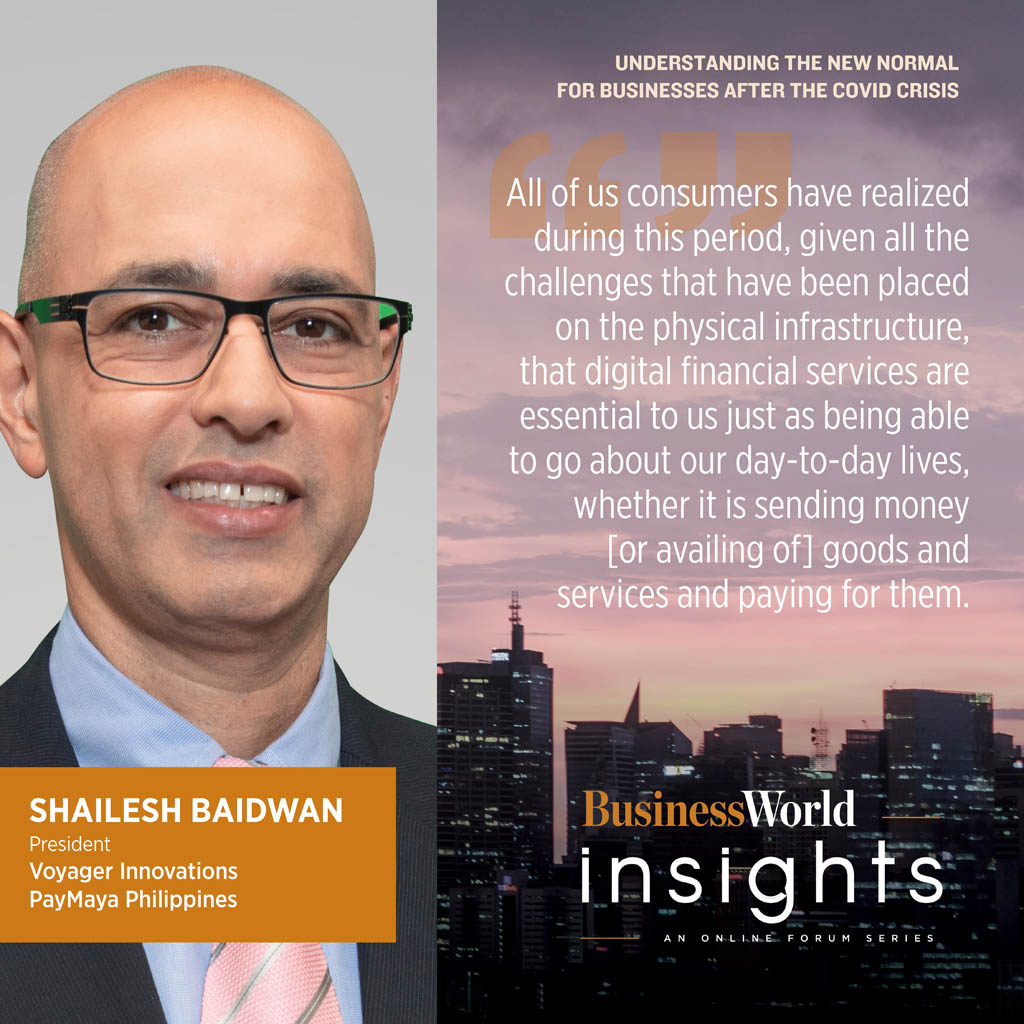
For Mr. Baidwan of Voyager and PayMaya, digital financial services will be an inevitable part of the new normal, and these services are no longer an option.

He observes an acceleration of such services on both consumer and enterprise levels.

Among enterprises, Mr. Baidwan sees businesses pushing their digital strategies from being a part of their long-term roadmap into a top priority to be delivered in the next few months.

Consumers, meanwhile, are realizing the advantages of digital payments.

“All of us consumers have realized during this period, given all the challenges that have been placed on the physical infrastructure, that digital financial services are essential to us just as being able to go about our day-to-day lives whether it is sending money [or availing of] goods and services and paying for them,” he said.

He shared that over the last few weeks, they have observed a significant increase in the number of people who are downloading the PayMaya app and using it to send money to continue supporting their loved ones in the provinces, as well as to buy mobile load and data.

Expanding financial inclusion in the Philippines, he said, is one of the big ways to counter the issues brought about by the present crisis.

Accelerating financial inclusion and ensuring wider access to payment, credit, insurance, and all kinds of other services, he added, will greatly help digital financial services to include “a large segment of the society that is today very vulnerable”.

“This is a time we really need to accelerate financial inclusion across the country because that to me will be one of the key factors that can help in the overall lift [of the ECQ], and to help to cushion some of the negative impacts that we will see over the coming months,” he said.

Mr. Baidwan also expounded on the significant roles digital financial services are playing during this crisis, such as enabling consumers and businesses to transact safely as well as helping needy communities access funds from the government and helping the government receive payments.

Adapting to ‘meaningful changes’

BCG’s Mr. Oundjian, meanwhile, shared that just like in previous major crises in history, meaningful changes will be imminent when the dust of the present crisis settles.

He sees two stages taking place specifically in the COVID-19 crisis. The first stage, he explained, happens for the next few quarters when people still live with a set of constraints related to COVID-19. The following stage will usher in “a more structurally different world once this is behind us”.

The managing director and senior partner of BCG sees digitalization ushering in a significant transition.

“The digitalization of our life, through the shopping, through the way we buy, through the way we interact, I think that will be a fundamental trend,” he said.

He sees the shift to home-based activities as the main change that is taking place among consumers, aside from a “major sustained shift” to digital services.

“We are not just talking about the work from home. We are talking about entertainment at home, consume at home, communicate socially from home,” he said. “For now, it’s by necessity; but we see that a lot of people start to realize actually that it’s quite convenient and it works well, and some of these will stay.”

As the new normal witnesses these significant changes, Mr. Oundjian considers the crisis as a wake-up call for businesses and communities to make their transition to the new normal a meaningful one as well.

“I’m hoping and I believe that this event is an opportunity to step back and realign our model to something which is much more sustainable for the planet but also for communities and something that we give like a fair share to provide the community,” he emphasized.

The next legs of BUSINESSWORLD INSIGHTS will tackle “COVID-19 and The Philippine Stock Market: Uncertainties and Opportunities” on May 13, and can be viewed on the Facebook pages of BusinessWorld and The Philippine STAR.


BUSINESSWORLD INSIGHTS is made possible by sponsors SM, Megaworld Corporation, Globe Telecom, and PayMaya; eLearning platfrom partner Olern; partner organizations Management Association of the Philippines, Philippine Chamber of Commerce and Industry, Philippine Association of National Advertisers, and Bank Marketing Association of the Philippines; and media partner The Philippine STAR.


Career insights during lockdown

By Hannah Mallorca
Features Writer, The Philippine STAR

Experts weigh in on how employees can better tackle important career decisions in the face of uncertainties brought by the pandemic

The coronavirus disease 2019 (COVID-19) has caused a looming global recession. It has posed an uncertain future in the economy and employment with various industries walking on a thin line. As a result, employees are faced with decisions — should they stay in their current jobs or move on to the next phase of their careers?

To help Filipino workers determine their next career move, The Philippine STAR’s CareerGuide shared insights on important job decisions during the pandemic.

The online discussion featured TalentView chief executive officer Anj Vera, Inspire Leadership Consultancy Inc. general manager and leadership consultant Jeff Manhilot, and TaskUs human resources leader Atty. Bianca Bacani.

Ensuring stability among employees

One of the major factors that determines an employee’s career decision is how their employers maintain stability during crises such as the COVID-19 pandemic. According to Ms. Vera, employers should establish effective communication with their employees.

“It doesn’t matter if you’re a small company or a big company, whether you see it or not — you have an employer brand. Especially in this crisis, it’s vital that you protect it, communicate well with your organization and just showcase who you are because it always comes out. Your true self comes out in a crisis like this,” she stated.

Ms. Vera also urged companies to provide sufficient assistance and strengthen their leadership skills for their employees’ sake.

“Pour out your resources for your organization: show them that you’re present, that you have strong leadership capabilities and that you’re at the forefront of this crisis,” Ms. Vera said.

 Working hand in hand during the crisis

Because of the pandemic, many companies experienced drastic changes in business operations. This includes the work-from-home setup, which goes beyond the traditional working relationship. Mr. Manhilot stated that employees and employers should preserve a stable working relationship.

“It will all play down with the combination of the two things. One is how the leaders are doing it and at the same time, how employees should be taking it,” he added. “We need to put into perspective that leaders have to play a huge role in making sure that the organizations they’re leading are really taken care of in all aspects.”

In making wise career decisions, Mr. Manhilot and Atty. Bacani encouraged employees to understand that various sectors are also affected because of the pandemic.

“As an individual, we all have to understand that our leaders are also encountering the same thing. The virus is a great equalizer, regardless kung nandito ka sa sitwasyon na ito or itoyung position mo sa organization. The amount of fear or risk is the same,” he said.

“Inevitably, our employees will feel uncertain, they will feel sad that there are so many changes around. Here’s the challenge for our employees, we want you to step up in this crisis as well. Once your employee steps up and tries to help you, you will also need to step up,” Ms. Bacani added.

Despite this, Ms. Vera advised employers to be transparent with their employees. “We really need to see our leaders communicating well enough, sometimes even as simple as being transparent is appreciated by your organization. It cannot be that the leaders are the ones who are silent,” she said. 

Making life-changing career decisions

Employees are faced with decisions on whether they should stay or move on with their careers as a result of the pandemic. With this, Ms. Bacani advised workers to consider important factors such as employment opportunities, salaries, and more.

“Every career move, it has to be a deliberate act. Whether or not there is a global pandemic or crisis, we have to take a pragmatic stance with regards to our career choices,” she added.

Since career transitions is a life-changing move for employees, Ms. Bacani stated that it’s a personal decision that one needs to make.

“Do you want to make a career change now? It depends. It’s a ‘no’ if you don’t have a plan, if you’re not pursuing your passion and you’re not doing anything productive. But on the other side, it’s a ‘yes’ if you are pursuing career growth, if you’re pursuing your passion or you’re protecting your mental health,” she said.


For more information about employment, job openings and advertising options, visit CareerGuide PH on Facebook and LinkedIn.


ADVERTISEMENT
ADVERTISEMENT