Home Blog Page 9464

DTI rules out rent concessions during MGCQ

THE Department of Trade and Industry (DTI) said rent deferrals will no longer apply during a modified general community quarantine (MGCQ).

The DTI once again changed its policy on rent deferral to apply the grace period consistently to businesses that closed down during the lockdown, regardless of the date businesses are permitted to operate.

The DTI will now require at least a 30-day grace period on rent payments counting from the date the quarantine is lifted.

This applies to residential rent as well as commercial rent for all micro, small, and medium-sized enterprises that were not permitted to operate during the lockdown.

The deferral applies to rent payments due during the enhanced community quarantine (ECQ), modified enhanced community quarantine (MECQ), and general community quarantine (GCQ).

Trade Secretary Ramon M. Lopez said in a mobile message Sunday that the deferral will not be extended to the MGCQ.

“Since MGCQ allows all sectors to operate, although category IV at 50% (capacity), there is no compelling reason to extend,” he said.

Areas outside Metro Manila, Central Luzon, Cagayan Valley, Calabarzon, Central Visayas, Pangasinan, Zamboanga City, Davao City, and Cebu City are under MGCQ.

The DTI in its previous memorandum circular 20-29 signed on June 2, granted commercial lessees grace periods counting from the date their businesses were permitted by the government to operate, whether or not they had resumed operations. Rent owed by businesses that are not yet allowed to operate was deferred by 30 days after the lockdown is lifted or after the date they are allowed to resume operations, whichever comes first.

But the DTI had since amended those guidelines to apply rent deferrals consistently regardless of permission to operate, under memorandum circular 20-31 signed June 4.

The businesses will not incur interest, penalties, or fees from deferred rent. The total rent that fell due within the lockdown is to be amortized over six months after the grace period.

The DTI continued to ask lessors to consider waiving or offering discounts for commercial rent or renegotiating lease term agreements for micro, small, and medium-sized enterprises.

“Enjoining lessors to still extend support like concessional rents or discount on months after the lifting of GCQ, since market demand may start weak,” Mr. Lopez said.

Lessors are not obligated to refund rent payments made during the lockdown.

LGUs ordered to streamline energy-project permit process

LOCAL government units (LGU) were ordered to streamline permit processing and fee structures for energy projects, in compliance with Republic Act No. 11234 or the Energy Virtual One-Stop Shop (EVOSS).

The Departments of Energy and Interior and Local Government (DILG) released on Friday a joint circular ordering a unified and streamlined permit process, harmonizing EVOSS, Administrative Order No. 23 which eliminates overregulation; Executive Order No. 30, which creates the Energy Investment Coordinating Council; and Republic Act No. 11032 or the Ease of Doing Business Law.

In the order, the DILG also prescribed a local government ordinance outlining the LGU Energy Code.

LGUs were ordered to create an energy sector committee under the local development council which facilitates the implementation of energy programs, policies, and projects that will also be included in the comprehensive development plans of provinces, cities, municipalities, and barangays.

Among provisions in the prescribed ordinance is the establishment of a local energy efficiency and conservation office, along with the appointment of its officer who will draft its office’s development plan.

Local governments were ordered to provide incentives to private-sector proponents of energy-efficiency projects in investment priority areas. — Adam J. Ang

PAGCOR remits P5B in fresh dividends to Treasury

THE Philippine Amusement and Gaming Corp. (PAGCOR) said it remitted P5 billion in additional dividends to the Treasury Friday to increase government funding for the coronavirus disease 2019 (COVID-19) containment effort.

In a statement late Friday, PAGCOR said the latest dividend contribution brings its total contributions to P17 billion so far this year.

“The agency’s latest remittance is mainly in support of the government’s fight against the COVID-19 pandemic,” it said.

PAGCOR turned over P12 billion on March 23.

PAGCOR is the third government-owned and controlled corporation (GOCC) to make major dividend payments. The other two are the Bangko Sentral ng Pilipinas and Philippine Deposit Insurance Corp.

“We might have suffered huge revenue losses but we can’t afford to lose the fight against this global health crisis,” PAGCOR Chairman and Chief Executive Officer Andrea D. Domingo.

GOCCs are required by law to remit 50% of their profits to the Treasury.

PAGCOR’s net profit dropped 49.8% year on year to P777.44 million in the first quarter after gaming was suspended due to the lockdown.

Gaming revenue declined 5.7% to P17.22 billion. — Beatrice M. Laforga

DTI’s Lopez says non-tariff barriers hinder pandemic response

TRADE Secretary Ramon M. Lopez expressed opposition to non-tariff measures across the region that could hinder the movement of essential goods as ASEAN members respond to the pandemic.

Mr. Lopez represented the Philippines at a video conference with ASEAN member states and partners China, Japan, and South Korea, the trade department said in a statement Sunday.

“In this critical time, we should refrain from imposing unnecessary non-tariff measures, such as export prohibitions and restrictions, to ensure adequate supplies of essential goods necessary to fight the pandemic,” he said.

At least 80 countries have placed temporary export restrictions on medical supplies including face masks, ventilators, and pharmaceuticals, the World Trade Organization reported in April. Some countries also placed restrictions on food items and toilet paper.

Mr. Lopez also supported the move to create an ASEAN emergency reserve for critical medicines and supplies.

Members of the Association of Southeast Asian Nations and their Chinese, Japanese, and South Korean counterparts in April agreed on a public health response fund, and are considering a medical supply reserve.

Tariff Commissioner Marissa Maricosa A. Paderon at a recent webinar also sought a review of outdated non-tariff measures.

Mr. Lopez said the pandemic exposed the vulnerabilities of supply chains.

“We see that by continuing to work together, we can consolidate our individual efforts, that of relevant

sectoral bodies, and our other partners into a coordinated strategy that will ensure the smooth flow of essential goods and services in combating COVID-19 in the region, as well as minimize disruptions in our supply chains,” he said.

Face masks produced in the Philippines are currently sold in both domestic and export markets. — Jenina P. Ibañez

Consensus in lease concessions due to COVID-19

(First of two parts)

Almost every part of the country has been, and remains, under community quarantine to help curb the COVID-19 pandemic. Business owners were forced to announce the temporary closure of non-essential establishments such as shopping centers, schools and office buildings, supermarkets, drugstores and other essential businesses which saw changes in operating hours and on-site operations, while food providers such as restaurants were only allowed to provide take away and food delivery services. As a result, commercial tenants found themselves in a dramatic situation where they lost all their revenue overnight while their obligations under their lease agreements continue to apply.

Although some lease contracts have provisions relating to force majeure events, most, if not all of these contracts do not include clauses on rent concessions specific to pandemics. In view of the situation, some lessors have announced that they are giving concessions to their lessees in the form of rent holidays or rent reductions during the lockdown, interest-free delays in rental payments, and even the restructuring of the amount and timing of rental payments until the end of the lease term. In lease contracts without force majeure clauses, lessors technically retain the discretion on whether to grant these reliefs, the extent of the relief to be provided, and over who they consider is entitled. Meanwhile, some lessees also proactively seek rent concessions (e.g., deferral of lease payments) or even amendments to the lease contracts to cushion their economic burden until the end of lease term, given that the full adverse effect of the pandemic remains unknown to this day.

Considering the voluntary nature of these concessions in this instance, many are curious as to how the lessors and lessees should account for these under PFRS 16, Leases.

ASSESSING WHETHER CHANGES IN CONTRACT ARE LEASE MODIFICATIONS
When changes are made to the terms of lease contracts (e.g., in lease payments or lease terms), the accounting for those changes will depend on whether they meet the definition of a lease modification under PFRS 16, which is defined as “a change in the scope of or consideration for a lease that was not part of the original terms and conditions of the lease.”

In assessing whether there has been a change in the scope of a lease, an entity considers whether there has been a change in the right of use granted to the lessee, which can be manifested in adding or terminating the right to use one or more underlying assets or extending or shortening the lease term. For example, a lessee may decide to rationalize operations and agree with the lessor to decrease the leased area from 1,000 square meters to 500 square meters. Another example would be a lessee negotiating with the lessor to extend or reduce the lease term.

On the other hand, when assessing whether there was a change in the consideration for a lease, the lessee and lessor should consider the overall effect of the change in the lease payments due under the contract. For example, there is a change in consideration when the lessor decides to provide a rental waiver during periods of the pandemic or when the lessor and lessee agree to change the lease payments from fixed to variable.

If there is no change in either the scope of or the consideration for the lease, then there is no lease modification. Even if there are such changes, but those would have resulted from clauses in the original lease contract or in the law or regulation covering the said contract, those changes are considered part of the original terms and conditions of the lease, hence there would still be no lease modification even if the effect of those clauses was not previously contemplated.

In considering whether changes in the scope or consideration are part of the original terms and conditions of a lease contract, an entity should consider all relevant facts and circumstances which may include the lease contract itself, or the law or regulation applicable to the lease contract. A paper by the International Accounting Standards Board (IASB) mentioned that for a change to be part of the original terms and conditions of the contract, there should be a clause present in either the contract itself or in the law or regulation governing the lease contract that provides an automatic adjustment of lease payments if a particular event occurs or circumstance arises. In some instances, it can be demonstrated by the presence of a force majeure clause in the contract, which allows for possible renegotiations or revisions when a specific situation occurs, such as when lease payments are suspended in cases of a prolonged market instability.

The presence of force majeure clauses in contracts would not automatically make the changes part of the original terms and conditions of those contracts. Oftentimes, these clauses are broadly written and do not specify what contractual rights and obligations are consequential to the occurrence of a force majeure event, much less what events would constitute force majeure. Therefore, the lessor and lessee may need to revisit the lease contract and agree on the coverage of the force majeure clause. In many cases, the parties may need to involve expert legal interpretation.

LEASE CONCESSIONS TREATED AS VARIABLE RENT
When it is established that a change in scope or lease consideration is not a lease modification, said change will generally be accounted for as a variable lease payment. Accordingly, each party should continue to account for the lease under the original lease contract, with the rent concession accounted for as an adjustment to lease income or expense in the period in which the concession arises.

LEASE CONCESSIONS TREATED AS LEASE MODIFICATIONS
When the change in lease payments is considered a lease modification, both the lessee and lessor should apply the guidelines for lease modifications under PFRS 16. The lessee in this case will remeasure the lease liability by discounting the revised lease payments using a revised discount rate, with a corresponding adjustment to the right-of-use (ROU) asset. This accounting treatment has an effect of recognizing the impact of the concession over the remaining lease term.

Since the modification requires the remeasurement of lease liability using a revised discount rate, it is necessary for the lessee to determine an incremental borrowing rate at the date of modification. The problem, however, is that the outbreak has driven market volatility, which could pose difficulties in estimating the revised incremental borrowing rate.

On the other hand, lessors will need to check whether the modification triggers a change in lease classification. For finance leases, if the modification changes the lease classification to an operating lease, then the lessor at the time of modification will derecognize the finance lease receivable and recognize the underlying assets according to their nature (i.e., property and equipment or investment property) at an amount equal to the investment in the lease immediately before the effective date of the modification. If the modification does not change the lease classification, the lessor shall recalculate on the modification date the present value of the renegotiated cash flows discounted at the lease receivable’s original effective interest rate, and recognize a gain or loss applying the concepts in PFRS 9, Financial Instruments.

For operating leases, the lessor treats the modification prospectively by recalculating the straight-line lease income, considering the effects of the concession and any prepaid or accrued rent at the time of modification over the remainder of the lease term.

LEASE CONCESSIONS ACCOUNTED FOR AS GOVERNMENT GRANTS
We observed that in some countries, governments roll out financial relief measures to support local businesses impacted by the pandemic. For example, in countries where most land properties are government-owned, the government provides relief to the lessees of these properties such as a waiver of rent, one-time property tax rebates and cash assistance during the outbreak. These government measures are not yet observed here at this point, although we may expect the same from the Philippine government to help drive the economy should the pandemic continue for a longer period. These actions by the government are outside the scope of PFRS 16 and may qualify as government grants to be accounted for in accordance with PAS 20, Accounting for Government Grants and Disclosure of Government Assistance.

LEASE TERM REASSESSMENT AND THE IMPAIRMENT OF LEASE-RELATED ASSETS
In the second part of this article, we will discuss the reassessment of lease terms, including the exercise of purchase, renewal or termination options, as well as the impairment of lease-related assets and a recent amendment issued on 28 May 2020 to IFRS 16 on pandemic-related rent concessions.

This article is for general information only and is not a substitute for professional advice where the facts and circumstances warrant. The views and opinion expressed above are those of the author and do not necessarily represent the views of SGV & Co.


Jerome B. Ching is a Senior Manager from the Assurance Service Line of SGV & Co.

Djokovic concerned over ‘strict’ US Open protocols

BENGALURU — World number one Novak Djokovic has said participating in the US Open would be an impossible task due to the “extreme” COVID-19 protocols in place for the tournament at Flushing Meadows.

The US Open, scheduled to begin on Aug. 31, will be the first Grand Slam to be played after the COVID-19 pandemic suspended the season in March. The French Open was postponed to September while the Wimbledon championships was cancelled.

The suspension of the tennis season was last extended until the end of July but Djokovic, a three-time champion in New York, is not sure the tournament will go ahead.

“I had a telephone conversation with the leaders of world tennis. There were talks about the continuation of the season, mostly about the US Open due in late August, but it’s not known whether it will be held,” Djokovic told Serbia’s Prva TV.

“The rules that they told us that we would have to respect to be there, to play at all, they are extreme. We would not have access to Manhattan, we would have to sleep in hotels at the airport, to be tested twice or three times per week.

“Also, we could bring one person to the club which is really impossible. I mean, you need your coach, then a fitness trainer, then a physiotherapist.”

Djokovic suggested economic factors were behind the push to play the tournament.

“They want the tournament to go ahead at any cost for economic reasons, which I understand,” he said. “But the question is, how many players are willing to accept those terms.”

World number two Rafa Nadal had also said he would not travel to the United States in the present circumstances.

Nadal has also questioned whether tennis can restart with the pandemic still gripping large parts of the world and unless every player is able to compete.

“For me is very difficult to separate the status that the world is living from my real perspective on the world of tennis, no?” Nadal said last week.

“We need to be responsible, we need to be sure that the situation is safe enough, and then of course try to come back to our tour when the things are clear.”

The US leads the world in total cases, numbering over 1.9 million, while it has also recorded more than 109,000 deaths due to the novel coronavirus. — Reuters

Phased in return for football, says PFF’s Araneta

By Michael Angelo S. Murillo, Senior Reporter

WHEN FOOTBALL in the country would resume its activities is still to be determined but officials assured that they have started working towards it, eyeing a phased in return.

Gracing “The Crossover” podcast last week, Philippine Football Federation (PFF) President Mariano “Nonong” Araneta shared that they already got the ball rolling for a possible resumption of action, reaching out to various government agencies and seeking guidance on how the football community could resume activities under the “new normal” brought about by the coronavirus disease 2019 (COVID-19) pandemic.

The PFF chief also said that they are taking cue from how leagues in Europe have dealt with such a situation and able to work to get back to resuming competition.

“[Games and Amusements Board] Chairman Baham Mitra contacted me and said we had to submit a set of protocols for him to submit to the IATF (Inter-Agency Task Force for the Management of Emerging Infectious Diseases) for consideration,” said Mr. Araneta, who earned another term as PFF president in elections held last year.

“It (protocols) was submitted to the IATF and it is now being reviewed by a group of people. We submitted a 27-pager document and hopefully IATF will allow us, our clubs, to practice. This just for the first phase, which is to practice, the second phase is to play,” he added, underscoring that they utilized FIFA documents as well as those from the World Health Organization to come up with the proper protocols needed.

Mr. Araneta further conveyed that the football community in the country, including clubs playing in the Philippines Football League, is aching for the return of activities but also recognizes that it should be done with utmost safety in mind.

Nonetheless, the PFF is hoping that the football scene in the country amid COVID-19 would go the way of that in some parts of Europe where action has taken off anew.

“Of course, number one that we have to consider is the safety of the players. If it’s not safe for the players, might as well not start it. But it has been shown in other countries that have been worse-hit than the Philippines, they are starting their leagues, they are starting their practice sessions,” Mr. Araneta said, referring particularly to Germany’s Bundesliga, which has resumed competition, and the-about-to-restart LaLiga in Spain.

“And talking about football, we are in an open area, you are talking about 8,000 square meters area of land and only 22 players will play. So it is not a congested area for players and we will do the necessary tests even before the practice sessions, we will install disinfectants and all this safety equipment or whatever, which will allow the players to practice safely… Let us practice then let’s see from there,” he added.

NEW DATES FOR ASIAN QUALIFIERS
Meanwhile, the Asian Football Confederation (AFC), in consultation with FIFA, announced the proposed match dates for the remaining matches of Round 2 in the FIFA World Cup Qatar 2022 and AFC Asian Cup China 2023 Asian Qualifiers, which were originally scheduled to take place in March and June 2020.

As per the document released by AFC last week, Match Days 7 and 8 are now scheduled to take place on Oct. 8 and 13, 2020 respectively, while Match Days 9 and 10 are due to kick off on Nov. 12 and 17, 2020.

The AFC is hopeful that with the new dates the Preliminary Joint Qualification Round 2 would be finished by November with the FIFA World Cup Qatar 2022 Asian Qualifiers Final Round as well as the playoff matches for the AFC Asian Cup China 2023 Round 3 Qualifiers commencing by the March 2021 match dates in line with the FIFA International Calendar.

The proposed new dates for the qualifiers would allow the Philippine men’s national football team, or “Azkals,” to get back on the field.

The Azkals are currently in third spot in Group A of the joint qualifiers with seven points built on a 2-1-2 record.

Syria (5-0-0) is on top of Group A with 15 points, followed by China (2-1-1) with seven.

Maldives (2-0-3) is fourth with six points while Guam (0-0-5) has no points and is already eliminated in the race.

The top teams in the groupings in round two advance to the third round of the World Cup qualifiers and earn a spot in the Asian Cup.

The Philippines last faced Syria in the qualifiers in November where it lost, 1-0.

Former La Salle star Mbala finding his footing as a pro baller

THREE YEARS removed from playing for the De La Salle Green Archers at the University Athletic Association of the Philippines, Ben Mbala has been touring different parts of the world as a professional basketball player.

Helped Taft-based La Salle to the UAAP men’s basketball title in 2016, Mr. Mbala, 24, has parlayed his wares in Mexico, Korea and France since last suiting up for the green-and-white in 2017.

It is a transition that he said he is still adjusting to but something he is determined to see work so as to establish a solid career for years to come.

“It’s tough. It’s different. You know being alone, being with myself, always having to fit in different places, different cultures, it is different,” said Cameroonian Mbala on the Tiebreaker Vods’ The Prospects Pod episode on Friday.

“It’s like really starting over and over. That’s one of the reasons why I kind of decided to sign for Pro A to get a three-year deal. Just want to have the stability of being somewhere for a while, making friends, getting acquainted with life and the people, which you can’t when you’re hopping from one place to another, it’s very tough,” he added.

Currently the two-time UAAP most valuable player (2016 and 2017) is signed with Limoges CSP at Pro A, the top-tier men’s professional basketball league in France.

Now with Pro A, Mr. Mbala said he feels he could grow as a player under it, saying “[Signing with] Pro A I feel like it was better for my growth as a player and you know have some strong business somewhere, unlike travelling, up and down that’s why I signed with a team who’s playing Euro Cup.”

But like most athletes right now, “Big Ben” is affected by the coronavirus disease 2019 (COVID-19) pandemic, with outside physical activities limited.

Recently, however, restrictions have been eased in France so he is looking forward to getting back and conditioning himself and working on his game.

“Actually right now, we are allowed to go out. … I can go to the gym finally, I am not moving my legs bro, I need that back. I am doing a little something from home but it’s different from going to the gym, going for practice and stuff. But the situation is pretty okay now…,” Mr. Mbala said.

Prior to joining La Salle at the UAAP, Mr. Mbala spent some time as a foreign student-athlete with Southwestern University in Cebu City where he competed at the Cebu Schools Athletic Foundation Inc. (CESAFI).

Later on he was recruited to play for La Salle, where he established his star in the collegiate ranks. It was a time he had a lot of fond memories.

“I miss the time spent with the guys. During the moment, you take them for granted but now that I am pro, oh I miss the guys. I miss talking about everything, playing video games. I used to Facetime them like ‘what’s up how are you doing’ where we can play video games and hang out there,” he said.

Adding, “Right now, I am with myself, it’s different. Every pro player thinks about himself first, his contract, his family. But as college teammate, it’s more about being family, winning games together; bonding. It’s not always like that in the pros, I miss the guys. People being nice, talking to you, those are the small things I miss. When you look back, life was really easy, you ask what’s for breakfast, you go to class, simple stuff.”

In two years Mr. Mbala played for La Salle, he helped the team to back-to-back finals appearances, winning the title in 2016.

He would not play his final year of eligibility in UAAP Season 81 with the Green Archers, deciding instead to take hold of his career and take on new challenges. — Michael Angelo S. Murillo

Nunes successfully defends women’s featherweight title at UFC 250

THE JUGGERNAUT that is Amanda “The Lioness” Nunes continued with her dominance after successfully defending the Ultimate Fighting Championship’s women’s featherweight title against challenger Felicia “Feenom” Spencer at “UFC 250” on Sunday (Manila time) at the UFC APEX facility in Las Vegas.

Defending the featherweight title for the first time since winning it in December 2018, two-division champion Nunes, also the women’s bantamweight titleholder, hardly left a doubt on her standing as the best female fighter in the game by punishing Ms. Spencer throughout their headlining five-round battle.

Brazilian Nunes was dominant right from the beginning of the fight, exacting punishing strikes on Ms. Spencer on various locations and coming from different directions en route to the unanimous decision victory, 50-44, 50-44 and 50-45.

Ms. Spencer never really got it going and was nearly finished several times by Ms. Nunes, who with the victory won her 11th straight fight.

The Lioness credited her win to staying sharp and being on top of her game.

“I know what she (Spencer) is capable of and I studied her. I just stayed sharp throughout the fight,” Ms. Nunes (20-4) said post-fight.

With the loss, Ms. Spencer dropped to an 8-2 record.

Also victorious at UFC 250 was former UFC bantamweight champ Cody Garbrandt, who stopped a three-fight losing streak with a devastating knockout victory over Raphael Assuncao in the second round of their co-headlining fight.

UFC 250 was a continuation of UFC’s push for some normalcy amid the coronavirus disease 2019 (COVID-19) pandemic. It was its fifth live event sans a live audience since restarting competition in May. — Michael Angelo S. Murillo

No to a return

Kevin Durant didn’t really have to issue a disclaimer. All along, he had been clear about his plans: He would be taking his time rehabbing from a ruptured right Achilles tendon, and doing so meant missing the entire 2019–20 season. He wanted to be extra careful in his recovery efforts, and not simply because he’s a relatively old 31. True, convalescence for any player is invariably more difficult with an advancing age. In his case, though, he is likewise informed by previous experience; his intrinsic competitiveness spurred him to hasten previous returns to the court off significant injuries, resulting in short-term gains at the expense of the future.

To be sure, unforeseen turns of events enabled the Nets to cling to the hope of Durant making an appearance before the end of the current season. The suspension of the campaign in March and projected restart next month gave rise to a timeline that had him more ready to trek back to the court. Not coincidentally, July was the original schedule of the Tokyo Olympics, cited by business partner Rich Kleiman in February as “definitely a possibility” for his return. The oxymoron, in turn, may have served as fuel for general manager Sean Marks to cite it as a “$110-million question,” albeit with the caveat that “he knows his body better than anybody.”

Marks is right, of course. Durant is the ultimate authority, and, over the weekend, he knew well enough to finally put all the talk to rest with a definitive no. “My season is over. I don’t plan on playing at all,” he told ESPN’s The Undefeated. “We decided last summer when it first happened that I was just going to wait until the following season. I had no plans of playing at all this season.” And, needless to say, the fact that he tested positive for the new coronavirus in March serves only to complicate matters, his subsequent clean bill of health notwithstanding.

Not that the Nets can be blamed for clinging to the prospect of Durant on the active roster. He’ll definitely improve their chances to go deep in the playoffs. That said, they remain a long shot for the Larry O’Brien Trophy; under the revised schedule, they have a mere eight games on tap before the start of the postseason, not enough to either improve their standing (seventh in the East) or get him back to prime physical shape. Meanwhile, pressure would be on him to deliver as their lone marquee name, not unlike that which led to his injury in Game Five of the 2019 Finals.

So, yes, Durant made the right choice early on. And, yes, he’s on the mark in sticking to it. The benefits may not be immediately apparent, but staying away is a longevity play that figures to reap lasting benefits. The need for him to explain his thought process in no way discounts the value of his decision. And, as a result, he and the Nets will be all the better once the 2020–21 campaign rolls around.


Anthony L. Cuaycong has been writing Courtside since BusinessWorld introduced a Sports section in 1994. He is a consultant on strategic planning, operations and Human Resources management, corporate communications, and business development.

Powering the Philippine recovery: The Duterte Administration’s COVID-19 Recovery Plan

On May 14, the National Economic and Development Authority (NEDA) unveiled PH-Progreso or the proposed economic recovery program of the Rodrigo Duterte administration. Building on earlier stages of the government’s four-pillar socioeconomic strategy against COVID-19, PH-Progreso entails a mix of supply-side, demand-side, and tax reform measures that are aimed at supporting a rapid or “V-shaped” recovery for the Philippine economy following the widespread disruption posed by the pandemic in the country.

While the PH-Progreso plan remains a work-in-progress, we are encouraged by several of its features, such as the priorities of its proposed Bayanihan II expenditure program. The spending program will direct public investment towards the health and the food value-chain (including agricultural) sectors, and will recommence Build, Build, Build projects, subject to health standards, with the most promising job-creation impact. We also support the passage of a revised Corporate Recovery and Tax Incentives for Enterprises (CREATE) Act, even as we propose critical adjustments to the said bill.

Moving forward, we urge our policymakers to also incorporate the following considerations in the government’s recovery plan:

NEDA should publicly share or develop contingency plans for different recovery scenarios.

In presentations of PH-Progreso and other facets of the recovery plan, the economic managers have spoken about proactively determining a “V-shaped” recovery in the forthcoming months. Yet this remains the best-case scenario among a variety of trajectories, and “radical uncertainties” remain as to how the COVID-19 mutates in the following months, and when or whether a vaccine against it will be developed. Indeed, on May 13, the head of the World Health Organization’s health emergencies program cautioned that COVID-19 could become a permanent “endemic virus” and that the development of an effective vaccine against the disease remains “a moon shot” rather than a certainty.

Given the various pathways in which the pandemic and responses to it can unfold, it is only prudent for the government to develop plans for scenarios that are other than the best case. Among others, these contingency plans can identify how the Build, Build, Build program and other public investment programs can be calibrated, as well as which sectors will be “rescued” and supported by supply-side measures, depending on how long the COVID-19 pandemic lasts. Especially in a situation that the pandemic persists, large-scale infrastructure projects whose viability may be severely affected by physical distancing and travel restriction measures (e.g. airports, tourism infrastructure, commuter railways, mega-bridge projects) may have to be put on hold for a longer period, while sectors that are capable of producing medical supplies (e.g. Protective Physical Equipment, N95 masks, testing kits) may need additional support to streamline their supply chains and expand their operations.

Fiscal stimulus is necessary to boost the economy in this crisis, but fiscal discipline should be maintained.

Because of the “radical uncertainties” surrounding the pandemic, we really cannot be definite about a particular development track and predict specific expenditures in the fiscal stimulus package being currently deliberated in Congress. It is wasteful and inefficient to allocate tens or hundreds of billions of pesos for specific projects that Congress dictates, some of which are redundant, some of which are questionable, and some of which are driven by commercial interests.

We recognize the imperative of adequate financing for health, social protection, and recovery. We recognize that the country must undertake bold deficit spending in a time of crisis, especially given our country’s “financial strength.” Spend if we must. But this cannot be a license for unbounded, undisciplined spending.

The CREATE bill can be fine-tuned to enhance its impact on employment.

Though a full CREATE bill has yet to be submitted to Congress, what has been disclosed thus far by the Duterte administration’s economic managers indicates that among the measures that will be included in the said reform will be an immediate reduction in corporate income tax rates (CIT) from 30% to 25% starting July this year. This will be coupled by an extension of Net Operating Loss Carry-Over (NOLCO) deductions to five years for non-large firms, as well as rationalization of fiscal incentives with a longer transition period for existing investors and greater capacity of the Fiscal Incentives Review Board to tailor-fit incentives to different types of investors.

While we see the proposed CIT reduction as an immediate fiscal stimulus to firms during the COVID-19 pandemic, we also take note that the literature on corporate income tax cuts is ambivalent on their effect on business investment and employment. This is ultimately because firms can choose to spend the windfall from tax reduction in a variety of ways, including those that do not trickle down to the rest of society (e.g. distributing dividends, replacing workers with automated technologies). Similarly, we emphasize that much of the anticipated stimulus effect of CREATE will be highly sensitive to changes in the expected trajectory of the COVID-19. That is, should recovery in businesses’ sales and income take longer, then the stimulus effect of CREATE would likewise be dampened. This underscores the importance of retaining substantial demand-side measures through government investment and spending.

Hence, we urge making CREATE’s CIT cut conditional on job preservation or job creation by individual firms. By integrating such conditions, we can be better assured that businesses will use the additional income afforded by the reform in ways consonant with an inclusive economic recovery. In line with our past positions on CITIRA, we likewise emphasize the importance of integrating direct employment considerations into the criteria by which fiscal incentives will be awarded and monitored by the Fiscal Incentives Review Board.

CREATE should not be considered in a vacuum but as part of a broader package. In conjunction with job preservation and creation, we emphasize propping up MSMEs (micro, small and medium enterprises) to ensure that not only formally registered corporations but also those in the informal economy benefit from the fiscal stimulus.

PH-Progreso must be made more responsive to region-by-region differences.

The administration’s recovery plan has been formulated on a nationwide basis. While this is understandable given the early stages of the plan’s development, the pandemic has had vastly different impacts across regions and provinces. Indeed, recent papers by the University of the Philippines’ School of Economics have underscored the varying infection risk levels faced by different economic sectors, while statements of Ateneo de Manila University economists have emphasized the need for a spatial restructuring of the Philippine economy to overcome the country’s economic dependence on infection-prone Metro Manila, Metro Cebu, and Metro Davao.

These spatial and sectoral differences on the impact of COVID-19, coupled with a need for a more even spread of economic activity and opportunities, make the planning of region-specific, if not province- and locality-specific recovery efforts, even more imperative. Just as academic institutions, businesses, and civil society organizations have been critical players in developing the national COVID-19 response, so too should such players be instrumental in designing regional efforts, whether with regional inter-agency task forces and regional development councils. To this end, region-level analysis of the impact of investments proposed in PH-Progreso must be undertaken to support the development of regional recovery plans that are sensitized to their existing endowments.

At present, the Balik Probinsya, Bagong Pag-Asa (BP) program, as established by Executive Order 114 on May 6, falls short of the localization needed for the government’s recovery program. The BP program prescribes a uniform approach towards regional development that, after the immediate relocation of beneficiaries to provinces and the extension of various types of social assistance, leans heavily on the proposed use of special economic zones (SEZ), infrastructure provision, fiscal incentives, and microenterprise promotion programs to generate local employment and livelihood opportunities. Thus far, there is little indication that this approach will leverage the local endowments of returnee destinations and will decisively address typical impediments to local business expansion and investment in more rural areas (e.g. governance issues, supply chain gaps, access to markets).

Quite indicative of the top-down nature of the program is the fact that no representatives among local government units or local government leagues are included in the Balik Probinsya Bagong Pag-asa Council, which is dominated by national agencies. If past experiences with such initiatives in the Philippines (e.g. SEZ development drives) are any indication, the BP program would likely not deliver upon its intended outcomes. Indeed, Rosario Manasan (2013) and the Philippine Human Development Network (2013) have emphasized that SEZs outside of Metro Manila, Central Luzon, and Calabarzon have typically underperformed for the reasons mentioned above.

Beyond recovery, we must build a more resilient, sustainable, and pandemic-proof agro-industry.

Government should beef up its support for sustainable investments in agriculture and agro-industry, particularly for R&D towards stronger agro-industry linkages in the rural areas. These will be investments in agro-industries and resource-based industries with potential for producing and health/medical supplies and for sustainable construction materials (e.g. abaca masks, and coconets for infrastructure projects). The agro-industry investments will promote domestic food supply, absorb displaced workers, and provide raw materials for key industry sectors.

Involved in the drafting of this paper are the following members of Action for Economic Reforms: Jerik Cruz, Victoria Viterbo Quimbo, Jenina Joy Chavez, Buenaventura Dargantes, Menandro Berana, Manuel Montes, Jessica Reyes-Cantos, Filomeno Sta. Ana III, Laurence Go, Nadine Agustin, and Arjay Mercado.


And do bring us to the test — please lang

A curious mix of relief and trepidation (plus exasperation over the lack of transport) has attended the dialing down of Metro Manila’s lockdown from “modified enhanced” to now only a “general” community quarantine. While most people are obviously pleased with the chance to return to work, a feeling of unease still hovers over them owing to the health risks they must face in their simple desire to earn a living.

The reason is that what is reputedly the world’s longest COVID-19 lockdown (two and a half months) was imposed and lifted without any clear milestones having been set and passed. No transparent, publicly announced basis has been given as to how and why it is now deemed safe to go out. What seems to have occurred instead is that sufficient political pressure — from local officials and the business sector — was finally brought to bear for the administration to overcome its indecision and temporizing on health grounds enough to worry about the quarantine’s economic cost.

Lobbying is fine, except that the administration was always insisting that science and data would guide its decisions. So, exactly what data or science was cited in relation to relaxing the NCR quarantine? After enumerating some figures on cases, recoveries, and mortality, the president on May 28 said, “So you would see that the Philippines has ratio and proportion vis-à-vis with the population, we have a low rate of mortality here in this country.” Then came the definitive statement: “All in all, para sa akin, hindi naman masama ito.” (So, ayos na. Ganu’n lang.)

(“All in all, for me, this is not bad.” [So, it’s OK now. That is all.])

The president referred to an apparent low case and mortality rate, an implicit comparison with other countries. In fact, however, the picture is hazy at best. With 188 cases per million (Table 1), the country at first glance seems to fare better than others like Malaysia or even South Korea, the latter often cited as a model of prompt response and effective control. Confirmed cases in Malaysia are 36% more and in South Korea 21% more than in the Philippines on a population-adjusted basis (Table 1). It is telling, however, that the country fares worse than Indonesia — a close comparator in terms of population age-structure, ethnicity, climate, and economic level — in both prevalence and mortality per million people. Indeed, even as Asian countries have generally fared better than Europe or North and South America in terms of mortality, the Philippines is probably the worst performer in Southeast Asia.

SEEK AND YOU SHALL FIND
A real objection to such comparisons is that not all countries have tested equally assiduously for cases, and it is likely the high case rates in Malaysia and South Korea are simply due to their far higher testing numbers. But this only makes the case worse for the Philippines, since its testing rate is also among the lowest — India does more and Indonesia even much more. This means case numbers here could actually be higher if testing had been more extensive. Hence the call for “mass” or “massive” testing. So, how much of the Philippine number is due to poor testing coverage and how much is due to the actual prevalence of the disease? No one really knows. Anyway, “para sa akin, hindi naman masama ito.”

The biggest confounding factor of the type of testing used thus far is that it focuses only on those who show symptoms of the disease (or those who, like frontline workers, are likely to contract the disease) and who present themselves for examination when ill. In other words, it draws from a statistically biased sample. It’s a lot like giving a test only to students with current failing status and using the exam to conclude how unintelligent the whole class is. In this sense it would tend to overstate the prevalence of the disease.

Its main effect however is to actually understate prevalence, since it fails to capture the infected-but-asymptomatic portion of the population, as well the many (mostly poor) who become ill but cannot have themselves tested for lack of the means to do so (Table 2). Other studies have shown poor people tend to forego medical attention even when ill to avoid trouble and expense. Returning to the exam analogy, even if only failing students take the exam, there may be poor students who never even bothered to show up. Which means underperformance may actually be under-estimated.

There are no firm global numbers for asymptomatics: estimates range from 80% of those infected (World Health Organization, WHO) to about one-fifth (a German study by Streeck et al.). Using the conservative German figure, the adjusted number of the infected including asymptomatics might be 232 rather than 186 per million, a number closer to Malaysia’s and Korea’s. The higher WHO figure could raise the number to a whopping 900-plus per million. The bottom line is that we are probably undercounting the number of COVID-19 cases. But by how much, we just don’t know.

It was precisely to gain a complete picture of the spread of the disease and of mortality that some of my UP School of Economics colleagues [Solon, Monsod et al. 2020] proposed testing based on random sampling, rather than “mass testing,” whatever that means. That would have meant drawing from every cell of Table 2, not just the shaded ones. But this is a call that has so far fallen on deaf ears, both from the generals running the inter-agency task force (who understandably cannot be expected to appreciate science), and from among the medical establishment (who are surprisingly impervious to statistical theory).

THE BODY (NON)COUNT
If the disease is more prevalent than measured, then it must at least mean mortality is actually lower, since we are at least counting dead bodies (the numerator) correctly, right? Actually, no. Chiara Zambrano of ABS-CBN News (yes, remember them?) wrote a vivid from-the-trenches story of how many deaths stemming from COVID-19-related symptoms or complications were being missed or misclassified since no tests were ever conducted — another reason random testing should have been adopted. In Quezon City from March 13 to April 17l, only 90 COVID-19-positive deaths were registered, but there were 308 COVID-19-related deaths (e.g., from respiratory and cardiovascular diseases) that never made it to the official COVID-19 death count. That is, the real COVID-19 death toll may have been more than four times that recorded.

A similar exercise was done for Jakarta, whose cemeteries counted an excess of 2,800 burials above the normal between March and April, while its COVID-19 death toll for those two months stood at only 381.

These are approximations of excess mortality, a catch-all measure of the impact of the pandemic called. It is the surge in deaths during the pandemic over and above historical or normal levels. Counts for the richer countries are more systematic. For certain periods, Italy’s excess mortality was 97% more than its official COVID-19 death toll; Britain’s was 30% more; New York’s 1%; and Istanbul’s 98% more than the official number. No similar official count or statistic exists nor to my knowledge has been attempted for the Philippines. What is only certain is that we are undercounting the COVID-19 death toll and “9 per million” is definitely an underestimate. But was the real number rising or falling before and after quarantine was lifted? By how much or how little? We do not know. At any rate, “para sa akin, hindi naman masama ito.”

BENDING IT LIKE BECKHAM (NOT)
To be fair, the “science-based” and “data-driven” measure typically cited by the health authorities is “doubling time,” or the time it takes for the number of confirmed cases or confirmed deaths to double — the longer the better. We already registered the caveats regarding these numbers. But even the trends are not straightforward.

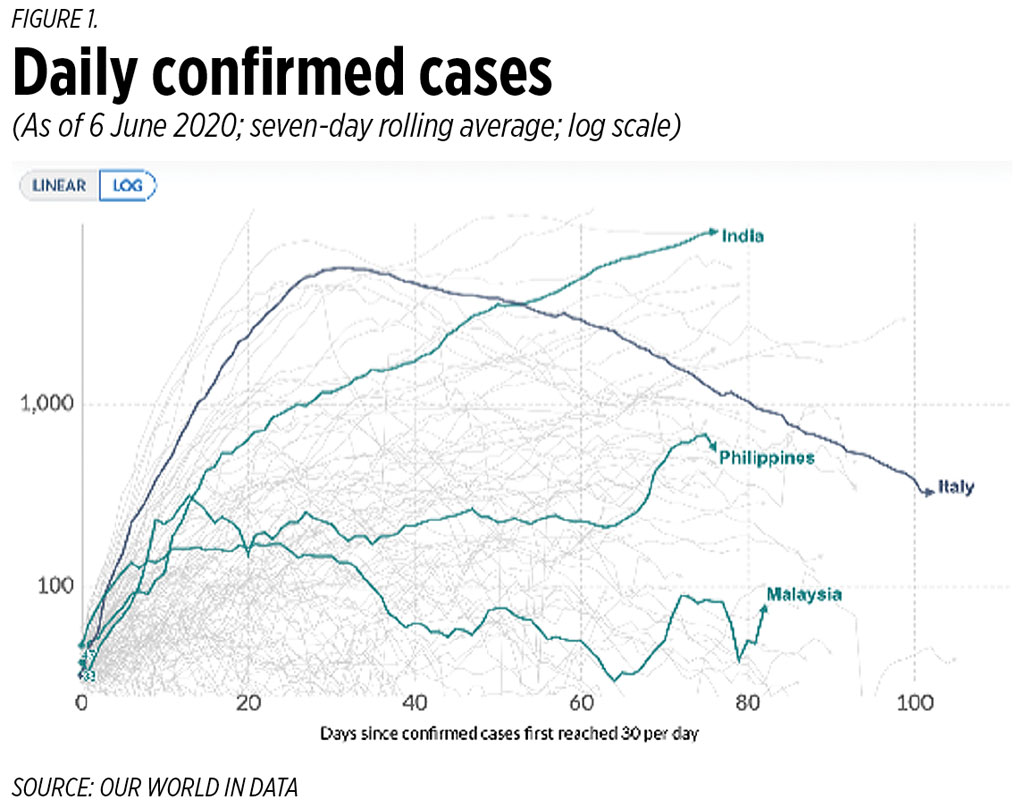
While it is true the doubling time for the number of cases has improved to a bit more than 10 days the trend has been slow and uneven, with the daily number of cases reported still rising (Figure 1). The classic case of “bending the curve” is that of Italy, while India thus far has obviously failed. Philippine case numbers are less clear cut. Daily numbers, even with averaging, have been rising significantly since late May and are higher now than at any time during the quarantine. (We now report more new daily cases than Italy.) What does the spike from late-May mean? Is this simply capturing the hidden spread through asymptomatics that is just being revealed through wider testing? Are these just late results? Or is this really a “second wave” of infections, as Duque alleges? We simply do not know. But in any case, “para sa akin…”

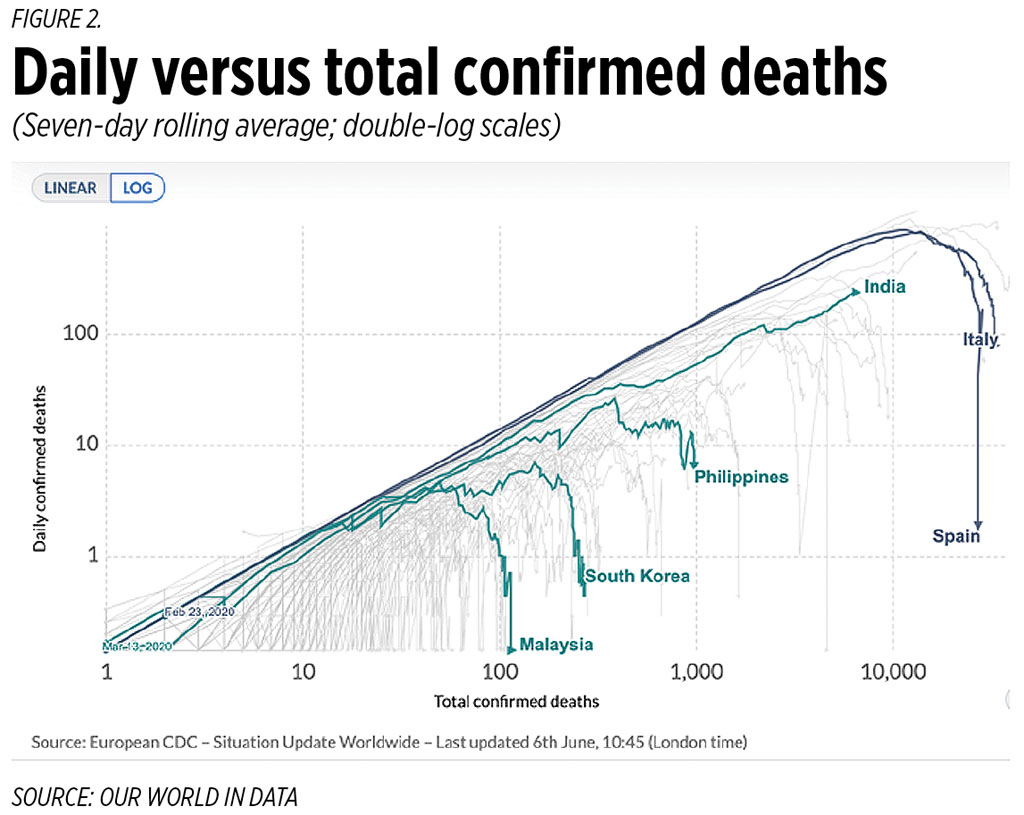
Finally, there is measured mortality, though we already know this is an underestimate. “Bending the curve” in this sense really means reducing daily confirmed deaths before the total death toll becomes too large. Malaysia essentially tamped down the daily toll to one or less around the time the total reached 100 (Figure 2). South Korea controlled it when its death toll had reached 250. Italy stabilized deaths only after these had reached 30,000, and India’s death toll is obviously still uncontrolled. The Philippines is closing on 1,000 deaths total but has not yet succeeded, although to its credit that the daily numbers are in single digits. But is this simply an artifact of poor coverage? A genuine improvement? A temporary lull? It is difficult to say. But… you know what’s next.

None of the foregoing by any means constitutes an argument to prolong the lockdown. It is simply to ask why and when it was sound to relax it and what role, if any, science played in the decision. Only compare this with the way Merkel’s Germany decided on their opening up based on a regular and public monitoring of their effective viral reproduction number (the so-called Rt). Similarly, with proper science, things could have gone the other way: if random testing had revealed that the prevalence rate including asymptomatics was wider but only spreading slowly or locally; if the real mortality rate was in fact lower and definitely falling; if the actual reproduction number was known and seen to be dropping — then perhaps the quarantine could have been safely lifted even sooner, thus lessening the economic damage and human cost.

But instead the quarantine was relaxed based more or less on hope and a prayer — an expected result when determined lobbying meets shaky science — with the final decision being made by the gut feel of a strongman. Have we opened up too soon, or too late? How safe or dangerous is it to go out? Who knows? We only have the say-so of authorities whose advice to citizens echoes that of Paul to the Philippians (later to haunt Kierkegaard): “Work out your own salvation in fear and trembling.”


Emmanuel S. de Dios is professor emeritus at the University of the Philippines.

ADVERTISEMENT
ADVERTISEMENT