Home Blog Page 922

Philippines central bank projects current account deficit at 3.3% of GDP

BW FILE PHOTO

MANILA – The Philippine central bank projected on Wednesday that the country will post a current account deficit equal to 3.3% of gross domestic product (GDP) in 2025, with a balance of payments deficit of $6.9 billion, equivalent to 1.4% of GDP.

In 2026, the current account deficit is expected to narrow to 2.9% of GDP, while the balance of payments deficit is anticipated to be $3.4 billion, representing 0.6% of GDP. — Reuters

Philippine manufacturing PMI deteriorates in September, first contraction in 6 months

REUTERS

FACTORY ACTIVITY in the Philippines contracted for the first time in six months in September, as manufacturers saw a drop in output and new orders, S&P Global said on Wednesday.

The S&P Global Philippines Manufacturing Purchasing Managers’ Index (PMI) stood at 49.9 in September, from 50.8 in August.

A PMI reading below 50 shows a deterioration in operating conditions from the preceding month, while a reading above 50 denotes better operating conditions.

This was the second contraction this year or since the 49.4 reading in March, as manufacturers cut output amid uncertainty surrounding US tariff policies at the time.

The Philippines PMI survey data showed the manufacturing sector moving into negative territory at the end of the third quarter which, despite indicating only a fractional decline, has been highly unusual in the sector’s post-pandemic history,” David Owen, senior economist at S&P Global Market Intelligence, said,”

David Owen, senior economist at S&P Global Market Intelligence, said.

“New orders and output decreased slightly, as firms mentioned a fall in client numbers and a modest drop in production from the suspension of rice imports,” he added.

According to S&P Global, this was only the third time in over four years that the Philippines’ manufacturing PMI fell below 50.” — Aubrey Rose A. Inosante

LEDAC identifies 44 priority bills, including general tax amnesty and amendments to bank secrecy law

By Chloe Mari A. Hufana, Reporter

President Ferdinand R. Marcos, Jr. and Congress leaders identified 44 priority bills under the Common Legislative Agenda of the 20th Congress, including a general tax amnesty, excise tax on single-use plastics, as well as amendments to the Bank Deposit Secrecy law and Anti-Money Laundering Act.

The legislative priorities are aimed at improving the investment climate, modernizing governance, helping farmers and fisherfolk, expand social services, and ensure energy security, according to a statement from the Presidential Communications Office following a meeting of the Legislative-Executive Development Advisory Council (LEDAC) in Malacañang on Tuesday.

“Governance and transparency remain central to the Common Legislative Agenda,” the Palace said.

Key measures in the list include proposed amendments to the Bank Deposits Secrecy Law and the Anti-Money Laundering Act, which are expected to improve compliance with global standards, potentially boosting the Philippines’ standing with credit raters and multilateral lenders.

A Progressive Budgeting bill and proposals requiring civil servants to waive bank secrecy protections are also on the table to strengthen fiscal discipline and curb graft, as the Philippines currently probes a massive corruption scheme within government ranks.

“These, together with the proposed tax amnesties, reforms on civil service accountability such as requiring bank secrecy waivers, and the Magna Carta for Barangays, are intended to modernize institutions, strengthen fiscal responsibility, and promote accountability,” it added.

Digital economy measures, including a Cybersecurity Act, a Digital Payments Act, and legislation on online gambling and artificial intelligence use in elections, were also included as LEDAC priorities.

“These initiatives are intended to secure online transactions, promote innovation, and ensure the safe and responsible use of digital platforms in governance and public life,” the Palace said.

The 44 Common Legislative Agenda measures are:

1. Amendments to the Coconut Farmers and Industry Trust Fund Act
2. Amendments to the Pantawid Pamilyang Pilipino Program (4Ps) Act
3. Department of Water Resources (DWR) Bill
4. Waste-to-Energy Bill
5. EPIRA Amendments: Energy Regulatory Commission (ERC) Strengthening Bill
6. National Land Use Act
7. Excise Tax on Single-Use Plastics
8. Blue Economy Act
9. Amendments to the Bank Deposits Secrecy Law
10. Progressive Budgeting for Better and Modernized Governance Act
11. Right to Information Act
12. Amendments to the Anti-Money Laundering Act
13. Philippine Civil Registration and Vital Statistics Act
14. Amendments to the Universal Health Care (UHC) Act
15. National Center for Geriatric Health
16. Assistance to Individuals in Crisis Situations (AICS) Act
17. Amendments to the Masustansyang Pagkain Para sa Batang Pilipino Act
18. Amendments to the Government Assistance to Students and Teachers in Private Education Act
19. Amendments to the Universal Access to Quality Tertiary Education Act
20. Amendments to the Teachers Professionalization Act
21. Amendments to the Local Government Code (Comprehensive)
22. General Tax Amnesty
23. Extension of Estate Tax Amnesty
24. Amendments to the Fisheries Code
25. Amendments to the Rice Tariffication Law or Rice Industry and Consumer Empowerment (RICE) Act, including AAES Act minor amendments (Comprehensive)
26. Amendments to the Downstream Oil Industry Deregulation Law
27. Amendments to the Biofuels Act
28. Cybersecurity Act
29. Amendments to the National Building Code
30. Amendments to the Magna Carta for MSMEs
31. National Reintegration Bill
32. Reprogramming of Seal of Good Local Governance
33. Digital Payments Act
34. Masterplan for Infrastructure and National Development
35. Classroom-Building Acceleration Program Act
36. Requiring Civil Servants to Waive Bank Secrecy
37. Law on Online Gambling
38. Disaster Risk Financing Insurance
39. Strengthening the Bases Conversion and Development Authority
40. Presidential Merit Scholarship Program
41. Disqualifying Relatives of Officials (4th degree) in Government Contracts
42. Fair Use of Social Media, AI and Internet Technology in Elections
43. Modernizing the Bureau of Immigration
44. Magna Carta for Barangays

Over 1,000 Filipino students to benefit from landmark program building pathways to green jobs

JPMorganChase, Junior Achievement of the Philippines and the Department of Education (DepEd) today launched Career Connect, a landmark program focused on building pathways to green jobs.

The initiative — covering schools in Manila and Cebu and supporting over 1,000 students — aims to equip young Filipinos with the skills, confidence and opportunities to succeed in the growing green economy.

Backed by leading financial services firm JPMorganChase and its network of employee volunteers, Career Connect combines training, mentorship and industry exposure to prepare students for sustainable careers. Beyond employability, it fosters leadership, problem-solving and awareness of environmental responsibility — helping to ensure that participants are ready not just for jobs, but for lifelong impact.

“Career Connect is about building pathways for young people into the jobs of the future,” said Krishna Alejandrino, executive director of JA Philippines. “Through the support of JPMorganChase and DepEd, we are preparing students not only to succeed in their careers, but to become leaders who will shape a more sustainable future for our country.”

“Our global programs such as Career Connect, encapsulates our vision for a brighter future for disadvantaged youth in the Philippines. By sparking their curiosity about emerging fields like the green economy, we hope to encourage them to pursue careers in and develop solutions for this growing sector. In addition, we hope to strengthen our commitment to the communities where we live and work by engaging our own employee volunteers in this meaningful endeavor,” said Bettina Salmo, head of JPMorganChase’s Corporate Centers in the Philippines.

Distinguished guests included Dr. Dexter A. Galban, assistant secretary for Strategic Management at DepEd; Atty. Fiel Y. Almendra, assistant regional director, DepEd Region 7; and senior executives from JPMorganChase in the Philippines.


Spotlight is BusinessWorld’s sponsored section that allows advertisers to amplify their brand and connect with BusinessWorld’s audience by publishing their stories on the BusinessWorld Web site. For more information, send an email to online@bworldonline.com.

Join us on Viber at https://bit.ly/3hv6bLA to get more updates and subscribe to BusinessWorld’s titles and get exclusive content through www.bworld-x.com.

Moderate US job openings, weak hiring underscore labor market stagnation

People shop at a UNIQLO store in New York City, New York, U.S., March 15, 2019. — REUTERS/BRENDAN MCDERMID/FILE PHOTO

WASHINGTON – US job openings increased marginally in August while hiring declined, consistent with lackluster labor market conditions that could allow the Federal Reserve to cut interest rates again next month despite resilient consumer spending.

Households are also growing pessimistic about the labor market. A survey from the Conference Board on Tuesday showed the share of consumers viewing jobs as “plentiful” fell this month to the lowest level since early 2021. There were 0.98 job openings for every unemployed person in August compared to 1.0 in July.

The labor market has almost stagnated amid slowing demand for workers, with economists blaming a lagging drag from uncertainty stemming from tariffs on imports as well as the rise of artificial intelligence. An immigration crackdown has also reduced labor supply, creating what Fed Chair Jerome Powell has described as a “curious balance.”

“The labor market remains lethargic but is not getting rapidly sicker,” said Samuel Tombs, chief US economist at Pantheon Macroeconomics.

Job openings, a measure of labor demand, rose 19,000 to 7.227 million by the last day of August, the Labor Department’s Bureau of Labor Statistics said in its Job Openings and Labor Turnover Survey, or JOLTS report. Economists polled by Reuters had forecast 7.185 million unfilled jobs.

With the government likely to shut down when funding runs out at midnight on Tuesday, the report could be the last key economic data for a while. The Labor and Commerce departments said on Monday all data releases, including September’s employment report due on Friday, would be suspended.

Job openings decreased 115,000 in the construction sector but were partly offset by a 106,000 increase in unfilled positions in the accommodation and food services industry.

There were also more vacancies at retailers as well as in state and local government, excluding education. But federal government job openings fell 61,000 amid spending cuts. The job openings rate was unchanged at 4.3%.

Hiring decreased 114,000 to 5.126 million in August, concentrated in the trade, transportation and utilities industry. Accommodation and food services hiring also declined, likely the result of immigration raids that have led to deportations and kept fearful workers at home.

EMPLOYERS HOLDING ON TO WORKERS
The hires rate fell to 3.2% from 3.3%. Employers continued to hold on to their workers, with layoffs dropping 62,000 to 1.725 million. There were fewer layoffs in the trade, transportation and utilities industry. The layoffs rate was unchanged at 1.1% for a third straight month.

Weak hiring, however, means people who lose their jobs will have a tough time finding new opportunities. The Conference Board survey showed the share of consumers viewing jobs as plentiful dropped to 26.9% this month, the lowest level since February 2021, from 30.2% in August. There was no change in the proportion perceiving jobs as “hard” to get.

The survey’s so-called labor market differential, derived from data on respondents’ views on whether jobs are plentiful or hard to get, narrowed to a more than 4-1/2-year low of 7.8 from 11.1 last month. This measure correlates to the unemployment rate in the Labor Department’s monthly employment report.

Economists said this suggested the jobless rate could rise further after climbing to 4.3% in August. The US central bank resumed easing policy this month, cutting its benchmark overnight interest rate by 25 basis points to the 4.00%-4.25% range, to aid the labor market.

Nonfarm payroll gains averaged only 29,000 jobs per month in the three months to August compared to 82,000 during the same period last year. But a raft of fairly strong reports, including second-quarter gross domestic product and August consumer spending, raised questions about whether more rate reductions were warranted this year.

Economists expect the Fed to put more emphasis on the labor market, though a government shutdown would leave policymakers without key data ahead of their October 28-29 meeting.

“The Fed has a bias to cut unless the labor market shows signs of improvement, but the fog the central bank sets monetary policy in may get thicker because the partial federal government shutdown could delay the release of the September employment report,” said Ryan Sweet, chief US economist at Oxford Economics.

Workers are remaining in their jobs, with resignations declining for the third straight month to a nine-month low.

The quits rate, a gauge of labor market confidence, fell to an eight-month low of 1.9% having held at 2.0% for three consecutive months. That also suggested slower wage growth, which could undercut consumer spending, the economy’s engine.

Indeed, the Conference Board survey showed consumers less inclined to make big-ticket purchases like motor vehicles and major appliances like refrigerators and washing machines over the next six months. Fewer planned to spend on travel-related services. Overall consumer confidence hit a five-month low.

“Consumer confidence is a factor in determining consumer spending, but it is not the dominant factor,” said Carl Weinberg, chief economist at High Frequency Economics. “Rattled consumers spend less than confident consumers.” — Reuters

OPEC+ mulls speeding up oil output hikes again, sources say

MODELS of oil barrels and a pump jack are displayed in this illustration photo taken on Feb. 24, 2022. — REUTERS

LONDON – OPEC+ may speed up production increases in November from the 137,000 barrels per day hike it made for October at its meeting on Sunday as its leader Saudi Arabia pushes to regain market share, three sources familiar with the talks said.

The group has made no final decision yet and member Russia could oppose a larger increase because it is unable to raise output owing to Western sanctions and is worried about weakening seasonal demand, one of the three sources said.

Eight members of OPEC+ could agree to raise production in November by 274,000-411,000 bpd, or two or three times higher than the October increase, two of the three sources said. OPEC+ pumps about half of the world’s oil.

WINDING DOWN LAYERS OF CUTS
The increase could be as big as 500,000 bpd, one of the three sources said.

Earlier on Tuesday, Bloomberg News reported that OPEC+ was considering accelerating its increases by 500,000 bpd.

OPEC in a post on X said it rejected media reports for plans to raise output by 500,000 bpd, calling them inaccurate and misleading.

Authorities in Saudi Arabia did not immediately respond to a request for comment.

OPEC+ in April reversed its strategy of output cuts and has already raised quotas by more than 2.5 million bpd, or about 2.4% of world demand, to boost market share and following pressure from U.S. President Donald Trump to lower oil prices.

The group has raised output in monthly chunks ranging from as little as 137,000 bpd to as much as 548,000 bpd.

Eight OPEC+ countries will hold an online meeting on October 5 to decide on November output. OPEC+ includes the Organization of the Petroleum Exporting Countries, Russia and other allies.

At their peak, OPEC+’s total output reductions amounted to 5.85 million bpd, made up of three different elements – voluntary cuts of 2.2 million bpd, plus 1.65 million bpd by eight members, and another 2.0 million bpd by the whole group.

The eight producers plan to fully unwind one element of those cuts – 2.2 million bpd – by the end of September. For October, they started removing a second layer, of 1.65 million bpd, with the increase of 137,000 bpd. — Reuters

Death toll rises after powerful quake hits Cebu province

Rescue personnel stand in front of a crack in a road caused by a magnitude 6.9 quake, in Daanbantayan, Cebu Province, Philippines, Oct. 1, 2025. Municipality of Daanbantayan/Handout via REUTERS

MANILA – The death toll from a powerful 6.9-magnitude earthquake in the central Philippines has risen to 27 with more than 140 people injured, and officials on Wednesday warned the numbers could climb further as rescuers access collapsed buildings.

The earthquake struck off the coast of Bogo City in Cebu province in the central Visayas region just before 10 p.m. (1400 GMT) on Tuesday, causing power outages and bringing down buildings, including a church that was more than 100 years old.

Cebu province, one of the Philippines’ most popular tourist destinations, is home to 3.4 million people. Mactan-Cebu International Airport, the country’s second busiest gateway, remained operational.

The quake struck hardest in northern Cebu, including San Remigio, which was placed under a state of calamity to facilitate response and relief efforts.

Alfie Reynes, vice mayor of San Remigio, appealed for food and water for evacuees, as well as heavy equipment to aid search and rescue workers.

“It is raining heavily and there is no electricity so we really need help, especially in the northern part because there’s a scarcity of water after supply lines were damaged by the earthquake,” Reynes told DZMM radio.

In the neighbouring city of Bogo, near the epicenter of the quake, hospital patients were evacuated and strong aftershocks forced many residents to stay in evacuation centres and out on the streets.

Earthquake monitoring agencies put the quake’s depth at around 10 km (6.2 miles) and recorded multiple aftershocks, the strongest having a magnitude of 6. There was no tsunami threat following the quake.

The Philippines lies in the Pacific “Ring of Fire,” where volcanic activity and earthquakes are common. The country had two major earthquakes in January, with no casualties reported. In 2023, a 6.7 magnitude offshore earthquake killed eight people. — Reuters

Trade deficit hits 6-month low in Aug.

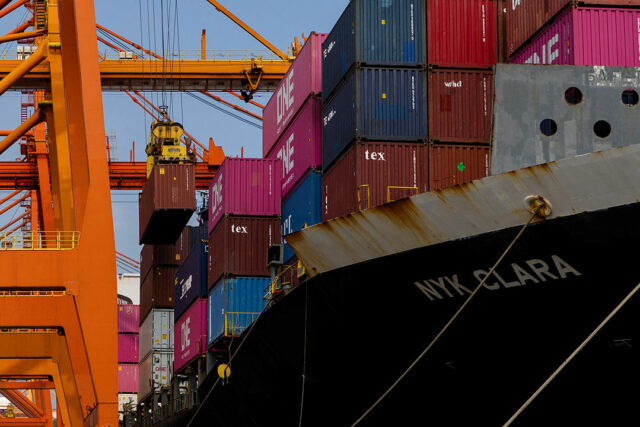
A container is loaded at the Manila International Container Terminal at the Port of Manila, Aug. 11, 2025. — REUTERS/ELOISA LOPEZ

By Lourdes O. Pilar, Researcher

THE Philippines’ trade deficit in goods shrank to a six-month low in August, as exports increased while imports fell, the Philippine Statistics Authority (PSA) reported on Tuesday.

Preliminary data from the PSA showed the country’s trade-in-goods deficit — the difference between exports and imports — narrowed to $3.54 billion in August. This is 19.4% down from the $4.4-billion deficit in the same month in 2024.

Month on month, the trade gap shrank from the revised $4.42 billion in July.

Philippine Merchandise Trade Performance (August 2025)

August saw the narrowest trade deficit since the $2.97-billion gap in February 2025.

Exports went up by 4.6% to $7.06 billion in August, slowing from the 17.6% increase in July but faster than the 0.4% growth in August 2024.

This was the slowest pace of export growth in eight months or since the 1.9% drop in December 2024.

In terms of value, outbound trade in goods in August is the smallest in four months or since the $6.78 billion recorded in April.

On the other hand, imports in August fell by an annual 4.9% to $10.6 billion, ending two straight months of growth. This was also a reversal of the 2.9% growth in August 2024, and the sharpest decline in 14 months or since the 7.2% slump in June 2024.

Import value was the lowest in six months or since the $9.76 billion in February 2025

8-MONTH TRADE GAP
For the first eight months, the trade deficit narrowed to $32.38 billion, 5.7% lower than the $34.33-billion deficit during the same period a year ago.

The country’s trade balance has been in deficit for over a decade or since the $64.95-million surplus recorded in May 2015.

For the January-to-August period, total outbound sales of Philippine-made goods increased by 12.6% to $55.7 billion, while imports rose by 5.1% to $88.08 billion.

The Development Budget Coordination Committee (DBCC) projects a 2% contraction in exports and 3.5% growth in imports this year.

“The narrowing of the country’s trade deficit in August, compared with a year ago, can be attributed to weak import growth. Although exports grew by 4.6% year on year, the 4.9% decline in imports resulted in a smaller deficit in August,” Cid L. Terosa, senior economist at the University of Asia and the Pacific, said in an e-mail.

He said that export growth slowed in August due to the implementation of US tariffs, which led to economic uncertainty, business caution, and market hesitation.

“Slow export growth in August can also be attributed to trade tensions that continue to strain the global economy. The weak growth trajectory of the global economy has hindered export growth in many developing countries, including the Philippines,” added Mr. Terosa.

The US began imposing a 19% tariff on Philippine goods starting Aug. 7.

Pantheon Macroeconomics Chief Emerging Asia Economist Miguel Chanco said in an e-mail that the trade deficit was mainly caused by a “substantial pullback in imports month to month,” reflecting “quite a severe deterioration in domestic demand” in the third quarter.

“While the narrower deficit is welcome from the standpoint of the peso, its real economic implications are quite concerning,” he said.

Ruben Carlo O. Asuncion, chief economist at Union Bank of the Philippines said that the trade deficit narrowed because of stronger exports and a notable drop in imports.

“Export growth was led by electronics, gold, and mineral products, while imports declined due to lower fuel and raw material purchases,” said Mr. Asuncion.

He noted the decline in imports reflected weaker domestic demand and lower global commodity prices. On the other hand, export growth moderated due to softer demand and base effects, he added.

In August, manufactured goods, which accounted for the bulk of the country’s total export receipts, rose by 2.3% year on year to $5.61 billion.

Electronic products, which made up almost three-fourths of manufactured goods and more than half of total exports in August, grew by 8.5% to $3.87 billion.

Almost half of total exports came from semiconductors, which jumped by 12% to $3.02 billion.

Exports of mineral products also expanded by 25% to $728.16 million in August, while petroleum products declined by 18.8% to $22.78 million.

Hong Kong was the main destination of Philippine-made goods in August, accounting for 16.9% or $1.19 billion in export sales. Other top export destinations were the United States, which accounted for 15.4% or $1.09 billion and Japan, which accounted for 13.9% or $979 million.

DECLINE IN IMPORTS
Meanwhile, imports of raw materials and intermediate goods in August fell by 6.2% to $3.82 billion. These accounted for 36% of the total August import bill.

In August, imports of capital goods grew by 8% to $3.24 billion, while the imports of consumer goods also increased by 3.1% to $2.31 billion.

Imports of mineral fuels, lubricants and related materials fell by 34.2% year on year to $1.18 billion.

China was the top source of imports, accounting for 30.1% of the total or $3.19 billion of the total import bill in August. It was followed by South Korea with an 8% share or $848.93 million and Indonesia with 7.9% or $838.78 million.

Mr. Terosa said the decline in imports can be attributed to the weaker peso, which made imports more expensive.

“The ‘wait-and-see’ attitude of businesses, due to economic uncertainties caused by US tariffs, has led to lower purchases of capital goods, mineral fuels, transport equipment, and other manufactured goods and raw materials,” he said, adding that slowing global growth also dampened trade prospects.

Philippine Exporters Confederation, Inc. President Sergio R. Ortiz-Luis, Jr. said imports may have declined due to restrictions on agricultural imports, such as rice. He also noted imports of raw materials have also declined amid a slowdown in manufacturing, construction and infrastructure projects.

“It is a question of confidence. For investors and tourists there is a loss of confidence. We are the last choice now,” Mr. Ortiz-Luis said.

The outlook for trade remains cloudy amid global uncertainties, analysts said.

“Downside risks prevail, particularly if the US imposes a sector-wide targeted tariff on its semiconductor imports, which could greatly affect the Philippines’ own chip shipments,” Mr. Chanco said.

He noted the DBCC’s projected 2% contraction in exports this year is “overly harsh,” while the 3.5% growth forecast for imports is reasonable.

Mr. Asuncion said the DBCC’s full-year projections can still be achieved, but risks persist.

“Looking ahead, trade performance will hinge on global demand for electronics, commodity price movements, and domestic consumption trends. Exchange rate dynamics and geopolitical developments may also influence trade flows in the coming months,” Mr. Asuncion said.

“If global demand softens further, and commodity prices remain subdued, both exports and imports could decelerate in the fourth quarter.”


NG outstanding debt slips to P17.47 trillion at end-August

THE National Government’s outstanding debt fell by P95 billion or 0.5% to P17.47 trillion as of end-August. — REUTERS/ROMEO RANOCO

THE NATIONAL GOVERNMENT’S (NG) outstanding debt slipped to P17.47 trillion at the end of August, but still remained above the full-year projection, data from the Bureau of the Treasury (BTr) showed.

The latest data from the Treasury showed outstanding debt dipped by 0.5% in August from the record-high P17.56 trillion at end-July. 

Despite the decline, the debt level is still 0.63% higher than the projected year-end level of P17.36 trillion.

National Government Outstanding Debt

Year on year, NG debt jumped by 12.3% from P15.55 trillion at the end of August 2024, the BTr said.

“This (debt reduction) was mainly due to the government’s full repayment of its biggest local bond for the year, worth P516.34 billion, and a stronger peso, which reduced the value of the country’s external debt,” the BTr said. 

NG debt is the total amount owed by the Philippine government to creditors such as international financial institutions, development partner-countries, banks, global bondholders and other investors.

In August, the bulk or 69.2% of the debt stock came from domestic sources, while external obligations made up the rest.

“The debt reduction was accompanied by an improvement in the country’s debt profile as the share of domestic debt to total borrowings increased to 69.2% from 68.9% in the previous month,” the BTr said.

A larger share of domestic borrowings in the country’s debt profile reflects “a generally more favorable debt position” as local debt is less vulnerable to shifts in foreign exchange movements, it added.

Domestic debt, which was composed of government securities, slid by 0.2% to P12.09 trillion as of end-August from P12.11 trillion as of end-July. It also rose by 12% annually from P10.79 trillion in August last year.

This was already 0.35% higher than the P12.04-trillion year-end domestic debt projection.

“Year to date, the NG raised P1.84 trillion in gross domestic financing, including the highly successful issuance of Retail Treasury Bond Tranche 31 (RTB-31),” the BTr said.

On the other hand, external debt fell by 1.4% to P5.38 trillion in August from P5.46 trillion in the previous month. This also exceeded the P5.32-trillion external debt projection this year by 1.24%.

“The reduction was attributed primarily to the effect of a stronger peso on external guarantees. Guaranteed obligations remained well-managed at only 2% of total NG debt,” the Treasury said.

Year on year, foreign debt climbed by 13.1% from P4.76 trillion.

Foreign debt was composed mainly of P2.74 trillion in global bonds and P2.64 trillion in loans.

External debt securities were made up of P2.32 trillion in US dollar bonds, P253.39 billion in euro bonds, P58.5 billion in Japanese yen bonds, P57.04 billion in Islamic certificates and P54.77 billion in peso global bonds.

For August, NG-guaranteed obligations slipped by 1.8% to P346.46 billion from the end-July level of P352.97 billion.

Year on year, it fell by 5.5% from P366.57 billion.

Rizal Commercial Banking Corp. Chief Economist Michael L. Ricafort attributed the minimal monthly decline in outstanding debt to the net payments of large debt maturities.

“This is somewhat expected for large debt maturities paid to reduce outstanding debt but offset by new NG borrowings to finance the NG budget deficit,” he said in a Viber message.

In August, the BTr raised P507.16 billion through its RTB offering.

Mr. Ricafort warned that total outstanding debt may breach the government’s P17.36-trillion projection by yearend, citing upcoming payments for maturing securities in September.

“(It) could still go up after payment of large NG debt maturities until September 2025,” Mr. Ricafort said.

John Paolo R. Rivera, a senior research fellow at the Philippine Institute for Development Studies, said the modest decline in debt may be temporary, citing scheduled repayments and favorable foreign exchange movements.

Mr. Rivera noted that NG debt remains 12.3% higher year on year and is likely to climb further, “likely staying above” P17.4 trillion by yearend.

At the end of the second quarter, NG debt as a share of gross domestic product surged to 63.1%, the highest since 2005.

The Department of Finance  expects the NG debt-to-GDP ratio to ease to 61.3% by end-2025 and eventually fall to 58% by 2030. — Aubrey Rose A. Inosante

ADB cuts PHL growth forecast for 2026, warns corruption is a ‘heightened risk’

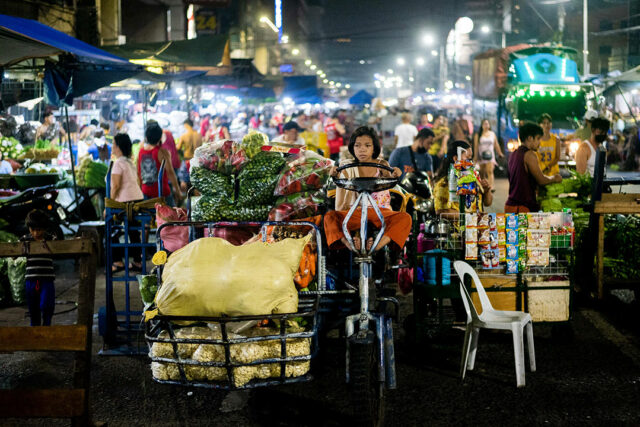
A CHILD sits on a motorized vehicle loaded with vegetables at a public market in Manila, Oct. 21, 2022. — REUTERS/LISA MARIE DAVID

By Aubrey Rose A. Inosante, Reporter

THE ASIAN Development Bank (ADB) has trimmed its gross domestic product (GDP) growth forecast for the Philippines for 2026, while keeping its projection this year, citing persistent external headwinds that weigh on investments.

At the same time, the ADB warned widespread corruption can impact economic growth and investor sentiment, saying it is a “heightened risk.”

In its latest Asian Development Outlook, the multilateral lender trimmed its Philippine growth forecast to 5.7% in 2026 from 5.8% in its July projection. This is below the Philippine government’s 6-7% growth goal for 2026.

For this year, the ADB kept its growth forecast unchanged at 5.6%, which is within the government’s 5.5 to 6.5% target.

“The Philippines’ growth outlook remains resilient amid a global environment of shifting trade and investment policies and heightened geopolitical uncertainties,” ADB Country Director for the Philippines Andrew Jeffries said in a statement on Tuesday.

“Though these uncertainties pose increased risk, we see strong domestic demand anchoring growth, with sustained investments and an accommodative monetary policy supporting the economy’s expansion.”

ADB Senior Country Economist for the Philippines Jacqueline Connell said the Philippine growth forecast for 2026 was downgraded mainly due to heightened uncertainty, shifting trade and investment policies, and lower growth outlook in major advanced economies.

“We see that this will weigh on trade and investment prospects, so that’s the main reason,” she said at a briefing on Tuesday.

Despite external challenges, domestic demand is expected to drive the Philippine economy’s growth this year, the ADB said. This is supported by easing monetary conditions which will help offset the impact of external uncertainties, it added.

In Southeast Asia, the Philippines is projected to be the second-fastest-growing economy until 2026, just behind Vietnam (6%).

It is ahead of Cambodia (5%), Indonesia (5%), Malaysia (4.2%), Lao PDR (3.8%), Timor Leste (3.4%), Myanmar (2%),  Thailand (1.6%),  Brunei Darussalam (1.5%), and Singapore (1.4%).

The Philippines’ growth forecast is also above the ADB’s projection for developing Asia, which is expected to grow 4.5% in 2026 and 4.8% this year. The region includes 46 Asia-Pacific countries, but excludes Japan, Australia and New Zealand.

“Heightened geopolitical tensions, adverse weather conditions, and climate shocks also pose risks which could drive commodity prices higher,” ADB Senior Economics Officer Teresa B. Mendoza said.

At the same time, the ADB sees headline inflation averaging 1.8% this year and 3.2% in 2026. This is slightly higher than the Bangko Sentral ng Pilipinas’ (BSP) 1.7% average forecast for 2025 but lower than 3.3% for next year.

Ms. Mendoza said monetary policy will likely remain accommodative as inflation remains moderate.

For the first eight months, headline inflation averaged 1.7%.

Since August 2024, the BSP has lowered borrowing costs by a total of 150 basis points, bringing the benchmark rate to 5%.

“Continued investment and leveraging on wide-reaching structural reforms that we have seen over the past few years up to this year are essential to lifting growth, generating quality jobs, and reducing productivity and demand,” Ms. Mendoza said.

She cited new laws such as the Accelerated and Reformed Right-of-Way (ARROW) Act that will help speed up infrastructure projects.

CORRUPTION
Meanwhile, corruption remains a “heightened risk” in the Philippines, according to the ADB.

“More broadly, corruption has broad impacts on economic growth in general and investment sentiment. We’re monitoring that and how that may be affected going forward,” Mr. Jeffries said, when asked why there was no mention of governance issues despite a widening corruption scandal involving government projects.

There is growing scrutiny of billions of pesos in flood control projects, with multiple congressional committees and the Palace-backed Independent Commission for Infrastructure probing allegations of corruption.

Finance Secretary Ralph G. Recto earlier said corruption related to flood control projects had cost the Philippines P42.3 billion to P118.5 billion in economic losses annually since 2023.

Mr. Jeffries said there was no reason to cut the Philippine GDP projections due to the corruption scandal. “Between now and our December update, there may be more quantifiable data available that may alter our projections,” he added.

He also assured that the ADB’s partnership with the Philippines remains unaffected.

“We have very strong due diligence on the financial management capabilities of our borrowers and any gaps found are built into the project to mitigate financial management risks,” he added.

Mr. Jeffries said the bank has a joint agreement with the World Bank Group to cross-debar contractors found to have violated project guidelines or engaged in questionable conduct.

“If we find such contractors through our project processes, we debar them from future participation for a certain amount of time. The World Bank follows suit and vice versa,” he said.

While the ADB does not maintain a formal blacklist, Mr. Jeffries said all contractors are vetted against debarment lists and flagged for potential links to money laundering or other financial risks.

“Now that said, if there is an officially sanctioned government blacklist, we would honor such a list and take that into account. But it would need to be officially sanctioned and not just a list of firms in the press, so to speak,” he added.

There are 25 Infrastructure Flagship Projects funded by the ADB in support of the Marcos administration’s “Build Better More” Program.

Inflation may have picked up in September

Headline inflation averaged 1.7% in the first eight months. — PHILIPPINE STAR/MIGUEL DE GUZMAN

BAD WEATHER continued to push up food and electricity prices in September, potentially bringing headline inflation back within he central bank’s target band, Metropolitan Bank Trust & Co. (Metrobank) said.

In a commentary on Monday, Metrobank said it expects inflation to pick up to 2.5% in September from 1.5% in August and 1.9% in September 2024.

If realized, September’s print would mark the first time in six months that inflation would have settled within the Bangko Sentral ng Pilipinas’ (BSP) 2-4% target range or since the 2.1% in February.

“Though rice inflation will remain in negative territory, food and energy will likely be the primary drivers of faster price growth for the month,” Metrobank said.

Metrobank said heavy rains and typhoons may have pushed up food prices, particularly vegetables and fish.

“Prices of vegetables and fish shot up significantly, with vegetable prices seeing a particularly dramatic rise compared with last year’s weaker price base. Meanwhile, the price of meat continued its upward trend, albeit at a slower pace,” it said.

However, the prices of fruits were “relatively stable” on a year-on-year basis, it added.

Metrobank said rice inflation will continue to soften, contrary to earlier projections, as record-high supply levels stabilized global prices.

“In the local space, rice prices also continue to drop amid the harvest season,” it added.

In August, rice inflation declined at a faster pace of -17% from -15.9% in July.

Agriculture Secretary Francisco P. Tiu Laurel, Jr. said on Monday that they have extended the rice import ban by 30 days and are looking to extend it until yearend amid falling farmgate prices of unmilled rice.

The 60-day suspension on regular milled and well-milled rice imports, which took effect on Sept. 1, was supposed to end on Nov. 2.

“Despite the ongoing import ban, sustained deflation in rice prices this month will continue to temper headline inflation,” Metrobank said.

Meanwhile, energy prices also likely drove inflation faster in September.

“While Meralco (Manila Electric Co.) electricity prices were lower month on month in September, rates remained elevated compared with last year. Visayas Electric and Davao Light also saw higher prices for the month, attributed to power plant outages across the country,” Metrobank said.

Meralco lowered electricity rates by P0.1852 per kilowatt-hour (kWh) in September, bringing the overall rate for a typical household to P13.0851 per kWh from P13.2703 per kWh a month ago.

Metrobank said the National Capital Region also saw an increase in pump prices of unleaded gasoline and diesel amid geopolitical tensions and dwindling supply.

The Philippine Statistics Authority is set to release September inflation data on Tuesday, Oct. 7. — Katherine K. Chan

ePLDT says 12th data center set to be largest; study to finish this year

STOCK PHOTO | Image by Wirestock from Freepik

By Ashley Erika O. Jose, Reporter

ePLDT Inc., the information and communications technology (ICT) arm of PLDT Inc., is aiming to finish the study for its 12th data center site in Cavite this year, which is targeted to double the capacity of its largest data center to date.

“We are checking the potential site. What we are doing now is what you call a vulnerability and risk assessment. It is a formal study that we are conducting,” ePLDT President and Chief Executive Officer Victor S. Genuino told reporters on the sidelines of the Pilipinas AI launch on Monday.

The 12th data center, expected to rise in General Trias, Cavite, will be ePLDT’s largest once completed, with a planned capacity of about 100 megawatts (MW), double the current 50-MW capacity of VITRO Sta. Rosa. VITRO Sta. Rosa, located on a five-hectare lot in Sta. Rosa, Laguna, is considered the country’s largest data center campus.

The company is optimistic construction for the planned site will start next year, once the study is completed, Mr. Genuino said.

“We are hopeful that with data sovereignty and everything we can accelerate and fill up our VITRO Sta. Rosa. Once it reaches a certain capacity of occupants and customers, then we can trigger the discussion on our data center 12,” he added.

Mr. Genuino also said the company is carefully evaluating trends for the new data center to ensure it uses the latest technology.

“We have to look at the site, obviously, the site location, and then we have to monitor the trends in technology. So that when we build something, we want to ensure that it is not old technology, it will be new technology,” he said.

In April, the company said construction for its next data center is scheduled to begin in 2026, with completion expected by 2028. The project will be scaled up in phases, starting at 20 MW.

VITRO, Inc., ePLDT’s data center arm and a PLDT group subsidiary, currently operates 11 data centers across the Philippines — including in Makati, Taguig, Pasig, Parañaque, Subic, Clark, Cebu, and Davao — with a combined capacity of nearly 100 MW, supporting enterprise and hyperscale demand.

Mr. Genuino said discussions to sell a stake in ePLDT’s data center assets are ongoing.

“We have an ongoing discussion. We are just trying to find the right partner for our data center assets. It is a very critical asset. We just want to find the right partner for it,” he said.

In August, PLDT Chairman Manuel V. Pangilinan said the company had resumed talks to sell a stake in its data center business.

ePLDT is currently negotiating with several companies to sell 49% of its data center business, valued at $1 billion.

Hastings Holdings, Inc., a unit of the PLDT Beneficial Trust Fund subsidiary MediaQuest Holdings, Inc., holds a majority stake in BusinessWorld through the Philippine Star Group, which it controls.

ADVERTISEMENT
ADVERTISEMENT