Home Blog Page 913

Philippine military spending vs regional neighbors: How does it stack up?

The Philippines’ military expenditure expanded by almost a fifth to $6.12 billion last year from $5.14 billion in 2023, the Stockholm International Peace Research Institute (SIPRI) database showed. This was equivalent to a military burden — share of military spending to gross domestic product (GDP) — of 1.3% in 2024.

Philippine military spending vs regional neighbors: How does it stack up?

Airline fuel surcharge unchanged for July

PHILIPPINE STAR/ WALTER BOLLOZOS

AIRFARES are likely to remain steady as the Civil Aeronautics Board (CAB) maintained the fuel surcharge at Level 3 for the month of July.

In an advisory on Wednesday, CAB said the passenger and cargo fuel surcharge for domestic and international flights will remain at Level 3 from July 1 to 30.

At this level, the passenger surcharge for domestic flights ranges from P83 to P300, while for international flights, it ranges from P273.36 to P2,032.54.

Since 2024, CAB has downgraded the fuel surcharge to Level 3 only twice — for June and July.

For airlines collecting the surcharge in foreign currency, the applicable conversion rate is P55.64 to the dollar, CAB said.

Fuel surcharges are adjusted based on the movement of jet fuel prices, using the Mean of Platts Singapore (MOPS) as the benchmark.

According to the International Air Transport Association (IATA), the global average jet fuel price rose by 2.2% week on week to $83.68 per barrel as of June 13. Year on year, the average price was down by 15.5%.

In a report dated June 2, IATA said the global aviation industry is expected to post strong growth, supported by declining jet fuel prices and the easing of visa restrictions.

Jet fuel is projected to average $86 per barrel in 2025, lower than the $99 average in 2024, IATA said. This could bring the industry’s total fuel bill to $236 billion, accounting for 25.8% of airline operating costs. — Ashley Erika O. Jose

Value of InstaPay, PESONet transactions surges to P9 trillion as of May

REUTERS

THE COMBINED VALUE of transactions done via InstaPay and PESONet rose by 37.06% year on year to exceed P9 trillion in the first five months of 2025, latest data from the Bangko Sentral ng Pilipinas (BSP) showed.

Transactions coursed through the two automated clearing houses surged to P9.13 trillion at end-May from P6.66 trillion in the same period a year ago, central bank data showed.

Meanwhile, the volume of transactions made via InstaPay and PESONet more than doubled to 1.206 billion in the five-month period from 542.28 million a year prior.

Broken down, the value of transactions done through PESONet stood at P5.06 trillion as of May, 28.17% higher than the P3.96 trillion recorded in the same period the previous year.

The total volume of PESONet transactions also climbed by 15.92% year on year to 46.65 million in the period from 40.25 million previously.

Meanwhile, the total value of InstaPay transactions jumped by 50.05% year on year to P4.06 trillion at end-May from P2.71 trillion a year prior.

The volume of transactions that went through the payment gateway likewise surged by 130.96% to 1.16 billion in the first five months of the year from 502.04 million in the comparable year-ago period.

InstaPay and PESONet are automated clearing houses that were launched in December 2015 under the central bank’s National Retail Payment System framework.

PESONet is mainly used for high-value transactions and may be considered as an electronic alternative to paper-based checks.

Meanwhile, InstaPay is a real-time, low-value electronic fund transfer facility for transactions up to P50,000 and is mostly used for remittances and e-commerce.

The increase in InstaPay and PESONet transactions seen in the first five months of 2025 reflects the continued growth in online payments that was accelerated by mobility restrictions due to the coronavirus pandemic, Rizal Commercial Banking Corp. Chief Economist Michael L. Ricafort said in a Viber message.

He added that there has been an “increased adoption of online banking and payment transactions in recent years as part of the e-commerce ecosystem and the increased shift from over-the-counter banking transactions, including the use of InstaPay and PESONet… since these are faster, safer, and more convenient for the general public from anywhere around the world, saving on costs and time in doing so.”

“The high double-digit growth rates also reflect the increased use of e-wallets by Filipinos that are already integrated in digital banking platforms as emerging payment platforms as alternative to cash, checks, and over-the-counter payment transactions,” Mr. Ricafort said.

He added that the growing adoption of digital payments can help improve financial inclusion, especially in unbanked or underbanked areas.

Latest BSP data showed digital payments made up 52.8% of the volume of retail transactions in 2023, higher than the 42.1% share in 2022. In terms of value, 55.3% of retail transactions in 2023 were done online, higher than the 40.1% the year prior.

The central bank has said the increase in digital payments was driven by wider use of online transaction channels, especially e-wallets, among individuals and businesses, with the coronavirus pandemic accelerating the shift.

The BSP wants online payments to make up 60-70% of the country’s total retail transaction volume by 2028. The share of Filipinos with bank accounts reached 65% of the adult population in 2022. — AMCS

Musk’s xAI on track to raise $5 billion in fresh debt following modest demand

ELON MUSK — REUTERS

NEW YORK — Elon Musk’s xAI is on track to close on a $5-billion debt raise led by Morgan Stanley, despite tepid investor demand, according to two people familiar with the matter.

The $5-billion debt sale, which includes a floating-rate term loan, a fixed-rate loan and secured bonds, will be allocated to investors on Wednesday, the two people said, asking not to be identified because the deal is private. xAI did not immediately respond to a request for comment while Morgan Stanley declined.

The xAI offering, which was reported on June 2 as Mr. Musk and US President Donald Trump traded barbs over social media, did not receive overwhelming interest from high-yield and leveraged loan investors, said five people briefed on the deal.

The floating-rate loan will be offered with an interest rate of 700 basis points over the Secured Overnight Financing Rate, a benchmark rate used to price bond deals, while the fixed-rate loan and secured notes will pay a yield of roughly 12%, the two people said.

The average yield-to-maturity on high-yield bonds closed on Monday at 7.6%, according to the ICE BofA High Yield Index. Mr. Musk’s AI company has to pay significantly more since xAI and its debt are not yet rated, giving investors little visibility into the company’s finances and higher risk.

Three bond investors who were offered the debt told Reuters they declined to invest. One of these investors noted that xAI has not yet turned a profit and the debt is not rated. They were especially reticent given Musk’s track record when he financed his $44 billion acquisition of social media giant X, known at the time as Twitter, in 2022. The banks that loaned him $13 billion to close the deal were forced to hold that debt on their balance sheets for two years because they could not offload it.

While the debt sold in full and on time, it received modest demand from investors, all five people said. Investors submitted orders for roughly 1.5 times the amount of debt available, according to the first two people briefed on the deal. Most similar junk bond deals have typically attracted orders for 2.5 to 3 times the loans and bonds being offered, the people said.

Unlike Mr. Musk’s debt deal when he acquired Twitter, Morgan Stanley did not guarantee how much it would sell or commit its own capital to the deal, in what is called a “best efforts” transaction, according to one person familiar with the terms.

In the Twitter acquisition, the banks ended up making money on the debt, selling it with little-to-no discount months after Mr. Trump won the White House and Mr. Musk’s influence in Washington grew.

Apart from selling debt, xAI has also been in talks to raise about $20 billion in equity, valuing the company at more than $120 billion, with some investors placing valuations as high as $200 billion, Reuters reported last week. Reuters

Demand for premium insurance rises with global travel disruptions

STOCK PHOTO | Image from Pixabay

LONDON/NEW YORK — With flight cancellations, delays and other disruptions on the rise, leisure travelers are being increasingly discerning over the level and type of insurance they buy and businesses are turning to specialist advisory services to limit risk.

Since 2019, travel disruptions around the world have risen due to everything from the coronavirus disease 2019 (COVID-19), extreme weather, volcanic eruptions, military conflict, jet safety issues, computer glitches and fires which have closed airports, grounded planes and stranded millions of passengers.

In the US, ongoing air traffic controller shortages and aging technology have caused significant disruption. In May, equipment outages, runway construction and staffing shortages caused flight cancellations, diversions and delays at Newark Liberty, one of the main airports serving New York City.

On Friday, Israel attacked Iran, forcing carriers to cancel or divert thousands of flights to avoid conflict in the Middle East.

Even with insurance, many policies specify a multitude of exemptions in the fine print.

As a result, more travelers are taking out higher-end insurance policies, often at higher premiums, to better protect themselves, according to interviews with nine travel executives, insurance companies and analysts.

“We’re in times that are quite unstable so people are canceling more frequently than previously,” said Duncan Greenfield-Turk, chief executive officer (CEO) of Global Travel Moments, a luxury travel agency based in London.

European tourists have increased their purchases of travel insurance for this summer by 3% compared with last year, according to German insurer Allianz Partners.

Squaremouth, the largest travel insurance marketplace in the US, has seen a 34% year over year increase globally in purchases of “Cancel For Any Reason” protection.

British and US holidaymakers in particular are more willing to pay a higher premium to protect their trip, said Anna Kofoed, the CEO of Travel for Allianz Partners.

About 32% more travellers globally requested an insurance quote from January to April compared to the same period in 2024, according to data from online travel insurance broker InsureMyTrip.

BUSINESSES SEEK TRAVEL ADVICE
There has also been a rise in demand for bespoke travel advice as US President Donald J. Trump has announced a number of immigration-related restrictions including tighter visa vetting procedures and travel bans.

World Travel Protection (WTP), a global firm that advises businesses on travel risk, said it has seen a rise in US residents being detained at US borders and told their documents were no longer valid as visa rules were changing.

WTP has worked with US government representatives to help those individuals return home, according to Frank Harrison, the company’s regional security director for the Americas.

“We’re seeing a very strong uptick in organizations coming to us wanting to know how to navigate the landscape of the US within the wider business,” Mr. Harrison said.

CIBT, which provides non-legal visa and immigration guidance, has seen a 50% rise in inquiries since November from companies seeking to better prepare their employees for travel to the US, according to CEO Steven Diehl.

HIGH-END INSURANCE PRODUCTS EMERGE
One of the newest areas of business is in parametric insurance, which pays compensation automatically after a “trigger” event such as a flight delay without the need to file a claim.

Parametric insurance took off in some countries during the COVID-19 pandemic and in recent months more insurers around the world have begun to offer it.

When testing the market last year, Spanish insurer Mapfre’s Mawdy unit in Ireland said about 11% more customers opted for higher-tier travel insurance packages when instant compensation was included.

Travel destinations have also spotted an opportunity in this burgeoning market.

Marriott Bonvoy’s villa rentals and waterparks offer parametric weather insurance at the point of booking, automatically paying out on rainy days.

Sensible Weather, one of the providers of such coverage, reported its weather guarantees were added to 30% of theme park bookings and 10-15% of higher-value accommodation bookings when they were offered in 2024.

In March, Squaremouth launched a new insurance product with cruise-specific benefits such as coverage for being confined on a cruise ship or missing the port of call.

“Everyone is trying to make it easier for people to understand that each trip (…) is going to have a different set of concerns whether it’s hurricanes or blizzards or what’s going on with air traffic controllers,” Suzanne Morrow, CEO of online insurance broker InsureMyTrip told Reuters. — Reuters


Footnotes

STOCK PHOTO | Image from Freepik

IN THE OLD DAYS, research papers depended a lot on library research. There were no chat sites or online searches accessible even by phone. The writer would put explanations on sources of a quote or information in the footnotes. This bit of typing was challenging in terms of spacing. Curious references like “ibid” or “op cit” precede the citation. These specific abbreviations stand for “ibidem” (or a source already cited before) and “opus citatem” referring to a cited work. (I admit I had to look them up again online.)

Financial statements are required to disclose details of certain entries that may be vague or out of the ordinary. Such items as “other income” need to be given a breakdown of their component parts. Where are these revenues derived from? These are often non-recurring and unusual transactions. “Advances to affiliates” is another entry that must detail which companies are involved and the nature of the cash given and whether it is expected to be liquidated at some future time.

In disclosures to the PSE, exits of senior officers or directors are explained succinctly. The subject has resigned as of an effective date. Maybe, for those still too young for mandatory retirement, additional details are added like health reasons or the desire to spend more time with the family abroad.

Are there also footnotes needed in social situations?

Footnotes are required when one is seen in an out-of-the-way resort (like La Union in the middle of a working week) with a person of the opposite sex (or the same sex) who is at least 30 years younger.

To avoid awkward explanations which anyway are difficult to concoct at a moment’s notice and likely to cause stammering and many pregnant pauses, it is best to simply avoid acquaintances altogether. This technique requires avoiding eye contact or taking the fire exit to the parking lot. This, of course, presumes that the potential explainer sees the embarrassing inquisitor before the latter sees him.

Anyway, there is really no need for footnotes in a chance encounter. The random meeting is not covered by any regulator requiring some disclosure related to anti-money laundering activity (AMLA). A simple faraway look may suffice. (Can I help you?)

The social pressure to provide social footnotes, even when not asked to do so, may be part of our maternal culture. Mothers, it seems, have a carte blanche authority to ask what their offsprings are up to, especially when they are behind locked doors — what are you doing in there? Open this door at once. Why are you panting heavily?

Giving unsolicited details tries to promote the fiction that what looks incriminating is merely an awkward incident. It craves another person’s good opinion. Thus, those who have nothing to hide, being where they have every right to be and with a companion legitimately related to them are only too eager to walk across the wide hall to greet distant acquaintances with the cheery — hi, how are you doing? I’d like you to meet my wife.

Even media interviews, now increasingly of the one-on-one variety where a corporate celebrity is asked questions (sometimes previously reviewed) to enhance an already high profile. Open-ended queries are preferred — What is your view of the economy?

Still, a clueless interviewer may spring an unexpected question on some still undisclosed venture the company has embarked on, like a movie production. Is this a new revenue stream for you? (Well, that’s still on the drawing boards for evaluation.)

Nothing attracts the need for footnotes like an item in the budget of a public official’s “confidential funds.” General explanations like security needs or travel expenses to be footnoted with details. Unusual levels of security needed to attend concerts abroad do not make good footnotes. What about all those funny names as payees of big checks through multiple bank accounts opened?

For a leader of a country or a company, the chaos, losses, and ruin of the organization he leaves behind consigns him to be dismissed as a “footnote in history.” Any biographical data can be found in fine print at the bottom of the page or the end of the book.


Tony Samson is chairman and CEO of TOUCH xda

ar.samson@yahoo.com

Scaffolding goes up in Venice to save Banksy’s migrant mural

VENICE — Scaffolding went up in Venice on Tuesday to restore a mural by the elusive street artist Banksy that had appeared on the side of a 17th century building in the lagoon city six years ago.

Migrant Child shows a boy wearing a life jacket and holding a pink flare, representing the artist’s support for migrant sea rescue charities.

But being exposed to Venice’s notorious humidity and painted on the canal-facing side of a crumbling palazzo, it was in danger of fading into oblivion.

The building, unoccupied when Banksy worked on it, was bought last year by an Italian bank that is now funding its entire restoration, mural included.

Banca Ifis is planning to turn the Palazzo San Pantalon into an exhibition space linked to the Venice Biennale art fair, it said in a statement.

The three-story building is in the Dorsoduro neighborhood, near Venice’s main university. The well-known Zaha Hadid Architects studio is working on the renovation project. — Reuters

Auto Sales (May 2025)

PHILIPPINE AUTOMOTIVE SALES slipped by 1.2% in May to 39,775, amid a double-digit drop in sales of passenger cars, an industry report showed. Read the full story.

Auto Sales (May 2025)

FEU to acquire majority stake in Pampanga school

FEU.EDU.PH

LISTED educational institution Far Eastern University, Inc. (FEU) is acquiring a majority stake in Higher Academia, Inc. (HAI), an educational provider based in San Fernando, Pampanga, under an P11.43-million deal.

In a regulatory filing on Wednesday, FEU said its board of trustees approved on June 17 an additional equity investment of P11.43 million, which will raise its ownership in HAI to 51%.

The investment will allow FEU to acquire an additional 114,286 common shares in HAI, increasing its total holdings to 2.91 million shares.

FEU said it has not yet signed a definitive subscription agreement pending the finalization of the transaction.

HAI currently offers secondary and tertiary education in San Fernando.

HAI is a 50-50 joint venture between FEU and Unilab Education.

In October 2023, FEU and Unilab announced a P600-million investment in HAI to acquire the assets of Colegio de Sebastian-Pampanga, Inc.

“With HAI’s acquisition of a secondary and tertiary school in San Fernando, Pampanga, the group looks at serving this geographical market, particularly in terms of access to quality education offerings,” FEU said.

Aside from HAI, FEU operates Far Eastern University in Manila and holds majority stakes in East Asia Computer Center, Inc., FEU Alabang, Inc., Far Eastern College Silang, Inc., FEU High School, Inc., and Roosevelt College, Inc.

FEU shares rose by 6.06% or P48.50 to P848.50 each on Wednesday. — Revin Mikhael D. Ochave

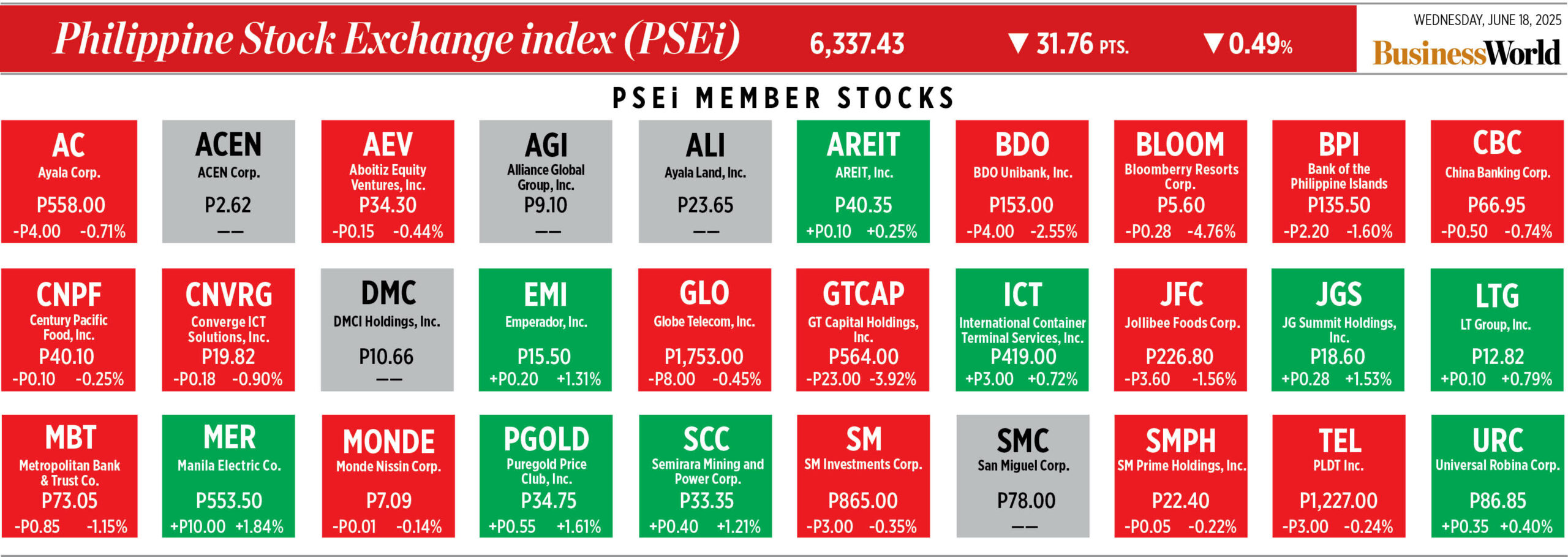
How PSEi member stocks performed — June 18, 2025

Here’s a quick glance at how PSEi stocks fared on Wednesday, June 18, 2025.

Peso moves closer to P57 level as Iran-Israel conflict continues

PHILIPPINE STAR/ MIGUEL DE GUZMAN

THE PESO dropped against the dollar for a seventh straight session on Wednesday to close near the P57 level as market sentiment stayed gloomy with the conflict between Iran and Israel showing no signs of easing.

The local unit closed at P56.98 versus the greenback on Wednesday, dropping by 28 centavos from its P56.70 finish on Tuesday, Bankers Association of the Philippines data showed.

This was the local unit’s weakest finish in over two months or since it closed at P57.08 on April 14.

The peso has now lost P1.235 since the start of June following its May 30 finish of P55.745.

Year to date, the peso is still up by 1.51% from its end-2024 close of P57.845.

The peso opened Wednesday’s session weaker at P56.75 against the dollar. Its intraday best was at P56.70, while its worst showing was its closing level of P56.98 versus the greenback.

Dollars traded went up to $1.27 billion on Wednesday from $1.203 billion on Tuesday.

The Philippines will tolerate the slide in its currency to a two-month low, with the central bank governor flagging that interventions won’t be effective in the face of global risk aversion, Bloomberg reported.

“It’s futile to intervene when it’s a strong dollar story driven by safe-haven flows,” Bangko Sentral ng Pilipinas (BSP) Governor Eli M. Remolona, Jr. said in a mobile-phone message on Wednesday.

Asian currencies have dropped against the dollar this week as an escalating conflict between Iran and Israel hurt sentiment. With the hostilities triggering a rise in the price of oil, the currencies of import-reliant countries such as the Philippines and India have been particularly affected.

“The dollar-peso closed higher due to escalating tensions in the Middle East,” a trader said in a phone interview.

The peso extended its losing streak amid safe-haven demand for the dollar and the recent climb in oil prices due to the Iran-Israel conflict, Rizal Commercial Banking Corp. Chief Economist Michael L. Ricafort said in a Viber message.

ING Bank said in a research note on Wednesday that higher oil prices could have a “more damaging impact” on the Philippines and could put more pressure on the peso.

“The country has the largest current account deficit in the region, driven by rising imports and softer remittance growth, making it highly vulnerable to oil price shocks. A 10% rise in oil prices could widen its deficit by roughly 0.25% of GDP (gross domestic product), which stood at an elevated 3.7% of GDP in the first quarter of 2025, pressuring the PHP in the near term,” it said.

For Thursday, the trader expects the peso to move between P56.70 and P57.10 per dollar, while Mr. Ricafort sees it ranging from P56.90 to P57.10. — A.M.C. Sy with Bloomberg

PHL shares retreat before BSP policy meeting

BW FILE PHOTO

PHILIPPINE SHARES dropped anew on Wednesday as the conflict between Iran and Israel continued and as investors stayed on the sidelines ahead of the Bangko Sentral ng Pilipinas’ (BSP) policy meeting on Thursday, where it is expected to deliver a second straight rate cut.

The main Philippine Stock Exchange index (PSEi) went down by 0.49% or 31.76 points to close at 6,337.43, while the broader all shares index declined by 0.29% or 11.07 points to 3,772.79.

“Philippine stocks fell as the Israel-Iran conflict entered its fifth day and US retail sales dropped more than expected, raising concerns about consumer spending,” Regina Capital Development Corp. Head of Sales Luis A. Limlingan said in a Viber message.

“Locals remained on the sidelines as they await the outcome of the latest meeting of the BSP, with many forecasting a rate cut, hoping to ease fears of further conflict escalation in the Middle East,” he added.

A BusinessWorld poll showed that 15 out of 16 analysts expect the Monetary Board to cut the policy rate by 25 basis points (bp) to 5.25% at Thursday’s review from the current 5.5%.

The BSP in April resumed its easing cycle with a 25-bp reduction following a surprise pause in February. It has now slashed borrowing costs by a total of 100 bps since it started cutting rates in August last year.

Iran and Israel launched new missile strikes at each other on Wednesday morning, forcing thousands of people to flee major cities, despite the call of United States President Donald J. Trump for Iran’s unconditional surrender.

“The local market pulled back as investors took a cautious stance ahead of the Federal Reserve’s policy decision,” Philstocks Financial Inc. Research Manager Japhet Louis O. Tantiangco said in a Viber message.

The Fed was set to announce its policy decision overnight at the close of its two-day meeting. It is widely expected to keep rates unchanged, but markets are waiting for fresh clues on the US central bank’s easing path.

Almost all sectoral indices closed lower on Wednesday. Financials sank by 1.7% or 40.05 points to 2,304.06; mining and oil declined by 1.54% or 155.44 points to 9,899.69; holding firms went down by 0.43% or 23.61 points to 5,415.15; services retreated by 0.23% or 5.30 points to 2,219.52; and property decreased by 0.04% or 1.05 points to 2,246.02.

Meanwhile, industrials rose by 0.44% or 40.64 points to 9,150.28.

“Manila Electric Co. was the day’s index leader, climbing 1.84% to P553.50. Bloomberry Resorts Corp. was the main index laggard, falling 4.76% to P5.60,” Mr. Tantiangco said.

Value turnover declined to P5.28 billion on Wednesday with 2.91 billion shares traded from P5.94 billion with 2.11 billion issues exchanged on Tuesday.

Advancers edged out decliners, 96 versus 95, while 52 names were unchanged.

Net foreign selling increased to P254.69 million on Wednesday from P15.05 million on Tuesday. — Revin Mikhael D. Ochave