Home Blog Page 904

At a Crossroads: Progress or more of the same?

By Jesus Felipe, Mariel Monica Sauler, Gerardo Largoza, Susan Kurdli, Alellie Sobreviñas, and Christopher James Cabuay

(Second of three parts)

II. HOW FAR CAN WE GO?

We all dream of a better country as stated in Ambisyon Natin 2040: “Filipinos enjoy a strongly rooted, comfortable, and secure life. In 2040, we will all enjoy a stable and comfortable lifestyle, secure in the knowledge that we have enough for our daily needs and unexpected expenses, that we can plan and prepare for our own and our children’s future. Our family lives together in a place of our own, and we have the freedom to go where we desire, protected and enabled by a clean, efficient, and fair government” (https://tinyurl.com/249ngsr4). We need to be realistic: this will not materialize. Still in 2040, not everybody will enjoy a stable and comfortable lifestyle, not everybody will be able to meet daily needs and unexpected expenses, and we will not be an advanced nation in 2040, 15 years from today.

At a meeting in Milan in early May, the economic team announced that the Philippines’ GDP will reach $2 trillion in 2050. We beg to disagree. The presentation indicated that today’s GDP is $392 billion. This implies that to go from today’s GDP to the one in 2050 (that is, in 25 years) requires an annual growth rate of 6.7%. This will not happen. It is too high. Historically, only a few countries have grown at almost 7% for 25 years. These countries are in Asia but they did it in a different world context, and their growth was manufacturing-cum-export-led.

For years, we have worked with a model of the Philippine economy. This is a very complex structure that relates hundreds of variables and that allows us to understand how the economy operates. We used it to project our GDP in 2050 (version run at the end of 2024, before the current tariff turmoil). This will be about $1.7 trillion. Average growth during the period of 2025-2050 will be 4.8%, with a slight declining trend until 2050, when growth will be 3.6%. This is just the result of “progress.” We cannot become richer and grow as fast as today.

We also question the claim made in other government presentations, that the Philippines will be a $6.6 trillion economy by 2075, the 14th largest economy in the world. This exercise was not done by the government but taken from very suspicious estimates concocted by Goldman Sachs for a large number of countries. It is another extrapolation, in this case assuming (guessing) some figures for labor force growth, investment rates, productivity convergence, and PPP-based exchange rate adjustments. This is wrong economics and wrong thinking. Don’t we have in the country the capabilities to estimate future GDP properly without taking it from an investment bank?

Our models do not reach 2075 but we are certain that this estimate is too high. The Goldman Sachs 2075 estimate implies an average growth rate of GDP of 5.6% for the next 50 years, 2025-2075. It takes an understanding of growth to refute this claim: supposedly (according to the government rhetoric) we would be an advanced economy by then, like Japan, Korea, or the European nations. Check what their actual growth rates have been for the last decades. Much lower than in the 1970s. The reason? Their potential growth is much lower — the contribution is labor force growth zero in some cases (even negative); all growth is the result of productivity growth, but since these economies are on the technological frontier, productivity growth is low. That’s why their growth rates are so low (but they have a very high per capita income).

We could certainly be wrong, but we are willing to bet that our economy will not register an average growth rate of 6.7% for the next 25 years, or 5.6% for the next 50. Using our models, we have estimated that in 2050 the share of work in agriculture will have declined significantly (this is good news). The bad news is that our major employer will be Wholesale and Retail Trade. This means low wages. Hence, our income per capita will be much lower than the $18,000 announced in Milan last May (not clear how this figure was calculated).

Our estimate is that our GNI per capita will be about $12,500 to $13,000, three times today’s (under a very favorable scenario of no major shock in 25 years). This shows progress but much less than what the administration claims. To do better, we need a very different economy. Unfortunately, our workers will not be engineers who design (or providing consulting services for) high-speed trains, airplanes, robotics equipment, satellite systems, intelligent buildings, submarines, dams, luxurious yachts and cruise liners, or nuclear power plants; and who earn P1 million/month, because we do not have such companies. We are very far from that. The government does not create these jobs and the government cannot tell the private sector what jobs it has to create and what wages to pay. Yes, our companies hire engineers but they do not create the products mentioned above. Most of the jobs being created in our country (by firms) are in low-productivity service activities. Let’s please stop the rhetoric about “quality jobs.”

Development happens in firms, in the productive sphere of an economy. This is what allows citizens to consume as wages increase. Our “industrial policy” initiatives should focus on the creation of the companies that will eventually manufacture such products, not on giving tax breaks. This industrial policy requires firm-level effort, especially crucial for developing organizational capabilities, as this process requires continuous adjustments in firm structure, entails adjustment costs, and often encounters internal resistance. We insist: this requires an industrial policy centered on firms’ learning so that they reach international standards and can compete by exporting high-quality products.

The government highlights tourism and Artificial Intelligence (AI) as new sources of growth. Yet, the reality is that neither one will be a game changer. Tourism, like any other activity that contributes to the nation’s GDP, is certainly welcome. But this will not be the “industry” that will make us a first-world nation. Advanced nations are not high-income economies because of this sector, which is a “follower” service of low productivity by its own nature (very labor intensive). The predictions about the sector are far-fetched and unrealistic: we have read that the government expects the value added of the sector to reach 20% of GDP — really? This is a very large share.

It is important to understand that tourism is a business of the advanced economies: with a few exceptions, virtually all major tourist destinations in the world, by country and by city, are advanced economies. Think of Paris, London, Rome, New York, Madrid, Bangkok, or Istanbul. People do not travel there because of their beaches (which many countries have too) but because of the “package” these places offer: culture (monuments, museums, opera), parks, restaurants, and public transportation to commute. We do not have these.

Likewise, people do not travel to those cities as tourists because receptionists and waiters smile. We need much better infrastructure but, more importantly, we have to upgrade our tourism package to compete with Thailand or Mexico first… then think about competing with the world’s largest tourist destinations, France and Spain. Let’s get the story right: tourism can be a springboard to develop infrastructure, to bring in foreign income, and to help create decent employment — hotel managers, receptionists, accountants, and chefs. This will help us reach upper middle income. High income requires much more than tourism.

We have also read as we finish this letter that the government, together with local industry groups, is aiming to boost sales of sari-sari (sundry) stores in the country to P2.4 trillion by 2030 as part of a strategy to develop the country’s wholesale and retail sector. If this is true, we are wordless. First, because this is incompatible with the objective of becoming an advanced economy. These stores (of low productivity and low wages) will have to disappear from our streets, the same as jeepney drivers, and the still large number of domestic helpers and security guards, amongst other professions that still exist in the Philippines. Why? Sari-sari stores are inefficient places to shop, the graphic sign of the nation’s poverty. People in developed countries shop in well-organized, very large, and cheap, supermarkets. And to become an advanced nation, wages will have to increase dramatically, for everyone. Who will hire a helper or a guard when their salaries reach P70,000/month (of course, these will have to be formal jobs, and with a contract that includes benefits, paid holidays, etc.). There is a second reason why this objective does not make any sense: P2.4 trillion in 2030 would represent, depending on whether this figure refers to nominal or real pesos, between 5% and 8% of our GDP in five years, a ridiculously large percentage.

Summing up: at least 25% of our GDP will come in the next few years from tourism and sari-sari stores. We implore the Economic team to put some order here.

Artificial Intelligence (AI) matters but it will not be either the game changer of the Philippine economy at large because we are very far from the technological frontier, because 10 million workers are still employed in backward agriculture, and because 19 million Filipinos are functionally illiterate. Certainly, many of our companies (surely the large ones) will use it and see some benefits. Indeed, using AI in chatbots, to detect fraud in banks, as voice assistants, to generate text and images, or to manipulate big data, is a step forward and important in order not to be left behind. At this level, AI is already being used everywhere. AI can also help companies in manufacturing. Yet, we doubt this will revolutionize the Philippine economy, as long as we do not have the capabilities to generate the advanced technologies of the so-called Fourth Industrial Revolution, including robotics.

What we should care about is aggregate productivity, and this is much more than using ChatGPT to summarize meetings or to do a quick search. For a particular technology to have a significant impact on society, including an improvement in productivity, it has to become a general-purpose technology (GPT), that is, it has to be used across a wide range of industries and activities, it evolves over time, it leads to complementary innovations, and it alters how people live, work, and interact. Electricity, indoor plumbing (the best invention ever), penicillin, and airplanes are examples of GPTs of the 20th century that changed our lives.

Time will tell us if AI becomes a GPT. Recall what economist Nobel Prize winner Robert Solow said in 1987: “You can see the computer age everywhere but in the productivity statistics.”

(To be continued.)


Jesus Felipe, Mariel Monica Sauler, Gerardo Largoza, Susan Kurdli, Alellie Sobreviñas, and Christopher James Cabuay are Faculty at De La Salle University (DLSU). This letter represents the views of the authors and not necessarily those of DLSU.


GreatWork to open 3 new branches in 2026, including first overseas site

GREATWORKGLOBAL.COM

LOCAL flexible workspace provider GreatWork Global Workspaces plans to open three new branches in 2026, including its first international location, the company’s top official said.

“Next year, we have three in the pipeline, but we are, of course, timing the market,” GreatWork Founder Jettson P. Yu said in an interview with BusinessWorld.

“We are timing a lot of factors, including global uncertainties and the sentiments of companies regarding the expansion of their footprint around the world,” Mr. Yu said.

The company is eyeing its first overseas expansion in the Asia-Pacific region, alongside two new domestic branches — one in the Visayas-Mindanao area and another in Central Luzon.

GreatWork offers build-to-suit private offices, coworking spaces, meeting rooms, and virtual office addresses.

At present, the company operates three branches in Metro Manila. Its first regional site, located in Bacoor, Cavite, is scheduled to open by yearend.

GreatWork ended the first half of the year with an 88% to 89% occupancy rate, driven by new signups from government and business process outsourcing tenants.

Mr. Yu said the company aims to open at least one new branch every six months.

Founded in 2018, GreatWork was established to meet demand for affordable, high-quality shared workspaces suited for smaller companies.

“In 2018, many office spaces were occupied, and many companies with 100 employees or less wanted to be in nice buildings, but they couldn’t get in,” he said in mixed English and Filipino. “That’s why I started GreatWork to bridge that gap.”

He added that many companies are outsourcing their workspace requirements to focus on business growth and innovation.

Tenant rates are expected to remain stable, Mr. Yu said.

“We work with office building owners with excess space in their building, and we come up with a partnership that’s designed to still make GreatWork competitive in pricing,” he said.

Mr. Yu noted that one of the key challenges for a homegrown workspace brand is overcoming the perception that its furnishings and services are inferior to those of global providers.

“When I started GreatWork, I already made sure that it would eventually become a global brand,” he said.

“What we did, branding-wise, is position GreatWork to focus on quality furnishings, fit-outs, and services. At the same time, we embraced competitive pricing compared to multinationals.” — Beatriz Marie D. Cruz

Mission: Impossible composer Lalo Schifrin, 93

Lalo Schifrin is best known for composing the theme of Mission Impossible, which was used for the original TV show and the subsequent film series. — IMDB

ARGENTINE MUSICIAN Lalo Schifrin, composer of the memorable Mission: Impossible theme and the scores for dozens of Hollywood movies and TV shows, has died at age 93, media outlets reported on Thursday.

Mr. Schifrin’s son, William, confirmed his father’s death, The Hollywood Reporter said. An agent for Mr. Schifrin did not immediately respond to an e-mail from Reuters.

Born in Buenos Aires, Mr. Schifrin became a fan of American jazz in his teens. He was also a pianist and conductor.

Mr. Schifrin received six Oscar nominations for movie scores that included the 1967 film Cool Hand Luke and The Amityville Horror in 1979.

He won four Grammys, including one for the Mission: Impossible theme set to an unconventional 5/4 time signature. The song was written for the CBS television spy drama that debuted in 1966 and became a blockbuster film franchise still running today.

Mr. Schifrin received an honorary Oscar for his lifetime of work in 2018. Clint Eastwood presented him with the award. — Reuters

Trump’s ‘big, beautiful bill’ to further tarnish Treasuries’ luster

TOKYO/SINGAPORE — As the Trump administration’s “big, beautiful bill” grinds its way through the US Senate, incentives are growing for foreign investors to diversify out of US Treasuries losing sheen from prospects of deficit spending and inflation-boosting tariffs.

President Donald J. Trump’s sweeping tax cut and spending measure will boost US debt by $3.3 trillion, the nonpartisan Congressional Budget Office estimates, while runaway deficits and swelling debt led Moody’s to cut its credit rating in May.

“Definitely I’m concerned about the fiscal deficit expansion,” said Toshinobu Chiba, a Tokyo-based rates and credit fund manager for Simplex Asset Management.

Mr. Chiba said he has been using futures to shift away from Treasuries and into European debt, but aims to move that trade to the cash bond market when Mr. Trump’s “big, beautiful bill” passes and inflation expectations tick upwards.

“I think the first options should be Europe, especially the bunds and French bonds, and also Australia and Singapore are options for global investors.”

Traditionally a refuge for markets, Treasuries have been volatile since April, becoming less attractive for overseas investors as Mr. Trump’s erratic policies on tariffs and taxes drove them to pare exposure to the dollar and US markets.

US Treasury International Capital (TIC) data shows foreign money leaving US short and long-term debt and banking flows stood at a net $14.2 billion in April, the same month that Mr. Trump rattled global markets with his “Liberation Day” tariffs.

The US national debt has increased fourfold in less than 10 years to some $36 trillion, with about $29 trillion held publicly.

Japan is the biggest external holder of Treasuries with $1.13 trillion, followed by Britain with $807.7 billion and China with $757.2 billion, TIC data show.

Treasuries fell in the aftermath of the tariff news, with benchmark 10-year yields reaching as high as 4.629% on May 22 before settling down to about 4.277%. Treasury 10-year yields have swung between 3.9% and 4.629% since April.

Passage of Mr. Trump’s long-simmering bill would give investors another reason to fret about the state of US finances.

Senators debating the measure in a marathon weekend session were expected to pass it late on Monday and in the Asian trading day on Tuesday.

Senate Republicans are set on using an alternative calculation method for the bill’s cost that does not factor in extending the 2017 tax cuts and seems to save $500 billion, according to an analysis by the Bipartisan Policy Center.

Prospects for even wider deficits in the US may compel European investors to dump Treasuries and bring their money home, said Gustavo Medeiros, London-based global head of research at emerging markets investment manager Ashmore Group.

When Treasuries and other major bond markets sold off in April, the Bund market held firm.

Though the amount of German debt is also growing after the new government’s trillion euro defense and infrastructure spending push, Europe’s biggest economy is the only Group of Seven member with a debt-to-GDP ratio below 100%, bolstering its safe-haven credentials.

“That not only creates an upward, better opportunity for the equity markets, but it also is going to increase the issuance of risk-free German bunds and pan-European debt,” Mr. Medeiros said.

“So you’re going to have a lot of incentive for capital to come back.”

Yet a widespread sell-off is unlikely, despite fiscal concerns over Mr. Trump’s spending bill that are expected to steepen the Treasury yield curve as investors demand higher returns to hold US debt for longer, said analyst Masahiko Loo.

“The reduction in foreign US Treasury holdings has been a long-term structural trend rather than a sudden exodus,” said Loo, a senior fixed-income strategist at State Street.

“It is a ‘diversification, not divestment’ story with foreign investors, particularly in Asia.”

Hemant Mishr, group CIO of SCUBE Capital, is also betting on a steeper Treasury curve.

“The markets are worried and US risk premiums will further widen,” he said. “We expect US credit default swaps to continue quoting at a substantial premium to similarly rated sovereigns.” — Reuters

Gokongwei Group taps Vantage Energy to power 35 properties

Seen in photo are (top row, L-R) Robinsons Supermarket Corp. Managing Director Christine O. Tueres, Universal Robina Corp. Chief Technology Officer David J. Lim, Universal Robina Corp. Vice-President for Quality Assurance Jesselyn Protacio-Panis, (bottom row, L-R) RL Commercial REIT Inc. President and Chief Executive Officer Jericho P. Go, Robinsons Land Corp. Executive Vice-President and General Manager Commercial Center Division Faraday D. Go, JG Summit Holdings Inc. President and Chief Executive Officer Lance Y. Gokongwei, Meralco Chairman and Chief Executive Officer Manuel V. Pangilinan, and Vantage Energy President Ernesto M. Cabral.

VANTAGE ENERGY, an affiliate retail electricity supplier (RES) of Manila Electric Co. (Meralco), has entered into a power supply agreement with the Gokongwei Group to serve 35 of its key properties nationwide.

The retail electricity supply deal covers facilities of Robinsons Land Corp., Robinsons Supermarket Corp., and Universal Robina Corp. (URC), with a portion of the contracted power to be sourced from renewable energy, the company said in a media release on Monday.

Robinsons Land is the property arm of JG Summit Holdings, Inc., the flagship conglomerate of the Gokongwei Group. URC is engaged in food and beverage manufacturing, while Robinsons Supermarkets, a subsidiary of Robinsons Retail Holdings, Inc., operates a nationwide supermarket chain.

“This commitment to renewable energy empowers the Gokongwei Group to wholeheartedly pursue our sustainability targets, knowing that we have strong, forward-thinking partners aligned with our environmental stewardship goals,” JG Summit President and Chief Executive Officer Lance Y. Gokongwei said.

Vantage Energy, the first affiliate RES of Meralco, supplies electricity to contestable customers outside the power distributor’s franchise area.

“Our partnership spans over half a decade now, with contestable properties recently added — some of which are already transitioning to renewable energy supply. This expansion reflects our aligned commitment to transforming shared values into meaningful, measurable progress toward a sustainable future,” Vantage Energy President Ernesto M. Cabral said.

Meanwhile, Meralco’s local RES unit MPower recently expanded its contract with the Gokongwei Group to deliver electricity to several of its major facilities in Luzon.

MPower supplies power to contestable customers, including large corporations within Meralco’s franchise area. It currently holds over a 25% share of the Competitive Retail Electricity Market (CREM) within Meralco’s coverage area.

Meralco’s controlling stakeholder, Beacon Electric Asset Holdings, Inc., is partly owned by PLDT Inc.

Hastings Holdings, Inc., a unit of the PLDT Beneficial Trust Fund subsidiary MediaQuest Holdings, Inc., has an interest in BusinessWorld through the Philippine Star Group, which it controls. — Sheldeen Joy Talavera

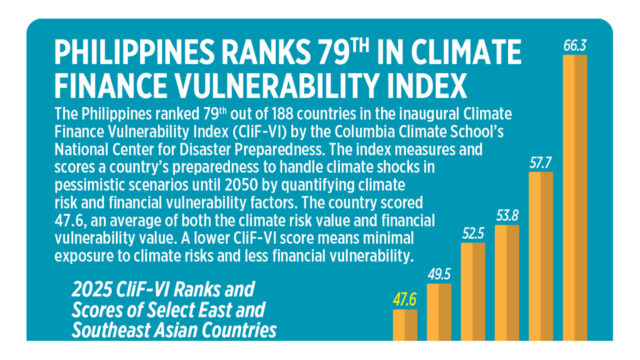
Philippines ranks 79th in Climate Finance Vulnerability Index

The Philippines ranked 79th out of 188 countries in the inaugural Climate Finance Vulnerability Index (CliF-VI) by the Columbia Climate School’s National Center for Disaster Preparedness. The index measures and scores a country’s preparedness to handle climate shocks in pessimistic scenarios until 2050 by quantifying climate risk and financial vulnerability factors. The country scored 47.6, an average of both the climate risk value and financial vulnerability value. A lower CliF-VI score means minimal exposure to climate risks and less financial vulnerability.

Philippines ranks 79<sup>th</sup> in Climate Finance Vulnerability Index

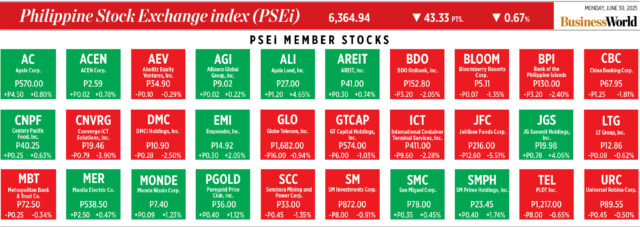
How PSEi member stocks performed — June 30, 2025

Here’s a quick glance at how PSEi stocks fared on Monday, June 30, 2025.


Exporters remain ‘in the dark’ about eventual US tariff rate

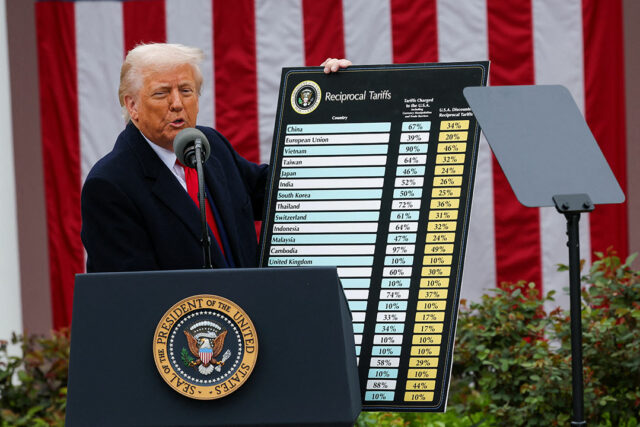
US PRESIDENT Donald Trump delivers remarks on tariffs in the Rose Garden at the White House in Washington, DC, April 2, 2025. — REUTERS

By Justine Irish D. Tabile, Reporter

PHILIPPINE EXPORTERS remain cautious in the face of the uncertainty posed by the US tariff regime, but are hoping that US President Donald J. Trump views the Philippines as a “friendly country.”

Foreign Buyers Association of the Philippines (FOBAP) President Robert M. Young said exporters still have “no clear information” about what tariffs will be assigned by Washington once the pause on the reciprocal tariff ends next week.

All exporters have to go on is that US Treasury Secretary Scott Bessent’s description of negotiations with the Philippines as having gone well, he said.

“It is most likely that we will be left without a choice but to be reverted to the (17%) April 2nd tariff rate or stay at 10%, depending on whether Trump deems the Philippines a friendly country negotiating in good faith,” Mr. Young told BusinessWorld on Monday.

“We are all in the dark indeed  … But FOBAP’s prayer is to have the most minimum tariff increase in order to (boost) our still struggling economy,” he added.

On April 2, Mr. Trump announced tariffs on most of its trading partners, with the Philippines being assigned the second-lowest rate in Southeast Asia at 17%. This has since been put on hold for 90 days to give time for negotiations. The pause ends on July 9 while trade delegations negotiate new deals with Washington.

In a Bloomberg report, Mr. Bessent was quoted as saying that Mr. Trump has threatened to impose new duties above the provisional 10% baseline rate for most trading partners, mostly smaller countries that do not reach deals by next Wednesday.

However, he said that about 20 countries “could continue negotiating but would see their tariff rates reverted to the higher April 2 rate or stay at 10% if they are deemed to be negotiating in good faith.”

In early May, a Philippine delegation led by Secretary Frederick D. Go, the Special Assistant to the President for Investment and Economic Affairs, and Trade Secretary Ma. Cristina A. Roque met with the US Trade Representative (USTR) to negotiate lower tariffs.

Following the meeting, the government created a technical working group to continue talks with the USTR. It was led by Trade Undersecretary Allan B. Gepty.

Asked to comment, Mr. Gepty said that negotiations with US counterparts are “still in progress.”

BoI pitching investors in Spain on 2 solar projects

THE Board of Investments (BoI) said it is making presentations about two major solar projects at a conference in Spain, to potential “impact-driven partners.”

“At the (conference) in Seville, the BoI will spotlight investor-ready renewable energy projects and engage with impact-driven partners, as it positions the Philippines as a prime destination for sustainable and inclusive investment,” the BoI said in a social media post.

In particular, the BoI will present the 76.65-megawatt Isabel Solar Project in Leyte and the 49.9-megawatt Libmanan Solar Project in Camarines Sur.

Proposed by Zenith Renewable Energy Corp. (ZREC), the ground-mounted Libmanan Solar Project is estimated to cost $33 million.

“ZREC is seeking $28 million in equity funding in exchange for an 85% ownership stake in the project,” BoI said.

Colombia, Costa Rica, Malawi, Pakistan, Paraguay, Papua New Guinea, Tanzania, and Ethiopia are also pitching bankable energy projects at the conference.

The conference is known as the 4th International Conference on Financing for Development and runs until July 3. It is billed as a platform for mobilizing private finance and investment for sustainable development.

The conference gathers participants from government, international, and regional organizations; financial and trade institutions; businesses; civil society; and the UN System.

In a separate statement, the BoI said it completed the Cebu and Davao legs of the Corporate Recovery and Tax Incentives for Enterprises to Maximize Opportunities for Reinvigorating the Economy (CREATE MORE) Act Roadshow.

During the roadshow, Mariane Genelou S. Reyes, chief investments specialist at the BoI’s Research and Policy Division, also presented an overview of the Strategic Investment Priority Plan (SIPP).

According to Ms. Reyes, the BoI has approved P3.38 trillion worth of investments since the SIPP took effect in June 2022 until December 2024.

“The top-performing sectors included renewable energy, which accounted for P2.58 trillion; digital infrastructure (P295.14 billion); and logistics and supply chain-related investments (P168.24 billion),” she said.

“These figures demonstrate the country’s strong positioning to attract high-value, sustainable, and forward-looking investments,” she added. — Justine Irish D. Tabile

21 renewable projects forwarded to NGCP for grid impact studies

PHILSTAR FILE PHOTO

THE Department of Energy (DoE) endorsed 21 energy projects in May for system impact studies (SIS) by the National Grid Corp. of the Philippines (NGCP).

“In May 2025, the DoE issued 21 SIS endorsements, including 17 new applications and four amendments,” the DoE said in a document posted on its website.

The SIS determines the adequacy and capability of the grid to accommodate the new connection.

The DoE issued SIS endorsements to 18 renewable energy projects, of which three solar projects are equipped with energy storage systems. It also endorsed three standalone battery energy storage systems (BESS).

For wind, the DoE endorsed Mainstream Renewable Power Philippines Corp.’s 375-megawatt (MW) Abra de Ilog project; Amihan Power, Inc.’s 304-MW Garchitorena project; and CI San Jose Corp.’s 260-MW San Nicolas onshore project and 279-MW Santa Fe onshore project.

Others that received SIS endorsements include Freya Renewables, Inc.’s 200-MW Dumangas wind project and 192-MW Silay wind project; and Envision Energy Philippines Corp.’s 200-MW Cauayan wind project.

SE Renewable Energy, Inc. received SIS endorsements for its 104-MW Balayan, Batangas wind project, 96-MW San Juan wind project, and 90-MW Lucban wind project.

The solar projects include Northern Sun Power, Inc.’s 351.436-megawatt-peak (MWp) Currimao project and Northern Sun Radiance, Inc.’s 188.644-MWp San Marcelino Floating Solar project.

Also endorsed were solar power projects equipped with energy storage systems such as Visayas Cleanergy, Inc.’s 416.102-MWp Cadiz solar project with a 390.254-megawatt-hour (MWh) BESS; North Luzon Green Power, Inc.’s 187.044-MWp Talingaan-Laoag solar project with a 276.954-MWh BESS; and South Cleanergy, Inc.’s 239.560-MWp Luna solar project with a 306.000-MWh BESS.

Baguio Asin Hydropower Corp.’s three hydroelectric power projects with a combined capacity of 12 MW were also cleared to undergo grid impact study.

Clearances were also issued for The Ark Green Dynamic Storage System Resources Corp.’s 40.12-MWh  Laguindingan BESS and 40.12-MWh Barotac Viejo BESS; and Mindanao Energy Development Corp.’s 55-MWh BESS.

For the five months to May, the DoE endorsed 43 power projects, of which 30 are renewable energy, 11 ESS, and two conventional. — Sheldeen Joy Talavera

Philippine corporate governance hindered by highly concentrated ownership, OECD says

PHILIPPINE STAR/KRIZ JOHN ROSALES

CONCENTRATED corporate ownership, particularly among family owned listed firms, undermines corporate governance, the Organisation for Economic Co-operation and Development (OECD) said.

“Concentrated ownership… can undermine corporate governance,” it said in its Asia Capital Markets Report issued last week.

The OECD described the Philippines’ concentration of corporate ownership as among the highest in Asia.

“The average equity held by the three largest shareholders in each company exceeds 50% in 11 out of 18 countries,” it said.

Ownership concentration is particularly high in Mongolia (75%), Sri Lanka (73%), Indonesia (71%) and Philippines (63%).

“These ownership structures often blur the lines between ownership and management, which can lead to the appointment of successors based on family ties or loyalty rather than qualifications, increasing the risk of poor leadership and weak oversight,” it said.

The OECD said corporate governance weaknesses and concentrated ownership structures continue to weigh on investor confidence in some Asian markets.

It said such controlling shareholders may choose to benefit themselves at the expense of minority shareholders through related-party transactions, asset transfers or the appropriation of company resources for personal or familial use.

The OECD warned that this could undermine value for outside investors and dampen transparency, accountability and long-term corporate performance.

“Regulatory enforcement is particularly limited in parts of Southeast Asia, including in jurisdictions such as Indonesia and the Philippines,” it said.

The OECD cited limited financial, human and technical resources as factors that constrain the enforcement of corporate governance frameworks.

“There is other evidence of constraints in regulatory capacity in the region. For example, in Indonesia and the Philippines, the number of insider trading cases reported is very low, suggesting limited enforcement activity due to a lack of investigative resources,” it said. — Aubrey Rose A. Inosante

Konektadong Pinoy’s lighter regime deemed attractive to tech investors

STOCK PHOTO | Image by DC Studio from Freepik

THE Konektadong Pinoy bill is expected to demonstrate a simplified regulatory regime to foreign investors that will serve to attract investors in digital infrastructure, the Financial Executives Institute of the Philippines (FINEX).

FINEX said on Monday that the bill will address long-standing gaps in digital infrastructure by, among others, removing the congressional franchise requirement for internet service providers.

“The bill sends a strong signal to global technology firms and hyperscalers looking to expand in Southeast Asia. Streamlining the regulatory environment could help the Philippines attract foreign investment in data centers, cloud infrastructure, and digital services, critical enablers for a modern, competitive economy,” FINEX said.

The Konektadong Pinoy bill is now with the Palace for President Ferdinand R. Marcos, Jr.’s signature. It had been ratified by legislators in both chambers of Congress.

The measure also relieves new data transmission entrants of the need to obtain a certificate of public convenience and necessity.

The Philippine Chamber of Telecommunications Operators has declared its opposition to the bill on cybersecurity grounds.

The measure also directs the government to incentivize participants in the data transmission industry to invest in, adopt, roll out, implement, establish, own, maintain, operate, or utilize new and next-generation technologies, with priority given to unserved or underserved areas.

“The bill sends a strong signal to global technology firms and hyperscalers looking to expand in Southeast Asia. Streamlining the regulatory environment could help the Philippines attract foreign investment in data centers, cloud infrastructure, and digital services, critical enablers for a modern, competitive economy,” FINEX said.

FINEX said it also supports reforms that align policy with inclusive growth and encourages reform and upgrade of digital transformation.

“Furthermore, the shift away from legislative franchises must be complemented by clear and transparent regulatory processes to prevent fragmentation and ensure a level playing field,” it said. — Ashley Erika O. Jose