Home Blog Page 901

Drones that shut Copenhagen Airport flown by ‘capable operator,’ Danish police say

WIKIMEDIA.ORG

COPENHAGEN — Danish police said on Tuesday that drones that shut the country’s main airport on Monday appeared to have been flown by “a capable operator” seeking to demonstrate certain abilities, adding that no suspects had been identified.

The airports in Copenhagen and Oslo, the two busiest in the Nordic region, were shut for hours after drones were observed in their airspace late on Monday, leaving tens of thousands of passengers stranded as flights were diverted.

“We have concluded that this was what we would call a capable operator,” Danish police Chief Superintendent Jens Jespersen told reporters on Tuesday, referring to the drones observed in Copenhagen.

“It’s an actor who has the capabilities, the will and the tools to show off in this way,” Mr. Jespersen said, adding that it was too early to say if the incidents in Denmark and Norway were linked.

Copenhagen Airport was closed for four hours when two or three large drones were seen flying in its immediate vicinity, officials said, while the Oslo Airport was closed for three hours following two sightings, according to local police.

Mr. Jespersen said the drones in Denmark came from several different directions, turning their lights on and off, before eventually disappearing after several hours.

Copenhagen diverted 31 flights to other airports, causing ripple effects that delayed or canceled around 100 flights and affected some 20,000 passengers, a spokesperson told reporters on Tuesday.

The airport shutdowns came after a string of disruptions at European airports in recent days.

A cyberattack last Friday knocked out check-in and boarding systems supplied by Collins Aerospace, a unit of RTX, affecting operations at London’s Heathrow and the Berlin and Brussels airports. Over the weekend and into Monday, the fallout continued to snarl travel across the region. — Reuters

Russia targets Ukraine’s lifeline railways with ‘systematic’ attacks — CEO

Army soldier figurines are displayed in front of the Ukrainian and Russian flag colors background in this illustration taken, Feb. 13, 2022. — REUTERS/DADO RUVIC/ILLUSTRATION

KYIV — Russia has unleashed a massive wave of attacks on Ukraine’s railways since the summer, using new tactics to hit key nodes with long-range drones, but the network is holding up for now, the CEO of the state railway company told Reuters.

“Their first aim is to sow panic among passengers, their second aim is to hit the overall economy,” Oleksandr Pertsovskyi said in an interview held in a rail carriage at Kyiv’s central station.

There did not appear to be a particular focus on targeting military cargo. “These are all, in essence, strikes on civilian infrastructure,” he said.

RAILWAY ATTACKS HAVE INTENSIFIED
Ukrzaliznytsia, the vast state-owned railway company, employs 170,000 people and has been the target of Russian attacks since the start of Russia’s invasion three-and-a-half years ago, but attacks have intensified, causing regular delays.

Since the start of the war in February 2022, the railway network has been a lifeline for people moving around Ukraine and out of the country, as all civilian flights have been grounded.

World leaders, from French President Emmanuel Macron to Indian Prime Minister Narendra Modi and former US President Joseph R. Biden, have arrived in wartime Ukraine by train.

The rail company’s popular sleeper carriages are seen as a reliable way to travel overnight and arrive early in the morning in cities many hundreds of miles away, until the latest Russian onslaught began to delay passengers by several hours.

The railway is also crucial for transporting military equipment and commercial cargo, although volumes of the latter have dropped significantly in wartime, denting the company’s finances.

Mr. Pertsovskyi said the attacks, which have hit dozens of substations, were linked to the dramatic increase in long-range drones that Russia’s military-industrial complex is producing.

“Previously, they simply did not have sufficient resources for a single combat drone, such as a Shahed, to hunt down a locomotive. Now they can afford to use Shaheds to hit individual locomotives rather than strategic targets.”

QUICK RECOVERY BUT AT A COST
For now, the railway is recovering from each blow, he said.

The immediate disruption to trains after an attack usually lasts six to 12 hours and electric locomotives are switched out for diesel while power is restored.

Mr. Pertsovskyi said disruption had been minimized and the transit of military cargoes had not been impacted.

“It’s a marathon … They strike us, we recover,” he said. “They strike us, we recover.”

Since the middle of summer, Russia has attacked railway electricity substations and other infrastructure nodes with an average of six to seven long-range Shahed kamikaze drones most nights, according to Mr. Pertsovskyi.

“They are … acting systematically, knocking out one substation after another or key rail hubs in order to stop passenger trains and sow panic and distrust among the people.”

Five or six key rail hubs have been bombarded since the summer, he said.

Reuters could not independently verify the reports. Russia denies targeting Ukrainian civilians.

The railway also faces sabotage from agents recruited by Russia in Ukraine. Ukraine’s security services regularly announce the detention of people they accuse of plotting to blow up vulnerable points on the network.

This is less of a threat than Russian airstrikes, but sabotage is on the rise with dozens of cases recorded this year, Mr. Pertsovskyi said.

And diesel locomotives are about five times more expensive to run per kilometer than their electric equivalents — an additional headache for a company with deep financial issues.

The World Bank estimates that roughly 30% of Ukraine’s railway is in a “damage-repair” cycle.

Some bridges had been hit many times over by Russian forces throughout the war and repaired each time, but Mr. Pertsovskyi declined to specify which ones, citing security reasons. The company would keep up the pace of repairs, he said.

“If we slow down a little and let the enemy strike and destroy, then they will be even more drawn to the smell of blood.” — Reuters


OECD says full brunt of US tariff shock yet to come as growth holds up

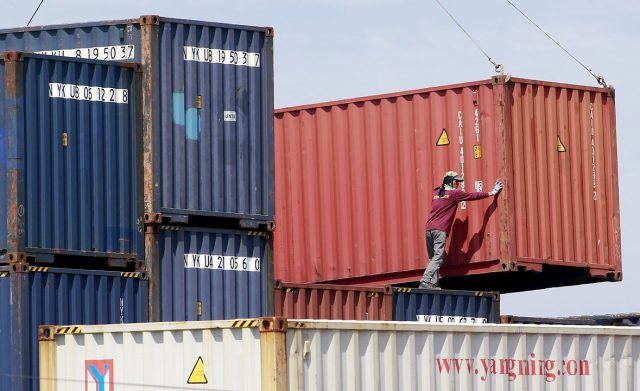
A gantry crane lifts a container at a port in Tianjin, China Feb. 8, 2025. — REUTERS/FLORENCE LO/FILE PHOTO

PARIS — Global growth is holding up better than expected, but the full brunt of the US import tariff shock is still to be felt as AI investment props up US activity for now and fiscal support cushions China’s slowdown, the OECD said on Tuesday.

In its latest Economic Outlook Interim Report, the Organisation for Economic Cooperation and Development said the full impact of US tariff hikes was still unfolding, with firms so far absorbing much of the shock through narrower margins and inventory buffers.

Many firms stockpiled goods ahead of the Trump administration’s tariff hikes, which lifted the effective US rate on merchandise imports to an estimated 19.5% by end-August — the highest since 1933, in the depths of the Great Depression.

OECD’S 2025 GROWTH FORECASTS UPGRADED
The global economy is now expected to slow only slightly — to 3.2% in 2025 from 3.3% last year — compared to the 2.9% the OECD had forecast in June.

However, the Paris-based organisation kept its 2026 forecast at 2.9%, with the boost from inventory building already fading and higher tariffs expected to weigh on investment and trade growth.

The OECD forecast US economic growth would slow to 1.8% in 2025 — up from the 1.6% it forecast in June — from 2.8% last year before easing to 1.5% in 2026, unchanged from the previous forecast.

An AI investment boom, fiscal support and interest rate cuts by the Federal Reserve are expected to help offset the impact of the higher tariffs, a drop in net immigration and federal job cuts, the OECD said.

In China, growth was also seen slowing in the second half of the year as the rush to ship exports before the US tariffs recedes and fiscal support wanes.

Nonetheless, China’s economy is expected to grow 4.9% this year – up from 4.7% in June – before slowing to 4.4% in 2026 – revised up from 4.3%.

In the euro zone, trade and geopolitical tensions were seen offsetting the boost from lower interest rates, the OECD said.

The bloc’s economy was seen growing 1.2% this year – revised up from 1.0% previously – and 1.0% in 2026 – down from 1.2% – as increased public spending in Germany lifts growth while belt-tightening weighs on France and Italy.

Japan’s economy is expected to benefit this year from strong corporate earnings and a rebound in investment, lifting growth to 1.1% – up from 0.7% – before momentum fades and the expansion slows to 0.5% in 2026, revised up from 0.4%.

The OECD revised its growth forecast for Britain up to 1.4% this year from 1.3%, and kept its 2026 forecast unchanged at 1.0%.

MONETARY POLICY EXPECTED TO BE LOOSE
With growth slowing, the OECD said it expects most major central banks to lower borrowing costs or keep policy loose over the coming year, as long as inflation pressures continue to ease.

It projected the US Federal Reserve would cut rates further as the labour market weakens — unless higher tariffs trigger broader inflation.

Australia, Britain and Canada are expected to see gradual rate cuts, while the European Central Bank is seen holding steady with inflation near its 2% target.

Japan, however, is expected to raise rates as it continues its slow withdrawal from ultra-loose monetary policy. — Reuters

Training cybercrime responders across the Philippines

The Philippine National Police (PNP) is submitting to Congress a position paper that recommends some amendments to the laws on cybercrime, including that of the SIM card registration, according to Brigadier General Bernard R. Yang, PNP’s anti-cybercrime group director.

The PNP, he said on the sidelines of Trend Micro’s DECODE 2025 event, is recommending limiting the number of SIM cards registered per person. This will reduce cybercriminal activities that involve exploiting multiple SIM cards to evade detection and carry out fraudulent schemes.

The police force, Mr. Yang said, has a cybercop training module consisting of 4 modules, and a thousand personnel have already received a badge for it. These cybercops help train other policemen in dealing with cybercrimes that are reported to their stations.

“People report to us because they know there is a unit of the PNP that [goes after] these crimes,” he said.

Interview by Patricia Mirasol
Video editing by Jayson Mariñas

House panel presses Rubio to secure Philippines funding to counter China threat

The US and Philippine flags are seen at a closing ceremony for the he Philippines-US Exercise Balikatan 40-2025 at Camp Emilio Aguinaldo in Quezon City, May 5. — PHILIPPINE STAR/WALTER BOLLOZOS

The US house committee on China has urged Washington to ensure funding for the Philippines to counter Beijing’s “aggressive and destabilizing actions” in the South China Sea, according to a letter to Secretary of State Marco Rubio, which warns cuts could threaten US security interests.

In the letter seen by Reuters on Tuesday, the House Select Committee on the Chinese Communist Party sought clarity on funding for the Philippine coast guard, noting the State Department had sought a dramatically reduced 2026 budget for International Narcotics Control and Law Enforcement that would “devastate” programs to help its ally stand up to China.

The select committee’s letter follows moves by China to further tighten its grip on the strategically located Scarborough Shoal, one of Asia most contested maritime features, where Philippine and Chinese vessels have clashed repeatedly.

“Beijing has significantly escalated its aggressive activities in the South China Sea, including its efforts to unlawfully assert control over much of the Philippines’ exclusive economic zone. (China’s) coast guard and maritime militia regularly attack or physically coerce Philippine vessels,” the letter said.

“Beijing’s actions have only grown more threatening over the last several months, reflecting the immediacy of this threat.”

The State Department did not immediately respond to a request for comment outside of office hours.

The Philippine Department of Foreign Affairs did not immediately respond to a request for comment on the letter.

The United States has stressed its alliance with the Philippines is “ironclad”. The Philippines was among countries whose security funding was exempted in February from US aid freezes.

It was not immediately clear how much of the $336 million Washington allocated for Philippine defence modernisation is for maritime security.

FUNDING ‘IMPERATIVE’
China claims sovereignty over almost the entire South China Sea and says it is lawfully preventing encroachment on its territory.

China’s coast guard last week used water cannon on Philippine boats it said had “illegally invaded China’s territorial waters”, actions Manila called “provocative and dangerous”.

Tensions have escalated since China said it would establish a national nature reserve at Scarborough Shoal, a move Rubio called “another coercive attempt to advance sweeping territorial and maritime claims”.

China’s foreign ministry last week protested over Rubio’s remarks and accused the United States of repeatedly meddling and bringing in other countries to “sow discord and fear”.

The house select committee letter said it was imperative future budget requests allow continuation of funding supporting Philippine maritime law enforcement, “as undermining such programmes would threaten our national security interests”.

It was signed by representatives Greg Stanton, Seth Moulton and ranking member Raja Krishnamoorthi.

The letter mentioned recent standoffs, including a near collision between a Chinese navy ship and a Philippine coast guard vessel at Scarborough Shoal, which the committee said could have led to Manila invoking a 1951 Mutual Defense Treaty with Washington.

The Philippines in 2023 successfully lobbied for more specificity in the treaty to include US defense from attacks “anywhere in the South China Sea” including on coast guard vessels. — Reuters

DoJ seeks freeze of lawmakers’ accounts over flood scam 

PHILIPPINE STAR/MIGUEL DE GUZMAN

By Adrian H. Halili, Reporter

The Department of Justice (DoJ) has recommended the freezing of bank accounts of lawmakers accused of getting kickbacks from anomalous flood control projects in Bulacan, Justice Secretary Jesus Crispin C. Remulla told senators on Tuesday. 

Appearing before a Senate hearing, Mr. Remulla said the Anti-Money Laundering Council (AMLC) had been given a digital copy of a sworn statement by former Department of Public Works and Highways (DPWH) district engineer Henry C. Alcantara, who earlier claimed that legislators and a DPWH undersecretary had benefitted from the scheme. 

“We contacted the AMLC and gave them a digital file of the affidavit, and they started acting on this,” Mr. Remulla said. 

Among those named were Senators Jose “Jinggoy” P. Estrada and Emmanuel Joel J. Villanueva, Party-list Rep. Elizaldy S. Co, former Caloocan Rep. Mary Mitzi L. Cajayon-Uy, and ex-Public Works Undersecretary Roberto R. Bernardo. 

Mr. Alcantara alleged that proponents of flood control projects had received as much as 30% of the proposed funding, though he admitted he had no direct dealings with lawmakers. 

The Senate blue ribbon committee is conducting an inquiry into the alleged scam. 

Stanley 1913 unites with chart-topping phenomenon JENNIE to launch ultimate luxe hydration collection

The limited-edition capsule launching Sept. 18th features new silhouettes from the innovative brand, and redefines style and functionality through JENNIE’s creative lens

Stanley 1913, the global lifestyle brand synonymous with iconic design and trusted performance, has announced its partnership with global superstar JENNIE, founding member of K-pop group BLACKPINK, to launch the new Quencher® Luxe Tumbler and All Day Slim Luxe Bottle as part of the Stanley 1913 x JENNIE collection in Midnight Ruby. The limited-edition capsule blends fashion, functionality, and JENNIE’s signature style across the brand’s most coveted hydration silhouettes.

Following successful launches with global artists such as Olivia Rodrigo, Tyla and more, Stanley 1913 continues to demonstrate its cultural relevancy via its latest signature, elevated partnership with JENNIE. JENNIE brings her authenticity, bold style, and creative energy to Stanley 1913. The Stanley 1913 x JENNIE collection in Midnight Ruby combines JENNIE’s personal aesthetic with the brand’s renowned quality and performance. The collaboration celebrates self-expression, fashion, and individuality — values championed by Stanley 1913 and JENNIE and shared with fans around the world.

The Stanley 1913 x JENNIE Collection in Midnight Ruby

At the heart of the collection are two inaugural Luxe products from the brand, delivering a premium experience for those who want to elevate their hydration accessories. The new 30 oz Quencher® Luxe Tumbler is a fitting debut for JENNIE’s bold, fashion-forward style. Each tumbler features a silicone base plus translucent Tritan™* handle and etched logo for an elevated look. Collectible charms with JENNIE’s personal touches — including a NINIBARA, an exclusive capybara design created by JENNIE; a bear; and a ‘JENNIE’ name plate — adorn the Quencher® Luxe. Also featured is the 12 oz All Day Slim Luxe Bottle — lightweight, portable, and effortlessly chic. Silver floral accents, a heart-shaped graphic, etched logo, and JENNIE’s signature are featured on both elevated, limited-edition products. The result: bold, functional pieces that channel JENNIE’s on-stage confidence and off-duty cool.

New from Stanley 1913:

  • Stanley 1913 x JENNIE Quencher® Luxe Tumbler (30 oz): A sleek take on the fan-favorite Quencher®, this limited-edition features JENNIE’s signature style in a compact, carry-everywhere size. With double-wall vacuum insulation and an easy-carry handle, it’s made for all-day hydration in style.
  • Stanley 1913 x JENNIE All Day Slim Luxe Bottle (12 oz): Effortlessly chic and perfectly portable, the All Day Slim Luxe Bottle is JENNIE’s go-to for on-the-go sipping. Featuring a minimalist silhouette and twist-off lid, this piece was made to fit seamlessly in any bag — or moment.

A dynamic creative campaign brings the collection to life with bold blacks, deep reds, and metallic silvers reflecting JENNIE’s powerful aesthetic. Imagery and video highlight her signature boots, sunglasses, and hydration accessories, capturing the energy and personality of the collection. Consumer activations in Seoul, Shanghai, Jakarta, Bangkok, Manila, Taipei, and Los Angeles provide fans with a “backstage” look into the artist’s world while celebrating her music, style, and individuality. In-store experiences in Sydney, Melbourne, and Hong Kong showcase the collection’s luxe design to fans worldwide.

“Our brand lives at the intersection of culture, lifestyle, and entertainment. We aim to surprise and delight customers around the world through authentic partnerships, and we found an ideal one in JENNIE,” said Matt Navarro, Global President, PMI WW Brands, LLC. “Her global presence, musical prowess, and ability to energize her global fan base make her a cultural powerhouse, and we are excited to partner with her to bring a truly one-of-a-kind, special collection to our consumers.”

“I love how the products turned out, and I think fans will notice the ‘JENNIE’ touches that represent me,” JENNIE shared. “I hope they feel the personality and energy we poured into every detail.”

Shop the Collection on New Stanley 1913 TikTok Shop

The Stanley 1913 x JENNIE collection in Midnight Ruby can be found on stanley1913.com starting September 18th, and globally via the locations below. The Stanley 1913 community and JENNIE fans in the US can also shop the Luxe collection on the brand’s TikTok Shop, the integrated e-commerce platform within the app where visitors can shop directly from the brand profile page. The collection will be available during a pre-sale on Sept. 17th. The brand’s relevancy on TikTok is legendary, igniting conversation and setting trends, having grown its follower count by nearly 2,500% and generating more than 110M organic views between 2023 and 2024 with its strategic approach to attract and engage with its Gen Z audience. Follow Stanley 1913 on TikTok (@stanleybrand) for more information.



Spotlight is BusinessWorld’s sponsored section that allows advertisers to amplify their brand and connect with BusinessWorld’s audience by publishing their stories on the BusinessWorld Web site. For more information, send an email to online@bworldonline.com.

Join us on Viber at https://bit.ly/3hv6bLA to get more updates and subscribe to BusinessWorld’s titles and get exclusive content through www.bworld-x.com.

EXPLAINER: Why is leucovorin being considered as an autism treatment?

On Monday, the US Food and Drug Administration published a notice to the Federal Register ahead of a speech by President Donald Trump, approving a version of leucovorin made by GlaxoSmithKline that the company had previously withdrawn from the FDA’s consideration when it stopped manufacturing the drug.

The FDA cited a review of the use of leucovorin in 40 patients with a rare metabolic disorder called cerebral folate deficiency that can lead to a range of neurological symptoms, some of which are seen in people with autism.

GSK stopped manufacturing and marketing its version of leucovorin in 1997 but still holds the New Drug Application (NDA), meaning it is responsible for requesting new indications to be added. It said on Monday it would, at the request of the US FDA, submit an application to update the label to include an indication for the treatment of cerebral folate deficiency.

Here’s what is known about leucovorin and autism.

WHAT IS LEUCOVORIN?
Leucovorin, also known as folinic acid, is a form of folate, an essential B vitamin, or B9.

Leucovorin has been approved by the US Food and Drug Administration for counteracting the toxic effects of certain cancer drugs, like methotrexate, that block the body’s use of folate.

Leucovorin is also used to enhance the effects of other chemotherapy drugs and to treat specific types of anemia. The drug can be given orally or intravenously.

It is made by more than half a dozen companies, according to the US Food and Drug Administration website.

WHY IS FOLATE IMPORTANT?
Folate helps cells grow and divide. It also supports the immune system and helps produce healthy red blood cells. In developing fetuses, inadequate folate leads to a type of serious birth defect called neural tube defects.

The US Centers for Disease Control and Prevention advises all women capable of becoming pregnant to supplement their diet with 400 mcg of folic acid every day to help prevent neural tube defects.

Some studies, but not all, have also found an association of low maternal folate levels during early pregnancy with an increased risk of autism in children.

WHY CONSIDER USING LEUCOVORIN TO TREAT AUTISM?
Doctors have been prescribing leucovorin for autism off-label, or repurposing a drug approved for one condition to treat another.

Studies from researchers at SUNY Downstate Medical Center in Brooklyn, New York, and elsewhere have suggested that up to three-fourths of children with autism have genetic variations that impair their body’s ability to process folate or autoimmune disorders that block folate transport to the brain.

Other small studies have linked these findings with more severe forms of the disorder and suggested that treatment with leucovorin can improve verbal skills, social skills and irritability in these youngsters.

However, the science regarding leucovorin and autism “is still in very early stages, and more studies are necessary before a definitive conclusion can be reached,” the Autism Science Foundation said in a statement.

The data in favor of treatment with leucovorin is “from four small randomized controlled trials, all using different doses and different outcomes, and in one case, reliant on a specific genetic variant,” the Foundation notes on its website.

Dr. David Mandell, a professor of psychiatry and autism expert at the University of Pennsylvania, told Reuters that leucovorin might well be a possible treatment for some children with autism, “but the evidence we have supporting it… is really, really weak.” — Reuters

House committee approves 2026 national budget bill

PHILSTAR FILE PHOTO

By Kenneth Christiane L. Basilio, Reporter

A House of Representatives committee on Tuesday approved the P6.793-trillion budget bill for 2026, bringing the massive spending plan to the floor after 37 days of committee-level vetting.

The House Appropriations Committee adopted the budget tweaks made by a sub-committee on Monday, which redirected about P255 billion in flood control funds originally allocated for the Department of Public Works and Highways (DPWH) mostly towards the Education, Health and Social Welfare departments.

Fifty-four lawmakers voted in favor of the bill, while six voted against. Four lawmakers abstained.

“We commit that we only changed the P255 billion… We didn’t hide anything, we didn’t alter anything,” Nueva Ecija Rep. Mikaela Angela B. Suansing, who heads the House Appropriations Committee, told lawmakers.

This year’s budget process saw major changes after Ms. Suansing introduced sweeping reforms aimed at boosting budget transparency, following last year’s controversy over alleged insertions in the spending plan. Amendments to the budget bill were previously handled by an opaque “small committee” consisting of select congressmen.

The budget panel added P26.5 billion to the Education department’s budget, with P22.5 billion earmarked for new classroom construction and P1.88 billion for school feeding programs, among others.

Lawmakers also hiked the Health department’s budget by P29.28 billion, with P26.73 billion going towards the agency’s medical assistance program for poor patients and P2.4 billion to fund the construction of key government hospitals nationwide.

About P60 billion were channeled to to Philippine Health Insurance Corp. (PhilHealth), serving as the government’s subsidy for the state health insurer.

Congressmen revised the proposed budget for the Social Welfare department, adding P35.91 billion. Broken down, P32.06 billion would be allotted for emergency cash aid to poor Filipinos and P3 billion for its sustainable livelihood program.

They also rechanneled P39.36 billion to the Agriculture department’s proposed budget. This included P8.89 billion for farm-to-market roads, P8.69 billion for post-harvest facilities and P7 billion for P7,000 cash aid to farmers and fisherfolk.

Ms. Suansing last month said lawmakers expect the budget bill to clear second reading by October, and third reading when sessions resume in November.

Congressmen have 10 days to pass the spending plan before Congress adjourns on Oct. 3 for a month-long break, set to resume on Nov. 9.

Bank of England’s Bailey says AI can help regulators to find the ‘smoking gun’

STOCK PHOTO | Image by Rawpixel.Com from Freepik

Bank of England Governor Andrew Bailey said on Monday that he and other regulators who oversee the financial services industry should use artificial intelligence to help them spot problems among the firms that they supervise.

“I think we’ve all got to invest heavily in data and data science, and techniques,” Bailey said during a discussion about financial regulation organized by the London School of Economics.

He said central banks and other watchdogs gather up vast amounts of data but “none of us, I think, can put our hand on our heart to say that we’re sort of optimally using it all.”

“It also creates the danger for the authorities that you’ve got the evidence in the building and you haven’t been able to use it and it subsequently comes out that somewhere in your system was the smoking gun,” Bailey added. “That’s a recurring concern for all of us.”

Bailey used his appearance at the LSE to repeat his view that calls for a cutting back of regulation of the financial sector should not lead to a return to risky behavior in the financial services industry that could put the broader economy at risk.

Bailey said in July he disagreed with Finance Minister Rachel Reeves’ description of regulation as a “boot on the neck of businesses” and he defended rules for the banking sector which are overseen by the BoE. — Reuters

Malaysia says RCEP bloc to consider adding new members, improve trade deal

REUTERS

KUALA LUMPUR — The China-backed Regional Comprehensive Economic Partnership (RCEP) will consider adding new members and discuss ways to improve trade flows when its leaders meet for the first time in five years in October, Malaysia’s trade minister said on Monday.

Malaysia plans to hold a summit of the RCEP, the world’s largest trade bloc, when it hosts the annual gathering of the Association of Southeast Asian Nations in Kuala Lumpur.

The RCEP – which includes all 10 ASEAN members as well as China, Japan, South Korea, Australia, and New Zealand – has not held an official leaders’ meeting since November 2020, when they signed a trade deal aimed at lowering tariffs, boosting investment and allowing freer movement of goods within the region.

The RCEP has been seen by some analysts as a potential buffer against tariffs imposed by US President Donald Trump’s administration. The October meeting is likely to coincide with a visit by Trump to Kuala Lumpur to attend the ASEAN summit.

Malaysia’s Investment, Trade and Industry Minister Tengku Zafrul Aziz said the meeting will allow members to suggest improvements to the RCEP trade deal and consider requests from some countries to join the bloc.

“We want to focus on issues that will help RCEP members,” Tengku Zafrul told Reuters in an interview ahead of an ASEAN economic ministers meeting this week.

China has called on countries in the region to embrace multilateral frameworks such as the RCEP to counter the impact of the U.S. tariffs.

Tengku Zafrul said given ASEAN and RCEP members all supported multilateralism, he wasn’t worried about the meeting being “hijacked” by China.

“To be fair to Malaysia and ASEAN member states, and even other RCEP members, they have said the same thing. I mean, Korea, Japan, New Zealand, Australia and all have stated their views on multilateralism,” he said.

“So whether China will hijack the agenda, I don’t think so, because there’s nothing new in our belief about that principle.”

Trump’s tariff drive has seen levies of between 10% and 40% placed on goods from Asian countries, with the majority of major ASEAN economies leveled with a rate of 19%.

The US tariffs are also expected to be a key point of discussion during the ASEAN ministers gathering this week, which will be attended by US Trade Representative Jamieson Greer. — Reuters

First Gen sets P1.7B for initial phase of Indonesia geothermal venture

PHILSTAR.COM

Lopez-led First Gen Corp. is allocating $30 million (P1.7 billion) for the initial phase of its joint geothermal exploration project in Indonesia with PT DSSR Daya Mas Sakti, part of the Sinar Mas Group.

“The first phase is probably around $30 million… parang start lang ’yan,” First Gen President and Chief Operating Officer Francis Giles B. Puno said, noting the venture will proceed to a drilling campaign in later phases.

PT DSSR Daya Mas Sakti is an indirect subsidiary of PT Dian Swastatika Sentosa Tbk engaged in the geothermal energy development business.

Founded in 1996, PT Dian Swastatika Sentosa Tbk is a leading energy and infrastructure company in Indonesia and part of the Sinar Mas.

Mr. Puno described Sinar Mas as a “very established” conglomerate, calling the partnership a strong platform for geothermal development in the region. — Sheldeen Joy Talavera