Home Blog Page 870

Actor who plays Jesus on TV’s The Chosen visits the Vatican

Jonathan Roumie in a scene from The Chosen.

VATICAN CITY – A US actor known for playing Jesus on a popular television show visited the Vatican on Monday.

Jonathan Roumie, star of the streaming series The Chosen about the life of Jesus Christ, spoke at an event ahead of a special Vatican screening of an episode from the fifth season of the show, which will be released internationally in July.

Mr. Roumie was joined by fellow cast members Elizabeth Tabish, George Xanthis, and Vanessa Benavente, who respectively play Mary Magdalene, St. John the Apostle, and Mary, the Mother of God.

“Coming to the Vatican is always an honor,” Mr. Roumie, a practicing Christian, told Reuters. “The possibility of getting to meet the newest pontiff is extraordinary.”

The Chosen is a historical drama that follows the life of Jesus Christ — from gathering disciples to his ultimate persecution at the hands of the Roman Empire.

Season 5 includes Jesus’ last supper with his disciples and many of the renowned biblical events just before his death.

The cast came to the Vatican a day after wrapping up three weeks of shooting for the sixth season of the show which will portray the crucifixion, an episode filmed in the southern Italian town of Matera.

One of the world’s oldest continuous human settlements, with stone houses cut from surrounding cliffs, some of which have been occupied for millennia, Matera stood in for Jerusalem.

US filmmaker Mel Gibson also used the Italian town for his 2004 movie about the crucifixion, The Passion of the Christ.

Mr. Roumie and the other cast members are set to meet Leo, the first US pontiff, during the pope’s general audience in St. Peter’s Square on Wednesday. Reuters

Beyond the blackboard: A school’s ‘built-in’ duty to provide a conducive atmosphere for learning

PHILIPPINE STAR/MIGUEL DE GUZMAN

Schools are not just centers of academic instruction. Years spent in school play a vital role in shaping a child’s character. As noted by the Supreme Court (SC) in the recently decided case of Mother Goose Special School System, Inc. v. Spouses Palaganas, G.R. No. 267331 (2025 Mother Goose Case), every parent who entrusts their child to a learning institution does so with the assurance that the school, owing to its obligation not only to provide but also to maintain a safe learning environment, will protect the child from harm to support his learning.

In the 2025 Mother Goose Case, the school was held monetarily liable for damages in the amount of P650,000 over a bullying incident on its premises. Rhys, a student at Mother Goose, was physically assaulted by classmates Noel and Mark. Reports to school officials led to no action and, despite their admission, Noel and Mark faced no consequences. Calls for investigation also resulted in inaccuracies in the school’s report, with the school downplaying the incident as a “form of teasing” and describing it as “natural and part of the growing up process.”

The SC, in finding the school liable, explained that Mother Goose’s liability arose from breaching its contractual obligation to provide and maintain a safe learning environment for its students (culpa contractual). Citing the landmark case of Philippine School of Business Administration v. CA, G.R. No. 84698, the SC explained that when an academic institution accepts students for enrollment, there is established a contract between them, resulting in bilateral obligations — for its part, the school undertakes to provide education to equip the student with the necessary skills to pursue higher education or a profession; on the other hand, the student commits to abide by the school’s academic requirements and rules and regulations.

Accordingly, academic institutions have a “built-in” obligation of providing “a conducive atmosphere for learning.” This includes providing adequate steps to maintain peace and order within the campus premises. While a school is not an insurer of all risks, it must still demonstrate its lack of negligence. Unfortunately, however, Mother Goose was evidently negligent in performing its obligation. Most telling is its own admission that it lacked a protocol in addressing incidents between students which explains why its teachers were unprepared to respond appropriately.

Consistent therewith, the SC, in the 2004 case of Khristine Rea M. Regino v. Pangasinan Colleges of Science and Technology (Rea), G.R. No. 156109, likewise ruled that upon enrollment, students and their school enter upon a reciprocal contract. Citing Alcuaz v. PSBA, G.R. No. 76353, the Court explained the “termination of contract theory” where the school-student contract subsists only for the semester during which the student is enrolled. This was modified two years later in Non v. Dames II (Non), G.R. No. 89317, where it was ruled that the contractual relationship between the school and the student is “not only semestral in duration, but for the entire period the latter are expected to complete it.”

The school’s obligation to its students was also discussed in Magtibay v. Garcia, G.R. No. L-28971, and Licup v. University of San Carlos, G.R. No. 85839, in which the Court held that, barring any violation of the rules on the part of the students, an institution of higher learning has a contractual obligation to afford its students a fair opportunity to complete the course they seek to pursue.

In these cases, the SC consistently ruled that the contract between an educational institution and its students is by no means an ordinary one. In both Rea and Non, it was stressed that the school-student contract is imbued with public interest, considering the high priority given by the 1987 Constitution (Article XIV) to education and the grant to the State of supervisory and regulatory powers over all educational institutions.

In the 2021 case of St. Benedict Childhood Education Centre, Inc. v. San Jose, G.R. No. 225991, the SC also upheld a school’s dismissal of a teacher after she scolded a student in public which lead to said student being bullied by his classmates. When confronted by the parents, the teacher refused to listen and denied any wrongdoing. In upholding the teacher’s dismissal, the SC, likening her conduct to child abuse, discussed how a teacher, as the representative of the school, had the foremost responsibility to promote the welfare of her students. In citing the Code of Ethics of Professional Teachers, the SC also emphasized that a teacher “must always maintain cordial relations with students’ parents” and “must hear their complaints with sympathy and understanding.”

These jurisprudential precedents underscore the legal duty incumbent upon educational institutions, including their administrators and faculty, to maintain an environment conducive to learning — one that affords students a fair and reasonable opportunity to acquire essential knowledge, values, and life skills necessary for their holistic development and future endeavors. Significantly, these decisions also illustrate that a breach of such duty may give rise to substantial legal consequences, including the imposition of civil liability by way of damages or the administrative sanction of suspension of a school’s permit to operate.

The views and opinions expressed in this article are those of the author. This article is for general informational and educational purposes only and not offered as and does not constitute legal advice or legal opinion.


Chrisha Ver R. Romano-Weigel is an associate of the Litigation and Dispute Resolution Department of the Angara Abello Concepcion Regala & Cruz Law Offices (ACCRALAW).

(632) 8830-8000

crromano-weigel@accralaw.com

Kwik.insure offers affordable HMO coverage to MSMEs

STOCK PHOTO | Image by Vectorjuice from Freepik

KWIK.INSURE, a local insurance tech company, is making health maintenance organization (HMO) coverage more accessible to micro, small and medium enterprises (MSME) by offering low-cost plans with monthly payment options.

The company started in 2020 as a one-stop digital marketplace for various lines of insurance but has recently narrowed its focus to HMOs.

“What we discovered was that the MSME market — the retail market, meaning individuals and families — was not really being catered to,” Kwin.insure’s Chief Executive Officer Hamilton C. Angluben said in an interview.

“And so, now we’re focusing more on KwikCare, which is really an HMO designed for individuals, families and small businesses,” he added.

KwikCare Health Insurance plans by Kwik.insure are underwritten by PhilhealthCare, Inc. and start at P995.

The entry-level plan covers inpatient, outpatient and emergency services, with a maximum benefit of P50,000 per illness or accident.

It also covers doctor-prescribed tests and consultations, up to the maximum benefit limit.

KwikCare members have access to 1,800 contracted hospitals and clinics nationwide, as well as more than 50,000 doctors and physicians, Mr. Angluben said.

“So really, it’s pretty much the same as what is being offered to large corporations,” he said.

“The main difference is that it’s so much more affordable because one, the price is lower — at least 20% lower than anything available in the market. Second, we are the only one offering a monthly mode of payment,” he added.

KwikCare plans also have no lock-in period, Mr. Angluben said, providing greater access to HMO coverage for underserved sectors such as MSMEs, professionals and the self-employed.

“This segment is really underserved. And sadly, just over 6 million Filipinos have HMO coverage — that’s roughly about 5% of our population,” he pointed out.

Mr. Angluben added that access to low-cost HMO coverage could help supplement the Philippine Health Insurance Corp. (PhilHealth), the state-owned health insurer.

A 2023 report by the Philippine Institute for Development Studies (PIDS) said that while the national average support value is 55.83%, many PhilHealth members, particularly those in underserved sectors, are covered for only 40% or less, resulting in higher out-of-pocket expenses.

The study was based on PhilHealth data from 2018 to 2021, along with auxiliary datasets from the Department of Health and other sources.

“It’s our current reality that there is a gap… and really, we’re doing our best to make HMO affordable to as many Filipinos as possible,” Mr. Angluben said.

To make HMO coverage more attainable for lower-income groups, Kwik.insure is developing a health insurance plan that costs below P400, to be launched by year-end.

He added that the company is also seeking distribution partners such as e-wallets and payment gateways to improve visibility and accessibility across various markets. — Edg Adrian A. Eva

Cebu ice maker renews RE deal with First Gen

FIRST GEN Chief Customer Engagement Officer Carlo Vega (second from left) and Cebu Cube Ice President and CEO Robert Tiu (third from left) shake hands after renewing an agreement for First Gen to supply Cebu Cube Ice with electricity from an RE source. Also in photo are Arlene Sy (left), First Gen sales and marketing head; and Elizabeth Tiu, Cebu Cube Ice chief financial officer.

LOPEZ-LED First Gen Corp. has renewed its partnership with Cebu Cube Ice Corp., a supplier of purified ice under the “Ice Man” brand, to supply electricity from renewable energy (RE) sources.

First Gen will provide 600 kilowatts (kW) of electricity per month from renewable sources to Cebu Cube Ice’s production facility in Mandaue City, the company said in a media release on Tuesday.

“We are very pleased to continue our partnership with Cebu Cube Ice as they invest in decarbonizing their operations. This proves that large or small, any enterprise can find solutions to reduce their carbon footprint and use electricity more efficiently,” said Carlo Vega, First Gen chief customer engagement officer.

Founded in 1992, Cebu Cube Ice supplies purified ice to nearly 2,000 customers, including major hotels, restaurants, and retail chains such as supermarkets and convenience stores in Cebu province.

The company integrates reverse osmosis in its water purification process to ensure “the highest standards for safety and sanitation in its ice production process.” It has also invested in cold storage facilities across Cebu to ensure a continuous 24/7 supply of ice.

The renewed partnership follows the initial agreement signed in 2022, making Cebu Cube Ice among the first adopters in Cebu of the government’s Green Energy Option Program (GEOP).

Implemented under the Renewable Energy Act of 2008, GEOP allows large electricity consumers with an average peak demand of at least 100 kW to source their power directly from a renewable energy supplier.

First Gen’s power portfolio currently has a combined capacity of 3,668 megawatts (MW) from geothermal, wind, hydropower, solar, and natural gas facilities. — Sheldeen Joy Talavera

Central banks eye gold, euro and yuan as dollar dominance wanes — OMFIF

STOCK PHOTO | Image from Freepik

LONDON — The custodians of trillions of dollars of global central bank reserves are eyeing a move away from the greenback into gold, the euro and China’s yuan as the splintering of world trade and geopolitical upheaval spark a rethink of financial flows.

According to a report by the Official Monetary and Financial Institutions Forum (OMFIF) due to be published later on Tuesday, one in three central banks managing a combined $5-trillion plan to increase exposure to gold over the next one to two years after stripping out those planning to decrease, the highest in at least five years.

The survey of 75 central banks — carried out between March and May — gives a first snapshot of the repercussions of US President Donald J. Trump’s April 2 Liberation Day tariffs that sparked market turmoil and a slide in the safe-haven dollar and US Treasuries.

Gold, which central banks have already been adding at a record pace, was seen benefiting even further longer term, with a net 40% of central banks planning to increase gold holdings over the next decade.

“After years of record-high central bank gold purchases, reserve managers are doubling down on the precious metal,” OMFIF said.

The dollar, the most popular currency in last year’s survey, fell to seventh place this year, OMFIF said, with 70% of those surveyed saying the US political environment was discouraging them from investing in the dollar — more than twice the share a year ago.

In currencies, the euro and yuan stand to benefit the most from a diversification away from the dollar.

A net 16% of central banks surveyed by OMFIF said they plan to increase euro holdings over the next 12 to 24 months, making it the most in-demand currency, up from 7% a year ago, followed by the yuan.

But over the next decade, the yuan is more favored, with a net 30% of central banks expecting to increase holdings and its share of global reserves seen tripling to 6%.

Separately, three sources who deal directly with reserve managers told Reuters they saw the euro as now having the potential to recapture the share of currency reserves lost following the 2011 euro debt crisis by the end of this decade. They cited more positive sentiment among reserve managers towards the euro following Liberation Day.

That would mean a recovery to a roughly 25% share of currency reserves, from around 20% currently, representing a key moment in the bloc’s recovery from the debt crisis that threatened the euro’s existence.

Max Castelli, head of global sovereign markets strategy and advice at UBS Asset Management, told Reuters that reserve managers made many calls after Liberation Day to ask if the dollar’s safe-haven status was at risk.

“As far as I remember, this question has never been asked before, not even after the great financial crisis in 2008.”

The average expectation for the dollar’s share of global foreign currency reserves in 2035 was 52%, the OMFIF survey showed, remaining the No. 1 reserve currency but seen down from the current 58%.

EURO’S MOMENT?
OMFIF survey respondents expected the euro to reach about a 22% share of global reserves in 10 years’ time.

“The euro’s share of global reserves will almost surely rise over the next few years, not so much because Europe is viewed so much more favorably, but because the dollar’s status is diminished,” said Kenneth Rogoff, Harvard professor and former International Monetary Fund chief economist, told Reuters by e-mail ahead of OMFIF’s publication.

But Europe could attract a higher share of reserves sooner if the bloc is able to boost its pile of bonds that are currently dwarfed by the $29-trillion US Treasury market, while integrating its capital markets, the sources that speak directly to reserve managers, told Reuters.

European Central Bank (ECB) President Christine Lagarde has also urged action to bolster the euro as a viable dollar alternative.

The euro is the “only real alternative currency for the moment to make a significant change in the level of reserves,” said Bernard Altschuler, global head of central bank coverage at HSBC, adding he saw it as “realistic” for the euro to reach a 25% share of global reserves in 2-3 years if those issues are addressed.

The European Union is the world’s largest trading bloc. Its economy is far bigger than the dollar’s other rivals. Capital controls limit the appeal of the yuan.

Momentum for change has gathered pace, with Europe signaling willingness to curb its dependence on the US by boosting defense spending, including through more joint EU borrowing. Germany is ramping up spending, while the EU is trying to revive efforts to integrate its capital markets.

Public pension and sovereign wealth funds, also surveyed by OMFIF, saw Germany as the most attractive developed market.

UBS Asset Management’s Castelli said he was receiving many more questions about the euro, estimating the euro could recover to a 25% share of reserves by the end of the 2020s.

At the most bullish end, Francesco Papadia, who managed the ECB’s market operations during the debt crisis, estimated the euro could recover to 25% in as soon as two years.

Reserve managers he holds discussions with were more willing to look at the euro than before, Papadia, senior fellow at think-tank Bruegel, said.

Zhou Xiaochuan, China’s central bank chief from 2002 to 2018, agreed the euro’s role as a reserve currency could grow. However, there’s “homework to do,” he told Reuters on the sidelines of a recent conference. — Reuters


Sean ‘Diddy’ Combs prosecutors show evidence of abuse and instances of consent

Sean “Diddy” Combs on the talk show Late Night with Seth Myers. — IMDB

NEW YORK — Prosecutors at Sean “Diddy” Combs’ sex trafficking trial showed over the past six weeks ample evidence the hip-hop mogul physically abused his former girlfriends and directed them to have sex with paid male escorts, but Mr. Combs’ defense is likely to highlight instances where the women participated willingly in making its own case to the jury, legal experts said.

Prosecutors are expected to rest their case against Mr. Combs, who founded Bad Boy Records and is credited with popularizing hip-hop in American culture, on Tuesday in Manhattan federal court. The defense is expected to put on its own case this week.

Mr. Combs, 55, has pleaded not guilty to two counts of sex trafficking as well as charges of racketeering conspiracy and transportation to engage in prostitution. The sex trafficking counts carry the highest potential prison sentence if convicted — a mandatory minimum of 15 years, and a possible life sentence.

To convict Mr. Combs of sex trafficking, prosecutors must prove the sex acts were commercial in nature, and that Mr. Combs used force, threats, fraud, or coercion to compel his girlfriends to take part. The defense argues that both former girlfriends, the rhythm and blues singer Casandra Ventura and a woman known in court by the pseudonym Jane, were willing participants in the sex acts.

“There’s got to be a linkage between the force, fraud, and coercion and the participation in the sex act,” said Sarah Krissoff, a former federal prosecutor in Manhattan. “There is some murky testimony and evidence in there regarding that, and the defense is certainly going to hammer that.”

Prosecutors say that for nearly two decades, Mr. Combs forced Ms. Ventura and Jane into ecstasy-fueled, days-long sexual performances, sometimes known as “Freak Offs” with male prostitutes in hotel rooms while he watched, masturbated, and sometimes filmed.

His defense lawyers do not deny that the sex acts took place, and acknowledge that Mr. Combs was abusive in domestic relationships.

But during cross-examination of the government’s witnesses, the defense brought jurors’ attention to sexually explicit text messages in which the women expressed affection for Mr. Combs.

Both women testified that they at times took part in the sexual performances to make Mr. Combs happy, and that they participated well after brutal beatings by Mr. Combs, who was also known during his career as Puff Daddy and P. Diddy.

Defense lawyers will likely use that evidence to try to convince even a single juror that Ms. Ventura and Jane took part consensually, said Ms. Krissoff, now at law firm Cozen O’Connor.

To convict Mr. Combs on any of the five counts he faces, the 12-member panel must unanimously conclude that prosecutors proved their allegations beyond a reasonable doubt.

‘TRAUMA BONDS’
Prosecutors argue the longevity of Ms. Ventura’s and Jane’s relationships with Mr. Combs does not mean they consented to take part in the sex acts. Both women testified that Mr. Combs beat them, threatened to cut off financial support, or publicly release explicit videos he had taken of them.

Legal experts said the testimony from forensic psychologist Dawn Hughes could be key in undermining the defense argument that Ms. Ventura and Jane took part in the “Freak Offs” consensually.

Testifying as an expert witness on May 21, Ms. Hughes said victims of sexual violence can form a “trauma bond” with their perpetrators that can make it difficult for the victims to leave an abusive relationship.

“Such compelling testimony from the victims, corroborated by the other evidence in the case of Combs’ abuse and control, will be very difficult for the defense to try to overcome,” said Stephen Reynolds, a former federal prosecutor and current partner at law firm Day Pitney. Reuters

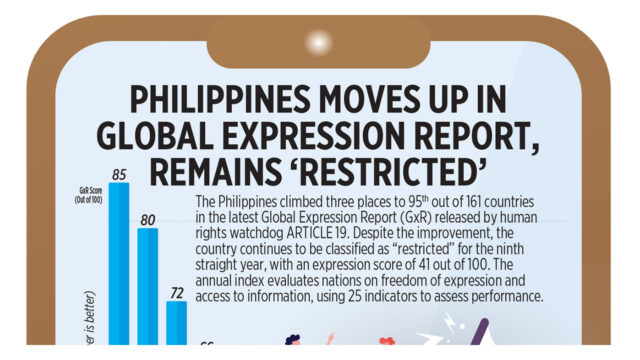
Philippines moves up in Global Expression Report, remains ‘restricted’

The Philippines climbed three places to 95th out of 161 countries in the latest Global Expression Report (GxR) released by human rights watchdog ARTICLE 19. Despite the improvement, the country continues to be classified as “restricted” for the ninth straight year, with an expression score of 41 out of 100. The annual index evaluates nations on freedom of expression and access to information, using 25 indicators to assess performance.

Philippines moves up in Global Expression Report, remains ‘restricted’

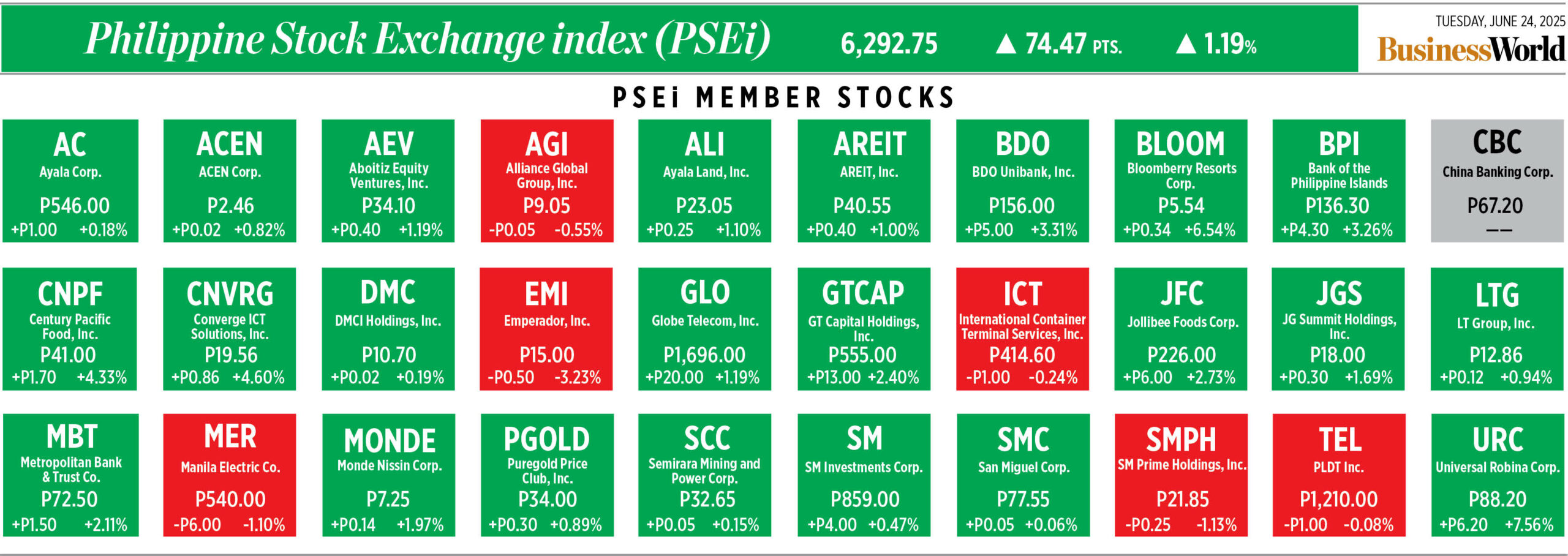
How PSEi member stocks performed — June 24, 2025

Here’s a quick glance at how PSEi stocks fared on Tuesday, June 24, 2025.


Shares up as Mideast ceasefire boosts sentiment

PHILIPPINE STAR/KRIZ JOHN ROSALES

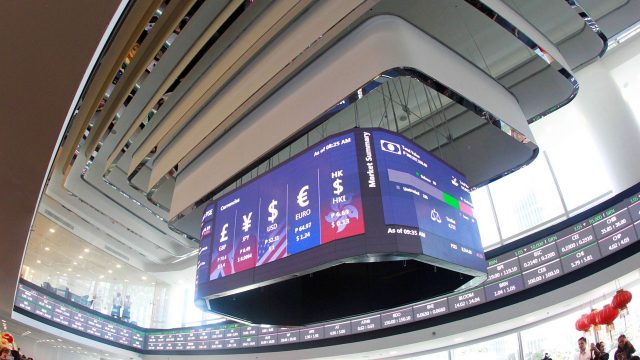
PHILIPPINE SHARES climbed on Tuesday following news that Iran and Israel agreed to a ceasefire after exchanging attacks for nearly two weeks.

The benchmark Philippine Stock Exchange index (PSEi) rose by 1.19% or 74.47 points to close at 6,292.75, while the all shares index climbed by 0.88% or 32.64 points to 3,739.20. The PSEi returned to the 6,300 level intraday, hitting a high of 6,331.02 as the ceasefire boosted market sentiment.

“The local market bounced back, driven by hopes of peace between Israel and Iran. This comes following US President Donald J. Trump’s announcement of a ceasefire between the two countries,” Philstocks Financial Inc. Research Manager Japhet Louis O. Tantiangco said in a Viber message. “As an effect, global oil prices declined, which investors also cheered.”

Global stock markets surged and oil prices tumbled on Tuesday after the announcement of the ceasefire, in the hope it heralded a resolution of the war just two days after the United States joined it by hitting Iranian nuclear sites with huge bunker-busting bombs, Reuters reported.

However, Israeli Defense Minister Israel Katz said on Tuesday he had ordered the military to strike Tehran in response to what he said were missiles fired by Iran in a violation of the ceasefire announced hours earlier by Mr. Trump.

Iran denied violating the ceasefire. The armed forces general staff denied that there had been any launch of missiles towards Israel in recent hours, Iran’s Nour News reported.

The developments raised early doubts about the ceasefire, intended to end 12 days of war.

“Philippine shares and Wall Street traded higher, shrugging off Iran’s failed strike on a US base in Qatar,” Regina Capital Development Corp. Head of Sales Luis A. Limlingan said in a Viber message.

“Markets now await Federal Reserve Chair Jerome H. Powell’s testimony before Congress, where he faces pressure to cut rates, with some officials signaling possible easing by July,” he added.

Last week, the Federal Open Market Committee left its overnight target rate range at 4.25% and 4.5%.

Almost all sectoral indices closed higher on Tuesday. Financials climbed by 2.59% or 58.86 points to 2,323.94; industrials went up by 1.41% or 126.27 points to 9,066.70; services rose by 0.72% or 15.66 points to 2,171.42; holding firms added 0.61% or 32.60 points to end at 5,358.56; and property increased by 0.22% or 4.94 points to 2,208.23.

Meanwhile, mining and oil dropped by 2.04% or 203.32 points to close the session at 9,748.75.

Value turnover went down to P5.81 billion on Tuesday with 1.13 billion shares exchanged from the P6.29 billion with 1.03 billion issues traded on Monday.

Advancers outnumbered decliners, 122 versus 73, while 54 names were unchanged.

Net foreign selling stood at P286.36 million on Tuesday, a turnaround from the P108.27 million in net buying recorded on Monday. — Revin Mikhael D. Ochave with Reuters

Peso rebounds on Israel-Iran ceasefire

BW FILE PHOTO

THE PESO rebounded against the greenback on Tuesday after Iran and Israel agreed to a ceasefire after exchanging attacks for 12 days.

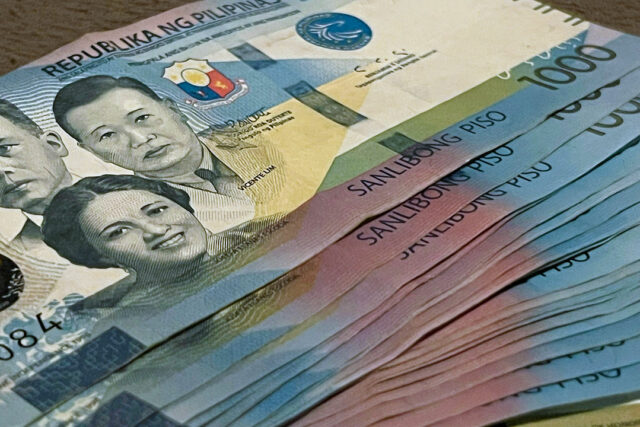
The local unit closed at P57.16 per dollar, surging by 42 centavos from its P57.58 finish on Monday, Bankers Association of the Philippines data showed.

The peso opened Tuesday’s session stronger at P57.20 against the dollar. Its intraday best was at P56.835, while its worst showing was at P57.21 versus the greenback.

Dollars exchanged jumped to $2.01 billion on Tuesday from $1.28 billion on Monday.

“The peso moved in line with regional peers as the dollar weakened following the ceasefire announcement. Interestingly, today’s close returned near Thursday’s level, suggesting that the gap seen last Friday was simply filled,” a trader said in a text message.

The local unit closed at P57.45 on June 19 (Thursday) and at P57.17 on June 20 (Friday). The peso fell sharply on Monday to hit a fresh three-month low due to fears of an escalation in the conflict after the United States attacked Iran’s nuclear facilities over the weekend.

The peso was also supported by the decline in global crude oil prices amid the ceasefire, Rizal Commercial Banking Corp. Chief Economist Michael L. Ricafort said in a Viber message.

“The US dollar-peso exchange rate corrected lower… as market sentiment globally improved after [US President Donald J.] Trump announced a tentative ceasefire between Iran and Israel, spurring optimism that the worst of the Middle East conflict is over,” he added.

For Wednesday, the trader expects the peso to move between P56.75 and P57.25 per dollar, while Mr. Ricafort said it could range from P57 to P57.30.

The US dollar fell on Tuesday after Mr. Trump announced a ceasefire between Israel and Iran, in news that sparked a risk rally and a sharp drop in oil prices, Reuters reported.

Mr. Trump announced a complete ceasefire between Israel and Iran, potentially ending the 12-day conflict that led millions of people to flee Tehran and prompted fears of further escalation in the war-torn region.

Israel has agreed to Mr. Trump’s proposal, saying it has achieved its goal of removing Tehran’s nuclear and ballistic missile threat.

The yen and euro benefited from a sharp fall in oil prices as both the European Union and Japan rely heavily on imports of oil and liquefied natural gas, while the US is a net exporter.

Against the yen, the dollar was down 0.75% at 145.03.

The euro rose 0.27% to $1.1609. It hit $1.1632 a couple of weeks ago, its highest level since October 2021.

Adding to the pressure on the dollar were dovish comments from Federal Reserve policymaker Michelle Bowman, who said the US central bank should consider interest rate cuts soon, triggering a fall in US Treasury yields.

Fed Governor Christopher Waller said in a television interview last week that he would consider a rate cut at next month’s meeting as well.

Mohit Kumar, economist at Jefferies, said he expected the Fed to take more time before easing.

“We are not in the July camp, but do believe that data should show signs of weakness over the summer months and hence prompt a rate cut in September.”

Mr. Trump said on Tuesday that US rates should be lowered by at least two to three percentage points.

Markets are now pricing in close to a 23% chance the Fed could ease rates in July, up from 14.5% a day ago, according to the CME FedWatch tool.

Against a basket of currencies, the dollar was down 0.14% at 98.09, extending its more than 0.5% decline in the previous session.

Fed Chair Jerome H. Powell is due to testify before the US Congress on Tuesday and Wednesday, where focus will be on the outlook for US rates.

The risk-sensitive Australian dollar got a lift and last traded 0.7% higher at $0.6506 as did the New Zealand currency, which rose 0.75% to $0.6025.

Israel’s shekel rallied sharply too, jumping 1.5% against the dollar to its strongest level since February 2023.

“It’s obviously positive news for risk sentiment,” said Rodrigo Catril, senior currency strategist at National Australia Bank, of the announced ceasefire.

“We need to obviously have a bit more detail in terms of exactly what all this means… I suppose it will be the conditions of the ceasefire, and what are the conditions for a longer-lasting peace deal.”

In cryptocurrencies, bitcoin rose 2% to $105,832, while ether jumped 3.2% to $2,425, in a reflection of the positive risk sentiment. — Aaron Michael C. Sy with Reuters

Users who missed 4G migration the ‘real opportunity’ for telcos

REUTERS

By Ashley Erika O. Jose, Reporter

THE telecommunications industry must seize the opportunity presented by the Konektadong Pinoy legislation to address users who missed the initial wave of migration to 4G mobile technology, US cloud and mobile technology company CloudMosa said.

“Telcos are racing to the future with 5G, but growth won’t come from the top alone. The real opportunity lies in those who were left behind in the migration to 4G and beyond. This is a call to action for industry leaders: those who move first to bridge the affordability gap will shape the next decade of the industry,” CloudMosa Chief Executive Officer Shioupyn Shen said in a report on Tuesday.

According to a study conducted by CloudMosa, Konektadong Pinoy will help expedite the phase-out of 2G and 3G, thereby providing a boost to affordable connectivity.

“While the rest of the world is rushing towards 5G, these users (those left behind in the 4G upgrade) present the region’s most overlooked commercial opportunity and telcos are uniquely positioned to move them up the value chain to ultimately close this gap. Doing so will unlock revenue, drive education, employment, economic mobility, and social inclusion,” according to the report.

The Konektadong Pinoy bill is now awaiting the signature of President Ferdinand R. Marcos, Jr., after the two chambers separately ratified the priority measure through voice vote in their respective plenary sessions.

Last week, the Palace said Mr. Marcos will be reviewing the bill in the wake of rising concerns by telecommunications companies. The Department of Information and Communications Technology has expressed optimism that the bill will be signed into law.

A joint statement on Tuesday by several business and industry groups, foreign chambers, public service organizations, tech organizations, and civil society and consumer groups urged Mr. Marcos to sign the bill into law.

The group, which composed of American Chamber of Commerce of the Philippines, Inc.; Canadian Chamber of Commerce of the Philippines, Inc.; Analytics & AI Association of the Philippines; Alliance of Tech Innovators for the Nation; Chief Information Officers Forum, Inc.; Better Internet PH and other industry leaders, described the measure as “landmark legislation that will democratize internet access, which could potentially be this Administration’s greatest legacy.”

The bill aims to increase internet access by relaxing regulations and allowing the entry of more data transmission entrants.

Konektadong Pinoy also raises the prospect of more optimal use of the radio frequency spectrum and the reallocation of underutilized and unutilized spectrum.

Information and Communications Technology Secretary Henry Rhoel R. Aguda has called for expediting the deployment of 5G technology.

The Philippine Chamber of Telecommunications Operators (PCTO) has warned that certain provisions of the measure could weaken regulatory oversight and threaten national security and fair competition.

PCTO President Froilan M. Castelo, in a statement on June 12, warned that the bill raises the risk of unregulated infrastructure and possible foreign control.

The version of the bill agreed by the bicameral conference committee outlines an open-access policy to create a more competitive environment for all qualified participants across the entire data transmission network, while encouraging investment in digital infrastructure to support reliable and affordable data services.

The final version exempts international gateway facilities, cable landing stations, and satellite service providers from legislative franchise requirements. This means any company may build and operate such facilities without going through the safeguards historically used to ensure national security.

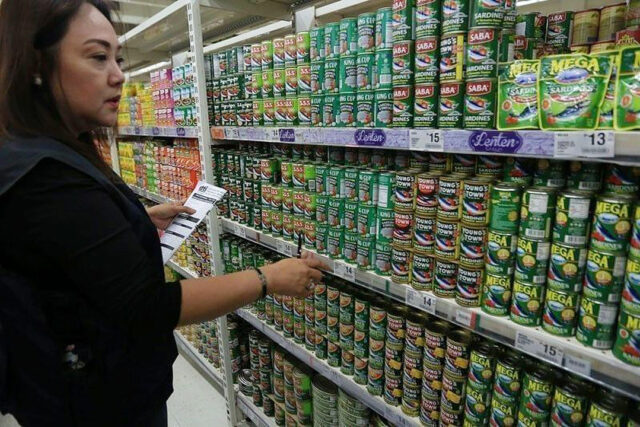
Sardine canners promise to keep prices steady

PHILSTAR FILE PHOTO

THE Department of Trade and Industry (DTI) said it received a commitment from sardine canners, who promised to hold prices steady, contrary to reports that they are seeking to charge more.

“We appreciate the industry’s commitment to the consumer, especially with the economic pressures families are facing today,” Trade Secretary Ma. Cristina A. Roque said in a statement on Tuesday.

“Their decision not to increase prices supports President Ferdinand R. Marcos, Jr.’s directive to keep basic goods affordable and ease the daily burden on consumers,” she added.

The manufacturers’ commitment follows her June 23 meeting with members of the Canned Sardines Association of the Philippines.

She said the commitment was given after news reports that the industry was planning to request an increase in the suggested retail price of a 155-gram can of sardines to P24 from P21, due to rising production costs.

Among the attendees were Chattrade, Mega Prime Foods, Inc., PERMEX, Universal Canning, Inc., and Century Pacific Food, Inc.

“They committed to maintaining the current suggested retail price for canned sardines, a staple in Filipino households,” the DTI said.

The DTI’s Fair Trade Group said that it has “not received a formal petition for a price adjustment but initiated the meeting to proactively address the issue.”

Under the Price Act, the DTI monitors prices of basic necessities and prime commodities, including canned fish. — Justine Irish D. Tabile