Home Blog Page 8692

The road back from a lost year for sports

By Michael Angelo S. Murillo, Senior Reporter

SPORTS FANS will long remember 2020 as a year like no other, with cancelled tournaments, empty stadiums, and the Olympic year moving to 2021 after the Tokyo Games were lost to the pandemic.

In the Philippines, the sports ecosystem, just like any other industry, is trying to cope with the cards it’s been dealt. But after the initial trauma of cancelled games and broadcast-industry upheaval, thoughts have now turned to rebuilding from the wreckage and the long road back.

“We were taken by surprise by the pandemic, leaving stakeholders scrambling (for a plan of action) to move forward,” sports marketer Rely San Agustin said in a Zoom interview.

The revenue hit taken by the various sports leagues that had to shut down because of the quarantine was compounded in sports supported by public funds as budgets were directed to matters deemed more urgent, like containing the pandemic or reviving the economy.

The Philippine Basketball Association (PBA), for one, said it lost some P30 million a month from foregone gate receipts, television, and sponsorships in the seven months it was out. The estimate covers only the league office and does not reflect the financial pressures on the 12 individual teams.  

In collegiate sports, meanwhile, many schools were forced to overhaul their athletic programs, even shutting down some of their varsity teams.

The National Collegiate Athletic Association (NCAA), which cut short its Season 95 because of the pandemic, said at least five thousand individuals, including athletes, coaches and officials, were affected financially as a result of various budget cuts implemented by member schools, whose core source of income — tuition revenue — took a hit from the health crisis.

The University Athletic Association of the Philippines (UAAP), home to some of the country’s biggest universities, was not spared as well.

Compounding the problems of the two TV-friendly leagues was the non-renewal of the franchise of ABS-CBN Corp. by the House of Representatives in May, which entailed the loss of their broadcast partner.

“It’s a hit for the UAAP and NCAA as apart from the reach that ABS-CBN gave them, they lost broadcast money, which is basically the funds that support the leagues (in recruiting) athletes and developing their programs. But good thing, there are other networks they can turn to,” according to Mr. San Agustin, who is also football commissioner for the UAAP.

The UAAP has since partnered with Cignal TV and its affiliate TV5, while the NCAA has chosen GMA Network, Inc.

The postponement of the Tokyo Olympics forced the Philippine Sports Commission (PSC) to overhaul its budget for Filipino athletes’ Olympic campaigns, reducing allowances by as much as half for both competitors and coaches.

The PSC spent some P351 million in the first six months of 2020 on Olympic candidates, a level of spending it is now obliged to maintain in some form for another year with the Games delayed.

PICKING UP THE PIECES
Ten months into the pandemic, the process of picking up the pieces continues for the sports community.

“We’re still finding our way back. The only sane way to go about it is to think we are in this together. We have to be patient and resilient during these times,” according to Mr. San Agustin, who runs RSA 1 Sports Group.

Chatri Sityodtong, CEO and founder of Singapore-based sports media property ONE Championship, said times are tough, but this should not stop anyone from trying to make things happen.

“The keys to success in this environment are twofold. One is creativity, because we are going to be faced with problems we’ve never seen before. So we have to be even more creative about solutions and products that we launch. And then resilience — we are going to get more rejections, failures, obstacles, setbacks, and mistakes than ever before,” said Mr. Sityodtong in response to a query from BusinessWorld during a media briefing.

ONE Championship counts the Philippines as a prime destination for live events. It has been staging combat sports cards in China, Thailand, and Singapore since June, after suspending activity in March.

One of the established avenues for getting leagues to move on with their seasons is to organize tournaments within a protective “bubble.”

Pro leagues like the PBA, Chooks-to-Go 3×3 Pilipinas, and Philippines Football League took the bubble route, confining all tournament participants inside a defined venue with extensive testing to detect infection promptly.

The NCAA and the UAAP are considering bubbles as well, as are the national athletes in training. 

“A bubble setup makes sense,” said Mr. San Agustin. “Seclusion is needed. You really have to control movement in and out of the venues.”

He cautioned however that once committed to a bubble, organizers have to accept everything that goes with it, particularly the cost.

“Looking at the bubble, the NBA (National Basketball Association) did it and it cost them $150 million. The PBA followed suit, and it cost P65 million, PFL (the Philippines Football League) did a semi-bubble for P6 million. They are spending money, but how do they earn from this? Ticket sales are gone. Games are shown on TV, but are corporate sponsors noticing?” he said.

“The PBA should be fine since it has FMCG (fast-moving consumer goods) teams and telcos, but for the smaller leagues, it will be a challenge,” Mr. San Agustin said.

Martin Aguda, Jr., a safety, resilience and crisis management consultant, said the bubble concept has broader applications for business.

“The bubble setup can be adopted not only in sports, but also in other businesses, so there will be less disruption… if done properly, a bubble can be effective,” according to Mr. Aguda, who is affiliated with The Safety Project PH and helped Chooks-to-Go 3×3 Pilipinas review the protocols for its tournament bubble at the INSPIRE Sports Academy in Laguna in October.

The bubble, he said, needs the three Cs — Compliance with all government regulations; Consistency in the implementation of the protocols; and Concern for the health and safety of the people inside it.

Other organizations considering a bubble for their events are the Maharlika Pilipinas Basketball League and volleyball associations Philippine Superliga and Premier Volleyball League.  

MOVING FORWARD
The sporting community is taking tentative steps out of the crisis and is playing things by ear.

“We’re still in wait-and-see. We’re taking it a step at a time. Focus right now. The tournament is at hand and for it to be finished… We are looking at what works and what doesn’t as we plan our next moves,” said PBA Commissioner Willie Marcial, whose organization was in the homestretch of its tournament bubble in Clark City in Pampanga at the time of writing.

The same goes for the collegiate leagues, which have written 2020 off and are now looking at resuming competition late in the first quarter next year, assuming the government approves. Of particular importance are the education agencies, which have indirect oversight over student-athletes.

The Commission on Higher Education has drafted guidelines for the return to training of collegiate athletes, but has not said when it will allow competitions to resume.

Mr. San Agustin said the sports community must make use of the idle time to carefully chart the path it plans to take.

“They have to have solid plans moving forward, despite the fact that at this point, everybody is going through a learning process,” Mr. San Agustin said.

“Expanding your business by going digital would help. We really have to be in tune with the times and go digital — online and social media. People are on their mobile phones much of the time. Leagues and businesses can create online campaigns for their brands. Capitalize on athletes and get the fans engaged,” he said.

He added, “You have to create value for sponsors for them to continue to support your brand, or for those who left, entice them back. At the end of the day, sponsors will come back and ask what you have done for us. Everything can be branded.”

Following the lead of the NBA, the PBA came up with an app for a “virtual experience” as a way of engaging with fans.

Through the app, fans are featured on LED screens at the Angeles University Foundation Arena in Pampanga, the official game venue for its bubble.

PBA games, too, have been live-streamed on Facebook and YouTube to complement the television broadcast, and they have been well-received.

Mr. San Agustin also touts the potential of esports, which he sees as a solid option for games organizers.

“Esports is getting a big boost during this time and experts say it will continue to grow bigger. The players and the following are there.”

Collegiate leagues are now considering including esports in the calendar of events for their upcoming seasons. They may go their own way, apart from the events offered by established esports leagues and organizations.

Mr. Sityodtong views the crisis as a test of the industry’s leadership.

“Ships are not made for the calm waters of the harbor, ships are made for the rough seas in search of new horizons and great captains are made in rough seas, never in the calm of the harbor… I genuinely believe that the best companies will not only survive, they will thrive in this environment. The show must go on,” he said.

Mr. San Agustin said the recovery will come for sports eventually, but patience and adaptability are needed.

“Right now, everything is at a standstill… But we will recover gradually. Patience is needed. Stay resilient and adapt.”

PSE extends disbursement of proceeds from stock rights offer

THE Philippine Stock Exchange (PSE) has extended the timeline for the use of the proceeds for its stock rights offer (SRO) to Dec. 31, 2023, the local bourse said on Thursday.

In a regulatory filing, the PSE said that it had so far disbursed 1,101.14 shares from its planned amount of 2,825.88.

It detailed that its net proceeds were meant to be used for acquisition of the Philippine Dealing System (PDS), product development and working capital requirements at 1,580 shares, 360 shares and 885.88 shares, respectively.

“This directive is being issued primarily for the purpose of ensuring the timely disclosure of information relating to PSE as a listed company and should not be construed as an approval by the (Securities and Exchange) Commission,” the PSE disclosed.

The PSE’s two wholly owned units include the Securities Clearing Corp. of the Philippines and the Capital Markets Integrity Corp.

The listed company holds a 20.98% interest in the Philippine Dealing System Holdings Corp. — the holding company of the Philippines’ fixed income exchange operator — and a 90% interest in Premier Software Enterprise, Inc.

PSE shares on Thursday inched down by 0.19% to close at P154.70 apiece. — Angelica Y. Yang

How PSEi member stocks performed — December 17, 2020

Here’s a quick glance at how PSEi stocks fared on Thursday, December 17, 2020.


Households’ spending outlook remains subdued for Q1 2021

Households’ spending outlook remains subdued for Q1 2021

Peso strengthens on stimulus progress

The peso appreciated slightly against the dollar on Thursday on news that proposed stimulus programs here and in the United States are making progress.

The local unit closed at P48.045 per dollar on Thursday, inching up by 2.1 centavos from Wednesday’s finish of P48.066, data from the Bankers Association of the Philippines showed.

The peso started the session at P48.06 against the greenback. It depreciated to as low as P48.07 and peaked at P48.04 per dollar.

Dollars traded rose to $674.59 million on Thursday from $499.86 million the day prior.

The peso inched up over positive news on developments over proposed stimulus measures in the Philippines as well as in the US, Rizal Commercial Banking Corp. Chief Economist Michael L. Ricafort said.

“The peso exchange rate has been steady to slightly stronger versus the US dollar on continued progress on the nearly $900-billion US stimulus package and the Federal Reserve pledged to maintain its massive asset purchase program until it sees substantial further progress in employment and inflation; Fed scrapped its previous pledge to keep buying over coming months,” Mr. Ricafort said in a Viber message on Thursday.

Reuters reported that deliberations over a US stimulus program may have advanced after House of Representatives Speaker Nancy Pelosi invited other lawmakers to meet on Tuesday to come up with a deal to be enacted within the week.

Mr. Ricafort said the market also reacted as one of the Philippine government’s recovery measures have been ratified by the Congress and inched closer to enactment.

He was referring to the Financial Institutions Strategic Transfer Act bill that allows banks to offload their bad loans to asset management companies as these are expected to rise amid a prolonged coronavirus pandemic. The bill will have to be signed by President Rodrigo R. Duterte to become a law.

UnionBank of the Philippines, Inc. Chief Economist Ruben Carlo O. Asuncion said via Viber that the peso’s movement was also affected by the higher inflow of remittances from overseas Filipino workers (OFWs).

OFW remittances increased for the second straight month in October, rising by 2.9% to $2.747 billion, central bank data showed.

Mr. Ricafort said the peso may trade within P48-48.10 versus the greenback on Friday while Mr. Asuncion expects it to range from P48.04 to P48.08 per dollar. — B.M. Laforga

Shares inch down as investors pocket their gains

By Revin Mikhael D. Ochave, Reporter

PHILIPPINE SHARES inched lower on Thursday as investors booked profits and remained wary of rising coronavirus disease 2019 (COVID-19) cases around the world.

The Philippine Stock Exchange index (PSEi) dropped 1.68 points or 0.02% to end at 7,298.02, while the broader all shares index fell 0.16 point to 4,350.29.

Philstocks Financial, Inc. Research Associate Claire T. Alviar said the market ended lower due to profit taking.

“Traders took to profit taking amid strong psychological resistance at 7,300 level, along with the overvaluation of the PSEi in terms of price to earnings ratio which is around 21x, higher than the five-year average of around 18x.” Ms. Alviar said in a mobile phone message.

“The last minute bargain hunting did not save the bourse from the negative territory, but losses were thinner at close,” she added.

For AAA Southeast Equities, Inc. Research Head Christopher John Mangun, the local bourse ended flat as investors remain confident in the market, which helped offset those who pocketed their gains.

“The PSEi ended flat on last-minute buying as the majority of investors remain confident and are willing to stay in the market, evident in the above average trading volumes that we continue to see,” Mr. Mangun said in an e-mail.

Timson Securities, Inc. Head of Online Trading Darren Blaine T. Pangan said in a mobile phone message that the market declined as investors remain cautious on the global COVID-19 infection count.

According to the Johns Hopkins University’s COVID-19 dashboard, the global COVID-19 case count as of Dec. 17 was at 74.21 million cases.

It said the United States still had the most COVID-19 cases at 16.96 million, followed by India at 9.96 million, Brazil at 7.04 million, and Russia at 2.71 million.

Back home, the majority of sectoral indices at the PSE ended in red territory on Thursday. Property declined 34.31 points or 0.92% to 3,693.7; industrials retreated 51.82 points or 0.54% to 9,477.91; financials shrank 8.09 points or 0.53% to 1,506.22; and mining and oil went down 23.45 points or 0.24% to 9,538.98.

Meanwhile, services improved 10.37 points or 0.67% to 1,537.49, and holding firms rose 50.05 points or 0.66% to 7,560.99.

Value turnover on Thursday reached P9.26 billion with 32.64 billion issues switching hands, lower than the P9.31 billion with 117.64 billion issues seen during the previous session.

Decliners bested advancers, 117 versus 105, while 49 names ended unchanged.

Net foreign selling amounted to P739.83 million on Thursday, an increase from  the net P501.32 million that left the market on Wednesday.

“As we draw closer towards the end of the week, we may have to see if the nearest support at 6,700 holds, with immediate resistance lying at the 7,500 area,” Mr. Pangan said.

DoH expects fresh COVID-19 infection surge this holiday

THE DEPARTMENT of Health (DoH) expects a fresh surge in coronavirus infections during the holidays as people violate quarantine rules and health standards.

Cases in Metro Manila could peak to 4,000 daily by next month, Health Undersecretary Maria Rosario S. Vergeire said, citing estimates by a research team from the University of the Philippines (UP).

“Cases in the national capital region may reach upwards of 4,000 cases per day, which may overwhelm our health system to upwards of 80% utilization by the end of January if we do not act aggressively to halt the transmission now,” she told an online news briefing.

Guido David, a mathematics professor from UP and part of the OCTA Research team, said 4,000 cases is at the “higher end of the projection.

He noted that the capital region had posted 2,000 cases daily when it was under a strict lockdown. “We don’t want to reach that level obviously,” he said at the same briefing.

Ms. Vergeire cited a similar infection surge in Canada and the US after thanksgiving celebrations.

“There is a likelihood of this surge in the Philippines in the coming holidays and we should take these threats seriously and act immediately,” she said.

Ms. Vergeire said the infection rates in Metro Manila, Ilocos, Cagayan Valley and the Cordillera Administrative Region have been rising.

The virus reproduction rate in the country and capital region was now more than 1 from 0.8, meaning a coronavirus patient could infect another person, she added.

She also said more than  half of the cities in Metro Manila have experienced an increase in cases, while improvements for the rest have slowed.

The occupancy rate in hospitals was “low risk” at 36% nationally, but health authorities were preparing these for a potential surge.

Health experts last month urged the public to hold activities outdoors and limit interactions during the holidays. Celebrations should also be limited within the household.

The government this week issued an order requiring face masks and shields in public.

DoH reported 1,470 coronavirus infections on Thursday, bringing the total to 454,447.

The death toll rose by 17 to 8,850, while recoveries increased by 633 to 419,902, it said in a bulletin.

There were 25,695 active cases, 84.8% of which were mild, 6.9% did not show symptoms, 5.4% were critical, 2.7% were severe and 0.3% were moderate.

Quezon City reported the highest number of new cases at 74, followed by Rizal at 64, Makati City at 58, Davao City at 55 and Quezon province at 46.

The agency said 11 duplicates had been removed from the tally, while three recovered cases were reclassified as deaths.

The coronavirus has sickened about 74.6 million and killed 1.7 million people worldwide, according to the Worldometers website, citing various sources including data from the World Health Organization (WHO).

About 52.4 million people have recovered, it said. — Vann Marlo M. Villegas

Duterte to sign 2021 budget bill by end of the year, Palace says

PRESIDENT Rodrigo R. Duterte will sign next year’s spending plan into law by the end of the month at the latest, according to the presidential palace.

The President would sign the measure either on Dec. 23 or 28, his spokesman Harry L. Roque told a news briefing on Thursday. He did not say whether the palace had received the ratified copy of the budget bill.

Last week, lawmakers ratified the P4.5-trillion spending plan for next year, which seeks to support economic recovery after a record recession amid a coronavirus pandemic.

The Palace earlier said Mr. Duterte would thoroughly review the measure for any lines that would need to be vetoed.

The bicameral conference committee increased the allocation for the health sector by 42% to P287.47 billion. The funds will go to the Department of Health (DoH), Philippine Health Insurance Corp. and healthcare personnel, among others.

Under the budget, P72.5 billion will be set aside for the implementation of a COVID-19 vaccine program. Of this, P2.5 billion is under the DoH, while the remaining P70 billion consists of unprogrammed funds.

The amount is lower than the Senate-approved P83-billion allocation for vaccines, which included P8 billion under DoH and P75 billion in unprogrammed funds for vaccine procurement, distribution and storage.

Lawmakers had worked to avoid a repeat of the 2019 budget scenario that led to the reenactment of the 2018 budget for more than four months.

The delay stemmed from an impasse between congressmen and Budget officials, and later with the Senate.

The 2019 budget was also reenacted for less than a week in 2020, after President Rodrigo R. Duterte signed the 2020 budget only on Jan. 6.

The largest share of the 2021 budget goes to the education sector with P708.18 billion, in line with the Constitution. The education sector’s budget, however, was 6.12% lower than initially proposed.

The second-largest chunk goes to the Department of Public Works and Highways (DPWH) with P694.82 billion, up by 4.12%, as the government boosts infrastructure projects to drive the sluggish economy.

Economic output slumped by 11.5% in the third quarter after a 16.9% contraction in the second quarter pushed the country into its first recession in nearly three decades.

Lawmakers also increased the budget of the Labor department by 33.1% to P36.6 billion and the Department of Social Welfare and Development by 3.19% to P176.65 billion. The Transportation department’s budget was cut by 39.1% to P87.44 billion. — GMC

10 more P2P routes for provincial buses opened — regulator

THE  LAND Transportation Franchising and Regulatory Board (LTFRB) on Thursday said 10 more routes would be opened for more than 260 provincial point-to-point (P2P) buses that will travel outside Metro Manila starting Dec. 21.

Separate routes from Clark, Pampanga to SM North EDSA, NAIA Terminal, Lubao, Dagupan, and Subic would be opened, the agency said in a statement.

Routes from NAIA/Parañaque Integrated Terminal Exchange (PITx) to Baguio City; separate routes from Batangas City to Ortigas and PITx; and separate routes from Lipa City to Ortigas PITx would also be opened.

The LTFRB said roadworthy public utility vehicles with valid certificates of public convenience would be allowed to operate.

Public utility vehicles that have sought an extension of their expired certificates and have personal passenger insurance policy will also be allowed to travel.

Provincial point-to-point buses need to get special permits for inter-regional routes outside Metro Manila, the LTFRB said. — Arjay L. Balinbin

Nationwide round-up (12/17/20)

PHILIPPINE STAR/ MICHAEL VARCAS

Duterte blames regulator for toll mess

PRESIDENT Rodrigo R. Duterte on Wednesday night warned toll officials to improve their service amid public complaints against cashless toll transactions or step down.

The President in a televised speech blamed the Toll Regulatory Board for glitches in radio frequency identification systems at toll gates that had caused traffic congestion at major expressways.

He called the regulator incompetent for failing to do a trial run. “The system was not tested thoroughly, which translates into something like incompetence.”

The government adopted a cashless toll payment system at about 200 toll gates after some workers got infected with the coronavirus.

Senators hit the regulator for failing to penalize toll operators for their faulty implementation of the cashless toll scheme since 2017.

“You have the power but you’re not using it,” Senator Sherwin T. Gatchalian told a Senate hearing on the RFID system. — Gillian M. Cortez and Charmaine A. Tadalan

House deputy speakers balloon to 32

THE HOUSE of Representatives now has 32 deputy speakers, just two months after Speaker Lord Allan Q. Velasco assumed the leadership.

Congressmen on Wednesday — the last day of sessions this year — elected Cavite Rep. Abraham Tolentino and Davao City Rep. Isidro Ungab as deputy speakers.

The deputy speakership is one of the chamber’s top posts. A deputy speaker can vote in all committees.

Some of the elected deputy speakers had helped oust Taguig City Rep. Alan Peter Cayetano, Mr. Velasco’s predecessor. — Kyle Aristophere T. Atienza

80,000 more OFWs to return

MORE than 80,000 migrant Filipino workers are expected to come home early next year as countries continue to reel from the impact of a global coronavirus pandemic.

“We are expecting over 80,000 to come home,” Hans Leo J. Cacdac, Overseas Workers Welfare Administration (OWWA) chief, told a news briefing on Thursday. “That’s for the first half of next year.”

More than half-a-million Filipinos have come home after being displaced by the pandemic, International Labor Affairs Bureau (ILAB) Director Alice Visperas told a separate briefing.

The government had helped more than 370,000 out of 550,000 overseas Filipino workers who got displaced to return to their home provinces, she said.

About 350,000 returning migrant workers also received a one-time cash aid of P10,000 each. — Gillian M. Cortez

NEDA bats for pilot physical classes

THE NATIONAL Economic Development and Authority (NEDA) on Thursday said a government plan to pilot-test face-to-face classes in January would help children learn more and boost the economy in the long run.

“We are glad as health systems improve and as we relax quarantines, we are now going to pilot face-to-face learning starting January,” Socioeconomic Planning Secretary Karl Kendrick T. Chua told a news briefing. “It will have a big impact on the economy because children will learn more and become more productive.”

“But we have to do it safely and slowly,” Mr. Chua said.

More than a thousand out of 61,000 schools in the country have been nominated to take part in the pilot run, Education Secretary Leonor Briones said on Wednesday. — Beatrice M. Laforga

Regional Updates (12/17/20)

Mactan airport chief suspended

MACTAN-CEBU International Airport Authority (MCIAA) General Manager Steve Y. Dicdican has been ordered suspended for six months for allegedly violating the Anti-Dummy Law.

Ombudsman Samuel R. Martires barred him from entering his office during his suspension to preserve evidence according to a copy of the order.

Mr. Dicdican was accused of letting foreign officials of GMR Megawide Cebu Airport Corp. (GMCAC) manage the airport. It is a consortium of Filipino company Megawide Construction Corp. and GMR Infrastructure Limited.

The National Bureau of Investigation (NBI) on Dec. 4 said it had filed a complaint before the Justice department against Mr. Dicdican, other airport executives, and GMCAC officials for violating the same law.

In 2014, the Transportation department and the airport authority awarded the airport’s management to GMCAC under a 25-year concession for P14.4 billion for the airport’s expansion.

The complainants said GMCAC’s actions went beyond the terms of the concession and the MCIA was operated and managed by foreigners.

MCIAA workers were set to release a manifesto of support for Mr. Dicdican, spokesperson Mary Ann Dimabayao said by telephone.

Mr. Dicdican had questioned the hasty filing of the complaint, saying the concession deal was awarded years before he joined the airport authority. — Kyle Aristophere T. Atienza

Anti-logging teams formed

THE ENVIRONMENT department has ordered one of its officials to set up four teams to boost monitoring of illegal logging operations in Cagayan Valley, Bicol and the Upper Marikina river basin, it said on Thursday.

This comes after lawmakers blamed illegal logging operations for recent floods that submerged many parts of Luzon after it was hit by a typhoon last month.

The government must go after illegal logging agents because transporters and buyers of undocumented forest products are often linked to these unlawful operations, Environment Secretary Roy A. Cimatu said in a statement.

Each team is made up of representatives from the agency, Interior and Local Government department, Defense department, Armed Forces, and Philippine National Police, the agency said. — Angelica Y. Yang

River dredging to start in January

THE GOVERNMENT will start its dredging project for Cagayan River next month, which will widen the river and prevent heavy floods.

Several areas of the region will be prioritized, Environment Secretary Roy A. Cimatu told a news briefing on Thursday. Mr. Cimatu sought the widening of the river after the Cagayan Valley region experienced heavy floods last month.

Priority areas include Aparri, Camalaniugan, Lallo, Gattaran, Sto. Niño, Alcala, Amulung, Iguig, Solana, Tuguegarao City and Enrile towns. — Gillian M. Cortez

Big-ticket project list up for revision by year’s end

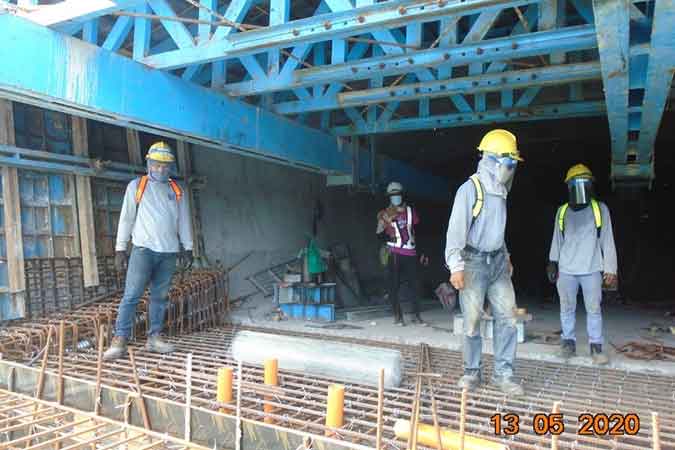
COURTESY OF DEPARTMENT OF PUBLIC WORKS AND HIGHWAYS

THE government’s flagship infrastructure project list — big-ticket priority works undertaken via the “Build, Build, Build” program — will be revised by year’s end to favor those more likely to make significant progress, based on projected construction timetables and funding availability, according to the National Economic and Development Authority (NEDA).

In a briefing Thursday, NEDA Undersecretary Jonathan L. Uy said the list of 104 infrastructure projects are under review to check for their readiness for implementation. He added that the new list might be ready before the year ends.

“We are now recalibrating the 104 infrastructure flagship projects. I hope by the end of this year we will have finalized a list, it would appear that we are now (at) about 100 projects (with) some additional ones we proposed for this particular update,” according to Mr. Uy, who also heads NEDA’s investment programming group.

“The important point is work (and) procurement (are) continuing… the disbursements are a bit late, and the extension of the 2020 budget to 2021 will ensure that all of these expenditures may be ramped up,” he added.

The government has revamped the list several times after identifying an initial 75 in mid-2019. The government has been prioritizing so-called “shovel-ready” projects as its time in office runs out, and also as a means of injecting money more rapidly into the economy to help it recover.

The overall program is estimated to cost P4.13 trillion, funded via foreign loans or aid, public-private partnerships, and budget funds.

Currently, 26 of the 104 priority projects are in the approval stages and are being reassessed for whether they can be substantially started or completed within the administration’s term, NEDA Acting Secretary Karl Kendrick T. Chua said at the briefing.

“If they will be able to go through the approval and final preparation process in the next few weeks, then they will remain. If they will not be achieving those objectives, then they may be parked, but we are also considering a number of other projects,” Mr. Chua said.

“We are constantly reviewing the list and it is likely that our further review will include some of the major flood-control projects as addition because of our recent experience (with typhoons),” he added.

Details on the specific projects dropped or included in the updated list were not provided during the briefing.

Infrastructure spending hit P508.5 billion in the 10 months to October, down 18.4% year on year, according to the Department of Budget and Management (DBM). In October, infrastructure and other capital outlays fell 30.6% to P57.1 billion.

Mr. Chua attributed the lower spending to the year-earlier base, at a time when the government was implementing a catch-up spending plan in the second half.

He said construction works are also continuing to face delays due to the disruptions caused by the late-year typhoons, as well as the dearth of transport for construction workers.

The government’s economic team early this month increased its expenditure target for infrastructure by 5% to P825 billion in 2020 from the reduced target in July. Despite the increase, this is still 16.6% lower than the original P989-billion pre-pandemic spending goal.

Capital outlays in the 10 months, which include equity injected into state-owned firms and transfers to local governments for their infrastructure projects, were down 11.8% year on year to P663.2 billion. The tally accounts for 80% of the P825-billion target for the year.

The DBM remained optimistic that the government can hit its revised target this year to help the economy recover faster from the recession. — Beatrice M. Laforga

ADVERTISEMENT
ADVERTISEMENT