Home Blog Page 846

BPO industry leads agentic AI adoption in PHL

FREEPIK

By Almira Louise S. Martinez, Reporter

THE BUSINESS process outsourcing (BPO) industry is leading the adoption of agentic artificial intelligence (AI) in the Philippines as companies transition from experimentation to application of AI solutions, the International Business Machines Corp. (IBM) said.

“In the Philippines, we have seen in the BPOs a lot of AI usage in call centers in terms of intent analysis or conversation summarizations,” IBM APAC Head of Client Engineering Anup Kumar told BusinessWorld in a virtual interview.

I will say they are the leaders for sure. They are the ones who have the necessary means to move forward with the piece.

Agentic AI uses “agents” for specific tasks with minimal human supervision. These systems can work autonomously and make decisions based on data, probability, and patterns learned from interactions.

Unlike traditional AI models, which still require human intervention, agentic AI exhibits “autonomy, goal-driven behavior, and adaptability,” IBM said.

“It started from typical machine learning, to becoming like an AI assistant, to now a bit of an autonomous agent or assistant,” Mr. Kumar said.

While many industries are already using agentic AI solutions in their operations, some sectors find it harder to tap these technologies, he said.

“I think the biggest challenge at the moment is the organizational challenge itself,” Mr. Kumar said. “An organization has to start thinking about how the agent will help and also how to start trusting it.”

The cost of deploying agentic AI is another hurdle, he added.

“A lot of the way people are building it is through LLMs (large language models) hosted on cloud providers, and the bigger you’re using, the bigger it costs. So, that is also preventing a lot of customers from going mainstream.”

As agentic AI continues to evolve, organizations need to be able to adapt so that they can leverage the potential of these technologies, he said.

“While I will say that some part of agentic AI, like in terms of workflow automation by using tools, is doing multiple agent orchestration, I will say theres a need for a bit more maturity in terms of the technology,” he added.

In 2024, the BPO industry employed around 1.4 million in the Philippines. It has also generated about $38 billion in revenue, making it a vital part of the country’s economy.

The 2025 Work Trend Index report by Microsoft revealed that 60% of Philippine leaders are extremely familiar with AI agents, while only 42% of employees are familiar with the technology.

It added that about 89% of Philippine leaders said they are confident about having AI agents as digital team members to expand their workforce capacity in the next 12 to 18 months.

SEC says 3 groups face charges for unauthorized investment-taking

SEC.GOV.PH

THE Securities and Exchange Commission (SEC) said the Department of Justice (DoJ) has filed criminal charges against three entities for soliciting investments from the public without the required licenses.

In a statement on Wednesday, the SEC said the DoJ found sufficient evidence to charge Eton Phil Non-Specialized Wholesale Trading, SCET Colleens Corp., and a group led by a casino junket operator for violations of the Securities Regulation Code (SRC).

“The groups were charged for engaging in unauthorized investment-taking activities without securing the necessary licenses from the SEC,” the corporate regulator said.

Under Sections 8 and 28 of the SRC, entities offering securities to the public must first secure registration and a secondary license from the SEC. Violations carry penalties of up to P5 million in fines and imprisonment of up to 21 years.

For Eton Trading, prosecutors recommended filing cases against its two founders and 12 agents. The company allegedly offered investment contracts for frozen meat products with promised monthly profits of 20% to 50% on placements ranging from P5,000 to P100,000.

The SEC issued a public advisory against Eton Trading in February 2023 and a cease-and-desist order (CDO) in July of the same year.

Meanwhile, the DoJ also recommended filing charges against SCET Colleens and its three directors for multiple violations of the SRC, including 28 counts of fraud related to transactions with investors.

SCET Colleens allegedly offered investment packages with monthly returns of 5% to 8%, and total returns reaching P1.08 million. The SEC earlier issued a CDO against the company in September 2021 and later revoked its registration in 2023.

The third group, reportedly led by a casino junket operator, allegedly solicited investments through unregistered entities — Philippine National ESports League, Horizon Players Club, and Team Z — promising annual returns of up to 111% secured by postdated checks. The SEC issued a permanent CDO against the group in October 2024.

BusinessWorld tried to reach out to the concerned parties for comment, but no public contact information or company profiles were available. — Alexandria Grace C. Magno

Enforced empathy

SECRETARY Giovanni “Banoy” Lopez takes the MRT-3.

Secretary Giovanni “Banoy” Lopez ordered his subordinates at the Department of Transportation (DoTr) to commute by public transportation at least once a week. The intent is for them to experience first-hand the delays, crowding, and other difficulties that ordinary commuters face daily.

“This… is to ensure the effective implementation of transportation projects and programs by allowing DoTr officials to gain first-hand experience of various public transport systems and better understand the daily struggles of commuters,” read the memorandum released Sept. 15.

Mr. Lopez ordered his senior officials to ride jeepneys, buses, and trains. Covered by the directive were the heads at the Land Transportation Office (LTO), the Land Transportation Franchising and Regulatory Board (LTFRB), the Light Rail Transit Authority (LRTA), and the Philippine National Railways (PNR).

By now, the directive is a month old. Mr. Lopez’s goal, I presume, is to make his officials better understand the hardships of the commuting public using all modes of public transport. Officials must also submit reports after each weekly commute, sharing observations, recommendations, and action plans.

While I laud the Lopez directive, I wonder why it needed a formal department order. The good secretary, in my opinion, seems to be intent on institutionalizing empathy in his office. As if a mere memorandum could make officials more empathetic and transform them into better public servants.

If empathy is the essence of public service, why must it be codified in memos and directives? The DoTr memorandum implicitly admits that empathy has lost its place in the DoTr bureaucracy, and that transport officials have become too insulated from the daily struggles of commuters, who are among the very people they serve.

Nothing proves this point more than the case of one of his undersecretaries who was ordered to explain the use of a protocol plate and blinkers on a private vehicle that was involved in a traffic altercation caught on video. Mr. Lopez ordered his undersecretary to explain why he shouldn’t be sanctioned.

The official, who is now on an indefinite leave of absence, had skipped a scheduled hearing on the incident at LTO. But his driver showed up, and LTO recommended revoking the driver’s license and impounding the vehicle, which was registered to a private company.

The incident highlights the clash between Mr. Lopez’s order for his people to experience the burdens of ordinary commuters, and the apparent perpetuation of official privilege. The protocol plate incident reveals the limits of the order and, in a way, diminishes it to nothing more than a symbolic gesture.

True public service rests on empathy and responsiveness. Yet, when institutions fail to nurture that mindset, government ends up institutionalizing what should be innate. It is ironic that public officials still need to be told to be among the people. Obviously, something has gone wrong in our public service culture.

Rank has clearly brought insulation. Officials sit in comfort while the rest of us wallow in traffic and floods. The result is a widening empathy gap. Lopez’s memo is a forced corrective. Servant leadership puts the needs of the people first. Officials may have forgotten they are public servants, first and foremost.

Without a formal order, the empathy campaign risks being symbolic. A memo from the secretary helps ensure compliance, consistency, and accountability. If it were merely voluntary, many officials might not participate, especially those used to private cars or service vehicles, or who do not wish to be inconvenienced.

By requiring senior officials to report observations and suggestions, the order also provides legal and administrative weight to data gathering and service assessment. If linked to performance evaluations, budgets, or project decisions, the exercise could actually have a more meaningful impact.

Without the memorandum, the public might dismiss the empathy initiative as hypocrisy. The mandate, at least, makes the effort official business. In other countries, though, such an order is unnecessary. Public officials ride transit as a matter of course. In Europe, for instance, some ministers even use a bicycle to get to work.

The Lopez memo underscores the distance that has grown over the years between rulers and the ruled. And in the case of his undersecretary, whose privilege was allegedly unchecked, the department’s attempt at empathy now risks collapsing into hypocrisy.

But honestly, is a weekly commute by senior officials really enough to inform transport policy? Can it truly make a difference? Can a once-a-week experience capture the complexity of public transportation issues, and lead to long-term solutions rather than stop-gap measures? Mr. Lopez needs to prove critics wrong.

There is also room for abuse. Officials could game the system by choosing easy routes or less crowded times, just to meet their “commuting day” requirement. Practical concerns also arise: security, safety, and time lost. Burdened officials might push back, arguing that the directive hampers their work.

Empathy, in my view, can be a valuable policy tool, especially when combined with solid data and empirical evidence. But empathy should not be contrived or mandated. Ideally, experiencing the system should be an instinctive part of transport policymaking. Opinion and learning come from experience, and not just from reading a report.

The Lopez order is a step in the right direction. But the real test is whether it can produce concrete reforms. Too early to tell, still. However, the effort must eventually translate into better conditions, more reliable systems, safer commutes, and improved infrastructure.

Otherwise, it risks becoming mere public relations. Lip service, and nothing else. A populist move meant to influence public opinion, if not entertain, without real connection to reform or change. To avoid this, the reports and feedback must feed directly into transport planning and help shape policy.

Public service is supposed to be rooted in empathy. Yet officials now need a memo to remind them to live through what their constituents endure daily. This paradox highlights the gap between the ideal of servant leadership, which is knowing the pulse of the people, and the reality of bureaucratic detachment.

Mr. Lopez means well. I do not think it is his intent to embarrass his subordinates. Rather, he is requiring them to feel what they should already understand. Empathy should flow naturally in public service. But for those who may have forgotten, Mr. Lopez’s corrective measure may indeed be necessary.

The danger is that commuting once a week turns into a staged act. And that undermines genuine empathy, which demands consistency, presence, and action, not token gestures. The order will matter only if it leads to reforms and solutions. Otherwise, it reduces empathy to ritual.

The protocol-plate scandal should not be just a footnote. Let it be the moment when mandate and accountability collide. If handled well, the probe can deepen the credibility of the DoTr’s empathy experiment. If mishandled, it will deepen public cynicism: that empathy from officials is just a pose.

Ultimately, public service should not have to require reminders to feel the pulse of the people. Empathy should be innate as it is the heartbeat of governance. If making it mandatory is necessary, it is because officials have forsaken their purpose, disregard accountability, and abuse their privileges.


Marvin Tort is a former managing editor of BusinessWorld, and a former chairman of the Philippine Press Council.

matort@yahoo.com

The World’s Best Bar in 2025 is Hong Kong’s Bar Leone

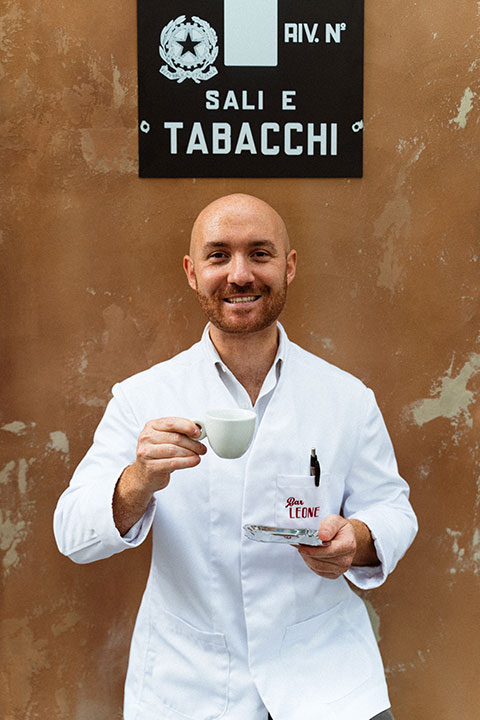
BAR LEONE’s Lorenzo Antinori

AN ITALIAN-THEMED bar that opened its doors less than three years ago in Hong Kong has been selected the world’s best — the first time for an Asian venue.

Bar Leone, famous for outstanding Negronis, olive oil sours, and other drinks, rose to No. 1 in the World’s 50 Best Bars list from second place last year. Spearheaded by cocktail master Lorenzo Antinori, a Roman bartender who previously worked in London and Seoul, the unpretentious venue was chosen as Asia’s best bar for the past two years.

The ascension comes as the Asian hub pushes to revive its ailing food and beverage scene following years of draconian pandemic-era rules that led to an exodus of expatriates and a slump in the number of visitors. While the number of tourist arrivals has been recovering steadily, it’s still below a peak seen in early 2019, before widespread protests also curbed the city’s appeal to international travelers.

“We want to share this with the city of Hong Kong, and the Asia bar community,” Mr. Antinori told Bloomberg. “I truly believe that Hong Kong has one of the best bar scenes in the world. It’s really about having a vision, creating spaces that are not just necessarily concept-driven, but places that have a true identity and speak to guests in a very direct way.”

Last year’s winner, Handshake Speakeasy in Mexico City, dropped to No. 2 on the list. The bilevel bar in the Colonia Juarez neighborhood, inspired by the Prohibition era, serves classically inspired drinks featuring molecular gastronomy with an on-site laboratory and a lab manager.

Coming in third, fourth, and fifth places, respectively, were Barcelona’s Sips and Paradiso and London’s Tayer + Elementary.

In an attempt to replicate Bar Leone’s success in mainland China, Mr. Antinori and co-founder Justin Shun Wah are set to open a branch in Shanghai in November. They also teamed up with barman Simone Caporale from Sips to open another venue in Hong Kong earlier this year. Their Cuba-inspired Montana reflects the colorful atmosphere of the Caribbean island and Miami in the 1970s, with a menu featuring cocktail classics such as the daiquiri, El Presidente, and the Montana.

The ranking for best bars is created by 50 Best, which has been publishing the list since 2009 and throwing a party to mark it since 2012. The same organization ranks the world’s 50 best restaurants.

The list was compiled with input from more than 800 industry experts from 29 regions, including bartenders, drinks writers and cocktail experts, according to the organizer. Each voter was required to name their eight best cocktail experiences from the previous 18 months, with the final ranking adjudicated independently by Deloitte.

The event marking the 17th edition took place on Oct. 8 at Hong Kong’s Kai Tak Cruise Terminal, located at the end of the city’s old airport runway overseeing Victoria Harbour. The list was announced in an Asian city for only the second time — it was held in Singapore in 2023.

The list of bars ranked 51st to 100th was revealed last month, highlighting venues from 35 destinations. Europe had the largest regional representation here, with 15 bars including Madrid’s Angelita (51), Berlin’s Wax On (57) and Naples’ L’Antiquario (63).

While landing the top position is expected to lead to more guests waiting in line outside of the Bar Leone in Hong Kong’s Central district, Mr. Antinori is not foreseeing major changes to the place. “Conviviality, sharing tables and food and drinks. Whatever you read on the menu is what you get. Bar Leone is a very digestible experience. It’s very comfortable,” he said. “Tonight, we are going to celebrate with some tequila.” — Bloomberg

Singlife offers digital insurance products via AUB’s HelloMoney e-wallet

SINGLIFE Philippines, Inc. has partnered with Asia United Bank Corp. (AUB) to offer digital insurance products via the HelloMoney e-wallet as they look to expand their customer base.

Users will be able to explore, purchase, and manage life insurance products on AUB’s e-wallet ecosystem HelloMoney and Hello Pag-IBIG through the Singlife microsite. Products currently available on the Singlife Shop on the HelloMoney app are Cash for Income Loss (Accidents), which covers up to P1.8 million in case of disability or death due to accidents, and Cash for Medical Costs, which provides up to P1.3 million for hospitalization or upon diagnosis for 125 listed critical conditions.

“So, the partnership is basically allowing the HelloMoney users to access Singlife products within the HelloMoney app. This is a good match because Singlife offers their products digitally only, and similarly, that’s also the thrust of HelloMoney by making banking products and services available via our digital channel using the HelloMoney app,” AUB Executive Vice-President and Operations & Information Technology Group Head Wilfredo E. Rodriguez, Jr. said at an event on Wednesday.

Singlife and AUB plan to roll out more insurance solutions on HelloMoney, he said, adding that the microsite gives AUB a new revenue stream through platform fees and lets the bank reach underserved segments.

Mr. Rodriguez said they expect steady revenue growth and customer acquisition for HelloMoney for this year as they continue to expand the e-wallet’s offerings.

“If you talk of the past, we’ve been doing very well in the last four to five years. In fact, since 2022, we’ve had one record year after the other, and it seems that that will continue this 2025 as well.”

The e-wallet is on track to add 1.2 million to 1.5 million more customers this year from 5 million at end-2024, he said, as HelloMoney currently has 6 million customers.

For their part, Singlife Philippines Chief Executive Officer Lester Cruz said the partnership will help increase customer awareness about their products through HelloMoney.

“The customer growth from the side of Singlife Philippines has been really quite encouraging. We grew our premium-paying customer base by tens of thousands on a monthly basis… I hope it continues all the way to the end of the year. This is our best year of customer growth so far alongside all the other metrics,” he said. — Aaron Michael C. Sy

Cybersecurity needs a rethink in the age of agentic artificial intelligence

STOCK PHOTO | Image by Gerd Altmann from Pixabay

By Asha Hemrajani and Ian Monteiro

ARTIFICIAL INTELLIGENCE (AI) has entered a new phase. It is shifting from passive tools to autonomous agents that can plan and act across digital and physical systems, often for extended periods and in concert with other agents. Their interacting and collaborating capabilities are scaling quickly, allowing them to perform increasingly complex tasks with minimal human input, across sectors such as banking, e-commerce, and logistics.

These systems are improving efficiency, but they also raise the stakes for cybersecurity as many of them were not built with security in mind.

Agentic AI systems can be attacked. As they interact with enterprise systems, other agents, and humans, the cybersecurity attack surface expands, exposing them to new threats such as impersonation attacks, prompt injections and data exfiltration.

The boundaries between appropriate autonomous use and deliberate misuse are blurring as enterprises permit AI agents to use apps on users’ behalf more frequently. Malicious agents can also take advantage of the same interfaces that authentic agents employ.

Safeguarding agentic AI in enterprise systems is therefore emerging as one of the defining upcoming cybersecurity challenges.

Recent state-linked campaigns such as UNC3886, reported in Singapore, revealed how adversaries try to exploit trusted enterprise platforms to gain persistent access. Similar risks will arise as agentic systems become more deeply integrated into operations. Protecting them is no longer optional; it is a strategic imperative.

CYBERSECURITY AS A STRATEGIC ENABLER
Traditional cybersecurity frameworks were designed for systems with predictable behaviors. Agentic AI breaks that predictability. It learns, adapts, and operates with varying degrees of autonomy, creating new layers of uncertainty that static defenses cannot contain.

For governments and large enterprises operating critical infrastructure, this shift requires a fundamental change in mindset. As agentic AI becomes embedded in decision-making, operations, and citizen services, cybersecurity must evolve from a defensive function to a strategic enabler of trusted autonomy.

Purposeful and appropriate agentic AI deployment is critical. The right safeguards are needed for such deployments. Deeper testing of how AI systems interact, along with clear human oversight and escalation management is essential, especially in critical infrastructure.

Security must now be adaptive, context aware, and integrated into business and operational strategy. It is no longer just about preventing attacks. It is about maintaining the trustworthiness of autonomous systems that are starting to influence decisions at national and enterprise scale.

The distinction between securing AI deployment and leveraging AI in cybersecurity is also one that needs to be recognized. Guardrails for this nascent field are still in a formative phase, but ethical and practical implementation realities are important pieces of the puzzle that cannot be ignored.

Fundamental signposts in cybersecurity also need revisits and rethinks. Identity, data and attack surfaces take on different complexions that are still evolving, and there are contradictory philosophies in concepts such as Zero Trust that need adaptation to the growing impact of AI.

REFRAMING DIGITAL RISK GOVERNANCE
Governance frameworks must evolve alongside technology. Two issues are becoming urgent.

First, the spectrum of autonomy must be understood. Agentic behavior is not a binary state. Treating a basic automation script as equivalent to a self-directing system results in misplaced controls and uneven risk management. Oversight and safeguards should correspond to degrees of autonomy, not broad labels.

Second, accountability must be redefined. If an agentic AI system executes an action that is harmful, who should bear responsibility? Without clear boundaries, legal and ethical gaps will persist, and adversaries may exploit them. Boards, chief information security officers, and regulators need shared accountability models that reflect how agentic AI systems work.

These questions are already visible in data governance disputes, algorithmic bias cases, and AI incidents where AI systems have behaved in unexpected ways. Unless accountability frameworks get better defined, accountability gaps will widen.

SECURING AGENTIC AI IN  CRITICAL INFRASTRUCTURE
Agentic AI deployment in critical infrastructure entities raises unique risks. Agentic AI promises gains in efficiency and resilience, but its vulnerabilities could cause cascading disruptions if compromised.

Protecting these systems requires new approaches to securing AI apps and agents.

It is essential that critical infrastructure entities retain control as they adopt more autonomous AI-driven systems.

Hence, the focus needs to be on detection and stopping attacks (such as direct and indirect prompt injection, data poisoning) on models/AI apps and agentic-AI workflows. Policy control for AI use such as blocking risky requests, data-leak prevention for AI apps, and detecting unsanctioned AI agents in use, among others, are also essential.

Equally important is ensuring resilience in agentic AI systems by governing the non-human identities (NHIs), the digital identities backbone of agentic AI. Enterprises will need to exercise proper oversight of NHIs in terms of access control, guardrails, and traceability.

CONVENING FOR RESILIENCE IN AGENTIC AI
No single government, enterprise, or regulator can address these challenges on their own. For agentic AI systems to be safe and resilient, collaboration across borders and sectors is needed.

Across ASEAN, economies like Singapore, Malaysia, and the Philippines are building stronger partnerships between government, industry, and academia to prepare for the next wave of AI-driven threats. Platforms such as GovWare in Singapore play an important role in connecting regional voices and advancing dialogue on shared cybersecurity challenges that affect the entire ASEAN digital ecosystem.

The real value of such forums lies in bringing together policymakers, enterprises and innovators to address accountability, interoperability and resilience together.

BUILDING TRUST IN THE AGE OF AUTONOMY
As agentic AI becomes part of daily operations, the real challenge is not only technical but human. Trust will depend on the people who design, deploy, and oversee these systems, and on their ability to step in when things go wrong.

Events like GovWare help translate complex AI and cybersecurity issues into shared understanding and practical collaboration. They remind us that resilience is built through people working together, not machines acting alone.

Ultimately, technology is only as trustworthy as the intent and integrity of those who create and use it. A secure digital future will depend on our collective willingness to stay curious, accountable, and connected, because trust is built by people, not algorithms.


Asha Hemrajani is a senior fellow at the S. Rajaratnam School of International Studies, Nanyang Technological University. Ian Monteiro, CEO and founder of Image Engine, organizer of the GovWare Conference and Exhibition, co-authored this article to offer an industry view on advancing trust and resilience in the era of agentic AI.

mWell, DICT to integrate digital health services into eGov PH app

METRO PACIFIC Investments Corp.’s (MPIC) digital healthcare platform mWell has partnered with the Department of Information and Communications Technology (DICT) to integrate digital health services into the government’s eGov PH application.

In a statement on Wednesday, mWell said the partnership seeks to develop the country’s first national digital health integration within a government platform, enabling users to access doctors, medical records, and other health services online.

Under the memorandum of understanding, the DICT and mWell will collaborate to embed a digital Health ID into the eGov PH app, giving users access to primary care doctors, specialists, and mental health professionals. Patients will also be able to view and store their medical records securely.

“This collaboration supports the government’s Digital Philippines agenda by bringing healthcare closer to Filipinos wherever they are,” DICT Secretary Henry R. Aguda said.

mWell President and Chief Executive Officer Chaye Cabal-Revilla said the integration aims to establish a unified digital network linking government, providers, and patients.

mWell said it has been working with the DICT to reach geographically isolated areas through its OnTheGo Clinic-In-A-Bag program, which provides telemedicine services to remote communities, including indigenous peoples and soldiers in conflict zones. The company has also introduced drone-based medicine delivery and its BangkaHealth telemedicine service for coastal areas in Sulu.

mWell, part of the MPIC group, operates an artificial intelligence-powered digital clinic and electronic medical records platform. The company also recently acquired KonsultaMD to expand its telemedicine and e-prescription services.

MPIC Chairman, President, and Chief Executive Officer Manuel V. Pangilinan said the partnership will support efforts to expand mWell’s coverage nationwide.

MPIC is one of the key Philippine units of Hong Kong-based First Pacific Co. Ltd., which also holds interests in Philex Mining Corp. and PLDT Inc.

Hastings Holdings, Inc., a unit of the PLDT Beneficial Trust Fund subsidiary MediaQuest Holdings, Inc., holds a majority stake in BusinessWorld through the Philippine Star Group, which it controls. — Alexandria Grace C. Magno

Proposal to cut up to P400B out of proposed budget 2026

My hypothesis on the ongoing corruption scandal in the country: As the size of the budget goes up yearly, the extent of corruption and waste also increases at a proportional rate (if not at higher proportion) as the overall budget expansion.

The reason why I make this hypothesis — it is an unproven theory — is because the budget deficit and the public debt keep rising. Meaning past spending did not result in higher productivity of our people and government institutions that are supposed to “outgrow the debt.”

If past spending on public physical infrastructure (roads, bridges, irrigation canals, etc.) and social infrastructure (education, healthcare, monthly cash, free seeds, etc.) were not wasted or inefficient, the resulting productivity increase would have allowed our economy to grow faster, with revenues larger to control the deficit and pay back the debt. This did not happen.

See also recent reports in BusinessWorld on the subject: “Corruption issues hurting US investor interest in the Philippines — Romualdez” (Oct. 10), “Analysts call for more transparency in bicameral committee meetings for budget bill” (Oct. 13), “House approves P6.793-trillion budget bill on final reading” (Oct. 14), “Flood control scam derails S&P credit rating upgrade for Philippines” (Oct. 15), and, “Corruption scandal to slow Philippine growth, says Recto” (Oct. 15).

With the above hypothesis, I make this proposal — that the budget for 2026 and the next few years be curtailed so that the annual budget deficit is not larger than P1 trillion a year, and the deficit/GDP ratio move towards a maximum of 3.5% by 2028.

This is a tough goal since the current average budget deficit is around P1.55 trillion a year. So, I propose cutting the budget of certain agencies based on these considerations.

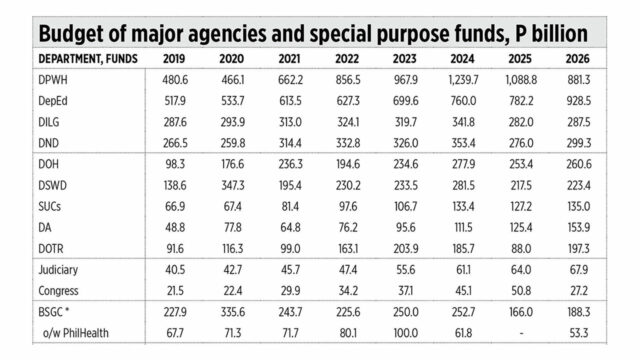
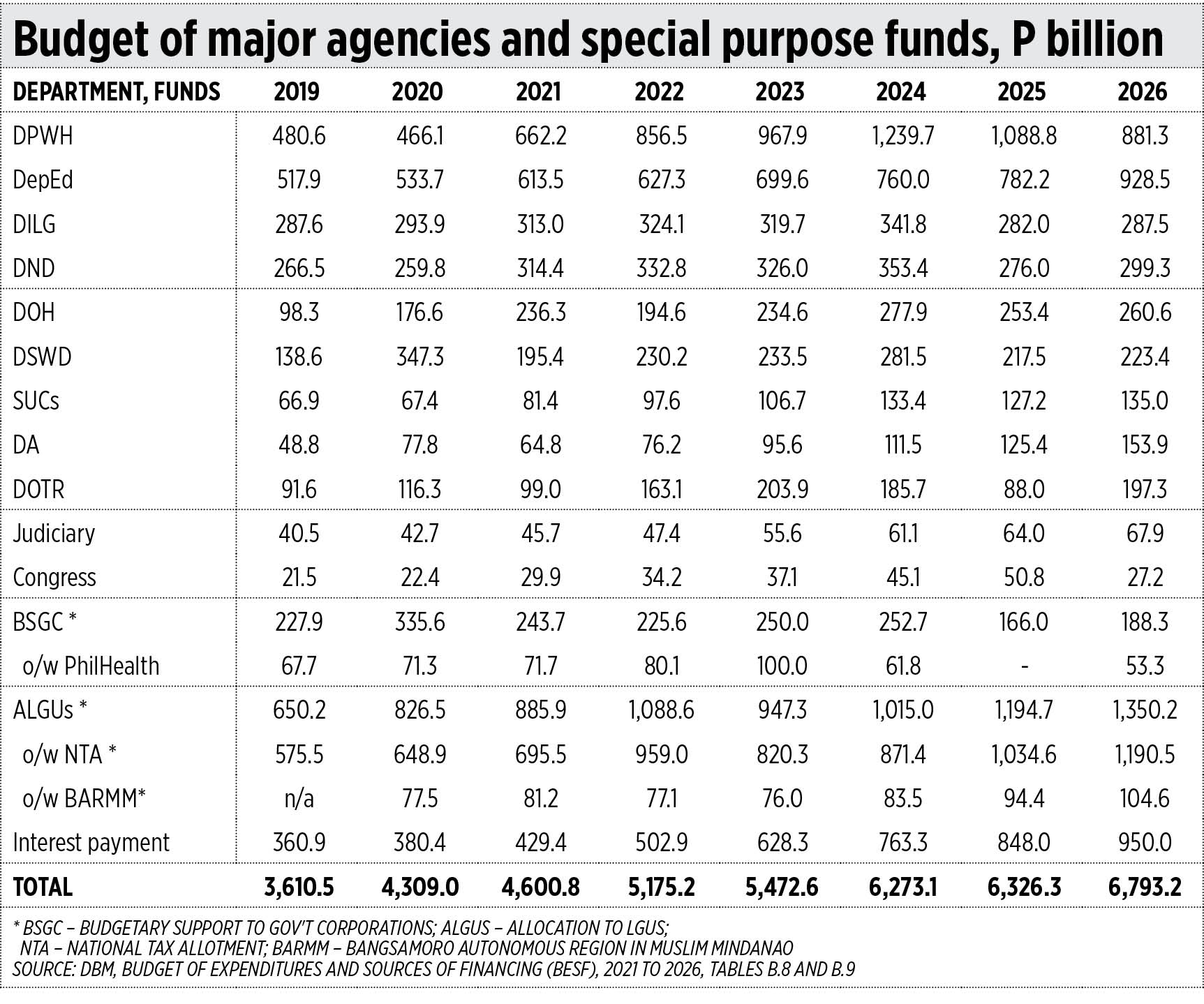
First, consider that the overall budget has nearly doubled from P3.61 trillion in the pre-lockdown year 2019 to P6.33 trillion in post-lockdown 2025. Interest payments alone for our public debt are projected to more than double from P361 billion to P848 billion over the same period.

So, agencies and departments with 2025 budgets that are twice their 2019 level are candidates for spending cuts because the virus crisis, which was used as the basis for the huge rise in their budgets, is no longer here. These include the Departments of Public Works and Highways (DPWH), Health (DoH), Social Work and Development (DSWD), Agriculture (DA), and state universities and colleges (SUCs). See the table for details.

Thus for 2026, the Senate may consider limiting the budget of these agencies: the DoH to P230 billion while the Philippine Health Insurance Corp. or PhilHealth subsidy is kept at around P60 billion, leading to savings of P25 billion; the DSWD up to P200 billion, with savings of P23 billion; the DA up to P130 billion, with savings of P24 billion; the SUCs up to P130 billion, with savings of P5 billion; the Department of Transportation up to P190 billion, with savings of P7 billion. This leads to a savings sub-total of P84 billion.

The rest of the departments may have to deal with across-the-board reductions in their budgets of 5% to 8% — that would come to around P150-P200 billion in additional savings.

Then cut the subsidies to government corporations like the National Irrigation Administration (NIA) from an average of around P60 billion/year to only P30 billion; remove the Power Sector Assets and Liabilities Management Corp. (PSALM) subsidy of P8 billion/year; and the National Electrification Administration (NEA) subsidy of around P4 billion/year. This will result in around P42 billion in savings.

The Bangko Sentral ng Pilipinas’ cut in interest rate should help reduce our interest payment to not more than the programmed P950 billion.

Overall, a spending cut of up to P400 billion can be made in the 2026 budget. This will be a big respite in our budget deficit and annual borrowings.

I hope that President Ferdinand R. Marcos, Jr., Budget Secretary Amenah F. Pangandaman, and Senate President Tito Sotto would consider these proposals. Also, the rest of the economic team, and the House leadership when the Bicameral Committee is formed for this.

When agencies feel the tightness in overall spending and their agency budget, they will tend to be more careful, more efficient, and less wasteful in their spending to avoid another round of public backlash.


Bienvenido S. Oplas, Jr. is the president of Bienvenido S. Oplas, Jr. Research Consultancy Services, and Minimal Government Thinkers. He is an international fellow of the Tholos Foundation.

minimalgovernment@gmail.com

A Japanese Pinot Noir town blessed by climate change now worries about the weather

TAKAHIKO.CO.JP

YOICHI, Japan — Climate change has helped make the small Japanese town of Yoichi the toast of Pinot Noir connoisseurs, with gradually warming temperatures encouraging locals to try their hand at the delicate grape variety over the past two decades.

Yoichi was well known as the home of Nikka Whisky. But it burst into the viticultural limelight five years ago, when the 2017 Nana-Tsu-Mori Pinot Noir from the local Domaine Takahiko winery was featured on the wine list of Copenhagen’s globally acclaimed Noma restaurant.

A bottle of that prized wine, which once sold for around $30, is now offered by resellers in Japan for about $560. Other wines from the town, which is located on Japan’s northernmost island of Hokkaido and now has about 20 wineries and 70 vineyards, have also won their fair share of accolades.

But Yoichi’s farmers fret that even before the town’s reputation has had a chance to be embraced by mainstream consumers, recent rapid gains in temperatures and potentially more rain during the harvesting season could mean that it will become difficult to grow the Pinot Noir grape here.

“It’s like a roller coaster,” said Domaine Takahiko owner Takahiko Soga, who founded his winery in 2010.

Mr. Soga said he once thought Yoichi’s temperatures during the growing season were roughly similar to France’s Alsace region, but then they reached levels on par with Burgundy, which produces some of the world’s finest Pinot Noirs.

“Then, when I thought we were at Burgundy temperatures, we got closer to Loire or Bordeaux levels this year,” he said.

Climate change is roiling many farmers of all types of crops across the world, while blessing only some. Wine producers are no exception, but the Pinot Noir grape is particularly sensitive.

Known for producing elegant transparent wines, the grape can thrive in cool to temperate climates, but its thin skin and tight clusters make it extremely sensitive to even a bit too much sun or rain.

VEXED BY BIRDS
Climates of wine-growing regions around the world are classified under the Winkler Index, which is calculated by adding daily average temperatures above 10°C (50°F) or growing degree days (GDD) from April to October.

Hokkaido has generally been viewed as having a Region I climate — the coolest of the five Winkler climate groups.

But since 2023, Yoichi’s GDD sum has nudged up into Region II territory, according to data from Japan’s Meteorological Agency. That’s a temperature zone more commonly viewed as suited to medium-bodied reds such as Merlot and Cabernet Sauvignon.

And this year, Yoichi had its hottest summer since record-keeping began, with average temperatures of 22.1°C between June and August, about three degrees higher than the average for the three decades to 2020.

Yoichi’s warmer and longer summer seasons increase the chances that Pinot Noir grapes could ripen too quickly, leading to undesirably high sugar and low acid levels. Higher temperatures also make the fruit more prone to damage from rain.

Yuichi Hirotsu, an award-winning vineyard owner whose family was in 2006 among the first of the town’s farmers to plant the classic red, said his Pinot Noir grapes had suffered from rain damage this year.

And another variety he grows, the Austrian Zweigeltrebe, was also severely hit by a particularly heavy downpour in September — something Mr. Hirotsu says he hasn’t previously seen at the beginning of autumn.

“It took us forever to pick Zweigeltrebe this year because we had to remove damaged grapes one by one,” he said.

Also vexing Yoichi’s winegrowers has been a marked increase in the number of birds looking to feast on their grapes — a trend they also blame on climate change, saying it has reduced sources of nuts and seeds for the birds in nearby mountains.

Such is the scourge that the sound of firecrackers to scare them away is ever-present in Yoichi.

The need to gain knowledge about coping with climate change was one of the primary reasons behind Yoichi Mayor Keisuke Saito’s formation of a “wine accord” with the historic Pinot Noir commune Gevrey-Chambertin in Burgundy this year that will see the two groups exchange know-how on production methods.

In terms of immediate measures, as temperature and humidity control become increasingly challenging, Domaine Takahiko has built an underground wine cellar to store 100 barrels.

Trying new types of Pinot Noir or other kinds of grapes will also be necessary, the farmers believe.

“Pinot Noir might not be the ultimate goal for this town. Varieties like Merlot or Syrah might be what await us in the future,” said Mr. Soga. — Reuters

AI investment boom may lead to bust, but not likely systemic crisis, IMF chief economist says

STOCK PHOTO | Image by Rawpixel.Com from Freepik

WASHINGTON — The US artificial intelligence (AI) investment boom may be followed by a dot-com-style bust, but it is less likely to be a systemic event that would crater the US or global economy, the International Monetary Fund’s (IMF) chief economist, Pierre-Olivier Gourinchas, said on Tuesday.

There are many similarities between the late 1990s internet stock bubble and the current AI boom, with both eras pushing stock valuations and capital gains wealth to new heights, fueling consumption that added to inflation pressures, Mr. Gourinchas told Reuters in an interview.

Then, as now, the promise of a new, transformative technology ultimately may not meet market expectations in the near-term and trigger a crash in stock valuations, he said. But just as in 1999, investment in the sector is not built on leverage, but by cash-rich tech companies.

“This is not financed by debt, and that means that if there is a market correction, some shareholders, some equity holders, may lose out,” Mr. Gourinchas said at the start of the IMF and World Bank annual meetings in Washington.

“But it doesn’t necessarily transmit to the broader financial system and create impairments in the banking system or in the financial system more broadly,” he added.

UNREALIZED GAINS
Tech firms are pouring hundreds of billions of dollars into AI chips, computing power, data centers and other infrastructure in a race to deploy the technology that promises massive productivity gains.

Mr. Gourinchas said these gains have not yet been realized in the economy, just as the lofty valuations of internet stocks in the late 1990s were often not based on actual revenues, leading to the dot-com bust in 2000 and a shallow US recession in 2001.

But the current scale of the AI boom is smaller than the dot-com era, with AI-related investment increasing by less than 0.4% of US GDP since 2022 compared to the dot-com era’s investment increase of 1.2% between 1995 and 2000, according to data compiled by the IMF.

While the direct impact on financial stability may be limited, Mr. Gourinchas said there was a possibility an AI correction could trigger a shift in sentiment and risk tolerance that could lead to broader repricing of assets that could put stress on non-bank financial institutions.

“But it’s not a direct link. We’re not seeing enormous links from the debt channel,” Mr. Gourinchas added.

Excessive leverage at the height of the US property bubble in 2008 helped bring on the global financial crisis, causing multiple large bank failures and triggering the deepest recession since the Great Depression of the 1930s.

INFLATION EFFECT
The IMF’s World Economic Outlook, released on Tuesday, cited the AI investment boom as one of the factors propping up US and global growth this year, along with US tariff rates coming in lower than feared and easier financial conditions prompted in part by dollar depreciation.

But Mr. Gourinchas said the added investment and consumption is helping to elevate demand and inflation pressures without associated productivity gains, even as non-tech investment falls, due in part to uncertainty over President Donald Trump’s tariffs.

The IMF is forecasting a smaller decline in US consumer price inflation for 2025 to 2.7%, declining only to 2.4% in 2026, Mr. Gourinchas said. A year ago, the IMF had forecast that US inflation would be back to the Federal Reserve’s 2% target level this year.

Among other factors keeping inflation elevated are reduced US immigration that limits the labor supply and the delayed effect of tariffs on consumer prices.

“Now, the effect of tariffs is kind of trickling in. So far, the evidence suggests that importers have absorbed it in margins, and they have not transmitted as much to the ultimate customers,” Mr. Gourinchas said. “It has not been paid by the exporters.”

Mr. Trump famously predicted that foreign countries would pay the price of his protectionist policies, wagering that exporters would absorb that cost just to keep a foothold in the world’s largest consumer market.

Mr. Gourinchas’ assessment agrees with the view of academic studies, surveys and business leaders that companies on the US side of the border are eating the tariffs.

He said import prices have not declined, “so it’s not the case that the exporters have absorbed the tariffs.” — Reuters

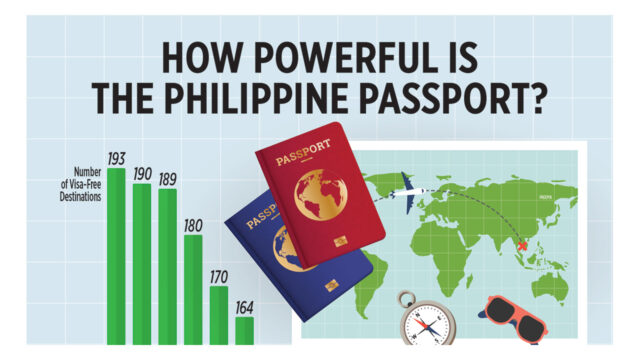
How Powerful Is the Philippine Passport?

The Philippine passport ranked 79th out of 199 in the October update of the Henley Passport Index (HPI). Filipino citizens enjoy visa-free or visa-on-arrival access to only 64 out of 227 destinations worldwide. The country’s passport ranking ties with Sierra Leone. The HPI is an authoritative ranking of all the world’s passports measuring how freely citizens can travel without a prior visa based on the number of destinations.

How Powerful Is the Philippine Passport?

DITO Telecommunity sees higher investor interest

BW FILE PHOTO

DITO TELECOMMUNITY Corp. said it is attracting more investors amid its continued business expansion, with revenues expected to rise by as much as 27% this year.

“With all these positive milestones, I think we’re getting a lot more visibility and interest from investment quarters,” DITO Telecommunity President and Chief Executive Officer Ernesto R. Alberto told reporters on the sidelines of an event on Wednesday.

He said the company’s growth momentum and expanding subscriber base, alongside a strong fixed wireless access (FWA) business, are driving investor confidence.

The telecommunications company expects to close the year with 16 million subscribers after surpassing 14 million in July, supported by ongoing network expansion and about 500,000 FWA users.

Earlier, DITO said it targets to reach one million FWA subscribers within the next 18 months. As of July, its FWA service — which uses wireless signals to deliver broadband connectivity — had 250,000 subscribers. The company aims to grow this to 300,000 by yearend.

Meanwhile, parent firm DITO CME Holdings Corp. said Summit Telco Corp. remains committed to investing in the company.

“Summit Telco is still very committed to their investment. We are just waiting for them to complete the infusion,” Mr. Alberto said, adding that the transaction is expected to be completed within the year.

The deal involves the sale of up to nine billion DITO CME shares. This year, DITO CME is planning to raise up to P26.53 billion to support the expansion of DITO Telecommunity’s operations, with an additional P28.83 billion to be raised over the next five years through private placements.

DITO Telecommunity also launched its new brand, BizBayan, which aims to offer digital products and services tailored for micro, small, and medium enterprises (MSMEs).

“We are unveiling a new brand conceived to meet the dynamic and evolving demands of Filipino MSMEs — delivering scalable, cost-efficient, and high-performance digital services and solutions,” Mr. Alberto said.

“These are not mere offerings; they are imperative instruments of transformation, designed to empower businesses to transcend limitations and to enable them to grow in this digital age,” he added. — Ashley Erika O. Jose

ADVERTISEMENT
ADVERTISEMENT