Home Blog Page 839

PHL ranks near bottom of Global Pension Index

PEOPLE inquire about their benefits at the Social Security System (SSS) Diliman branch in Quezon City, Jan. 3. — PHILIPPINE STAR/ MIGUEL DE GUZMAN

THE PHILIPPINES’ pension system remained the third worst in the world, according to the 2025 edition of Mercer CFA Institute’s Global Pension Index.

The Philippines’ score, which is graded based on adequacy, sustainability, and integrity, improved to 47.1 in 2025 from 45.8 in 2024, primarily due to “clarification of regulations,” the report said.

However, the score was way below the 64.5 global average, and the third-lowest score among 52 retirement income systems in the index. Last year, the Philippines’ pension system was also the third worst out of 48 systems.

Mercer CFA Institute: Philippines’ pension system still third worst in the world

In the report, the pension systems in the Philippines, Turkey, Argentina and India, were given a “D” grade. This means the pension system has some “desirable” features but also has “major weaknesses” that should be addressed.

“Without these improvements, its efficacy and sustainability are in doubt,” the report said.

The Netherlands had the best pension system with a score of 85.4. Aside from the Netherlands, the pension systems in Iceland, Denmark, Singapore and Israel were also given an “A” grade, which meant they had robust and sustainable systems that deliver good benefits with a high level of integrity.

The Global Pension Index reviews an economy’s retirement income systems based on three weighted subindices: adequacy, sustainability, and integrity.

The Philippines’ adequacy score went down to 40.6 in 2025 from 41.7 in 2024. This was below the global average of 66.1 for adequacy.

Its sustainability score improved to 64.4 from 63.4, which was higher than the global average of 55.3.

For integrity, the Philippines’ score inched up to 33.2 from 27.7. However, this was significantly lower than the global average score of 74.7.

The Philippines was the only economy in the integrity sub-index that had an “E” grade, which indicates “a poor system that may be in the early stages of development or nonexistent.”

“The Philippines’ retirement income system comprises a small basic pension and an earnings-related social security pension,” the report said.

“Members can receive a lifetime pension if they have contributed for a minimum of 180 months for government and 120 months for nongovernment members. Both schemes provide calibrated benefits if the minimum number of contributions is not satisfied.”

The Mercer CFA Institute report said the Philippine pension systems could be improved if the minimum level of support for the poorest elderly is increased and the benefits are aligned with the country’s cost of living.

It also said the Philippines’ requirements for vesting in private sector plans should be improved.

The report said the local pension system lacks non-cashout options for retirement plan proceeds, so they are preserved for retirement purposes.

It also cited the need to improve governance requirements for the private pension system.

In the Philippines, there are two main pension funds — the Social Security System (SSS) for private workers and the Government Service Insurance System  for government workers.

Starting Jan. 1 this year, the SSS increased the contribution rate to 15%, up from 14%. Under Republic Act No. 11199 or the Social Security Act of 2018, the SSS implemented incremental contribution rate hikes of one percentage point every two years starting in 2019 from the original contribution rate of 11%.

All SSS pensioners as of Aug. 31, 2025 began receiving higher pensions starting September this year. Retirement and disability pensions will increase by 10% annually every September until 2027, while death or survivor pensions will rise by 5% each year. — A.M.C.Sy

Five firms express interest in North-South rail contract

The North-South Commuter Railway project will connect Malolos, Bulacan with Clark International Airport, and Tutuban, Manila with Calamba, Laguna. — PHILIPPINE STAR/MIGUEL DE GUZMAN

AROUND five local and foreign companies have expressed interest in bidding for the operations and maintenance (O&M) contract of the North-South Commuter Railway (NSCR) project, the Department of Transportation (DoTr) said.

“The original schedule is either the last week of October or first week of November (for the bidding) as suggested by our transaction advisor, the ADB (Asian Development Bank). So far, I think there were four or five companies (interested),” Transportation Acting Secretary Giovanni Z. Lopez told reporters on the sidelines of a transport conference on Wednesday.

These companies are a mix of local and foreign firms, Mr. Lopez said, adding that the names of these firms cannot be disclosed before the auction officially starts.

In September, the agency said it was working double time to secure an operator for the NSCR project. It was targeting early October for the release of bid documents following the conclusion of its final roadshow, which drew interest from foreign firms.

For Rene S. Santiago, an international consultant on transport development and former president of the Transportation Science Society of the Philippines, local companies are capable and well-suited to operate such a massive rail line like NSCR.

Philippine-based companies are also capable of operating and managing the NSCR, but foreign firms may have the advantage when it comes to channeling profits, Mr. Santiago said in a Viber message on Thursday.

“The dice are loaded against local firms. Foreign consultants wrote the specs; foreign bidders held the playbook; and local companies would play in dim light. The bidding rules are also pro-foreign, while locking the government into massive subsidies,” Mr. Santiago said. 

The agency has conducted roadshows in Japan, Singapore and France to promote the P229.32-billion O&M contract for the NSCR project.

Transportation Undersecretary Timothy John R. Batan said that the contract for the NSCR O&M will be for a period of 15 years.

The agency is fine-tuning the bidding documents for the concession to address the feedback and comments from roadshow participants which include investment returns, Mr. Batan said.

The ADB, which serves as the Transportation department’s technical advisory services provider for the project, previously said the DoTr aims to award the concession by March or April next year, with the formal bidding process expected to take around six months.

The 147-kilometer NSCR will connect Malolos, Bulacan with Clark International Airport, and Tutuban, Manila with Calamba, Laguna. The P873-billion project is co-financed by the Japan International Cooperation Agency and the ADB. It will have 35 stations and three depots.

According to the DoTr, the NSCR can begin partial operations of the Valenzuela to Malolos line by 2027; while the Malolos to Clark segment can start operations by 2028. — Ashley Erika O. Jose

‘AI-nabled’ marketing in focus on 54th National Marketing Conference

With the evolving digital landscape, the demand for artificial intelligence (AI) has never been more apparent. AI has redefined how Filipino lives are operating — from daily household chores to office tasks, it gives not just information but also convenience.

The same potentials are starting to be explored as well in the marketing field, and so the Philippine Marketing Association (PMA) will host the 54th National Marketing Conference (NMC) with the theme “AI-NABLED MARKETING: Artificial Intelligence Inside Out” on Oct. 23 at Hilton Manila, Newport World Resorts in Pasay City.

AI’s potential as an agent for progress has been overshadowed by confusion and being a potential threat to human capability. Hence, the forum aims to help Filipino marketers discover and understand AI’s potential while remaining human-centric.

“It is a call to action. We’re at a pivotal moment where technology and human creativity are converging in unprecedented ways.” Faye Arellano-Martinez, executive vice-president and director for NMC, said during the launch of this year’s conference. “The goal of this event is to really demystify AI and how it can be a powerful tool for enhancing and adapting our marketing strategies.”

For businesses, AI has become integral to their survival and growth. “The role of marketers today is no longer confined to creativity alone — it now requires mastery of data, technology, and consumer psychology,” the NMC’s Overall Chair Lucien Dy Tioco emphasized. “[AI] will not replace our creativity nor empathy. It will supercharge them and make things faster and easier for us, so we can focus on other strategic tasks.”

Bringing together entrepreneurs, marketers, and academics — the forum will feature international and local keynote speakers. Key conference sessions will cover: real-world applications for improving reach, personalization, and efficiency; leveraging neuroscience to decode Filipino consumer behavior and decision-making; and strategies that help brands stay ahead amidst disruption.

The 54th NMC will also include panel discussions, workshops, and interactive sessions that will focus on empowering Filipino businesses with tools, strategies, and insights to keep pace with the AI-driven economy.

“While the challenge of embracing AI is still there, it is our responsibility to impart wisdom and knowledge not only to our people, but also to our business partners, fellow marketers, and most especially, to our customer,” 2025 PMA President Ma. Cristina Llacer Oreta explained. “Hence, this year’s conference will be highlighted by our invited select key leaders who has the experience and ability to discuss the latest trends in AI marketing and how we can help our fellow Filipinos separate reality from virtual reality.”

Furthermore, the conference will also explore on how AI is redefining innovation and competition in marketing with confessionals from business owners who gained feat by using the technology.

Participants are expected to learn AI-driven neuromarketing strategies to enhance content, commerce, and customer experience.

For registration, inquiries, and partnerships, you can contact PMA Secretariat Lira Ligero through 0917-308-7877 or email at lira@philippinemarketing.net.ph.


Spotlight is BusinessWorld’s sponsored section that allows advertisers to amplify their brand and connect with BusinessWorld’s audience by publishing their stories on the BusinessWorld Web site. For more information, send an email to online@bworldonline.com.

Join us on Viber at https://bit.ly/3hv6bLA to get more updates and subscribe to BusinessWorld’s titles and get exclusive content through www.bworld-x.com.

DoE clarifies coal moratorium rules; allows new capacity only in exceptional cases

PIXABAY

THE Department of Energy (DoE) has clarified the implementation of its coal moratorium policy, saying that new capacity from on-grid coal-fired power plants may be allowed only under “exceptional circumstances.”

In an Oct. 14 advisory signed by Energy Secretary Sharon S. Garin, the agency laid out additional conditions and exemptions governing the processing of applications for endorsements for new coal-fired power projects.

The advisory was issued pursuant to guidance from the Office of the President and addresses inquiries about the moratorium’s applicability to self-generating or own-use facilities, as well as to new capacities in both on-grid and off-grid areas.

The DoE said the 2020 moratorium halted the processing of applications for new or “greenfield” coal projects, except for those “falling under the conditions for non-coverage,” noting that increased requests for clarification prompted the formal advisory.

EXCEPTIONAL CASES, EXEMPTIONS
Under the updated policy, the DoE said new capacity from on-grid coal plants may be allowed “solely under exceptional circumstances, such as during a declared or imminent power crisis, or when there is an imminent shortage of electricity supply that, if unaddressed, may lead to severe impacts in specific areas or regions.”

The agency also identified other categories of coal projects that may qualify for non-coverage under the moratorium. These include industrial parks planning to develop and use coal-fired power plants for their own operations, “provided that locators registered as Philippine Economic Zone Authority (PEZA) industrial park locators secure endorsement from the PEZA,” according to the advisory.

Coal-fired power projects in off-grid areas are also explicitly exempt, as are own-use coal plants supplying power for mining and processing of critical minerals essential to energy transition projects.

Developers of projects that fall under these instances are required to apply with the DoE for a “letter of acknowledgment of non-coverage,” the advisory said.

Proponents of coal-fired projects with existing letters of acknowledgment of non-coverage must commit to a guaranteed delivery or commercial operations date (COD), with any changes subject to DoE review and approval.

“All coal-fired power plants with a letter of acknowledgment of non-coverage shall have a time-bound transition plan to renewable or clean energy sources, with retirement or conversion to clean fuel alternatives not later than Dec. 31, 2060, whichever comes earlier,” the advisory read.

“This does not preclude such power plants from being retrofitted or converted for continued operation using clean fuel alternatives to coal.”

The DoE said the updated advisory supports the Philippines’ energy transition goals while maintaining energy security.

It will also study and determine a specific timeline for the retirement or transition of all existing coal-fired power plants, taking into account “the economic life span of the power plants, access to financing mechanisms, and the need to ensure sufficient and stable energy sources to replace coal.”

EFFECTIVITY
The advisory, addressed to all concerned stakeholders including the Energy Regulatory Commission (ERC) and PEZA, took effect immediately upon posting on the DoE website.

“The Department of Energy remains committed to balancing energy security, affordability, and sustainability in line with the country’s clean energy transition,” the agency said. — Sheldeen Joy Talavera

CNPF boosts coconut processing capacity with P2.6-B Mindanao facility acquisition

CENTURYPACIFIC.COM.PH

LISTED food and beverage manufacturer Century Pacific Food, Inc. (CNPF) is expanding its coconut processing capacity with a $45-million (around P2.6 billion) investment to acquire and upgrade a fully integrated facility in Tupi, South Cotabato, from Roxas Sigma Agriventures, Inc. (RSAI) through its subsidiary Coco Harvest, Inc. (CHI).

In a statement on Thursday, the company said the transaction marks its third coconut processing facility in the Philippines, following its existing plants in General Santos and Misamis Occidental, the latter acquired in 2024.

It said the investment will be funded through internally generated cash flows.

The plant produces high-value coconut products such as coconut cream, coconut milk, virgin coconut oil, and coconut water concentrate.

Planned upgrades, the company said, will expand its capabilities to serve both domestic and export markets, add new product lines, and improve overall efficiency.

CNPF also said the acquisition is expected to create around 800 manufacturing jobs in Mindanao and support local coconut farmers through its supply chain network.

“This acquisition is a milestone for our coconut business and a testament to our commitment to inclusive growth,” said Noel M. Tempongko, Jr., CNPF vice-president and general manager for OEM Coconut Exports.

“By expanding our capacity in coconuts, we enhance our competitiveness in the global coconut industry and create meaningful economic opportunities for local communities in Mindanao.”

CNPF began manufacturing coconut water for export in 2012 and has since expanded into producing a range of coconut-based products for domestic and overseas markets.

It also partners with regional players such as Linaco Manufacturing in Southeast Asia.

In 2019, the company launched its own branded coconut line in the local market. It recently renewed a five-year supply contract with The Vita Coco Company, Inc., valued at about P14 billion, which will take effect in January 2026.

In a separate disclosure, Roxas and Company, Inc. (RCI) said its subsidiary RSAI sold the 2.2-hectare integrated processing facility to reduce debt and focus on the development of its landholdings in Nasugbu, Batangas.

“We are confident that Century’s plans to upgrade the facility will usher in a new phase of growth and expanded product offerings,” RSAI Business Development Manager Antonio T. Roxas said.

On Thursday, CNPF rose by P1.25 or 3.42% to close at P37.75 apiece, while RCI slipped by one centavo or 0.36% to P2.79 each. — Alexandria Grace C. Magno

PAL to pilot GenAI voice agent to handle 80% of live agent tasks

AN AIRPLANE is seen landing at the Ninoy Aquino International Airport, March 7, 2024. — PHILIPPINE STAR/RUSSELL PALMA

By Beatriz Marie D. Cruz, Reporter

SYDNEY, AUSTRALIA — Flag carrier Philippine Airlines (PAL) is investing in artificial intelligence (AI) technology to improve customer experience and operational efficiency, starting with AI-driven voice bots and a unified data platform that aims to deliver more personalized engagement.

PAL Vice-President for Customer Experience Mark Anthony C. Munsayac said the company is piloting a proof of concept for its Generative AI-powered voice agent this quarter, which is designed to handle up to 80% of the tasks performed by live agents.

“The tool will use a natural-sounding bot powered by GenAI and will be able to perform up to 80% of the tasks that a [PAL] live agent can perform,” he told BusinessWorld on Oct. 15 here.

The AI voice agent will assist customers in checking flight status, rebooking, or canceling tickets. PAL expects the technology to automate 50-70% of inquiries, with the remainder handled by human agents.

“For PAL, by March 2026, we should be achieving the super AI agent status — that’s for e-mail, chat, and voice,” he said, noting that the transformation will allow AI to both answer queries and execute service tasks.

Since launching its GenAI chatbot in June, PAL has recorded a 45% deflection rate, indicating that nearly half of customer concerns are being resolved without human intervention.

Despite this, Mr. Munsayac said PAL will continue to maintain live agents to cater to passengers who prefer personal interaction, particularly from older demographics.

“Our strategy is human plus the AI agent working together. In the foreseeable future, I don’t expect PAL to get rid of live agents. We always want to give that option to passengers,” he said.

PAL currently receives up to 8,000 customer concerns daily, he added.

Beyond AI voice and chat, the airline is developing a unified communication platform that will consolidate customer-related data from marketing, services, and sales. The system will use machine learning to analyze customer behavior and generate targeted offers.

“It’s integrating and unifying all the customer engagement data that we have so we can get to know our customers on a personal level,” Mr. Munsayac said. “That can help improve customer experience and drive revenue for us.”

He said the system will also address data silos and ensure compliance with data privacy laws.

“When we offer you something, it’s not random — it has to be something relevant to your trip or to you as a person,” he said.

According to the 2025 State of Customer Engagement Report by US-based cloud communications firm Twilio, 71% of Philippine consumers are willing to spend more when a brand’s engagement is personalized in real time.

TV5’s Vibe PH now hosts Awit Awards

ON OCT. 15, Mquest Ventures and the Philippine Association of the Record Industry (PARI) signed a partnership that would let the 38th Awit Awards — the country’s longest-running music award-giving body — hold its awards show within TV5’s Vibe PH, an OPM (Original Pilipino Music) countdown show. The awards show will be held on Nov. 16.

“They’re going to do the awards in the Vibe program,” said Jane Basas, MediaQuest Holdings Inc. president and chief executive officer. Mquest Ventures is the content creation hub of the MediaQuest Group, which also includes BusinessWorld.

The Awit Awards will be held on Nov. 16 at the Meralco Theater, directed by Johnny “Mr. M” Manahan. It has five categories: Performance Awards, Genre Recording Awards, Special Recording Awards, Technical Achievement Awards, and Grand Awards.

Vibe jocks Ana Ramsey, Maxie, Joao Constancia, Elijah Canlas, Dylan Menor, Ryle Santiago, Paolo Angeles, Kych Minemoto, and Queenay will host the awards night and kick it off with a special performance. Joining them will be Vibe’s young Gen Vs, who will interview the nominees and bring exclusive behind-the-scenes moments. Performers for that evening include Ben&Ben, Over October, Lola Amour, and Dionela.

“From a format standpoint, it actually makes sense,” she told BusinessWorld after the contract signing at the PLDT Ramon Cojuangco Building in Makati. “They give recognition to Filipino music and artists. That’s the same thing that we celebrate in Vibe.

“The objective of Awit’s management is to attract the young listeners and the young viewers, and that’s precisely the target market for Vibe.”

This comes on the heels of recent activity within Mquest Ventures’ music publishing and label, MQuest Music, which has published two new releases since its inception a month and a half ago, by Ms. Basas’ count. These include Kit Inciong’s “Sukob Na” and “Tayo na Lang” by Carmela Lorzano, along with a partnership with songwriter Vehnee Saturno.

“I see it as a pillar in an ecosystem of entertainment platforms I’m building,” she said. “The big vision for MediaQuest is to make sure that we’re able to build an ecosystem of content and platforms. Part of that content is actually music.”

The 38th Awit Awards will be broadcast nationwide via Vibe on TV5. Audiences can also catch the event via livestream on the official social media platforms of Vibe PH, TV5, MQuest Ventures, and Awit Awards. Lists of the nominees can be found on the Awit Awards Facebook page (facebook.com/AwitAwards/). — Joseph L. Garcia

InstaPay, PESONet transactions jump to P17.5 trillion as of Sept.

REUTERS

By Katherine K. Chan

THE VALUE of transactions made via the automated clearing houses InstaPay and PESONet grew by 41.1% to over P17 trillion at end-September, with InstaPay transfers reaching over P1 trillion for the first time last month.

InstaPay and PESONet transactions increased to P17.458 trillion in the first nine months of 2025 from P12.369 trillion a year earlier.

Meanwhile, the volume of transactions coursed through the clearing houses more than doubled (175.7%) to 2.89 billion in the period from 974.406 million.

Broken down, the value of transactions done on InstaPay surged by 54.5% to P7.945 trillion as of September from P5.144 trillion a year prior.

In September alone, InstaPay transfers were valued at P1.017 trillion, marking the first time that transactions made via the payment gateway reached the trillion-peso mark for a single month.

The volume of InstaPay transactions soared by 187.8% to 2.804 billion in the nine months to September from 974.406 million the previous year.

On the other hand, the value of PESONet transactions amounted to P7.945 trillion in the nine-month period, climbing by 31.7% from P5.144 trillion a year ago.

The volume of transactions made through the gateway also rose by 16.2% year on year to 85.926 million from 73.972 million.

InstaPay and PESONet are automated clearing houses under the central bank’s National Retail Payment System framework.

InstaPay is a real-time, low-value electronic fund transfer facility for transactions up to P50,000 and is mostly used for remittances and e-commerce.

Meanwhile, PESONet is mainly used for high-value transactions and may be considered as an electronic alternative to paper-based checks.

“The sustained double-digit growth could reflect increased use by more Filipinos of electronic commerce and other businesses, as well as personal transactions that use digital payment solutions such as InstaPay and PESONet that are already integrated in digital banking fund transfers,” Michael L. Ricafort, chief economist at Rizal Commercial Banking Corp., said in a Viber message.

Digital transactions are becoming more mainstream and are now widely used in the local economy, he said, “even at the grassroots level around the country, especially in more rural areas including those that are unbanked, thereby further increasing financial inclusion provided there is mobile data or internet signal.”

Consumers are moving towards online transfers as these are more convenient than over-the-counter transactions or check payments and can be done at any time and from anywhere, “saving on time, effort and costs,” Mr. Ricafort said.

“For the coming months, strong growth could still be sustained as more Filipinos adopt digital banking and payment solutions as reflected in the strong growth in online business and personal transactions as alternative to using cash and checks,” he added.

Improving financial literacy in the country is also helping accelerate the adoption of digital payments, bringing more Filipinos into the formal financial system, he said.

The BSP wants digital payments to make up 60-70% of the total volume of retail payments by 2028 in line with the Philippine Development Plan.

The share of online payments in monthly retail transactions stood at 57.4% in terms of volume and 59% in value terms in 2024, according to the BSP’s 2024 Status of Digital Payments in the Philippines report. These are up from 52.8% and 55.3%, respectively, in 2023.

SEC orders Microdot Lending to halt activities over missing platform disclosures, debt collection practices

SEC.GOV.PH

THE Securities and Exchange Commission (SEC) has issued a cease-and-desist order against Microdot Lending Corp. and several of its associated online lending platforms (OLPs) for failing to disclose all operating platforms and for allegedly engaging in unfair debt collection practices.

In a cease-and-desist order dated Sept. 23, the SEC’s Financing and Lending Companies Department instructed Microdot and its platforms, including MF Cash, Credit Cash, Credit Peso, Pesoloan Mart, Cash Baka, Cash Mabilis, Go Peso, Instant Loan, and Timely Loan, to immediately stop promoting or conducting lending activities.

The SEC noted that Microdot is licensed as a lending company under Registration No. CS201951287 and Certificate of Authority No. 2921.

Its investigation found that certain platforms, specifically Credit Peso Pro and MF Cash, were not disclosed as required under Section 3 of SEC Memorandum Circular No. 19, Series of 2019.

“[Microdot’s] operation of the undisclosed OLPs, blatant disregard of the SEC’s regulatory authority over it, and practice of unfair debt collection, may unjustly cause grave or irreparable injury or prejudice to the borrowing public,” the order read.

The SEC said it has received numerous complaints since 2024 regarding allegedly unfair debt collection methods by Microdot, which the regulator said may violate the implementing rules and regulations (IRR) of Republic Act No. 11765, or the Financial Products and Services Consumer Protection Act, as well as Rule 8(c) of the IRR of Republic Act No. 9474, the Lending Company Regulation Act.

The agency said enforcement measures against Microdot have included show-cause letters, notices of deficiencies, assessment letters, walk-through audits, desk reviews, and on-site inspections.

BusinessWorld tried to reach out to the concerned party for comment, but no public contact information or company profiles were available. — Alexandria Grace C. Magno

Actress Meryll Soriano to direct her own films

MERYLL SORIANO (leftmost) with some of the actors and musicians on the roster of CreaZion Studios.

CreaZion Studios’ artists discuss next projects

AWARD-WINNING actress Meryll Soriano is spreading her wings — she will be directing two films, one short, and one full-length, in the near future.

She revealed this plan when the actors and musicians on the roster of CreaZion Studios Artists gathered on Oct. 9 at Glorietta 1 in Makati to talk about their upcoming projects and career trajectories for 2025 and beyond.

“The short film that I’m directing is something that has been brewing for 20 years. This concept has been with me for 20 years,” said Ms. Soriano, who will also star in the film herself.

She explained that the short film will be about post-partum depression, which she clarified that she didn’t experience herself to any great extent aside from the usual “baby blues.”

Ms. Soriano had a baby with her boyfriend Joem Bascon in 2021. She also has an older son with her ex-partner Bernard Palanca.

“It’s about mental health,” she said told the press of the short film, “because that’s my advocacy.”

Aside from that, Ms. Soriano — who has won awards for her acting from Cinemalaya, Gawad Urian, and the Brussels International Independent Film Festival, among many others — is working on a full-length film, which she only described as being “very personal” and that she is being guided by director Mark Meily at the behest of screenwriter and National Artist Ricky Lee.

“I’m happy that Mark Meily is helping me write the script. I had a long journey of finding a writer, until Sir Ricky Lee advised me, isulat mo na! (go write it already!),” Ms. Soriano explained.

Hindi ko nagustuhan ang sarili kong gawa, kaya naghanap ako ng tutulong sa akin na ayusin ’yung gawa ako (I didn’t like my own work, which is why I looked for someone to help me improve it),” she added.

She hopes to start shooting the short film in the first quarter of 2026, and her full-length directorial debut some time after that. It has been her dream to direct since 2010.

Another dream is to work with her aunt, actress Maricel Soriano. “Nakasama ko na siya noong bata ako (I acted with her when I was young),” said the former child actress. “But now, with our sensibilities as older people.”

A project with her longtime partner, Mr. Bascon, would also be welcome — “something like Marriage Story!” she said, referring to the drama starring Scarlett Johansson and Adam Driver.

ARTISTS’ PLANS
Other veteran actors on CreaZion Studios’ roster include Dolly De Leon and Charo Santos-Concio, though neither could make it to the press conference.

The rest were rising artists — including young actor Esteban Mara, who had a minor role in Padamlagan, the all-Bicolano slow-burn period film at the recently concluded Cinemalaya Independent Film Festival.

“It was a challenging role,” he told BusinessWorld. “I had a limited chance to make people root for me, so it really sunk in that you have to make the most of the small amount of exposure.”

Mr. Mara played Ivan, the son of singer Ely Buendia’s character Doring, and his screentime was limited as his character goes missing early in the film.

“When I watched it a second time, that’s when I realized I could have done things a bit differently here and there,” he said.

In contrast, his breakout project, the boys’ love (BL) series Got My Eyes On You, available on the Puregold Channel on TikTok, saw him with plenty of screentime — though he wants to be known as more than just a pretty face.

“I want to be known as a reliable actor,” he said, “like Dolly De Leon.”

A dream project for him would be something similar to one of his favorite films, Before Sunrise.

Meanwhile, the only musician in the lineup that day was Brei, a former member of the P-pop girl group MNL48. She was there to launch her single, “Digital,” which is set to be part of her upcoming EP.

Hindi pa buo ang EP, pero pop-rock siya (The EP is not yet complete, but it will be pop-rock),” she told the press.

Brei, whose real name is Aubrey Binuya, said that she hopes to be a relatable artist with unusual lyrics that will catch people’s attention.

As for her dream collaborations, she said that she would love to work on music with singer-songwriter Maki and drag artist Maxie Andreison.

“I love their artistry and I want to explore what I’m able to do with them!” she said.

Updates on CreaZion Studios’ various artists can be seen on their official social media pages and creazionstudios.com. — Brontë H. Lacsamana

BPI net income hits P50.5 billion in first nine months as revenues increase

BPI FACEBOOK PAGE

BANK of the Philippine Islands’ (BPI) net income rise increased by 5.2% in the first nine months of the year as its revenue growth outpaced the rise in its expenses.

The Ayala-led bank’s net profit rose to P50.5 billion in the nine months ended September from P48 billion in the same period last year, it said in a disclosure to the stock exchange on Thursday.

Its financial statement was unavailable as of press time.

BPI’s revenues grew by 13.2% year on year to P142.3 billion in the period.

This, as its net interest income jumped by 16.2% to P109.1 billion as the bank’s average earning asset base expanded by 8.7%.

This caused its net interest margin to improve by 30 basis points (bps) to 4.6%, BPI said.

The bank’s non-interest income likewise went up by 4.2% to P33.3 billion, driven by earnings from its fee-based businesses like credit cards and wealth management, as well as higher trading income.

Meanwhile, operating expenses increased by 10.3% year on year to P65.5 billion in the nine-month period due to higher business volume-related expenses and manpower and technology costs.

Despite this, its cost-to-income ratio improved by 118 bps to 46% on strong revenue generation.

BPI’s gross loans expanded by 13.3% year on year to P2.4 trillion at end-September, backed by strong growth in its non-institutional loans.

Its nonperforming loan (NPL) ratio stood at 2.3%.

It set aside P11.8 billion for provisioning for an NPL cover of 96.5%.

On the funding side, total deposits with the bank were up by 7.7% to P2.7 trillion. BPI said P1.6 trillion of the total were current account, savings accounts (CASA) deposits for a CASA ratio of 61%.

The bank’s loan-to-deposit ratio was at 90.3%.

BPI’s total assets reached P3.5 trillion at end-September, up by 9.3% year on year. Total equity stood at P474.8 billion, rising by 9.6%.

Common equity Tier 1 ratio was at 14.9%, while its capital adequacy ratio stood at 15.8%.

BPI shares jumped by P1.10 or 1.03% to close at P108 apiece on Thursday. — Aaron Michael C. Sy

Finding new hope through advanced proton therapy

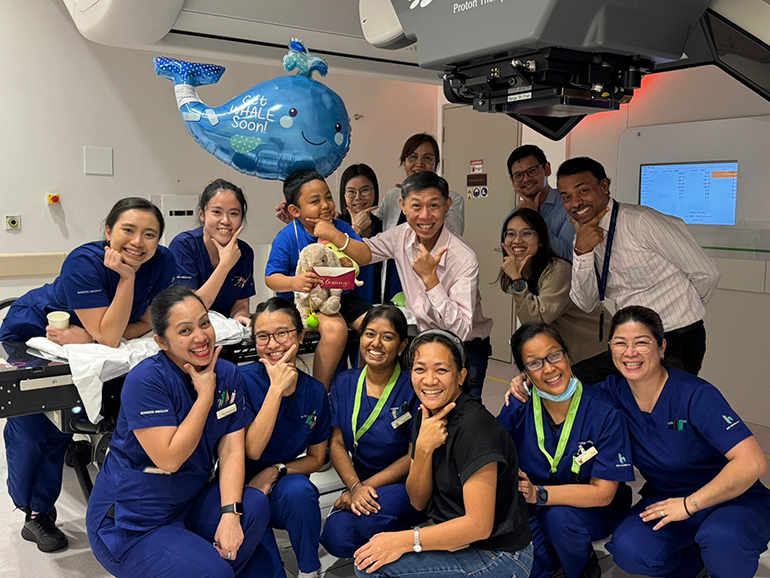
Dr. Lee Kuo Ann (left) with seven-year-old Ieuan Magat and his mother, Roda Shane, at the Mount Elizabeth Novena Proton Therapy Centre in Singapore

When four-year-old Ieuan Magat started bringing books close to his face, his mother, Roda Shane, assumed he needed glasses. What she did not expect was a doctor’s diagnosis revealing a craniopharyngioma, a rare brain tumor pressing against his optic nerves and threatening to take away his sight.

Roda sat in the hospital as doctors explained what that meant. The tumor came with a long list of complications, including vision loss and hormonal imbalance. Before his fifth birthday, Ieuan lost sight in his right eye.

She searched for hospitals beyond the Philippines, sending emails to medical centers around the world. Days passed with little to no response, until she heard back from Mount Elizabeth Novena Hospital in Singapore.

An answer far from home

At that time, Dr. Lee Kuo Ann, a radiation oncologist at the hospital, was visiting Manila for a medical lecture. A representative from IHH Healthcare Philippines showed him Ieuan’s scans. The doctor immediately saw the severity of the case.

“There was a large tumor pressing on the nerves of the eyes,” Dr. Lee said. “I recommended surgery [in the Philippines] followed by radiation therapy [in Singapore.]”

However, the public hospital system in the Philippines faced long waiting lists and limited access to advanced treatment. Ieuan had to wait ten months before surgery could be performed at the Philippine General Hospital. During that time, the tumor grew larger, further affecting his vision and sensation to temperature.

When surgery finally happened, doctors managed to reduce the tumor’s size, but the damage to his nerves could not be repaired.

“He asked why everything went black,” Roda told the media in Filipino. “I did not know how to answer.”

Despite that, Ieuan recovered faster than expected and remained cheerful throughout the process.

With arrangements made by Mount Elizabeth Novena Hospital, Roda and Ieuan flew to Singapore in August to begin advanced proton therapy, a precise type of radiation treatment that helps protect healthy tissues while targeting the tumor.

“Everything was already prepared when we arrived,” Roda said. “We were picked up from the airport and brought to the hotel. God is so good. Everything about our journey from Day 1 went smoothly.”

She added that the support from the medical team and hospital staff made a huge difference. Though her son could no longer see, she believed that the treatment gave him a better future and a chance to live without the constant threat of the tumor returning.

Roda said she hopes that more families in the Philippines can one day access advanced treatments like proton therapy. For now, she holds on to the hope that her son’s story will help others find strength, no matter how difficult the path may be.

Seven-year-old Ieuan Magat (center) with Dr. Lee Kuo Ann (standing behind him) and the medical team of Mount Elizabeth Novena Hospital

Searching for the best treatment

Ieuan’s case became one of many where proton therapy provided a safer option for treating complicated brain tumors. Craniopharyngioma affects about two in every one million people and accounts for about 5% of childhood brain tumors. While benign, it can return after surgery and press on critical nerves.

“Because the tumor grows near sensitive areas in the brain, surgery alone may not be enough,” Dr. Lee said. “Traditional radiation can affect surrounding healthy brain tissue. For children, that can mean long-term complications such as lower IQ, memory loss, or developmental delays.”

Proton therapy offers an alternative that minimizes these risks. Instead of X-rays, it uses charged particles known as protons. These particles can release energy directly at the tumor site, preventing unnecessary exposure to surrounding areas.

“Proton therapy lets us target the tumor precisely, reducing damage to the rest of the brain,” Dr. Lee explained.

Ieuan’s tumor measured about six centimeters in diameter. Ieuan was in Singapore for more than a month and had 30 sessions of Proton Therapy. Each proton therapy session took about 30 to 45 minutes, though the actual proton radiation took less than two minutes. Most of the time was spent on precise tumour localisation by adjusting the equipment to make sure everything was perfectly aligned, since even small movements could affect results.

Dr. Lee explained that pencil-beam scanning treatment delivery method, one of the most advanced forms of proton therapy mode today, was used in Ieuan’s treatment. The method is available only in a few hospitals across Asia.

Dr. Lee and his team created a treatment plan specific to Ieuan’s case without damaging the rest of his developing brain. While Ieuan’s vision could not be restored, the treatment succeeded in stopping the tumor’s growth.

“With the radiation treatment, we can control the tumor about 85% of the time,” Dr. Lee said. “Control means the tumor shrinks or remains stable. Lack of control means it grows.”

For Roda, the journey was emotionally exhausting but worth it. Watching her son go through treatment was difficult, yet she found comfort in knowing Ieuan was receiving the best possible care.

Meanwhile, Dr. Lee noted that proton therapy is not a universal solution for all cancer cases. It is most effective for tumors located near vital organs or sensitive tissues where traditional radiation could cause severe side effects. In such cases, proton therapy allows doctors to treat the disease with greater precision and safety.

Singapore has become a regional destination for advanced cancer care, offering technology and expertise that attract families from across the globe. In May 2023, the country opened its first Proton Therapy Centre at Mount Elizabeth Novena Hospital, one of only two countries in Southeast Asia to offer proton beam therapy.

Since its launch, the Mount Elizabeth Proton Therapy Centre has treated patients from 29 countries. The youngest patient was just 1.5 years old, while the oldest was 87. The centre has established a strong reputation in managing head and neck cancers, brain cancers, and prostate cancers, which represent its top three treated cancer types.

ADVERTISEMENT
ADVERTISEMENT