Home Blog Page 8265

World Health Day 2021: By the numbers

Image via Jernej Furman/Flickr/CC BY 2.0

THE IMPACT of the global pandemic, according to the World Health Organization (WHO), “has been harshest on those communities which were already vulnerable, who are more exposed to the disease, less likely to have access to quality healthcare services and more likely to experience adverse consequences as a result of measures implemented to contain the pandemic.”

For World Health Day 2021 (celebrated today), WHO has chosen the theme “Building a fairer, healthier world” to highlight health inequities.

Here is a snapshot of the world’s health and the country’s, as told by numbers.

PRIMARY HEALTHCARE
3.6 billion — the number of people worldwide who still lack full coverage of essential health services, according to a fact sheet released by WHO this April

930 million — the number of people worldwide who are at risk of falling into poverty due to out-of-pocket health spending of 10% or more of their household budget (WHO, April 1)

1% — the additional percentage of Gross Domestic Product (GDP) that the WHO recommends every country allocate or reallocate to primary healthcare from government and external funding sources (WHO, April 1)

30,604,466 — the total number of members of the Philippine Health Insurance Corporation (PhilHealth) who are direct contributors (or members who pay the monthly premium contribution) as of June 30, 2020 (PhilHealth, 2020 Stats and Charts)

20,807,011 — the total number of members of PhilHealth who are indirect contributors (or members who are indigents and thus do not pay any contributions) as of June 30, 2020 (PhilHealth, 2020 Stats and Charts)

ECONOMIC REPERCUSSIONS
71 to 100 million — the estimated number of people that the COVID-19 crisis pushed into extreme poverty in 2020, effectively wiping out the progress made since 2017 (United Nations Office for Disaster Risk Reduction’s Asia Pacific COVID-19 brief, July 16, 2020)

More than 1 billion — the number of people living in informal settlements or slums who are facing increased challenges in preventing infection and transmission of COVID-19 (UN Department of Economic and Social Affairs, 2020)

$3.7 trillion — the equivalent amount of global income lost due to the pandemic, equivalent to 4.4% of the global GDP (UN International Labour Organization, Jan. 25)

10.3% — the annual unemployment rate in the Philippines in 2020, twice as high as the rate recorded in 2019. Four and a half million Filipinos do not have jobs but are looking for one (Philippine Statistics Authority’s Annual Labor and Employment Estimates, 2020)

COVID-19 CASES
131,716,054 — the total number of COVID-19 cases worldwide at the time of writing, according to the Johns Hopkins University Coronavirus Resource Center

2,860,100 — the number of people worldwide who died of COVID-19 worldwide at the time of writing, according to the Johns Hopkins University Coronavirus Resource Center

803,398 — the total number of COVID-19 cases in the Philippines as of April 6, according to the Department of Health COVID-19 Case Tracker

13,435 — the number of Filipinos who died of COVID-19 as of April 6, according to the Department of Health COVID-19 Case Tracker

116.79 — the total number of vaccination doses administered per 100 people as of April 4 in Israel, which leads all other countries in administered doses per 100 people, according to Our World in Data

0.67 — the total number of vaccination doses administered per 100 people in the Philippines as of April 4, according to Our World in Data

TOP KILLERS
16% — the percentage of deaths around the world due to ischemic heart diseases, or heart problems caused by narrowed heart arteries, making it the top cause of death in the world since the year 2000. Stroke and chronic obstructive pulmonary disease are the second and third leading causes of death, accounting for approximately 11% and 6% of total deaths respectively. (WHO, Dec. 9, 2020)

71% — the percentage of deaths globally attributed to noncommunicable diseases such as heart disease, cancer, and diabetes (Deloitte’s Global Health Care Outlook, 2021)

17.3% — the percentage of total deaths in the Philippines (or 99.7 thousand deaths) due to ischaemic heart diseases in 2020, making it the top cause of death in the country. Cancers came in at second with 62.3 thousand deaths (or 10.8% of the total) and cerebrovascular diseases came in at third with 59.7 thousand deaths (or (10.4% of the total), according to numbers released this March by the Philippine Statistics Authority (PSA)

NUTRITION GAPS
1 in every 9 — one in every nine people in the world is hungry (Access to Nutrition Initiative’s Global Access to Nutrition Index, 2021)

1 in 3 — one in every three people in the world is overweight or obese (Access to Nutrition Initiative’s Global Access to Nutrition Index, 2021)

1/4 — almost a quarter of all children under five years of age worldwide are stunted (Access to Nutrition Initiative’s Global Access to Nutrition Index, 2021)

350.6 million — the Food and Agriculture Organization’s most recent estimate of the number of undernourished people in the Asia Pacific region, amounting to about 51% of the global total of 687.8 million (Food and Agriculture Organization of the United Nations’s Asia Pacific Regional Overview of Food Security and Nutrition, 2021) 

1.9 billion — the number of people worldwide who are unable to afford a healthy diet even before the pandemic (World Health Organization, Jan. 20)

130 million — the additional number of people worldwide who are at risk of becoming acutely food insecure as a result of the pandemic, with up to 24 million in the Asia and Pacific region (Food and Agriculture Organization of the United Nations’s Asia Pacific Regional Overview of Food Security and Nutrition, 2021)

MENTAL WELLNESS
1 in 4 — the number of people who will be affected by a mental or neurological disorder at some point during their lifetime (Deloitte’s Global Health Care Outlook, 2021)

$16 trillion — the amount that could cost the global economy between 2010 to 2030 if a collective failure to respond to mental health disorders is not addressed. The pandemic has produced spikes in anxiety and similar challenges. Prolonged isolation and physical distancing measures are demonstrating how social connection contributes to physical, mental, and emotional well-being (Deloitte’s Global Health Care Outlook, 2021)

42% — the number of Filipino respondents in a 2021 Asia-wide report who said they experienced elevated stress, anxiety, and depression as a result of COVID-19 (PruLife’s Pulse of Asia: The Health of Asia Barometer, 2021)

DIGITAL SHIFT
80% — percentage of people worldwide who have used virtual visits and are likely to have another virtual visit even post-pandemic. Consumer adoption of virtual visits has been increasing since 2018. (Deloitte’s Global Health Care Outlook, 2021)

79% — percentage of Filipino respondents in a 2021 Asia-wide report who said that they already use digital health platforms and personal health technologies (PruLife’s Pulse of Asia: The Health of Asia Barometer, 2021) —  Patricia B. Mirasol

Sources: World Health Organization, the Department of Health, PhilHealth, the United Nations Office for Disaster Risk Reduction, Johns Hopkins University, Deloitte, Our World in Data, Worldometer, UN News, The University of Southern California’s Keck School of Medicine, Food and Agriculture Organization of the United Nations, Access to Nutrition Initiative, and Mercer ASEAN.

Paul Simon joins trend to monetize old song catalogs

PAUL SIMON — MATTHEW STRAUBMULLER (IMATTY35) / EN.WIKIPEDIA.ORG

LOS ANGELES — Paul Simon has sold his entire song catalog to Sony Music Publishing, joining a string of older musicians cashing in on their life’s work.

Sony Music Publishing said last Wednesday that the deal includes classic songs ranging from “Bridge Over Troubled Water,” to “Still Crazy After All These Years” that Simon wrote and recorded over his six-decade career.

The value of the deal was not disclosed.

Mr. Simon, 79, a 16-time Grammy winner who in 2018 announced he was retiring from touring, said in a statement he was “pleased to have Sony Music Publishing be the custodian of my songs for the coming decades.”

The sale is the latest in a string of catalog deals that includes the music of Bob Dylan, Stevie Nicks, Neil Young and Carole Bayer Sager in the past year.

Mr. Dylan sold his back catalog of more than 600 songs in December to Universal Music Group and the purchase price was widely reported as $300 million. Other songs have been snapped up by London-based Hipgnosis, which has attributed the deals to a surge in music streaming especially during the coronavirus pandemic when concerts and music festivals have been canceled.

Companies can reap royalties from licensing the songs they have acquired for use in movies, commercials, and branding deals. —  Reuters

Lockdown mental fatigue rapidly reversed by social contact, study finds

STOCK PHOTO

MANY OF US are looking forward to a summer of relative freedom, with road-mapped milestones that will grant us more opportunities to see our friends and family. But we’ll be carrying the effects of months of isolation into those meetings, including a sense that our social skills will need dusting off, and our wits will need sharpening.

The mental effects of lockdown have been profound. Social isolation has been shown to cause people’s mental health to deteriorate even if they have no history of previous psychological problems. Alongside this drop in mood, loneliness has been linked with a host of cognitive problems, including fatigue, stress, and problems with concentration.

In our recent study, we set out to understand how people recovered from last year’s period of social isolation, tracking their cognitive function as the UK transitioned from a full lockdown to reduced social restrictions in summer 2020. Promisingly, we found that people swiftly recovered from cognitive issues when given the chance to blow away the cobwebs by socializing once again.

Lockdowns have given psychologists a unique opportunity to study the effects of social isolation on the general population. Such effects are normally only studied in older adults, or in very special groups of people such as astronauts, desert trekkers, and polar explorers. But for over a year now, ordinary people of all ages have been experiencing prolonged periods with minimal social contact.

We know that humans derive many benefits from socializing. These range from preventing dementia and enhancing memory to improvements in concentration and the ability to think clearly. When our social lives shrank last March, we lost these cognitive payouts too.

To investigate what happens when these payouts return, we surveyed hundreds of Scottish adults between May and July 2020: a period when strict national lockdown restrictions were gradually eased. It was the perfect time to observe how the benefits of socializing might change how people think and feel.

Unsurprisingly, we found that people’s moods were lowest when we first approached them in May. Those who were shielding or living alone suffered the most and only began to feel better when the final restrictions were eased towards the end of our survey period in July. But our study was most interested in other psychological indicators: those that would show whether people’s cognitive abilities improved when they had more opportunities to socialize.

To measure this, we asked our survey participants to complete a series of online tests to assess changes in their attention, learning ability, working memory — and even their perception of time.

Attention, learning ability, and working memory are all essential for tasks we might perform at work or while studying. They’re indicators of how well we remember things we’ve learned, how long we can concentrate on a task, and how many tasks we can juggle in our heads at one time.

All of these indicators improved rapidly as lockdown restrictions eased, with clear week-on-week improvements each time we returned to our study participants for more data. This suggests that we’re likely to enjoy a similarly speedy boost in our ability to work when lockdown restrictions ease this time around.

We’ve all been experiencing varying degrees of loneliness and isolation, so it’s no wonder that we’re running low on the benefits that socializing can bring. Our findings offer concrete proof that lockdown makes us all a little more distracted, sluggish and fatigued — cognitive problems that may be affecting our performance at work and our social interactions outside of it.

But the speed at which we witnessed cognitive function improve once people began socializing again last summer shows that there’s hope. As days lengthen, the weather improves, and society reopens, our study suggests that renewed social contact will quickly and thoroughly reverse any cognitive decline we’ve experienced during the most recent lockdown.

Our findings extend beyond the unique circumstances brought about by the pandemic. While there’s no denying that humans are social creatures, psychologists are only now beginning to recognize just how integral social interaction is to every aspect of our wellbeing and mental ability — and how isolation, whether for elderly people or those with extreme vocations, can affect our mental health and aptitude across so many measures.


Christopher Hand is a lecturer in psychology at the Glasgow Caledonian University. Greg Maciejewski and Joanne Ingram are both lecturers in psychology at the University of the West of Scotland.

SEC sets up digital company registration system eSPARC

THE Securities and Exchange Commission (SEC) is setting up a new company registration platform called the Electronic Simplified Processing of Application for Registration of Company or eSPARC, which is expected to go live by April 19.

“Our goal is to provide users with a complete, end-to-end company registration system linked to a unified and centralized company information database that will simplify the company registration process while also refining how we process information,” SEC Chairperson Emilio B. Aquino said in a statement on Tuesday.

The platform will be accepting registration applications of stock and nonstock entities from one person corporations (OPC), corporations with two to four incorporators, to regular domestic and foreign-owned corporations.

Applicants or authorized representatives may use the platform to submit proposed company names, company information, and documentary requirements for their application.

The status of applications may easily be accessed through a “real-time inquiry facility” to be featured in the eSPARC.

The eSPARC is said to be “more secure, transparent, and efficient,” as the platform will be connected to the SEC cashiering system and the SEC payment portal to make payment transactions more convenient.

It will also be integrated with the Central Business Portal, the government’s system where the public may access and fill out registration forms and submit requirements for business registration and other transactions.

“This initiative further strengthens our ongoing digital transformation, as part of our efforts to further improve ease of doing business in the country,” Mr. Aquino said.

The new platform will replace the interim registration system (IRS) being used to register OPCs and corporations with two to four incorporators. The IRS will conduct maintenance activities from 6 p.m. on April 8 to 9 p.m. on April 11 to prepare for the move to eSPARC.

eSPARC will also replace the company registration system (CRS) used by regular domestic and foreign-owned corporations.

Registration applications submitted to the CRS before April 19 will still be processed by the portal, unless otherwise instructed.

However, once the eSPARC is up and running, only the registration applications of foreign corporations and partnerships will be processed through the CRS. — Keren Concepcion G. Valmonte

Banks’ loans to MSMEs fail to hit quotas in Q4

BIG AND THRIFT banks were unable to disburse the minimum credit for small businesses required by law in the fourth quarter of 2020, data from the Bangko Sentral ng Pilipinas (BSP) showed.

Loans disbursed by the banking industry to micro-, small-, and medium-sized enterprises (MSMEs) stood at just P480.501 billion versus their lending portfolio worth P8.412 trillion.

This was also 12% lower than the P547.022 billion lent a year ago but 3% higher than the P464.346 billion recorded as of the third quarter of 2020.

Republic Act 6977 or the Magna Carta for MSMEs requires banks to allocate at least 10% of their loan book for small businesses to boost the sector — 8% to micro and small enterprises (MSEs) and 2% to medium-sized enterprises.

Big banks have often opted to pay penalties for noncompliance instead of taking on the risks of lending to small firms.

Broken down, loans disbursed to MSEs amounted to P186.124 billion or just 2.21% of their loan portfolio, lower than the 8% required under the law, which is worth P673.013 billion.

Meanwhile, lending to medium-sized businesses reached P294.377 billion, which is equivalent to 3.5% of banks’ loan portfolio, beyond the mandated 2% allocation.

By type of lender, credit granted by universal and commercial banks to MSEs during the period amounted to P126.334 billion, equivalent to only 1.67% of their P7.574-trillion loan portfolio. They allocated P247.358 billion to medium-sized enterprises, which is 3.27% of their credit book.

Thrift lenders extended P31.582 billion in loans to MSEs or 4.39% of their P719.645-billion loan portfolio. These banks also granted credit worth P32.749 billion or 4.55% of their total lending book to medium-sized firms.

Meanwhile, rural and cooperative banks reached the quotas as their loans to MSEs amounted to P28.198 billion or 23.75% of their P118.722-billion portfolio. Loans to medium-sized businesses reached P14.27 billion or 12.02% of their lending book.

MSMEs made up 99% of the roughly one million business establishments in the country in 2018, based on data from the Department of Trade and Industry. They also accounted for 5.7 million or 63.19% of the new jobs that year.

The central bank provided lenders regulatory relief measures last year in a bid to boost lending to MSMEs as they were among the sectors worst hit by the pandemic. These include counting MSME loans as alternative reserve compliance and the reduced credit risk weight for loans extended to the sector.

Other initiatives are also in the works to bridge the gap in MSME financing, including a credit risk database project spearheaded by the central bank and the Japan International Cooperation Agency.

It has also teamed up with various institutions for a study on small businesses with a gender lens to look into boosting lending to MSMEs. The study will be a maiden national-level report on issues, challenges, and opportunities for businesses owned by women from a demand-side perspective. Its results are expected to be ready by the fourth quarter.

The BSP is likewise exploring supply chain financing for small businesses which will ease collateral requirements by leveraging on the credit profiles of their major customers. — Luz Wendy T. Noble

Arts & Culture (04/07/21)

Character illustration workshop with Myle Villareal

THE BGC (Bonifacio Global City) Arts Center will hold a character illustration workshop with artist Myle Villareal on April 10 (10 a.m. to noon) via Zoom. Ms. Villareal will share her techniques on how she creates character illustrations using Adobe Illustrator. The workshop is open to participants ages 12 and above. The application to the workshop includes a requested donation of P500 per participant (the contribution will support programs that champion the arts in the community). Register at https://docs.google.com/forms/d/e/1FAIpQLSek3NSWNuQ7FIztFhPzkwiDrpiA5kPR34EIdT8zWsDbWOWobw/viewform?gxids=7628. For inquiries, e-mail programs@artsatbgc.org.

Webinar on Pigafetta and Philippine history and heritage

THE PHILIPPINE Italian Association presents a webinar on Antonio Pigafetta and Philippine History and Heritage on April 12, 2 p.m. Pigafetta chronicled the first encounter between Europeans and the people who would become Filipinos. Speakers in the webinar are Danilo Madrid Gerona, PhD., from the Magellan-Elcano Studies Center — Partido State University, who will talk about Pigafetta’s participation in the Magellan expedition and questions on his purposes; and sculptor Juan Sajid Imao, son of the late National Artist Abdulmari Asia Imao, who will talk about his father’s stories on when he was working on the monument to Pigafetta mounted in Cebu. To register for the webinar, visit https://us02web.zoom.us/webinar/register/WN_TVmAw0cgSNy_XIl0G456OA.

Atlantis’ virtual workshop continues in May

LAST year’s Atlantis Virtual Workshop proved to be a huge success, which is why Atlantis Theatrical is bringing it back with another intensive yet fun-filled training program for young, aspiring musical theater artists. The workshop will tackle the necessary topics and activities to develop and hone children’s talents in performing arts. Kids from ages seven to 12 and teens from 13 to 18 can enter this safe online space. And because it’s online, even kids from different parts of the world can join. Song analysis, storytelling techniques, vocal techniques, and basic jazz are just four of the many topics that will be explored. Classes are an hour to an hour and 15 minutes long, and will only have two to three students per time slot. All classes will be held live via Zoom from Mondays to Fridays. There are two 15-session schedules to choose from: May 10 to 28 with a recital on May 29, and July 5 to 23, with a recital on July 24. Visit www.atlantistheatrical.com/workshops for more details. Contact Atlantis Theatrical at info@atlantistheatrical.com or at 0917-838-1534 to sign up.

The Not So Ugly Duckling dance showcase

A NEO-CLASSICAL version of the literary fairy tale “The Ugly Duckling” takes shape in the form of online film The Not So Ugly Duckling, which encapsulates the beauty of ballet as a performance art. It will be livestreamed for free from April 10 to 17, from 10 a.m. to 11 a.m. on https://www.facebook.com/TNSUD2021. The dance showcase follows the journey of Cacciatore, a duck from a small town in pursuit of her Hollywood dream. The modern interpretation of the iconic story speaks of self-love, acceptance and appreciation. The Not So Ugly Duckling is written by De La Salle-College of Saint Benilde Dance Program Chairperson and dancer Nina Anonas-De Santos, directed and choreographed by contemporary dancer Ruthame Hurtado. It features emerging classical ballet dancers and performers including Nika Villarin, Yella Carlos, Jireh Cariaso, Anthony Peñaranda, Agatha Yulo, Jessa Aquino, Jharexa Myze Carvajal, Trisha Galang, Esabel Galang and Athena De Guzman.

Instituto Cervantes presents 4 contemporary Spanish filmmakers

THIS APRIL, Instituto Cervantes de Manila will screen online the work of four contemporary Spanish filmmakers. The film series, Del corto al largo, will be streaming two works (a short and a feature film) by each of the selected filmmakers: directors, Álex Montoya, Belén Macías and Juanjo Giménez, and the producer María del Puy Alvarado. The films will be shown through the Instituto Cervantes channel on the Vimeo platform (vimeo.com/institutocervantes) and will be freely accessible for 48 hours from their start date and time. The series will kick off on April 7, at 2 a.m., with the online screening of Lucas, directed by Alex Montoya in 2016. Available anytime for 48 hours, the short can be watched for free and with English subtitles through this link: https://vimeo.com/519053672. The comedy Asamblea, directed by Alex Montoya in 2018, will be available on April 10 and 11 through this link: https://vimeo.com/518996347. Other films in the series are Mala espina (2001), a short film by Belén Macías; Juanjo Giménez’ Rodilla and Nos hacemos falta (2001); and María del Puy Alvarado’s Pulse (2013) and Antonio Muñoz Molina, el oficio de escritor (2014). The films, presented by Instituto Cervantes in collaboration with ALCINE, the Alcalá de Henares Film Festival (Spain), and the Embassy of Spain in the Philippines, will be in Spanish with English subtitles. Admission is free. For further information on the film series, check out the event page on Instituto Cervantes de Manila Facebook site: https://www.facebook.com/events/355457229118138.

SMC packaging unit partners with gov’t for milk feeding initiative

THE PACKAGING unit of San Miguel Corp. (SMC) has partnered with the Philippine Carabao Center (PCC) for a nationwide milk feeding program that will utilize its new packaging solution.

SMC President and Chief Operating Officer Ramon S. Ang said in a statement that the company’s San Miguel Yamamura Packaging Corp. (SMYPC) will be a third-party toll packer that will use its retort process to package 40,000 liters of carabao milk from farmer cooperatives in Nueva Ecija.

Equivalent to 4 million cans of sterilized carabao milk, Mr. Ang said the products will be distributed in Ilocos Region, Cagayan Valley, Central Luzon, and areas in the Cordillera Administrative Region as part of the school-based feeding program under the Department of Education and Department of Social Welfare and Development.

“We are very happy that almost one year since we promised to help the carabao cooperatives, we will now see both farmers and our school children benefit from this worthy endeavor,” Mr. Ang said in the statement.

Mr. Ang said that with the use of retort process, the shelf life of carabao milk will last up to six months without preservatives, compared to a previous shelf life of seven days using flexible packaging.

He added that carabao milk can reach more children in need of nutritional support due to the longer shelf life of the product, adding that it can be easily transported and can be stored under ambient temperature.

“At the same time, this will boost the livelihood of local dairy farmers who have always been looking for ways to keep carabao’s milk fresh and prevent spoilage,” Mr. Ang said.

According to SMC, carabao milk will be consolidated by PCC from dairy cooperatives in Nueva Ecija and will be delivered to SMYPC’s facility in San Fernando, Pampanga for sterilization and packaging.

From the Pampanga facility, the milk will be delivered to schools division offices to be distributed to the beneficiaries.

In 2020, dairy cooperatives assisted by the PCC committed to give milk to 503,955 children. Currently, some 1.01 million children are benefiting from carabao milk provided by the cooperatives, with supply set to increase after SMC’s initiative.

Previously, SMC also helped dairy farmers by purchasing excess carabao milk used for donation to poor communities and promised to help create a packaging format to make the product more marketable.

“It is through meaningful and sustainable programs like this that we will empower various sectors to not just weather the impacts of the pandemic, but have more opportunities to grow in the future,” Mr. Ang said. — Revin Mikhael D. Ochave

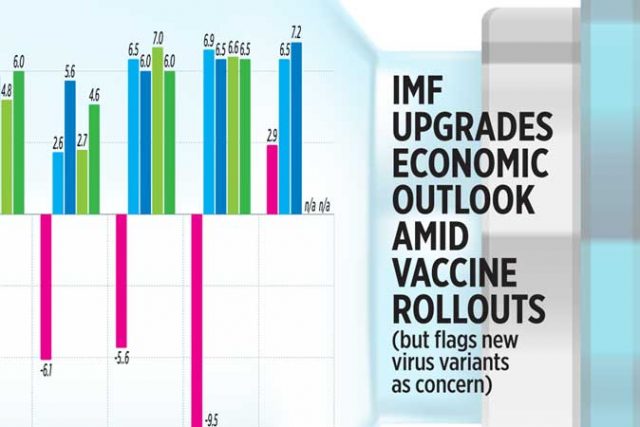
IMF upgrades economic outlook amid vaccine rollouts

THE International Monetary Fund (IMF) sees the Philippine economy bouncing back slightly faster than previously expected this year, but noted it is “critical” to contain the surge in coronavirus disease 2019 (COVID-19). Read the full story.

Real GDP growth of select Asian and Pacific Economies

Patient safety is at the heart of COVID‑19 vaccine development

In a previous column, we talked about the four types of COVID-19 vaccines and how they work (“No one is safe unless everyone is safe,” BusinessWorld, Feb. 24, 2021). In today’s column, we will discuss how vaccine manufacturers and regulatory agencies work together to make these all-important vaccines safe and effective.

Patient safety is central to the research and development of every vaccine. Vaccine makers must follow very strict scientific and health authority processes to bring a new vaccine to the public, even during the current pandemic. With vaccine development moving so quickly, it is understandable why some people are asking whether a vaccine for coronavirus disease 2019 (COVID-19) will be safe and effective.

Like all vaccines, the COVID-19 vaccines go through many stages of approval, including exploratory “proof of concept” stage, pre-clinical stage, clinical development (which include human clinical trial phases 1 to 3), health authority review, authorization or approval, and finally, manufacturing and quality control.

COVID-19 vaccines are only authorized or approved for use with the general public after a rigorous process. Clinical trials thoroughly test candidate vaccines on tens of thousands of people. An independent group of experts work with health authorities to carefully review all the scientific and clinical trial data results. They will only authorize said vaccine for use with the general public if the benefits of the vaccine far outweigh the known and possible risks of getting a COVID-19 infection.

Clinical trials also help find adverse events that may happen shortly after getting a vaccine. The health authorities also check for very rare side effects, or side-effects that may become apparent only after long-term use. This is why researchers and health authorities will continually monitor that use to check that no safety concerns surface and the vaccines continue to work well in different groups of people over time.

Health authorities review all the scientific and clinical trial data and decide if the vaccines can be authorized or approved for use in their region or countries. They review all the preclinical, clinical, and manufacturing process data, including the safety and efficacy (i.e., how well it works) data. These health authorities include regional regulatory authorities like the European Medicines Agency (EMA) in the European Union, and national regulatory authorities such as the Food and Drug Administration (FDA) in the US and the Pharmaceuticals and Medical Devices Agency (PMDA) in Japan. In the Philippines, scientific and clinical data are reviewed by the Food and Drug Administration and expert panels convened by the government.

COVID-19 vaccines follow international standards for vaccine development and approval. Like all new medicines or treatments, vaccines must pass a thorough set of tests that show their quality, safety, and efficacy in tens of thousands of volunteers before being approved or authorized by independent, scientific experts who work for health authorities.

Due to the public health emergency, the authorization and manufacturing of COVID-19 vaccines have been quicker than with previous vaccines. There has been a unique level of preparation and collaboration among researchers, vaccine makers, governments, and health authorities, as well as unprecedented funding for vaccine development and manufacturing. These partnerships accelerated the safe and effective development and authorization of COVID-19 vaccines, without compromising on any of the safety or authorization processes.

There were other factors as well that shortened the development timeline. Vaccine makers carried out clinical trials and making vaccines in parallel instead of doing one after the other. This avoided long wait times between trials. Given the high spread of the virus, it has been easier to have clinical trial volunteers and easier to test the efficacy of vaccines. Vaccine makers gave health authorities access to the clinical trial results throughout the process (“a rolling review”), rather than waiting until the end, to help them carry out ongoing reviews of results. Even before final authorization, vaccine makers started manufacturing preparations to shorten the time it would take to distribute vaccines.

Vaccine makers have worked around the clock to update facilities and hire and train more staff to make the huge number of vaccines needed. Suppliers making vials, syringes, and stoppers are working overtime and in close partnership with the vaccine makers. Health authorities set up dedicated task forces made up of independent experts and rapid review processes to evaluate high-quality applications from vaccine makers. This allows the shortest possible timeframes while ensuring robust scientific opinions.


Teodoro B. Padilla is the executive director of the Pharmaceutical and Healthcare Association of the Philippines (PHAP). PHAP and its member companies represent the research-based pharmaceutical and healthcare industry. For more information about vaccine development, please go to teamvaccines.ifpma.org. #TeamVaccines   

Financial firms told to guard vs risks from payments, e-money companies

FINANCIAL INSTITUTIONS must practice risk management in doing business with e-money and payment players to ensure financial stability and security against “dirty money” activities, the Bangko Sentral ng Pilipinas (BSP) said.

Memorandum No. M-2021-021 signed by BSP Deputy Governor Mamerto E. Tangonan on April 5 said the central bank’s directive to impose sound risk management policies when dealing with operators of payment systems (OPS) and nonbank electronic money-issuers (EMIs) is in line with their mandate under Republic Act 11127 National Payment Systems Act.

BSP-supervised financial institutions (BSFIs) were told to limit their transactions to only OPS and nonbank EMIs that have secured licenses with the central bank.

The central bank also reminded BSFIs to assess observable business activities and transactions of OPS and EMIs and to ensure they perform customer due diligence measures when dealing with them.

“Where a BSFI is unable to comply with the relevant customer due diligence measures, it shall not open the account, not commence business relations, business relations, refuse to perform the transaction or terminate the business relationship; and consider filing a suspicious transaction report…,” the memorandum said.

Transaction monitoring of personal accounts of beneficial owners of OPS or nonbank-EMIs is also expected from BSFIs that have business relationships with these firms.

Financial institutions are likewise expected to have systems in place to trace unusual movements of funds and transactions of the OPS or nonbank EMIs, as well as appropriate risk assessment and due diligence of these firms. This includes assessing their risk profile and other factors, including business, operations, customer profile, activities rendered, distribution channels, and exposed jurisdictions.

Financial institutions are also expected to establish policies and guidelines with criteria on anti-money laundering and counter-terrorism financing obligations, covered and suspicious transaction reporting.

The central bank last year put in place a new system for assessing dirty money and terrorism financing risks which uses a four-point rating scale to gauge risks ranging from low to high. The move was done as part of reforms to strengthen the country’s guard against money laundering and terrorism financing. — LWTN

China asks major lenders to curtail credit growth this year

THE PEOPLE’S Bank of China asked banks to curtail loan growth for the rest of this year amid bubble risks. — REUTERS

CHINA’S CENTRAL BANK asked the nation’s major lenders to curtail loan growth for the rest of this year after a surge in the first two months stoked bubble risks, according to people familiar with the matter.

At a meeting with the People’s Bank of China (PBoC) on March 22, banks were told to keep new advances in 2021 at roughly the same level as last year, said the people, asking not to be identified as the matter is private. Some foreign banks were also urged to rein in additional lending through so-called window guidance recently after ramping up their balance sheets in 2020, one of the people said.

The comments give further detail to what the central bank stated publicly after the meeting, when it said it asked representatives of 24 major banks to keep loan growth stable and reasonable. In 2020, banks doled out a record 19.6 trillion yuan ($3 trillion) of credit, with about a fifth directed to inclusive financing such as small business loans. Lending the same amount this year would bring the outstanding balance to about 192 trillion yuan, an annual increase of about 11%, the slowest pace in more than 15 years.

“On the one hand, there will be slowdown in loan growth, and on the other hand, the slowdown is quite moderate,” said Lu Ting, chief China economist at Nomura Holdings Inc., adding that the pace is line with the PBoC’s stance of making no sharp policy turns.

With the coronavirus largely contained and the economy rebounding, Chinese policy makers have renewed a campaign to curb risks, especially in the financial and real estate sectors. Even if credit growth eases, the prospect of higher interest rates and fewer soured assets may boost the profitability of banks, which saw earnings slump after they were enlisted to help borrowers obtain cheap financing during the pandemic.

The PBoC didn’t immediately comment.

Chinese banks advanced 4.9 trillion yuan of new loans in the first two months, 16% more than the same period last year, official data show. The central bank told banks in February to keep new lending in the first quarter roughly at the same level as last year, if not lower, the Financial Times reported earlier.

Credit curbs will drain liquidity from the stock market and pressure sectors with high valuations, said Ken Chen, a Shanghai-based analyst at KGI Securities.

Kweichow Moutai Co., the Chinese liquor giant, led a sell-off in blue-chip shares on Tuesday, falling as much as 2.8%. WuXi AppTec Co. slid as much as 5.4%.

The PBoC wants banks to focus on lending to areas such as innovative technology and the manufacturing sector, it said at the March gathering. Earlier in the month, Guo Shuqing, chairman of the China Banking and Insurance Regulatory Commission, warned about bubbles in the property and financial markets, fueling concerns policy makers will begin tightening monetary policy.

China’s government is taking advantage of the economic recovery to deleverage, a long-standing goal shelved during the trade war with the US and further delayed by the pandemic. Last year’s stimulus pushed debt to almost 280% of annual economic output.

The economy accumulated much of its record debt pile after the global financial crisis, when it binged on credit to avoid the economic slumps ravaging the West. Efforts in 2017 to restrain debt growth, especially in the shadow-banking industry, led to higher money-market rates and a slump in government bonds. — Bloomberg

Headline inflation rates in the Philippines (March 2021)

INFLATION eased in March after five straight months of acceleration, as food prices increased at a slower pace, the government’s statistical agency reported on Tuesday. Read the full story.

Headline inflation rates in the Philippines (March 2021)

ADVERTISEMENT
ADVERTISEMENT