Home Blog Page 8185

Free WiFi sites now in 80 provinces — DICT

INFORMATION and Communications Technology Secretary Gregorio B. Honasan II said the government’s nationwide rollout of free WiFi sites has jumped 500% during the pandemic.

There are now “8,453 live sites in 17 regions, 80 provinces, 1,109 municipalities and 125 cities as of April 16, 2021,” Mr. Honasan said at the virtual Pre-State of the Nation Address (SONA) Economic Development and Infrastructure Clusters Forum on Monday.

He also said the country’s fixed-broadband speed has improved from 8.40 megabits per second (Mbps) in 2016 to 46.25 Mbps in 2021.

Mobile internet speed is now at 25.43 Mbps, compared with the speed of 7.77 Mbps in 2016, Mr. Honasan noted.

The Department of Information and Communications Technology (DICT) targets to establish a total of 67,233 WiFi sites by 2022 in public places and government buildings including schools and hospitals. — Arjay L. Balinbin

Bacolod City logs 20% positivity rate as it ramps up COVID-19 testing

BACOLOD CITY EOC
MEDICAL workers in Bacolod City take swab samples for coronavirus testing in this October 2020 photo. — BACOLOD CITY EOC

BACOLOD City has been ramping up coronavirus testing operations, with focus on individuals and sectors at high risk of infection, and immediately isolating those who test positive.

The “Emergency Operations Center (EOC) is maximizing its testing operations… the EOC is aggressively conducting surveillance testings in various areas, the recent of which was in the Bacolod City Police Office after some police officers tested positive for the virus,” the city government said in a statement released on Sunday evening.

“Those who test positive will immediately be placed under isolation, as ordered by Mayor Evelio Leonardia,” it added.

City Administrator Em L. Ang, who also sits as executive director of the EOC, said with the targeted testing, there was a 20% positivity rate among 441 individuals as of April 23.

Ms. Ang said the 20% positivity rate is “alarming” as a 5% rate is already considered “too high.” The city official again appealed to residents to follow minimum health protocols and avoid social gatherings among people from different households.

“It is important to avoid mixing people in one place at the same time because it is one key factor of spreading COVID-19 (coronavirus disease 2019) infection,” she said.

As of April 25, Bacolod had 900 active COVID-19 cases out of the 7,192 total since the start of the pandemic. There were 6,087 recoveries and 205 deaths. Of the total cases, 6,766 are local transmissions.

A total of 74,886 individuals have undergone RT-PCR testing in the city as of April 24, according to data from the EOC.

Hog deliveries to Metro Manila nears 345,000

PHILIPPINE STAR/ MICHAEL VARCAS
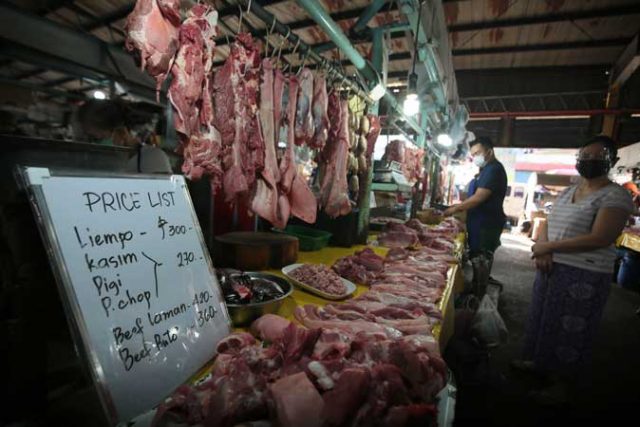
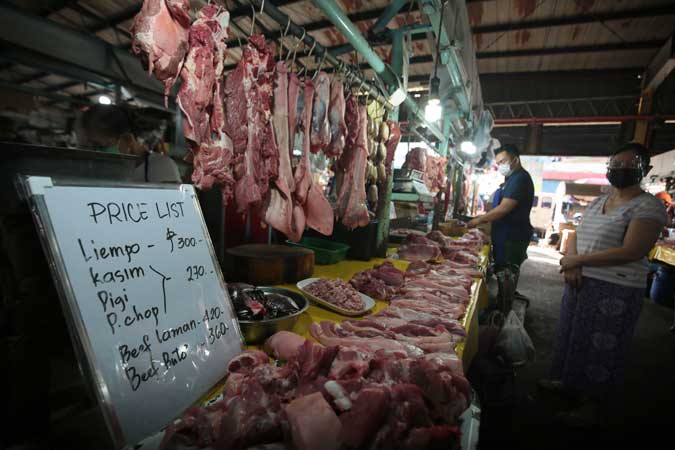
PORK supply and prices in Metro Manila have been affected by the African Swine Fever (ASF) outbreak. — PHILIPPINE STAR/ MICHAEL VARCAS

HOG shipments from various parts of the country to Metro Manila under the ongoing initiative to augment pork supply in the capital region is nearing 345,000 heads, the Department of Agriculture (DA) said.

In a report, the DA said an additional 5,592 hogs were delivered to Metro Manila on April 25, bringing the cumulative total to 343,435 hogs since the government’s implementation of price controls on Feb. 8.

From the new shipments, 3,826 hogs came from South Cotabato and General Santos City, followed by Batangas and Quezon at 1,208 hogs, and Oriental Mindoro at 440 hogs.

Other areas that sent supply were Davao City at 110 hogs and Tarlac at 8.

Since Feb. 8, CALABARZON (Cavite, Laguna, Batangas, Rizal, and Quezon) accounted for the highest share of total hog deliveries among provinces at 42.68%, followed by Western Visayas at 20.9%, and MIMAROPA (Mindoro, Marinduque, Romblon, and Palawan) at 12.44%.

Meanwhile, the DA said an additional 21,163 kilograms of pork in carcass form arrived in Metro Manila on April 25. The new shipments brought the total pork carcass deliveries to 2.372 million kilograms since Feb. 8.

The ongoing delivery of hogs from other provinces to Metro Manila is part of the government’s effort to augment supply and bring down retail prices amid the African Swine Fever (ASF) outbreak.

After the price controls ended on April 8, the DA replaced it with the implementation of a suggested retail price (SRP) for imported pork shoulder (kasim) at P270 per kilogram (/kg), and imported pork belly (liempo) at P350/kg.

Under the previous price cap, pork kasim was priced at P270/kg, pork liempo at P300/kg, and whole chicken at P160/kg.

President Rodrigo R. Duterte also signed Executive Order No. 128 on April 7 that lowered the tariff rates for pork imports within the minimum access volume (MAV) quota to 5% in the first three months, which will increase to 10% in the following nine months.

The tariff of out-quota pork imports were also lowered to 15% in the first three months, and up to 20% in the succeeding nine months.

Previously, pork imports within the MAV quota paid 30% tariff, while out-quota pork imports paid 40%.

Mr. Duterte also recommended to increase the volume of pork imports within the MAV quota by 350,000 metric tons (MT), to go with the current allocation of 54,210 MT, after the DA projected a pork supply deficit of around 400,000 MT after the country’s hog inventory was affected by African Swine Fever (ASF). — Revin Mikhael D. Ochave

House panel approves bills creating multiple ecozones

ANFLOINDUSTRIALESTATE.COM

THE HOUSE Ways and Means Committee approved bills that proposed new economic zones in various parts of the country, including Mindoro, Sangley Point, Cavite, and Bacolod City.

In a hearing on Monday, the committee made an omnibus approval on the tax provisions of unnumbered substitute bills to House Bills 263, 264, 655, 3239, 5440, 5538, and 5794 subject to amendments.

The seven bills called for special economic zones to be created in Paluan, Occidental Mindoro; Sangley, Cavite; Cebu’s 4th District, Bacolod, Northern Bohol, and Metro Iloilo.

Representative and House Committee on Economic Affairs Chairman Teodorico T. Haresco, Jr. said at the hearing that each of the bills will help boost local economies, which he called a timely response to the pandemic.

“The ecozone house bills today will seek to establish economic zones in strategic locations (which have) great potential of promoting economic development in their respective provinces and nearby provinces as well,” he said in sponsoring the measures during the hearing.

Albay Rep. and House Ways and Means Committee Chairman Jose Ma. Clemente S. Salceda said his panel supports the bills, noting that the incentives to be offered to registered enterprises in the proposed economic zones are in line with the intent of Title XIII of the National Internal Revenue Code.

Rules on taxes paid for raw materials will be drafted by the economic zones in collaboration with the Philippine Economic Zone Authority (PEZA), the Bureau of Customs, the Bureau of Internal Revenue, and the Department of Trade and Industry.

Enterprises engaged in industries classified in PEZA’s negative list are not allowed to engage in the domestic sale of their output. — Gillian M. Cortez

First-quarter rice tariff collections top P4 billion

PHILIPPINE STAR/ MICHAEL VARVCAS

THE Bureau of Customs (BoC) collected P4.29 billion worth of rice tariffs in the first quarter on imported volume of 606,000 kilograms (kg), Finance Secretary Carlos G. Dominguez III said at a forum Monday.

The quarter’s tally puts the BoC ahead of the pace to collect P10 billion a year from rice tariffs, which is to support the Rice Competitiveness Enhancement Fund (RCEF) as authorized by Republic Act 11203, or the Rice Tariffication Law.

In 2020, the government collected P15.47 billion in tariffs from 2.38 million kg of imports. The total was up 27.43% from collections posted in 2019 beginning in March, when the tariffication law came into force.

Total collections amounted to P31.9 billion since the law became effective.

The law removed restrictions on rice imports by private entities, which must pay a tariff of 35% on shipments of Southeast Asian grain.

RCEF will support farm mechanization and other programs to enable farmers to better compete against imports.

“The Rice Tariffication Law was finally achieved after more than thirty years of failed attempts under previous administrations. The law opened up the Philippine rice market and, in turn, lowered the price of our country’s staple for more than 100 million Filipinos, who spend about a fifth of their total budget on rice alone,” Mr. Dominguez said.

He said the law helped temper inflation, with its share of the overall consumer price index falling to 0.1 percentage point compared to its one-percentage point share at the height of the inflation crisis of 2018.

“The law ensures that farmers benefit directly from import tariffs by providing at least 10 billion pesos each year for mechanization, high quality seed, access to credit, and training,” he added. — Beatrice M. Laforga

LGU rate of business permit automation lagging at under 40%

BW FILE PHOTO

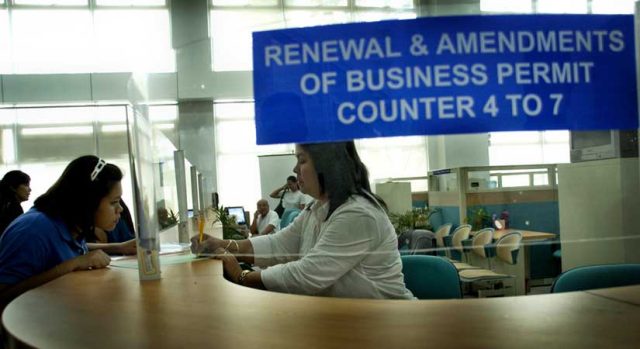
LESS THAN 40% of local government units (LGUs) have so far automated their business permit systems with smaller municipalities falling behind, the Department of Trade and Industry said.

Citing an April 14 compliance report from the Department of the Interior and Local Government, Trade Secretary Ramon M. Lopez said only 39% of 1,516 LGUs have automated their business permit and licensing systems.

Some 91% of the 33 highly-urbanized cities have automated their systems, compared to 52% of first-class municipalities, 41% of second-class municipalities, and 30% of third to sixth-class municipalities.

The third to sixth class municipalities represent 884 of the country’s LGUs. The classifications of municipalities are based on their income, with sixth-class municipalities representing the smallest average annual income of less than five million pesos.

“The cities in NCR (National Capital Region) have set up their own online registration systems and payment systems. Outside of Metro Manila, we also have cities like San Fernando, Cagayan de Oro, and Mandaue City that have end-to-end systems just like Valenzuela and Parañaque in NCR,” Mr. Lopez said at the Sulong Pilipinas 2021 economic forum on Monday.

Smaller municipalities, he said, are being assisted by various government agencies to shift their processing online.

“We expect these numbers to increase by June 2021,” Mr. Lopez said.

All LGUs are required to move their entire business permit application processes online by mid-June, according to a joint memorandum circular from the Anti-Red Tape Authority and other agencies.

Local governments that have fully put up an online business registration service must cut the number of steps to one. Those transitioning to a fully-automated system must have a maximum of four steps under a hybrid manual and digital process.

Business registration must be processed within three business days, while the number of signatories on permits must be reduced to three people. — Jenina P. Ibañez

LANDBANK farm loans exceed P229 billion

OUTSTANDING LOANS made to the agriculture sector totaled P229.70 billion at the end of March, the Land Bank of the Philippines (LANDBANK) said.

LANDBANK said in a statement Monday that small, medium and large agribusiness enterprises accounted for P143.11 billion of the total; followed by agri-aqua related projects of local government units and government-owned and-controlled corporations at P50.32 billion; loans to small farmers and fishers, cooperatives, and rural financial institutions amounted to P36.27 billion.

Relative to the overall banking industry, LANDBANK cited a Bangko Sentral ng Pilipinas estimate that total loans extended by universal and commercial banks to agriculture, forestry, and fishing borrowers fell 6.1% year on year in February, LANDBANK said.

“LANDBANK has assisted cumulatively 2.70 million farmers and fishers nationwide as of end-March, recording increases of 14,147 beneficiaries from February and 25,990 for the first three months of the year,” it added.

Recently, LANDBANK increased its loan facility to hog raisers and feed millers to P30 billion, from P15 billion previously. The funds will be used to boost hog repopulation initiatives and address the impact of the African Swine Fever outbreak.

The loans will be available to commercial hog raisers registered as cooperatives or farmer associations, small and medium enterprises, and large enterprises or corporations.

LANDBANK President and Chief Executive Officer Cecilia C. Borromeo told stakeholders during a consultation session on April 22 that the bank will continue to address credit-access issues faced by its clients during the pandemic. — Revin Mikhael D. Ochave

Industry lobby to draft policy proposals to improve education

PHILSTAR FILE PHOTO

THE Philippine Chamber of Commerce and Industry (PCCI) is putting together an education task force to draft policy recommendations to the government to address gaps in the education system that were exposed during the pandemic.

The country’s largest business group said in a statement Monday that the task force will hold its first meeting this week to review the state of the education sector.

The task force’s policy paper will describe the state of education and will make recommendations on qualifications, curricula, teacher competency, and institutional reform.

Task force members will include 12 “recognized experts,” PCCI said, along with the industry group’s representatives. Members include representatives from universities and education groups like the Association of Local Colleges and Universities, Coordinating Council of Private Educational Associations, and the Association of Universities of Asia and the Pacific.

“The COVID-19 pandemic has exposed the challenges, gaps, and deficiencies of our educational system.  Now is the best time that we sit down and seriously discuss these gaps and provide solutions that would make the system at par with other countries,” PCCI President Benedicto V. Yujuico said.

The Philippines last year inched up one spot to 48th out of 63 economies in the IMD World Competitiveness Center’s World Talent Ranking 2020 report, an annual league table seeking to gauge countries’ ability to attract and retain a skilled workforce.

The Program for International Students Assessment report released in 2019 showed the Philippines ranked last in reading comprehension and second-lowest in science and mathematics among 79 countries. — Jenina P. Ibañez

DoTr targets inauguration of LRT-2 East Extension by June

PHILSTAR FILE PHOTO

THE Transportation department said Monday that the LRT-2 (Light Rail Transit Line 2) East Extension Project is set to be inaugurated by June, while the Common Station project will begin partial operations by the end of the year.

“This year, we will finally be witnessing the completion and the start of operations of two big-ticket projects. First, the LRT-2 East Extension Project, with two additional stations in Marikina and Antipolo, is set for inauguration in June,” Transportation Secretary Arthur P. Tugade said at the virtual Pre-State of the Nation Address Economic Development and Infrastructure Clusters Forum Monday.

He added: “The second one is the Common Station… After nine years of delay, the construction for the Common Station is now ongoing, and will be partially operable in December 2021.”

The East Extension Project adds four kilometers to the 13.8-kilometer LRT-2 train line, connecting it to Antipolo City.

It aims to reduce the travel time between Manila and Antipolo from three hours to 40 minutes.

The East Extension is expected to add 80,000 passengers to the current 240,000 daily ridership of the LRT-2, which currently connects Recto Avenue in Manila to Santolan station in Marikina.

Meanwhile, the Common Station Project features a 3,700-square meter concourse area, which will interconnect LRT-1, Metro Rail Transit (MRT) Line 3, MRT-7, and Metro Manila Subway.

The Common Station, once operational, is expected to serve about 478,000 commuters daily.

“Please note that the investment poured by this administration in the railways sector under the Build, Build, Build Program is significantly larger than the total railway investments in the last 50 years combined,” Mr. Tugade said. — Arjay L. Balinbin

Stricter enforcement of excise on sugar-sweetened drinks urged

PHILSTAR FILE PHOTO

LEGISLATORS on Monday said the excise tax regime on sweetened drinks needs to be properly enforced, after it found revenue shortfalls and the non-implementation of programs for sugar farmers.

In a hearing, Nueva Ecija Rep. Estrellita B. Suansing said there is a “significant deficit” in actual performance against targets for sweetened beverages because enterprises began using high-fructose corn syrup, a shift that was not easily verified and may be subject to misdeclaration.

During the first year of the excise tax’s implementation in 2018, the targets were P52.03 billion for the Bureau of Internal Revenue and P2.45 billion for the Bureau of Custom. Actual collections were P39.77 billion and P2.82 billion respectively.

“In total there is a shortfall of P12.26 billion which is equivalent to 37% of the total target,” she said.

House Committee on Ways and Means Chairman Jose Ma. Clemente S. Salceda said part of the panel’s recommendations is for the Food and Drug Administration to improve its product testing and post-market surveillance.

“Now, the Food and Drug Administration is procuring new machines to verify sugar content in response to our Committee’s pressure,” he said.

Ms. Suansing said because the excise taxes on sweetened beverages discourage sugar consumption, part of the law provides that the taxes collected should fund programs to help sugarcane farmers via the Sugarcane Industry Development Act.

She added that the Department of Budget and Management cited the low absorptive capacity of the Sugar Regulatory Administration (SRA) in receiving the revenue from the excise taxes.

“We encourage SRA to increase their absorptive capacity, because this was one of the reasons why (the farmers) are not benefitting from the revenue of the excise tax on sugared/sweetened drinks and beverages,” she said. — Gillian M. Cortez

House committee approves bill creating bureau focused on procuring medical supplies 

REUTERS

THE House Committee on Ways and Means approved on Monday a bill calling for the establishment of a bureau and special fund focused on procuring medical supplies.

In a hearing Monday, the committee approved House Bill 6995 or the proposed Health Procurement and Stockpiling Act subject to amendments. If passed, the measure will create a Health and Procurement and Stockpiling Bureau (HPSB), to be managed by the Department of Health (DoH). The HPSB will absorb the DoH’s Procurement Service. 

Quezon Rep. Angelina D.L. Tan, the bill’s principal author, said at the hearing that the bureau is necessary in times of public health crises. It will be tasked with identifying critical medicines and supplies that need to be stockpiled. 

“It shall serve as the principal agency mandated to undertake a transparent, fair, proactive, and innovative procurement service of the DoH and stockpile, conserve and facilitate the release of adequate amounts of potentially life-saving pharmaceuticals, vaccines, devices, and materials during public health emergencies,” she said at the hearing.

Ms. Tan said the bill also aims to address issues that hinder access to critical drugs and other medical equipment during crises. 

The bill also calls for the creation of the Medical Stockpiling Fund which will “support the national drug and device security program.” The fund will be handled by the DoH. The DoH may solicit and receive donations in cash or in kind, subject to exemption from donor’s tax and other charges. 

However, the Department of Finance said during the hearing that it proposed that the Bureau of the Treasury should manage the fund.  

“This is consistent with the existing policy and treatment of grants and donations of a special account in the general fund,” Finance Director Valery Joy A. Brion said at the hearing. — Gillian M. Cortez

Wish list for reforms on tax filing, payment and administrative compliance

It’s been more than a year since the onset of the COVID-19 pandemic. This global health crisis, which has claimed millions of lives and continues to change the ways businesses operate, has spanned two tax seasons in the Philippines.

In 2020, when the pandemic was declared and lockdowns were imposed, the April 15 deadline for filing and payment of annual income tax returns (AITR) was extended for two months. This year, the government did not heed the taxpayers’ call for an extension in filing and payment of annual income tax for tax year 2020. Instead, the following measures were implemented to alleviate hardship in meeting the deadline during these challenging times:

• Amendments to the 2020 annual income tax return have been allowed without penalty until May 15, 2021;

• Out-of-district filing and payment of tax returns falling due on March 22, 2021 to April 30, 2021 has been allowed;

• Use of electronic signatures on 2020 annual ITRs, attachments, and documents has been allowed; and

• Taxpayers may opt to submit copies of electronically-filed AITRs and attachments via the eAFS Facility of the Bureau of Internal Revenue (BIR). Attachments to electronically filed AITRs are due on April 30, 2021 or 15 days from electronic filing, whichever comes later.

Indeed, the above measures have eased the burden of filing and paying taxes under stricter quarantine guidelines implemented by the government. However, the measures were announced by the government less than three weeks from the filing deadline. Hence, the following reforms on tax filing and payment in line with the aforementioned circumstances and other administrative tax compliance requirements, some of which are also embodied under the proposed House Bill No. 8942 or the “Ease of Paying Taxes Act,” may be considered by the government:

ENHANCE THE PORTABILITY OF TAX TRANSACTIONS BY REMOVING VENUE RESTRICTIONS IN FILING AND PAYMENT OF TAXES
Under the Tax Code, except in cases which the Commissioner otherwise permits, tax returns are required to be filed with an authorized agent bank, Revenue District Officer, or Collection Agent in the Revenue District Office (RDO) where the taxpayer is registered.

To address the influx of taxpayers filing and paying their annual income tax returns close to the April 15 deadline, the BIR normally issues memorandum circulars allowing out-of-district filing and payment for tax returns due during the tax season. Unless the BIR issues a circular which normally covers only specific tax returns, taxpayers are obligated to file and pay their taxes in the RDO where they are registered, regardless of where they are during the time of filing. Failure to file and pay at the correct venue is subject to penalty. This creates an additional burden and inconvenience to taxpayers due to safety and travel restrictions during the pandemic.

In this regard, the file-and-pay-anywhere system must be institutionalized to relieve taxpayers of the extra burden of awaiting for a memorandum circular allowing them to file and pay out of district. Since this will be more convenient for taxpayers, this measure could result in higher tax collections.

Penalties for filing and paying in the wrong venue should accordingly be abolished, too.

INSTITUTIONALIZE THE ACCEPTANCE OF E-SIGNATURE ON ALL TAX RETURNS AND DOCUMENTS REQUIRED BY THE BIR
Currently, except for certificates of withholding taxes (BIR Form 2304, 2306, 2307 and 2316) and the 2020 AITR and attachments, the BIR still requires wet signatures in tax returns, forms, and documents due to be submitted to the BIR. Also, a number of tax returns and submissions relating to tax assessments still require manual submission. 

With the ongoing pandemic and initiatives to comply with the Ease of Doing Business and Efficient Government Service Delivery Act of 2018, the BIR should allow the use of electronic signatures and electronic submission of documents/letters to the BIR. This will not just be more convenient for taxpayers, but it will also save the BIR storage costs and time spent looking for lost dockets.

REMOVE THE DISTINCTION BETWEEN VALUE-ADDED TAX (VAT) SALES INVOICE AND VAT OFFICIAL RECEIPTS
For the sale of goods or property, sellers are required to declare and remit VAT based on gross sales during the period. On the other hand, for sales of services or lease of goods or property, sellers are required to declare and remit based on gross receipts during the period. A VAT sales invoice must be issued for the sale of goods or property. A VAT official receipt must be issued for the sale of services or lease of goods or property.

This distinction often causes confusion among taxpayers, especially businessmen who are not tax practitioners and foreign investors who are not savvy about our tax intricacies. This distinction also raises issues regarding differences in timing of reporting and claiming of input VAT by sellers and purchasers, resulting in significant discrepancies in case of third-party matching of information by the BIR.

All things considered, legislators should indeed look at removing the distinction between sale of goods and services for VAT purposes. For easy monitoring and compliance, VAT should be based on gross sales/selling price, regardless of whether it is a sale of goods or services. In both instances, a VAT sales invoice should be issued upon sale and a non-VAT official receipt must be issued upon collection.

REMOVE UNNECESSARY DOCUMENTARY REQUIREMENTS FOR PAYING TAXES SUCH AS SPECIAL POWER OF ATTORNEY
Taxpayers should be allowed to pay taxes without unnecessary documentary requirements. The act of paying taxes should be the easiest part of tax compliance. While in other stages of tax compliance, proof that the representative is authorized by the taxpayer may be needed, there should be no further proof required for payment of taxes. Paying taxes on behalf of another taxpayer will not in any way disadvantage the government. Hence, unauthorized payment of taxes should not be an issue for the tax bureau.

The above suggestions are just some of the reforms which our legislators and the BIR may consider. As these measures will indeed help ease tax compliance, and accordingly, improve compliance levels of businesses in the Philippines, I do hope that these reforms could materialize soon as they can help raise taxes that would add to the government’s capacity to mitigate the effects of the pandemic.

Let’s Talk Tax is a weekly newspaper column of P&A Grant Thornton that aims to keep the public informed of various developments in taxation. This article is not intended to be a substitute for competent professional advice.


Ma. Lourdes Politado-Aclan is a director from the Tax Advisory & Compliance division of P&A Grant Thornton, the Philippine member firm of Grant Thornton International Ltd.

pagrantthornton@ph.gt.com

ADVERTISEMENT
ADVERTISEMENT