Home Blog Page 818

Sept. LEDAC to determine priority status of military pension reform

PHILIPPINE STAR/EDD GUMBAN

THE Legislative-Executive Development Advisory Council (LEDAC) meeting next month will determine whether military and uniformed personnel (MUP) pension reform remains on the priority legislation list, Budget Secretary Amenah F. Pangandaman said.

“We’ll find out during our LEDAC meeting. It’s scheduled for September. There, we will check if it’s still included among the priority legislation,” Ms. Pangandaman said during the Kapihan sa Manila Bay briefing on Thursday.

Asked if the government is still pushing for pension reform, she said, “Yes, I think,” adding that “the Department of Finance (DoF) is the one in charge.”

“There really is no fiscal space. It is still the same allotment. We don’t know what will happen with the bill. The bill is still pending,” she said.

According to the 2026 National Expenditure Program (NEP), the government allocated P197.99 billion for the pension and gratuity fund, up 36.80%.

Finance Secretary Ralph G. Recto has said the government is unlikely to revive the MUP reform bill due to cost constraints.

Last year, Mr. Recto sought changes in the MUP pension scheme applicable only to new personnel.

In 2023, the House of Representative approved House Bill No. 8969, which sets a member contribution rate of 9% of monthly salary for new entrants and a 12% top-up from the government.

The Senate version of the MUP reform bill has been awaiting second reading approval since November 2023.

Senate Bill No. 2501 seeks to set monthly retirement pay at 50% of the base pay for the last position held by retired MUPs. It also requires new MUPs to contribute to their pension. — Aubrey Rose A. Inosante

Chamber backs Ang proposal for private sector-led flood control

RAMON ANG — SANMIGUEL.COM.PH

THE Federation of Filipino Chinese Chambers of Commerce and Industry, Inc. (FFCCCII) said it supported a proposal by San Miguel Corp. (SMC) Chairman Ramon S. Ang to lead a private-sector initiative to build flood-control projects in Metro Manila.

“We fundamentally endorse such visionary private sector initiatives that directly address critical national challenges,” FFCCCII President Victor Lim said.

“This proposal arrives at a pivotal moment, promising not merely infrastructure intervention but a transformative commitment to safeguarding our capital’s communities, securing livelihoods, and fortifying the region’s economic vitality,” he added.

Earlier this month, Mr. Ang volunteered to help solve the flooding problem in Metro Manila at no cost to the government.

“Mr. Ang’s vision — centered on the pragmatic, scientifically grounded approach of removing critical obstructions from vital river systems — resonates deeply with the urgent need for sustainable solutions,” Mr. Lim said. 

“His emphasis on holistic remediation, including the conscientious relocation of affected communities and institutions, demonstrates leadership that harmonizes ambitious engineering with profound social responsibility,” he added.

He said the chamber is confident of Mr. Ang’s ability to deliver on this project, noting the success of SMC’s Skyway project and the privatization of the Ninoy Aquino International Airport.

“The FFCCCII views Mr. Ang’s offer not merely as commendable philanthropy but as a potent catalyst for resilience. His proven track record in delivering massive infrastructure projects provides a compelling foundation for trust,” Mr. Lim said.

“We recognize in this initiative the potential to unlock significant economic benefits by mitigating the devastating, recurring costs of flooding,” he added. — Justine Irish D. Tabile

Entire sugar harvest to be classified for domestic use

PHILSTAR FILE PHOTO

THE Sugar Regulatory Administration (SRA) on Thursday said all sugar that will be produced in the coming crop year will be classified in the “B” category (for domestic use) to stabilize prices.

The classification will cover the entire milling season that starts on Oct. 1 or the nearest Monday, SRA Administrator Pablo Luis S. Azcona said in a statement.

Since Oct. 1 falls on a Wednesday, milling will open on Sept. 29, the SRA noted.

It added via Viber that it has classified sugar as B since 2022 “because  despite growth, we are still below demand.”

In his report to the industry, Mr. Azcona said as of July 27, raw sugar production amounted to 2.084 million metric tons (MMT) on input of nearly 26 MMT of cane harvested over 405,000 hectares.

Mr. Azcona said Mindanao farmers were this year’s “heroes of the sugar industry,” after they posted the strongest production growth.

“Mindanao will likely be our last frontier in our road towards sustainability,” he said, without providing details.

The SRA is seeking an P8-billion budget for soil rejuvenation and small-scale irrigation covering about 160,000 hectares over three years.

It is also seeking P1.2 billion for a 20,000-hectare site to propagate plantlets of a high-yielding variety.

“Our productivity in the past three years was largely due to the distribution of high-yielding cane and the SRA intends to focus on this along with other scientific approaches to farming that we have been learning from our foreign partners towards our self-sustainability,” Mr. Azcona said.

Mr. Azcona said the sugar industry could receive P1 billion in the next year from funding authorized by the Sugar Industry Development Act (SIDA).

He noted the industry’s efforts to seek the amendment of SIDA to raise from P2 billion a year to P5 billion “considering the substantial contribution of the sugar industry to the national coffers.” — Kyle Aristophere T. Atienza

MSRP will remain during freeze on rice imports

PHILSTAR FILE PHOTO

THE maximum suggested retail price (MSRP) for imported rice will remain in place during the two-month suspension of rice imports ordered by President Ferdinand R. Marcos, Jr., the Department of Agriculture (DA) said on Thursday.

“We will maintain the MSRP even during the two-month rice import ban,” Agriculture Secretary Francisco P. Tiu Laurel, Jr. said.

The MSRP for 5% broken-grain imported rice was reduced to P43 per kilo from P45 on July 16.

Mr. Marcos suspended rice imports between September and October to stabilize palay (unmilled rice) prices, which have reportedly fallen to as low as P8 per kilo in parts of the country. The DA said farmers cannot recover their production costs at this level.

The DA said the duration of the import freeze may be adjusted depending on price movements and the outcome of the main harvest in the coming months.

Specialty rice varieties, such as Japanese, black, and basmati rice are exempt from the ban.

The Bureau of Plant Industry reported that imported rice landed between January and July amounted to 2,443, 337.556 metric tons, with pending Sanitary and Phytosanitary Import Clearances covering an estimated 300,000 metric tons.

Philippine consumption is roughly 9.8 kgs of rice per person per month (325.5 grams/day), according to the Philippine Statistics Authority.

Under the Rice Tariffication Law, Mr. Marcos has the authority to halt rice imports to provide relief to farmers and stabilize market prices.

The DA said it “remains prepared to adjust policies if supply tightens.” — Kyle Aristophere T. Atienza

GMR interested in Laoag, Siargao airport upgrades

ABOITIZINFRACAPITAL.COM

INDIA’s GMR Group has expressed interest in participating in upgrading key regional airports in the Philippines, particularly the ones in Laoag and Siargao, the Department of Trade and Industry (DTI) said.

GMR currently has a firm commitment to helping develop Sangley Point International Airport (SPIA).

“The President warmly received this proposal, noting its potential to support regional economic growth and tourism in developing regions, aligned with the government’s ‘Build Better More’ program,” the DTI said in a statement.

Earlier this year, the Department of Transportation (DoTr) said that it is hoping to privatize at least 15 airports next year, including the Laoag International Airport and Siargao’s Sayak airport.

“GMR is exploring a range of opportunities in the Philippines, and the list is indicative and subject to change,” according to Jollan Margaret A. Llaneza, commercial counsellor of the Philippine Trade and Investment Center in New Delhi.

“Their current priority is the Sangley Point International Airport project,” she added.

GMR redeveloped Mactan-Cebu International Airport with Megawide Construction Corp.

President Ferdinand R. Marcos, Jr. secured the GMR’s commitment to develop Sangley Aerocity and the SPIA in a meeting with GMR and its local partners Cavitex Holdings, Inc. and House of Investments.

“The President assured the consortium that the National Government is actively working with the Cavite provincial government to expedite land-related approvals, ensuring the project stays on track,” the DTI said.

The development of the airport and surrounding aerotropolis at Sangley Point, Cavite is expected to create up to 15,000 jobs and generate $500 million in government revenue.

“GMR has been a trusted partner of the Philippines since 2014 and is widely recognized for its successful delivery of the Mactan-Cebu International Airport and new passenger terminal at Clark despite the pandemic,” Trade Secretary Ma. Cristina A. Roque said.

According to the DTI, GMR has expressed its intention to be involved in the Philippines over the long term, citing its “strategic location, robust economic growth prospects, and the government’s strong backing for infrastructure development.”

The Public-Private Partnership Center of the Philippines said that the SPIA project involves the development of a new international airport and support facilities.

Cavite province is implementing the project, which is estimated to cost P215.69 billion. 

In a separate statement, the DTI said India’s Tata Consultancy Services (TCS) has announced plans to expand its presence in the Philippines over the next three years.

The information technology firm is also partnering with NOW Corp. to “strengthen national digital sovereignty, promote financial inclusion, and build a clean network.

“A signed memorandum of understanding (MoU) outlines TCS’s support for NOW’s capabilities in expanding trusted networks, providing sovereign cloud technology, and offering a robust cyber-defense suite,” the DTI said. — Justine Irish D. Tabile

Offshore wind auction on track for this year

STOCK PHOTO | Image by Nicholas Doherty from Unsplash

THE Department of Energy (DoE) said the fifth round of the green energy auction (GEA-5) this year, which is dedicated to offshore wind, will keep the industry on track to start generating power by 2028.

“It is on track. The auction will be conducted within the year,” Energy Secretary Sharon S. Garin said on the sidelines of a forum organized by the American Chamber of Commerce of the Philippines, Inc. on Thursday.

GEA-5 focuses on fixed-bottom offshore wind technology, with an installation target of 3.3 gigawatts (GW) and a delivery commencement period of 2028 to 2030.

Ms. Garin said the DoE is working with the Philippine Ports Authority, the Energy Regulatory Commission, and the National Grid Corp. of the Philippines to address the needed support infrastructure.

GEA-5 is expected to facilitate market access for offshore wind developers, ensuring long-term demand for their capacity.

With the Philippines’ offshore wind potential estimated at over 178 GW, the DoE has issued 87 offshore wind service contracts with an aggregate capacity of approximately 68 GW.

The DoE expects offshore wind to play a key role in achieving the Philippine target of increasing renewable energy’s share in the power mix to 35% by 2030 and 50% by 2040.

“Central to our energy transition is our aggressive pursuit of developing and maximizing our renewable energy,” Ms. Garin said.

At present, there are 1,392 active renewable energy projects awarded by the DoE with 7 GW already installed and potential capacity of 151 GW.

“There is so much interest in the Philippines, not only for the domestic developers but also for international as we have opened up renewable energy for 100% ownership of foreign investors,” Ms. Garin said. — Sheldeen Joy Talavera

BPOs still evaluating potential impact of US bill requiring reshoring of call centers

SIXELEVEN GLOBAL SERVICES

By Justine Irish D. Tabile, Reporter

THE IT & Business Process Association of the Philippines (IBPAP) said it is still evaluating the potential impact of the proposed Keep Call Centers in America act.

“It talks about US call centers so I really do not know who that will affect with the way that it is worded,” IBPAP President and Chief Executive Officer Jonathan R. Madrid said on the sidelines of an ECCP AI Forum.

“We need to understand it a little bit more. I think I know what their intention is. But I don’t know the likelihood of this passing. Obviously it is something we are monitoring, and with the way that it is worded, we need to study it more,” he added.

Introduced in the US Senate last month, the bill aims to impose restrictions on US firms outsourcing their call center operations.

In particular, the bill, if signed into law, will render employers outsource call center work overseas ineligible for new federal grants or guaranteed loans.

“I am speaking to the American Chamber of Commerce; we are discussing it and we will see. But we are all aligned on how we will manage this,” he said.

“While the bill is still in the early stages of the legislative process, we remain committed to keeping our stakeholders informed, providing timely guidance, and ensuring that the Philippine IT-BPM industry is well-positioned to adapt and thrive in a changing regulatory environment,” he said.

Philippine Institute for Development Studies Senior Research Fellow John Paolo R. Rivera said that the proposed bill poses a “clear risk to the Philippine IT-BPM industry, especially in the call center segment.”

“By restricting access to US federal grants, contracts, and loans for companies that offshore customer service jobs or do not properly disclose them, the bill raises the regulatory and reputational costs for offshore operations,” he said via Viber .

He said the Philippine industry has been evolving beyond voice-based call centers, which are less exposed to call center-specific legislation.

“We now see strong growth in high-value services such as finance, healthcare information management, legal process outsourcing, software development, and data analytics,” he said.

With the US Senate’s proposal to bring back call centers to the US, he said that the Philippines must continue to move up the value chain to reduce exposure to such policies.

“While the bill underscores vulnerabilities in our call center export model, it also reinforces the importance of accelerating investment in high-value, tech-enabled services where the Philippines can maintain global competitiveness,” he added.

Rizal Commercial Banking Corp. (RCBC) Chief Economist Michael L. Ricafort said the bill could be “a potential drag on future growth of the industry.”

For this year, the IT-BPM industry is expected to generate $40 billion in export revenue and increase its workforce to 1.9 million.

Mr. Ricafort said US firms’ bigger savings in outsourcing work to the Philippines could be a brake on any companies reshoring call center operations to the US.

“The service quality of Philippine contact centers, the number 1 in the world, at a much lower cost than in the US, would remain a competitive advantage to service the customers of global companies,” he said.

“Still, the bill presents a threat to call centers in the US, as it is more expensive, and in the Philippines if there are  any additional charges or taxes by the US,” he added.

He also said that the bill has the potential to increase the use of artificial intelligence in the call center industry as a cheaper alternative.

Earlier this year, IBPAP said that 70% of its members are North American, including IT-BPM firms that have North American clients.

MARINA to push bills to enhance shipbuilding, fleet competitiveness

HANJIN FACEBOOK PAGE

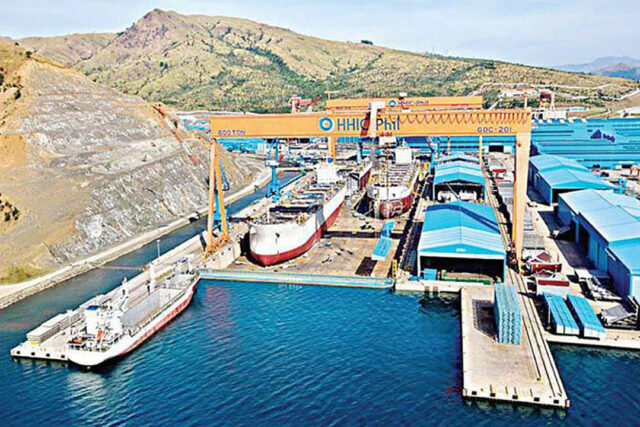
THE Maritime Industry Authority (MARINA) said it will push legislation to boost the competitiveness of Philippine shipbuilding and shipping, warning that most of the industry’s shipyards are outdated.

It added that the competitiveness of the shipping fleet has significantly declined over the past three decades.

According to MARINA, two proposed measures will modernize shipyards, while also attracting investment, boosting trade and facilitating the development of green and sustainable technology in shipping.

Marina Administrator Sonia B. Malaluan has said that the measures are crucial and will bring the Philippines at par with international standards.

Two measures were filed in July, seeking to revitalize the shipbuilding industry. House Bill (HB) No. 2597 proposes government support for domestic shipbuilding to help scale operations and reduce business costs.

Meanwhile, HB No. 2598 proposes to offer fiscal incentives to shipbuilding companies, including value-added tax exemptions and the removal of import duties on capital equipment.

The filing of the two measures follows the revival of interest in shipbuilding after the 2019 bankruptcy of the Hanjin Heavy Industries operation in Subic.

“These bills send a positive signal to both local and international shipbuilders that the Philippines is ready to be a leading destination for Shipbuilding and Ship Repair (SBSR),” Ms. Malaluan said in a statement.

A revived SBSR industry will have a ripple effect on domestic shipping, supporting agriculture, manufacturing, national defense and inter-island trade, MARINA said. — Ashley Erika O. Jose

Gov’t ready to facilitate US companies’ expansion in PHL

SECRETARY Frederick D. Go, the special assistant to the President for investment and economic affairs, said the Philippines is ready to assist US companies looking to expand in the Philippines.

Mr. Go said that the record turnout of the US-ASEAN Business Council (USABC) mission reflects the confidence of US businesses in the Philippines’ investment climate.

“This engagement opens new avenues for strategic public-private partnerships that leverage our countries’ complementary strengths in key industries, such as electronic and semiconductors, food and agriculture, pharmaceuticals, infrastructure, and digitalization,” he said.

“We stand ready to assist US companies expand their presence in the Philippines and participate in the country’s promising growth story,” he added.

In a statement on Thursday, the USABC announced the conclusion of its 2025 Philippine Business Mission, which ran from Aug.  11-14, in which 35 US companies participated.

“The USABC is conducting this event back-to-back with an Aerospace, Defense, and Security (ADS) Mission to the Philippines, from Aug. 14-15,” it said.

“This industry mission marks the council’s largest-ever ADS delegation to the country, with participation from 26 leading US companies across the defense and security sectors,” it added.

The USABC mission was co-led by USABC Senior Vice-President and Regional Managing Director Ted Osius and USABC Philippine Committee Co-Chairs IBM and Citi Philippines.

“With close to 60 companies joining these historic back-to-back business missions, the US private sector demonstrates its steady, deep, and enduring commitment to the Philippines as a key partner in the region,” Mr. Osius said.

“The US-Philippines relationship is a unique one, and our delegation reflects our collective commitment to supporting the Philippines’ long-term economic growth, innovation, and regional competitiveness,” he added.

The mission started with a meeting at Malacañang, where the US executives “reaffirmed their commitment to expanding investment and upskilling in the Philippines.”

They met with Mr. Go, Trade Secretary Ma. Cristina A. Roque, Board of Investments Managing Head Ceferino S. Rodolfo, and Philippine Economic Zone Authority Director General Tereso O. Panga. — Justine Irish D. Tabile

Palace orders measures to defend banana industry’s competitive position

ANFLOCOR.COM/TADECO

PRESIDENT Ferdinand R. Marcos, Jr., has ordered action to defend the banana industry’s global position and safeguard farmers incomes, the Palace said on Thursday.

The Department of Agriculture (DA) has also requested funding to contain pests and diseases afflicting banana farms, particularly those run by smallholder growers, Palace Press Officer Clarissa A. Castro said at a briefing.

She did not provide details on the President’s instructions.

“There is also work being done on the issue of tariffs in Japan because the tariffs are quite high; during the summer, they are 8%, and during the winter, 18%,” she added.

The Philippines is the world’s fourth-largest banana exporter in 2024, according to the United Nations’ Food and Agriculture Organization (FAO). It trails Ecuador, Guatemala and Colombia.

Officials are also pushing to expand production of the Cardaba (saba) variety for export to Australia, the US, the Middle East, and other destinations, while promoting development of value-added products like steamed and frozen bananas and banana chips.

Bananas are the country’s most economically important fruit crop, dominated by the Cavendish variety, followed by Cardaba and Lakatan.

Cardaba is mainly processed into chips for export, while Lakatan is largely consumed fresh on the domestic market. — Chloe Mari A. Hufana

Philippines keeping warships at bay to avoid fueling SCS tensions

SCREENSHOT of a China Coast Guard ship chasing Philippine boats carrying out a Kadiwa operation for Filipino vessels in Scarborough Shoal on Aug. 12. — PHILIPPINE COAST GUARD/JAY TARRIELA

By Kenneth Christiane L. Basilio and Chloe Mari A. Hufana, Reporters

THE PHILIPPINES is opting to keep its warships away from a disputed atoll in the South China Sea (SCS) for now, preferring to let its coast guard handle operations to avoid escalating tensions with China, its security adviser said on Thursday.

National Security Adviser Eduardo M. Año said the government is leaving security operations at Scarborough Shoal (Bajo de Masinloc) to the Philippine Coast Guard (PCG), including safeguarding Filipino fishers and enforcing maritime law, but stressed the military remains ready to assist “if needed.”

“As much as possible, we don’t want to be the ones to trigger any escalation,” he told reporters in a phone call. “We haven’t seen anything that would trigger military involvement so far.”

A China Coast Guard vessel collided with a Chinese navy warship on Monday as the former was chasing a Philippine vessel that was distributing aid to Filipino fishermen at the contested Scarborough Shoal.

And on Wednesday, a Chinese fighter jet “intercepted” a Philippine aircraft conducting a patrol flight over Scarborough, PCG spokesman Jay Tristan Tarriela said that same day, adding that there were two US warships spotted sailing near the disputed shoal.

The string of incidents were the latest flare-up in the long-standing dispute between the Philippines and China in the South China Sea, a key global trade route believed to be rich in minerals and oil deposits.

Access to Scarborough Shoal has been restricted for Filipinos after China seized control of the atoll in 2012 following a standoff with Philippines forces. It is a vast fishing lagoon that lies within Manila’s 200-nautical-mile (370 kilometers) exclusive economic zone.

The shoal is located 240 kilometers west of the main Philippine island of Luzon and is nearly 900 kilometers from Hainan, the nearest major Chinese landmass.

Mr. Año said China has been “intensifying” its actions at Scarborough in an apparent attempt to intimidate the Philippines. “But we’re not intimidated as we’re on the right side.”

“We have the legal and historical basis for our position, so no matter what they do, we will not back down,” he said, adding that Philippine forces would not be the ones to provoke conflict in the contested waters.

China asserts a sweeping claim over the South China Sea based on its so-called nine-dash line, which overlaps with the exclusive economic zones of countries like the Philippines, Vietnam, and Malaysia.

A 2016 ruling by a United Nations-backed tribunal in The Hague voided Beijing’s claim, but China has rejected the decision and maintains significant naval presence in contested areas, including the Spratly Islands and Scarborough Shoal.

“We will not be the ones to start any escalation, but we are prepared to defend the country when necessary,” said Mr. Año.

Meanwhile, government monitoring showed a sharp increase in Chinese vessel presence at Scarborough Shoal even before Monday’s collision, with at least 14 Chinese coast guard and maritime militia ships swarming the area two days prior.

There were eight China Coast Guard vessels and 14 militia ships recorded around the atoll on Monday, according to a tally shared to reporters by Philippine Rear Admiral Roy Vincent T. Trinidad, navy spokesman for the South China Sea.

Chinese presence persisted at the shoal even after the incident, with seven coast guard ships and 13 maritime militia vessels recorded near the area on Tuesday.

NOT BACKING DOWN
Also on Thursday, the Palace denounced China’s claims that it is provoking Beijing, asserting that Manila is only protecting its territories as tensions with the world’s second-largest economy intensify in the South China Sea.

“I will repeat what the President has said: we will not back down from a fight, but we are not provoking — we are not [waging] any war against any country,” Palace Press Officer Clarissa A. Castro told a news briefing in mixed English and Filipino. “We are merely defending our rights. It should be remembered that there is an arbitral ruling that clearly sets out our rights in the West Philippine Sea, and that is documented.”

Ms. Castro reiterated that the Philippines will not back down from any fight so long as it is in accordance with international law.

The Chinese state-run newspaper Global Times on Wednesday night said that the Marcos administration is using recent tensions at the Scarborough Shoal to distract from domestic issues and advance political self-interest.

It alleged Manila is scheming to bolster its legal claims in the South China Sea and warned that continued “provocation” would invite “more targeted countermeasures” from Beijing.

According to Josue Raphael J. Cortez, a diplomacy lecturer at De La Salle-College of St. Benilde, the Philippines’ recent incidents within its exclusive economic zone, including a collision and unsafe aircraft maneuvers, highlighted China’s blatant violations of its maritime and aerial rights.

He added that such actions risk triggering armed conflict, breaching the newly enacted Maritime Zones Act and Archipelagic Sea Lanes Act, and contravening international agreements.

“These are crystal clear instances of China wantonly impeding on our sovereign rights both in our maritime and aerial domains,” he said in a Facebook Messenger chat. “Such perils should be effectively addressed, as they also violate our recently enacted policies, Maritime Zones Act and Archipelagic Sea Lanes Act.”


Over 1,000 reports filed on flood control projects, Palace says

PRESIDENT Ferdinand R. Marcos, Jr. held a press conference on Monday in Malacañan Palace during the launch of the “Sumbong sa Pangulo” website, which will allow the public to report issues on flood control projects.— PHILIPPINE STAR/NOEL B PABALATE

OVER 1,000 Filipinos had already reported on President Ferdinand R. Marcos, Jr.’s flood control complaint website within just three days since it launch on Aug. 11, the Palace reported on Thursday.

Palace Press Officer Clarissa A. Castro said the sumbongsapangulo.ph website had received 1,148 reports, 823 pieces of feedback, and 84,892 total views from Aug. 11 to Aug. 13.

Mr. Marcos on Monday, revealed that 6,021 flood control projects launched since July 2022, totaling over P350 billion, lacked basic details specifying the type of infrastructure to be built.

He flagged troubling findings from an initial government review, including 50 separate projects that shared an identical contract price of P150 million.

The President also noted that out of the P545 billion in total flood control funding since 2022, P100 billion (about 20%) went to only 15 contractors. Notably, five of these firms secured projects in nearly every region across the country.

President Marcos clarified no accusations have been made yet as the findings are preliminary.

Further, he noted a misalignment between project distribution and flood vulnerability: provinces most prone to flooding — like Pampanga, Nueva Ecija, and Metro Manila — should logically receive more mitigation efforts, but data does not always reflect this.

In his last State of the Nation Address, the President ordered the Department of Public Works and Highways (DPWH) to investigate flood control projects that failed during recent storms, calling out widespread corruption in infrastructure spending and warning of criminal charges for those found guilty.

He cited his recent inspections after the onslaught of the southwest monsoon and tropical cyclones Crising, Dante, and Emong, which exposed the country’s inadequate flood control projects.

Mr. Marcos accused unnamed officials and contractors of pocketing public funds through “kickbacks, initiatives, errata, and SOPs (standard operating procedures), for the boys” and called out their lack of shame.

Meanwhile, a congressman on Thursday urged the DPWH to immediately expel engineers linked to corruption or project irregularities, calling for a zero-tolerance policy amid mounting scrutiny on flood infrastructure spending.

Public Works Secretary Manuel M. Bonoan must start firing officials linked to construction anomalies, like questionable transactions, Las Piñas Rep. Mark Anthony Santos said.

“Public works projects are vital to national development. We cannot allow corrupt practices to compromise the quality, safety, and integrity of these initiatives,” he said in a statement.

“It’s time to institutionalize a strict, one-strike policy that reinforces accountability across all regional and district offices,” he added. — Chloe Mari A. Hufana and Kenneth Christiane L. Basilio