Home Blog Page 806

Maynilad kicks off IPO offer, eyes up to P34.3 billion

MAYNILADWATER.COM.PH

Philippine water utility Maynilad Water Services, Inc. kicked off the offer period on Thursday for its initial public offering worth up to P34.3 billion ($590 million) after securing regulatory approval, with shares priced at P15 each.

Maynilad, the largest private water concessionaire in the Philippines, said in a statement on Thursday that the offer runs until Oct. 29, ahead of a planned listing on the Philippine Stock Exchange on Nov. 7.

The IPO is set to be the country’s biggest IPO this year and the largest since Monde Nissin’s record IPO that raised $1 billion in 2021.

Maynilad is offering 1.66 billion common shares and 24.9 million primary shares to First Pacific Co Ltd, with an overallotment option of up to 249 million shares and an upsize option of 354.7 million secondary shares, the company said.

At the final price, the IPO could raise as much as P34.3 billion, valuing the company at about P151 billion if all options are exercised.

Proceeds will fund capital expenditure and general corporate purposes, the company said.

International Finance Corp and Asian Development Bank are lead cornerstone investors, alongside domestic and international institutions including BDO Capital, BPI Asset Management, abrdn Malaysia and Maybank Asset Management Singapore, the statement showed.

The IPO is being arranged by BPI Capital as domestic lead underwriter, with HSBC, Morgan Stanley and UBS as joint global coordinators, according to the statement.

The announcement confirms a Reuters report earlier in October that cornerstone investors would take a large portion of the IPO. — Reuters

Megawide Foundation creates sustainable spaces for people and the environment, turns over two new community projects

In another step towards building better communities, Megawide Corporate Foundation, Inc. (“MCFI” or “the Foundation”)—the corporate social responsibility arm of Megawide Construction Corporation (“Megawide”)—recently completed two sustainability projects, embodying its mission to build sustainable, inclusive spaces.

A renewed home of hope and care for children in need

On 16 October, the Foundation formally turned over the newly renovated Milagrosa Dormitory to White Cross Children’s Home in San Juan City, providing a safe and nurturing home for children under the organization’s care.

The upgraded facility includes a sleeping area, play zone, and comfort rooms, all thoughtfully designed to create a space of comfort and security. The project was carried out through EConstruction, MCFI’s sustainability initiative that integrates eco-friendly materials, upcycled resources, and efficient design practices into community infrastructure.

“This collaborative project is truly a labor of love and light,” shared MCFI Executive Director Atty. Mia Castro. “Love, because it represents the compassion and collaboration among Megawide’s teams, partners, sponsors, and volunteers. And light, because it brings hope to the children of White Cross showing that they are seen, valued, and supported. This is how engineering a better future begins: with empathy and collective action.”

White Cross President Mary Concepcion Young expressed that the dormitory represents a fresh start and a renewed sense of home for their children.

“We are deeply grateful to Megawide Foundation for their generosity. This dormitory gives our children a space built with care, compassion, and a commitment to their well-being,” said Young.

Bridging urban life and nature through a sustainable space

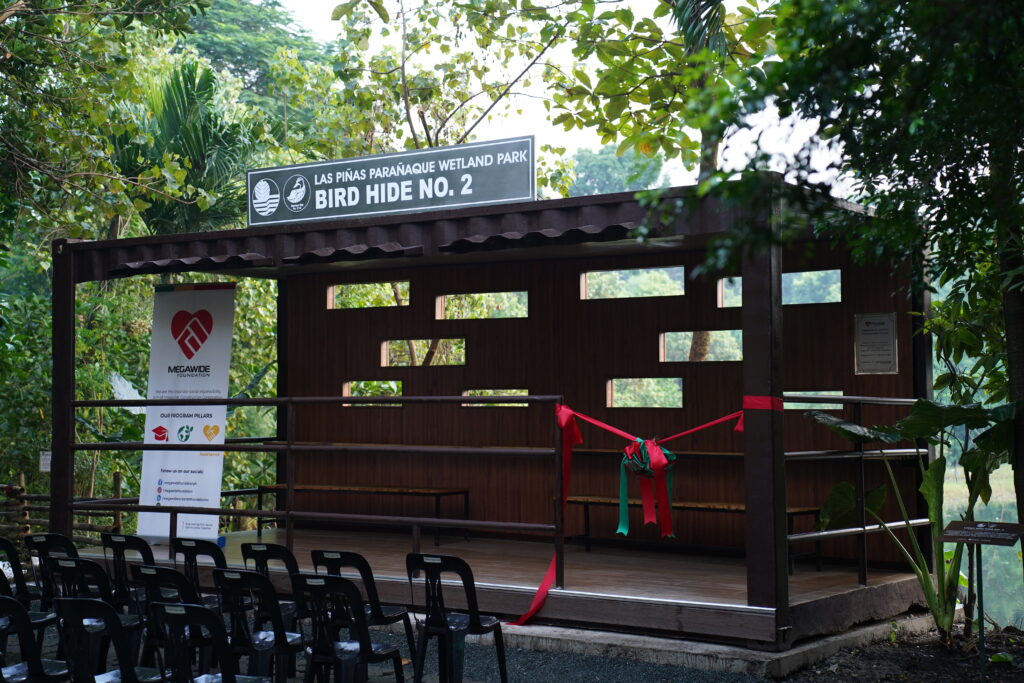
Last Oct. 10, MCFI also unveiled another EConstruction milestone—the Bird Hide Project—at the Las Piñas–Parañaque Wetland Park (LPPWP). The structure was designed as a sustainable viewing deck that supports birdwatching, biodiversity conservation, and environmental awareness. Built with recycled materials and efficient design principles, the project serves as a symbol of harmony between urban development and environmental stewardship.”

“The Bird Hide stands as proof that sustainability and social responsibility go hand in hand,” shared MCFI President Tata Saavedra. “Our work goes beyond construction; we’re building trust, hope, and opportunities for a First-World Philippines. These projects show how thoughtful design can uplift lives while protecting our natural and social environments.

Department of Environment and Natural Resources (DENR)-Las Piñas-Parañaque Wetland Park Protected Area Superintendent Christopher Villarin also commended the initiative for its meaningful contribution to the environment.

“This indeed is a meaningful contribution to our efforts in conserving urban biodiversity. It provides a safe and educational space for visitors to appreciate nature while reinforcing the importance of protecting ecosystems. We are thankful to Megawide Foundation for supporting our mission to balance development with environmental protection.”

Both projects were implemented in partnership with Megawide Construction, the Foundation’s key builder-partner that shares the same vision of empowering communities and advancing a First-World Philippines. The White Cross Milagrosa Dormitory was led by Group Operations Head Rey Rodrin, while the Bird Hide Project was headed by Group Operations Head Jules Ronquillo, showing the company’s unified commitment to social responsibility and sustainable innovation. Megawide Foundation aims to continuously champion sustainable community building, demonstrating how innovation in construction can drive lasting positive impact for people, communities, and the planet.


Spotlight is BusinessWorld’s sponsored section that allows advertisers to amplify their brand and connect with BusinessWorld’s audience by publishing their stories on the BusinessWorld Web site. For more information, send an email to online@bworldonline.com.

Join us on Viber at https://bit.ly/3hv6bLA to get more updates and subscribe to BusinessWorld’s titles and get exclusive content through www.bworld-x.com.

US officials head to Asia for talks with China, Trump-Xi meeting still on

US and Chinese flags are seen in this illustration. — REUTERS

WASHINGTON — Top US officials headed to Malaysia on Wednesday to defuse a spike in US-China trade tensions over Beijing’s move to curb exports of rare earth magnets, and keep next week’s planned meeting of US President Donald Trump and Chinese President Xi Jinping in South Korea on track.

US Treasury Secretary Scott Bessent said US Trade Representative Jamieson Greer was already en route to Kuala Lumpur and he would head there later on Wednesday, before joining Trump for the rest of his Asia trip.

Trade tensions between the US and China, the world’s two biggest economies, have flared in recent weeks after months of relative calm. Trump imposed additional duties of 100% on China that are due to take effect on November 1 after China announced export controls on nearly all rare earths.

“This is China versus the globe. It’s not just on the US,” Bessent told Fox Business Network’s “Kudlow” program. “This licensing regime that they’ve proposed is unworkable and unacceptable.”

He said the US and its Western allies were contemplating how to respond if they were unable to negotiate a pause in Beijing’s plans, or some other relief.

“I’m hoping that we can get this ironed out this weekend so that the leaders can enter their talks on a more positive note,” he said. Bessent described the planned meeting as a “pull-aside”, in what may be an attempt to dampen expectations.

Greer, the top US trade negotiator, told CNBC’s “Squawk Box” program that there was still a spot on the schedule for Trump to meet Xi, but it would be up to both parties whether the meeting took place on the sidelines of an economic conference in South Korea next week.

Trump is scheduled to travel to Kuala Lumpur for a meeting of the Association of Southeast Asian Nations that begins on Sunday, and later that week is expected in South Korea ahead of a leaders’ summit of the Asia-Pacific Economic Cooperation forum that is being held October 31-November 1 in Gyeongju.

Bessent said Trump would also stop in Japan to meet the new prime minister, Sanae Takaichi.

The US Treasury chief said he was optimistic that two days of “fulsome” talks with Chinese officials would lay the groundwork for a good meeting of the two leaders, noting that Trump had great respect for Xi.

But US officials are preparing a harsher response if China does not back down on the rare earth licensing changes.

Reuters reported earlier that the Trump administration is considering a plan to curb a wide range of software-powered exports to China, from laptops to jet engines, to retaliate against Beijing, following Trump’s threat earlier this month to bar “critical software” exports to China.

CHINA VIOLATED COMMITMENTS, GREER SAYS
Washington also announced sweeping new sanctions against two Russian oil companies, but stopped short of imposing tariffs on China, one of the largest buyers of Russian oil, as it has done with India, another big purchaser.

Greer and Bessent have both stressed they do not want to decouple from China, or escalate the situation, but insist the United States needs to rebalance trade with China after decades of very limited access to Chinese markets.

Trump on Tuesday insisted any deal with China had to be fair and suggested the meeting with Xi could still be scrapped.

“Maybe it won’t happen,” he said at a White House lunch with Republican senators. “Things can happen where, for instance, maybe somebody will say, I don’t want to meet, it’s too nasty. But it’s really not nasty, it’s just business.”

Greer told CNBC that China’s rare measures violated a commitment its officials had made months ago to keep supplying rare earths needed for high technology, but said the US and China could find a new balance.

“There notionally is a good landing zone for the United States and China where we trade in a way that’s more balanced, and we’re trading in non-sensitive goods, and where we have a constructive relationship,” Greer said.

“The US has always been quite open to the Chinese, and it’s really been driven by Chinese policies that exclude US companies and drive overcapacity and overproduction in China. None of that works for the United States,” he said. “We can’t live that way anymore so we need an alternative path.”

Greer said Trump and other US officials would raise concerns about China’s moves to stop purchasing US soybeans and sorghum, which he said were intended to deliberately hurt US farmers.

“Obviously the president will raise…we all…raise this with them,” he said, noting that China still has unfulfilled obligations to buy agricultural and manufactured goods under a trade deal signed during Trump’s first term.— Reuters

Tesla profit falls short despite record sales, hit by higher costs and fading credits

STOCK PHOTO | Image by Blomst from Pixabay

Tesla reported record third-quarter revenue that beat Wall Street estimates on Wednesday, driven by the highest quarterly sales of its electric vehicles as US buyers rushed to lock in a key tax credit ahead of its expiry last month.

But Tesla’s profit failed to live up to analysts’ expectations, in part due to tariff and research costs, as well as a drop in income from regulatory credits that are expected to continue to fade away with recent legislation passed by the Trump administration.

Shares of the Austin, Texas-based company were down about 2% in extended trading.

Demand for Tesla’s vehicles and those of its rivals is also expected to drop through the rest of the year without the tax credits that have been a key driver of EV sales. Tesla did not provide a full-year forecast.

Tesla’s $1.45 trillion valuation largely reflects investor bets on CEO Elon Musk’s pivot to robotics and AI, but vehicle sales remain key to the financial stability of the company while those products are being developed.

“While we face near-term uncertainty from shifting trade, tariff and fiscal policy, we are focused on long-term growth and value creation,” the company said on Wednesday.

Apart from the removal of tax credits and the waning sales of regulatory credits that traditional automakers bought to make up for their polluting vehicles, Tesla is also grappling with tariffs imposed by the Trump administration on auto-part imports.

To combat a demand drop, Tesla introduced lower-cost “Standard” variants of Model Y and Model 3 vehicles earlier this month, stripping out a myriad of premium and basic features and lowering prices by about $5,000 to $5,500.

While Tesla hopes the cheaper variants will drive higher volumes, analysts warn the move will squeeze margins as thousands of dollars of cost cuts per vehicle may not fully compensate for lower selling prices.

Tesla said it was on track to start volume production of its Cybercab robotaxi, Semi truck and Megapack 3 battery in 2026.

The electric vehicle maker reported total revenue of $28.1 billion for the third quarter ended September 30, compared with analysts’ average estimate of $26.37 billion, according to data compiled by LSEG.

Profit per share in the third quarter was 50 cents, below analysts’ estimates of 55 cents.

Automotive regulatory credits, once a key driver of profit, fell to $417 million in the quarter from $739 million a year ago and $435 million in the second quarter.

Tesla reported gross margin of 18%, compared with estimates of 17.5%. Its closely watched automotive gross margin, excluding regulatory credits, was 15.4%, compared with an average estimate of 15.6%, according to 19 analysts polled by Visible Alpha.

Tesla flagged rising expenses in multiple areas, including a 50% rise in operating expenses driven by AI and other research and development projects, an increase in stock-based compensation, and higher costs per vehicle due to an increase in tariffs and other issues.

Tesla’s limited rollout of its self-driving “robotaxi” service in Austin, Texas, earlier this year marked a key strategic pivot, underpinning investor expectations that the company will transition from pure vehicle sales to focusing on self-driving technology.

Wall Street expects Tesla’s deliveries in 2025 to fall 8.5% due to the expiry of the tax credit, reliance on older models and rising competition. CEO Musk’s embrace of right-wing politics has also alienated some potential buyers.

Some analysts remain skeptical of a strong rebound as the cheaper version could take away sales of more profitable premium vehicles.

Tesla’s automotive gross margin improves in Q3.— Reuters

Haiti gang warfare stalls long-awaited elections

HAITI will not hold a general election before the end of the current interim government’s mandate next February, the head of the country’s electoral council told Reuters on Wednesday, as the expansion of armed gangs makes any hope for a full and stable vote impossible.

The Caribbean’s most populous nation has not held elections since 2016. Its last president, who repeatedly delayed elections, was assassinated in 2021. Armed gangs have since taken control of much of the capital and surrounding areas.

“We cannot hold elections before February,” electoral council president Jacques Desrosiers said. “It is impossible.”

The council in June conducted an evaluation of hundreds of voting centers around the country, though many communes were inaccessible due to the insecurity. Access has since worsened as gangs have expanded in areas outside the capital.

“A lot has changed now,” Desrosiers said, adding that new areas cut off from electoral registries include the towns of La Chapelle and Liancourt in the lower Artibonite, Haiti’s main agricultural region.

At the start of the year, the interim government had said it planned for elections to take place around November 15 of this year.

In a report disseminated on Wednesday, the UN estimated, citing the June evaluation, that just over 6 million people – around half the population – might have access to working voting centers. Desrosiers said he could not provide a current estimate.

“Critical decisions will be required by national authorities and stakeholders in the coming months in the lead-up to the 7 February 2026 deadline,” UN Secretary General Antonio Guterres said in the report.

“Haiti cannot afford a political vacuum.”

TRANSITION OF POWER
February 7 marks the end of the term envisioned for the nine-member transitional presidential council, which took power in April 2024.

That February 7 date has traditionally marked the constitutional deadline for handing over power, and is often met with protests, as it has been flouted in the past by leaders refusing to step aside. The day will have particular salience in 2026 as it would have been the presidential handover had an election taken place five years previous.

Haitian political groupings are divided over how to move forward, with some calling for an extension or modification of the interim presidential council and others for it to step aside in favor of a Supreme Court judge.

Meanwhile, Haiti’s Viv Ansanm gang alliance – which controls most of the densely populated capital Port-au-Prince – has declared itself a political party and called for dialogue with the establishment.

Washington has designated the group as a terrorist organization, with its members accused of thousands of killings, as well as widespread kidnappings, torture, arson and gang rape. Gangs also often provide key services and food in areas they control.

Around half of Haiti’s 12 million-strong population faces severe food insecurity and over 1.3 million are internally displaced due to the violence, many living temporarily with friends or families or in crowded displacement camps.— Reuters

Biopsy won’t spread cancer, says medical expert

Image of a breast cancer cell, photographed by a scanning electron microscope. —WIKIMEDIA COMMONS/NATIONAL CANCER INSTITUTE

A medical oncologist debunked claims that a biopsy, a medical procedure used to accurately diagnose cancer, can cause the disease to spread or become more aggressive.

“It’s a very wrong notion,” Dr. Marvin Jonne L. Mendoza, medical oncologist at St. Luke’s Medical Center, said during a breast cancer awareness forum organized by AstraZeneca on Wednesday.

“The conduct of the biopsy is really very important…it enables us to know if the cancer is malignant or not,” Mr. Mendoza added.

After a cancer screening, such as a mammogram for breast cancer, a biopsy is usually performed to collect and examine a sample of tissue from a suspicious lump or lesion to confirm whether it is cancerous or benign.

Mr. Mendoza said the procedure is also necessary for oncologists as it allows them to determine the cancer’s pathology, or how the disease affects the patient’s body.

According to the American Cancer Society’s report, cancer spread after a biopsy, also called tumor seeding, is technically possible, but it occurs only in extremely rare cases and is far outweighed by the benefits of the procedure.

Tumor seeding may occur when the needle used during a biopsy touches the tumor and accidentally dislodges some cancer cells, which could then spread to nearby areas, the report said.

In a separate study that it cited, 42 patients were reported to experience tumor seeding after a prostate biopsy via a needle, most following transperineal procedures (through the skin between the scrotum and anus) and nine after transrectal procedures (through the rectum), with the overall incidence estimated at less than 1%.

However, it concluded that this complication is rare, and its actual incidence is currently difficult to quantify. It added that the benefits of the biopsy still outweigh any potential risks from seeding.

Mr. Mendoza urged people, especially women, to undergo early screening for breast cancer—the most common cancer in the country—and to have a biopsy if needed to ensure proper and timely treatment. — Edg Adrian A. Eva

EU approves 19th package of Russian sanctions including liquefied natural gas ban

A EUROPEAN UNION’S flag flutters outside the European Commission headquarters in Brussels, Belgium, Oct. 15, 2020. — REUTERS

BRUSSELS — EU countries approved a 19th package of sanctions against Russia for its war against Ukraine that includes a ban on Russian liquefied natural gas (LNG) imports, the Danish rotating presidency of the EU said on Wednesday.

“We are very pleased to announce that we have just been notified by the remaining member state that it’s now able to lift its reservation on the 19th sanctions package,” it said.

Slovakia was the final holdout after EU countries agreed on the final text last week. Slovakia’s Prime Minister Fico wanted assurances from the European Commission on high energy prices and aligning climate targets with the needs of carmakers and heavy industry. A Slovak diplomat said the country’s demands were met in new clauses added to the final communique for the EU leaders summit on Thursday.

“Consequently, a written procedure for Council approval has been launched. If no objections are received, the package will be adopted tomorrow by 8 a.m.,” it added.

The LNG ban will take effect in two stages: short-term contracts will end after six months and long-term contracts from January 1, 2027. The full ban comes a year earlier than the Commission’s proposed roadmap to end the bloc’s reliance on Russian fossil fuels.

The new package also adds new travel restrictions on Russian diplomats and lists 117 more vessels from Moscow’s shadow fleet, mostly tankers, bringing the total to 558. The listings include banks in Kazakhstan and Belarus, the presidency said.

EU diplomatic sources told Reuters that four entities linked to China’s oil industry will be listed but the names will not be made public until the official adoption on Thursday. These include two oil refineries, a trading company and an entity which helps in the circumvention in oil and other sectors.— Reuters

GDP growth likely below target in Q3

PHILIPPINE STAR/WALTER BOLLOZOS

By Katherine K. Chan

TYPHOONS and the ongoing corruption scandal involving government flood control projects may have led to slower economic growth in the third quarter, the University of Asia and the Pacific (UA&P) said.

In its latest The Market Call report released on Wednesday, UA&P said Philippine gross domestic product (GDP) likely grew by 5.2% last quarter, below the government’s 5.5-6.5% target.

“We project a GDP slowdown to a 5.2% year-on-year pace in (the third quarter) due to more weather disturbances and the popular uproar over the flood control controversy,” UA&P Senior Economist Victor A. Abola and economist Marco Antonio Agonia said.

This is slower than the 5.5% expansion recorded in the second quarter but would match the pace recorded in the same three-month period last year.

Third-quarter GDP data will be released on Nov. 7.

Economy Secretary Arsenio M. Balisacan earlier said growth might soften further in the third quarter due to typhoon-related disruptions but could still meet the lower end of the government’s goal.

Meanwhile, the UA&P economists said economic growth could pick up to 5.7% in the fourth quarter, which would bring the full-year average to the low end of the government’s goal.

Mr. Abola and Mr. Agonia said there are “positive signs of recovery” this quarter as they expect inflation to remain benign and average at just 1.6% in the three-month period, which would support domestic demand.

Headline inflation picked up to 1.7% in September, faster than the 1.5% clip in August but slower than the 1.9% seen in the same month last year. Still, this marked the seventh straight month that the consumer price index (CPI) was below the Bangko Sentral ng Pilipinas’ (BSP) 2-4% annual target.

For the first nine months, inflation averaged 1.7%, matching the BSP’s full-year forecast.

They added that the employment recovery seen in August also bodes well for growth. The country’s unemployment rate eased to 3.9% that month amid increased hiring activity in the agriculture and construction sectors, lower than the three-year high of 5.3% in July and 4% in the same month a year ago. However, the year-to-date jobless rate was a tad higher at 4.1% from 4% last year.

“Robust” remittances from overseas Filipino workers could also support consumption, they said, and exports also remain steady despite the tariffs imposed by the United States on Philippine goods.

Cash remittances rose by 3.2% to $2.977 billion in August, bringing the eight-month tally to $22.909 billion, up by 3.1% year on year. Filipinos abroad are expected to send more money home in the coming months amid the holiday season.

Meanwhile, the country’s exports climbed by 4.6% in August, slower than the 17.6% growth seen in July but faster than the 0.4% a year earlier. This led to the narrowest trade gap in six months at $3.54 billion.

MORE RATE CUTS
The UA&P economists also expect further monetary easing until next year as inflation remains low, which would provide more economic stimulus.

“With its view of ‘benign’ inflation until 2027, BSP will likely cut another 25 bps (basis points) before the end of 2025 to bring policy rates to 4.5%,” they said.

“More easing in 2026 should bring policy rates to 4% or lower by end-2026.”

The central bank sees inflation averaging 3.1% in 2026 and 2.8% in 2027, well within its 2-4% target.

The Monetary Board this month unexpectedly lowered benchmark borrowing costs by 25 bps for a fourth straight meeting, bringing the policy rate to 4.75%. It has now cut rates by a total of 175 bps since kicking off its easing cycle in August 2024.

BSP Governor Eli M. Remolona, Jr. said another reduction is possible at their last meeting this year on Dec. 11. He added that they could extend their rate cut cycle until next year as they now see the neutral nominal policy rate to be closer to 4% than their earlier projection of 5% as they see the need for a more accommodative stance as governance issues related to the corruption mess have led to softer growth prospects due to weakening investor sentiment.

Mr. Abola and Mr. Agonia added that lower benchmark rates would also support the Philippine bond market and ease the government’s interest payment burden.

Online gambling’s huge social costs outweigh ‘minimal’ economic contribution, DEPDev says

BW FILE PHOTO

By Kenneth Christiane L. Basilio, Reporter

THE PHILIPPINES’ economic planning department on Wednesday expressed its support for either an outright ban of online gambling operations or tighter regulations for the sector, a position that might give lawmakers impetus to crack down on the industry that has come under scrutiny due to its social impact.

The Department of Economy, Planning, and Development (DEPDev) said the electronic gaming industry contributed only about P81.6 billion or 0.37% to real gross domestic product last year, according to a technical brief submitted to a House of Representatives committee and obtained by BusinessWorld.

“Given its minimal contribution to the economy and vis-à-vis the significant social cost, we do support either its complete prohibition or stricter regulation,” DEPDev Director Desiree Joy O. Narvaez told lawmakers at a congressional hearing.

Online gambling has emerged as a growing concern in the Philippines amid rising cases of addiction, prompting lawmakers to file multiple bills in Congress seeking to either ban or tighten its regulation.

“Studies have found that people are more inclined to engage in online gambling due to its high accessibility, affordability, convenience, anonymity and the ability to participate in multiple gaming activities,” according to a DEPDev position paper signed by Economy Secretary Arsenio M. Balisacan.

About 32 million Filipinos —half of the country’s working-age population — gamble online, from 469,000 in 2018, according to government data.

The House Committee on Games and Amusement has yet to decide whether to endorse a full ban on online gambling or pursue stricter regulations, its chairman Cavite Rep. Antonio A. Ferrer said. However, most congressmen favor a total ban, he added.

“At the end of the day, this will be voted on. This is a numbers game,” Mr. Ferrer told reporters after the congressional hearing.

The House Games Committee would likely come up with a technical report that would be the basis of the consolidated bill on proposals that mandate either a total ban or tighter industry regulations before yearend, he said.

The Finance department shared the DEPDev’s support for stricter online gambling regulation while noting potential gains from the sector.

“The DoF (Department of Finance) recognizes the potential economic benefits arising from online gaming or electronic games… provided that the associated economic and social costs are mitigated through very stringent regulations,” Finance department Director Maria Karla L. Espinosa told the same hearing.

The Philippine Amusement and Gaming Corp.’s (PAGCOR) gaming income was at P40.5 billion in the first nine months of the year, Jessa Mariz R. Fernandez, an assistant vice-president at the gaming regulator’s licensing department, said at the hearing.

However, she said PAGCOR’s full-year earnings could fall short of the P60-billion target for this year as it has seen a “sharp” drop in income after the Bangko Sentral ng Pilipinas (BSP) in August ordered its supervised financial institutions, including electronic wallets, to remove all links to gaming or gambling platforms from their online apps.

“We felt a sharp decline in income — up to a 49% drop,” Ms. Fernandez said in Filipino. “One of the main factors we’re looking at is the delinking of the platforms from our payment e-wallets. We also observed a slight decline in the number of new players.”

Meanwhile, PAGCOR reiterated that a total online gambling ban could cause both operators and players to go underground, making it harder for authorities to police the industry.

“Such measures would not eliminate online gambling,” the state gaming regulator said in a position paper obtained by BusinessWorld.

“[It would] instead push players and operators towards unregulated platforms where player protection mechanisms, responsible gaming programs, anti-money laundering safeguards and government revenue contributions are altogether absent,” it added.

PAGCOR recommended that lawmakers remove its power to regulate the online gambling industry if the government moves to ban the industry to ensure the measure won’t have “constitutional infirmities.”

Ronald B. Gustilo, national campaigner for digital advocacy network Digital Pinoys, likewise said that a sweeping online gambling ban could end up encouraging more unregulated activities, noting what has happened following prohibitions on online cockfighting and offshore gaming.

“Up to this day, they are still operating, as if taunting the government if the state can completely eradicate their operations,” he said in a Viber message.

But with the government recognizing the industry’s harmful effects on society, it should clamp down on its operations, Hansley A. Juliano, a political science lecturer at the Ateneo de Manila University, said in a Facebook Messenger chat.

“There’s enough basis to already cast online gambling as a dangerous industry with its socioeconomic costs to the public,” he said.

It would be a “delicate balancing act” for the government to crack down on the industry, which is a massive revenue source that helps fund public social services, said Michael L. Ricafort, chief economist at Rizal Commercial Banking Corp.

“There is a need to better manage the risk of social ills of gambling, especially easier access online, to align with global best practices in managing gambling operations onsite and online, while also taking into account the large government revenues for many years to partly fund for social services,” he said in a Viber message.

Batangas tourism thrives in the shadow of Taal Volcano

Tourists enjoy the sight of Taal volcano while walking around Picnic Grove in Tagaytay City, Feb.17, 2024. — PHILIPPINE STAR/MIGUEL DE GUZMAN

By Edg Adrian A. Eva, Reporter

FOR CLUB BALAI ISABEL, a lakeside resort in Talisay, Batangas province, Taal Volcano, one of the Philippines’ most iconic natural landmarks, is both an economic lifeline and an ever-present risk.

“Taal Volcano is both a gift and a curse,” Chief Operating Officer Cecille Terrible told BusinessWorld in an interview. “It’s a blessing because it is a world-class beauty, a world-class treasure to be close to. But it has also been active since the 2020 eruption.”

Taal Volcano sits majestically in the heart of Batangas, its calm green waters and postcard-perfect crater having long defined the skyline of Tagaytay City and powered the province’s tourism and agriculture industries.

Yet beneath its beauty lies an unpredictable force that has repeatedly reshaped lives, economies and landscapes.

Taal’s power is as real as its beauty. Its last major eruption in January 2020 blanketed nearby provinces in thick ash and caused P3.4 billion in damage to infrastructure and agriculture across Batangas, Laguna and Cavite, according to the National Disaster Risk Reduction and Management Council (NDRRMC).

The volcano remains under Alert Level 1, with a minor phreatic eruption recorded as recently as this week.

The volcano’s eruptions have made Taal both a symbol of resilience and a source of recurring hardship for communities that live around it.

Batangas recorded about nine million tourists in 2022, nearing pre-pandemic levels after peaking at 13.5 million in 2018, according to data from the Cavite Provincial Tourism Office. Much of that tourism is anchored on Taal Volcano, which dominates the view from Tagaytay City.

Originally designed as a residential subdivision, Club Balai Isabel transitioned into a resort in 2007 to meet rising demand from local and international visitors. It now spans 14 hectares, making it one of the biggest properties around Taal Lake.

When Taal erupted in 2020, the resort was buried in ash. “All the trees were destroyed, and we looked like a vast wasteland,” Ms. Terrible said.

The resort reopened a month later but has continued to face cancellations whenever Taal’s alert level rises. “Every time there’s a scare, people cancel. They get scared to come,” she said.

To address this, Club Balai Isabel now works closely with the Philippine Institute of Volcanology and Seismology to provide guests with real-time updates and educational materials on volcanic alert levels.

The town of Taal, known for its heritage houses and ancestral architecture, also bore the brunt of the 2020 eruption.

“It really became a ghost town,” Jocelyn Villavicencio Joven Quiblat, owner of Villavicencio Wedding Gift House, one of Taal’s most prominent ancestral homes, said in an interview.

A report by the Batangas Provincial Tourism and Cultural Affairs Office showed that tourism sites within 14 kilometers of Taal Volcano suffered P86.5 million in damage and P123.2 million in losses after the 2020 eruption. Cultural sites reported an additional P2.8 million in damage.

The Villavicencio house, fortunately, escaped significant destruction. Ms. Quiblat said that while the disaster disrupted tourism, Taal Volcano remains a defining part of their identity.

“It’s still a gift to our province,” she said. “Because the town shares its name with the volcano, people recognize us more — it draws visitors back.”

ENDEMIC SARDINE
Beyond tourism, Taal Lake sustains thousands of fisherfolk and farmers. It is home to sardinella tawilis, the world’s only freshwater sardine, found exclusively in this lake.

In 2021, Taal Lake’s fisheries produced about 1,000 metric tons of fish, with tawilis accounting for almost half, based on data from the National Fisheries Research and Development Institute.

Fishing in Taal Lake has been a key livelihood source for almost five decades for Jessie Dano Nabor, 61, from Agoncillo town. While the tawilis was declared an endangered species in 2019, Mr. Nabor said his daily catch had not declined dramatically.

But the 2020 eruption paralyzed their operations for months. “We couldn’t fish properly, and the Philippine Coast Guard did not allow us to,” he told BusinessWorld in Filipino. “The risks were too high.”

The NDRRMC estimated that fisheries suffered P1.6 billion in losses, the heaviest hit among agricultural sectors. High-value crops followed with P1.4 billion in losses, while livestock and rice sustained smaller damage.

The Department of Agriculture allotted P468 million from its quick-response fund in 2020 and P100 million in 2022 to support rehabilitation.

Still, Mr. Nabor said aid alone is not enough.

“What we really need are more buyers,” he said. “Most of us only sell to people who make dried fish. If there were a factory that could make canned tawilis, our income would increase.”

For Batangas residents, coexisting with Taal Volcano means balancing opportunity and danger. The volcano’s fertile soil supports agriculture, its lake fuels fisheries, and its scenery sustains tourism. But each tremor or wisp of smoke reminds locals of how fragile those gains are.

Taal has erupted more than 30 times in recorded history, with major events in 1754, 1911, 1965, and 2020. Each eruption reshaped the terrain and forced communities to rebuild from the ashes.

Five years after its most recent major eruption, Batangas continues to rebuild while keeping one eye on the horizon — and another on the volcano that both threatens and defines it.

“Taal Volcano has always been the centerpiece of our tourism campaign,” Ms. Terrible said. “It’s an ecological wonder, so people will keep coming back to the volcano and the lake.”


More US capital flowing to Asia as dollar weakens

A US dollar note is seen in this June 22, 2017 illustration photo. — REUTERS

GLOBAL INVESTORS with heavy US exposure are steadily shifting more capital to Asia as the dollar loses steam and the region’s fundamentals shine, according to the co-chief executive officer of KKR & Co.

While the rebalancing doesn’t amount to a US retreat, global investors are channeling their “incremental dollar” to Asia, where capital raising and data-center infrastructure are emerging as major themes, Joe Bae said. The region’s institutions remain underweight in alternative investments, and its vast household savings offer a major source of capital, he said.

“As the dollar weakens and other markets like Asia continue to have these fundamental tailwinds in terms of growth, you’re going to see people diversify their portfolios more and more to Asia over time,” Mr. Bae said in a Bloomberg Television interview with Haslinda Amin.

The New York-based buyout giant is ramping up in Japan, deploying capital at five times the pace of a decade ago, making it KKR’s most active investment destination outside the US. Japan is now its largest Asian market, accounting for 40% of regional assets.

With $14 trillion in household wealth, half still in cash, the country offers rich opportunities as savers move into new asset classes, Mr. Bae said.

Japan’s new Prime Minister Sanae Takaichi shares many of the economic views of former leader Shinzo Abe, who championed the reflationary policies known as “Abenomics.” Ms. Takaichi has long backed increased government spending to spur growth and has criticized the Bank of Japan for moving to tighten monetary policy. Mr. Takaichi won a parliamentary vote Tuesday to become the first woman to clinch the nation’s top leadership job.

“Our hope and expectation is this new prime minister will be committed to that same reform path,” Mr. Bae said, in an interview from Singapore aired Wednesday. “If that happens, I think the future is very, very bright for Japan.”

The asset manager is also doubling down on India, its No. 2 Asian market. KKR is making bets on toll roads, renewables and digital infrastructure as the country’s demographics, consumption and manufacturing boom fuel demand. India will be one of KKR’s largest destinations for infrastructure capital going forward, he said.

CHINA WARY
While Asia stands to be a key beneficiary of global diversification, major North American investors remain wary of China amid elevated US tensions and lingering losses from the government’s earlier crackdown on private enterprise. As recently as 2020, China accounted for more than half of Asia-Pacific’s deal value, but its share fell to just 27% in 2024, according to Bain & Co.

Investor sentiment toward China won’t truly turn around until private equity firms see a clearer path to monetization, Mr. Bae said. Given the current geopolitical climate, the “aperture of what’s investible for us today is a little bit more narrow than what it was.”

Exiting investments will be the key catalyst for China in the near term, though the outlook remains subdued. Most of the activity over the next three to five years will consist of private equity firms doing deals with each other, as strategic buyers take longer to return. Still, KKR remains focused on domestic consumption and value-added services, which Mr. Bae said continue to be China’s investment sweet spot.

“We’ve definitely not pulled back from China in terms of our commitment there,” he said. KKR recently completed a control buyout of Dayao Beverage, China’s largest homegrown soft drink brand, in a deal valued at about $2 billion, according to Mr. Bae. — Bloomberg

Philippine data center capacity may hit 1.5 GW by 2028 — DICT

BW FILE PHOTO

By Ashley Erika O. Jose, Reporter

THE PHILIPPINES’ data center capacity could reach 1.5 gigawatts (GW) by 2028 as more operators, both local and foreign, set up facilities in the country next year, the Department of Information and Communications Technology (DICT) said.

“We will likely reach more than 1 GW,” ICT Secretary Henry Rhoel R. Aguda told BusinessWorld on the sidelines of Equinix, Inc.’s data center launch on Wednesday. “The private sector is committing 1.5 GW (by 2028)… It is a matter of attracting as many companies as possible to set up here.”

Equinix, a global digital infrastructure company, opened its data centers in the Philippines. The facility provides high-speed interconnection services that give enterprises direct access to networks, cloud platforms and artificial intelligence (AI) service providers through a secure private network.

Mr. Aguda said the additional capacity is expected to come in starting next year, as several foreign hyperscalers and local developers have shown interest in expanding in the Philippines.

The Philippines is becoming a strategic location for data centers, driven by our strong digital economy, improving connectivity and large consumer base, the DICT said earlier.

Mr. Aguda said the agency is set to conduct an investment mission to the US to promote the country as a data center hub. They seek to attract two or three new large-scale operators next year, with a combined capacity of about 200 megawatts (MW).

The country’s total operational data center capacity stands at about 200 MW. He said the momentum is growing, and more developments are expected in the next few years.

VITRO, Inc., the data center unit of the PLDT Group under ePLDT, Inc., is building its 12th data center in General Trias, Cavite, which will be its biggest to date.

The facility will have a capacity of 100 MW — double that of its 50-MW VITRO Sta. Rosa campus in Laguna, now the biggest in the country.

Mr. Aguda said power and connectivity will not be major issues in supporting the industry’s growth.

“We have a lot of renewables and LNG (liquefied natural gas), so power will not be a major issue,” he said. On the connectivity side, the Philippines has an expanding fiber backbone and multiple submarine cable links, he added.

The DICT earlier said the Philippines is emerging as one of the region’s top data center locations, with strong demand for cloud, fintech, e-commerce and AI services.

Its strategic geographic position, growing pool of digital talent and government initiatives to improve broadband infrastructure make it increasingly attractive to global operators.

ADVERTISEMENT
ADVERTISEMENT