Home Blog Page 8037

Meralco to source 1,500-MW renewable power in next 5 years
BW FILE PHOTO

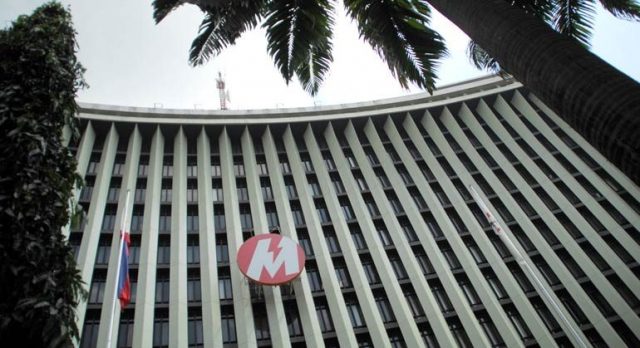
MANILA Electric Co. (Meralco) plans to draw on renewable energy (RE) sources for 1,500 megawatts (MW) of its power needs in the next five years as the firm ramps up the construction of utility-scale renewables plants, a company official said on Tuesday.

“We aim to accelerate our transition to cleaner energy as we pledge to source 1,500 MW of power requirements from renewable energy sources in the next five years,” Meralco Chief Executive Officer and President Ray C. Espinosa said during the company’s annual stockholders’ meeting held virtually on Tuesday.

“We are also committed to building up to 1,500 MW in utility scale renewable energy power plants in the next five to seven years,” he added.

This comes about two weeks after Meralco PowerGen Corp. (MGen) said that its subsidiary had begun commercially operating a 50-MW solar plant in San Miguel, Bulacan after receiving clearance from the Energy Regulatory Commission (ERC). MGen is the renewable energy arm of Meralco.

On Tuesday, the Meralco official also gave updates on the firm’s sustainability initiatives, which include shifting to electric vehicles to serve its business centers in the capital and upgrading its distribution transformers to run on plant-based oil.

“We are moving towards the electrification of Meralco’s vehicle fleet. Beginning this year, we will deploy electric pickups, vans, cars and motorcycles to serve our Metro Manila business centers,” he said.

Mr. Espinosa said the firm is building up its “Race to Zero Waste Program,” which will cover its distribution network as well.

“Going forward, one hundred percent of our new distribution transformers will be powered by plant-based natural ester oil, making these assets 99% recyclable and biodegradable,” he said.

‘BILL SHOCK’ NOT LIKELY
Meanwhile, Mr. Espinosa said a “bill shock” is not likely to happen amid varying lockdowns imposed by authorities.

“We do not expect the same bill shock problem that we encountered last year. In fact, even with the declaration of ECQ (enhanced community quarantine) and MECQ (modified enhanced community quarantine), our meter readers have been able to read the meters and use this meter readings for the proper billing,” he said, referring to the strick lockdowns that authorities placed over the capital and nearby areas.

He added that the firm is grateful to the Energy department, the Energy Regulatory Commission and partner local government units for allowing Meralco to deploy its meter readers during this period.

In May last year, the country’s largest distribution utility said that the bill shock reflected on customers’ accounts was caused by the hike in electricity charges computed based on the actual consumption in kilowatt-hours from the current meter reading, plus the estimated consumption reflected in the deferred April and March bills.

Meralco previously said that its consolidated core net income in the first quarter declined by 11% to P5.11 billion year on year as energy sales from the commercial sector slumped due to the impact of the pandemic.

However, its attributable net income for the quarter ending March, stood at P4.33 billion, higher by around 65% from P2.62 billion in the same period last year.

Shares in Meralco at the local bourse improved by 0.59% or P1.6 to close at P274 apiece on Tuesday.

Meralco’s controlling stakeholder, Beacon Electric Asset Holdings, Inc., is partly owned by PLDT, Inc.

Hastings Holdings, Inc., a unit of PLDT Beneficial Trust Fund subsidiary MediaQuest Holdings, Inc., has interest in BusinessWorld through the Philippine Star Group, which it controls. — Angelica Y. Yang

Online Art Fair Philippines draws 40,000 visitors

ARTFAIRPHILIPPINES.COM

DESPITE initial technical glitches, the online iteration of Art Fair Philippines this year could be deemed a success, drawing many more people to its talks, virtual tours, and workshops than it had in previous editions held in a  Makati carpark.

Held online for the first time in its nine year history, the 10-day art fair featured 44 exhibitors, recorded over 276,000 website views, and drew over 40,000 visitors from May 6 to 15.

Adapting to the ongoing COVID-19 pandemic by migrating online, the 2021 Art Fair Philippines focused on digital arts with the Welcome to the Metaverse, NFT 101 Showcase in its Projects section. The section featured non-fungible tokens (NTFs, one-of-a-kind digital properties) from Narra Art Gallery and Tropical Futures Institute, as well as talks on crypto art and an introduction to NFTs.

“I think we succeeded in giving fair visitors a selection of artwork in the digital format that was varied and different from what they have seen locally before. We showcased work that keeps to what is current globally. I did get several comments about the quality of the talks on digital art,” Art Fair Philippines co-founder Trickie C. Lopa wrote in an e-mail to BusinessWorld.

“Despite some technical glitches early on, I would assess it as a fairly successful effort to achieve a robust online art fair presence. We worked very hard to deliver a simple, user-friendly website with easily navigable gallery pages,” co-founder Lisa O. Periquet wrote in the same e-mail.

“We boosted our educational program with a jam-packed schedule of talks, tours, workshops and demos that catered to a variety of interests. The take-up of these online events was a revelation; we had twice to thrice the number of attendees that we normally register in the physical fair — this is one of the effects of a digital space that eliminates many barriers to access,” Ms. Periquet added.

The co-founders noted the favorable reception to this year’s talks, virtual tours, and workshops.

At the very least, we doubled the attendance for talks versus figures in the live events. At best, we quadrupled [in] the number of attendees,” Ms. Lopa said.

The virtual gallery tours of Narra Art Gallery and a studio visit with acclaimed artist Alfredo Equillo were among the well-attended tours, while the talk on issues in archiving Philippine photographs and the panel discussion on the Art Fair’s first Residency Program gained the most participation.

While on-ground events are yet to make a comeback, the co-founders foresee that the physical and virtual fairs will co-exist in the future.   

“We would love to be able to get back to a physical fair, as having a personal interaction with art is an unbeatable experience. However, running an online platform this year has revealed many areas that could be further developed, such as the educational aspect of the fair which is very important to our mission to widen the audience for contemporary art,” Ms. Periquet said. “Having a hybrid of physical and online might be in the works for the next fair edition.” 

The 2021 Art Fair Philippines website (www.artfairphilippines.com) remains live until June 15. Recorded talks, tours, and select workshops will be uploaded soon. For updates, visit https://www.facebook.com/artfairph. Michelle Anne P. Soliman

COVID-19 insurance payouts hit nearly P4 billion last year

BW FILE PHOTO

INSURANCE PAYOUTS related to the coronavirus disease 2019 (COVID-19) have reached P3.89 billion as of end-2020, a survey conducted by the Insurance Commission (IC) showed.

Out of the 111 regulated entities, 69 respondents reported to have received COVID-19-related claims — particularly from 22 life insurers, 15 nonlife insurers, 18 mutual benefit associations (MBAs), and 14 health maintenance organizations (HMOs).

“The aggregate COVID-19-related claims paid by the HMO sector per the three surveys accounted for 49% of said amount, or approximately P1.91 billion,” Insurance Commissioner Dennis B. Funa said in a statement on Tuesday.

“Life insurers were able to pay P1.46 billion in COVID-19-related claims in 2020, accounting for 38% of the whole amount. Meanwhile, MBAs paid P354.90 million (9%) and nonlife insurers paid P160.20 million (4%),” he added.

Broken down, the latest survey covering October to December 2020, showed that P1.48 billion had been paid for COVID-19-related claims. The amount is a 29.41% drop from the P2.09 billion covered in the second survey from May to September 2020.

Majority or 44% of the P1.48 billion were paid by life insurers at P646.84 million, of which P607.46 million were paid within contractual obligations. The figure is 14.26% lower than the previous survey reported at P708.51 million.

However, payment terms outside of contractual obligations increased by 6.09% compared with the level in the previous survey.

On the other hand, payouts made by HMOs were 45.63% less between the second and third surveys, from P1.09 billion to P592.47 billion.

Furthermore, payouts for medical reimbursements benefits increased by 30% at P12.36 million in October to December, compared to the reported P9.49 million amount in the previous survey.

For the entire 2020, death benefits were the biggest COVID-19 payout amounting to P1.22 billion, followed by in-patient benefits (P1.18 million), and out-patient benefits (P933.7 million).

Moreover, there is a reported steady upward trend in average claims paid by the four sectors per survey, taking into account the adjusted number of months in each. However, there are limitations in the study as financial impact of the quarantine measures and its effect on production of insurance and HMO agents were not included.

“At any rate, we hope that the aggregate amount of COVID-19-related claims paid in 2020 will educate our fellow Filipinos of the benefits of availing the insurance and HMO products and the benefits of MBA membership,” said Mr. Funa.

As of Monday, the Health department reported a total COVID-19 deaths in the Philippines at 19,983, while confirmed active cases reached 48,917. — I. B. Celis

PXP unit launches case vs Australia’s Karoon Energy

PXP Energy Corp. said on Tuesday that its subisidary Pitkin Petroleum Z-380 SRL had filed a dispute against the Karoon Energy Ltd. for breaching its obligations related to the drilling of a well in the Peru Block Z-38.

The block is situated in the Tumbes Basin offshore Northwest Peru.

In its disclosure, Manuel V. Pangilinan-led PXP said that Karoon Energy’s unit KEI Sucursal del Peru, the operator of the block, was supposed to drill a second well during the third exploration phase, as stated in its contract.

If the well is not drilled during this time, KEI must continue drilling activities until the fourth period of the exploration phase.

KEI is also required to pay Pitkin’s participating interest of 25% in all expenses incurred until the second well is completed.

“KEI is in breach of its obligations to Pitkin by not entering into the [fourth exploration phase],” PXP said.

According to KEI’s April 23 letter, it “will not take any action to extend the term of the contract or any exploration phase, including by seeking to enter into the fourth period of the exploration phase.”

“This suggests that KEI will not comply with the guarantee obligation,” PXP said.

KEI also stated in its letter that: “if Pitkin wishes to exercise its rights by entering into the [fourth exploration phase], KEI would exercise its rights to withdraw from the Joint Operating Agreement.”

This implies that KEI will not comply with its second well obligation, PXP said.

The listed Filipino firm is asking for more than $100 million in damages for KEI’s failure to comply with its obligations.

Pitkin Petroleum Ltd., a 53.43%-owned subsidiary of PXP, holds a 25% participating interest in Peru Block Z-38 located in offshore Peru.

On Tuesday, shares in PXP Energy declined by 6.82% or 56 centavos to finish at P7.65 apiece.

PXP is a unit of Philex Mining Corp., which in turn is one of the Philippine units of Hong Kong-based First Pacific Co. Ltd, the others being Metro Pacific Investments Corp. and PLDT, Inc.

Hastings Holdings, Inc., a unit of PLDT Beneficial Trust Fund subsidiary MediaQuest Holdings, Inc., has interest in BusinessWorld through the Philippine Star Group, which it controls. — Angelica Y. Yang

A Pinoy library at the Venice Architecture Biennale

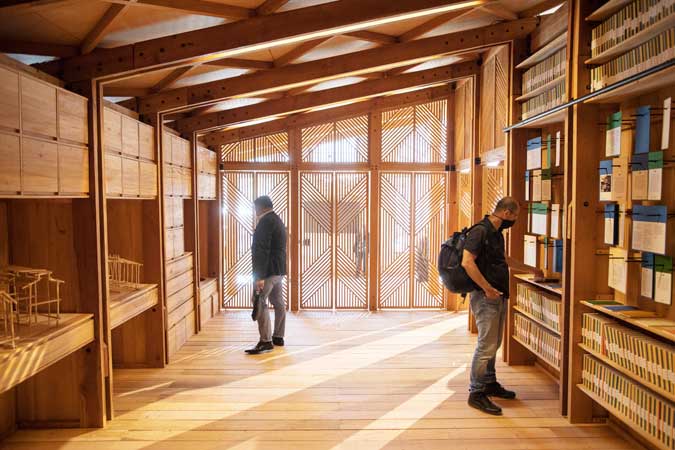
INSIDE the Library at the Philippine Pavilion of the Venice Architectural Biennale — FEDERICO VESPIGNANI

THE QUESTION some people may ask is “How did a Philippine library become this year’s pavilion at the Venice Architecture Biennale?”

Well, the story starts in late 2019 when architects Sudarshan Khadka, Jr. and Alexander Eriksson Furunes conducted a 22-day workshop in Barangay Encanto in Angat, Bulacan with 32 representatives the GK Enchanted Farm community, composed of farmers, carpenters, housewives, students and other laborers, to attend the workshop. The representatives also invited the members of the community of Barangay Encanto in the workshop and they all discussed building a structure within and for the community. They decided to build a library.

“We started by reflecting on what are the problems and what are the possible solutions of the community. At first there are many opinions and different stories. But as we [went] further with the collaboration, we saw one thing from every opinion, and we came up with a library and it is [was] very fun and fulfilling journey for everyone,” said Aliza Mae Antonia, a community representative of GK Enchanted Farm said of the experience in a documentary video.

“The power of the collective is greater than individuals alone. There is this natural synergy which happens when people come together and create something none of them can do on their own,” Mr. Khadka said in the same video.

The building meant to cater to a specific community was built — then dismantled and shipped across the world where it would serve as an example of the bayanihan spirit.

THE VENICE BIENNALE
Due to the COVID-19 pandemic, the 17th Venice Architecture Biennale was postponed twice. Originally scheduled to open in May 2020, it was moved to July, postponed again, then finally opened on May 22, 2021.

Meanwhile, the library in Bulacan was dismantled, packed, and shipped to Venice, Italy on March 6 this year, arriving on April 13, then installed in the Philippines’ pavilion alongside other national pavilions at the Arsenale.

The Philippines opened the country’s National Pavilion on May 20, 2021 with an exhibition titled, “Structures of Mutual Support,” curated by Messrs. Khadka and Furunes, and the members of GK Enchanted Farm.

The Philippine’s participation in Venice is a project of the National Commission for Culture and the Arts (NCCA), the Department of Foreign Affairs (DFA), and the Office of Deputy Speaker and Congresswoman Loren Legarda.

“When I spearheaded our participation in the Venice Biennale way back in 2014, my goal was for the country to be involved in the global discourse — a conversation wherein we are able to share concepts and ideas that could make a better future for the world,” Ms. Legarda said in her speech at the exhibit opening on May 20, which was held via Zoom and streamed through Facebook.

“We join the 17th Venice Architecture Biennale with our exhibition Structures of Mutual Support that reminds the world of what truly is essential, our sense of belonging and our being part of humanity. We are telling the world, it is time to forge and frame a new and more cohesive ‘spatial contract,’ which is attentive and empathic and very much responds to the question on how we all can live together,” Ms. Legarda said.

BUILT THROUGH CONCEPTS OF BAYANIHAN AND MAALIWALAS
“Structures of Mutual Support” involves the traditional concept of bayanihan — the spirit of communal unity, work and cooperation to achieve a particular goal, traditionally seen in the moving of a house from one village to the other — as the library structure was transported to Venice for the duration of the exhibit which runs until Nov. 21. It is expected to be returned to the community in Bulacan after.

During a tour of the exhibit livestreamed through Zoom from Venice, Messrs. Furunes and Khadka noted that the structure’s design was built on the concept of “maaliwalas” or being bright and spacious.

“[It is] when space is very bright, airy, it has a lot of air movement. And at the same time, it is also very clean and neat and open,” Mr. Khadka said of the library’s interior during the live tour. 

The library’s interior includes shelves, study spaces,  storage spaces, and a sitting area.

“Buildings are not just buildings; they are a process. The structure and the way it was created — all that needs to be flexible enough to transform, and live with the community,” Mr. Furunes said.

“It belongs to them.”

The Philippine Pavilion will be accessible to the public through digital programs and virtual tours. To learn about the digital agenda and offerings, visit philartsvenicebiennale.org. Updates are made on Facebook and Instagram via @philartsvenice. To watch video documentaries on the exhibition, go to: PAVB YouTube (https://www.youtube.com/channel/UCiBD6kLhhM4Lpgkh_q04rwA). For more information, on the 17th Venice Architecture Biennale, visit https://www.labiennale.org/en/architecture/2021. Michelle Anne P. Soliman

S&P flags possible ratings risk from cyberattack on banks

S&P GLOBAL RATINGS warned of emerging risks to banks’ credit ratings caused by the rise of cyberattacks during the pandemic.

The ratings agency in a note titled “Cyber Risk In A New Era: The Effect on Bank Ratings” said it would gauge the cyber risks of a financial institution both at the system-wide and entity-specific level.

“Cyber attacks have the potential to harm credit ratings through reputational damage as well as monetary loss. Nevertheless, in the event of a large-scale attack on a systemic bank or several large institutions we could foresee governments taking measures to stabilize the sector,” S&P said in a report.

Based on data from S&P and US based Guidewire Software, Inc., financial institutions (26%) received the most frequent cyberattacks from 2016 to 2020, followed by other sectors such as public administration (13%) and healthcare (11%).

From a system-wide banking analysis, events including repeated, serious breaches of security in a given country, or a sense of a more reactive than proactive response from financial institutions in strengthening cybersecurity frameworks could be a risk to bank ratings.

Meanwhile, bank-specific factors that may have an impact on assessment of bank ratings include impaired business stability due to loss of confidence from an attack and material losses that could hurt lenders’ capitalization due to cyber events.

S&P said cyber risks may also be exposed through structural weakness of banks’ risk management and reputational damage caused by a cyber event that could lead to sudden outflows of clients’ funds in an extreme scenario.

“In our view, the key to cyber resilience lies in risk management action, both before and after an attack,” the ratings agency said.

Bangko Sentral ng Pilipinas Governor Benjamin E. Diokno said earlier this month that a major cyberattack could affect the stability of the financial system. He vowed that the central bank would remain vigilant against new cyberthreats.

In April, the central bank required its supervised financial institutions to report within five calendar days from determination of an incident events that affect banks’ reputation.

A study by the Anti-Money Laundering Council on financial crime trend during the early part of the pandemic showed cases such as skimming, phishing, and unauthorized transactions made up 49% of suspicious transaction reports in the first few months of the pandemic. — Luz Wendy T. Noble

Transpacific’s franchise approved on 3rd reading in Senate

THE Senate approved on third reading a bill renewing Transpacific Broadband Group International, Inc.’s congressional telecom franchise for another 25 years, the listed company announced on Tuesday.

In a disclosure to the stock exchange, the company said the Philippine Senate on March 24 approved on third reading House Bill No. 8551 that seeks to renew its franchise for another 25 years.

Under the franchise bill, the company will be allowed to construct, establish, install, maintain and operate communications systems for the reception and transmission of message within the Philippines.

The House of Representatives approved the bill on Feb. 10.

Also under the bill, the company must secure a Certificate of Public Convenience and other required permits and licenses from the National Telecommunications Commission in relation to the operation of its telecommunication systems and facilities.

On establishing or maintaining poles and other conductors, the company will need to secure approval and permit from the Department of Public Works and Highways or the local government units.

The company said recently that it had set a target to install 10,000 sites and towers for the third telco player.

“With the fast-growing demand for connectivity, Transpacific Broadband has invested in new satellite infrastructure (Ka-Band) to provide the most reliable and cost-efficient connectivity to its subscribers, thereby increasing shareholder value and economic performance,” the company said in its annual report.

Transpacific Broadband said it generates revenue mainly from internet, intranet, and local loop services subscriptions for schools, the private sector and government agencies.

It is developing a niche as a telecommunications tower infrastructure provider. — Arjay L. Balinbin

Lack of infrastructure hampers telemedicine

BECAUSE the pandemic made online consultations a necessary innovation, telemedicine has now entered the mainstream. The convenience of booking appointments remotely has reduced barriers such as the need to travel to primary care clinics, thereby allowing patients to consult physicians more often, receive treatments faster, and become more engaged about their health.

Juniper Research, in its May 2021 Telemedicine report, expects the total number of teleconsultations performed worldwide to reach 765 million in 2025, up from 348 million in 2020, reflecting a compound annual growth rate of 17.1% across the forecast period. The UK-based analyst house indicated that the primary factor driving teleconsultation adoption among providers and patients is the increased efficiency they afford the former, and improved standard of care they provide the latter.

In the Philippines, telemedicine includes medical consultations over the phone, as well as chats, short messaging services, and other audio- and visual-conferencing platforms. Healthcare providers conducting these consultations are allowed to issue electronic case reports and prescriptions according to the Department of Health and the National Privacy Commission.

Remote consultation is more appealing given the risks of contracting coronavirus disease 2019 (COVID-19), said Carlo Miguel A. Francia, concurrent business head of Dok2Me, a scheduling platform that powers the Fatima University Medical Center’s telehealth portals.

“As of today, we have had a 74.33% increase in 2021 vis-à-vis 2020 in our total of online consultations across all of our platforms,” said Mr. Francia. “Also, because of telemedicine’s characteristics, some specializations lend themselves better to telemedicine than others. Specializations with the most number of consultations in our platforms are dermatology, psychiatry, and pediatrics.”

Cost-effectiveness is another benefit of remote platforms. Juniper Research notes that the average teleconsultation will cost an average of $32.40 in 2025, compared to $93.90 for an in-person one. The average person will use teleconsultation services 3.6 times per year by 2025, added the industry research and data firm, with the number expected to be higher in countries with universal healthcare systems and/or where teleconsultation appointments are mostly, if not fully, reimbursed.

In Dok2Me, doctors’ professional fees range from P500-P1,500 depending on the specialization. Patients can pay through cards, GCash, GrabPay, 7-Eleven, and Cebuana Lhuillier. Unfortunately, the platform does not yet have the capability to accept HMO (Health Maintenance Organization) cards as payment.

LIMITED INFRASTRUCTURE
For all its accessibility, telemedicine is not built for emergencies. Dr. Augusto Jose G. Galang, president of the Philippine Society of Gastroenterology, advises patients to proceed to the nearest emergency department for severe symptoms or urgent complaints. “Medical evaluation using this option (telemedicine) cannot replace actual physical evaluation and examination. As such, a complete and accurate medical evaluation is not possible,” he wrote in an April 2020 Facebook post.

It is also dependent on the technical infrastructure required for its technologies to function. A robust and reliable broadband connection, which smaller hospitals may find hard to acquire, is a must.

BusinessWorld previously reported that the Philippines ranked 86th out of 140 countries in terms of mobile internet speed, and 100th out of 175 in fixed broadband speed in January, citing the findings of the Ookla Speedtest Global Index.

Dok2Me’s Mr. Francia said that because telemedicine heavily relies on technology, there are a number of breaking points throughout the process, including but not limited to: payments, patient and doctor consultation confirmatory notifications, data connections of both the patient and doctor at the time of the consultation, and hardware and software specifications of the devices used by the patient and doctor to access the consultation.

He added that telemedicine necessitates having the facilitating technology and infrastructure behind it to be scalable to other parts of the country.

“The reality is, as long as there are no stable and affordable data connections and devices that people in the D and E classes can readily access, telemedicine cannot be made available to them,” Mr. Francia said.  Patricia B. Mirasol

If I could go anywhere

THE French Gardens — PHOTO FROM EN.CHATEAUVERSAILLES.FR

Marie Antoinette’s private boudoir and mechanical mirror room at Versailles

In this series, The Conversation pays tribute to the art we wish could visit — and hope to see once travel restrictions are lifted.

A LONG a dusty path on the outskirts of the Château de Versailles lies my favorite destination: Queen Marie-Antoinette’s private bedroom and boudoir in the Petit Trianon (small trianon). Built for King Louis XV and his mistress Madame de Pompadour in 1768, it was gifted to the new queen of France by Lous XVI and refurbished after 1774.

It was already an extremely beautiful cuboid design by Ange-Jacques Gabriel, the height of neo-classical French taste. Its reconfiguration and that of the surrounding grounds by the queen saw it embody a raft of new ideas concerning everything from the education of children to what women should wear.

The bedroom and boudoir were rooms in which the queen retreated from the formality and etiquette of the main palace of Versailles to spend time with women friends. She assembled aristocrats such as the Princess de Lamballe as well as famed portrait painter Elisabeth Vigée-Lebrun.

Here the group wore a wardrobe not possible at formal assemblies: loose, tubular muslin dresses secured with a high sash, similar to juvenile girls’ clothes worn in England and the practical Creole summer dress they knew of from the French colony Louisiana.

The clothes were considered so scandalous that Vigée-Lebrun’s painting of the queen in such attire had to be taken down at the public Salon exhibition. The queen looked like she was in her underwear, the pose was too informal and the superfine muslin was likely imported from India. It was replaced by another portrait by Vigée-Lebrun of the queen in French silk, one of the many luxury trades that bolstered the French economy.

Leaving the formal apartment, the ceilings suddenly lower. Framed by two large corner picture windows are views from the boudoir of the garden outside. But this is no ordinary garden.

French formal architecture had been characterized by geometrical designs in which trees and other plantings were clipped into axial vistas, often leading to sculptures or fountains indicating the status of the king, aristocrat, or grandee who commissioned the work. The garden at Versailles was an abstraction in which viewing positions and plantings were subject to order, the ultimate act of control. Enormous canals mirrored the sky, unifying heaven and earth under the spell of their creator, Louis XIV.

From Marie-Antoinette’s window we see a simple landscape in which a large tree on the side anchors the “composition.” This was the new jardin anglais (English garden), claimed to embody ideas of liberty and freedom rather than French absolutism. Such gardens were anchored by asymmetrical lakes, elegant, classical pavilions as well as “ruins” (faked old structures, in which hermits sometimes resided) evoking melancholy and Romanticism.

Marie Antoinette’s private view looks rather like the wings of a theater. Rather than a painting, we look out at nature, reframed by a set designer and man-made for wandering and thoughtful contemplation.

Light pours into the boudoir from several directions. It falls onto delicate wall paneling and a beautiful set of calcified, white gessoed furniture in the most advanced taste by Georges Jacob. The perfectly cubic space is small, accommodating only about four people comfortably, a contrast to court levées or assemblies for hundreds.

As evening comes, a miracle happens. From the basement kitchen-floor below, as directed by the queen, come two large glaces volantes (flying Venetian mirrors) to fill the window panes, raised by a series of weights and pulleys. The engineer Mercklein received 12,500 livres tournois (later francs) for this innovation (overall per capita income was about 250 per year); his system is now electrified.

The room goes from day to night. Views of a garden, perhaps on a gloomy day in autumn, are replaced by the sparkling reflections of mirror. Large expanses of mirror glass could only be made in Venice until industrial espionage brought the technology to France. Mirrors perform important cultural work as they can infer vanity, falsehood, or indeed show the truth. Animated guests were doubled and conversed like shadowy ghosts.

The queen and her circle could not be observed. Privacy, a new social conception that comes to govern middle-class life in the 19th century, now reigns. What a contrast to the Hall of Mirrors at the palace, where a sense of infinite repetition was created in a 73-meter-long gallery with 17 enormous windows and where hundreds of people thronged.

Marie-Antoinette’s domain at Versailles was dominated by her frustration with a rigid court and her desire to embrace contemporary ideas. In her adjacent farmlet (the hameau), farm buildings were built to look shabby. Simulated wooden buckets of the finest porcelain by Sèvres lined the farmhouse stairs.

Following the educational ideas of Jean-Jacques Rousseau, Marie-Antoinette encouraged her children to plant seeds and dig the earth. She did not, as many believe, play at being a shepherdess or farmer. The woman who was erroneously claimed to have said of the hungry peasantry “let them eat cake” (this translates as brioche or sweet bread and was likely uttered by someone else), was simply trying to be a good mother as advocated by contemporary thinkers.

And what of the female friends? The queen was accused of running a tribadic or lesbian household. These scurrilous claims were designed to discredit her circle. Similarly, the bedroom shows no evidence to back the claim in an 18th-century English travel guide that Marie-Antoinette slept in a suspended bed-basket of roses.

Later generations were not much interested in the queen’s motivations. She became an index of the profligate spending and obscene luxury of the old regime. She and her husband, as well as the Princess de Lamballe, were executed by the guillotine or in massacres between 1792 and 1793.

The mirrors were lowered, the furniture auctioned, and the domain went to sleep until Empress Eugénie turned it into a museum honoring the queen.

A Swiss luxury brand has recently restored the rooms. They allow us to imagine a spirited woman married off from Austria aged 14, stripped of her foreign clothes at the French border, who became a lover of the latest French design and manufactures — rather than the debauched queen image we have inherited from the post-revolutionary period.

Wandering through the spaces I didn’t see ghosts. I did see the queen’s modern dress echoed in the brilliant white wall panels. She wandered a little in the distance towards the “temple of love” in her up-to-date garden. Her cracked mirrors are now nicely restored for the tourists.


Peter McNeil is a Distinguished Professor of Design History at the University of Technology Sydney.

Phinma adds Union College of Laguna to school network

THE education unit of Phinma Corp. has acquired Union College of Laguna (UCL) for P88.17 million, making it the company’s second school in Laguna and its ninth in the Philippines.

“Despite the challenges we faced during the COVID-19 pandemic, our mission to provide quality, accessible education to underserved students has not changed,” Phinma Education Holdings, Inc. Country Head Dr. Raymundo P. Reyes said.

UCL has undergraduate programs in education, accountancy, computer science, computer engineering, information technology, criminology, hotel and restaurant management, and psychology.

The school is evaluating and adjusting courses “based on the needs of industries.”

“We may add more courses that are better suited for the employability of our graduates, especially after the pandemic,” Dr. Reyes said.

UCL also offers kindergarten, elementary, junior high school, and the academic track and the technical vocational track in senior high school.

Last year, it acquired the Phinma Rizal College of Laguna for P448.76 million. Rizal College offers junior high school, senior high school, and undergraduate courses in education, business administration, office administration, and industrial technology.

The other schools in its portfolio are Phinma Cagayan de Oro College, Southwestern University Phinma in Cebu City, Phinma University of Iloilo, Phinma Saint Jude College in Manila, Phinma Araullo University in Nueva Ecija, Phinma University of Pangasinan, and Phinma Republican College in Quezon City.

Phinma Education also manages one school in Karawang, West Java, Indonesia and a training center in Yangon, Myanmar. It aims to further grow its network in Southeast Asia.

“As part of our network, UCL will benefit from the strategies that we have been able to hone over the past 17 years,” Dr. Reyes said.

Phinma’s schools are using two flexibility learning models called Flex Learning and Remote and Distance Learning, both uses printed modules and remote teaching through the internet.

The company said it partnered with Globe Telecom, Inc. and PLDT, Inc. to provide monthly mobile data of 10 gigabytes to its 72,000-student population. It also continued to provide scholarships to qualified students.

Phinma Corp. is a listed conglomerate with businesses in education, property development, hospitality, and construction materials.

On Tuesday, shares of Phinma Corp. at the stock exchange went up by 0.65% or eight centavos to close at P12.30 apiece. — Keren Concepcion G. Valmonte

Central banks face thinning options amid Asia’s struggle

ASIA’s surging coronavirus infections and slow pace of vaccinations is testing the limits of what central banks can do to further support what, until recently, had been the world’s stand out economic recovery.

With interest rates already low, the likely policy response will center on more government borrowing, relegating central banks to a supporting role. That backdrop will overshadow decisions this week where policy makers are expected to keep rates on hold — Indonesia, South Korea and New Zealand.

“In my view, there is little room for further monetary policy stimulus, at least in terms of traditional policy levers like interest rate cuts,” said Tuuli McCully, head of Asia-Pacific economics at Scotiabank. “I expect additional fiscal stimulus to play a key role in helping economies.”

In Jakarta, the finance ministry has offered more tax cuts to spur economic activity and plans to stick with its $84-billion net bond issuance target this year, even as borrowing costs climb. Bank Indonesia is expected to keep rates unchanged Tuesday.

South Korea’s economy is being cushioned by soaring exports even as rolling social distancing restrictions damp consumer spending — prompting the government to pledge more fiscal spending to create jobs. The Bank of Korea is also expected to remain on hold when it meets Thursday.

New Zealand’s economy continues to recover, amid a low case count, after contracting at the end of last year. The Reserve Bank of New Zealand is expected to hold steady Wednesday after the government’s annual budget last week included the biggest increase in welfare payments in more than a generation as part of measures to support growth.

India is the global epicenter of the latest virus surge, and even other economies that had kept infections under control — such as Singapore and Taiwan — are also battling flare ups. Japan continues to struggle with spreading cases and even China is seeing an uptick in infections.

The region is also lagging in the vaccination rollout, with Singapore having inoculated around 30% of its population, followed by China at around 15% and the others well behind.

“The region’s relatively slow vaccine rollout is increasingly proving to be a drag, including for the more developed economies whose hitherto successful strategy to more emphasize contact tracing, rapid testing and social distancing, is being challenged by the recent surge in cases,” according to Sameer Goel, Deutsche Bank AG head of emerging market research.

The Reserve Bank of India will be central to how India responds to the crisis, given the government has only limited fiscal space with a budget deficit of 6.8% of gross domestic product in the year to March 2022, down from an estimated 9.5% last year. Benchmark rates have remained unchanged for a year amid sticky inflation.

Next month the RBI’s monetary policy committee is likely to keep rates unchanged, but Governor Shaktikanta Das could expand a quantitative easing program for the second straight quarter to keep borrowing costs under check.

PANDEMIC SUPPORT
Other Asian central banks are supporting their nations’ fiscal policies. Bank of Japan Governor Haruhiko Kuroda said last week he will continue with powerful monetary easing, indicating his yield curve control program will keep government bond yields low to help additional fiscal spending. China’s central bank is also continuing to ensure borrowing costs are kept low for those parts of the economy that need it, while keeping an overall disciplined approach to the volume of its stimulus.

“Monetary policy is not as effective compared to fiscal policy in responding to the current virus wave,” said Khoon Goh, head of Asia research at Australia & New Zealand Banking Group Ltd. “Extension of fiscal support is what is needed.” — Bloomberg

As COVID-19 rages, don’t let your guard down against other viruses

Photo of HPV-infected squamous cell of the cervix via Ed Uthman/Flickr

THE world’s laser-like focus on SARS-CoV-2, the virus that causes coronavirus disease 2019 (COVID-19), hasn’t stopped the medical community from remaining vigilant against other viruses that continue to pose great health risks. One of these is the human papillomavirus (HPV), a sexually transmitted infection that may lead to genital warts and, in worst-case scenarios, cancer.

HPV infects at least 80% of sexually active people, both men and women, at least once in their lifetime, according to data from the US Centers for Disease Control and Prevention. This includes asymptomatic cases of HPV.

Even the benign type of HPV, which manifests as uncomfortable genital warts, has an overall prevalence of almost 3% in Filipinos, with higher prevalence in men. Not all cases are severe, but they can later on lead to more life-threatening complications or get passed on to a sexual partner.

During a time where having any comorbidities can make people more prone to stress and illnesses such as COVID-19, the health risks are all the scarier. Dr. Mary Ann Escalona, country medical lead of Merck Sharp & Dohme (MSD) in the Philippines, ensures that “by putting HPV back in the conversation on overall health, we can make better decisions that can help protect us and our loved ones from HPV-related diseases.”

EASING THE BURDEN BY RAISING AWARENESS
After about a year of slowed activity due to the pandemic, MSD in the Philippines re-launched their advocacy program Guard Against HPV this May, which aims to communicate the importance of safe sex practices, regular checkups, and vaccination for both men and women.

“HPV is a DNA virus that infects human skin and mucosal cells,” said Dr. Portia A. Ortiz, president of the Philippine Society of Venereology. “There is a low-risk type, which causes genital warts or benign lesions, and a high-risk type, which is associated with cancers. In fact, 70% of HPV can cause cervical cancer.”

She added that the virus can spread through any kind of sexual intercourse, whether vaginal, anal, or oral, making the ABCDEs of sexually transmitted infection prevention all the more important. (ABCDE stands for “Abstinence, Be faithful, Correct condom use, Don’t do drugs, and Education.”)

“The chances of getting HPV are greatly reduced if you’re faithful to one partner. It’s also safer for both parties to use a condom during sexual intercourse,” Dr. Ortiz said.

HPV, aside from spreading through sexual contact, can also spread through sharing needles when injecting drugs.

Photo of HPV-infected squamous cell of the cervix via Ed Uthman/Flickr

MEN CAN GET HPV TOO
Men are just as prone to HPV as women, said Dr. Jovanni R. Templonuevo, vice-president of the Philippine Society of Venereology. “It’s possible to get genital warts that can later develop into penile and anal cancers if the person has gotten infected many times,” he warned.

Asymptomatic men can unknowingly transfer the virus to their partners. Gone are the days of HPV and cervical cancer as illnesses associated mainly with women, said Dr. Templonuevo, who later added that cervical cancer vaccines are available for men.

“Men: be responsible,” he said. “We all want a productive, stress-free life without sickness.”

CLEARING UP MISCONCEPTIONS
One concern brought up during the conference was the sense of shame that can come with getting diagnosed, as if the HPV could be proof of unfaithfulness. However, all the panelists echoed the same assurance that this shouldn’t be the case.

“HPV has an incubation period of two weeks up to eight months, and in some cases, even years. This means that it’s likely a person got it from a previous partner, even if they hadn’t been together for a long time,” Dr. Ortiz said.

As for vaccination, all doctors clarified that the earlier, the better. Vaccines are available for children as young as nine years old, with variations in dosage depending on the age.

The benefit of getting a vaccine early would be gaining the antibodies needed fight off HPV in the future, when one becomes sexually active. Dr. Templonuevo backed this up with data, saying that “43 million HPV infections were recorded worldwide in 2018, many of them in their late teens and early 20s.”

Unfortunately, Dr. Ortiz reported that the incidence of HPV in Filipinos under 18 years of age is high. “But for those who’ve already been exposed, you can still get value from vaccination,” she said. “Your body can still make antibodies for the HPV strains that you don’t have. Thankfully, we have vaccines that cover nine of them.”

The panelists suggested going to a trusted healthcare provider, whether it be a family doctor, a dermatologist, or even pediatrician, to ask about vaccination.

For more details on HPV awareness and prevention, visit Guard Against HPV at facebook.com/guardagainstHPV. — Brontë H. Lacsamana

ADVERTISEMENT
ADVERTISEMENT