Home Blog Page 8037

SEC greenlights Ayala Corp.’s P30-B debt program

THE Securities and Exchange Commission (SEC) has given the go signal for Ayala Corp.’s P30-billion debt securities program.

“In its meeting on May 11, the commission en banc resolved to render effective the registration statement of Ayala, subject to the company’s compliance with certain remaining requirements,” the corporate regulator said in a statement on Wednesday.

The listed conglomerate has set P6 billion for the first tranche of the program consisting of three-year bonds due in 2024 and five-year bonds due in 2026, with an oversubscription of up to P4 billion.

The bonds will be listed and traded on the Philippine Dealing & Exchange Corp.

Around P9.88 billion of net proceeds is expected from the first tranche of the P30-billion debt securities program should the oversubscription option be exercised.

According to the company’s prospectus filed with the SEC at the end of March, majority of the proceeds will be used to pay for its short-term loans and it will partially be used to fund the company’s capital expenditures.

Ayala Corp. assigned BPI Capital Corp. as the transaction’s issue manager, joint lead underwriter, and bookrunner.

BDO Capital & Investment Corp., China Bank Capital Corp., First Metro Investment Corp., and SB Capital Investment Corp. were also tapped as joint lead underwriters and bookrunners.

RECYCLING INITIATIVES
Meanwhile, the company’s real estate arm Ayala Land, Inc. said it was able to recycle 28 metric tons of plastic waste into eco-products last year.

Ayala Land collaborated with Green Antz Builders, which converted the dry plastic waste to construction materials like bricks, pavers, and casts.

“The cycle involves collecting clean and dry plastics at designated drop-offs and transporting them to eco-hubs, which are recycling facilities where the plastics are shredded and incorporated into concrete products developed by Green Antz,” Anna Maria Gonzales, sustainability manager of Ayala Land, said in a statement.

Dry plastic waste products were collected from its properties and communities and Ayala Land said these were recycled into eco-materials as part of the company’s “circular waste management” initiative.

As a result, the converted plastic waste materials are now used in Ayala Land’s estates and sites as pathways, fences, and sidewalks.

Ayala Land said the total plastics it was able to recycle in 2020 may be compared with how much dry plastic waste may be collected from its two largest malls in a regular year.

“Processing and using these eco-products effectively prevented clean and dry plastics from Greenbelt and Glorietta from ending up in dumpsites,” Ms. Gonzales said.

Shares of Ayala Corp. at the local bourse went down by 1.76% or P13 on Wednesday to close at P727 each, while Ayala Land stocks slipped by 0.93% or 30 centavos to finish at P31.95 apiece. — Keren Concepcion G. Valmonte

Florals in Spring? Groundbreaking 

Yes, if we’re talking about drinks

WHILE the heat of summer blazes on in the Philippines, Don Papa Rum flexes its global reach by coming out with a spring campaign called “Sweet Sugarlandia Spring.”

 In a Zoom conference on May 10, the Bleeding Heart Rum Company showed off its glossy spring campaign photos shot by Steve Tirona. These were taken at the historic Dawnridge House, seen in the Netflix series Ratched, and known as one of America’s best-designed homes, thanks to its previous ownership by designer Tony Duquette.

 “Spring is not necessarily a Filipino concept,” said Monica Llamas Garcia, Director of Communications for Bleeding Heart Rum Co., Don Papa’s parent company. “How many seasons do we have here? What do they say, two? Hot, and hotter?”

 But the Philippines is not the only place where the brand is available. Ms. Garcia notes that since its founding in 2012, Don Papa is now present in about 30 countries, its reach spanning from South Africa, North America, to New Zealand. “The whole spirit of Don Papa is all about inclusivity. We look at the seasons of the entire world.”

 “The idea of spring is all about the idea of rebirth, and looking forward to better things ahead,” she said. The spring campaign is part of an ongoing series (“Winter” was launched last December), and the slant towards temperate seasons (and the accompanying culture) is not incidental. More campaigns based on the seasons are set to be launched later this year (as is a new Don Papa expression).

 The campaign is also accompanied by cocktails (of course). The brand relied on its US Brand Ambassador, Tomas delos Reyes, for two tipples: Botanica Obscura (Don Papa Rum, lemon juice, hibiscus syrup, bitters) and Avalon Awakens (Don Papa Rum, pineapple juice, lime juice, velvet falernum, ube syrup). 

“You usually think of spring cocktails as shaken, and bright, airy,” he said during the Zoom call. “The main element and inspiration came from many years of experiencing the turn of winter to spring in New York City. It’s really just energy popping in the air.”

These cocktails will be available soon through Run Rabbit Run’s cocktail delivery service.

“I kind of wanted to present them like exotic flowers.” — Joseph L. Garcia

Loans disbursed by credit surety funds hit P6.9B at end-2020

PHILIPPINE STAR/ GEREMY PINTOLO

BORROWINGS from credit surety funds (CSF) amounted to P6.925 billion last year as more micro-, small- and medium-sized enterprises (MSME) needed financing, Bangko Sentral ng Pilipinas (BSP) Governor Benjamin E. Diokno said on Wednesday.

The central bank chief said estimates from a BSP survey of 30 CSF correspondents showed loans from the program reached P6.925 billion as of end-December.

Credit extended by CSFs stood at just P2.08 billion in 2015, which was when the program was institutionalized under the Republic Act 10744 or the Credit Surety Fund Cooperative Act.

“The same upward trend can be seen in the cumulative number of beneficiaries with only 66 in 2009 growing to 15,233 in 2015,” Mr. Diokno said in an online briefing.

“As of end-2020, an estimated 17,527 beneficiaries have benefited from the CSF program since its launch as an advocacy program in 2008,” he added.

There were 55 CSFs across the country as of 2020, 14 of which are registered with the Cooperative Development Authority (CDA), which is the lead implementer of the program. For its part, the BSP is in charge of the promotion of CSF cooperatives and providing technical assistance for both CDA and CSF cooperatives.

“At least 15 more CSFs are expected to be registered by yearend with the rest likely to complete the process next year,” Mr. Diokno said.

Funds disbursed through the program come primarily from the contributions of well-capitalized cooperatives and local government units, as well as government financial institutions such as the Development Bank of the Philippines, Land Bank of the Philippines, and the Philippine Guarantee Corp.

The program is meant to provide financing for small businesses, as it gives “a maximum surety cover of 80% to loans granted by banks to MSMEs, which serves as an alternative to hard collaterals”, Mr. Diokno said.

While MSMEs make up about 99% of the country’s businesses, the sector faces financing constraints due to collateral requirements.

“Through this [CSF] mechanism, banks gain additional confidence in lending and expanding their exposure to cooperatives and MSMEs. At the same time, cooperatives and MSMEs under the program enjoy access to bank financing to enable them to grow their business, create jobs, and support their local economy,” Mr. Diokno said. — L.W.T. Noble

Globe eyeing new products to ‘regain momentum’

GLOBE Telecom, Inc. is planning to offer new products and services as it prepares for increased competition in the telecommunications industry, its top official said.

“Globe is stepping up its efforts so you will start to see more aggressive offers that will give the people basically more value for their money,” Globe President and Chief Executive Officer Ernest L. Cu said in an e-mailed statement on Wednesday.

The company said the new offerings it is set to introduce should “strengthen its leadership in the mobile sector and regain business momentum despite mobility restrictions, as it continues to gear up for increased competition.”

“The company is determined to reinvent its products and services while embarking on a sustained network upgrade and expansion,” Globe added.

Credit rating agency Fitch Ratings has said Globe Telecom and PLDT, Inc. would be “accelerating their network rollout in mobile and fiber broadband” because of the entry of the third telco player, DITO Telecommunity Corp., which targets to capture 30% of the telecommunications market.

DITO is currently capable of serving 37.48% of the country’s population, according to a technical audit report by R.G. Manabat & Co.

The third telco has a commitment to cover 84% of the population and provide an internet speed of at least 55 megabits per second by the end of its fifth year of commercial operations.

“Certainly, at this point, we don’t see that (effect) yet given the very wide disparity in coverage between them (DITO) and the two incumbents,” Mr. Cu said.

Globe noted that DITO only runs on fourth-generation (4G) and 5G networks “that cater mostly to data services and not voice calls and SMS.”

The Ayala-led telco targets “to own the widest 5G coverage worldwide with more upcoming launches in Europe and North America,” the company said.

Globe announced last week that its attributable net income reached P7.31 billion in the first three months of the year, up 11% from P6.58 billion in the same period in 2020.

Its total revenues for the first quarter rose 4% to P42.85 billion from P41.19 billion in the same period last year.

Service revenues — which include mobile, home broadband, corporate data, and fixed line voice — increased 2.5% to P37.81 billion from P36.88 billion previously.

Globe Telecom shares closed 1.67% lower at P1,829 apiece on Wednesday. — Arjay L. Balinbin

2020 Doreen Gamboa Fernandez Food Writing Award: Welcoming the goat to our tables

BW FILE PHOTO

By Jeanne Rebollido Jacob-Ashkenazi

(Third Prize winner of the 2020 Doreen Gamboa Fernandez Food Writing Award)

I WONDER why eating goat generates such divergent reactions. Maligned as “poor man’s beef,” yet it has graced a royal table, that of Spain’s King Philip II, after whom, we all know, our country was named. For the third course of his Christmas feast, Cabrito Asado y Mechado was presented, noted in the cookbook of the royal chef Antonio Martinez Montiño, published in 1611. Kid — cabrito or chivo — has been highly esteemed Christmas fare since, whether as the Extremaduran classic Caldereta de Cabrito with roasted and mashed liver sauce, ancestor of our own Caldereta, or the Guisado de Cabrito en Sidra in Asturia, heady with the fumes of apple cider, or the Malagan Chivo al Ajillo, with its glorious surfeit of garlic.

Perhaps it’s the smell exuded by mature goats that turns some people off. However, true lovers of goat meat, like those who prefer mutton to lamb, enjoy the savor and scent of mature chevon (yes, its name has been gentrified). Older, less tender goat meat lends itself to long, slow, moist cooking, and its intrinsic aroma is sufficiently robust to stand up to fennel and mace and diverse bold spices in Rendang Kambing, a celebratory dish for Hari Raya in Indonesia and Malaysia. Goat, historically dubbed “mutton” in India and Pakistan to cosset colonial British sensibilities, performs equally well in Korma, marinated in yogurt overnight for tenderness, then gently braised with cardamom, cumin, coriander, and more. Goans pride themselves on their goat Xacuti (“xa” pronounced “sha”), meltingly rich with coconut cream and redolent with white poppy seeds, pepper, chilies, nutmeg, cloves, and star anise. For the purist caprine gastronome, in the land where raw attests to unquestionable freshness and impeccable quality, mountain goat (yagi) sashimi in Japan’s southernmost prefecture, Okinawa, offers a different gustatory experience altogether.

From the Near East (the goat’s center of domestication over 8,000 years ago) to Central Asia, Eastern Europe to Central and South America, including the Caribbean, the goat is far from lowly fare. It has always been at center stage for feasts and celebrations. In our country, there appears to be a gender divide (and dare I say, perhaps a class one too) about eating goat, with men keenly salivating at the prospect, particularly when alcoholic drinks are involved, and ladies regarding the idea with revulsion, gagging at the imagined hircine reek —  its anggo (attributed to the chemical 4-ethyloctanoic acid). This ambivalence is puzzling because goat cheeses, especially French ones, are highly regarded by both female and male gourmets. Even where goat meat is unwelcome, its cheese, when coated in pankō and grilled, is an inevitable and popular first course at British gastro-pubs (the French word for goat cheese, chèvre, doubtless worked its charm there). Nonetheless it is all the more curious because lamb, its nearest relative, is not subjected to the same disdain (their only difference is a mutation, resulting in the sheep’s wooly fleece).

The goat’s shady reputation may also be attributed to Greek mythology. The god of the wild, Pan, is depicted as half-goat, half-man who plays music on reeds and seduces nymphs. The word “goat” can mean “lecher,” an association with the unbridled behavior of male goats during the mating season. It is not too far-fetched to regard goat dishes as aphrodisiacs, with the soup called Mannish Water a must at Jamaican weddings. This (quite likely unjustified) reputation may well explain the ribald repartee of male cooks preparing Pinapaitan (soup of beef or goat innards with bile) and Kilawen (raw or half-cooked beef or goat in vinegar) at Ilocano feasts.

Goat meat is currently gaining worldwide acclaim as healthier red meat. It has lower cholesterol than beef and pork, as much protein as beef and more than chicken, and higher levels of iron. Goat farms in Tarlac and Mindanao are crossing local breeds with exotic stock, such as Nubian and Boer, for fleshier, more flavorful hybrids.

It may be time to expand our local repertoire beyond Caldereta and pulutan-style dishes, such as Batangueño Shampeni (or champeni, beef skin and innards cooked in a sauce) and Sinunggaok (soupy pork with yardlong beans and radish cooked with tomatoes and a bit of pork blood).

Roast suckling kid from modern hybrids can well rival lechon for succulence and tenderness. Besides Ensaimada, we might adapt another Mallorcan specialty —  Asado de Cabrito Estilo Mallorquín —  oven-roasted with our unique herbs over native tubers tugi or cassava, rather than potatoes, and basted with our local fruit wines. 

There is no lack of goat or kid dishes to inspire us — from Mexico and South America, whose flavor principles partially mirror our own colonial heritage, to the spice-rich dishes of our neighbors throughout Asia. The Ottoman Turkish culinary tradition throughout the Middle East and the Balkans offers luxuriant scope for sumptuous rice-cum-goat platters. A cornucopia of innovative dishes from professional kitchens in Australia, New Zealand, the UK, and the USA may provide additional inspiration, as contemporary chefs worldwide awaken to the flavorsome potential of goat. (Or chevon, if you prefer).

THE DOREEN Gamboa Fernandez Food Writing Award (DGF Award) recently announced the winners of the 2020 competition. The subject matter was “Livestock,” which, in the Philippines refers to cattle, pigs, goats, carabaos, and horses. The DGF Award is now in its 19th year. Named after the late dean of food writers, Doreen Gamboa Fernandez, it was founded to encourage writers to contribute to Philippine food literature. The winning essays of the first 15 years have been published in two books — Savor the Word and Sangkap.

PNB net profit climbs 34%

BW FILE PHOTO

PHILIPPINE NATIONAL Bank (PNB) booked a higher net earnings in the first quarter as lower expenses helped offset a decline in its total operating income.

The Tan-led lender’s net earnings rose by 34% to P1.791 billion in the quarter ending March from P1.337 billion in the same period in 2020, it said in its unaudited quarterly financial statement filed with the local bourse on Wednesday.

This translated to a return on equity of 4.68% as of March, up from 3.53% a year earlier. Return on average assets also improved to 0.61% from 0.49%.

The bank’s net interest income decreased by 6.69% to P8.237 billion from P8.828 billion a year earlier.

Its net interest margin dropped to 3.17% at end-March from 3.33% in the comparable year-ago period.

Meanwhile, net service fees and commission income improved by more than a third to P1.293 billion in the first quarter from P961.542 million on the back of higher credit card-related fees and underwriting fees.

On the other hand, PNB’s other income dropped by 38% to P1.552 billion from P2.512 billion amid lower gains from trading, investment, and foreign exchange

With this, the bank’s total operating income dropped 9.9% to P11.083 billion last quarter from P12.302 billion in the first three months of 2020.

Meanwhile, it reduced its operating expenses by 17.1% to P8.782 billion from P10.597 billion.

This decline was mainly attributed to lower provisions for impairment, credit, and other losses, which stood P2.095 billion, down by 37.5% from the P3.355 billion it set aside in the first quarter of 2020.

PNB’s loans and receivables inched up 1.5% to P609.3 billion as of end-March from P600 billion as of end-2020. Despite the decline in credit, its nonperforming loan ratio stood at 6.37%, higher than the 1.78% a year earlier.

Meanwhile, the bank’s deposit liabilities stood at P847.6 billion as of March, down 4.8% from the end-2020 level. Demand and savings deposits increased by 3.8% and 5.5%, respectively, while time deposits went down by 31.2%.

The bank’s capital adequacy ratio stood at 14.77% as of March, up from 14.72% a year earlier, while its common equity Tier 1 ratio was at 14.11%, also better than the 13.8% seen last year. Both were beyond the minimum regulatory requirements.

PNB’s shares closed at P28.50 apiece on Wednesday, down by 10 centavos or by 0.35%. — LWTN

Taking a virtual tour of a show kitchen

SINCE people haven’t been going out due to the coronavirus disease 2019 (COVID-19) pandemic, our homes have served as centerpieces in our lives. Kitchens in particular have taken on a particular importance, something that Focus Global, Inc., the distributor of Sub-Zero and Wolf (among other brands) in the country has focused on.

 Last week, the company unveiled the latest renovations to its Makati showroom in The Residences at Greenbelt. “Our brands Sub-Zero and Wolf have had the great honor of being part of Filipino homes for over 20 years,” said Lolita Sy, Executive Vice-President of Focus Global during a Zoom conference on May 6, adding that the brands entered the market in 2000. “Given the challenges of our times, our team has worked very hard the past year to make this showroom accessible.”

 While the showroom has been renovated, the pandemic has also made it necessary to do some housekeeping online. A revamped website features a virtual tour of this new showroom, and also makes it possible to book an appointment in advance (or even a video tour and talk with a representative).

 A virtual tour during the press conference showed the brands’ latest offerings. Sub-Zero is known as a food preservation specialist because of its advanced preservation technologies. Its refrigerators’ features include: a dual refrigeration system that ensures that air between the two compartments will never mix (which allows it to be cool and humid in the refrigerator and frigid and dry in the freezer); a NASA-based air purification technology that scrubs the air of odors, mold, viruses, bacteria, and ethylene every 20 minutes; and the precise temperature control which makes use of microprocessors that maintain interior temperatures within one degree of setpoint.

 They’ve also revamped the outdoor refrigeration and cooking units section, which shows outdoor grills and stoves by Wolf. The space was designed by architect Anna Sy, Managing Director of CS Design Consultancy, Inc. A press release also says, it “has taken COVID-19 safety protocols very seriously, to ensure clients a safe and delightful shopping experience.” 

 The products on the virtual tour are accompanied by little bubbles that show information about the product. Clicking on the little bubbles can also take you to view product specifications and other such details, and tools within the site make it easier for one to share product details with planners and designers.

 “For those who are not able to go out, it’s good to know that you can still explore the place through our virtual showroom from the safety and comfort of your home,” said Steven Sy, founder and President of Focus Global.

 Access the virtual showroom and website through https://subzero-wolf.com.ph/ and bit.ly/SZWFRez2virtualshowroom. — JL Garcia

Outstanding gov’t securities hit P7.3 trillion

BW FILE PHOTO

OUTSTANDING Treasury bills (T-bills) and bonds (T-bonds) issued by the government inched up by 1% to P7.271 trillion as of end-April, according to government data.

Latest Bureau of the Treasury (BTr) data showed outstanding government securities barely rose from the P7.203 trillion seen as of March.

Year on year, however, the debt pile climbed 31% from P5.56 trillion in the period ending April 2020 and also increased by 7% since the start of the year.

Broken down, outstanding T-bills edged up by 1.9% to P1.06 trillion as of April from P1.049 trillion at end-March. Year on year, it jumped by 64%.

The total was made up of P138 billion in outstanding 91-day debt papers, P212 billion in 182-day T-bills and P710 billion in 364-day securities.

Meanwhile, outstanding T-bonds reached P6.211 trillion as of last month, up by 1% from P6.154 trillion the month prior. This was also higher by 26% compared with the year-ago level.

The end-April debt stock was made up of P252.51 billion in three-year debt papers, P351.78 billion in five-year T-bonds, P518.13 billion in seven-year instruments, P719.55 billion in 10-year notes, P420.33 billion in 20-year IOUs, and P235.98 billion in 25-year securities.

Meanwhile, outstanding retail Treasury bonds reached P2.596 trillion as of April.

The government runs on a budget deficit as it spends more than the revenue it generates to boost economic growth. It borrows from domestic and external lenders to plug this funding gap.

The government began ramping up its borrowings last year to finance its budget deficit that hit 7.63% of gross domestic product (GDP), up from the record low ratio of 3.38% seen in 2019.

For this year, it is looking to borrow P3 trillion as the fiscal gap is seen to hit 8.9% of GDP.

Of this total, P2.22 trillion will be raised from local sources and the remaining P785.6 billion will be sourced offshore. — B.M. Laforga

Metro Retail Stores incurs P126-M loss as customer traffic slows

METRORETAIL.COM.PH

METRO Retail Stores Group, Inc. incurred a P126.47-million net loss in the first quarter, a reversal of its P7.98-million income year on year, as lower customer foot traffic and the trend of prioritizing essential goods led to lower revenues.

In a statement on Wednesday, the company said its topline for the period declined by 18.9% to P6.95 billion from the P8.57-billion revenues seen last year. Blended same-store sales also went down by 21.4%.

Total food retail business went down by 14.7% to P5.43 billion from P6.37 billion, while the company’s general merchandise segment dipped by 30.2% to P1.48 billion from P2.12 billion.

The listed grocery operator temporarily halted its supermarket and department store operations in mid-March after the country reported a surge in coronavirus disease 2019 (COVID-19) infections.

“These were gradually opened, but were faced with customer traffic constraint since community quarantine is still in effect and as consumers prioritized the purchase of essential goods in general,” the company said in a regulatory filing on Tuesday.

Meanwhile, operating expenses for the period amounted to P1.48 billion, declining by 19.1% from P1.83 billion last year as the company reduced costs and improved efficiency measures.

The company finished the quarter with an EBITDA (earnings before interest, taxes, depreciation, and amortization) of P236.74 million.

“Along with the challenges and uncertainties brought about by the pandemic are opportunities for growth that we intend to tap. With the right strategy, people and partnerships, we are focusing on long-term sustainable recovery and growth,” Metro Retail Stores President and Chief Operating Officer Manuel Luis C. Alberto said in a statement on Wednesday.

Metro Retail Stores opened three more shops in Cebu and Leyte and reopened its flagship Metro Ayala Center Cebu – Department Store, which brought its total network to a total of 60 stores.

The company said it is eyeing to open another store in Bacolod come June.

On Wednesday, shares of Metro Retail Stores at the stock exchange closed unchanged at P1.28 each. — Keren Concepcion G. Valmonte

Tech giants join call for funding US chip production

TRUSTPAIR.COM

SOME of the world’s biggest chip buyers, including Apple, Inc., Microsoft Corp. and Alphabet, Inc.’s Google, are joining top chipmakers such as Intel Corp. to create a new lobbying group to press for government chip manufacturing subsidies.

The newly formed Semiconductors in America Coalition, which also includes Amazon.com’s Amazon Web Services, said Tuesday it has asked US lawmakers to provide funding for the CHIPS for America Act, for which President Joe Biden has asked Congress to provide $50 billion.

“Robust funding of the CHIPS Act would help America build the additional capacity necessary to have more resilient supply chains to ensure critical technologies will be there when we need them,” the group said in a letter to Democratic and Republican leaders in both houses of the US Congress.

A global chip shortage has hit automakers hard, with Ford Motor Co. saying it could halve second-quarter production.

Automotive industry groups have pressed the Biden administration to secure chip supply for car factories. But Reuters last week reported administration officials were reluctant to use a national security law to redirect computer chips to automakers because doing so could hurt other industries.

The new coalition includes some of those other chip-consuming industries, with members such as AT&T, Cisco Systems, General Electric, Hewlett Packard Enterprise and Verizon Communications, Inc. It cautioned against government actions to favor a single industry such as automakers.

“Government should refrain from intervening as industry works to correct the current supply-demand imbalance causing the shortage,” the group said.

Tech companies such as Apple are also being hit by the chip shortage, but far less severely than automakers.

The iPhone maker said last month it will lose $3 billion to $4 billion in sales in the current quarter ending in June because of the chip shortage, but that equates to just a few percent of the $72.9 billion in sales analyst expect for Apple’s fiscal third quarter, according to Refinitiv revenue estimates. — Reuters

After $260-billion slide, Alibaba aims to show the worst is over

TRUSTPAIR.COM

HAS the storm passed for Alibaba Group Holding Ltd.?

That will be the question for executives and investors as the Chinese e-commerce giant reports earnings on Thursday in the wake of a government crackdown on co-founder Jack Ma’s empire. Profit and revenue for the quarter are sure to be less consequential than any concrete evidence about whether the regulatory issues are resolved.

Alibaba has agreed to a record $2.8-billion penalty from Beijing and vowed to change certain practices deemed anti-competitive, including a requirement that merchants sell exclusively on its platforms or not at all. Executives also thanked regulators and pledged to support merchants — all in a bid to put the regulator troubles behind it. 

On Monday, Alibaba held its annual staff and family event at its sprawling Hangzhou campus, where kids played in ball pits and drew doodles while the company’s animal mascots posed for photos with employees in cosplay outfits. Chief Executive Officer Daniel Zhang hosted a wedding ceremony for dozens of young couples, according to a corporate video. “No matter when you have good times or challenges, let’s have passion and love, and make our lives and work better,” he told them. Ma was spotted in a blue t-shirt at the festivities, according to photos online, making a rare appearance following a period of enforced hibernation during the worst of Alibaba’s troubles.

But several key issues remain unresolved. Alibaba’s finance affiliate, Ant Group Co., is still wrangling with regulators over its future. Beijing is debating how it will regulate the use of data, which is core to Alibaba’s competitive advantage. And finally, the government is considering whether to compel Alibaba to shed media assets, which have supported its brand — and Ma’s. The firm has lost roughly $260 billion in value since rising to a record in late October. Its Hong Kong shares rose as much as 4.4% Wednesday, paring losses since the fine was announced to about 1%.

For the record, the financial results are expected to be strong. Revenue for the March quarter is projected to rise 58% to 180.4 billion yuan ($28 billion) — recovering from a COVID low — although net income will take a hit from the fine. Here are the key things investors will quiz management about.

ANT’S CERTAIN FUTURE
Alibaba owns a third of Ant, the company at the center of Beijing’s financial technology (fintech) crackdown. Its report cards this week will provide a peek into how the affiliate performed during the three months ended December — when its record initial public offering was called off as regulatory scrutiny swung into high gear — as the fintech firm’s results lag one quarter behind Alibaba.

Just days after the antitrust watchdog handed down its fine on Alibaba, financial regulators ordered Ant to turn itself into a financial holding company that will effectively be supervised more like a bank. The company will need to open its payments app to competitors, increase oversight of how that business fuels its profitable consumer lending operations and cut the outstanding value of its money-market fund Yu’ebao.

That overhaul has already prompted some investors including Fidelity Investments and Warburg Pincus to slash their valuation estimates for Ant, which had once targeted a record $35 billion for its dual listings in Hong Kong and Shanghai. Now, the firm’s value could plummet to as low as $29 billion from $320 billion previously, according to Bloomberg Intelligence analyst Francis Chan.

DATA HORDE
China’s crackdown on its internet behemoths extends well beyond rooting out practices like forced exclusivity agreements and predatory pricing. Attempts to loosen the stranglehold of Alibaba and its peers over the vast reams of data they’ve accumulated may have even more far-reaching implications and the government is said to be exploring a number of models and actions to force the corporations into opening up their data hoards.

Beijing is pouring money into digital infrastructure, drafting new laws on data usage and building new data centers around the country with the goal of positioning China as a leader in transforming the world economy over the next few decades. Xi Jinping declared his intention in March to go after “platform” companies that amass data to refine their services and create better products that allowed them to create natural monopolies that squeeze out smaller competitors. 

MEDIA AND DEALS
Like other Chinese tech giants, Ma’s firm has previously carried out a series of mega mergers and acquisitions through a so-called Variable Interest Entity Structure, which operated on shaky legal grounds. That practice has now come under scrutiny from the State Administration for Market Regulation, which began reviewing years-old deals. Since December, it’s issued a series of fines to firms for not seeking antitrust clearance, a move that may chill future dealmaking and hamper Alibaba’s ability to gobble up promising start-ups or simply buy out competitors that threaten its dominance.

Alibaba was ordered in December to pay 500,000 yuan in December for a 2017 deal involving its stake in department store operator Intime Retail Group Co. Other such deals may also come under the spotlight, including its takeover of food-delivery service Ele.me and investment in hypermart operator Sun Art Retail Group Ltd. In the worst-case scenario, Alibaba could be forced to unwind those investments, if they’re found to have violated anti-monopoly laws.

Meanwhile, the Chinese government wants Alibaba to sell some of its media assets, including the South China Morning Post, because of growing concerns about the technology giant’s influence over public opinion in the country, a person familiar with the matter has said. The company has a major stake in the Twitter-like Weibo and owns Youku, one of China’s biggest streaming services, as well as the SCMP, the leading English-language newspaper in Hong Kong.

MOVING ON
For Alibaba, the $2.8-billion fine was less severe than many feared and helps lift a cloud of uncertainty hanging over Ma’s empire. Following the fine, Vice-Chairman Joseph Tsai told investors the company was “happy to get the matter behind us,” and that it’s unaware of any other probes into its businesses.

Now, the attentions of Beijing appear to be turning to its rivals. Days after bringing the Hangzhou-based giant to heel, the antitrust watchdog summoned 34 of the country’s most influential tech firms and ordered them to learn from Alibaba’s example. They were told to pledge compliance with regulations and given one month to rectify their business practices, a deadline that expires this week.

Food delivery behemoth Meituan has been the most visible target. Authorities announced in April they were beginning a probe into for alleged abuses like forced exclusivity, the same charges leveled against Ma’s firm. The food delivery firm and fast-growing Pinduoduo, Inc., which recently over took Alibaba in annual users for the first time, were also criticized by the Shanghai Consumers Council this week for hurting consumer rights.

Meanwhile, Beijing is preparing to slap a fine of at least $1.6 billion on Tencent Holdings Ltd., Reuters has reported, adding that its music streaming business is under particular scrutiny. Financial regulators also see Asia’s largest company as deserving increased supervision after the clamp down on Ant, people with knowledge of their thinking told Bloomberg in March.

“The fine on Alibaba — although a record high — is manageable for the company and demonstrates that Beijing seeks change and not disruption, in our view,” UBS Global Wealth Management Chief Investment Office said in its May report. “It also gives a glimpse into what other firms under the regulatory microscope can expect in terms of penalty amount and restructuring changes.” — Bloomberg

More variations on the essential lugaw

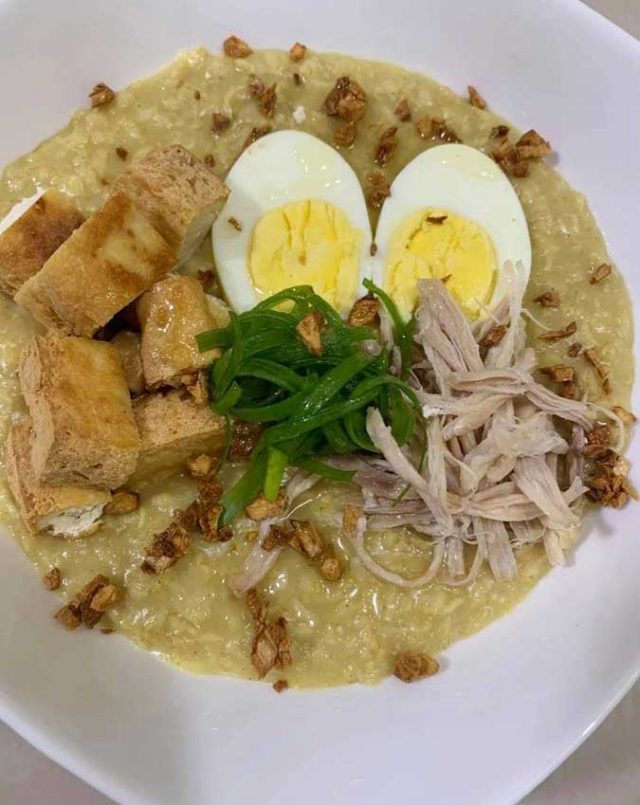
Oatmeal Curry Lugaw with Hard Boiled Egg, Fried Tokwa, Shredded Chicken, Toasted Garlic and Leeks by Chef Zemir Herrera-Rollan

LAST week we presented three iterations of lugaw — the quintessential Filipino rice porridge — created as a result of the De La Salle-College of Saint Benilde (DLS-CSB) Culinary Cluster’s Lugaw Challenge which saw 10 culinary experts from the School of Hotel, Restaurant, and Institution Management give their own twist on this favorite Filipino comfort food.

This week we present three more of the recipes the chefs developed.

CURRY OATMEAL LUGAW
Recipe by: chef Zemir Rollan, De La Salle-College of Saint Benilde Part-Time Faculty for Principles of Menu Planning and Food

“My lugaw is a healthier version, for I opted for whole grain rolled oats instead of glutinous rice. These are high in fiber and can help reduce cholesterol.

“My inspiration for my dish is my husband, because he eats oatmeal with honey and milk every morning. To change it up, I decided to bring a new spin to his familiar breakfast.”

Ingredients:

480 grams whole rolled oats

250 grams chicken breast

10 grams curry powder

5 grams salt

5 grams leeks

2 eggs, hard boiled

2 grams garlic, fried

50 grams tofu, fried Pepper to taste

Procedure:

1. Boil the chicken in 750 ml water. Reserve the chicken stock to cook the oatmeal.

2. When the chicken is cooked, shred it into pieces.

3. Cook the whole rolled oats in the chicken broth. Add water if necessary.

4. Simmer for 10-15 minutes.

5. Season the porridge with curry mix, salt and pepper.

6. Once cooked, place it in a bowl and garnish with fried tofu, leeks, shredded chicken, hard boiled egg and fried garlic.

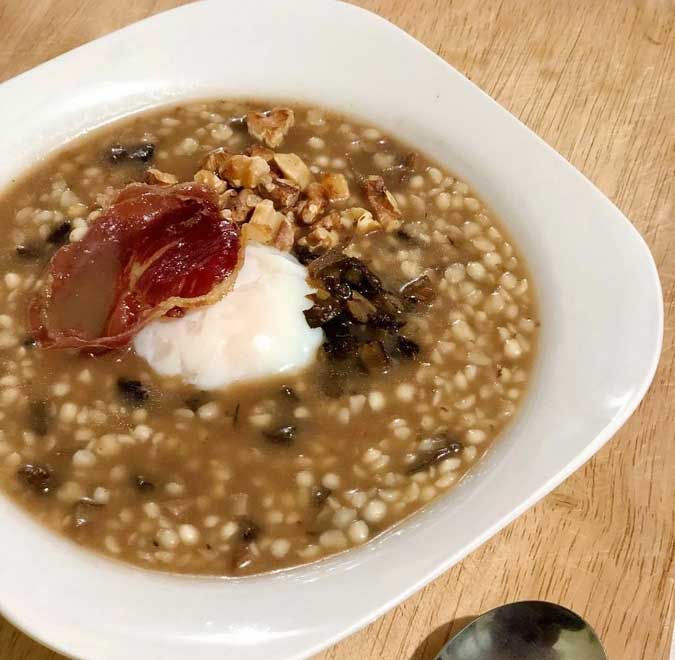
WILD MUSHROOM AND ADLAI LUGAW SERVED WITH SOUS VIDE EGGS, CRISPY PANCETTA, TOASTED WALNUTS, AND ROSEMARY OIL
Recipe by: chef Jade Christopher Lee, De La Salle-College of Saint Benilde Professor on Principles of Menu Planning and Food Production, Professional Cooking, Garde Manger and Charcuterie, Poultry and Meat Cookery, International Cuisine, and Food Safety and Sanitation

“The inspiration for my lugaw recipe are my travels to Italy and my love of Italian cuisine. I live by the words Il cibo é l’essenza della vita, meaning, food is the essence of life.

“The core of Italian cooking is its simplicity. We must use the freshest ingredients possible and use cooking techniques that enhance and highlight the natural flavor of food. Food is a way of life, meant to be enjoyed and savored!”

Ingredients:

6 eggs

100 ml olive oil

10 grams fresh rosemary leaves

200 grams white onion, large dice

100 grams carrots, large dice

100 grams celery, large dice

1 grams whole black peppercorns

1 grams fresh rosemary

½ gram bay leaf

5 grams garlic, peeled

2 liter water

30 grams dried wild mushrooms

30 ml rosemary oil

30 grams butter

100 grams white onion, chopped

400 grams adlai

1.5-2 liters vegetable stock, warm

Salt

Pepper

50 grams pancetta, thinly sliced

60 grams walnuts, chopped

Procedures:

1. Sous vide eggs at 145F or 63C for 1 hour and 30 minutes.

2. Combine olive oil and rosemary in a saucepan. Cook over low heat for 5-10 minutes. Oil should be warm and not hot.

3. Turn off the heat and leave the rosemary to infuse for at least an hour.

4. Using a blender, blend the infused oil and strain. Set the rosemary oil aside.

5. Place onions, carrot, celery, peppercorns, rosemary, bay leaf, garlic and water in a pot and simmer for 30-45 minutes. Strain and reserve the liquid.

6. Soak dried mushrooms in warm vegetable stock for 20-30 minutes. Strain and reserve the mushrooms and the soaking liquid.

7. Dice the mushrooms.

8. Heat rosemary oil and butter in a pan, sauté onions until translucent.

9. Add chopped mushrooms and sauté until slightly toasted.

10. Add adlai and stir until grains are coated in fat.

11. Add vegetable stock and the mushroom soaking liquid. Simmer until adlai grains are cooked about 30-45 minutes. Season with salt and pepper.

12. Cook pancetta slices until crispy either in a pan over the stove or in the oven. Set aside.

13. Toast chopped walnuts until fragrant and golden brown.

14. To plate: ladle a portion of lugaw in a bowl, crack a sous vide egg in the middle, sprinkle with toasted walnuts and crispy pancetta, and lastly, drizzle with a little rosemary oil.

Serves 5-6 people

MISO AND SHIITAKE LUGAW WITH MISO-GLAZED CHICKEN, SPICY PICKLED WOOD EAR MUSHROOMS AND RAMEN EGG, GARNISHED WITH NORI FLAKES AND SESAME CHILI OIL
Recipe by: chef Erica Aquino, De La Salle-College of Saint Benilde Part-Time International Cuisine Lecturer

“When we were picking our themes, the other chefs were mostly doing western versions of lugaw. I knew I wanted to do something Asian. When I looked around my kitchen, I noticed we had a lot of Japanese ingredients that I could use. This recipe was inspired by my obsession with ramen eggs and miso soup during last year’s quarantine.”

Miso Shiitake Lugaw:

2 pcs. Dried Shiitake Mushrooms

1 cup Hot Water

2 tbsp. Vegetable Oil

2 tbsp. Chopped Onion

1 tsp. Minced Garlic

1 tbsp. Grated Ginger

3 tbsp. Red Miso Paste

½ cup Japanese Rice

2 cups Low-Sodium Chicken Stock

Salt and Pepper to taste

Miso-Glazed Chicken:

250 grams Skinless Chicken Breast

Salt and Pepper

Miso Marinade:

1 tbsp. Red Miso Paste

1 tsp. Hot Water

1 tbsp. Light Soy Sauce

3 tbsp. Brown Sugar

1 tbsp. Mirin

1 tsp. Grated Ginger

1 tsp. Sesame Oil

Spicy Pickled Wood Ear Mushrooms:

5 grams Dried Wood Ear Mushrooms

1 cup Hot Water

¼ tsp. Salt

2 tbsp. Apple Cider Vinegar

¼ tsp. Salt

½ tsp. White Sugar

¼ tsp. Black Pepper

¼ tsp. Togarashi Spice Powder

1 tsp. Sesame Oil

½ tsp. Toasted White Sesame Seeds

Ramen Egg:

2 Large Eggs

Water for boiling

Ice water

Other toppings:

Sliced Spring Onions, optional

Seasoned Seaweed Flakes, as needed

Sesame Chili Oil, as needed

Miso-glazed chicken:

1. Season the chicken breast with salt and pepper.

2. In a bowl, combine marinade ingredients and set aside 2 tablespoons of marinade for glazing. Pour remaining marinade over chicken. Let marinate for at least 30 minutes before grilling.

3. Grill chicken on a preheated grill pan over medium high heat. Brush chicken on both sides with reserved marinade while grilling. Cook for 5-8 minutes or until cooked through.

4. Allow chicken to rest for 5 minutes before cutting into 1/2 -inch cubes.

Spicy pickled wood ear mushrooms:

1. Add ¼ tsp salt to hot water. Rehydrate dried mushrooms in salted water for 20 minutes.

2. Drain liquid from mushrooms and pat dry with a towel.

3. Cut the mushrooms into thin strips.

4. In a bowl, mix vinegar, salt, sugar, pepper, togarashi, sesame oil and sesame seeds.

5. Toss mushroom in vinegar mixture and let marinate for at least 30 minutes or until ready to use.

Ramen egg:

1. Boil water in a pot over medium high heat.

2. Lower heat to medium and gently place eggs in the water.

3. Boil the eggs for exactly 6 minutes and 30 seconds.

4. Remove eggs from boiling water and immediately place in ice water to stop cooking.

5. Keep in ice water until ready to use.

Miso shiitake lugaw:

1. Rehydrate dried shiitake mushrooms by soaking in hot water for 20 minutes.

2. Remove mushrooms from water and reserve mushroom stock. Slice mushrooms and set aside.

3. In a pot, heat vegetable oil over medium heat. Sauté onions, garlic, and ginger until fragrant and tender.

4. Add mushrooms and sauté for 2 minutes.

5. Add miso paste, chicken stock and reserved mushroom stock. Bring stock to a boil.

6. Add rice grains and lower heat to a simmer. Constantly stir the lugaw for 30-40 minutes until the rice is cooked and the mixture thickens.

7. You may add more water or stock to achieve desired consistency. Season with salt and pepper to taste.

To assemble: In a bowl, ladle lugaw and top with diced chicken, pickled mushrooms, peeled and halved ramen egg, nori flakes and sliced spring onion. Drizzle chili oil on top and sprinkle togarashi for extra spice.

For more lugaw recipes, go to Lugaw Challenge brings a new spin to the essential Filipino dish — BusinessWorld (bworldonline.com)