Home Blog Page 7987

Bridging the digital divide in the Philippines
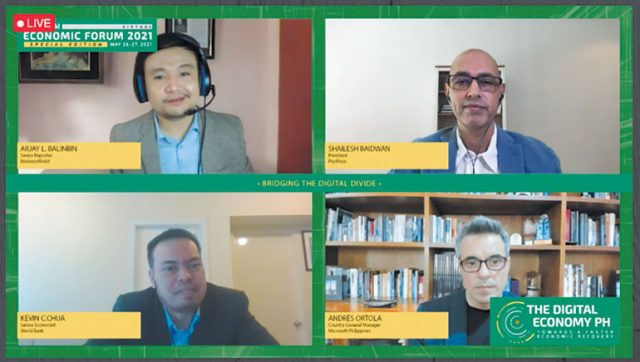
(Clockwise, L-R) Moderator Arjay L. Balinbin of BusinessWorld with panelists Shailesh Baidwan of PayMaya, Andrés Ortola of Microsoft Philippines, and Kevin C. Chua of World Bank for the session “Bridging the Digital Divide”

By Adrian Paul B. Conoza, Special Features Writer

As the push towards a digital economy gets accelerated, with the increased use of and preference for digital tools due to the COVID-19 pandemic, several related issues cannot be overlooked. Among them is the “digital divide” which simply indicates the lack of equity in access to digital tools such as the Internet and digital-enabled services such as electronic payments and online learning.

The Philippines Digital Economy Report 2020 of the National Economic Development Authority and the World Bank highlighted that the Philippines still experiences “a very significant digital divide”, with more than half of total households in the country lacking Internet access and fixed and mobile Internet penetration in the Philippines faring relatively low, compared to its Southeast Asian neighbors. This divide is seen to contribute to unequal access to services that are delivered via the Internet.

During a panel discussion in the BusinessWorld Virtual Economic Forum 2021 Special Edition, two heads from leading digital companies and an economist recognized the need to address this divide, while sharing their thoughts on how it can be done.

Sharing from the digital payments perspective, Shailesh Baidwan, president of PayMaya Philippines, noted that the advent of digital economy allows nearly everyone to participate in the formal economy. He also observed that as the push for digital payments is now taking a ‘natural momentum’ — with various sectors of society further appreciating digital payments — the opportunity opens to include more Filipinos into the financial system.

“For fintechs like us working with the government, the regulators, and other players in the industry, I think this is an opportunity to narrow and break the [digital] divide with financial solutions; and to bring the unbanked, the underserved, and what I call the unhappily served into the formal system,” Mr. Baidwan said.

The PayMaya executive pointed out three priorities in bridging the digital divide, namely bridging online and offline and vice versa; moving at an accelerated pace to include the unbanked sectors; and working on a bigger and deeper digital talent pool.

“The solutions need to be built on automated and digital platforms that can serve large volumes. [We should also] provide sachet-sized financial services in a cost-effective way,” Mr. Baidwan said about including the unbanked.

Giving insights from a broader perspective, Kevin C. Chua, senior economist at World Bank, highlighted several barriers that are causing the digital divide. These include gaps in material access, pertaining to gadgets and network connection; gaps in skills access, referring to digital literacy and competency; gaps in usage access, having to do with the systematic use of programs, applications, content, and services; and gaps in motivational access, which refers to the trust and confidence in using technologies.

Mr. Chua further noted that there are two determinants driving the digital divide. In terms of access, income becomes the determining factor, with well-off consumers more able to afford gadgets and connectivity. In terms of digital skills, age generates the gap, with the younger population being more tech-savvy and receptive to change.

The senior economist added that while there are indications that the digital divide may be narrowing in the Philippines, including surge in the number of Internet and digital payments users, much work remains to be done. “There’s a lot of catching up [which] will require addressing these barriers to material, skills, usage, and motivational access,” he said.

Mr. Chua recommends that devices, gadgets, and connections should be made more available and affordable by mobilizing the private sector and encouraging competition.

He also stressed the need to support the young and working-age population through education and digital skills training. “We need to encourage the young people to move beyond entertainment, gaming, and communication, into [learning] more advanced tasks, and education would be key to that,” he added.

Mr. Chua also finds it important to address the gaps in motivational access by building trust and confidence in the use of technology. “This involves strengthening cybersecurity measures, data privacy, and data protection ecosystem,” he said. “In e-commerce, we should set up a regulatory framework to protect both sellers and buyers from fraud and unscrupulous practices.”

Going deeper into other aspects of addressing the digital divide, Andrés Ortola, country general manager of Microsoft Philippines, noted the value of activating partnerships and collaborations especially in education, with many students struggling to access quality online learning.

“We must continue building coalitions, partnerships, and initiatives to tackle this digital divide,” he said, adding that public and private institutions coming together to tackle societal problems is needed to create new economies.

Mr. Ortola further stressed that the future of a digital society must be built in the pillars of trust, inclusion, growth, and security. “It’s our responsibility as leaders to ensure inclusive access, leverage technology to reach millions of people, and empower them with the necessary skills to thrive in the digital era,” he added.

He also said that while many technologies are already available, the greater challenge is driving innovation in a more pervasive way.

Among these technologies, the Microsoft executive noted the potential of cloud infrastructure to allow solutions to be deployed faster, more securely, and more broadly. “The Philippines is an ideal country for cloud,” he said. “Cloud would bring this level of resiliency and service that everybody needs.”
Clearer directions for organizations’ digital journeys

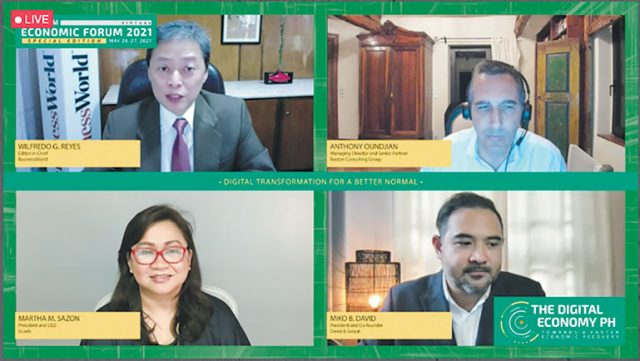
(Clockwise, L-R) Moderator Wilfredo G. Reyes of BusinessWorld with panelists Anthony Oundjian of Boston Consulting Group, Miko B. David of David & Golyat, and Martha M. Sazon of GCash for the session on “Digital Transformation for a Better Normal”

By Adrian Paul B. Conoza, Special Features Writer

Beyond being a buzzword in the business community, digital transformation has really become a turning point for many businesses as they rose from the impacts of coronavirus disease 2019 (COVID-19).

In efforts to curb the spread of the virus, digital tools have been sought to help organizations continue operations while ensuring safety and even add flexibility and convenience among workforces. Their digital journeys, nonetheless, are in progress, with much more opportunities to maximize, pitfalls to avoid, and concerns to prioritize.

The first panel discussion held during the BusinessWorld Economic Forum 2021 Special Edition last May 26 further explored how digital transformation can build a better normal for businesses, with two experts from business strategy and consulting firms and an executive from a leading digital platform sharing their insights.

Anthony Oundjian, managing director and senior partner at Boston Consulting Group, first noted that while COVID-19 has laid bare some gaps and triggered an accelerated digitalization, digital has already been helping build the country’s economic resilience even before recovery from the pandemic has been discussed.

“A lot of the continuity that we got was [brought] by some digital tools,” Mr. Oundjian said, citing the trends in remote work, electronic commerce, and online learning.

Nonetheless, the need remains to further build an environment that keeps in step with digital transformation, starting with initiatives such as the national identification system. “More investment in infrastructure, both from the public and the private sector, will certainly help us to be more resilient and stronger in the next crisis,” he said.

Mr. Oundjian also pointed out that digitalization is imperative for economic recovery, given that consumers are behaving differently and businesses are not going back to former ways of working and engaging with customers. At the same time, digitalization opens opportunities as it transcends physical borders.

“We see people looking for talents across the world when they used to look for it locally,” he explained. “If you are a talented data scientist in the Philippines, you have fantastic opportunities working at home. If you are a startup, you immediately have a broader reach.”

Mr. Oundjian also stressed that digital transformation does not start with technology, but with designing solutions to address consumers’ pain points. “Digital transformation starts with how we can make things easier, more intuitive for consumers or customers. The thinking needs to start there,” he said.

Citing data gathered by his firm, Miko David, president and co-founder of David & Golyat, shared that there are immense opportunities for businesses in rising consumption across different online channels, particularly social platforms and e-commerce marketplaces.

At the same time, levels of competition have become more intense in terms of capturing the online market, as indicated by increased advertising in online channels.

“Across the board, this is a theme we see for the economy. There are a lot of opportunities despite gaps and missteps that are happening [among both] leaders and other incumbents,” he said.

Mr. David noted that even traditional sectors have been quite good to adapt, particularly in terms of opening up more channels of communication, but the challenge to keep at pace with the accelerated push for digitalization remains among organizations.

“The biggest challenge for a lot would be translating their historical activities to these existing channels,” he said. “When you look at the options that they should utilize for their executions on digital, it’s not always translating as well.”

Mr. David added that organizations need to look into other dimensions such as their culture, structure, and strategy. He sees that such “enablement activities” can help improve employee morale and perseverance.

“Companies who have this culture or mindset of always being in the know and staying hungry to learn, test something, or just be aware of the market, actually end up learning from their mistakes really early and implement better than what their competitors have done,” he added.

Aside from highlighting how GCash has leveraged digital products amid the increased need for digital payments and transfers, Martha M. Sazon, president and CEO of Mynt (the e-wallet platform’s operator), noted the deepened appreciation for customer centricity.

“Because of the change in the conditions that we’ve seen, people are forced to reimagine the business in a way that will service the customers, in a way that will reach the customers even better,” Ms. Sazon said.

The executive also stressed that as long as there are friction points in the customer industry, there will be a reason for any competitor to play. “Customer is king. It’s always been like that, but more and more businesses are realizing and are lazer-focused on customer experience,” she said.

Ms. Sazon also noted that the current situation calls for transformative leaders who are agile and flexible.

“[One has to have] a growth mindset [and a] very entrepreneurial spirit that always finds opportunities to grow and frictions to address,” she continued. “[This should be] combined with empowering the organization, trying to spot that talent who can deliver and encourage collaboration among other parts of the organization.”

Destination up north: Ayala Land takes Central Luzon to new heights

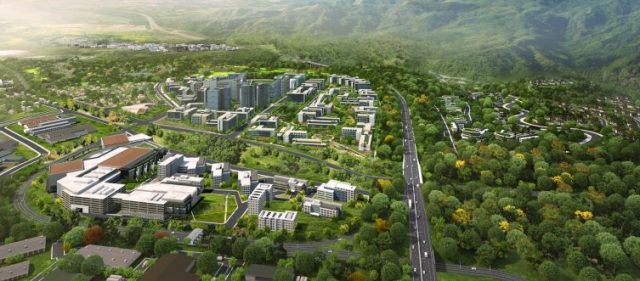
The Alviera Industrial Park is a 64-hectare eco industrial park for light to medium industries that will help generate work opportunities for communities within and outside the estate, which will further boost the economic potential of the region.

Propelled by economic movement and infrastructure support, Ayala Land’s Alviera in Pampanga and Cresendo in Tarlac are destined to be the region’s growth engines

While Metro Manila’s core and fringes are now filled with some of the country’s top urban centers, its northern neighbors in Central Luzon are bursting with fresh promise. The provinces of Pampanga and Tarlac are undergoing developments that will soon epitomize growth outside of the nation’s capital — as seen in the Alviera and Cresendo Estates of leading property developer Ayala Land, Inc. (ALI).

Combining a remarkable mix of economic energy and relaxing suburban pace, ALI’s Alviera and Cresendo estates are already showing vigor for high-investment potential. Top property consultancies recently reported a renewed interest in residential property purchases, particularly in places outside of Metro Manila. Colliers, in their first quarter report for the year, shared that house-and-lot investments are on the rise, with buyers’ preference shifting to spots outside of Metro Manila such as Central Luzon.

The commercial and residential interest in Central Luzon is further boosted by improvements in infrastructure, which will support the region’s thriving communities and maximize investors’ gains. One of the country’s major gateways, Clark International Airport, is strategically located in Angeles, Pampanga while ongoing national projects such as the Central Luzon Link Expressway-Phase I and Subic-Clark Railway are set to complement the existing North Luzon Expressway, Subic-Clark-Tarlac Expressway, and Tarlac-Pangasinan-La Union Expressway.

With market confidence and infrastructure in place, Alviera in Porac, Pampanga, and Cresendo in Tarlac City are poised to bring ALI’s seasoned and distinct development touch to the north, while enabling more opportunities for Filipino businesses, families, and individuals to realize their goals through integrated yet relevant commercial and lifestyle offers.

Consonance of lifestyles amid nature
Showcasing ALI’s master-planning expertise are Alviera’s four main districts which will comprise the 1,800-hectare development. Together, these districts will present a spectrum of settings for a lifestyle that seamlessly melds business, leisure, tourism, and education. ALI’s development ethos also ensures that Alviera will capture urban conveniences, while still being strongly grounded in nature, an intrinsic feature of the property.

Alviera’s first district is the City Center, the community’s central business district. Here, offices stand side by side with retail and commercial establishments that can house both local and multinational operations. The district also hosts the Alviera Country Club, a key lifestyle anchor and the first of its kind in Central Luzon. Residential spaces, parks, and open grounds round up this contemporary core, which will serve as the development’s nucleus.

The east and west sections of the property are also groomed for polar yet harmonizing features. Alviera East will host the new campus of the Holy Angel University, one of the region’s most esteemed institutions, while the 64-hectare Alviera Industrial Park will house light to medium industries which will provide work opportunities for communities in the area. The park is aimed to become one of Pampanga’s premier business hubs and will be open to PEZA and non-PEZA registered companies. On the other end of the property is Alviera West, which is designated for leisure and tourism-related establishments. Themed hotels, wellness centers, and recreational developments are set to rise in this part and will be fused with pockets of retail and residential spaces that look out to a rich natural landscape.

These three sections will be connected by the Alviera Greenbelt, the last of the estate’s four districts. This five-kilometer open space will be headlined by the La Salle Botanical Gardens, an environmental and educational facility with 25 themed gardens, a laboratory, a plant nursery, greenhouses, and libraries.

Historic charm in a city of the future
ALI has also moved further north to Tarlac City, the province’s capital. The 290-hectare Cresendo will amplify Tarlac City’s position as one of the Philippines’ high-potential cities as recognized in the Digital Cities 2025 report. With IT and business process management as new growth founts for the city, an integrated estate like Cresendo can help supercharge Tarlac City’s development trajectory.

Cresendo Downtown will feature shophouse lots that will allow employees
and entrepreneurs to live right by their business ventures — a viable location
for future micro, small and medium enterprises.

Cresendo is built with local elements as inspiration, promoting design and an estate plan that calls to mind poblacions from the province’s storied past. The vision is to keep Tarlac City’s charming local character while propping it for expansion and growth through the property.

Cresendo Downtown and Cresendo Industrial Park are the estate’s main draws, each occupying 47 hectares and 32 hectares, respectively. Cresendo Downtown serves as the property’s set piece, housing commercial, civic and institutional establishments such as a church, a K-12 school, a technical training center and the focal Cresendo Town Plaza. This 1.5-hectare plaza will visually take visitors and residents to a bygone era while also providing modern comforts and areas for seasonal activities and community events.

Commercial lots will be available in the Cresendo Downtown together with micro commercial lots where Shophouse-style commercial spaces will be built in 20th-century architectural blocks, making this part of the estate a truly dynamic and unique spatial experience. These shophouse lots are aimed to serve small businesses whose owners and employees would opt to live next to their jobs and ventures.

Like its equivalent in Alviera, the Cresendo Industrial Park will support light to medium industries. The park will feature industrial lots with sizes ranging from 1,300 sq.m. to 15,000 sq.m. and is expected to provide 2,000 new jobs to Tarlac City’s residents and other nearby communities. ALI has reported manufacturing, packaging, logistics, and warehouse companies as new sign-ups in this new economic hub.

Navigating Cresendo also hails ALI’s use of natural scenery as the property boasts of 30% of open space. Cresendo will also have a 1.5-kilometer greenway for walking around while incorporating the 7-hectare River Terraces, a multi-functional sustainable garden.

Strong investment in new centers of growth
The creation and development of ALI’s Alviera and Cresendo Estates indeed define the next stage of growth in Central Luzon, while also providing businesses, families, individuals, and investors new opportunities. These estates are expected to benefit from the region’s rising economic potential as supported by public and private projects that aim to bring development outside of Metro Manila.

Those keen on riding on this wave of development can also rely on ALI’s long-held track record and expertise in property development, with an estate portfolio that corners the most sought-after properties in the Philippines. Everyone is invited to explore and join the movement towards modern communities up north with Alviera and Cresendo Estates.

Tracking the path towards a digital economy

Digitalization, related trends explored in BusinessWorld virtual forum

By Adrian Paul B. Conoza, Special Features Writer

Along the journey of organizations to adapt to the changes brought by the coronavirus disease 2019 (COVID-19) pandemic, one significant course of action that is regarded as necessary towards economic recovery is digitalization. In fact, the Philippines Digital Economy Report 2020 by the World Bank and the National Economic and Development Authority revealed that an opportunity already lies for the Philippine economy to hasten its recovery and build up its resilience by further embracing digital technologies.

BUSINESSWORLD President and CEO Miguel G. Belmonte opens the first day of the economic forum.

This discourse was continued during the special edition of the BusinessWorld Virtual Economic Forum, which was held last May 26 and 27. Themed “The Digital Economy PH: Towards a Faster Economic Recovery”, the online forum further explored the vision of a digital economy in the country and the initial steps that must be taken to realize such goal, along with underlying issues that must be resolved.

As BusinessWorld President and Chief Executive Officer (CEO) Miguel G. Belmonte shared in his opening remarks on the forum’s first day, the special edition of the forum picks up from the conversations from last year’s first BusinessWorld Virtual Economic Forum, which largely tackled digitalization. “[This year’s forum] would be a very good venue to tackle digital transformation as an urgent component in accelerating the country’s recovery and creating a stronger, more resilient, and sustainable economy,” Mr. Belmonte said.

BusinessWorld Executive Vice-President Lucien C. Dy Tioco delivers his welcome remarks on the forum’s second day.

Meanwhile, Lucien C. Dy Tioco, BusinessWorld’s executive vice-president, pointed out on the forum’s second day the need to fully accept and understand the changes that have recently taken place. “We were all anticipating to move forward without really understanding what has changed, its effects, and how to effectively solve it,” Mr. Dy Tioco said in his welcome address on Day 2, adding that the pandemic is teaching organizations to manage how the future should take shape by finding solutions to current problems.

The way forward

Starting off the forum with his keynote address, Fernando Zobel de Ayala, president and CEO of Ayala Corp., stressed that digital transformation, as the “the way forward towards a resilient, progressive, and equitable country”, goes beyond developing or pushing the latest technologies and so must take into consideration other factors.

“Meaningful and genuine digital transformation is deeply understanding our stakeholders’ needs and aspirations, and integrating technology to provide them with relevant and inclusive solutions,” Mr. Zobel de Ayala said.

While he observed that digitalization has made a tremendous impact on several sectors such as financial services, healthcare, and e-commerce, to name a few, Mr. Zobel de Ayala further stressed that the Philippines faces a “persistent challenge to ensure widespread and equitable access to digital infrastructure and the Internet.”

Ayala Corp. President and CEO Fernando Zobel de Ayala talks about “Accelerated by the Pandemic: Digital Transformation as the Way Forward” in his keynote address.

He said that a digitally developed economy should be built on reliable infrastructure, a national ID system, digital records and online access to services, and cybersecurity.

Among organizations, the Ayala Corp. president and CEO said that digital transformation should be accompanied by highly regarding the “fundamental components” of such shift which are the stakeholders.

“Specifically, institutions should be deliberate in deeply understanding stakeholder pain points and aspirations. There should also be a commitment to address underserved needs, most especially the inequalities the pandemic exacerbated,” he said, adding that holistic stakeholder understanding requires mining insight from both big data and small data.

Mr. Zobel de Ayala also emphasized that managing the complexities of the future of work lies in promoting greater flexibility and choice, where the main principle is to work where one is most effective for the job at hand.

The first day of the two-day forum continued with panel discussions on how digital transformation can enable a ‘better normal’ and how the digital divide in the country — a pressing issue in building a digital economy — should be bridged.

These were coupled with fireside chats on topics such as “Building the Foundation of Digital Resilience”, “Digitalizing the Philippine Economy Now”, as well as the Digital Payments Transformation Roadmap 2020-2023 of the Bangko Sentral ng Pilipinas.

Along the digital track

The forum’s second day took a deep dive into the trends that go along with building a digital economy, led by keynotes from Bernadette Nacario, country director of Google Philippines; and Kais Marzouki, chairman and CEO of Nestlé Philippines.

Google Philippines Country Director Bernadette Nacario shares her insights on “The Emerging New Economy: New Skills, Jobs, and Business Tools” in her keynote speech.

Discussing the topic “The Emerging New Economy: New Skills, Jobs and Business Tools”, Ms. Nacario of Google Philippines highlighted the opportunities that have opened up through digital transformation.

Citing the “e-Conomy SEA 2020” report of Google, Temasek, and Bain & Company, Ms. Nacario noted that many Filipinos went online “searching for solutions to their sudden new challenges”; while e-commerce has driven significant growth in the country at 55%, largely offsetting declines in travel and transport.

The overall Philippine ‘e-conomy’, she added, is expected to reach $28 billion in value in 2025, reaccelerating to a compounded annual growth rate of roughly 30%.

“The future is indeed bright. Yearly, our growing digital economy presents ripe opportunities for Filipinos,” Ms. Nacario said.

Barriers, however, still exist. Among these include challenges around talent, which the Google Philippines country director observes as “a key blocker that all sectors need to keep working on”.

To optimize such opportunities and address such barriers, she continued, Google is committed to invest in digital skills and education, as well as to provide tools and platforms for businesses. “Together with our partners from the public and private sectors, we will continue closing the gap in digital opportunity,” she said.

Nestle Philippines Chairman and CEO Kais Marzouki, in his keynote address, discusses “From Brown to Green Economy: Is the Philippines Ready?.”

Meanwhile, in his keynote on the readiness of the Philippine economy to transition from a brown to green economy, Mr. Marzouki of Nestlé Philippines noted that businesses are called upon by the pandemic to reflect and to act on their collective impact on the environment by transitioning from a fossil fuel-dependent brown economy to a sustainable green economy.

“In a green economy,” Mr. Marzouki explained, “growth in employment and income are driven by public and private investments into such economic activities; infrastructure and assets that allow reduced carbon emission and pollution; enhanced energy and resource efficiency, and prevention of the loss of biodiversity and ecosystem services.”

While getting to a green economy takes much more time as it involves a whole-of-society approach, Mr. Marzouki said that a “window of opportunity” is now open “to make brave new choices that will allow the country to grow economically within sound ecological boundaries.”

Panel discussions on the second day gathered thoughts on how a hybrid mode of work is shaping today’s workplaces, as well as on how an omnichannel experience is being realized in retail.

The fireside chats gathered insights on how organizations can build their brands through sustainability and purpose, as well as on how digital tools can be utilized by micro, small, and medium enterprises for them to survive and thrive amid the global crisis.

BusinessWorld Editor-in-Chief Wilfredo G. Reyes wraps up the two-day forum.

Wilfredo G. Reyes, BusinessWorld’s editor-in-chief, wrapped up the virtual forum, in his closing remarks. “The COVID-19 crisis made us a little bit more adept at promptly improving the way we do things even if this takes a complete overhaul. We need to mesh digital more into our strategies and not to treat it as something completely separate,” he said.

BusinessWorld Virtual Economic Forum 2021 Special Edition was presented by BusinessWorld Publishing Corp.; with co-presenter GCash; gold sponsors Cisco, Globe, Meralco, Radius Telecoms, and San Miguel Corp.; silver sponsors Ayala Group of Companies, BPI-Philam, FWD Life Insurance, Toyota, UnionBank, and Vista Land; bronze sponsors BDO, BPI, First Gen Corp., J&T Express, Mabuhay Energy Corp., PAGCOR, PayMaya, Pacific Cross, PLDT, Smart, SGV & Co, and SM Investments Corp.; partner organizations Asia Society – Philippines, British Chamber of Commerce Philippines, French Chamber of Commerce and Industry in the Philippines, Financial Executives Institute of the Philippines, Management Association of the Philippines, Philippine Chamber of Commerce and Industry, and Philippine Franchise Association; official TV partner OneNews; and media partner The Philippine STAR.

SM Foundation presents college scholar-graduates for 2020-2021

SM Foundation, in a virtual gathering, recognized the 219 SM scholar-graduates for 2020 and 2021 — 38 of whom graduated with honors/distinction.

SM Foundation’s Scholarship Program, which was established in 1993, aims to contribute in eradicating the intergenerational cycle of poverty in the country by giving scholarship grants to poor but deserving students. It has already produced almost 7,600 college and tech-voc scholar-graduates — enabling them to uplift the lives of their families out of poverty.



This program is anchored on the belief of SM Group late founder, Henry Sy Sr., that education is the greatest equalizer and that if he could help send one child to school, that child can then help his or her siblings finish schooling and together, they can help uplift their family out of poverty.

The Seasons Residences: Experience the seasons of Japan at the heart of BGC

The country’s first MITSUKOSHI will rise at Grand Central Park in Bonifacio Global City (BGC).

By Bjorn Biel M. Beltran

When you think of life in Japan, you think of the vibrant metropolis of Tokyo, the scenic mountainsides and hot springs, and cherry blossoms in spring. You may also think of the fascinating innovative technology, a rich and storied culture, and world-class cuisine. Indeed, the Japanese lifestyle is one that is evocative and immediately recognizable.

Federal Land, Inc., together with Nomura Real Estate Development Co., Ltd., and Isetan Mitsukoshi Holdings, Ltd., is bringing that lifestyle to the Philippines, as it aims to set a new global standard in the real estate industry through the premier four-tower residential development — The Seasons Residences at Grand Central Park.

Own a piece of Japan at The Seasons Residences in BGC.

The Seasons Residences is the country’s first residential project with a distinct Japanese concept and is located right at the heart of Bonifacio Global City (BGC), one of the country’s premier central business districts.

Grand Central Park in North BGC is a master-planned community home to the newest go-to-lifestyle district Grand Hyatt Manila, where people can live, work, shop, and dine. It is also very accessible, proximate to major highways, link roads going to Makati, Ortigas, EDSA, and transportation hubs like airports and bus terminals making it a very attractive option for those who like to be in the center of activity in the city.

BGC’s accessibility will further improve with the completion of various infrastructure projects such as the BGC-Ortigas Link Road, Mega Manila Subway, BGC-Makati Skytrain and BGC-NAIA Bus Rapid Transit.

The Seasons Residences, rising alongside Grand Hyatt Manila, is inspired by the four seasons of Japan. It is designed to fuse Filipino hospitality with Japanese efficiency, allowing its future residents to experience an elevated lifestyle at the heart of BGC.

It will bring the Japanese tradition of excellence, innovation, and artistry to the Philippines, elevating Filipino lifestyle through the introduction of Japanese technology and quality. Its architecture and design marry Japanese design, technology, and innovation with the Filipino sense of community.

The Seasons Residences amenity floor is influenced by the seasons of Japan, with the arrangement of the elements inspired by spring, summer, autumn, and winter.

The four residential towers — Haru (Spring), Natsu (Summer), Aki (Autumn), and Fuyu (Winter) — will feature Japanese design innovations and technologies to elevate your lifestyle with convenience, safety, cleanliness, and eco-friendliness.

Interest from home seekers and investors has continuously been high for The Seasons Residences since the launch of its first tower (Haru) in 2018. The third tower, Aki, is targeted to be launched in third quarter of this year.

Meanwhile, The Seasons Residences stays true to its name with an amenity floor influenced by the seasons of Japan, with the arrangement of the elements inspired by spring, summer, autumn, and winter.

A modern gym, zen garden amidst natural landscapes will evoke the fresh beginnings of spring, while the pool, karaoke room, and a game room call to mind the fun of summer. Quiet autumn is an inspiration to creativity, so a music room, reading lounge, and a business center is provided to accommodate that. Lastly, The Seasons Residences offers its authentic onsen or Japanese hot spring and spa to warm away the chilly weather.

The Seasons Residences also features a unique amenity offering called The Guest House. Inspired by traditional Japanese architecture, it will be made available for lease to relatives and friends of residents so they too can experience the lifestyle of The Seasons Residences homeowners.

Units at The Seasons Residences come with a sunken slab technology for convenient pipe maintenance and repair, Japanese storage system, as well as a shower toilet.

Finally, at the podium of The Seasons Residences will be the first MITSUKOSHI in the country. The four-storey mall will feature well-curated selection of Japanese fashion items, food and cosmetics brands, and will highlight the Japanese way of polite service known as Omotenashi.

Touted to be the ‘next Manila lifestyle’, MITSUKOSHI aims to become the new lifestyle destination in BGC. It is designed for customers living in today’s fast-paced environment, providing new and elevated retail experiences with a merchant selection ranging from splendid global labels to the best local retail names.

A beauty section will also be one of the highlights of the mall, serving as an anchor with luxury cosmetic brands. At the center of this section will be a modern beauty store by Isetan Mitsukoshi Holdings, Ltd., which will offer natural and organic cosmetic brands and beauty salon service.

At the basement level will be MITSUKOSHI’s signature depachika, a haven of top-shelf Japanese food and related products. It will feature a supermarket with a wide array of treats and produce, as well as food halls of international culinary offerings.

The mall will also feature well-loved Japanese accessories and household goods to introduce modern Japanese culture.

To know more about The Seasons Residences visit this website.

Bad loans ratio highest since 2009

BW FILE PHOTO

By Luz Wendy T. Noble, Reporter

SOURED LOANS held by Philippine banks continued to rise in April, bringing the nonperforming loan (NPL) ratio to its highest in nearly 12 years as borrowers’ capacity to pay debts were affected by the reimposed restriction measures.

The banking industry’s nonperforming loans surged 84% to P463.659 billion in April from P251.984 billion a year ago, based on central bank data posted on its website over the weekend. The April figure was also higher by 3.39% from the P448.44 billion in March.

This brought the system-wide NPL ratio to 4.35%, rising from the 2.31% in April 2020 as well as the 4.21% in March. This is also the highest NPL ratio since the 4.37% recorded in May 2009.

Bank loans are recognized as nonperforming once they are left unpaid for at least 30 days beyond the due date. These soured loans are risky to asset quality of banks as borrowers are likely to default on these debts.

Analysts said the reimposition of lockdown restrictions in late March hurt business activity and affected the capacity of borrowers to repay their debts.

“Many small businesses have had to shut shop as revenues plunged with the lockdowns. Household incomes have been disrupted due to job losses and salary cuts,” S&P Global Ratings analyst Nikita Anand said in an e-mail.

Metro Manila and four adjacent provinces were placed under the tightest form of lockdown for two weeks from late March to mid-April to curb a spike in coronavirus infections. Restrictions in these areas have since been eased.

“The recent lockdowns resulted to temporary and permanent closure of some businesses as well as temporary or permanent losses of some employment, thereby impairing the ability to pay by some borrowers, both businesses and individuals,” Rizal Commercial Banking Corp. Chief Economist Michael L. Ricafort said.

Banks also continued to recognize the rise in bad loans following the expiration of the loan payment extension under Republic Act 11469 or the Bayanihan to Heal as One Act (Bayanihan II) in December, further contributing to the rising NPL ratio, Mr. Ricafort added.

Due to the uptick in bad loans, banks remained risk averse, causing the total loan portfolio to drop by 2.47% to P10.649 trillion from P10.919 trillion last year and by 0.1% from the P10.66 trillion in March.

In April, past due loans rose 38.13% to P574.128 billion from P415.619 billion. This brought the ratio to 5.39% from 3.81% a year ago.

Restructured loans also increased 411% to P242.044 billion from P47.354 billion logged in April 2020. These loans made up 2.27% of banks’ credit portfolio from merely 0.43% last year.

Banks also continued to boost their loan loss reserves to P377.811 billion, up 58% from a year ago’s P238.675 billion. This brought the ratio to 3.55% from 2.19% a year ago.

Despite this, NPL coverage ratio — a gauge of allowance for potential losses due to NPLs — declined to 81.48% from 94.72% a year ago.

BSP Deputy Governor Chuchi G. Fonacier has said that banks’ NPL ratio may continue to climb to a little over 5% by the end of 2021. She assured the banking industry continues to remain stable as it has ample capital.

Central bank officials expect the Financial Institution Strategic Transfer (FIST) Law could bring down the NPL ratio by about 0.63 to 0.71 percentage point. Under the law, banks may sell assets or loans that will be recognized as nonperforming until Dec. 31, 2022.

The BSP estimates at least P152 billion in nonperforming assets (NPAs) will be offloaded by banks through FIST.

“We believe banks will wait and assess the impact of recurrent pandemic waves and vaccination progress to evaluate the amount of NPLs they want to sell,” Ms. Anand said, noting the law could help banks to focus on growth opportunities instead of spending on recoveries from stressed loans.

The central bank has released implementing rules and guidelines for financial institutions that seek to transfer their NPAs to FIST corporations. The BSP will be accepting applications for certificate of eligibility to sell these NPAs until Feb. 24, 2023.

No need to extend merger review suspension — PCC

By Jenina P. Ibañez, Reporter

MERGERS that have avoided government scrutiny since a suspension on some reviews could be difficult to unwind, a competition watchdog commissioner said as he urged Congress to retain the agency’s authority to assess mergers in the proposed Bayanihan III law.

Johannes Benjamin R. Bernabe, a commissioner at the Philippine Competition Commission (PCC), said he hoped Bayanihan III will not extend the exemption from compulsory notification all mergers and acquisitions with transaction value of less than P50 billion that were entered into two years from the effectivity of Republic Act No. 11494 or Bayanihan II.

“I just hope that (Bayanihan III) will not go in the direction of Bayanihan II, which had a last-minute insertion which curbed the powers of the PCC,” Mr. Bernabe said in a phone interview.

Signed in September 2020, Bayanihan II also suspended the PCC’s review of these transactions, conducted on its own initiative, for a year.

“That’s something that I hope Bayanihan III will not extend,” Mr. Bernabe said, noting that the proposed stimulus measure, which offers cash aid and wage subsidies, will help the Filipino people.

Mergers without PCC scrutiny could result in one entity’s market dominance of key sectors, he said.

“(The suspension) has nothing to do with trying to protect MSMEs (micro, small and medium enterprises) which are probably failing and in need or white knights or businesses that will acquire them or infuse equity in them,” the PCC official said.

Small businesses under standard PCC merger review thresholds prior to the measure would not have required a review.

Only companies whose parent company assets exceed P6 billion and whose merger and acquisition transactions exceed P2.4 billion were required to notify the commission, according to rules implemented in March last year.

Although the thresholds are usually adjusted yearly based on the nominal gross domestic product growth of the preceding year, the PCC did not set new thresholds for 2021 because of Bayanihan II.

House of Representatives passed House Bill 9411 or the Bayanihan to Arise as One Bill (Bayanihan III) last week. The Senate version was still pending at the committee level, as Senate leaders and Malacañang have signaled the measure is not a priority.

Mr. Bernabe said the commission would have liked to have reviewed certain mergers and acquisitions since the suspension, but he declined to name the sectors the firms belong to.

“I can think of one or two off the top of my head which probably deserve review, but if the P50-billion threshold is maintained it will probably avoid our scrutiny and that might not be to the long-term benefit of the country and our economy.”

Some acquisitions might result in some important sectors being controlled by one entity, he said.

“That entity will have dominance or market power which will allow it to control the flow of goods and services… once you acquire dominance over a particular phase of the value chain, and it gets cleared from any scrutiny by a competition authority, it’s going to be very difficult to unravel, to unwind such acquisition.”

Such dominant firms, he said, can control prices and service quality.

The PCC plans to resume reviews conducted on its own initiative after the year-long pause, unless Bayanihan III extends the higher threshold.

Francisco E. Lim, professor of Competition Law at Ateneo de Manila Law School, last year said that the provision will be good for business in the short term because less time would be required for transactions but noted that the commission may still challenge their validity post-transaction.

Investments in science, technology to get longest period of incentives

REUTERS
The Philippines is hoping to attract investments in science and technology sector. Photo shows vials of a coronavirus vaccine inside a lab at the Serum Institute of India, in Pune, India, Nov. 30, 2020. — REUTERS/FRANCIS MASCARENHAS

By Beatrice M. Laforga, Reporter

COMPANIES investing in science, technology and other sectors considered “critical” to the economy’s industrial revolution will be granted the longest period of incentives, according to the Fiscal Incentives Review Board (FIRB).

The FIRB last week adopted the Strategic Investment Priorities Plan (SIPP) framework, which sets the menu and length of perks for key industries eligible under the Corporate Recovery and Tax Incentives for Enterprises (CREATE) Act.

In a statement, the Department of Finance (DoF) said industries will be classified into three tiers based on their ability to make high-value and labor-intensive investments that will create more jobs and boost the country’s competitiveness.

Companies under Tier 3 will receive the longest period of incentives, with a total of 16-17 years of income tax holiday and special taxes or enhanced deductions for export companies and 11 years for domestic-focused businesses, based on a document sent by Trade Secretary Ramon M. Lopez on Sunday.

Export enterprise refers to a company who exports at least 70% of its total output, while domestic market enterprise should be registered with an Investment promotion agencies (IPAs).

The validity of tax incentives will also vary depending on the location of investments: shorter for those in the capital region and its nearby areas, while those in other areas will be longer by a year.

Tier 3 will include sectors that will play key roles in “structural transformation and industrial revolution” of the country, such as research and development activities; breakthroughs in health and science; generation of new knowledge; commercialization of patents, industrial designs, copyrights and utility models; and highly technical manufacturing activities.

Trade Undersecretary Rafaelita M. Aldaba said activities under Tier 3 would involve vaccine development and production; manufacture of 3D printers, drones, robots and electrical vehicles; predictive agriculture; new technologies; and innovative processes using artificial intelligence and machine learning.

For Tier 2, tax perks will be available for 15-17 years for export market activities and 10-12 years for local enterprises, while Tier 1 incentives will be available for 14-16 years for exporting companies and 9-11 years for those focused on domestic market.

Sectors under Tier 2 would include companies manufacturing supplies and parts not being produced in the Philippines, Ms. Aldaba said, adding this will promote local production and address gaps in the domestic supply chain.

For instance, production of iron, steel and non-ferrous metals, copper rods, plastics and synthetics in primary form, basic chemicals, pharmaceuticals, fiber optic cables, refined petroleum, semiconductor devices, and other electrical components, would be under Tier 2.

Ms. Aldaba said investments in Tier 1 sectors would generate a significant number of jobs, add value to products, and provide support to sectors critical to industrial development.

Tier 1 activities would include modern agriculture and food processing; design-focused industries like furniture, games and toys, jewelry and garments; energy efficiency and environment-friendly activities; health and medical products; industrial parks; and ports, airports and seaports.

Republic Act No. 11534 or the CREATE Act lowered the corporate income tax and reformed the country’s fiscal incentive system. Under the law, sectors that the government identified would enjoy income tax holidays for 4-7 years, then a special corporate income tax for 10 years.

Finance Secretary Carlos G. Dominguez III asked the Department of Trade Industry to select at least two potential foreign companies that are highly qualified in each tier level.

IPAs will then offer incentives to these companies to encourage them to set up operations in the country, Mr. Dominguez said.

Mr. Lopez said IPAs will serve as the “marketing arms,” on top of their existing function processing investment applications.

During the same meeting, the FIRB agreed that it will approve tax incentives for all investments worth at least P1 billion until the end of next year, while its technical committee will handle the approval for investments worth P1-3 billion starting 2023.

ECONOMIC BILLS
Sought for comment, John Forbes, senior advisor of the American Chamber of Commerce of the Philippines, said the list of priority sectors is “very appropriate” for American investors.

“The Philippines has many attractions but so does its regional competitors. The SIPP approach has been thoroughly studied by the government and the Congress and is very sensible,” Mr. Forbes said in a mobile phone message.

“Because the world is still in an extended period of depressed FDI (foreign direct investments), it will take time to identify new investments and market new reforms the government is still making, especially PSA (Public Service Act) and Retail Trade Liberalization (RTL) Act,” he added.

President Rodrigo R. Duterte earlier certified as urgent three bills that will ease foreign investment restrictions in the country, namely the amendments to the PSA, RTL and Foreign Investments Act.

“While we believe there are merits to such a classification, the more important aspect when attracting foreign investments to the country lies in the passage of economic reforms such as the amendments to the PSA, FIA and RTL,” Nabil Francis, president of the European Chamber of Commerce of the Philippines, said via Viber on Sunday.

Passing these reform measures will not only drive economic growth and create jobs but also level the playing field for businesses and promote competition, Mr. Francis said.

However, Mr. Forbes said new investments should still come from businesses already present in the country such as those in electronics and business process outsourcing sectors.

PHL needs flexible power plants amid rotating outages

PHILIPPINE STAR/ MICHAEL VARCAS

By Angelica Y. Yang, Reporter

THE Philippines needs to shift to flexible power plants and renewables, according to some experts, after rotating “brownouts” hit parts of Luzon last week.

Alberto R. Dalusung III, energy transition advisor of nongovernment organization Institute of Climate and Sustainable Cities, said the recent plant outages show that “reliability of our power plants is falling below expectations.”

The National Grid Corp. of the Philippines (NGCP) last week placed the Luzon grid under red alert for three consecutive days after four major coal plants cut more than 1,300 megawatts (MW) in available capacity.

Data from the Energy department showed that forced outages from four coal plants removed 1,314 MW of available capacity from the Luzon grid, while 435 MW from three units of a hydro plant were declared unavailable on Thursday. Meanwhile, some 484 MW was shaved off of KEPCO Ilijan Corp.’s gas power plant on the same day.

“We don’t need new baseload capacity…. The new plants that we need are renewables and (those that allow for) flexible generation or those which can adjust to varying levels of load,” Mr. Dalusung told BusinessWorld in a video call on June 4.

He noted that coal and natural gas plants are the ones that mainly provide baseload capacity.

“Coal is touted as one that (provides) cheap baseload capacity, and that it’s available 24/7. That’s not the only characteristic that we should bear in mind. The other characteristic is — not only is it available 24 hours in a day, you practically have to run it at that same level the whole day, every day. That’s not what our system needs,” Mr. Dalusung said.

Coal is considered as an inflexible plant, he said, because they can only adjust to a limited degree. “When they do that, they harm themselves because…you’re asking them to operate beyond their designed operating point,” he said.

Mr. Dalusung emphasized the country needs a grid which can deliver reliable power every day.

“If the country can generate power from various renewables, it only needs to run flexible power plants at certain hours of the day.”

On Thursday, the de-rated or reduced output of solar, hydro, geothermal, biomass and wind plants reached 1,558 MW. Of the amount, majority or 820 MW came from hydro plants. Mr. Dalusung said it is natural for hydro facilities to have low output during the summer season.

For his part, University of the Philippines Diliman Associate Professor Joey D. Ocon, who teaches energy engineering, told BusinessWorld in a June 4 e-mail that “the need for flexible power plants and energy storage is warranted with the increasing amount of variable renewables we are connecting to the grid.”

Green groups and consumer rights advocates cautioned against turning to fossil gas to ensure the country’s energy security.

In a statement, the Power for People Coalition said that the rotating blackouts and low power reserves is “a glimpse into sustained unreliability of power systems in the country, if it turns to another fossil fuel — natural gas — to address the Philippines’ power needs.”

Last month, the Senate committees on energy and finance approved of proposed Midstream Natural Industry Gas Development Act, which seeks to develop and regulate the industry.

WHO SHOULD BE BLAMED?
Mr. Ocon said that while the lack of supply could have been avoided early, the blame should not fall on one company or agency.

“But there’s obvious negligence on why we do not have enough operating reserve in the middle of the pandemic, where the demand is supposedly lower than what was expected years ago,” he said.

Mr. Ocon said generation companies need to ensure that their plants are in top shape to avoid unplanned outages. Meanwhile, the government has to be “proactive” in reducing red tape while enticing investments that increase the country’s operating reserves.

He said power consumers are now placed at a “disadvantage since they now have to pay the price of incompetence and lack of foresight.”

Terry L. Ridon, convenor of public policy think tank Infrawatch PH, said that the Department of Energy (DoE) has yet to slap penalties on erring generators whose plants went offline in 2019 and caused red alerts.

“Consequently, it has no penalty mechanisms on power plants involved in the current red alert situation. We maintain that (these) mechanisms should be undertaken on power generators that have been involved in unplanned outages, and price fluctuations in the spot market as a result of their activities should not be borne by the public,” he told BusinessWorld in an e-mail on June 4.

Mr. Ridon said that generating companies involved in the unplanned outages should pay the additional spot market charges. “This should be their market penalty for failing to contract standby power supply in the event of unplanned outages,” he added.

On Friday, the DoE said that red alerts on the Luzon grid are still likely to happen until this week if power plants do not return to service.

SEC extends deadline for transparency disclosures

THE Securities and Exchange Commission has extended to July 31 the deadline for the mandatory disclosures under Sections 6 and 8 of Memorandum Circular No. 01, Series of 2021 or the Beneficial Ownership Transparency Guidelines.

According to a notice on the commission’s website, the extension was given in consideration of the implementation of several lockdowns.

The circular provides transparency guidelines to prevent corporations from being misused for but not limited to money laundering and terrorist financing.

Section 6 covers required declarations for the incorporators, directors, trustees, and shareholders of stock and nonstock corporations applying for registration with the commission on or after the effective date of the circular, which fell on Jan. 29.

Under Section 6, a beneficial ownership transparency declaration (BOTD) form and consent agreement form are required for incorporators registering the corporation or on behalf of someone else, nominee incorporators, nominee directors or trustees, and nominee shareholders.

Nominee directors or trustees and nominated shareholders are required to disclose their principals, which may be a natural person or a juridical entity.

It must be made clear if directors/trustees/shareholders/incorporators are not nominees, and if the corporation was not applied for on behalf of another person. Non-nominated directors, trustees, shareholders, and incorporators of applicant corporations are required to submit a declaration and consent form.

Meanwhile, Section 7 of the circular requires nominee directors or trustees and nominee shareholders of existing stock and nonstock corporations to submit a BOTD form and a consent agreement form. — Keren Concepcion G. Valmonte

SEC flags Gaza’s digital currency Xian Coin

THE Securities and Exchange Commission (SEC) flagged Xian Coin, which is an unregistered “digital currency” promising big returns with Christian Albert Gaza or Xian Gaza as the sole issuer.

Xian Coin is said to be a centralized digital currency powered by the Etherium Blockchain traded exclusively by its coin holders. A blockchain or distributed ledger is a “peer-to-peer” database across computer networks, recording transactions that may never be altered.

“Unlike other digital assets which are decentralized and use consensus [mechanisms] such as proof-of-work/proof-of-stake or mining and whose value is dependent on supply and demand, Xian Coin is centralized, pre-mined or generated and whose supply and purported value is controlled by Xian Gaza,” the SEC said.

Xian Coin is not registered with the SEC as a corporation or as a partnership and it is also not authorized to solicit investments from the public.

It is also not registered as a Virtual Asset Service Provider with the Bangko Sentral ng Pilipinas, as required under Circular No. 1108, series of 2021, or the Guidelines for Virtual Asset Service Providers.

The advisory noted Xian Coin is not registered and traded with recognized cryptocurrency exchanges and has no particular use cases.

The commission also pointed to the “unsavory reputation” of Mr. Gaza to warn the public. Mr. Gaza apparently said he would be using the money generated from Xian Coins to support his “underground activities.”

Mr. Gaza has been the subject of another SEC advisory for his Cristiano Alberto Real Estate Fund.

The commission noted that Xian Coin does not have a white paper, which should detail how it will generate business, and neither does it have a working model that “[determines] how the money of the investors will make returns.”

“The scheme employed by Xian Coin clearly shows indication of a possible Ponzi scheme, where monies from new investors are used in paying ‘fake profits’ to prior investors and is designed mainly to favor its top recruiters and prior risk takers and is detrimental to subsequent member in case of scarcity of new investors,” the SEC said.

BusinessWorld sought comments from both Mr. Gaza and NYEAM VLOGS Facebook Page, where Xian Coin transactions are facilitated, but neither has responded as of writing.

The SEC reminded that those who are involved in the venture may be held criminally liable under the Securities Regulation Code, and may face a fine of up to P5 million, may be jailed for 21 years, or both. — Keren Concepcion G. Valmonte