Home Blog Page 7966

Ex-police chief says he may run for top position next year

SENATE PRIB

A SENATOR who is a former national police chief on Tuesday said he would either run for President next year or retire from politics.

Senator Panfilo M. Lacson, who lost to Gloria Macapagal Arroyo in the 2004 presidential election, said he would get Senate President Vicente C. Sotto III as his vice-presidential mate. “That’s already cast in stone,” he told reporters at an online news briefing about his choice of running mate.

“In case we decide, I have no other (vice president) besides the Senate president,” he said in Filipino. “We already agreed on it.”

Politicians seeking to run for office in the May 2022 elections have until October to file their certificates of candidacy.

Mr. Lacson said if he decides not to run, he would campaign for Mr. Sotto as vice president and help him look for a presidential running mate.

Mr. Sotto on Monday said he would be Mr. Lacson’s vice presidential running mate once he decides to run for President.

Mr. Lacson said that in their discussions, Mr. Sotto had wanted to be in charge of peace and order and illegal drugs.

He said he has done his part after serving as a senator for three terms. Under the law, he may still run for reelection next year for a second consecutive term.

Mr. Lacson said a coalition headed by retired Supreme Court Justice Antonio T. Carpio, 1Sambayan, had invited him to the group. But he would probably decline since he is one of the authors of the country’s Anti-Terror Act, which some members of the coalition have questioned before the Supreme Court.

Mr. Lacson said he would meet with the ruling Partido Demokratiko Pilipino–Lakas ng Bayan (PDP Laban) to discuss various agenda including politics and alliances.

The party earlier passed a resolution urging its chairman, President Rodrigo R. Duterte, to run for vice president next year.

Constitutional experts have said a potential Duterte vice presidency would circumvent a constitutional provision that says a sitting president “shall not be eligible for any reelection.”

Davao City Mayor Sara Duterte-Carpio was among those being considered by Mr. Duterte to become the party’s standard bearer in the 2022 elections, presidential spokesman Herminio L. Roque, Jr. said last week.

Also included on the list of Mr. Duterte’s presidential bets were former Senator Ferdinand R. Marcos, Jr., Manila Mayor Francisco M. Domagoso, Senators Christopher Lawrence T. Go and boxing champion Senator Emmanuel D. Pacquiao, Mr. Roque said. — Bianca Angelica D. Añago

Duterte appoints Bordado as next PHL Navy commander

PHLNAVY PHOTO

PRESIDENT Rodrigo R. Duterte has named Rear Admiral Adelius S. Bordado as the next chief of the country’s maritime defense, according to the presidential palace.

Mr. Bordado will be the next flag officer-in-command of the Philippine Navy, presidential spokesman Herminio L. Roque, Jr. told a televised news briefing on Tuesday.

Mr. Bordado, who will replace outgoing Navy head Giovanni Carlo J. Bacordo, will assume the position on June 9.

He had served as chief of naval staff, according to a report by the state news agency. He also headed the Armed Forces of the Philippines’ (AFP) education, training and doctrine command.

The appointment of a new Navy head comes at a time when hundreds of Chinese vessels were recently spotted in different areas in the West Philippine Sea.

Also on Tuesday, Senator Risa Hontiveros-Baraquel urged the Defense department to study a proposal that seeks to restructure the AFP to boost the country’s maritime defense.

“Our armed forces primarily consist of land forces. While we still do have internal security threats on land, I think there is no harm in studying how we can better equip our maritime forces, especially since China is not leaving our waters,” she said in a statement.

Citing Clarita Carlos, a former National Defense College of the Philippines President, the minority senator said the country’s armed forces are “configured for a continental country rather than an archipelagic one.” — Kyle Aristophere T. Atienza

Duterte to peruse advice of allies on his political future

PCOO

PHILIPPINE President Rodrigo R. Duterte will consider the advice of his allies regarding his future political career, according to the presidential palace.

This after two major allies, Senator Emmanuel D. Pacquiao and Taguig Representative Alan Peter S. Cayetano, discouraged him to run for vice president in next year’s polls.

The President is yet to decide on whether or not he would run for the country’s second highest post, “but he welcomes suggestions from everyone, lalo na galing sa malalapit sa kanya (especially those coming from people close to him),” his spokesman Herminio L. Roque, Jr. told a televised news briefing.

In an interview with ABS-CBN News Channel, Mr. Pacquiao asked supporters of Mr. Duterte and her daughter, Davao City Mayor Sara Duterte-Carpio, who is supposedly being urged to run for president, to “give others a chance.”

Mr. Cayetano, Mr. Duterte’s running mate in 2016, said it’s better for the President to become an “elder statesman” than run for vice president in the upcoming polls.

“Look at President Ramos, not everyone agrees with him and to be frank, he was not the most exciting politician. But naging (he has become an) elder statesman,” he said.

“I’m sure the President will listen to all these well-meaning remarks,” Mr. Roque said.

The ruling Partido Demokratiko Pilipino–Lakas ng Bayan (PDP-Laban) earlier passed a resolution urging its chairperson, Mr. Duterte, to run for vice president. The President was also allowed to choose his own running mate.

The President, 76, is barred by law from running for reelection.

Ms. Carpio, who is not a party member, was among those being considered by Mr. Duterte to become the ruling party’s standard bearer in the 2022 elections, Mr. Roque said last week.

Michael Henry Ll. Yusingco, a senior research fellow at the Ateneo de Manila University Policy Center, said the “Duterte for VP proposal is more of a PDP-Laban issue than a Duterte issue.”

“I see certain elements in the party probably feeling anxious of a possible Sara Duterte presidency given that she is not actually a member of the party,” he said in a Facebook Messenger chat.

Howard Calleja, a convenor of the opposition coalition 1Sambayan, said Ms. Carpio would not become a “unifying” leader, adding that she would only continue the controversial legacies of her father.

Mr. Calleja made the statement after former Defense Secretary Gilbert Teodoro, Jr., said the presidential daughter “would have the ability to unite a lot of people.”

Mr. Teodoro, who lost to Benigno C. Aquino III in the 2010 presidential elections, made the remark after meeting with Ms. Carpio at her office last week. — Kyle Aristophere T. Atienza

Immigration bureau extends policy on foreigners’ exit without ACR card

THE BUREAU of Immigration has extended its policy to allow foreign nationals with approved immigrant and non-immigrant visas to depart from the country whose alien certificate of registration identity card (ACR I-Card) are still pending.

In a news release on Tuesday, Immigration Commissioner Jaime H. Morente said the policy is extended until Dec. 31.

“In lieu of the ACR I-Card, the said departing aliens need only to present official receipts of the ACR I-Card waiver application fee and reentry permit or special return certificate,” Mr. Morente said.

Immigration Deputy Commissioner J. Tobias M. Javier, whose office processes ACR I-Card waiver applications, recommended the policy extension for the convenience of foreigners who wish to leave the country amid the pandemic. — Bianca Angelica D. Añago

PHL reiterates demand for P12-M compensation for fishing boat hit by Chinese vessel

PHILIPPINE representatives, in a meeting with Chinese counterparts Monday, demanded payment of the P12-million compensation for the owner and crew members of the fishing vessel that was destroyed after it was hit by a China-flagged boat in 2019.

“The Philippine panel reiterated the claim of the owner and the crew members of the F/B Gem-Ver1 for compensation for the damage sustained by the fishing vessel, for loss of income, and for moral suffering and mental anguish,” Justice Undersecretary Adrian F. Sugay told reporters on Tuesday.

The P12-million cost covers the boat’s repairs and related expenses worth P2.97 million, the fishermen’s lost income for six months estimated at P2.94 million, and P6.1 million in moral damages.

“The Bureau of Fisheries, for its part, undertook to coordinate directly with the (Department of Justice) to ensure that the owner and crew members of the F/B Gem-Ver1 are fairly and satisfactorily compensated for all damages sustained as a result of the collision,” Mr. Sugay said.

He added that “(w)hether or not the parties can still sue each other after payment of compensation, this has to be agreed upon by the parties.”

The meeting was hosted by the Philippine Embassy in Beijing and was attended by representatives from the Philippines’ Justice and Foreign Affairs departments, owners of the Gem-Ver fishing vessel, and members of China’s Bureau of Fisheries. — Bianca Angelica D. Añago

Davao ICT group warns vs lockdown strategy on coronavirus-infected BPO offices 

THE HEAD of a regional information and communication technology (ICT) sector group called on the Davao City government to reassess its lockdown approach in containing coronavirus transmissions in offices, citing its potential devastating effect on the outsourcing industry.

ICT-Davao, Inc. President Samuel R. Matunog said shutting down the physical base of business process outsourcing (BPOs) companies significantly disrupt operations, which could easily prompt clients to change service providers.

“In outsourcing, the BPO gets paid only for work done. That’s the source of the money they pay their employees. If the BPOs concerned are cooperative, and there are alternative ways of protecting workers from COVID-19 transmission while in the workplace, then lockdowns should be a response of last resort,” Mr. Matunog told BusinessWorld.

“My understanding is that center-based BPOs are willing to work with public health authorities to implement alternative measures to contain COVID-19 short of total lockdown,” he added.

ICT-Davao is the umbrella organization of the sector’s players in Davao Region, which covers five provinces apart from Davao City.

Davao City Assistant City Health Officer Marjorie D. Culas announced Monday that 403 call center agents in one of the BPO companies in Davao City tested positive for coronavirus disease 2019 (COVID-19).

The results were from surveillance testing of about 1,000 BPO workers. The health officer did not name the company, which has been placed under lockdown.

In the last week of May, BPO firm Teleperformance’s office was locked down by the city government after at least 44 workers tested positive for COVID-19.

Ms. Culas said there are currently 11 BPO companies with reported COVID-19 cases. She also noted that there have been “uncooperative” BPO firms that were found to have allowed employees with coronavirus symptoms to still report for work.

She added that contact tracers also faced difficulties getting information from patient on their close contacts.

The Labor department’s regional director, Ofelia B. Domingo, said they have inspected 14 BPOs so far this year. Of these, 12 were found compliant to health and safety protocols while the rest were given recommendations for improvement.

Apart from BPOs, the city government has ordered lockdowns on more than 20 establishments including government offices, banks, and food and dining shops. — Maya M. Padillo

Agri dep’t says Filipinos continue to fish in West Philippine Sea with gov’t support 

PHILIPPINE STAR/ MICHAEL VARCAS

INCREASED government presence at the West Philippine Sea has allowed Filipino fishermen to continue operating in the area, according to the Department of Agriculture (DA).    

The DA’s Bureau of Fisheries and Aquatic Resources (BFAR) said in a statement on Tuesday that 108 commercial fishing vessels from Bataan and Zambales, 20 from Pangasinan, 19 from Palawan, and two from Occidental Mindoro have been fishing in the West Philippine Sea since January.    

Agriculture Secretary William D. Dar said the West Philippine Sea has a significant share to the country’s food security due to its abundance of fish supply.    

“Our increased presence in the area, through the BFAR’s floating assets, is the DA’s way of ensuring that our fisherfolk are able to enjoy access to our fishery and aquatic resources in the West Philippine Sea, while ensuring at the same time that these activities are within sustainable and rational means,” Mr. Dar said.    

BFAR said there are currently five monitoring, control, and surveillance (MCS) vessels and one multi-mission offshore vessel deployed at the Kalayaan Island Group and one MCS vessel at the area of Bajo de Masinloc to protect and assist venturing Filipino fisherfolk.    

It added that programs on fisheries development and regulation are being provided to provinces and coastal communities facing the West Philippine Sea aside from patrolling activities.    

Recently, militant fishers’ group Pambansang Lakas ng Kilusang Mamamalakaya ng Pilipinas (PAMALAKAYA) said the income of Filipino fishermen operating near the West Philippine Sea dropped 70% due to Chinese presence in Scarborough Shoal.    

The group disclosed that the average income of a small fisherman fell to P300 compared to P1,000 per fishing trip and asked for government intervention.     

An arbitral ruling in 2016 rejected China’s claim that it had sovereign and historic rights in the South China Sea. Amid the ruling, the Philippines filed several diplomatic protests against China as a result of their intensified presence in the highly disputed area. — Revin Mikhael D. Ochave 

The enduring humanity of work

PHC.VECTOR-FREEPIK

Part 2

For those who want to understand better how the pandemic has impacted on the world of work, I would suggest a book written by famous journalist, Thomas L. Friedman, entitled Thank You for Being Late, with the sub-title “An Optimist’s Guide to Thriving in the Age of Accelerations.” He was also the one who explained to the non-specialist the complex process of globalization in another best seller entitled The World Is Flat. The key word is “acceleration.”

In this little over year during which the world has suffered from the tragic effects of COVID-19 virus that, as we pray in the Oratio Imperata “has disturbed and even claimed lives,” we have heard or read many times that the exponential growth of such activities as teleconferencing, e-commerce, online learning, and other IT-enabled daily activities was a result of acceleration. What could have taken three years without the pandemic was made possible in three months. I am sure that those of us who are among the non-techie senior citizens and had to force ourselves to adjust to new ways of attending board meetings, giving lectures or economic briefings, or just saying hello to relatives and friends, can identify with this observation. Without all the lockdowns in which we Filipinos were number one in the East Asian region, we wouldn’t have had the motivation to learn all those apps and algorithms with which we now have sufficient familiarity, after the patient assistance from younger members of our family (especially grandchildren for those over 70).

It is understandable that those of us who belong to the highly educated class in our society are focused on the uses in our professional work and other daily activities of such products of digital technology as Facebook, Twitter, the cloud, 4G, LinkedIn, Skype, and Big Data. We must not forget, however, that the vast majority of Filipinos have more modest requirements to be able to eke out a decent living for themselves and their families. We should take as our guiding principle in building the New Reality after the pandemic what Pope Francis wrote in his latest book, Let Us Dream: “For me it’s clear: we must redesign the economy so that it can offer every person access to a dignified existence while protecting and regenerating the natural world… What I also see — and this give me hope — is a people movement calling for profound change, a change that flows from the roots, from the concrete needs of people that arises from the dignity and freedom of the people. This is the deep change that arises from people capable of meeting, organizing, and coming up with truly human proposals.”

To avoid redesigning the post-pandemic economy along the lines of very developed economies or taking into account only the circumstances of the elite in our society, we should take a very close look at the present stage of our economy in what Friedman calls the age of accelerations. It does not take much reflection to realize that the vast majority of our people are still very much stuck in the first three stages of the industrial revolution, i.e., the age of mechanization, the age of electrification, and the electronics age. Although many of them have literally one of their fingers in the Industrial Revolution 4.0 through the smart phone that is ubiquitous in our country, the vast majority of them still make their living with the small plot of land they got as agrarian reform beneficiaries, the low-quality education they got from our schools, their physical strength, and whatever skill they can acquire on the job. Without neglecting the imperatives of making sure that our knowledge workers are able to constantly improve their ability to keep pace with the age of accelerations, we must devote more of our attention to investing in the human capital of the less privileged members of our society.

We must have what Friedman calls a “New Social Contract.”

He quotes from Byron Auguste, who cofounded Opportunity@Work, a social venture that aims to enable at least one million more Americans to “work, learn, and earn to their full potential” in the next decade. Auguste wrote that in a very major economic shift, a new asset class becomes the main basis for productivity growth, wealth creation, and opportunity. In the agrarian economy, that asset was land. In the industrial economy, it was physical capital. In the services economy, it was intangible assets, such as methods, designs, software, and patents. In today’s knowledge economy it will be human capital — talent, skills, tacit know-how, empathy, and creativity. These are massive, undervalued human assets to unlock — and our educational institutions and labor markets need to adapt to that. We must avoid a growth model based on assets or opportunities that are accessible only to a fortunate few. The massive redistribution of wealth that would be required to support such a society is not politically sustainable.

More than ever, we must focus on investment in human capital, especially in the poorer segments of society. Investing in human capital can produce a more dynamic economy and inclusive society, since talent and human capital are far more equally distributed than opportunity or financial capital. To give shape and direction to this focus on human capital, Friedman suggests three social contracts: those between workers and employers, students and educational institutions, and citizens and governments. He considers it the only way to create an environment in which every person is able to realize his or her full potential and human capital becomes a universal, inalienable asset.

To even begin designing such social contracts, we must have a clear idea of the actual human resources of the Philippines today. In 2020, the Philippine labor force (made up of all Filipino citizens who are over 15 years and who are actually looking for work) counted 42.9 million men and women. These are the people for whom we must redesign the post-pandemic economy so that each one of them can attain a “dignified existence” in the words of Pope Francis.

In financial terms, since the fundamental unit of each society is the family, each one of them must belong to a household that can earn at least P20,000 in real monthly income (which can be a combination of money and real goods and services). This is what UA&P economists have calculated as the threshold family income for an average family of five (parents with three children) in today’s prices.

Where do our workers earn a living? Information on this will give a clue to the types of social contracts that must be negotiated. Some 55% to 57% of the labor force are employed in Services; 23% to 25% work in agriculture as small farmers, farm workers, fisherfolk, and landless farmers; 19% to 20% work in industry, with 8% to 9% in the industrial subsection of manufacturing (other sectors of Industry are public utilities, construction and mining). Although only some 25% work in agriculture (farming and fisheries), if we include the whole value chain of agribusiness (post-harvest, agricultural inputs, logistics, food processing, and food retailing), the percentage jumps to as high as 65%, as recently reported in a column by foremost commentator on agricultural issues, Ernesto Ordoñez. That is why the most important solutions to providing work to the unemployed and underemployed will be found in the agribusiness sector. Attaining the top Sustainable Development Goals (SDGs) of food security and zero hunger will also automatically address the problem of providing more work. It is important to accelerate the Build, Build, Build program that is directly related to providing more farm-to-market roads, irrigation systems, post-harvest facilities and other infrastructures directly targeted towards the small farmers, especially the rice and corn farmers.

As regards the poorest of the poor among the farmers — the coconut farmers — the private sector has a significant role in helping consolidate the millions of hectares of coconut farms so that the small farmers can be organized either in cooperatives or as “corporatives” involving large investors (whether domestic or foreign) that can do the consolidation work to attain the necessary economies of scale that will enable the farm owners to get much higher value for the coconut products in the forms of coconut water, coconut sugar, coconut milk, virgin coconut oil and a host of other by-products of the coconut tree. I have often referred to two possible existing models of successful consolidation: that of Axelum in Misamis Oriental and Cardinal Agriculture in Brooke’s Point, Palawan. This is the social contract that should be made among the farmers, the Government, and the large corporate investor. A very important role is that of the Department of Agrarian Reform that, instead of continuing to focus on the fragmentation of coconut farms, should make sure that there is this necessary consolidation through cooperatives, corporatives, and other models that we can learn from countries like Malaysia, Thailand and Vietnam to finally redeem the coconut farmers from abject poverty.

Since more than 50% of the labor force are in the services sector, we should look for more creative ways of organizing service workers, both new and old, so that that they can attain what Pope Francis calls a “dignified existence.” We already referred to the challenge of improving the earnings and social security of the thousands of delivery riders who have been spawned by e-commerce. They should be regularized as employees and not as individual contractors. It should be top priority in the Build, Build, Build program of the Government to implement the P1.1-billion national bike lane project that will improve the safety of these bike riders.

We should also revisit the whole industry of Workers’ Cooperatives that have organized restaurant, household, and hospitality workers. It is time that we look at the way domestic workers are organized in more advanced economies like Hong Kong, Singapore, and some Middle Eastern countries where those who do household work like cleaning apartments, cooking meals, doing the laundry, are not live-in workers but actually have a life of their own and only report to their respective employers during limited hours of the week. They are treated as regular employees and are given the same social benefits as those who work for corporations. This approach can first be tried in the tens of thousands of condominium units that are dotting highly urbanized centers, not only in the National Capital Region but increasingly in the surrounding regions of Calabarzon, Central Luzon, Central Visayas, Western Visayas, Davao, Cagayan de Oro and others. The younger couples of today will increasingly find it difficult to enjoy the luxury of having the same live-in domestic helpers that their parents or grandparents had. They will have to increasingly do more of  their own household chores but would appreciate being helped these part-time service workers who can be organized as Workers’ Cooperatives.

The retraining, reskilling or upskilling of repatriated OFWs should also be on top of the agenda of human resource development programs of the Technical Skills Development Authority (TESDA) and affiliated organizations, such as the academe and industry associations. Philippine society owes a big debt to these OFWs who have sustained our economy through thick and thin. In fact, during the pandemic, their remittances to their relatives have hardly fallen, and in 2021, when there are still dark prospects for the economy, those who are still employed abroad are expected to increase their remittances for the whole year at 3% to 5%, contributing close to 10% of the country’s GDP. A recent study by the International Organization for Migration (IOM) reported in this paper indicated that more than three-fourths of those OFWs who lost their jobs, especially in the Middle East and had to return to the Philippines, are still struggling to find new jobs. Helping these repatriated OFWs to either go back overseas again or seek employment in the Philippines should be given the highest priority by both the State and the private sector.

I have just scratched the surface in identifying creative ways of negotiating social contracts between employees and employers as well as the citizens and the State in meeting the challenges of the New Reality resulting from the era of acceleration that has been made even more rapid by the pandemic. I would emphasize again that most of our efforts in crafting these new social contracts should be focused on the more disadvantaged members of our society, those whose family incomes for a household of five are less than P20,000.

To be continued.


Bernardo M. Villegas has a Ph.D. in Economics from Harvard, is Professor Emeritus at the University of Asia and the Pacific, and a Visiting Professor at the IESE Business School in Barcelona, Spain. He was a  member of the 1986 Constitutional Commission.

bernardo.villegas@uap.asia

An out-of-bounds tax regulation

MACROVECTOR-FREEPIK

Legislation is regarded as the domain of Congress. When the implementing agencies in the executive branch issue conflicting policies, then there are controversies that often involve a wide spectrum of stakeholders because of the detrimental effects of a provision that often snowballs into a national political issue with complex dimensions. We have seen how disjointed policies, whether deliberate or unintentional, can negate the laudable intentions of lawmakers and cause great damage to stakeholders if left uncorrected.

A new controversy of unaligned policy making has been exposed involving the wide spectrum of educational stakeholders who have been hardest hit by this pandemic crisis. The private educational sector, already heavily burdened by the disruptions of this crisis and, like most industries, in survival mode, must focus their resources and energies to delivering the quality of education of their learners. This critical sector is instead facing a hostile tax regulation never before seen in the history of Philippine education.

This serious threat to educational stakeholders is a provision in the recently released revenue regulation of the Bureau of Internal Revenue (BIR) that will significantly affect all private educational institutions. The agency issued Revenue Regulation 5-2021, slapping private educational institutions with a tax rate of 25%, making this regulation very controversial on so many levels.

Currently, the income tax rate for proprietary educational institutions stands at 10%. However, the new BIR revenue regulation — signed in April 2021 — will now exact 25%, a whopping 150% increase.

The rate of 25% in the revenue regulation released by the BIR wantonly disregards the will of Congress to grant a 1% tax rate for proprietary educational institutions from July 2020 until the end of June in 2023 as tax relief under the CREATE Law. In March of this year, after several reincarnations — from TRABAHO to CITIRA to CREATE — the second package of the administration’s Comprehensive Tax Reform Program finally passed into law. After failing to pass Congress in its earlier versions, the CREATE law — when it finally passed — was repackaged to supposedly make it more relevant and responsive to the needs of businesses negatively affected by the COVID-19 pandemic.

It is ironic that the revenue regulations released by BIR will accomplish the exact opposite of what the administration worked so hard to achieve — passing the CREATE bill — to the point of resorting to tax relief provisions to make the measure gain more support. Considering government pronouncements about its supposed response to businesses affected by the pandemic, this move is callous, insensitive, and a mockery to the stakeholders in the education sector. Increasing the tax rate by 150% at this time — or any other time — will have ripple effects that would all make the price of education much higher. It is, therefore, unconscionable, and contrary to the provisions of the Constitution that provides in Article XIV, Section 1 that the State shall take appropriate steps to make quality education accessible to all.

Any attempt to argue that accessible quality education can be achieved through the public school system may fall flat on its face. According to higher education data from the Commission on Higher Education, private colleges and universities produced 402,437 graduates in academic year 2019-2020, higher than the 394,139 from state universities and colleges (SUCs). From 2010-2020, approximately 3.7 million students from all disciplines graduated from private schools, accounting for about 50% of the Philippine education system’s output.

Aside from these reasons, the controversial revenue regulation strikes at the very heart of rule of law that dictates the fundamental need to respect the hierarchy of laws. In general, the Constitution which contains the principles that its government is obligated to uphold, reigns supreme. Next in line are the statutes or laws enacted by Congress. As we often hear, these laws must conform to the Constitution. Following statutes are the rules, regulations, and guidelines issued to provide administrative and technical details to carry out the purpose of the statute. These may be seen as delegated legislation.

How can a mere BIR issuance that fixes the income tax rate for private educational institutions at 25% be considered valid when the form and spirit of the Constitution is patently subverted and when Republic Act No. 11534 or the CREATE Law made by Congress puts that tax rate at 1%? Even removing all these technicalities, the burning question remains — how can an administration that professes to care for its people do something that clearly hurts education and, eventually, its people, especially now, during these trying pandemic times?

The BIR should immediately rectify this serious error that jeopardizes a strategic sector of the country.


Edwin P. Santiago has been an educator for 25 years in a private higher education institution. His main field is in development management and development finance.

Is air rage caused by class warfare?

PIKISUPERSTAR-FREEPIK

SINCE THE BEGINNING of the year, the Federal Aviation Administration (FAA) has reported a sharp uptick in the number of passengers behaving badly. In a typical year, the FAA logs between 100 and 200 incidents. In the first three months of 2021, it reported a whopping 1,300, despite the fact that the number of passengers was still well below normal levels.

It’s difficult to account for this recent uptick, but it’s hard to dispute that air rage has become a growing problem over the past few decades. The usual explanations — shrinking legroom, alcohol, and flight delays — have merit. But these are arguably overshadowed by a decades-long trend: the transformation of air travel from an elite prerogative to a service that divides passengers into haves and have nots.

This wasn’t a problem in the early years of aviation — and not necessarily because wealthy passengers were better behaved. Look carefully at the interior of the Pan Am Clipper, which crossed the oceans in the late 1930s. They featured comfortable beds, luxurious fittings, and delicious dinners served on china. These flying palaces gave passengers a remarkable amount of room to sit, lounge, walk and mingle. They weren’t claustrophobic in the least.

Most important of all, perhaps, was the fact that they weren’t stratified by class: Everyone enjoyed the same luxuries. There was no distinction between first class, business class and coach. Every passenger belonged to the elite.

The idea of different classes of passengers was born in the postwar era, but at first, this didn’t mean putting people into seats of different sizes and comfort levels. Instead, “coach class” in these years simply meant a ticket on a plane that made more stops. All passengers on these planes sat in precisely the same seats and enjoyed the same amenities and legroom as passengers on non-stop flights. It simply took longer to get to your destination.

The problem of air rage arguably traces its origins to a momentous shift in travel unleashed in 1952. That year, the Civil Aeronautics Board in the US and its global counterpart, the International Air Transport Association, began permitting flights that charged passengers different fares on the same flight. In 1955, planes began flying with different “classes” of seats. While first-class seats continued to enjoy amenities, coach-class seats began their long slide into discomfort, losing legroom with every passing decade.

Not coincidentally, it was precisely in these years that you can find the first expressions of concern over unruly passenger behavior. Conventional wisdom held that alcohol was to blame. Senator Strom Thurmond became the public face of reform, introducing legislation banning airlines from serving booze. He argued that children should not be corrupted by “flying saloons.”

The Civil Aeronautics Board disagreed. It reviewed all the cases of alcohol-fueled bad behavior, concluding that none imperiled other passengers, much less planes. Thurmond’s legislation went nowhere, though airlines adopted a “voluntary” pledge to make sure that passengers weren’t served more than two drinks each. In the end, the push to ban alcohol died out by the 1960s.

In the 1970s, high fuel prices accelerated the inequalities that increasingly defined air travel. As airlines struggled to make money, they crammed in ever more coach seats into the same space, while cutting amenities for coach-class passengers. Yet air travel remained highly regulated; individual carriers had little leeway in setting fares. But in 1978, President Jimmy Carter unleashed the power of the free market on air travel, deregulating the industry.

Airlines responded by creating ever more extreme distinctions between different classes of passengers. Passengers willing to withstand ever-shrinking levels of legroom and bare-bones service could now fly far more cheaply, if uncomfortably, sitting at the back of planes while their well-heeled counterparts enjoyed free drinks and plenty of room at the front. It was during this era that air rage suddenly became increasingly common.

An academic study of air rage incidents published in 2016 shed some light on the issue. It found that the presence of a first-class section made it 3.84 times more likely that someone in economy class would act out. This rage-inducing effect was equivalent to delaying a plane by 9 hours and 29 minutes. Likewise, making economy-class passengers board from the front of the plane — where they get to see the comfort enjoyed by first-class or business-class passengers — had a similar, if lesser effect.

Understood this way, the growing reports of air rage that appeared in the 1980s and 1990s weren’t a function of the fact that economy-class passengers found themselves crammed in ever-smaller seats, but that the inequality in seating arrangements grew, often dramatically, during these years. The bargain-basement seats grew ever narrower, while the business-class seats gained amenities. 

There’s nothing inherently wrong with this: narrower, more cramped seats are cheaper, enabling more people to travel. If they want the legroom, they can pay extra for it. But as this study makes clear, such rational thinking may not prevail when passengers find themselves parked on a runway in cramped, uncomfortable seats while they watch well-heeled customers relax, surrounded by creature comforts. That’s particularly the case when alcohol gets added to the mix, loosening people’s inhibitions.

Airlines have responded in predictable fashion, attacking the symptoms of the problem. They’ve trained flight attendants to disarm belligerent passengers and handcuff them. They’ve cut back on alcohol as well. But at the same time, the distance between the most comfortable and least comfortable on planes has only increased. It’s also gotten more stratified, with intermediate seating classes that, perversely, may foster more resentment.

There’s no obvious solution to this. Abolishing luxury seating isn’t particularly practical. But at the very least, the FAA may want to consider defining a reasonable lower bound to the distance between rows and the width of seats. Legislation passed by Congress in 2018 enjoins the FAA to do precisely that. But so far it hasn’t set these standards and shows no sign of doing so.

Which means that for now, air rage is likely to remain an issue for the simple reason that contemporary air travel hammers home the fact that social inequality is, quite literally, a pain in the butt.

BLOOMBERG OPINION

European firms plan to invest more in China after pandemic

Shanghai, China - STOCK PHOTO

EUROPEAN businesses are increasing investment in China and moving supply chains onshore after the quick recovery from the pandemic last year made China an even more important source of growth and profits.

Nearly 60% of European companies plan to expand their China operations in 2021, up from 51% last year, according to an annual survey by the European Chamber of Commerce released Tuesday. About half of the 585 respondents reported profit margins in China higher than their global average, a jump from the 38% recorded a year earlier.

“The resilience of China’s market provided much-needed shelter for European companies amidst the storm of the COVID-19 pandemic,” said the survey report. China’s quick containment of the virus and successful reopening of its economy early last year made it the main global growth driver in 2020, throwing a lifeline to European companies from French luxury giant LVMH SE to German car maker BMW AG.

A total of 73% of the survey respondents reported a profit last year, with another 14% breaking even. That was about the same level as in previous years despite the pandemic, showing how quickly the domestic market bounced back. Some 68% of the survey respondents were optimistic about the business outlook in their sector over the next two years, up from 48% last year.

Businesses are also expanding in China to further separate their operations in the country from the rest of the world, in order to avoid supply chain disruptions due to geopolitical tensions, according to the chamber’s report.

A quarter of the surveyed companies are “onshoring” their supply chains by moving production lines into China or switching to suppliers with local production, according to the chamber. Only 9% of firms said they were considering moving any current or planned investment out, the lowest level on record.

“The main point is to develop supply chain as much as possible here, as far as it’s possible, to provide what’s needed for the market here,” said Charlotte Roule, a board member of the chamber.

Companies are exposed to the threat of decoupling between China and other economies, with many reliant on imports for critical components or inputs that could be disrupted by restrictions or bans by other nations. A third of firms say that there are simply no viable alternatives to some of the equipment or components they import from abroad into China, leaving them exposed to production disruptions. Another 40% said that any alternative would be either more expensive or be of lower quality.

The political environment for European firms in China has become more difficult in 2021, with consumer boycotts of companies such as Hennes & Mauritz AB in March and Beijing and Brussels imposing tit-for-tat sanctions on each other over accusations of human rights abuses by China against the Uyghur population in Xinjiang. Even before that, more than 40% of the respondents in the February survey thought the business environment in China had become more political in the past year.

European companies continued to experience forced technology transfer, even though it’s banned by the Foreign Investment Law China enacted last year. Sixteen percent of respondents said they were compelled to transfer technology in order to maintain market access, unchanged from the survey a year ago.

Respondents are also concerned that China’s push for technology self-reliance will hurt businesses as it increases compliance costs and Chinese customers may increase their scrutiny of foreign services or even switch to local suppliers, the report said. — Bloomberg

Globe cracks down on organized crime after US and Australia sting

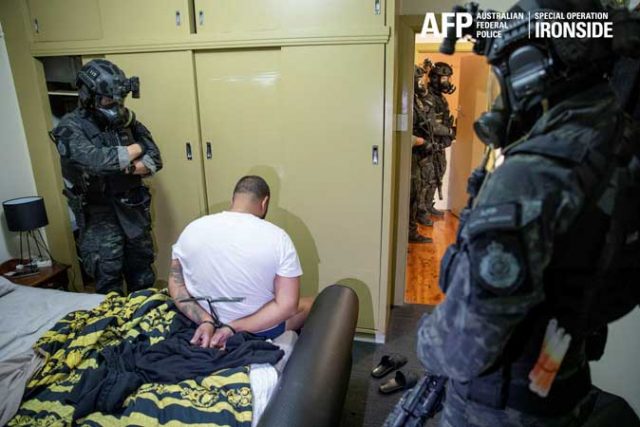
A person is detained by Australian Federal Police after its Operation Ironside against organized crime in this undated handout photo released June 8, 2021. — AUSTRALIAN FEDERAL POLICE/HANDOUT VIA REUTERS

CANBERRA — US and Australian authorities hacked into an app used by criminals to read millions of encrypted messages, leading to hundreds of arrests of suspected organized crime figures in 18 countries, Australian officials said on Tuesday.

“Operation Ironside” by Australian police and the US Federal Bureau of Investigation (FBI) ensnared suspects in Australia, Asia, South America and the Middle East involved in the global narcotics trade, the officials said.

Australian Prime Minister Scott Morrison said the operation “struck a heavy blow against organized crime — not just in this country, but one that will echo around organized crime around the world”.

“This is a watershed moment in Australian law enforcement history,” Mr. Morrison told reporters in Sydney.

Australian Federal Police Commissioner Reece Kershaw said police raids in 18 countries netted hundreds of suspects. Europol and the FBI said on social media they would hold news conferences later on Tuesday.

Australia said it had arrested 224 people, including members of outlawed motorcycle gangs, while New Zealand said it had detained 35 people.

The operation, which was conceived by Australian police and the FBI in 2018, saw officials in the United States take control of the ANOM messaging app, which is popular with organized crime networks.

When an Australian underworld figure began distributing customized phones containing the app to his associates as a secure means to communicate, police could monitor their messages. The gangs believed the system was secure because the phones did not have any other capabilities — no voice or camera functions were loaded — and the app was encrypted.

“We have been in the back pockets of organized crime,” Mr. Kershaw said at the same media briefing. “All they talk about is drugs, violence, hits on each other, innocent people who are going to be murdered.”

The messages were brazen and there was no attempt to hide behind any kind of code, he said.

“It was there to be seen, including ‘we’ll have a speedboat meet you at this point’, ‘this is who will do this’ and so on.”

Mr. Kershaw said the Australian underworld figure, who had absconded from the country, had “essentially set up his own colleagues” by distributing the phones and was a marked man. “The sooner he hands himself in, the better for him and his family,” he said.

One murder plot that authorities got to know of involved plans to attack a cafe with a machine gun, while a family of five was also targeted. Authorities said they were able to prevent these attacks.

Executing Australia’s largest number of search warrants in one day, police on Monday seized 104 firearms as well as almost A$45 million ($34.9 million) in cash.

A total of 525 charges have been laid but authorities expect more in the coming weeks. — Reuters

ADVERTISEMENT
ADVERTISEMENT