Home Blog Page 7929

IMF slashes PHL growth outlook anew

PHILIPPINE STAR/ MICHAEL VARCAS
A recent wave of new coronavirus infections likely slowed the Philippine economy’s recovery this year. — PHILIPPINE STAR/ MICHAEL VARCAS

By Luz Wendy T. Noble, Reporter

THE International Monetary Fund (IMF) sharply cut its growth projection for the Philippines this year, after a fresh wave of coronavirus disease 2019 (COVID-19) infections slowed the economy’s recovery.

Thomas Helbling, division chief of IMF’s Asia Pacific Department, said the Philippine economy is now forecast to grow by 5.4% this year, lower than its previous 6.9% projection, after the reimposition of tighter lockdown measures in Metro Manila and nearby provinces in late March.

The multilateral lender’s new gross domestic product (GDP) growth projection is also less optimistic than the 6-7% target set by the government for this year.

“The slowing in the recovery in the first half is mostly due to the second wave of the pandemic which peaked in April and necessitated some stricter quarantine measures and has also weighed on confidence. But now, hopefully, the second wave should be on the way out,” Mr. Helbling said at a virtual briefing where he discussed the preliminary findings of the IMF’s 2021 Article IV consultation mission that concluded earlier this month.

Restrictions have gradually been eased in the Philippine capital and adjacent provinces as the number of new COVID-19 cases has declined from the peak.

“The economy is recovering gradually as quarantine measures are eased. The recovery that began in the third quarter of 2020 should gain momentum,” Mr. Helbling said, citing the easing of quarantine measures, the vaccination campaign and macroeconomic policy support.

However, downside risks to the growth outlook include the possible resurgence of COVID-19 cases, and delays in the vaccination rollout due to lack of supply, he said.

“Risks of the virus resurgence will remain high until a sufficiently high proportion of the population is vaccinated,” Mr. Helbling said.

The Health department reported 5,414 new COVID-19 infections on Wednesday, bringing the number of active cases to 56,170. However, a spike in new cases has been reported in provinces.

Government data showed the Philippines had administered two doses of COVID-19 vaccines to 1.88 million people as of June 13. The government is targeting to inoculate 70 million Filipinos against COVID-19 this year.

REBOUND IN 2022
For 2022, the IMF raised its GDP forecast to 7% from the previous projection of 6.5%.

“The core of the forecast is that the health situation improves which will allow for economic reopening and also build confidence…. More businesses will increase activity, there will eventually be more investments including from the government side as restrictions are lifted, then you will have the multiplier effect,” Mr. Helbling said.

The IMF official said monetary policy should remain accommodative for the recovery to take hold.

“While the recent spikes in inflation should be closely monitored, the present monetary policy setting is appropriate as the current inflation pressure appears to be temporary and is likely to taper off in the second half of the year,” he said.

The IMF expects inflation to reach 4.2% this year, beyond the 2-4% target and the 3.9% forecast of the Bangko Sentral ng Pilipinas (BSP). Headline inflation is expected to ease to 3% by 2022.

Mr. Helbling said the government should utilize its fiscal space to support the needs of vulnerable groups affected by the lockdown, as well as to strengthen the healthcare sector.

“Priorities would still be to provide support to vulnerable households, and businesses hard hit. And then of course, really center of fiscal support should be the healthcare sector including the vaccination,” he said.

Mr. Helbling said the government’s infrastructure push will also be essential to recovery, as it will create much-needed jobs.

REFORMS
While the country has made “important progress” in terms of tax reform, digital payments, cutting red tape, and climate mitigation and adaptation, the IMF said more reforms are needed to ensure the country can reinvigorate the investment climate and return to pre-pandemic growth rates.

“Sustained efforts will be needed to reduce restrictions on foreign investment, fast-track the rollout of the national ID, scale up social protection, strengthen healthcare and education, and implement climate change commitments,” Mr. Helbling said.

The proposals to amend the Public Service Act (PSA), the Foreign Investments Act of 1991 (FIA), and the Retail Trade Liberalization Act of 2020 (RTLA) have been certified as urgent by President Rodrigo R. Duterte.

The amendments to the PSA and the FIA are pending in the Senate, while a Bicameral Conference Committee will still hammer out the final version of the RTLA amendments.

“We’re working with the legislature through the LEDAC (Legislative- Executive Development Advisory Council) on those priorities,” Finance Secretary Carlos G. Dominguez III said in a Viber message to reporters.

Senator Vicente C. Sotto III in a WhatsApp message said the discussions on the RTLA is already “in advance stages” and “will [be] passed upon resumption [of the session].”

Congress will resume session on July 26.

The IMF also warned the country should continue to strengthen its regulations against money laundering and terrorism financing to avoid being “gray listed” by the Financial Action Task Force.

Tourism contribution to GDP lowest in at least 2 decades

PHILIPPINE STAR/ MICHAEL VARCAS
Many tourism-related businesses have been affected by the strict quarantine restrictions implemented amid the coronavirus pandemic. — PHILIPPINE STAR/ MICHAEL VARCAS

By Ana Olivia A. Tirona, Researcher

THE TOURISM industry’s contribution to the economy plunged to its lowest level in at least two decades in 2020 amid the ongoing coronavirus disease 2019 (COVID-19) pandemic, Philippine Statistics Authority (PSA) data released on Wednesday showed.

Preliminary data compiled by the PSA showed tourism’s direct gross value added (TDGVA) accounted for 5.4% of gross domestic product (GDP) in 2020, down from 12.8% of GDP in 2019.   

This was the lowest in at least 20 years based on available data dating back to 2000. The last time the sector posted similar figures were in 2000 and 2002 when it contributed 5.6% to the country’s GDP during those years.

Tourism contribution to national output in 2020 smallest since at least 2000

Measuring the tourism-related value created by various industries, the country’s TDGVA was estimated at P973.31 billion at current prices, down 61.2% from P2.51 trillion a year earlier.

The decline in 2020 snapped the sector’s 11 straight years of growth, 10 of which were in double digits.

The TDGVA indicator is based on the results of the Philippine Tourism Satellite Accounts report, which the PSA compiles from the Department of Tourism (DoT). 

“The drop of tourism’s share in the GDP was to be expected considering that tourism has been virtually inactive since mid-March of 2020. This was a shame as we were anticipating in further increasing the industry’s share based on the growing interest in the Philippines as a destination,” said Tourism Congress of the Philippines (TCP) President Jose C. Clemente III in a Viber message.

John Paolo R. Rivera, associate director of the Dr. Andrew L. Tan Center for Tourism at the Asian Institute of Management (AIM), noted that prior to the pandemic, the country’s tourism sector has been averaging a 10% growth, similar to growth seen in remittances.

“[However,] the restricted movement of people, border closures, and quarantine protocols halted travel and tourism. The entire value chain of tourism was disrupted,” he said in an e-mail.

Domestic tourism expenditures, which cover spending of resident visitors within the country either as a domestic trip or part of an international trip, plunged 82.3% to P556.89 billion in 2020 from P3.14 trillion in 2019.

Meanwhile, tourism expenditure by non-residents amounted to P132.59 billion, falling 77.9% from the previous year’s P600.08 billion.

Compared with the country’s total exports, the share of inbound tourism expenditure was 2.9% in 2020 versus the 10.8% share in 2019.

Employment in the tourism industries was estimated at 4.68 million in 2020, or 11.9% of total employment. This was lower than the 5.72 million employed in the sector in 2019, or 13.6% of the working population.

On an absolute basis, tourism employment was lowest since the 4.56 million in 2012. Relative to the total working population, this was lowest since the 11.7% in 2011.

OUTLOOK
Mr. Clemente said that they do not expect the sector to return to pre-pandemic levels “until 2023 or 2024.”

“Projections are hard to give at the moment due to the fluid nature of the pandemic and with so many factors in play as well. It’s anyone’s guess right now,” he said.

Mr. Clemente said the TCP, along with other tourism-related organizations and the DoT, has been formulating market strategies to reflect emerging trends in travel that came about as a result of the pandemic.

“We have also been lobbying for the gradual reopening of the tourism industry to fully vaccinate tourists subject to health guidelines,” Mr. Clemente said.

“[W]e are optimistic that tourism will bounce back as our markets have indicated the willingness of people to travel to the Philippines once we can reopen safely,” he added.

Mr. Rivera noted the government’s financial and nonfinancial assistance to tourism enterprises and the “slow and calibrated” opening of tourism and the economy in general.

Among the assistance provided to the sector include the cash aid under the COVID-19 Adjustment Measures Program (CAMP) for affected tourism workers. In May, the Department of Labor and Employment reported that it has already given out P2.6 billion worth of CAMP assistance to over 520,000 tourism workers.

Another is the COVID-19 Assistance to Restart Enterprises for Tourism Rehabilitation and Vitalization of Enterprises and Livelihood program (CARES FOR TRAVEL), of which P6 billion in loans were reserved for tourism enterprises. The program is part of the Bayanihan to Recover as One Act (Bayanihan II).    

“Forecasting tourism recovery is dependent on the rate at which the Philippines is vaccinating…. It is definite that domestic tourism will recover first when travel restrictions are lifted. Foreign tourism will follow once borders have been opened again,” Mr. Rivera said.

“Once herd immunity is achieved and the economy can be opened, tourism will naturally follow,” he said.

DoF firm on keeping stimulus at P173B

FINANCE SECRETARY CARLOS G. DOMINGUEZ III — SEONGJOON CHO/BLOOMBERG

FINANCE Secretary Carlos G. Dominguez III said the government can only provide P173 billion in stimulus funds this year, as it is unsustainable to have the fiscal deficit exceed 9.3% of gross domestic product (GDP).

“If we are going to have another round of Bayanihan stimulus package this year, the economic team will work with Congress on looking for funding sources to ensure that it will not further widen our deficit,” Mr. Dominguez told reporters via Viber on Wednesday.

“It will be very unsustainable if we will have a fiscal deficit higher than what we estimated this year,” he said separately in a Senate hearing on Tuesday, as lawmakers consider a third stimulus package.

The economic team capped this year’s budget deficit at 9.3% of GDP.

Mr. Dominguez said they are “internally looking for the sources” to finance at least P173 billion of the proposed Bayanihan III. He said this package should be aimed at combating poverty and hunger, after the pandemic dealt a heavy blow on poor families.

Last year, the government allocated P275 billion for relief measures under Republic Act No. 11469 or the Bayanihan to Heal as One Act (Bayanihan I), followed by a second package worth P160 billion.

The House of Representatives passed House Bill 9411 or the Bayanihan to Arise as One Bill (Bayanihan III) which will provide more than P400 billion to help unemployed and hungry Filipinos amid a coronavirus pandemic.

Senator Juan Edgardo M. Angara on Wednesday said the Senate will tackle the third stimulus package when session resumes on July 26.

“Well the Bayanihan II expires at the end of this month. So siguro when Congress resumes, we can hear the different measures. It’s the right time to have hearings on Bayanihan III,” Mr. Angara, chair of the Senate Committee on Finance, said  at the Kapihan sa Manila Bay. “So end of July, mag-hearing tayo diyan.”

Meanwhile, Mr. Dominguez said they will remain open to Bayanihan III if lawmakers can identify other potential revenue-generating measures.

However, he said the Department of Finance (DoF) is not proposing any tax hikes to boost revenues, but instead looked for savings from the 2020 budget and asked state-run firms to increase their dividend remittances to P47.17 billion this year.

As of end-May, government-owned and -controlled corporations remitted P31.38 billion to the National Government.

FISCAL SPACE
The government faces growing fiscal constraints as the coronavirus pandemic persists.

Under National Budget Memorandum No. 141 published on Wednesday, the Department of Budget and Management (DBM) said the fiscal space is projected to shrink to P329.8 billion next year, or equivalent to 6.6% of the proposed P5.024-trillion 2022 budget.

This is drastically lower than the average fiscal space worth P714.4 billion each year from 2017-2021. The DBM identifies these excess funds to fund new and expanded programs every year.

More than half of next year’s budget or P2.743 trillion will be earmarked to ongoing programs and projects while 38.8% or P1.951 trillion will be allotted for automatic appropriations, which includes allocations to local government units, the National Disaster Risk Reduction and Management Fund, and the Contingent Fund.

DBM Secretary Wendel E. Avisado asked line agencies to “focus on the more pressing priorities” in crafting their budget proposals because of the limited fiscal space next year.

The government released P653.4 billion for its pandemic response as of April 15, according to the DBM. — Beatrice M. Laforga with inputs from Vann Marlo M. Villegas

Building material price growth eases in May

PHILIPPINE STAR/ MICHAEL VARCAS

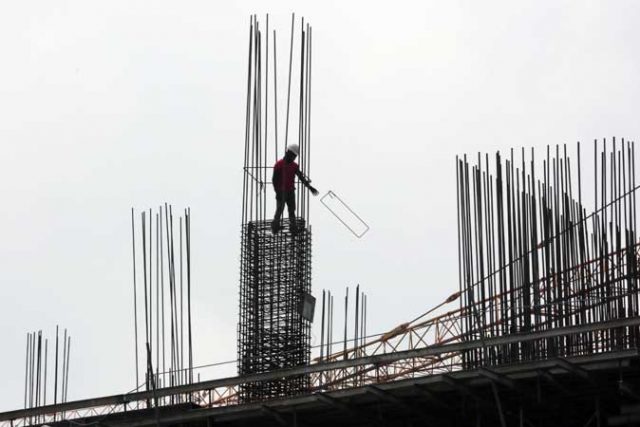
THE GROWTH in retail prices of construction materials in the National Capital Region (NCR) eased in May, the Philippine Statistics Authority (PSA) said on Wednesday.

Data from the PSA showed the NCR construction materials retail price index, which measures changes in the average retail prices of construction materials in the region, registered an annual growth of 1.2% in May, a tad slower than the 1.3% logged in April.

May’s preliminary result was driven by slower pickup in prices of carpentry materials (1.5% from 1.8% in April) and masonry materials (1.5% from 1.6%).

The year-on-year growth in other commodities remained unchanged when compared with the previous month: tinsmith materials (1.8%), painting materials and related compounds (0.9%), and plumbing materials (0.7%).

On the other hand, the indices for miscellaneous materials and electrical materials showed faster annual growth with 1.5% and 0.8%, respectively, from 1.2% and 0.5% in April.

In an e-mail, ING Bank N.V. Manila Senior Economist Nicholas Antonio T. Mapa attributed the slight easing of prices in May to the stoppage of some construction activities in April when stricter lockdown measures were implemented in Metro Manila and adjacent provinces.

The so-called NCR Plus was placed under an enhanced community quarantine (ECQ) from March 29 to April 11 amid a surge in coronavirus disease 2019 (COVID-19) cases. This was later relaxed to a more lenient modified ECQ from April 12 to May 14.

“Given expectations for faster economic growth and a resumption of construction activities, we can expect the index to accelerate in the coming months,” Mr. Mapa said.

“On top of demand dynamics, we are noticing a gradual uptick in global prices for commodities due to supply bottlenecks, a container shortage and the acceleration of growth in China and the US. Thus, we can expect construction materials to see an uptick in prices in the coming months with both the domestic and global economic activity accelerating,” he added. — Bernadette Therese M. Gadon

Megaworld’s REIT plans to raise P27B from IPO

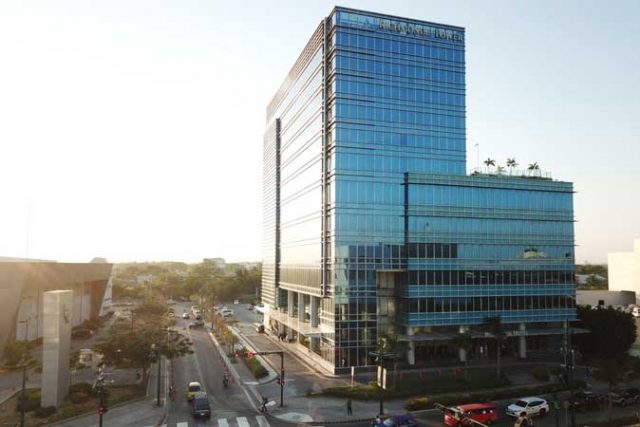
RICHMONDE Tower in Iloilo Business Park

By Cathy Rose Garcia, Managing Editor

MEGAWORLD Corp. is putting 10 of its key office assets into a real estate investment trust (REIT) that is aiming to sell up to P27.3-billion worth of shares in an initial public offering (IPO).

According to a prospectus filed with the Securities and Exchange Commission (SEC) on Wednesday, MREIT, Inc. is planning to offer secondary shares of up to 1.239 billion common shares at a maximum price of P22 per share.

“We are going to launch the largest REIT in the country. This will be the largest IPO of a REIT. We are launching a total asset size of about P55.6 billion for 10 properties. The size of the offering will be around P27.3 billion (including overallotment),” Kevin Andrew L. Tan, Megaworld chief strategy officer and MREIT president, told reporters on Wednesday.

The offer shares represent 49% of the company’s total issued outstanding capital stock, assuming the overallotment option is fully exercised. Megaworld will retain the remaining 51%.

Through a property-for-share swap, Megaworld put in 10 office, retail and hotel assets with a combined gross leasable area of 224,430 square meters (sq.m.) into MREIT.

The buildings are located within Megaworld’s major townships — Eastwood City in Quezon City, McKinley Hill in Bonifacio Global City, and Iloilo Business Park in Mandurriao, Iloilo City.

Included in the portfolio are: 1800 Eastwood Avenue, 1880 Eastwood Avenue, E-Commerce Plaza, One World Square, Two World Square, Three World Square, 8/10 Upper McKinley, 18/20 Upper McKinley, One Techno Place, and Richmonde Tower, which houses Richmonde Hotel Iloilo.

Mr. Tan emphasized that they chose only the office buildings with “Tier 1” tenants, mostly business process outsourcing (BPO) companies. He noted these office buildings have around 95% occupancy, with most lease contracts between five to 10 years.

“We have carefully selected the properties that we will be putting in here. We selected them for the quality of the buildings… and for the diversity, which includes location… We only choose those with the best quality tenants, superior BPOs. No POGOs (Philippine offshore gaming operators),” Mr. Tan said.

While only 10 of Megaworld’s office assets are included in MREIT, the company has identified four more to be injected in the next four years.

“Today, it’s 10 properties but Megaworld has 70 buildings, we have 1.4 million sq.m. (in office space). What we’re launching in the REIT is only 224,000 sq.m. and every year Megaworld builds an average of 100,000 sq.m. a year. In the last two years, we slowed down a bit… but we will accelerate again next year,” Mr. Tan said.

NGCP to seek bids for reserve power services

BW FILE PHOTO

By Angelica Y. Yang, Reporter

PRIVATELY-led National Grid Corp. of the Philippines (NGCP) said on Wednesday that it would hold a competitive public bidding for the supply of power reserves or ancillary services (AS) to fulfill government requirements and secure the “best value” for consumers.

“We want to guarantee the best pricing for AS, especially since this is a pass-on cost to consumers. With an open and public bidding process, we ensure full transparency and comply with internal governance imperative of accountability, which all our stakeholders deserve,” NGCP President and Chief Executive Officer Anthony L. Almeda said in an e-mailed statement.

AS are support services that help maintain the electric grid’s quality, reliability and security.

However, the NGCP official said that procuring reserves on either firm or non-firm arrangements will not solve the recurring brownouts or power interruptions.

“What we have is a supply and not a distribution problem. For the grid to effectively address imbalances between supply and demand, we need to increase the power capacity of the country to meet rising demand as we start to recover and fully reopen the economy,” he said.

Mr. Almeda reiterated NGCP’s stand that full firm contracting of reserves, which the Department of Energy (DoE) has mandated, will “only lead to a change in payment terms where all the power, used or unused, will be shouldered by the public.”

‘URGENT’ NEED FOR RESERVES
Separately on Wednesday, the Philippine Independent Power Producers Association, Inc. (PIPPA) said fulfilling the country’s need for ancillary services and allowing the entry of new plants would lessen the effects of forced outages on the power grid.

“There is an urgent need to fill in the ancillary services requirement of the grid and complement it with additional capacity with the entry of new plants. This combination will ensure that the impact of forced outages will be minimal or at a best-case scenario, no blackouts,” PIPPA said in an e-mailed statement.

The DoE previously flagged NGCP for not procuring enough firm-contracted reserves for the grid as of end-2020.

Last week, NGCP explained that if it implements the 100% firm-contracted requirement for AS, consumers will see spikes in their power bills — with typical households in Luzon, Visayas and Mindanao seeing increases of P128, P108, and P278 in their monthly electricity bills, respectively.

According to a DoE circular issued in 2019, NGCP is required to fully procure firm-contracted reserves to guarantee the grid’s reliability.

“(We) value compliance and strive for transparency and adherence to the industry’s rules and regulations,” PIPPA said, adding that it “fully supports the policies that will result to stability, security, and reliability in the energy system.”

The group added that it is awaiting the completion of transmission and connection projects, including the Mindanao-Visayas Interconnection Project (MVIP), which will link the Mindanao and Visayas grids. Once this happens, the country will be connected under one grid.

“In particular, for Mindanao, we would like to see the interconnection happen as there is currently an oversupply of energy which can be tapped and used properly,” PIPPA said, referring to the MVIP’s goal of allowing excess power to be exported where it is needed, subsequently helping prevent shortages.

“By linking the three grids and with firm contracting as per the mandate of the DoE, we can be confident that we have investors entertaining the build of new plants,” it added.

In February, NGCP reported that the interconnection project might not be completed by the end of this year after discovering portions of its fiber optic cable to be damaged.

The system operator earlier placed the Luzon grid under red alert, triggering rotating brownouts in portions of the major island for three consecutive days amid higher temperatures and forced plant shutdowns. A red alert notice is declared if the supply-demand balance deteriorates, bringing the possibility of power interruptions.

Mindanao Rail consultancy contract seen in June

By Arjay L. Balinbin, Senior Reporter

THE Transportation department is expecting to award the project management consultancy services contract of the Mindanao Railway Project (Tagum-Davao-Digos segment) this month, an official said on Wednesday.

Ito pong buwan na ito, tayo po ay umaasa na mai-award na po natin ‘yung kontrata doon po sa ating project management consultant (We are hoping to award the contract to the project management consultant this month),” Transportation Undersecretary Timothy John R. Batan said at a virtual press briefing.

The Department of Transportation announced in December last year its invitation to shortlisted Chinese consultants to submit bids for the project management consultancy services contract.

The China-funded project has an approved budget of P3.09 billion for the consultancy services.

The department requires the completion of the detailed design and works within 17 months, with 33 months set as the period for the contractor to be engaged in pre-construction activities and the defects notification period.

The railway project, one of the Duterte administration’s priority infrastructure projects, was originally scheduled to start construction in January 2019 but right-of-way issues, mainly in Davao City, held back the timetable.

The railway’s P82.9-billion first phase, covering the 100.2-kilometer Tagum-Davao-Digos segment, is financed through an official development assistance package from the Chinese government.

D&L plans to offer up to P5-B fixed-rate bonds

BW FILE PHOTO
PROCEEDS will be used to partially finance the company’s capital expenditures. — BW FILE PHOTO

D&L Industries, Inc. has filed with the Securities and Exchange Commission a registration statement and a preliminary prospectus for its P3-billion fixed-rate bonds, with an oversubscription option of up to P2 billion.

The offer will consist of three-year series A bonds due 2024 and five-year series B bonds due 2026, which will be listed and traded on the Philippine Dealing & Exchange Corp. once the company receives regulatory approvals.

If the oversubscription option is exercised, D&L expects to raise P5 billion in proceeds, which will be used to partially finance its capital expenditures (capex), repay bridge loans and interest costs incurred to fund its capex, and for other general corporate purposes.

“Capital expenditures related to the Batangas expansion project has been ongoing since the past year,” D&L said in its preliminary prospectus.

The facility in Batangas is being built on a 26-hectare property in First Industrial Township – Special Economic Zone. It will cater to D&L’s export business in the food and oleochemicals segment.

The expansion is said to be instrumental in the development of more coconut-based products and in the company’s plan to expand in new international markets.

“It will add the capability to manufacture downstream packaging, thus allowing the company to capture a bigger part of the production chain,” D&L said.

The company has been funding the project through bridge financing of short-term loans from partner banks.

“D&L intends to repay these bridge loans from the proceeds of the offer,” the company said.

The company engaged China Bank Capital Corp. as the sole issue manager, lead underwriter, and sole bookrunner for the offering.

D&L shares at the stock exchange improved by 2.13% or 17 centavos on Wednesday, closing at P8.15 each. — Keren Concepcion G. Valmonte

917Ventures: health technology demand surges

917Ventures, Globe Telecom, Inc.’s corporate venture builder, said on Wednesday that demand for services offered by its health technology platforms, KonsultaMD and HealthNow, is increasing as the pandemic crisis continues.

“Consultations made through KonsultaMD skyrocketed by 461% in 2020 compared to the previous year,” 917Ventures said in a statement.

Since its launch in August last year, the HealthNow mobile application has been downloaded over 240,000 times, it also noted.

KonsultaMD has been offering healthcare services for the past five years. The telehealth company has worked with the Health department to provide free telemedicine consultation to residents in the Philippine capital.

HealthNow, a collaboration between 917Ventures and ACHealth (Ayala Healthcare Holdings, Inc.), offers online consultations, medicine delivery, clinic appointments, and laboratory services.

917Ventures Managing Director Vince Yamat said, “We continue to reinvent lifestyle and movement through different products and services in the areas of health, e-commerce, financial technology, and advertising technology that deliver indelible value to consumers and businesses.”

Other Globe companies under 917Ventures are AdSpark, GCash, PureGo, and Rush.

“Being a venture builder, the company is constantly on the lookout for new ideas to launch and accelerate, to further improve the lives of Filipinos,” 917Ventures said. — Arjay L. Balinbin

Jollibee offers discount to vaccinated customers

THE Jollibee Group offers 10% discount for its vaccinated customers to make dining in even more rewarding.

SEVERAL brands under Jollibee Foods Corp. are offering vaccinated customers a 10% discount as part of a private sector initiative to encourage the public to get inoculated against the coronavirus disease 2019 (COVID-19).

“This discount promo is our way to thank our customers for getting vaccinated,” Jollibee Group Chief Sustainability and Public Affairs Officer Jose Miñana said in a statement on Wednesday.

“The vaccine is the solution that we have been waiting for to protect ourselves and our loved ones, as well as help revive our economy and livelihoods,” he added.

Vaccinated customers of Jollibee, Chowking, Mang Inasal, Greenwich, Red Ribbon, Burger King, Panda Express, and PHO24 may avail of the discount by presenting their vaccine card along with a valid ID. Specific terms for each discount promo are also available on the brands’ Facebook pages.

The 10% off promo may be availed for as many times as they want when they dine in at the restaurants until the end of August.

More than 150 restaurants in the NCR (National Capital Region) Plus bubble are part of the Smart Bakuna Benefits program of the private sector-led campaign, Ingat Angat. The full list of participating brands is available on www.ingat-angat.com/benefits.

Jollibee shares at the stock market closed lower by 3.81% to finish at P206.80 apiece. — Keren Concepcion G. Valmonte

Thai on a cloud

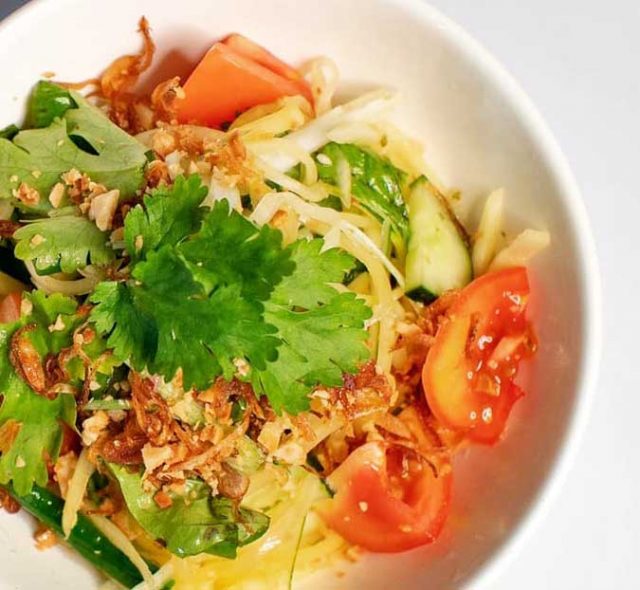
SOM Tam or Papaya Salad

Trying out chef Rob Pengson’s new cloud kitchen chicken restaurant

By Joseph L. Garcia, Reporter

PERHAPS it’s because Thailand was never really colonized by any European power, but nobody quite does Asian-tropical food quite like the Thais. Heavier colonial fare’s influence on its cuisine is minimal. Its dishes hit a sweet spot of being lively and light enough for days under the sun, but with enough heft and gravity to warm up the belly during one of the region’s rainstorms.

We were able to think of this while munching on treats from Miam Miam during a hot day last week. Miam Miam sent over a tray of its fried chicken, pad thai, and bagoong rice, and suddenly, sitting in the heat stopped being a chore.

The name itself isn’t even completely Thai, according to founder and celebrity chef Rob Pengson, who developed the dishes with his team (and especially giving thanks to his chef de cuisine). Miam Miam comes from a French phrase children use to say “yummy,” which Mr. Pengson overheard while in France many years ago, he said during a Zoom call earlier this week.

While developing the menu for different concepts, everybody at the table — partners and staff alike — liked the Thai offerings so much that they pushed the Thai dishes ahead of the others in line: through a cloud kitchen network, Mr. Pengson is developing about five brands at present, with a wings concept coming next. This comes at the heels of his present venture, a tapas bar called Beso Beso, which might open its rooftop for small events; but which is currently offering party trays and private dining at home.

CHOOSING CHICKEN
Going back to the name, its French provenance also allows for some slack when it comes to strict authenticity. “We’re not full-on traditional Thai,” said Mr. Pengson. “It can accept some kind of fusion from other cultures.”

For example, the pad thai, a spicy fried noodle dish, did not have the traditional prawns or chicken as in the original. For weight and flavor, Miam Miam’s version uses mushrooms. This is influenced by Mr. Pengson’s plant-forward diet, having been vegan for a period. “What we wanted was to strike a balance,” he said, citing that while he felt the benefits of a vegan diet on his health and planet’s, the lifestyle is still a bit away from the mainstream, and it wouldn’t be as popular. “We have to be realistic about it.” As a compromise, while Miam Miam is billed as a fried chicken brand, it has vegetarian and vegan options, such as the aforementioned pad thai, and the som tam papaya salad.

Asked why they decided on building their brand on chicken, their own market research via food delivery apps showed that “Fried chicken is very easy. Fried chicken is the number-one seller, everywhere in the Philippines,” said Mr. Pengson. “You have to have a version of fried chicken.”

The pad thai, by the way, was delicious. It was scattered with spring onions and herbs and had a spiciness that flirted with, and not bruised the tongue. The bagoong rice, laden with strips of green mango, was a similarly tasty experience. It’s unfortunate that the vibrancy of these dishes would outshine the fried chicken itself though.

The chicken is good — very good. It’s crispy, and it hits the right notes, and with a dip made from fish sauce, vinegar, herbs, and chili, it feels like a vacation in Thailand. “Every time we eat it here in the office, everyone always goes ‘miam miam,’” said Mr. Pengson.

We also have to commend the brand for delivering the chicken from Makati to Quezon City, and finding it steaming and still crispy. Not even the chicken chain a 15-minute walk from my house could do that. Still, sitting beside more flamboyant siblings like the pad thai, its flagship product takes a backseat.

CLOUD KITCHENS VS BRICK AND MORTAR
“The plan for the F&B brands is eventually to have brick and mortar restaurants,” he said. But of course, this is the plan for when things are safer and better. In the meantime, he and his team are making do with cloud kitchens. Weighing the advantages of a cloud kitchen vs a real restaurant, he said, “Less costs, for sure. But it’s a different game.”

“The pros are lower costs, and you can scale up to as many brands as your operations can handle. But for us, we want quality, so we’re only looking at five brands, max,” he said. On the other hand, “The cons are, everyone’s selling online, so it’s a completely saturated and competitive market. You have to really find ways to stand out.”

Cloud kitchens aren’t the only things Mr. Pengson has picked up from the ongoing COVID-19 pandemic. He gives his observations on how disaster after disaster on the restaurant industry has changed the atmosphere in kitchens. “More people treat each other more like colleagues now, and not like competitors,” he said. “Now, everyone takes care of each other.

“I think the industry gave a lot of attention to things that aren’t — I’ll use the word — essential. There was a lot of luxury, and vanity strategies: trying to get on this list, that award. But in reality, it’s good to be practical.”

To order from Miam Miam, call 0966-795-6709, message @miammiamchickenph on Instagram or @miammiamthaichicken on Facebook. It accepts orders from Monday to Sunday, 10 a.m. to 9 p.m., and is located at 257 Don Chino Roces Ave. Ext., Makati.

Alliance Select incurs losses on weak demand

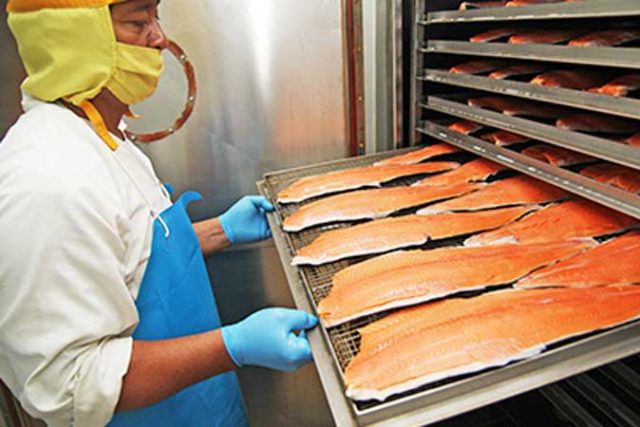
ALLIANCE Select expects its automation and equipment upgrade to improve the company’s production efficiency. — CORPORATE.ALLIANCESELECTFOODS.COM/

ALLIANCE Select Foods International, Inc. incurred net attributable losses in 2020 and in the first quarter of 2021 due to a slump in market demand caused by the health crisis.

“The prolonged COVID-19 (coronavirus disease 2019) pandemic has weakened market demand and resulted in higher freight and raw material costs,” the company said in a statement on Wednesday.

Alliance Select posted a $521,006 net loss attributable to equity holders of the parent company in the January-to-March period, a reversal of its $26,990 profit in the same period last year.

The company’s topline amounted to $8.58 million in the first quarter, 46% lower than $15.94 million in the same period in 2020 as higher freight costs led to deferred shipments.

“We have taken several initiatives to improve our market share in Asia and North America. Likewise, our recent capital investment for automation and equipment upgrade should improve our production efficiency and reduce cost,” Alliance Select Chief Executive Officer Raymond K.H. See said.

Last year, the company’s net loss widened to $10.24 million from $5.08 million the previous year.

Full-year net revenues went down by 26% year on year to $62.71 million from $84.88 million due to lower fish costs in other regions, resulting in lower sales prices.

The company said during its stockholders’ meeting on Wednesday that it continued to secure more orders to counteract the decline.

In 2020, Alliance Foods earned the top spot in the Greenpeace Southeast Asia’s Tuna Cannery Ranking Report for sustainability practices. It was ranked first in the Philippines for the second consecutive year, and third in Southeast Asia.

“[Alliance Select] aims to sustain its growth trajectory despite the challenges brought by the COVID-19 pandemic,” Mr. See said.

On Wednesday, stocks of Alliance Select at the local bourse went up by 8.06% or five centavos to close at 67 centavos each. — Keren Concepcion G. Valmonte

ADVERTISEMENT
ADVERTISEMENT