Home Blog Page 7750

Shares rise on bargain hunting, better earnings
COURTESY OF PHILIPPINE STOCK EXCHANGE, INC.

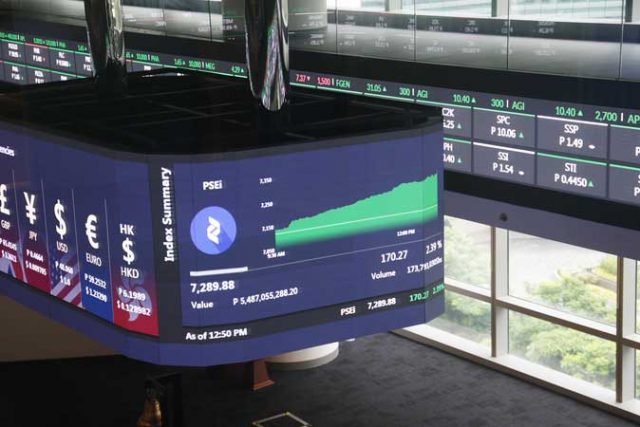
PHILIPPINE shares rallied on Monday as investors went bargain hunting and as sentiment improved after several companies released their earnings reports for the second quarter.

The Philippine Stock Exchange index (PSEi) gained 176.08 points or 2.8% to close at 6,446.31 on Monday, while the all shares index went up by 50.41 points or 1.28% to end at 3,985.27.

“Philippine shares were bought up on close after being heavily sold down last Friday as investors reassessed the impact of having the ECQ (enhanced community quarantine) imposed on the country,” Regina Capital Development Corp. Head of Sales Luis A. Limlingan said in a Viber message.

“More [second-quarter] results have trickled in, and many from the main index have performed above expectations, hinting that companies are slowly recovering or adjusting to the changing environment,” Mr. Limlingan said.

On Monday, PSEi member BDO Unibank, Inc. said it swung to profit in the second quarter with P11.043 billion in net earnings from the P4.5-billion loss it posted in the same period last year. Meanwhile, SM Prime Holdings, Inc. reported a P5.2-billion net income in the April to June period, up by nearly 148% year on year from P2.1 billion.

“Investors took opportunities out of the market’s slide causing the rise this Monday. Foreign investors helped in the rally,” Philstocks Financial, Inc. Senior Research Analyst Japhet Louis O. Tantiangco said via a separate Viber message.

“Trading had no conviction however… as many investors still chose to stay on the sidelines due to the lingering uncertainties on our COVID-19 (coronavirus disease 2019) situation and economic outlook amid the threat of the Delta variant,” he added.

“[The] sharp rise of the market was also helped by the low value traded, which may come across as negative but on the bright side, it signals continuing appetite for local blue chips,” First Metro Investment Corp. Head of Research Cristina S. Ulang said in a separate Viber message.

Majority of sectoral indices closed in the green on Monday except for mining and oil, which lost 249.06 points or 2.54% to end at 9,527.20.

Meanwhile, holding firms climbed 186.29 points or 2.97% to 6,451.57; property went up by 84.91 points or 2.89% to 3,019.48; financials improved by 35.44 points or 2.6% to 1,396.53; services gained 22.58 points or 1.48% to close Monday’s session at 1,547.81; and industrials rose by 123.52 points or 1.37% to end at 9,091.90.

Value turnover dropped to P3.54 billion with 1.5 billion issues traded on Monday, from the P6.27 billion with 1.81 billion shares switched hands on Friday.

Decliners outnumbered advancers, 119 against 78, while 46 names closed unchanged.

Foreigners turned buyers with P135.03 million in net purchases logged on Monday from the P1.60 billion in net outflows seen on Friday. — Keren Concepcion G. Valmonte
Metro mayors agree on 2-week 8-hour curfew

PHILIPPINE STAR/ MIGUEL DE GUZMAN

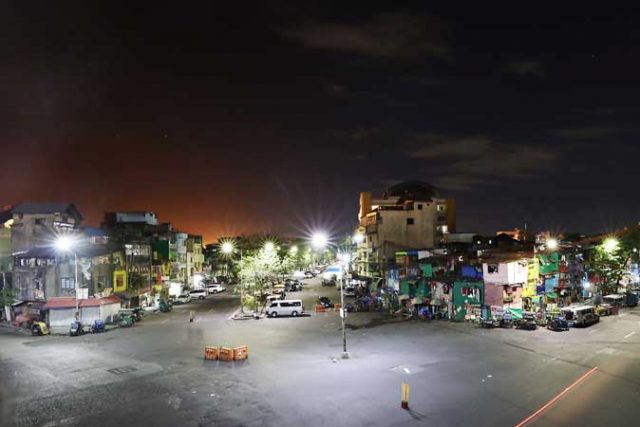
METRO Manila mayors have agreed to impose an 8 p.m. to 4 a.m. curfew starting Aug. 6, when a two-week strict lockdown takes effect to contain a more contagious Delta coronavirus variant.

Cities in the capital region will decide whether to impose a liquor ban, Benjamin de Castro Abalos, Jr., who heads the Metro Manila Development Authority (MMDA), told an online news briefing on Monday.

President Rodrigo R. Duterte has placed Manila, the capital ang nearby cities under an enhanced community quarantine until Aug. 20 amid a surge in infections probably spurred by the Delta variant from India.

The government also extended the travel ban on India and its neighbors until mid-August.

Makati, Taguig, Pasig and Las Piñas probably won’t ban liquor, unlike the cities of Valenzuela, Mandaluyong, Parañaque, Pasay, Navotas, Pateros, Quezon City and San Juan, Mr. Abalos said.

“When it comes to the liquor ban, each city will decide,” he said in Filipino.

Health Undersecretary Maria Rosario S. Vergeire said health authorities have detected 165 local cases of the Delta variant.

Of 216 patients who got the virus, 17 still have it, nine have died and 190 recovered, she told an online news briefing

Of the 17 active cases, 15 were local and two were returning migrant Filipinos, she said.

Ms. Vergeire said there was still no evidence that the Delta coronavirus is freely roaming in the community. “We need sufficient evidence for us to declare that there is already a community transmission.”

The Octa Research Group from the University of the Philippines on Sunday flagged a fresh surge in coronavirus infections in the capital region, suggesting that a more contagious Delta variant was freely moving in the community.

The capital region reported 1,740 infections on July 31, the highest since May 10, it said.

The weekly average of new coronavirus cases in the region rose by 40% to 1,279 from a week earlier, it added.

The increase could not be easily explained by Alpha or Beta variants that have been managed, OCTA Research fellow Fredegusto P. David said. There might be 300 new Delta variant infections daily in Metro Manila.

DAILY TALLY
The Department of Health (DoH) reported 8,167 coronavirus infections on Monday, bringing the total to 1.6 million.

The death toll rose to 28,093 after 77 more patients died, while recoveries increased by 9,095 to 1.51 million, it said in a bulletin.

There were 62,615 active cases, 93.9% of which were mild, 1.3% did not show symptoms, 2.1% were severe, 1.48% were moderate and 1.2% were critical.

The agency said 94 duplicates had been removed from the tally, 20 of which were tagged as recoveries.

Nineteen recoveries were reclassified as active cases, while 29 recoveries were classified as deaths, it added. Three laboratories failed to submit data on July 31.

Meanwhile, Interior Undersecretary Jonathan E. Malaya said Metro Manila residents who will get vaccine during the two-week lockdown would be allowed to leave their homes.

Cargo vehicles may enter and leave the capital region, while other vehicles would need to pass through checkpoints, he told an online news briefing.

Also on Monday, Justice Secretary Menardo I. Guevarra said unvaccinated people would not be discriminated against during the two-week enhanced lockdown in Metro Manila.

“There will be no distinction between authorized persons outside residence who have been vaccinated and those who have not received such vaccines,” he told reporters in a Viber group message. 

Mr. Guevarra said an inter-agency task force had made the decision since most Filipinos have not been vaccinated against the coronavirus.

Under the rules, only essential workers and people buying essential goods would be allowed to go out.

President Rodrigo R. Duterte earlier ordered police and village captains to bar unvaccinated people from leaving their homes during the enhanced quarantine period.

“If they refuse vaccination, barangay captains should not let them leave their house,” Mr. Duterte said in Filipino at a televised Cabinet meeting on Wednesday.

Meanwhile, Senator Mary Grace Natividad Poe-Llamanzares said vaccination cards should be used to facilitate mobility including that of Filipino workers seeking to travel overseas.

“Now that we are once again about to enter a two-week hard lockdown, we need to have a recovery plan for the economy to keep businesses from closing and more people from losing jobs in the pandemic,” she said in a statement.

Ms. Poe has filed a bill seeking to expand the use of the vaccination card from being a purely informative record to a document that a fully vaccinated person can use to travel locally or overseas.

“I totally support the move to have a unified vaccine card because it is easier to verify the authenticity of the information and will make mobility of Filipinos for travel easier,” said Sherilyn G. Malonzo, officer-in-charge of the Philippine Overseas Employment Agency.

“It will also make the job of enforcement officers easier,” she said in a Viber message. “This will also close the door for discretion and wrong judgment and even bias on the part of enforcement officers at checkpoints.” — Kyle Aristophere T. Atienza, Alyssa Nicole O. Tan and Bianca Angelica D. Añago

Metro residents to get P1,000 cash aid amid lockdown

PHILIPPINE STAR/ MICHAEL VARCAS

LOW-INCOME residents of Metro Manila will get P1,000 each in cash aid before a two-week enhanced lockdown that will start on Aug. 6, according to the presidential palace.

Budget officials were set to meet on Monday to decide where the cash aid, which will be limited to P4,000 per household, would be taken, presidential spokesman Herminio L. Roque, Jr. told a televised news briefing.

“It’s sure to be given away,” he said. “What we don’t know yet is where the money will come from. The President’s order was to look for funds.”

Think tank IBON Foundation has said the administration could realign the 2021 budget to fund more urgent concerns amid lockdowns spurred by a more contagious Delta coronavirus variant.

The Department of Budget and Management said P13 billion in government savings were not enough to fund the cash aid.

State offices have identified P13 billion of unspent funds from their 2020 budgets, Budget Undersecretary Tina Rose Marie L. Canda said in a Viber message. “All of it is still not enough.”

President Rodrigo R. Duterte issued Administrative Order 41 in May asking agencies to identify funds from their 2020 budgets that can be declared as savings and used for cash handouts.

Lawmakers are pushing for a third stimulus package worth P400 billion to help sectors hit hard by the pandemic.

The Public Works department identified the biggest savings among agencies Ms.  Canda said.

The government releases cash handouts to low-income families during a strict lockdown.

In March when Metro Manila reverted to an enhanced community quarantine the state allotted P23 billion in cash aid. Beneficiaries got P1,000 each, or as much as P4,000 per household.

The Budget department has released  P679.27 billion to agencies as of June 30 for the government’s pandemic response.

Meanwhile, the Labor department said it would allot less than P4 billion from its budget as cash aid for workers affected by the two-week enhanced community quarantine.

Labor Assistant Secretary Dominique R. Tutay told an online news briefing they would meet with officials from various agencies including the Social Welfare, Budget and Finance departments on Tuesday to discuss the cash aid.

The labor department would come out with a memo before Aug. 6 she said.

She added that the agency expects about 327,000 workers with flexible working arrangements, 127,000 of whom are in the capital region, to be affected by the two-week lockdown due to fewer work days.

The Philippine economy could lose more than P200 billion during the two-week lockdown, the National Economic and Development Authority said in a statement last week.

It would also increase the number of poor people by as many as 177,000 and add 444,000 jobless Filipinos, Socioeconomic Planning Secretary Karl Kendrick Chua said.

The government should use the next three weeks to fast-track vaccinations in high-risk areas, he said.

The OCTA Research Group from the University of the Philippines earlier urged the government to impose a “circuit breaker” lockdown to contain a fresh surge in coronavirus infections that may be due to the Delta variant. — Kyle Aristophere T. Atienza, Beatrice M. Laforga and Bianca Angelica D. Añago

Local governments outside the capital take measures vs Delta variant spread 

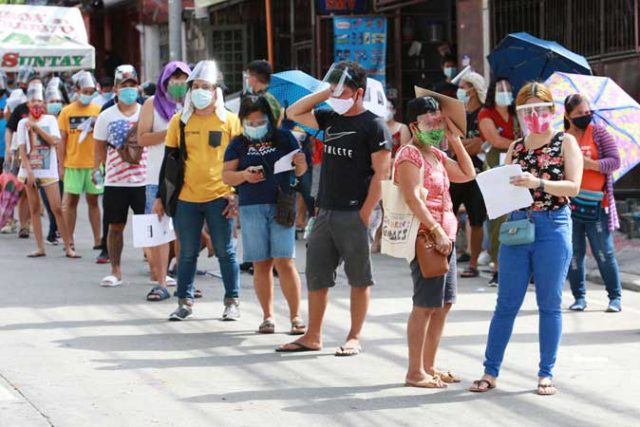
PEOPLE line up for vaccination on Aug. 2 at the Festive Walk Transport Hub 2 inside the Megaworld Business Park in Iloilo City. — @FESTIVEWALKILOILO

SEVERAL LOCAL governments across the country are taking various measures to prevent a surge in coronavirus cases amid the threat of the more transmissible Delta variant.  

In Iloilo City, the regional center of Western Visayas in central Philippines, Mayor Jerry. P. Treñas announced Monday morning that a “stricter lockdown” will be imposed this week to Sunday.    

“From Aug. 3 to 8, I will place the city on hard lockdown as protection for everyone here. Aklan and Cebu are both experiencing a surge; their hospitals are full with patients already being confined outside the facility. We don’t want the same scenario in Iloilo City,” he said in a statement.  

The city is already under the enhanced community quarantine from Aug. 1 to 7, the second strictest lockdown level.   

Non-essential establishments or those not related to food and medicine will be temporarily closed. A total liquor ban that prohibits sale and consumption of alcoholic drinks will be imposed, according to the statement.   

All inbound flights and sea travel will be suspended from Aug. 4 to 8, and all travelers will be banned during the five-day period.    

In Easter Visayas, the regional Health office is expanding contact tracing to the “third generation level” of the positive patient. It also asked local governments, through the barangay health emergency response teams, to ensure isolation in a facility or home quarantine for second and third generation contacts. 

Over the weekend, the regional office confirmed 10 Delta variant cases, which were all “considered to be local cases because there were no recorded travel history outside the region amongst them.”  

Zamboanga City, in the southwestern part of the country, has declared a no-movement day during the first three Sundays of the month despite being under the general community quarantine, the most relaxed lockdown level. The city also maintains the requirement of a negative RT-PCR test result for all inbound travelers.   

Baguio City, a popular tourist destination in northern Luzon, is banning non-essential travelers “regardless of place of origin” starting July 31.  

The local government, in a statement, said this will be in effect “tentatively” for one week. — MSJ 

Damage in infra, farm output from rains at P1.87B

BAGUIO PIO

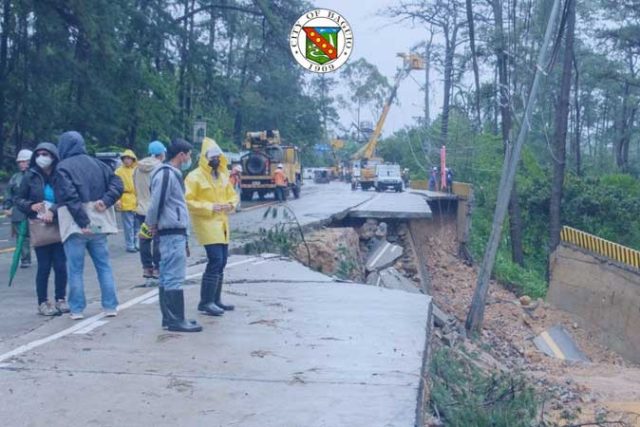
THE GOVERNMENT has so far recorded P1.87 billion worth of damage to public structures and agricultural produce due to weeks of incessant rains brought by the southwest monsoon.   

The Department of Public Works and Highways (DPWH) said Monday that the partial cost of damage to roads and flood-control structures has reached P1.17 billion.  

“As of 6:00 am Monday, Aug. 2, 2021, the DPWH Bureau of Maintenance reported that in Central Luzon alone, partial cost of damage to public infra is at P699.16 million from P349.96-million damage to roads and P301.20 million to flood-control,” the department said in a statement.  

It said the CALABARZON region — composed of Cavite, Laguna, Batangas, Rizal, and Quezon provinces — has the second highest cost of damage at P224.2 million from P222.62-million damage to roads and P1.60-million damage to flood-control structures.  

The Cordillera Administrative Region recorded a P113.51-million damage to roads.   

In MIMAROPA — Mindoro, Marinduque, Romblon, and Palawan — cost of damage reached P65 million with P5 million in roads and P60 million in flood-control structures.  

The DPWH also reported a P39.66-million cost of damage to roads in the National Capital Region, and P31.05-million damage to roads and flood-control structures in the Ilocos Region.  

The department said it has cleared 32 national roads in Luzon, but six roads remain closed to traffic, including four roads in Cordillera and two in Central Luzon “due to soil collapse and flooding.”  

AGRICULTURE
In the agriculture sector, losses rose to P698.53 million against the previous estimate of P615.72 million, according to the Department of Agriculture (DA).   

The DA’s Disaster Risk Reduction and Management Operations Center said in a bulletin on Monday that those affected include 26,994 farmers and 34,029 hectares of agricultural areas across the Cordillera Administrative Region, Ilocos, Central Luzon, CALABARZON, MIMAROPA, Bicol Region, and Western Visayas.  

Farm production losses reached 14,175 metric tons (MT). Affected commodities include rice, corn, high value crops, livestock and poultry, fisheries, and agri-infrastructure.  

Damage to rice totaled P586.01 million, with 11,918 MT of lost production volume and 31,900 hectares of affected agricultural areas.   

High value crops losses totaled P47.85 million. A total of 719 MT of production volume and 1,288 hectares of farmlands were affected.    

Losses to corn amounted to P37.57 million. 1,538 MT of production volume were damaged while 841 hectares of farm production areas were affected.    

Other subsectors that recorded losses include fisheries at P14.2 million, irrigation facilities at P9.53 million, and livestock and poultry at P3.37 million.    

The DA said it is conducting further assessment and validation of agricultural losses and is coordinating with other government agencies and local government units in providing assistance to affected farmers.   

“Based on reports (of the different regions), there are no reported damage on road networks and bridges that can affect accessibility and mobility of food supplies to date,” the DA said in the bulletin. — Arjay L. Balinbin and Revin Mikhael D. Ochave 

P46.9M worth of irrigation projects completed in Camariñes Sur  

IRRIGATION projects totaling P46.92 million were recently inaugurated in Camariñes Sur, the National Irrigation Administration (NIA) said.   

NIA, in a statement on Monday, said it launched on July 28 to 29 the following: P26.16 million Pump House and Farm Pond at Tigman-Hinagyanan-Inarihan River Irrigation System in the town of Calabanga; P14.08 million Punta Diamante Pump Irrigation System in the town of Canaman; and P6.69 million rehabilitated Taisan Communal Irrigation System Dam (Sibagat Small Reservoir Irrigation Project) in the town of Minalabac.    

The irrigation project in Calabanga will serve 1,363.12 hectares and benefit 2,245 farmers, while the Canaman project will serve 250 hectares tilled by 122 farmers.  

The Minalabac project will benefit 165 farmers covering 350 hectares of agricultural areas.  

Meanwhile, Camariñes Sur Rep. Luis Raymund F. Villafuerte, Jr. asked for NIA’s help on the completion of the Sustainable Bicol River Irrigation System.    

Mr. Villafuerte said more than 2,000 hectares of agricultural areas will be covered by the project.  

“Camariñes Sur is top five among rice producing provinces in the country despite having few irrigation systems since the majority of our lands are rain-fed. If the Sustainable Bicol River Irrigation System is finished, it could push the province into the top three major rice producers,” Mr. Villafuerte said.    

For his part, NIA Administrator Ricardo R. Visaya said 153 projects worth P11 billion were inaugurated in the last two months, while around 35 projects amounting to P2.7 billion will be launched this August.    

“NIA continues to develop and construct irrigation systems nationwide amidst the pandemic. The agency remains committed to its mandate of developing and maintaining irrigation systems in support of the agricultural program of the government most especially in this time of pandemic,” Mr. Visaya said. — Revin Mikhael D. Ochave  

Taiwanese, Korean fugitives arrested in the Philippines 

TWO FOREIGN fugitives, a Taiwanese and a Korean, both wanted in their respective countries for intimidation, fraud, and money laundering were arrested by Philippine immigration officers last week.   

In a news release on Sunday, the Bureau of Immigration (BI) reported the arrest last Wednesday of 53-year-old Korean national Yoo Moon Jong in Mabalacat City, Pampanga and 30-year-old Taiwanese Chen Yan Syun in Ermita, Manila.  

Mr. Yoo was convicted for swindling a fellow Korean of more than P2.6 million in 2007 and threatening to kill the victim upon learning that the latter had filed a case against him.    

Mr. Chen, according to Taiwanese authorities, is a member of a money laundering syndicate that preyed on victims in Taiwan.  

The two are temporarily held at the BI’s detention facility in Camp Bagong Diwa, Taguig while waiting to be deported.   

Mr. Morente said the two fugitives have been blacklisted in the Philippines to prevent them from re-entering the country.   

“As we have repeatedly warned these wanted (foreigners), do not use the Philippines because we will never allow our country to become a haven for fugitives,” he added. — Bianca Angelica D. Añago  

No delay expected in 2022 budget submission despite secretary’s leave 

SENATE.GOV.PH

THE DEPARTMENT of Budget and Management (DBM) is expected to submit the government’s 2022 spending plan as scheduled on or before August 25 even with Secretary Wendel E. Avisado’s sick leave, according to a lawmaker. 

Senator Panfilo M. Lacson Sr., in a statement, said no delays are seen in the transmittal of the 2022 National Expenditure Program (NEP) as online communication with the Budget chief is possible.    

“Even with the physical absence of Secretary Wendel Avisado, the Department of Budget and Management has an abundance of competent and capable career undersecretaries and assistant secretaries who can avail of existing telecommunication technology for his guidance and direction,” said Mr. Lacson, vice chair of the Senate Finance Committee.  

“I thus cannot see any reason for the delay in the constitutionally mandated 30-day period submission of the National Expenditure Program to Congress, after President Rodrigo Duterte’s State of the Nation Address last July 26,” he said.  

DBM announced Saturday that Mr. Avisado will be on medical leave from August 2 to 13 following his recent bout with coronavirus disease 2019 (COVID-19). Budget Undersecretary Tina Rose Marie L. Canada will be temporarily in charge of the department.  

Mr. Lacson said he also sees no impediment to holding simultaneous public hearings on the budget in the House of Representatives’ Appropriations Committee and the Senate Finance Committee. — Alyssa Nicole O. Tan 

Labor chief presses PHL gov’t to swiftly ratify ILO charter changes  

PHILIPPINE STAR/KRIZ JOHN ROSALES

LABOR Secretary Silvestre H. Bello III called on the Philippine government to fast-track the ratification of the 1986 instrument that amends the constitution of the International Labor Organization (ILO), which he currently chairs.   

Mr. Bello said the Philippines must take the lead in approving the instrument that will give speaking and voting rights to more state members of the ILO governing body.   

“I am convinced that the Philippines’ non-ratification is just a case of oversight rather than a deliberate rejection of the Amendment,” Mr. Bello said in a statement on Sunday.   

He added that the Philippines has accepted and ratified many other key ILO conventions in the recent years, “this is why I believe our government can act swiftly on it.”   

In a press conference last July 10, Philippine Labor attaché to Geneva Cheryl D. Yañgot, where the headquarters of the ILO is located, said the Labor department had already coordinated with the Department of Foreign Affairs (DFA) on the country’s ratification of the amendment.   

Under Executive Order 459, the DFA serves as the lead agency in guiding the president in such ratifications, which is subject to the Senate’s concurrence.   

Mr. Bello assumed the top position in the organization that sets the global labor standards in July 2021.   

He said one of his top priorities during his one-year term is to a push for the amendment that will increase the voting membership in the ILO and abolish the “seeming permanent status of 10 members of chief industrial countries” to take effect.   

At present, out of 187 member states of the ILO, only 28 have voting and speaking rights, another 28 have only speaking rights, and the rest “are mere observers with neither voting and speaking rights, including the Philippines.” — Bianca Angelica D. Añago 

Bureau of Customs beats July revenue target

BW FILE PHOTO

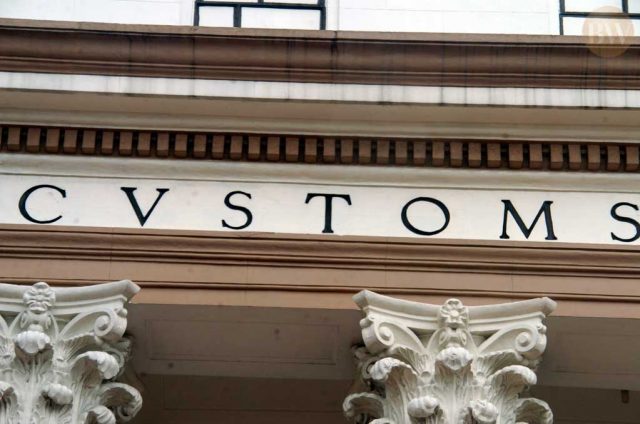
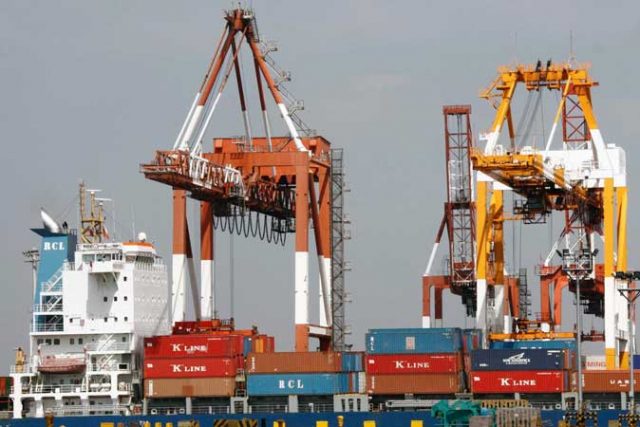
THE BUREAU of Customs (BoC) collected P58.183 billion in duties and taxes in July, exceeding a monthly target once again on improving imports, it said in a statement Monday.

Last month’s performance exceeded the P53.751-billion target set for the month by 8.2%. It also beat the P49.82 billion year-earlier total by 16.8% and the P52.17 billion collected in June by 11.5%.

The BoC said 14 of its 17 collection offices met their targets — Aparri, Batangas, Cagayan De Oro, Clark, Legaspi, Limay, Davao, Manila, Ninoy Aquino International Airport, San Fernando, Subic, Surigao, Tacloban and Zamboanga.

In the year to date, the bureau collected P359.93 billion, or 4.15% ahead of the target pace for the seven months to July and also 4.2% more than the year-earlier total.

“The bureau continues to prove the intensified collective efforts of all ports this year, not to mention, the improvement of volume of imports while maintaining border security and facilitating trade,” the BoC said.

The seven-month total accounted for 58% of its P620-billion target for 2021.

At the 117th anniversary celebration of Bureau of Internal Revenue (BIR) Monday, Finance Secretary Carlos G. Dominguez III stressed the need for tax-collecting agencies to meet or exceed, their revenue goals to support the government at a time of increased spending for the pandemic.

Mr. Dominguez challenged the BIR to exceed its P2.081-trillion target for the year to help ensure the economy recovers.

“This is my marching order to the men and women of the BIR: go for the gold. I urge the agency to not just meet, but exceed its collection targets this year and beyond,” he said in his speech.

“There is no room for our revenue efforts to fail. To win this battle for our economic recovery, everything depends on the bureau’s success in raising much-needed revenue,” he added.

The BIR collected P1.034 trillion in the first half, beating its P1.018-trillion target for the period by 1.61%.

The government budget this year is P4.5 trillion, with P2.88 trillion to be funded via revenue from tax and other sources. The remainder will raised through debt.

Tax collections fell last year after the pandemic weakened consumption during an economic downturn. — Beatrice M. Laforga

Port authority tightens border controls to keep Delta coronavirus from spreading

THE PHILIPPINE Ports Authority (PPA) said it has imposed stricter border-control measures at all ports to contain the spread of the Delta variant of coronavirus disease 2019 (COVID-19).

In a memorandum dated July 30 and signed by PPA General Manager Jay Daniel R. Santiago, the agency said it will strictly enforce regulations regarding the notice of arrival for vessels as well as applications for berthing or anchorage.

The notice of arrival should be submitted at least 48 hours prior to arrival or before any delivery of cargo inside the port for loading, the agency said in a statement.

The notice of arrival may also include a crew list with detailed information about the persons on board, it added.

As for berthing or anchorage, the agency said the application should be submitted at least 24 hours for vessels on scheduled runs and 36 hours for tramping vessels.

“Coordination shall be made, as applicable, with the Bureau of Customs, Bureau of Immigration, Bureau of Quarantine, and Philippine Coast Guard on matters affecting border protocols,” according to the memorandum.

“Crew change or disembarkation shall continue to be done only at PPA ports identified as crew change hubs.”

The PPA also said there will be no boarding by pilots until submission of “free pratique” and clearance by the Bureau of Quarantine or Department of Health boarding team.

The memorandum was addressed to port managers, terminal operators and cargo handling operators, shipping lines and shipping agents, and pilots and pilotage associations.

The Ports authority said its directives are in accordance with the July 29 resolution of the Inter-Agency Task Force for the Management of Emerging Infectious Diseases or IATF.  — Arjay L. Balinbin

Measure signed creating energy research institute

PHILSTAR

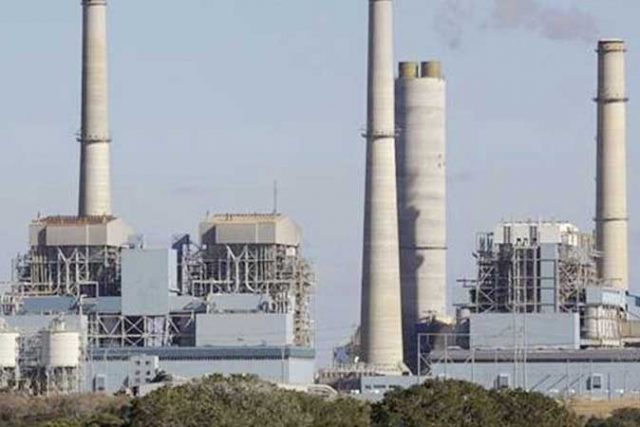
PRESIDENT RODRIGO R. Duterte last week signed into law a measure establishing an energy research institute of experts and researchers from both the private and public sectors, the Palace said. 

Mr. Duterte signed Republic Act No. 11572, which establishes the Philippine Energy Research and Policy Institute, his spokesman Herminio L. Roque, Jr. said at a televised news briefing Monday.

The law enables the institute, an independent agency attached to the University of the Philippines, to study issues and challenges in the energy sector, “including the environment, health, and consumer impacts of energy policies and programs.”

The institute is to collaborate with government agencies, academic institutions, and other stakeholders while remaining independent and ensuring that its research remains uninfluenced by political affiliation, technological bias, “or other presuppositions.”

The law tasks the body to conduct energy-related research and development programs and capacity-building training, with special attention given to the needs of the Department of Energy, the Energy Regulatory Commission, and the legislature.

The institute is to be headed by an executive director, reporting to an executive board composed of seven members with the UP president as ex-officio chairperson, “and at least one representative from the fields of engineering, law, science, statistics, economics, social science, and public health.”

“A Special Account in the General Fund for energy research, which shall be maintained and managed by the Bureau of Treasury, shall be established to support the research undertaken by the Institute,” according to the law.

The law appropriates P200 million for the initial operating funds of the institute.

“Government agencies concerned are hereby authorized to include in their respective annual budget such necessary amounts as their contribution to the funding of certain research activities of the Institute,” it said. — Kyle Aristophere T. Atienza

ADVERTISEMENT
ADVERTISEMENT