Home Blog Page 7721

Yields on gov’t debt slip
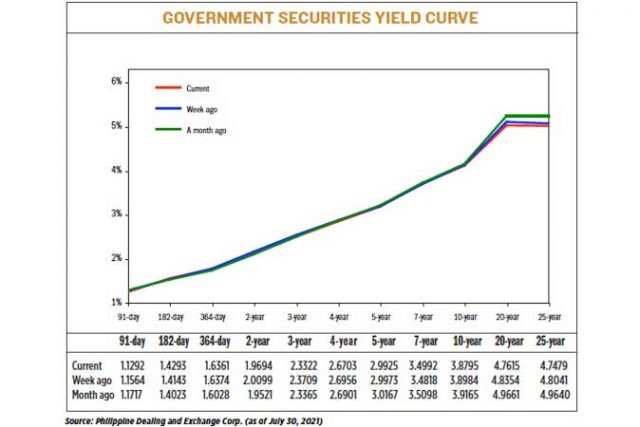
YIELDS on government securities (GS) slipped after the US Federal Reserve left its rates and bond-buying program unchanged at its meeting last week and following the Treasury bureau’s announcement of its August borrowing program.

GS yields, which move opposite to prices, slipped by 2.31 basis points (bps) on average week on week, data from PHP Bloomberg Valuation Service Reference Rates as of July 30 published on the Philippine Dealing System’s website showed.

Yields moved sideways across the curve on Friday from their July 23 finish. At the short end, the rates of the 91- and 364-day Treasury bills (T-bills) fell by 2.72 bps (to 1.1292%) and 0.13 bp (1.6361%) respectively, while the 182-day tenor inched up by 1.5 bps (1.4293%).

At the belly of the curve, the yields on the two-, three-, four- and five-year T-bonds declined by 4.05 bps (1.9694%), 3.87 bps (2.3322%), 2.53 bps (2.6703%), and 0.48 bp (2.9925%), respectively. Meanwhile, the seven-year bonds saw its rate increase by 1.74 bps to 3.4992%.

At the long end, the yields on the 10-, 20-, and 25-year tenors went down by 1.89 bps (3.8795%), 7.39 bps (4.7615%), and 5.62 bps (4.7479%), respectively.

A bond trader said demand for longer-dated tenors has been strong due to the lack of supply.

“Recent auctions have been concentrated on the five- and seven-year tenors so there are supply concerns in that area of the curve,” the bond trader said in a phone interview last Friday.

The trader added that the US Federal Reserve’s policy meeting last week “kept investors buying local bonds as yields have been trending lower as well.”

“[Federal Reserve Chair Jerome C.] Powell did not rock the boat and he kept everything status quo and his rhetoric the same. More or less, it provided some relief for the market,” the trader said.

The Fed kept its key rates near zero last week, as expected. Mr. Powell said the US job market still has “some ground to cover” before the Fed can scale down its $120-billion monthly bond-buying program.

Meanwhile, Jose Miguel B. Liboro, ATRAM Trust Corp. head of fixed income, said yields closed mostly flat or marginally higher last week despite decent trading volumes.

“[The Bureau of the Treasury’s (BTr)] seven-year bond auction was the initial market catalyst — issuing to strong demand. Even the P10-billion tap offer was fully awarded as the market digested the supply easily,” Mr. Liboro said in an e-mail.

“Announcement of the August auction schedule later in the week, which showed incoming supply on the long end of the curve, caused yields to retrace,” he added.

The BTr on Tuesday raised P35 billion as planned via its offer of reissued seven-year T-bonds with a remaining life of six years and eight months. The bonds fetched an average rate of 3.651%.

Total bids for the papers reached P69.758 billion, making it nearly twice oversubscribed and causing the Treasury to open its tap facility to raise additional P10 billion from the tenor. 

For this month, the Treasury plans to borrow P200 billion from the domestic bond market, lower than the P235 billion programmed in July. It is looking to offer P60 billion in T-bills and P140 billion in T-bonds.

The government wants to borrow P3 trillion from domestic and external sources this year to help fund a budget deficit seen to hit 9.3% of gross domestic product.

For this week, Mr. Liboro expects yields to adjust higher in the short term due to the 10-year bond auction on Aug. 3.

“But depending on where it clears, we expect yields to adjust lower given expectations that inflation for June may come in below the 4% level,” he said.

The bond trader sees yields remaining range-bound despite the announcement of a lockdown in Metro Manila.

“Generally, fixed income would benefit on quarantine measures given the fact that inflation can be tamed/most likely lower given the demand side will be lower. Volatility would remain given the fact that ECQ (enhanced community quarantine) will provide some uncertainty to the market,” the trader said.

The government on Friday announced that the National Capital Region will be under ECQ, the strictest quarantine classification, from Aug. 6 to Aug. 20 to contain the spread of the highly transmissible Delta variant of the coronavirus. — N.M.A. Bo


Mindanao banana farm rehabilitated after bout with Panama disease

A BANANA FARM in Bukidnon has been successfully brought back after having been infested with Panama disease by a local team of farm experts and plant pathologists, the Mindanao Development Authority (MinDA) said.

MinDA Chairman Emmanuel F. Piñol said the group led by Lalaine Albano-Narreto, Jose Barrosa, and soil experts from Unifrutti Tropical Philippines have succeeded in rehabilitating the Manupali Agri-Development Corp. (MADC) Cavendish banana farm in Valencia City, Bukidnon after six years.

“After a six-year field experiment (that) started in 2015, MADC was brought back to life with the banana farm area expanded from 280 to 371 hectares. While there are still negligible cases of the disease, the problem is effectively under control and easily prevented from spreading,” Mr. Piñol said in a Facebook post over the weekend.

Panama disease, also known as fusarium wilt, is a soil-inhabiting fungus that causes bananas, mostly Cavendish, to die.

Ms. Albano-Narreto said the fields had been abandoned, leaving the area barren for a period.

“We replanted after three months but the disease manifested again. So, we extended it to six months. Still the disease came back. Finally, we ‘scorched’ the land for one year and denied the fungus any host to survive,” Ms. Albano-Narreto said.

Ms. Albano-Narreto added that a new banana variety was introduced, UCL4, while an old variety, called Tall Williams, was replanted.

Currently, the rehabilitated farm employs 1,000 workers and produces 4,200 boxes of Class A bananas per hectare every year.

“The MADC success story is also a game changer for the country’s Cavendish banana industry which had suffered reversals because of the devastation of fusarium wilt. With this development, the Philippines could again regain its status as one of the top Cavendish banana producers in the world,” Mr. Piñol said.

Mr. Piñol said in a separate Facebook post that MinDA will launch a field learning program for Cavendish banana farmers who wish to learn the methods used by MADC in controlling the disease.  

He said the field learning program will be implemented after an offer by Unifrutti and its officers in the MADC farm in Bukidnon to share their practices with interested farmers.

During a July 20 virtual briefing, Pilipino Banana Growers and Exporters Association, Inc. Chairman Alberto F. Bacani said the Philippines remains the number two exporter of Cavendish banana.  

Mr. Bacani said the country produced 162.2 million boxes of Cavendish banana in 2020, down 17% from the prior year, due to Panama disease. — Revin Mikhael D. Ochave

Chevrolet PHL awards Grandmasters

IMAGE FROM CHEVROLET PHILIPPINES

ALL 22 CHEVROLET dealers from different parts of the country gathered online last June 29 for the virtual launch of the all-new Tracker, Chevrolet’s latest entrant to the highly competitive local crossover SUV segment, as well as to celebrate the big winners of the 2020 Grandmasters.

Said Chevrolet Philippines-The Covenant Cars Company, Inc. (TCCCI) President and Chief Executive Officer Atty. Albert B. Arcilla, “The launch of the all-new Chevrolet Tracker marks a very exciting time for Chevrolet Philippines as we introduce a new generation of models that will further invigorate and strengthen the Chevy brand in the Philippine market.”

TCCCI, the exclusive importer and distributor of Chevrolet automobiles and parts in the country, also named its 2020 Chevrolet Grandmasters for Best in Sales, Best in Service, and Dealer of the Year. The winners are: Chevrolet Iloilo, “three-peat” Grandmasters for Best in Sales (led by Grandcars Chairman Peter Po, President Jan Andrew Po, and Comptroller Caroline Po); Chevrolet Cebu Mandaue, named Grandmasters for Best in Service (led by Genesis Motors Corp. President and CEO Franklin O. Ong and EVP and Chief Financial Officer Emily S. Ong); Chevrolet Iloilo, named Dealer of the Year for three consecutive years (led by Grandcars Chairman Peter Po, President Jan Andrew Po, and Comptroller Caroline Po).

Remarked Atty. Arcilla, “Our dealers have been instrumental in our drive to find new roads and build a customer-oriented dealer network in the country. We are grateful to have dedicated dealer partners who have done a remarkable job in calibrating their business operations during a very challenging 2020, to ensure that Chevrolet customers are given the best quality service expected from the Chevy brand.”

The Chevrolet Grandmasters is an annual event that recognizes the “exemplary commitment of individuals and Chevrolet dealers in serving Chevrolet customers across sales, service, and after-sales.”

For more information, visit www.chevrolet.com.ph, follow Chevrolet Philippines on Facebook and Instagram, or subscribe to the Chevrolet Philippines YouTube channel. For convenient and contactless Chevy vehicle shopping experience, visit www.shopclickdrive.com.ph.

Earnings report, lockdown announcement drive BPI stock movement

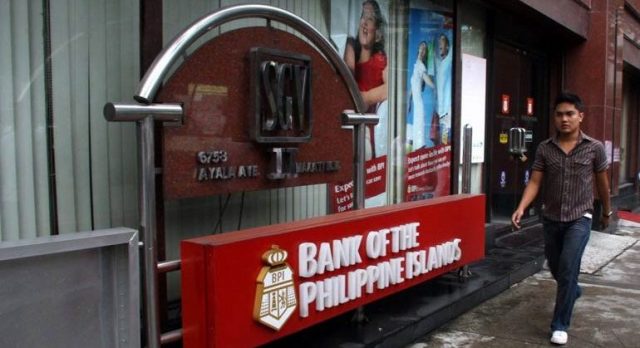
THE latest earnings results of Bank of the Philippine Islands (BPI) and news on putting Metro Manila at the strictest form of lockdown led to increased trading activity in the bank stock last week.

The Ayala-led lender was the tenth most actively traded stock last week with a total of 8.12 million shares worth P675.33 million having exchanged hands on the trading floor from July 26-30, data from the Philippine Stock Exchange showed.

BPI shares closed at P80.50 apiece on Friday, down 6.9% from its July 23 closing price of P84.50 apiece. Year to date, its price has gone down by 2.3%.

“There were a lot of factors that affected BPI stock price movement [last] week. But the most significant one for the overall market sentiment… was the last-minute announcement of ECQ (enhanced community quarantine) for NCR (National Capital Region) starting Aug. 6 to 20 because of the threat of the new Delta variant,” said I.B. Gimenez Securities, Inc. Research Head Joylin F. Telagen in an e-mail, referring to the more infectious variant of the coronavirus disease 2019 (COVID-19).

In a Viber message, Mercantile Securities Corp. Analyst Jeff Radley C. See attributed the stock movements to BPI’s second-quarter earnings report released on July 22 and the updates surrounding its merger with thrift bank subsidiary BPI Family Savings Bank (BFSB).

The government approved last Friday the imposition of ECQ in Metro Manila to curb the spread of COVID-19’s Delta variant. The ECQ, which is the country’s strictest form of lockdown, will span from Aug. 6 to 20.

The announcement came just after Malacañang said on Wednesday that Metro Manila and nearby provinces of Bulacan, Cavite, Laguna, and Rizal, or the NCR Plus bubble, will remain under the lighter general community quarantine (GCQ) until mid-August.

Prior to the ECQ, Metro Manila was placed under GCQ “subject to heightened and additional restrictions” from July 31 until Aug. 5. Under the added restrictions, indoor and al fresco dining will be prohibited, and only authorized persons will be allowed to travel to and from the NCR Plus bubble.

Meanwhile, BPI in earlier July obtained the approval of the Philippine Deposit Insurance Corp. to pursue its planned merger with BFSB. A few days later, the Philippine Competition Commission said the merger can be exempted from its review as it qualifies as an internal restructuring.

BPI will still need to secure approval from other regulators, including the Bangko Sentral ng Pilipinas and the Securities and Exchange Commission (SEC), to push through with the merger.

To recall, BPI announced its plan to absorb BFSB in January with the former as the surviving entity. The plan was approved by a quorum or at least two-thirds of BPI’s stockholders in April.

BPI’s net income stood at P6.8 billion in the second quarter, 28.8% higher than the P5.4 billion posted in the same period last year, it said in a disclosure to the stock exchange on July 22.

This brought its profit for the first half to P11.8 billion, up by 1.2% from the P11.756 billion seen a year ago.

“On conservative note, I’m looking at P23.50 billion for the year,” I.B. Gimenez Securities’ Ms. Telagen said when asked on her outlook on the bank’s financial performance this year.

For Mercantile Securities’ Mr. See: “[BPI’s] earnings would be consistent going forward. Not much news so far for the company as the Delta virus is still the number one concern of investors.”

“The stock is nearing support level of P80, which may go below due to bearish market sentiment, while resistance is at P84 pesos,” he said.

For Ms. Telagen: “BPI is fundamentally good, but technically, BPI is consolidating at P79-P90 within the long-term uptrend channel,” she said.

“Breakdown within the P79-support might revisit P65 per share. Breakout to P90, [the stock] will retest P100 to the [all-time high] P129,” she added. — Abigail Marie P. Yraola

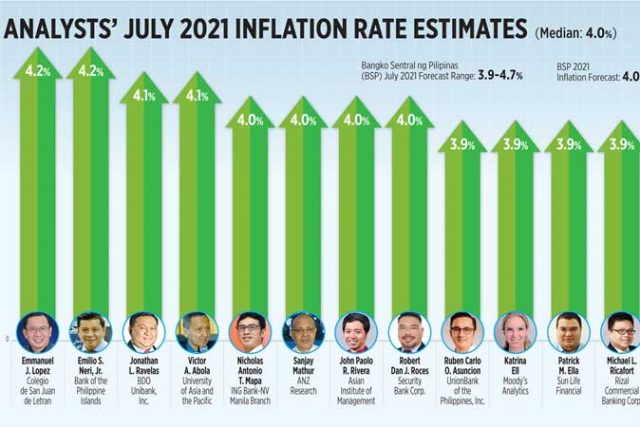
Analysts’ July 2021 inflation rate estimates

HEADLINE INFLATION likely eased to a seven-month low in July, and returned to within the central bank’s target range, with analysts noting that improved meat supply and a slower rise in transport costs likely offset higher prices of fuel and other food items. Read the full story.

Analysts’ July inflation rate estimates (2021)

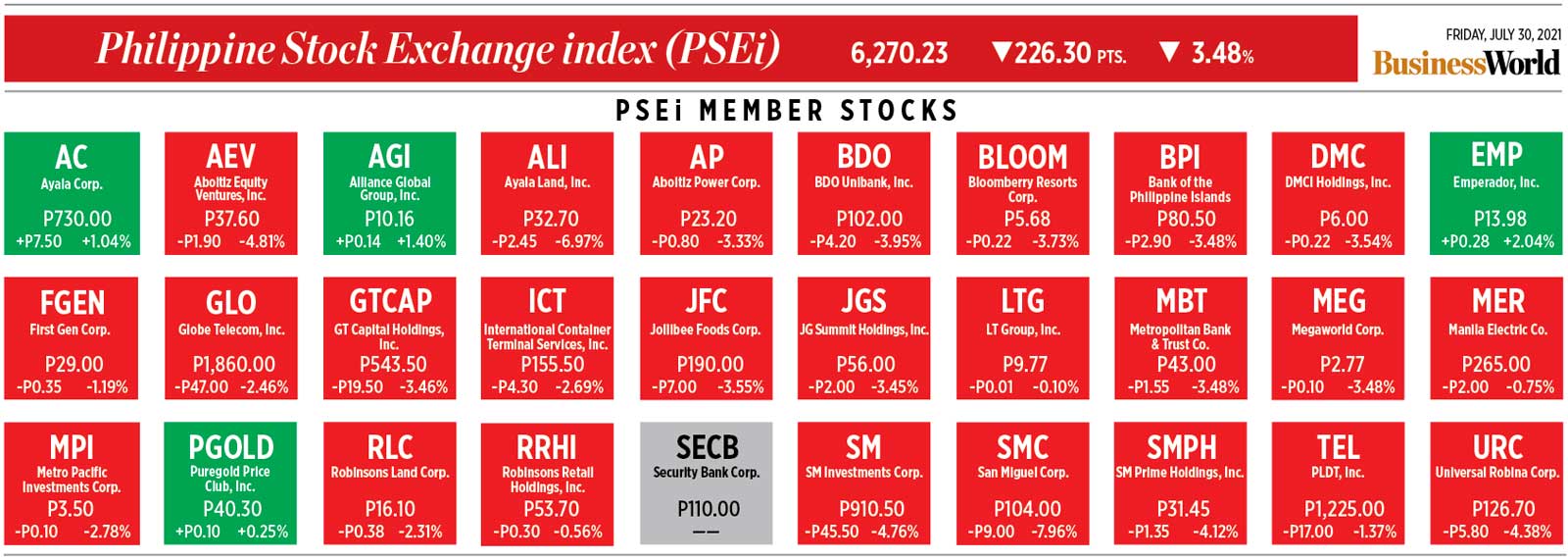
How PSEi member stocks performed — July 30, 2021

Here’s a quick glance at how PSEi stocks fared on Friday, July 30, 2021.


Peso to weaken on fears over rising cases of Delta variant

BW FILE PHOTO
THE PESO could drop on concerns over rising cases of the Delta variant. — BW FILE PHOTO

THE PESO may weaken against the dollar this week due to continued worries over the Delta variant of the coronavirus disease 2019 (COVID-19), but sentiment could improve on expectations of slower July inflation as well as positive manufacturing data.

The local unit closed at P49.97 per dollar on Friday, strengthening by 33.5 centavos from its P50.305 finish on Thursday, data from the Bankers Association of the Philippines showed.

It also gained 37 centavos from its P50.34-per-dollar finish on July 23.

The peso climbed as the government tightened restriction measures in Metro Manila, which reduced demand for dollars, Rizal Commercial Banking Corp. Chief Economist Michael L. Ricafort said.

Metro Manila will be under the tightest lockdown level from Aug. 6 to 20, Presidential Spokesperson Herminio L. Roque, Jr. said on Friday, to prevent the further spread of the more infectious Delta variant, which has already sickened 216 in the country as of Thursday, based on data from the Department of Health.

Socioeconomic Planning Secretary Karl Kendrick T. Chua on Friday told reporters that latest estimates show each week in lockdown costs the economy about P105 billion.

The policy meeting of the US Federal Open Market Committee last week also affected peso-dollar trading, UnionBank of the Philippines, Inc. Chief Economist Ruben Carlo O. Asuncion said.

The Fed last week kept interest rates near zero and maintained its asset purchases at $120 billion monthly and said its policy will remain loose until “substantial further progress” is made on employment and inflation.

Fed Chairman Jerome Powell said they had discussions on how to scale back the US central bank’s bond buying program but had not decided on the timing.

Mr. Asuncion said the spread of the Delta variant will continue to cloud investor sentiment this week.

Meanwhile, Mr. Ricafort said the market will also be monitoring manufacturing and inflation data to be released this week.

IHS Markit will release the July Philippine Manufacturing Purchasing Managers’ Index (PMI) on Aug. 2, Monday. In June, the PMI rose to 50.8 from 49.9 in May. This marked the first month since March of a reading beyond the neutral 50 mark that separates contraction from expansion as demand and production increased amid looser restriction measures.

Meanwhile, the Philippine Statistics Authority will report July inflation data on Aug. 5, Thursday.

A BusinessWorld poll of 15 analysts yielded a median estimate of 4% for July headline inflation on the back of lower prices of meat following the easing of import tariffs, which is seen to offset higher costs of oil and other food items.

If realized, this would be the first time inflation would fall within the 2-4% target of the central bank since the 3.5% headline print in December. This would also be slower than the 4.1% pace in June but still faster than the 2.7% logged a year ago.

For this week, Mr. Asuncion gave a forecast range of P50.10 to P50.50 per dollar, while Mr. Ricafort expects the local unit to move within P49.70 to P50.20. — L.W.T. Noble

Stocks to move sideways on lockdown, inflation

COURTESY OF PHILIPPINE STOCK EXCHANGE, INC.

INVESTORS are expected to go bargain hunting this week after the market closed in the red on Friday and are likely to take their cue from the release of July inflation data.

The 30-member Philippine Stock Exchange index (PSEi) shaved off 226.30 points or 3.48% to close at 6,270.23 on Friday, while the broader all shares index dipped by 107.17 points or 2.65% to end at 3,934.86.

Week on week, the benchmark index lost 250.51 points from its 6,520.74 finish on July 23.

“The market [fell] steeply [on Friday] after the government announced a two-week reimposition of ECQ (enhanced community quarantine) for Metro Manila in August,” China Bank Securities Corp. Research Associate Jason T. Escartin said in an e-mail.

“Market sentiment was weak all throughout the last week of [last] month, as investors stayed cautious ahead of the President’s final State of the Nation Address, and due to participants monitoring the spread of the Delta variant across the globe,” Timson Securities, Inc. Trader Darren Blaine T. Pangan said in a Viber message.

The government on Friday announced that Metro Manila and nearby cities will be put under the most stringent lockdown classification from Aug. 6 to Aug. 20.

The Health department on Thursday reported 97 new Delta variant cases, bringing the country’s total infections of the more transmissible coronavirus disease 2019 (COVID-19) variant to 216.

On Saturday, the country logged 8,147 new COVID-19 cases, bringing the total to 1,588,965. Of this, 60,887 were active infections.

“We think the ECQ announcement sounds the clarion call for aggressive cash deployment [this] week, especially if prices are able to hold at the 6,200 level,” China Bank Securities’ Mr. Escartin said.

“The market had already progressively priced in the lockdown when it started selling off two weeks ago; investors may begin looking past this event toward year-end narratives,” he added.

Mr. Escartin said they are expecting a seven-percent increase when the market recovers once lockdowns are eased.

“We think current PSEi prices indicate limited downside risk… Meanwhile, August 2020’s post-ECQ surge of seven percent gives an indication of the magnitude of the potential post-ECQ recovery in August 2021,” he said.

Meanwhile, Timson Securities’ Mr. Pangan said investors will be taking their cue from the upcoming release of July inflation data.

“We’ll have to see next week if the support at 6,160 holds, otherwise 6,000 seems to be the next major support to watch,” he added.

The Philippine Statistics Authority will report July inflation data on Aug. 5, Thursday.

A BusinessWorld poll of 15 analysts yielded a median estimate of 4% for July headline inflation on the back of lower prices of meat following the easing of import tariffs, which is seen to offset higher costs of oil and other food items. — Keren Concepcion G. Valmonte

Telecom foreign opening seen improving pandemic response

GLOBE.COM.PH

A TELECOMMUNICATIONS industry more open to foreign participation is expected to improve the Philippines’ efforts to contain the pandemic and stimulate a recovery, economists said amid hearings in the Senate on amendments to the Public Service Act (PSA).

“The pandemic has revealed the gaps in telco services as Filipinos became more reliant on internet services during the pandemic. Essential activities in commerce and education, as well as accessing government services like vaccination and financial assistance require access to telco services. We need foreign investment to come in to ensure that Filipinos get the services that they need,” economist and former Finance Secretary Margarito B. Teves said in a statement.

Mr. Teves noted that continuing to restrict foreign investment in the telecommunications sector has had the unintended effect of protecting oligopolies.

The chamber is hearing arguments on the amendments contained in Senate Bill No. 1441 seeking to alter the Public Service Act or the Commonwealth Act No. 146, which limits foreign ownership in telecommunications companies to 40%.

The National Economic and Development Authority estimates that 64% of barangays do not have telecommunication services, 88% have no free WiFi zones, and 70% have no fiber optic cable. The International Telecommunication Union ranks the Philippines in the lower 40% in terms of access to the internet in the Asia-Pacific region.

“Telecommunications is a capital-intensive sector. All our current local telco companies have foreign partners because domestic capital is inadequate to fund the needed infrastructure. There is also the matter of technology transfer to consider,” Mr. Teves said.

According to the 2020 Digital Quality of Life survey, the Philippines was 66th out of 85 countries. The study attributed the poor showing to expensive, low-quality internet and the need to upgrade infrastructure.

John Paolo R. Rivera, an economist from the Asian Institute of Management, said in a Viber message that more foreign involvement could greatly “improve communications and enhance the Philippines’ digital capacities.”

If amendments to the PSA are approved, Mr. Rivera said he expects heightened competition in the industry, which tends to improve services, facilitating productivity gains for their users.

“On the consumer side, everyone just wants better and seamless services. Regulatory frameworks should ensure competition is fair for all players (and that) consumers benefit from reasonable prices. The last thing we want is squabbles and/or collusion among players that makes the industry inefficient,” he added.

Economist Calixto V. Chikiamco expressed support in a separate statement for the amendments, arguing that telecoms cannot be considered public utilities because of the absence of a natural monopoly.

“There are currently three telco companies that are profitably operating in the same area here in the Philippines, Globe, SMART, and DITO. This goes to show that several telecom firms can operate in the same area without leading to higher costs and economic inefficiency,” Mr. Chikiamco said.

The co-sponsor of the bill, Senate Minority Leader Franklin M. Drilon, has said that based on the proposed definition of public utilities in the amendments, only natural monopolies will be considered public utilities.

Natural monopolies are industries in which the most efficient number of companies providing the required service is one.

US company Space Exploration Technologies Corp., which uses satellite technology, has expressed interest in investing in the Philippine market, along with Japanese companies KDDI Corp. and Softbank Telecom Corp. Australian company Telstra Corp. Ltd. also attempted to invest in the Philippine telco industry, but partnership talks with the San Miguel Corp. collapsed in 2016. — Alyssa Nicole O. Tan

Makati-BGC pedestrian, bike link to start full operations next year

By Arjay L. Balinbin, Senioir Reporter

AN ELEVATED walkway with at-grade bike lanes along Epifanio de los Santos Avenue (EDSA) Northbound and Quingua Street, connecting Metro Rail Transit Line 3 (MRT-3) Buendia Station (Northbound) to Bonifacio Global City (BGC) Bus Depot, is expected to start full operations next year, the Transportation department said. 

The Makati-BGC Greenways project is expected to be fully operational by the “third quarter of 2022,” according to a document obtained from the Department of Transportation (DoTr).

It said the detailed architecture and engineering design process is “ongoing.”

The project involves the development of pedestrian networks to connect Makati to BGC through covered, elevated walkways and bike lanes.

The department said the first phase of the project will run from MRT-3 Buendia Station (Northbound) to BGC depot.

The DoTr and Bases Conversion and Development Authority (BCDA) have signed a memorandum of agreement for the planning, implementation and funding of the project, which is included in the overall Metro Manila Greenways Project.

The project will be financed by the DoTr’s budget. Some P962 million was downloaded to BCDA to implement the project.

“P952.1 million was remitted to the Bureau of Treasury last 30 March 2020 (as authorized by the) Bayanihan to Heal as One Act,” the department also said.

“P9.9 million remains as the balance to be used as the consultancy fee of the detailed architecture and engineering design,” it added.

The department said the project hopes to promote walking and cycling, reduce congestion, improve road safety for all users, help businesses along the greenways corridors, increase tourism and recreation potential, and promote social inclusiveness and improve health. 

GOCC subsidies down by 80.1%

NIA

BUDGET SUPPORT extended to state-owned firms declined by 80.1% year on year to P8.34 billion in June, after government significantly lowered subsidies to major non-financial government corporations and supplied no funds to the Philippine Health Insurance Corp. (PhilHealth), the Bureau of the Treasury reported.

Preliminary data from the Treasury also indicated that subsidies dropped 81.33% from their May levels.

The National Irrigation Authority received the largest allocation of P2.645 billion or 68% of the month’s total. This rose 7.96% from year-earlier levels.

The National Housing Authority received P2.123 billion, down 71.5% from a year earlier.

Budgetary support was received by trade-related government-owned and -controlled corporations (GOCCs) such as the Aurora Pacific Economic Zone and Freeport Authority (P4 million), the Center for International Trade Expositions and Missions (P12 million), the Southern Philippines Development Authority (P6 million), the Tourism Infrastructure and Enterprise Zone Authority (P30 million), and the Zamboanga City Special Economic Zone (P24 million).   

Support was allocated to non-PhilHealth government health institutions such as the Lung Center of the Philippines (P34 million), National Kidney and Transplant Institute (P107 million), Philippine Heart Center (P164 million), Philippine Children’s Medical Center (P87 million), and the Philippine Institute for Traditional and Alternative Health Care (P18 million).

GOCCs in the agriculture sector receiving subsidies were the National Dairy Authority (P30 million), Philippine Coconut Authority (P597 million), and the Philippine Fisheries Development Authority (P277 million).

Government-led research institutions were also granted subsidies such as the Philippine Center for Economic Development (P5 million), Philippine Institute for Development Studies (P16 million), and the Philippine Rubber Research Institute (P35 million). 

Other GOCCs that received budgetary support in June are the Bases Conversion and Development Authority (P270 million), Civil Aviation Authority of the Philippines (P903 million), Cultural Center of the Philippines (P33 million), Light Rail Transit Authority (P85 million), Credit Information Corp. (P7 million), People’s Television Network, Inc. (P9 million), and IBC-13 (P6 million).

The National Government did not provide subsidies during the month to the National Food Authority, Philippine National Railways, Cagayan Economic Zone Authority, Development Academy of the Philippines, Philippine Crop Insurance Corp., the Subic Bay Metropolitan Authority, and the Small Business Corp.

In the first half, GOCC subsidies fell 28% year on year to P88.282 billion.

Subsidies to GOCCs are meant to cover operational expenses not supported by their revenue. — Luz Wendy T. Noble  

Key legislator says mining industry fiscal overhaul crucial for recovery

STOCK PHOTO | Image by David Hellmann from Unsplash

A PROPOSED LAW overhauling the tax regime for the mining industry is considered critical for the economic recovery because of its potential to generate revenue for the government and make the investment climate more certain.

Albay Rep. Jose Ma. Clemente S. Salceda, chairman of the House Ways and Means Committee, said the bill is important because of current “deficiencies” in how the government manages its natural wealth.

“We still need a fiscal regime for mining, as a baseline or downside protection for whatever negotiations are entered into by the government (with investors),” he said in a speech at the Philippine Extractive Industry Transparency Initiative National Conference on Thursday.

Mr. Salceda said that he sees the mining industry as “a potential job creator post-pandemic” and crucial for the economic recovery because of the tax revenue it will likely generate.

“The proposed regime will generate P7.2 billion in incremental revenues in the first year and P37.9 billion over the next five years,” he added.

The Mines and Geosciences Bureau estimates the mining sector accounted for P102.3 billion in output, equivalent to 0.6% of gross domestic product, in 2020.

However, Mr. Salceda said that there is a “lack of a coherent fiscal regime” that would set aside funds for rehabilitation and investment.

House Bill 6135 seeks to “introduce corporate governance structures” such as the imposition of royalty payments, margin-based windfall profits tax, and (will discourage) businesses’ dependence on excessive debt funding.

The measure also seeks to create a national resource trust fund from royalty payments of large-scale metallic mining operations outside of mineral reservations to fund projects by local government units that are affected by these activities.

“If we don’t set aside anything from the mining revenue for those externalities, the costs will (manifest) in some form, sometimes in tragedy. There has to be a dependable reserve of financial resources for timely rehabilitation of mines and for mining communities,” Mr. Salceda said.

Chamber of Mines of the Philippines Executive Director Atty. Ronald S. Recidoro said Friday via Viber that the group supports the proposed law, calling it necessary to “create a more stable investment environment.”

“We expect this policy to impact laws such as the tax code that properly governs revenue sharing in all mineral agreements,” he told BusinessWorld. — Russell Louis C. Ku

ADVERTISEMENT
ADVERTISEMENT