Home Blog Page 772

Toyota Financial raises P5B from oversubscribed debut bond sale

REUTERS

TOYOTA FINANCIAL Services Philippines has raised P5 billion from its maiden fixed-rate bond issuance after strong investor demand pushed subscriptions to 3.5 times its initial P2-billion target.

The offer period ran from Oct. 6 to 13, but the company said it closed the sale early after exercising its oversubscription option due to high demand.

“We are delighted by the overwhelming response from investors, underscoring the market’s trust and confidence in our stability and growth prospects,” Toyota Financial President Rommel J. Ocampo said in a regulatory filing.

The offering is the first tranche of the company’s P20-billion bond program. It consists of two-year Series A bonds due in 2027 with a fixed rate of 5.7725%, and three-year Series B bonds due in 2028 with a rate of 5.9418%.

Philippine Rating Services Corp. gave Toyota Financial a PRS Aaa issuer rating with a stable outlook, citing its strong shareholder base, solid brand franchise, healthy asset quality and steady revenue growth.

“This achievement reinforces our commitment to supporting Toyota customers and dealer partners nationwide and establishes us as an even more competitive leader in the industry,” Mr. Ocampo said.

First Metro Investment Corp. and ING Bank N.V. Manila Branch served as joint lead arrangers and bookrunners, while Metropolitan Bank & Trust Co. and BPI Capital Corp. acted as selling agents.

Toyota Financial is 60% owned by Japan-based Toyota Financial Services Corp. and 40% by GT Capital Holdings, Inc. — Alexandria Grace C. Magno

Gunboat diplomacy: How classic naval coercion has evolved into hybrid warfare on the water

CHINA COAST GUARD VESSEL collides with Philippine Coast Guard ship. — SCREENGRAB FROM A PHILIPPINE COAST GUARD VIDEO

Over the summer, the United States deployed warships to the Caribbean — ostensibly to menace drug traffickers but also as a none-too-subtle warning to Venezuela. Earlier in the year, a US Navy destroyer bobbed along waters close to Iran for similar reasons. And in the Taiwan Straits and Pacific, China and the US frequently show off their respective maritime military might.

Close to 200 years after first being used to assert geopolitical dominance, gunboat diplomacy is very much alive and well.

In fact, the tactics employed by the US, China, and others today fit naval strategist James Cable’s classic formulation for gunboat diplomacy as “the use or threat of limited naval force, otherwise than as an act of war, in order to secure advantage or avert loss.”

The ships, boats, and objectives have shifted since Cable first penned his now-classic definition in 1971, to be sure. But the core logic is the same: Conducted in tandem with political diplomacy, deploying state-of-the-art military vessels off or near a rival’s coast makes one hell of a statement.

GUNBOAT DIPLOMACY SETS SAIL
Gunboat diplomacy originally took shape in the mid-19th century during an era of industrial navies, imperial rivalry, and weak international law.

Steam power and heavy guns delivered mobility and shock, while diplomacy often happened via a few warships off a harbor, a short blockade or a punitive raid. These were highly visible acts, clearly attributable, and designed to stop just short of war.

US Navy Commodore Matthew Perry’s fleet known as “Black Ships” on account of their painted hulls are seen as the archetype. Anchoring in Tokyo Bay throughout 1853-54, they helped secure the Treaty of Kanagawa in 1854, forcibly opening the Japanese ports of Shimoda and Hakodate to American ships.

Similarly, during the Don Pacifico affair of 1850, British navy squadrons pressured Greece to compensate a British subject.

A half-century later, Britain, Germany and Italy united to impose a naval blockade on Venezuela, seizing ships and customs houses to force the Venezuelan government to pay its foreign debts.

In each case, a limited naval force was openly brandished at a chokepoint or capital to win a narrow concession and then withdraw.

TROUBLED POSTWAR WATERS
After 1945, nuclear risk, alliance politics, and evolving maritime law made traditional gunboat diplomacy less attractive — and riskier.

As a result, the method adapted. Coercion shifted toward temporary, reversible shows of force and tools such as law enforcement actions at sea, patrols, boardings. and embargo enforcement, rather than outright coercion or punishments.

The US’s 1962 “quarantine” of Cuba — deliberately not called a “blockade” — used naval power to halt missile shipments from the Soviet Union while managing escalation and legal exposure. At the other end of the spectrum, Iceland’s Cod Wars from 1958 to 1976 pitted coast guard cutters and net-cutters against British trawlers. Controlled ramming and “lawfare” pushed fishing limits outward without triggering a shooting war between allies.

The classic logic of gunboat diplomacy endured, but it was increasingly hedged by law, alliance relations, and fear of nuclear escalation.

MARITIME POLICY IN THE MODERN AGE
Today global and regional great powers jostle with one another for power and influence across the intertwined domains of global economics, technology standards, information and law. That geopolitical environment has further called for adaptation of gunboat diplomacy.

It has resulted in states being pushed to compete with one another in the gray zone between peace and war.

Analysts now describe a “maritime hybrid warfare” rather than out-and-out naval confrontation. This consists of a persistent, below-threshold uses of legal, informational and paramilitary tools alongside limited force to make routine activity at sea — transits, resupply, repairs — riskier, slower, and more expensive.

The tool kit of maritime hybrid warfare blends nonmilitary coast guards with maritime militias, legal moves, cyber and electronic interference, and pressure on undersea infrastructure.

In the South China Sea, China’s coast guard and maritime militia have blocked, rammed, and used high-pressure water cannons to disrupt Philippine resupply at disputed islands. Beijing presents such actions as law enforcement, but the effect is coercive restraint of movement at sea.

In the Baltic–North Atlantic, the 2023 damage to the Balticconnector gas pipeline and nearby telecom cables — linked by investigators to an anchor drag from the Hong Kong-registered New Polar Bear — and persistent GPS jamming allegedly emanating from the Russian exclave of Kaliningrad show how seabed infrastructure and electronic warfare can raise risk and uncertainty without a shot being fired.

And then there is the US.

Since early September 2025, counternarcotics and maritime security operations in the southern Caribbean have involved a conspicuous US Navy and Coast Guard presence, high-seas interdictions and publicly released videos of precision strikes on small boats near Venezuela.

The Trump administration has framed these actions as part of a “non-international armed conflict” with drug cartels. But functionally, this is gunboat diplomacy.

Indeed, gunboat diplomacy remains what it has always been: the application of limited, creditable maritime power to shape the behavior of other states. Only now, nations have found a way to update an old strategy to make it relevant — and useful — to navigating a 21st century waterscape.

THE CONVERSATION VIA REUTERS CONNECT


Andrew Latham is a professor of Political Science at Macalester College.

Unified data: The winning formula for the AI grand slam 

By Gavin Barfield

TENNIS is gaining traction in the Philippines, following Alex Eala’s rise to global fame this year. The first Filipina to break into the world’s top 100 female tennis players, the 20-year old now stands alongside Filipino athletes who have put the nation on the sporting map.

In many ways, tennis — a sport requiring skill, precision, and strategy, is a fitting metaphor for how organizations approach agentic AI. Giving an amateur player the best racket, shoes, or access to the best tennis courts is not enough. To become truly competitive, that player needs consistent training and high-quality, trusted input from coaches. Likewise, even the most advanced AI agents are ineffective without the input of trusted, unified data.

Without trusted data, AI outputs are often inaccurate, overly generic, or simply lacking the specific context needed to drive meaningful action. It’s no surprise that, according to a Salesforce study, the majority (85%) of Filipino service professionals using AI believe having better access to data will improve the support they provide. The reality is that many organizations, in their rush to embrace the latest AI advancements, are overlooking a critical element for success: the ability to scale their solutions and consistently deliver reliable outputs.

DOMINATE THE AI COURT WITH CONTEXT
Businesses have been told time and again: “Your AI is only as good as your data.” They invest significant effort into cleaning and structuring their data. Yet, many still struggle to achieve meaningful and useful outputs from their AI agents.

The problem? AI agents don’t just need data; they need context — the deep, nuanced understanding of the business, embedded in an organization’s enterprise knowledge.

This “enterprise knowledge” isn’t just the sum of a company’s data stored in intentionally created, curated, and maintained databases. While structured information — such as customers’ names, contact details, financial transactions, and product information — is essential, it represents only part of the picture.

True enterprise knowledge also encompasses a vast, often untapped trove of unstructured information that includes everything from documents, e-mails, customer interactions, internal guides, and even the nuances of teams’ knowledge. Without harnessing both structured and unstructured knowledge, even the most advanced AI agents will fall short of delivering meaningful, trusted, and actionable outputs.

To return to our tennis analogy, giving an AI agent data without context is like sending a player to Wimbledon without any trusted, quality training or coaching. Enterprise knowledge is the coach’s playbook — clear drills, step-by-step guidance, and a game plan based on an analysis of the competitors’ strengths and weaknesses. Having that crucial context gives the athlete a full picture of the game, enabling smarter decisions and a better chance of winning.

Consider a customer service agent tasked with resolving a billing dispute. Raw transactional data might tell the agent what a customer purchased and when. But without enterprise context, such as the customer’s interaction history, seasonal purchasing patterns, and even sentiment from previous e-mail conversations, that agent won’t be able to grasp the specific context to provide a helpful solution.

WHEN ORGANIZATIONS HIT A WALL
This context gap is where many organizations, including businesses in the Philippines, stumble in their AI journey. Enterprise knowledge is often notoriously difficult to achieve, locked away in hundreds of disconnected systems and buried in unstructured formats like Slack messages, PDFs, meeting recordings, and support tickets. With the average enterprise juggling over 897 applications, 71% of which are disconnected, it’s no wonder agents struggle to get a full picture of the business, let alone offer useful or trusted outputs.

Data silos mean there’s no single source of truth. Without it, agents can’t reason effectively, understand nuance, or make confident, informed decisions. Instead, they risk making superficial or even incorrect choices, which erodes trust and limits their ability to drive real value.

THE POWER OF UNIFIED DATA
The only way for agentic AI to truly succeed is to connect all of this disparate data and infuse it with real-world business context. When AI agents have access to the full picture, they’re able to act more intelligently, adapt to dynamic scenarios, and deliver meaningful outputs.

Platforms like Salesforce Data Cloud connect both structured and unstructured data sources into one unified, integrated platform. Its zero copy technology allows organizations to access and query their data in real-time, without the need to extract, transform, and load their data across multiple sources — a process which can be costly and time-consuming. All of this data grounds Agentforce, Salesforce’s suite of AI agent tools. It ensures that AI agents are grounded in all your business data, while providing robust security, governance, and compliance.

When done right, agentic AI can be a game-changer. Sales teams can send personalized messages based on real-time customer insights. Service agents can resolve issues faster and with more empathy, and customers can get product recommendations that feel intuitive and relevant.

GETTING TO MATCH POINT
A skilled tennis player can’t win with just the best equipment; they need rigorous training and trusted, quality coaching. The same is true for AI agents: they require trusted, unified data and crucial business context to deliver their full potential. As the AI rally heats up, organizations that connect their data and ground it in real context will gain a decisive edge — and have the best shot at winning the Grand Slam.


Gavin Barfield is vice-president and chief technology officer for solutions at Salesforce ASEAN, where he leads a regional team of engineers in developing integrated technology solutions to support customers’ digital transformation.

Peso plunges to near nine-month low

BW FILE PHOTO

THE PESO plunged to a near nine-month low against the dollar on Wednesday as market players awaited US inflation data and following the sharp decline in gold prices.

The local unit closed at P58.41 versus the greenback, sinking by 18.5 centavos from its P58.225 finish on Tuesday, Bankers Association of the Philippines data showed.

This was its worst finish in nearly nine months or since it closed at P58.66 per dollar on Feb. 3.

The peso opened Wednesday’s session weaker at P58.30 versus the dollar. Its intraday best was at P58.28, while its worst showing was at P58.43 against the greenback.

Dollars exchanged went down to $1.29 billion on Wednesday from $1.43 billion on Tuesday.

“The dollar-peso closed higher on cautious trading ahead of the release of US inflation data,” a trader said in a phone interview.

A US government shutdown, which began on Oct. 1, has halted key economic data releases, leaving investors without crucial indicators. That places Friday’s consumer price report, a pivotal inflation gauge, firmly in the spotlight ahead of the US Federal Reserve’s policy meeting on Oct. 28-29, Reuters reported.

While September’s core inflation is expected to hold steady at 3.1%, markets widely expect a quarter-point rate cut this month, with another reduction likely in December.

The dollar was also generally stronger early on Wednesday following the sharp decline in gold prices, Rizal Commercial Banking Corp. Chief Economist Michael L. Ricafort said in a Viber message.

The US dollar was flat against a basket of currencies on Wednesday, pausing after a three-day rise. After sharp falls, gold prices eased to steady at $4,119.80 per ounce after their biggest one-day plunge in five years the previous session.

The US dollar was last 0.1% weaker at 151.85 yen.

The dollar index, which measures the greenback’s strength against a basket of six currencies, was last trading at 99.01, little changed on the day after three consecutive days of gains. President Donald J. Trump on Tuesday rebuffed a request by top Democratic lawmakers to meet until the three-week-old US government shutdown ends.

Expectations that the shutdown will end soon are dwindling, according to the prediction market site Polymarket, which is pricing a 40% implied probability that the US government will remain closed until Nov. 16 or later.

For Thursday, the trader sees the peso moving between P58.20 and P58.50 per dollar, while Mr. Ricafort said it could range from P58.30 to P58.55. — A.M.C. Sy with Reuters

Ayala, ADB deal awarded for pushing electric vehicle use

REUTERS

AYALA CORP. and the Asian Development Bank’s (ADB) $100-million financing deal has been recognized as the Philippines’ Transport Deal of the Year at The Asset Triple A Sustainable Infrastructure Awards 2025 for supporting the expansion of the country’s electric vehicle (EV) infrastructure.

The agreement funds AC Mobility Holdings, Inc. (AMHI), Ayala’s mobility arm, in developing a network of charging stations and commercial EV fleets nationwide.

In a statement, Ayala President and Chief Executive Officer Cezar P. Consing said the recognition highlights efforts to expand electric mobility in the country.

The ADB-Ayala partnership is part of the Ayala Electric Mobility Ecosystem project, which aims to install as many as 1,700 EV charging stations.

The project supports the Philippines’ target of reducing greenhouse gas emissions by 75% by 2030.

The deal includes an $85-million loan from the ADB’s ordinary capital resources and a $15-million concessional loan from the Canadian Climate and Nature Fund for the Private Sector in Asia.

The Asset Triple A Sustainable Infrastructure Awards recognize projects across Asia that have made notable contributions to sustainable infrastructure and development.

At the local bourse on Wednesday, Ayala Corp. shares gained 1% or P4.80 to close at P484.20 each. — Alexandria Grace C. Magno

Brief encounters

STOCK PHOTO | Image from Freepik

AT CONFERENCES, wakes, and office parties with outside guests, one can bump into long lost acquaintances, barely remembering their faces which have changed their shapes. The safest greeting seems to be a kind of pleasant surprise at this unexpected encounter. No details need to be given to show proof of familiarity, not even the name. (Hey, there.)

“Long time, no see” is an awkward phrase used often enough in brief encounters where there is not much else to say. This neutral greeting is handy when searching for something more interesting to talk about — have you been following the flood stories? It’s also helpful when neither greeter remembers the other’s name.

What is this amazement at the lapsed time since last seeing someone else mean? The cited separation is seldom the result of forced exile. It’s just an incident of having different schedules and meeting places.

Noting an unintended social separation is seen as an expression of fondness. (Has it been since the COVID shutdown?) This is followed by a recollection of the last meeting with blurred details. Of course, the expression of delight can be sincere, especially if the absence is from a health issue now in the past.

There are valid reasons why two parties have not seen each other for a while.

Mr. B may have been trying to get an appointment with Mr. A for a job or a loan. The latter has instructed his secretary to keep the favor seeker away — Sir, we will call you when he comes back from a long trip. The two may cross paths by chance at the lobby of a mall. It is at this point that “B” may comment on the length of time since the last meeting with “A.” Before more details on the visual gap are brought up (I thought you were on a trip), “A” makes a quick exit. He mumbles an excuse — I need to buy an umbrella for the house.

Estranged couples who have avoided each other for years dispense with expressing pleasant surprise in a chance encounter. Ms. B has been avoiding her ex due to the possibility of throwing up at the mere sight of him. The un-reconciled couple may civilly give a nod to each other from a distance. But what if a third party who is clueless about the fraught relationship pulls one to the other — look what the cat dragged in? The gagging expression of someone who has mistaken a mosquito repellent for mouthwash in gargling is the likely result.

The chit-chat in a chance encounter revolves around present circumstances. Topics include the state of health along with the medications being taken, whether one is in touch with common friends, where a favorite restaurant moved to, current occupation (What keeps you busy nowadays?) and the most recent wake attended.

Given more time being stuck with one another may lead to discussing current entanglements. This involves a conversation that starts only on the third bottle of beer — didn’t you hear? I have switched to raising pets. Finally, there is the attempt, sometimes quite earnestly expressed, to make the time till the next meeting much shorter. (How about tomorrow again?)

There may be a plan to get together for lunch with the date kept vague. (What else is left to talk about?) Some attempt to find a geographically accessible area for a shared meal is made, allowing for traffic and available parking space. Maybe, a distant date is even vaguely set (The next solar eclipse — I like dark mornings) which needs to be confirmed by messaging a few days before.

The lunch is of course canceled at the last minute — I forgot I was supposed to be going on a cruise. Let’s coordinate again when I get back. The meeting never takes place as the other party cancels on the next one.

Anyway, a chance encounter is unplanned. There is no need to prepare for a subject to talk about. All that is expected is a pleasant greeting of surprise with the trite phrase of “long time, no see.” Even a token glance at the watch and a quick exit after that are not considered rude or even worth noting. (She looked familiar.)


Tony Samson is chairman and CEO of TOUCH xda

ar.samson@yahoo.com

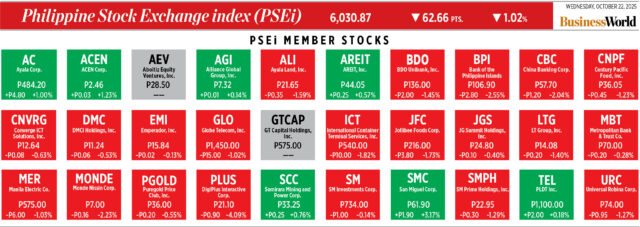
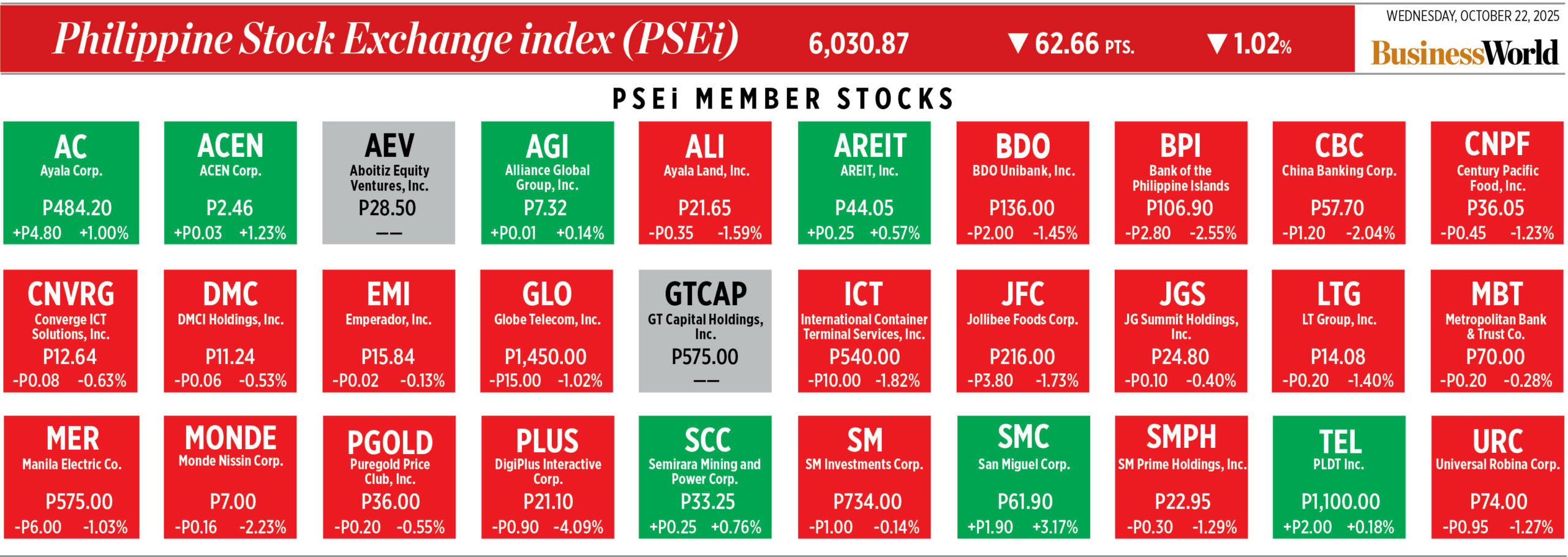
How PSEi member stocks performed — October 22, 2025

Here’s a quick glance at how PSEi stocks fared on Wednesday, October 22, 2025.


How reliable is the Philippines as an investment destination?

The Philippines ranked 169th out of 226 countries and territories in the Global Investment Risk and Resilience Index by Henley & Partners in partnership with AlphaGeo. With a risk score of 44.06, where lower is better, and 48.42 in resilience, where higher is better, the country had a total score of 52.18 out of 100. This put the Philippines as the fourth least reliable destination for investment among its peers in the region. The index measures a jurisdiction’s reliability as an investment destination structured around two pillars: risk and resilience.

How reliable is the Philippines as an investment destination?

DTI overhauls PCAB, tightens licensing rules

TRADE SECRETARY Ma. Cristina A. Roque attended the hearing of the Independent Commission for Infrastructure at its Taguig office, where she revealed changes in the composition of the Philippine Contractors Accreditation Board (PCAB) and its licensing rules. — ICI

By Erika Mae P. Sinaking

THE GOVERNMENT is set to implement major reforms in the country’s contractor licensing system as it overhauls the Philippine Contractors Accreditation Board (PCAB) amid investigations into anomalous flood control projects, Trade Secretary Ma. Cristina A. Roque said on Wednesday.

Appearing as a resource person before the Independent Commission for Infrastructure (ICI), Ms. Roque said members of the board as well as executive directors of PCAB and the Construction Industry Authority of the Philippines (CIAP) will be replaced.

“We are just waiting for the appointments,” Ms. Roque told a news briefing.

The Department of Trade and Industry (DTI), along with PCAB and CIAP, is also reviewing processes and implementing reforms to strengthen oversight, she said.

As part of the reforms, PCAB board members will no longer be allowed to own construction companies to prevent conflicts of interest.

“They should have a construction background, meaning they could be engineers or part of construction firms,” Ms. Roque explained. “But they cannot own a construction company.”

Relatives of board members are also being considered for exclusion from receiving licenses if found to be involved in any anomalies.

A fact-finding team, which Ms. Roque first mentioned in September, has been established within the DTI to review contractors involved in flood control projects and other anomalies, as well as new applicants. “We want the legitimate construction industry to follow these new rules so they do not abuse their licenses,” she said.

Licenses will now be routed through the Office of the DTI Secretary for checking before being granted by the PCAB. “Before, the license went directly to the PCAB board. Now, the license will be passed to the office of the secretary for checking, and then from there we will give it to the PCAB board,” she said.

Ms. Roque also said the review for the potential license revocation of the 15 contractors initially flagged is now in the “final stages,” Ms. Roque said in the same briefing. While their names remain undisclosed, the DTI and ICI are verifying their violations before taking formal action.

These 15 contractors were identified in a presidential audit, which revealed they cornered approximately P100 billion or about 20% of the P545-billion budget, allocated to flood control projects since 2022.

Ms. Roque noted that, beyond the 15 top contractors, there is an additional list of firms, which she revealed to the ICI during the hearing. She noted that the department is still finalizing details to ensure all information is accurate.

“We can’t divulge the names of additional contractors that have some violations, as we are still investigating with the ICI since the ICI is really investigating this issue of the flood control and issue with the contractors,” Ms. Roque said.

GOING LIVE
Also on Wednesday, the ICI said it will begin livestreaming its proceedings by next week, following calls from the public to make its probe on the multibillion-peso flood control scandal for transparency.

“We will now go on livestream next week once we get to be able to have the technically capability.” ICI Chairman Andres B. Reyes, Jr. told the Senate Committee on Justice.

Since its creation by the President in September, the ICI has kept all of its proceedings behind closed doors. The independent body had only issued press statements or conducted news briefings, led by the ICI spokesperson.

Earlier, several lawmakers and civil society organizations called on the independent body to be more transparent in its proceedings, warning that any attempt to conceal wrongdoing could further erode public trust.

Business groups have also called on the Marcos administration to take swift and decisive actions against corruption, noting that the controversy could further damage investor confidence and posed serious threat to the country’s economy, governance, and international standing.

“We will try our best to be able to be on full blast in our investigation of all this fraud,” Mr. Reyes said.

Justice Committee Chairman Senator Francisco Pancratius N. Pangilinan welcomed the ICI’s move as the panel deliberates on the proposed Infrastructure Anomalies Investigation, under Senate Bill No. 1215.

“People would like to know the facts of these cases and would like to be updated as to the developments and progress of the investigation. The livestreaming of the proceeding would definitely address this concern of the public,” he added.

The proposed measure seeks to create the Independent People’s Commission to investigate all government infrastructure projects, in effect institutionalizing the ICI which was created through an executive order.

Congressmen also welcomed the move as it could boost transparency and potentially help restore public confidence amid waning confidence in the government.

“Livestreaming the hearings will help restore public trust and dispel doubts about the fairness of the investigation,” Las Pinas Rep. Mark Anthony G. Santos said in a statement.

The move would also be a deterrent against political interference that may happen behind closed doors, said Mr. Santos.

In a separate statement, a group of minority lawmakers called on the public to remain vigilant, saying there may have already been cover ups in its earlier discussions.

Meanwhile, Malacañang dismissed as baseless a private citizen’s letter urging the ICI to investigate alleged ties between First Lady Marie Louise Araneta-Marcos and businessman Maynard S. Ngu.

In a briefing, Palace Press Officer Clarissa A. Castro said the letter, filed by an individual identified as John Santander, did not contain any evidence linking the First Lady to irregularities involving flood control or infrastructure projects — the specific mandate of the ICI.

“From what we’ve read — and I know you’ve read it as well — there is nothing in the letter of sentiment that alleges any irregular flood control projects linking the First Lady, Liza Araneta-Marcos,” she said in Filipino.

Ms. Castro also questioned the motive behind the complaint, suggesting it may be an attempt to discredit Ms. Marcos.

“Is this simply a fishing expedition meant to malign the First Lady?” She said.

She added that Mr. Ngu, a tech billionaire, is no longer the Special Envoy to China as his term expired last August.

Mr. Santander earlier this week asked the ICI to investigate alleged links between Ms. Marcos and Mr. Ngu, who was described in the complaint as a supposed “bagman” of Senator Francis Joseph “Chiz” G. Escudero.

The letter of sentiment urged the ICI to look into possible irregularities involving flood control projects.

Also on Wednesday, Ms. Castro said President Ferdinand R. Marcos, Jr. has yet to take a position on reinstating the death penalty in the Philippines amid renewed public frustration over corruption.

Any move to lift the decades-long suspension of the death penalty would require “careful and thorough study,” she said, stressing that the country’s five pillars of the justice system must first be strengthened.

“We cannot simply reimpose the death penalty without ensuring that our justice system is clean, fair, and functioning properly,” she added, warning that past cases of fabricated evidence and wrongful convictions underscore the risks of reinstating the measure.

“The reimposition of the death penalty must be studied deeply.”

The Philippines abolished capital punishment in 2006 under then-President Gloria Macapagal Arroyo, making it the first Asian nation to do so in the 21st century.

Calls to restore it have resurfaced periodically, especially in response to crime and corruption scandals, but the measure has yet to gain traction in Congress.

The Philippines is embroiled in a multibillion-peso public works scam following the pronouncements of Mr. Marcos last July, where he exposed lawmakers allegedly receiving kickbacks from such projects. with Adrian H. Halili, Kenneth Christiane L. Basilio, and Chloe Mari A. Hufana

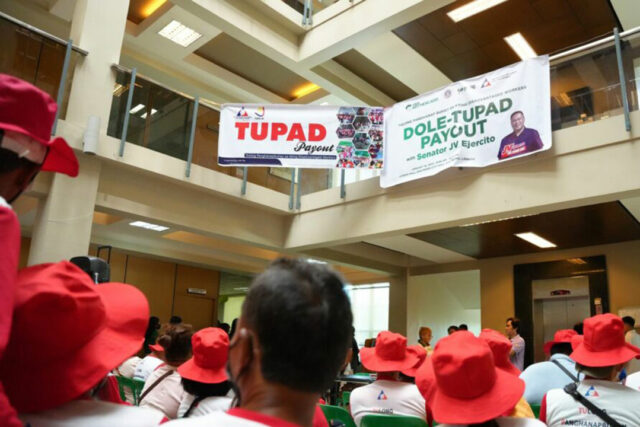
Budget cuts to cash aid for displaced workers could hurt 1M Filipinos

CITYOFSANPEDROLAGUNA.GOV.PH

A MILLION Filipinos may be affected by the reduction in the Labor department’s budget for its livelihood program for displaced workers, a senator said on Wednesday.

Senator Sherwin T. Gatchalian, who heads the Finance committee, said that the P6.3-billion reduction in the Department of Labor and Employment’s (DoLE) budget for the Tulong Panghanapbuhay sa Ating Disadvantaged/Displaced Workers (TUPAD) program could impact “more or less a million” Filipinos.

“There were 4.2 million TUPAD beneficiaries in 2024. It will be reduced by around one-third, so that’s almost one million,” he said during the discussion on the department’s proposed P44.38-billion budget for 2026.

The 2026 National Expenditure Program allocated P11.03 billion for the TUPAD program, representing a 36% drop from the P17.35 billion allocated for this year.

Labor Secretary Bienvenido E. Laguesma said that about 50% of the 4 million beneficiaries from calamity areas were aided by the cash assistance program.

“If we look at the number of typhoons that hit the Philippines in 2024, we can say that 50% of the total number benefited from TUPAD,” he said.

Labor Assistant Secretary Amuerfina R. Reyes said that the reduced budget would impact the number of beneficiaries under the programs.

“The number of beneficiaries would be impacted, most notably in times of calamities or emergencies,” she told senators.

The agency’s TUPAD program provides short-term, community-based emergency employment to displaced, underemployed, and seasonal workers.

Beneficiaries under the program work for a minimum of 10 to a maximum of 30 days on community projects and receive a wage based on the regional minimum wage.

“It has been emphasized that this is a stop gap measure. This is temporary employment,” she told senators.

“If the support in terms of financial (aspect) is reduced, it will definitely have a domino effect, not only in terms of the number but in terms of the quality of intervention for our people who need us the most in times of emergencies and calamities,” she added. — Adrian H. Halili

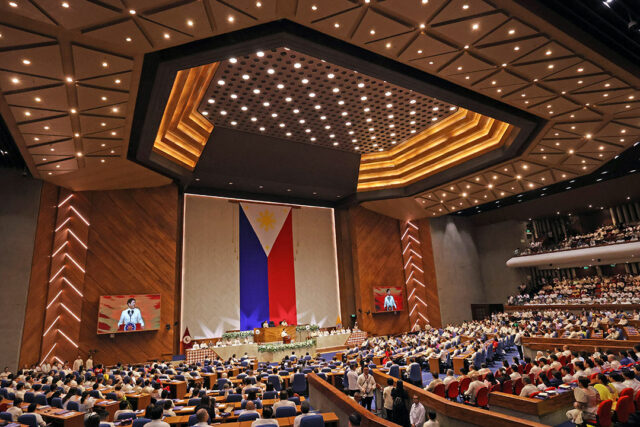
Speaker forms panel to review asset disclosures amid flood control mess

PHILIPPINE STAR /KJ ROSALES

By Kenneth Christiane L. Basilio, Reporter

SPEAKER Faustino “Bojie” Dy III on Wednesday formed a House of Representatives committee aimed at reviewing the chamber’s guidelines on releasing net worth statements, amid calls for greater government transparency.

In a statement, Mr. Dy said he formed the committee to fulfill his commitment to review the House’s policy on releasing lawmakers’ statements of assets, liabilities and net worth (SALN).

The memorandum, which takes effect immediately, directs the committee to begin reviewing the House’s rules on publicizing lawmakers’ net worth disclosures.

The panel will be chaired by Deputy Speaker and Cotabato Rep. Ferdinand L. Hernandez, with Iloilo Rep. Lorenz R. Defensor and Marikina Rep. Romero Federico S. Quimbo as deputies.

The Speaker last week said that congressmen are open to the idea of releasing their SALNs, following Ombudsman Jesus Crispin C. Remulla’s reversal of a restrictive policy that has limited public access to government officials’ net worth disclosures since the Duterte administration.

Republic Act No. 6713, the Code of Conduct and Ethical Standards for Public Officials and Employees, assigns multiple custodians for SALNs across government branches and regions. The Ombudsman is the repository of net worth statements of the President, Vice-President and heads of Constitutional offices.

The Office of the President holds those of the Cabinet, presidential appointees and high-ranking military officials.

Senators and congressmen file their SALNs with their respective chambers, while judges and justices submit theirs to the Office of the Court Administrator and the Supreme Court’s Clerk of Court, respectively.

EASIER WITH FOI
The House SALN release policy should not be too complicated and be bogged down with bureaucratic processes, Hansley A. Juliano, a political science lecturer at the Ateneo de Manila University, said in a Facebook Messenger chat.

“As long as it is consistent with lobbied standards for Freedom of Information (FOI) requests, and as long as it provides the relevant information, we should not complicate the process and we should not involve too many politicians,” he said.

But he said it would be easier for the House to just pass an FOI law to ease government requests, like SALN releases. “They’d garner more with that legislation.”

Also on Wednesday, Mr. Dy released his SALN, declaring a net worth of P74 million that includes 11 agricultural lots, two residential lots and three house properties.

His declared assets include P25.18 million in cash, P29.6 million in investments and P12 million worth of jewelry and other personal items.

Mr. Dy’s SALN also listed 16 relatives in government service, including a nephew serving as Philippine Ambassador to Switzerland. His son, daughter-in-law and another nephew currently hold mayoral posts in cities and municipalities across Isabela province, where his family maintains political influence.

Three of his relatives are also district representatives of Isabela, occupying half of the legislative seats in the lower house allocated to the northern province.

Shares decline on weak peso, dearth of leads

BW FILE PHOTO

SHARE PRICES closed lower on Wednesday, weighed down by a weaker peso and falling gold prices, with investors grappling with the absence of fresh catalysts.

The benchmark Philippine Stock Exchange index (PSEi) fell 1.03% or 62.66 points to close at 6,030.87, while the broader all-share index dropped 0.83% or 30.47 points to 3,627.38.

AP Securities, Inc. said in a market note that the equities fell back after four consecutive days of unsuccessful attempts to breach the 6,100 level.

“The market struggled to find new catalysts (while) the peso weakened. Moreover, the dip in gold spot prices also contributed to the negative sentiment in the market,” Regina Capital Development Corp. Head of Sales Luis A. Limlingan said via Viber.

The peso closed at P58.41 to the dollar on Wednesday, weakening from Tuesday’s finish of P58.225, the Bankers Association of the Philippines reported.

US stocks were mixed in Tuesday trading, with the Dow higher as solid earnings drew investors to industrial and capital goods sectors, Reuters reported.

“The S&P 500 finished flat, showing little movement by the close, while declines in growth and semiconductor stocks pulled the Nasdaq slightly lower,” Mr. Limlingan said.

Most sectoral indices closed lower Wednesday. Mining and oil were down 5.91% or 834.12 points at 13,278.49; financials dropped 1.62% or 33.2 points to 2,010.92; services fell 1.42% or 33.05 points to 2,291.24; property was down 1.14% or 25.68 points at 2,228.64; and industrials fell 0.95% or 85.22 points to 8,879.32.

Meanwhile, holding firms rose 0.06% or 3.16 points to 4,877.17.

Decliners outnumbered advancers, 150 to 57, while 48 issues were unchanged.

The value of trade was P10.81 billion on Wednesday on a volume of 12.06 billion shares. Tuesday’s value and volume had been P5.24 billion and 1.31 billion shares.

Net foreign selling was P104.43 million, reversing the P231.58 million in net buying Tuesday. — Alexandria Grace C. Magno