Home Blog Page 7708

Hidilyn answered the question… emphatically

WWW.FACEBOOK.COM/HIDILYNWEIGHTLIFTER

With a new Olympic record lift, three-time Olympian Hidilyn Diaz won the country’s first gold medal since its Olympics debut in 1924 at the Paris Olympics, the first in the modern era.

Hidilyn’s gold medal performance once again highlighted the significant role women continue to play in any aspect of economic and human development. Aside from the record- breaking performance, Hidilyn beat the best of the best in her weightlifting class, including perennial rival China.

That last nuance did not go unnoticed among some observers.

The victory also answered the question, “Can the Philippines win an Olympic gold medal?,” which was the title of a recent virtual webinar organized by the Archer Talks and the Benita and Catalino Yap Foundation. Although that question was answered, there was a second one: “How do we get it done?”

Before we answer that relevant query, it may be worthwhile to be reminded and be mindful of the principles of Olympism as espoused by Baron Pierre de Coubertin, founder of the modern Olympics and re-emphasized by Juan Antonio Samaranch. Samaranch is the Spaniard who headed the International Olympic Committee (IOC) from 1980 to 2001:

“Olympism is a philosophy which by blending sport with culture seeks to create a way of life based on the joy found in effort, the educational value of a good example and respect for universal ethical principles.”

In answering these questions, including the first which has been resolved by Hidilyn, we must establish the fact that sports development is a constitutional mandate. Section 19 of the Constitution states, “the state shall promote physical education and encourage sports programs, league competitions and amateur sports including training for international competitions, to foster self-discipline, teamwork and excellence for the development of a healthy and alert citizenry.”

Having addressed the legal basis for the commitment of government resources to sports and physical education, it is time to respond to the second. Incidentally, another reason why the state must devote resources for physical education and sports is the Philippines is committed to the International Charter of Physical Education, Physical Activity and Sport.

The charter “is a rights-based reference that orients and supports policy- and decision-making in sports.” This particular formulation is at the heart of the question “What needs to be done.” In essence, the charter says any person has the right to play the sport of his choice. In short, “sports is for all, regardless of age, talent, gender, capability, religion, race, ethnicity or creed.”

The second question is a bit tricky since a sensible answer will cover a lot of territory. First there is an actual and ideal framework of Philippine sports and an actual and ideal way of breathing life into the framework.

Breathing life into the framework will require a thorough understanding of the logic of the sports sector. To begin with, at opposite ends of the spectrum are mass-based sports and elite or high-performance sports. Mass-based sports start, obviously, at the grassroots, the barangays and municipalities and rural areas. This sector is supposed to provide the extraordinarily talented for elite sports such as the SEA Games, Asian Games, the Olympics, and world and regional/continental championships.

These raw talents at the grassroots are identified ideally through the physical education system in schools and intramurals. Kids who are identified as more talented than the others get to compete in barangay, municipal, city, district, provincial, regional meets and ultimately at the Palarong Pambansa, collegiate leagues, the Philippine National Games (the Philippine Olympics) and the national championship.

Imagine a pyramidal structure with the barangays and out-of-school youth at the base of the pyramid and elite sports and sports for entertainment at the apex.

The other participants in the framework are the different sectors of the body politic. For a truly comprehensive and inclusive approach to a solid elite athlete development program, that program must be anchored on an equally comprehensive and inclusive mass-based plan of action. As the saying goes, “it’s easier to choose 100 elite athletes from 100,000 than from 1,000.” To have a wider base of selection, sectors like farmers, fisherfolk, drivers and conductors, laborers, OFWs, etc., need to be mobilized. These sectors, when consolidated, provide talent for competitions and programs that serve as a feeder to the national training pool and eventually for the national team. Our population is still our biggest resource.

At the middle of all these is the Philippine Sports Commission (PSC) that funds the training of elite athletes and provides policy direction and guidelines for sports development. Ideally, the PSC should be engaging all other line departments in the executive branch especially the Department of Education and Commission on Higher Education for school sports and complementation and synergy with the physical education program. The PSC cooperates with the Philippine Olympic Committee for participation of the Philippines in the highest levels of international competitions.

The PSC is in the middle of all these to represent government. Government involvement is, at this stage of our economic development, crucial. Government, in consultation with the citizenry, has to make basic policy decisions on budgets for mass-based and elite sports, physical education, the role of the private sector and how to encourage it to take part in sports development. The development of software and hardware require enormous amounts of money. It is government that can mandate the allotment of government funds for these purposes.

Inasmuch as the Olympics are the apex of elite sports development, a calculation of the cost of training and preparing an athlete over a four-year period is presented as part of the answer to the question “What is needed to make it happen?” The estimate is based on our own experience over the years as chairman of the PSC and as president of a National Sports Association. The figures do not include all earlier expenses prior to training specifically for the Olympics.

Our most recent estimates, based on actual costs and some assumed outlays, indicate that at least P40 million is needed over four years to make the athlete “battle ready and prepared” to compete at the Olympics. The basic assumptions are the athletes is training either at the United States or Europe, competing in at least 12 high level outdoor and indoor events per year, quartered and training full time at modern facilities, with availability of top-level skills and strength and conditioning coaches, therapist, osteopath and other professionals.

The expenses can be divided as follows: training allowance 8%; professional fees 38%; training camp 24%; competitions 13%; airfare 5%; other expenses 6%; contingency 5%.

To be sure, as the country is able to provide more resources for elite sports and as the PE program is given much, much more than what it is getting, we will have more athletes in proper training venues and in more high-level competitions. Being exposed to high level competitions is essential if all the training one undergoes is to be maximized. Modern training facilities by themselves are not enough.

In spite of the cost, we will continue to participate in all Olympics and in Olympic-type sports events. Participation is part of the cost of being a member of the international community, and participation in the Olympics is part of diplomacy. To participate in the Olympics is to make a statement which countries need to make periodically.


Philip Ella Juico’s areas of interest include the protection and promotion of democracy, free markets, sustainable development, social responsibility and sports as a tool for social development. He obtained his doctorate in business at De La Salle University. Dr. Juico served as Secretary of Agrarian Reform during the Corazon C. Aquino administration.

The need to explain

GOONERUA-FREEPIK

FINANCIAL STATEMENTS, especially of publicly listed companies, are required to explain certain entries that may be vague or out of the ordinary. Such items as “other income” need to be given a breakdown of their component parts, such as revenues from subsidiaries or Christmas cash gifts. “Advances to affiliates” need details on which companies are involved and the nature of the advances given and whether it is expected to be liquidated at some future time.

Explanatory notes also apply to social situations.

If you bump into a friend at an out-of-the way restaurant (like Tagaytay on a weekday), he is likely to explain what he is doing there, maybe a despedida for a colleague. (You recognize him even with the face mask.) You too will need to reciprocate with an explanation of your own, after the fist bump.

More complicated situations can arise as when one is seen in the same place with a person of the opposite sex (or the same sex for that matter) who is 40 years younger. If the other party is there attending a company seminar (we don’t believe in webinars), he has a legitimate explanation. The one with a younger associate in tow then tries to promote an acceptable fiction on the situation — she’s showing me some properties for investment. (Wait, we have to check the basement parking of this building.)

To avoid awkward explanations which anyway are difficult to concoct at a moment’s notice and likely to cause stammering and many pregnant pauses, it is best to simply avoid acquaintances altogether. This evasion technique requires a double mask or taking the fire exit to the parking lot.

Westerners, or even natives with more sophisticated civility, will not inquire into why a person is where she is or why she is with who she’s with. They don’t presume intimacy such as blurting out intrusive observations on a person’s status — Wow, you’re so fat. What have you done to yourself? Meddling and the inability or unwillingness to recognize borders behind which individuals deserve their privacy are somehow an intrinsic part of our culture. Aunts don’t think anything of asking what one does for a living and sometimes even how much one’s salary is.

The social pressure to explain oneself even when not asked to do so may be part of our maternal culture. Mothers, it seems, have a carte blanche authority to ask what their offspring are up to, especially when they are behind locked doors — What are you doing in there? Open this door at once. Are you soiling the bedsheets again?

Is it possible to greet an acquaintance and his family at a restaurant without introducing the person one is with? The knowing looks directed at the unidentified and masked partner are silent appeals to introduce who is standing quietly beside you. Briskly moving on and heading for the exit without further ado may cause some static with the companion. (Why didn’t you introduce me? I feel so slighted.)

Explanations try to prove that what looks embarrassing is just taken out of context. It craves for another person’s good opinion. Thus, those who have nothing to hide, being where they have every right to be and with a companion legitimately related to them are only too eager to walk across the wide hall to greet distant acquaintances with the cheery — Hi, how are you doing? I’d like you to meet my wife. (And is that one dining beside you your niece perhaps?)

Politicians, especially those running for office (or thinking about it), try to avoid explanations. Even when caught in a compromising situation (like an unexplained bank account) they dodge and avoid interviews. They can even argue quite calmly that lying is part of the political game — Everybody lies, so why are you in such a snit if you caught me in one? It was always just a joke.

Anyway, when there are all sorts of things that need to be explained, the attention span of the public can be short. The sovereignty issue over some body of water may just require too many details in fine print.

Those who have something to hide or are required to explain what they have not successfully hidden can take comfort in the dismissive shrug of a bored audience that wants to move on…after getting “too much information.”


Tony Samson is Chairman and CEO of TOUCH xda

ar.samson@yahoo.com

Biden’s ‘summer of joy’ turns grim as Delta infections skyrocket

REUTERS

PRESIDENT Joseph R. Biden promised a “summer of joy” on July 4 as he declared America’s independence from Covid-19. Three weeks later that sense of victory is evaporating in the face of a resurgent pandemic.

The US now faces a surge in cases fueled by vaccine holdouts and the highly transmissible delta variant, prompting the federal government and companies on Tuesday to weigh mandatory vaccinations of workers and a return to widespread mask wearing.

That reversal of fortune could bring back restrictions many Americans had hoped were gone for good — a bitter setback for Mr. Biden, who has counted on defeating the pandemic as a cornerstone of the nation’s economic recovery.

As the seven-day rolling average of new infections approached 52,000 on Tuesday, more than four times the level just three weeks ago, the Centers for Disease Control and Prevention (CDC) issued new guidance recommending Americans resume wearing masks in indoor public places in many parts of the country — regardless of whether they’re vaccinated.

Just two months ago, the agency said vaccinated Americans could safely remove their masks everywhere.

The rapidly rising case count is prompting concern about the safety of schools, which are poised to begin reopening for the fall in less than a month, and whether the economy will suffer another blow should Americans resume social distancing practices.

Virus fears could keep Americans away from restaurants, hotels and bars, especially in areas with high transmission, and cause them to reconsider reporting to their jobs or traveling.

The apprehension was evident on Tuesday at the White House. Press Secretary Jen Psaki spent much of her daily briefing jousting with reporters over the new CDC guidance.

Since May, virtually all White House staff and reporters at the complex had gone without face coverings. But on Tuesday, even before the CDC formally announced its new recommendations, a handful of reporters and photographers donned masks at Psaki’s briefing.

Vice President Kamala Harris put one on during a meeting with Native American leaders, and reporters accompanying her were abruptly instructed to wear masks by press aides, who said the level of virus transmission in Washington had been upgraded by the CDC to “substantial.”

At 5 p.m., White House staff received an email directing them to wear masks while indoors at the White House even if they’re fully vaccinated. The White House Correspondents’ Association sent a similar message to the hundreds of journalists credentialed to be in the complex.

Staff and journalists quickly followed suit, digging masks out of bags and desk drawers.

After months of resisting vaccine mandates, Mr. Biden told reporters that he was considering forcing federal employees to get shots. While there have been so-called breakthrough cases among the vaccinated, Mr. Biden said the Delta variant is primarily circulating among those who aren’t inoculated.

“If you’re not vaccinated, you’re not nearly as smart as I thought you were,” Mr. Biden said during a visit to Tuesday to the headquarters of the Director of National Intelligence in Virginia.

Some major employers are implementing similar policies. The Washington Post announced Tuesday it would require employees to show proof of vaccination, joining the ranks of companies mandating workers get their shots. Ford Motor Co. reinstated masking requirements for workers at facilities in Missouri and Florida, after General Motors Co. did the same at a Missouri factory.

The president faces significant political risks if rising case levels once again disrupt everyday life in the US. He has touted progress against the virus as his most significant achievement and Americans have given him high marks for his handling of the pandemic thus far.

Almost two-thirds of Americans approved of his approach to the virus, according to a CBS News/YouGov poll released last week.

The CDC’s reversal on masks could make it more difficult to convince Americans to adhere to the new policy, according to Leana Wen, a former Baltimore health commissioner.

“The CDC made a critical mistake back in May. By issuing guidance that led to the end of indoor mask mandates prematurely, they gave the impression that the pandemic was over. It’s very hard to walk this back,” she said.

But Peter Hotez of the Baylor College of Medicine says he believes the CDC made the correct decision in easing masking rules in May and again on Tuesday, given how high viral loads are for people with the Delta variant.

“They’re following the evidence, following the science,” he said. “The problem is it’s not a 30-second Unicef commercial, it takes nuance and time to explain” why the policy reversal makes sense.

Mr. Biden missed his July 4 target of 70% of US adults receiving at least one dose of a COVID-19 vaccine, and the holdouts — particularly in parts of the country that are heavily Republican, such as the Deep South — have left the country vulnerable.

More than two weeks past that deadline, 69% of adults have had at least one inoculation, according to the CDC.

Republicans, many of whom have only recently begun to urge their constituents to get vaccinated, have indicated they don’t plan to offer Mr. Biden help in getting them to follow the CDC’s suddenly stricter mask guidance. Former President Donald Trump, in a statement on Tuesday night, belittled the new concerns: “We won’t go back. We won’t mask our children.”

And Senator Ted Cruz of Texas said, “today’s decision, sadly, was driven by politics, not science. Let me be clear: There should be no more COVID mandates, no mask mandates, no vaccine mandates, no vaccine passports, no lockdowns, and no school closures. Enough is enough.”

Delta’s spread has touched all corners of the country — from Cruz’s home state, which posted its biggest daily jump in new infections in five months, to New York and Los Angeles, which have joined rural states among places where the new mask guidance applies.

But the White House has some reason to hope that the latest surge will not lead to the type of widespread turmoil and death that occurred last year.

The U.K. recently went through a spike in infections driven by the Delta variant, despite having fully vaccinated 56% of its population, according to the Bloomberg Vaccine Tracker.

Cases there topped 50,000 a day, close to the level of the country’s winter surge. But unlike the winter peak, there has been little corresponding rise in hospitalizations or deaths, a sign that the wide use of vaccines has prevented infections from becoming severe.

Yet in the US, where case counts are following a similar trajectory, the outcome is less certain. Parts of the country, in particular the East and West Coasts, have vaccination levels in line with the U.K. But in the central and southern parts of the US, the share of people getting shots has lagged badly and hospitalization rates are rising.

In Missouri and Arkansas, two of the states with the worst ongoing outbreaks, hospitalizations are at levels not seen since January. In younger age groups, such as those ages 30-59, new hospitalizations have already passed the US winter peak and continue to rise. — Bloomberg

Vatican starts corruption trial with cardinal among defendants

THE VATICAN started a corruption trial with alleged offenders including a previously powerful cardinal as Pope Francis ramps up a campaign to overhaul the city state’s scandal-plagued finances.

Cardinal Angelo Becciu, who served as chief of staff in the Vatican’s secretariat of state, is the highest-placed Vatican figure to face a trial for alleged financial crimes. At the trial that started on Tuesday, the 73-year-old Mr. Becciu and two former leaders of the Vatican’s financial watchdog are among the 10 defendants who are accused of offenses including fraud, embezzlement, abuse of office, money-laundering and corruption.

Pope Francis, who once called money “the devil’s dung,” has made the clean-up of the Catholic church’s finances a pillar of his papacy. To drive his campaign home, Pope Francis last year requested and accepted Mr. Becciu’s resignation after the cardinal was linked to a controversial London property deal. In the 2014 transaction the Vatican’s Secretariat of State — equivalent to the prime minister’s office — invested in a former Harrods warehouse in the affluent Chelsea neighborhood that was slated to become luxury apartments.

Pope Francis dismissed five Vatican employees over the London deal, which went south, and an investigation was launched to determine whether the bureaucrats were scammed or if they themselves profited.

After Tuesday’s first hearing, Mr. Becciu awaits the continuation of the trial and expects that “numerous pieces of evidence and witnesses will indicate his innocence with respect to every accusation,” according to a statement by his lawyer, Fabio Viglione, cited by the Ansa news service.

“I believe this trial marks a turning point, which can lead to greater credibility for the Holy See on economic matters,” Father Juan Antonio Guerrero Alves, the Vatican’s economy minister, told the official Vatican News website on Saturday. “The fact that this trial takes place means that certain internal checks work: the accusations came from inside the Vatican.”

Defendants in the trial include financial brokers, Vatican officials and a lawyer, according to a Vatican statement.

The Vatican’s losses in the London deal amount to as much as 150 million pounds ($208 million), Archbishop Nunzio Galantino, who heads the Administration of the Patrimony of the Holy See which manages real estate holdings, told the Catholic newspaper Avvenire last year. — Bloomberg

Kuwait bans unvaccinated citizens from traveling abroad

STOCK PHOTO | Image by Stefan Fluck from Unsplash

CAIRO — Kuwait on Tuesday said only citizens who have been vaccinated for the coronavirus will be allowed to travel abroad starting on Aug. 1.

A government statement said the rule excepted children under age of 16, those with a health ministry certificate saying they cannot be vaccinated, and pregnant women who have a pregnancy proof certificate from authorities.

Also on Tuesday, the civil aviation authority said that all arrivals in Kuwait must have a negative COVID-19 PCR test before they board their flights and must not be showing any symptoms.

All arrivals will have to be home quarantined for seven days unless they take a COVID-19 PCR test inside Kuwait that comes out negative.

The Kuwaiti government on Monday eased some coronavirus related restrictions and resumed all activities except for gatherings which include conferences, weddings, and social events. — Reuters

UnionBank Private Banking, Lombard Odier, to push for Circular, Lean, Inclusive, Clean (CLIC™) economy in the Philippines

From resource-intensive mass production methods that often lead to overconsumption, to anti-green practices that contribute to the continuous degradation of the environment, many of today’s investment strategies employ models that are not sustainable. Lombard Odier has aptly named these models WILD or “Wasteful, Idle, Lopsided, Dirty”, an issue UnionBank Private Banking is similarly trying to address, in the context of sustainable investing in the local landscape.

There are many factors that Filipino ultra-high net worth individuals consider when choosing a bank. Sustainability, one such factor, is starting to grow in weight of preference. According to the whitepaper “Connection, Transition, Transformation: engaging Asia’s UHNWI in the New Normal” published in February 2021 by Lombard Odier and UnionBank Private Banking together with Lombard Odier’s other strategic alliances in the region, many UHNWIs have noted their concern for climate change and the need for action once the pandemic has ended with 89% of the respondents believing that the sustainability trend in one form or another is here to stay in the long run.

As an answer to the WILD model, Lombard Odier has created the CLIC™ framework. Short for “Circular, Lean, Inclusive, Clean,” the CLIC™ framework promotes sustainable and forward-looking business practices and further drives the ongoing shift toward a circular and leaner economy, where waste and emissions are minimized, and growth is inclusive. Through the framework, Lombard Odier aims to meet the long-term objectives of its private banking clients through strategies that are aligned with the United Nations Sustainable Development Goals.

“The CLIC™ economy leverages efficient production and consumption, and the sharing economy, reducing the wasteful accumulation of idle assets. It reduces the dependence on ever-greater extraction of mineral resources and draws on the substantial value of the materials and components that constitute the products that we so readily discard today. The transition to a circular, lean economy; one which invests to protect and regenerate its natural capital; will unlock trillions in untapped value,” said Dr. Christopher Kaminker, Head of Sustainable Investment, Research, Strategy and Stewardship at Lombard Odier.“The transition is already underway, and we are seeing many regions across Asia embrace the CLIC™ revolution.”

UnionBank Private Banking believes in the power of the CLIC™ framework to usher in a new age where economic growth can enjoy a harmonious co-existence with eco-conscious efficiency and innovation. Because the framework synergizes perfectly with UnionBank’s “Tech Up Pilipinas” advocacy, the Bank is once again leveraging on its strategic alliance with Lombard Odier to inspire Filipino UHNWIs to become catalysts of the CLIC™ economy in the Philippines.

“UnionBank’s “Tech Up Pilipinas” sustainability thrust revolves around three focus areas- Digital Transformation, Sustainable Finance, and Inclusive Prosperity, which are compatible with Lombard Odier’s CLIC™ framework. We are happy that this synergy allows us to be one of the movers in the local banking industry to pioneer an ESG-led investment program for our UNHWI clients.” said UnionBank Senior Vice President and Head of Private Banking Atty. Arlene Agustin.

“The Philippines is one of the countries in the region that is on the lower side of the transition towards Sustainable Investments. However, we see positive change where more and more investors are looking towards the better business models and practices. UnionBank Private Banking continues to strive towards a more cognizant approach towards sustainable investing and pave a way towards more sustainable frameworks such as CLIC™. We are committed towards this positive change that could lead to a shift in methods within the local market. We share the same belief as Lombard Odier that it is time to let go of old wasteful, idle, lopsided, and dirty practices to bring forth a clean change towards society.” Arlene added.

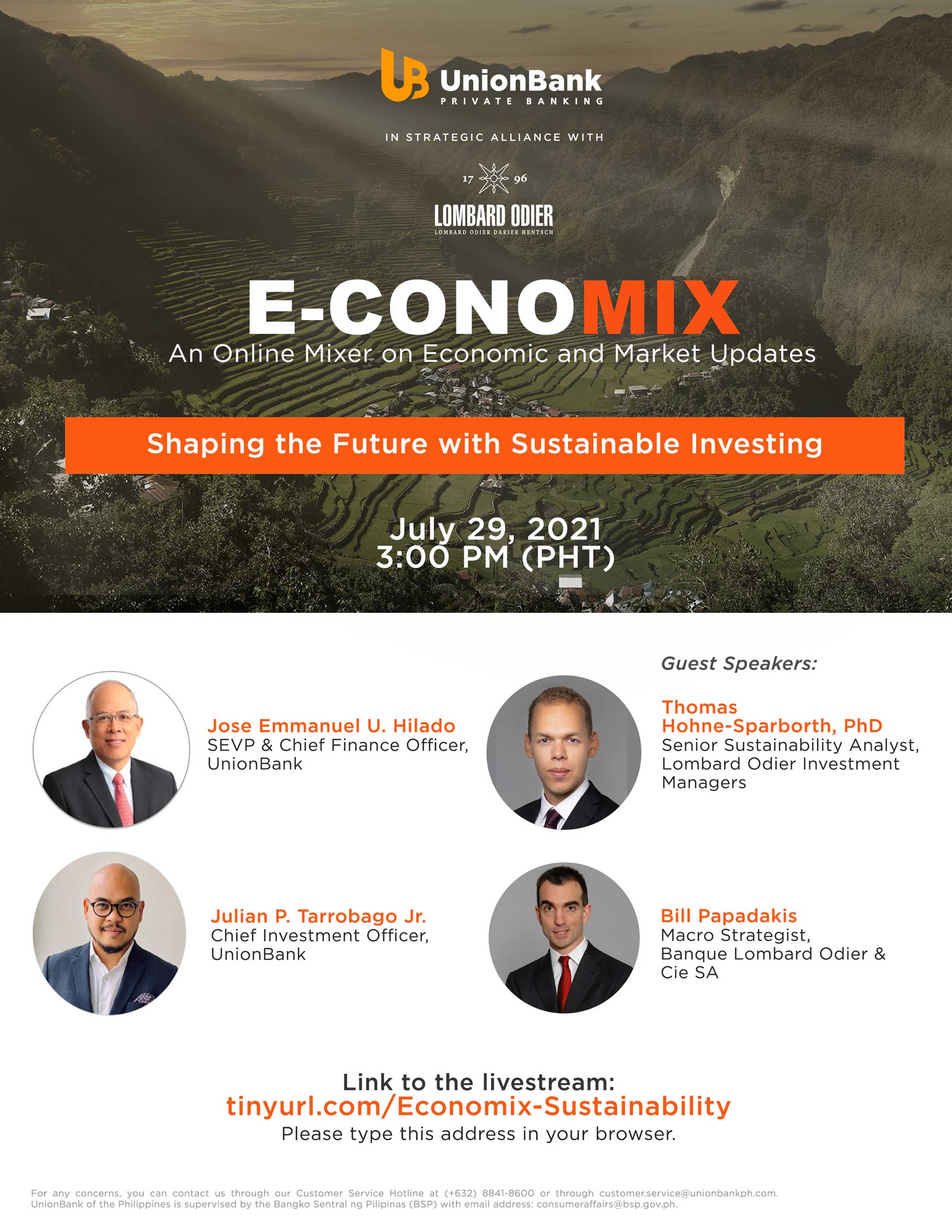
Join UnionBank Private Banking and Lombard Odier in a live virtual event “E-conoMix: Shaping the Future with Sustainable Investing” on July 29 where subject-matter experts from both banks will share their current global and local market views as well as insights on sustainable investing and transitioning to a CLIC™ Economy.

The event is open to the public and will be live-streamed via YouTube on July 29 from 3:00 to 4:30 PM. To access the event, visit tinyurl.com/Economix-Sustainability.

For any concerns, you may contact us through our Customer Service Hotline at (+632) 8841-8600 or through customer.service@unionbankph.com. Union Bank of the Philippines is an entity regulated by the Bangko Sentral ng Pilipinas (BSP) with website address: https://www.bsp.gov.ph.

NextPay raises $1.6M to develop digital banking solutions for MSMEs

Financial technology startup NextPay raised $1.6 million in its new round of seed funding, which was led by Golden Gate Ventures, a Singapore-based venture capital firm; and Gentree Fund, a private investment vehicle of the Sy Family, which owns Filipino conglomerate SM Group.    

The funds will be used to develop digital banking solutions for micro, small, and medium enterprises (MSMEs), allowing them access to financial services such as digital invoicing, cash management, and batch payments to local banks or e-wallets. 

“We believe that business banking will continue to digitally evolve, as the Philippines accelerates its digital transformation initiatives,” said Don Pansacola, NextPay chief executive officer and co-founder, in a statement on Wednesday. “This investment supports our goal of putting the power of big banks in the hands of small businesses.”  

Other investors include Tribe Capital; Broadhaven Ventures; Ayala Group’s Kickstart Ventures; Lisa Gokongwei-Cheng of JG Summit; Rohit Mulani of GoTrade; and Goodwater Capital, which has invested in Facebook, Spotify, and Twitter.  

“NextPay uniquely addresses the local needs of its customers by matching SMEs looking to go digital with mobile and convenient digital financial tools, which scales dynamically with their businesses,” said Mark Sng, Gentree Fund vice-president.  

The fundraiser adds to the $125,000 pre-seed investment the startup received after graduating from the Y-Combinator program in April. Since its launch in 2020, NextPay has processed $9.1 million (P457.5 million) in digital transactions for more than 100 businesses. — Brontë H. Lacsamana 

Sydney adds four weeks to lockdown as Australia COVID-19 cases grow

REUTERS

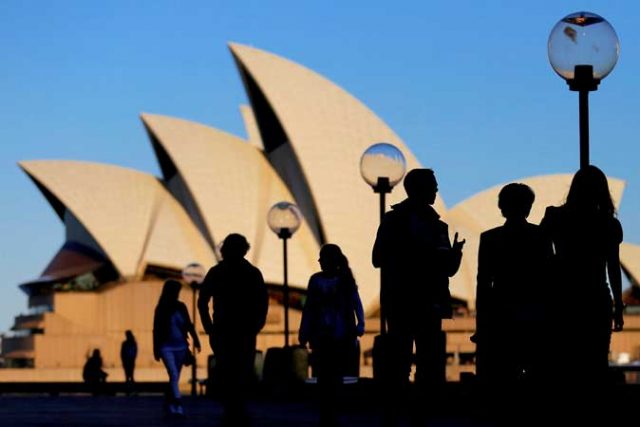
SYDNEY — Australia’s biggest city, Sydney, extended a lockdown by four weeks on Wednesday after an already protracted stay-at-home order failed to douse a coronavirus disease 2019 (COVID-19) outbreak, with authorities warning of tougher policing to stamp out non-compliance.  

Far from a planned exit from lockdown in three days, the city of 5 million people and neighboring regional centers spanning 200 km (120 miles) of coastline were told to stay home until Aug. 28 following persistently high case numbers since a flare-up of the virulent Delta variant began last month.  

The state of New South Wales (NSW), of which Sydney is the capital, reported 177 new cases for Tuesday, from 172 on Monday. That is the biggest increase since an unmasked, unvaccinated airport driver was said to have sparked the current outbreak. The state also reported the death of a woman in her 90s, the 11th death of the outbreak.  

Of particular concern, at least 46 of the new cases were people active in the community before being diagnosed, raising the likelihood of transmission, said authorities. They have cautioned that active community transmission must be near zero before rules are relaxed.  

“I am as upset and frustrated as all of you that we were not able to get the case numbers we would have liked at this point in time but that is the reality,” state Premier Gladys Berejiklian told a televised news conference.  

Ms. Berejiklian added police would boost enforcement of wide-ranging social distancing rules and urged people to report suspected wrongdoing, saying “we cannot put up with people continuing to do the wrong thing because it is setting us all back.” 

In one case, a mourning ceremony attended by 50 people in violation of lockdown rules resulted in 45 infections, she said.  

The extension turns what was initially intended to be a “snap” lockdown of Australia’s most populous city into one of the country’s longest since the start of the pandemic, and may spark the second recession of the $1.47 trillion national economy in two years, according to economists.  

To minimize the economic impact, the NSW government said it would lift a ban on non-occupied construction in most of Sydney. However, it expanded a list of local government areas within the city where the ban would stay because of the prevalence of COVID-19 cases there.  

“It’s getting really difficult, day in and out, day by day, for us to continue running the same business,” said Raihan Ahmed, a convenience store owner at Bankstown, one of the main affected suburbs. “Somehow we have to survive, and we are trying our best.”  

FEDERAL FALLOUT 
Opinion polls have shown slipping support for Prime Minister Scott Morrison’s government amid criticism of a slow vaccination roll-out that has been blamed on changing regulatory advice and supply shortages.  

“There is no other shortcut, there is no other way through, we have to just hunker down and push through,” Mr. Morrison said during a televised news conference in the national capital Canberra.  

All Australians who wanted a vaccination would receive it by the end of the year, and “I would expect by Christmas that we would be seeing a very different Australia to what we are seeing now,” he added.  

The NSW government said it was redirecting Pfizer Inc vaccine doses, which have so far been restricted to people aged 40–60, from relatively unaffected regional areas to final-year school students in the worst-affected Sydney neighborhoods.  

The state and federal governments also said they were expanding relief funding to enable affected companies to keep paying wages through the closure.  

In contrast to New South Wales, the states of Victoria and South Australia began their first day out of shorter lockdowns that halted outbreaks there. Victoria reported eight new cases, all of them isolated throughout their infectious period, and another case still under investigation.  

Australia has kept its COVID-19 numbers relatively low, with just over 33,200 cases and 921 deaths, out of a population of about 25 million, since the pandemic began. — Renju Jose and Byron Kaye/Reuters

US concern over China nukes buildup after new silos report

Screenshot via Google Earth

WASHINGTON — The Pentagon and Republican congressmen on Tuesday aired fresh concerns about China’s buildup of its nuclear forces after a new report saying Beijing was building 110 more missile silos.  

An American Federation of Scientists (AFS) report on Monday said satellite images showed China was building a new field of silos near Hami in the eastern part of its Xinjiang region.  

The report came weeks after another on the construction of about 120 missile silos in Yumen, a desert area about 240 miles (380 km) to the southeast.  

“This is the second time in two months the public has discovered what we have been saying all along about the growing threat the world faces and the veil of secrecy that surrounds it,” the US Strategic Command said in a tweet linked to a New York Times article on the AFS report.  

The State Department in early July called China’s nuclear buildup concerning and said it appeared Beijing was deviating from decades of nuclear strategy based around minimal deterrence. It called on China to engage with it “on practical measures to reduce the risks of destabilizing arms races.”  

Republican Congressman Mike Turner, ranking member of the House Armed Services Subcommittee on Strategic Forces, said China’s nuclear buildup was “unprecedented” and made clear it was “deploying nuclear weapons to threaten the United States and our allies.”  

He said China’s refusal to negotiate arms control “should be a cause for concern and condemned by all responsible nations.”  

Another Republican, Mike Rogers, ranking member of the House Armed Services Committee, said the Chinese buildup showed the need to rapidly modernize the US nuclear deterrent.  

A 2020 Pentagon report estimated China’s nuclear warhead stockpile in “the low 200s” and said it was projected to at least double in size as Beijing expands and modernizes its forces. Analysts say the United States has around 3,800 warheads, and according to a State Department factsheet, 1,357 of those were deployed as of March 1.  

Washington has repeatedly called on China to join it and Russia in a new arms control treaty.  

The report on the new silos comes as Assistant Secretary of State Wendy Sherman is due to hold arms control talks with Russia in Geneva on Wednesday.  

Ms. Sherman was in China earlier this week for talks at which Beijing accused Washington of creating an “imaginary enemy” to divert attention from domestic problems and suppress China.  

Beijing says its arsenal is dwarfed by those of the United States and Russia and it is ready to conduct bilateral dialogues on strategic security “on the basis of equality and mutual respect.” — Reuters

US urges vaccinated Americans to wear masks indoors in many places

FREEPIK

WASHINGTON — Americans fully vaccinated against coronavirus disease 2019 (COVID-19) should go back to wearing masks in indoor public places in regions where the coronavirus is spreading rapidly, US health authorities said on Tuesday.  

In a toughening of guidance issued earlier this month, the US Centers for Disease Control and Prevention (CDC) also recommended all students, teachers, and staff at schools for kindergarten through 12th grade wear masks regardless of whether they were vaccinated.  

US coronavirus cases have been rising due to the highly contagious Delta variant, which emerged in India but has quickly spread and now accounts for more than 80% of US coronavirus cases.  

US President Joseph R. Biden, Jr., said that increased vaccination and mask wearing would help the United States avoid the pandemic lockdowns, shutdowns and school closures that the country faced in 2020. “We are not going back to that,” Mr. Biden said.  

The CDC said that 63.4% of US counties had transmission rates high enough to warrant indoor masking and should immediately resume the policy. Manhattan, Los Angeles, and San Francisco meet the transmission criteria, as does the entire state of Florida, but Chicago and Detroit do not.  

American Federation of Teachers President Randi Weingarten praised the new CDC mask guidance in a statement, calling it “a necessary precaution until children under 12 can receive a COVID vaccine and more Americans over 12 get vaccinated.”  

The CDC’s previous guidance for schools only called for unvaccinated students to wear masks.  

However, the new CDC recommendations are not binding and many Americans, especially in Republican-leaning states, may choose not to follow them. At least eight states bar schools from requiring masks.  

Arizona Governor Doug Ducey, a Republican, rejected the CDC guidance. “Arizona does not allow mask mandates …,” he said in a statement. “We’ve passed all of this into law, and it will not change.”  

The United States leads the world in the daily average number of new infections, accounting for one in every nine cases reported worldwide each day. The seven-day average for new cases has been rising sharply and stands at 57,126, still about a quarter of the pandemic peak.  

Two months ago, when the CDC announced that fully vaccinated people could shed their face coverings, COVID-19 was on the decline. Vaccinations have since slowed dramatically and only 58% of people eligible are fully vaccinated.  

New studies show that fully vaccinated people who become infected carry as much virus as unvaccinated people do, suggesting they may be able to transmit the infection to others, CDC Director Dr. Rochelle Walensky told reporters on a telephone briefing.  

“We felt it was important for people to understand that they could pass the disease onto someone else,” she said.  

On Monday, the Biden administration confirmed it will not lift any existing international travel restrictions, citing the rising number of COVID-19 cases and the expectation that they will continue to rise in the weeks ahead.  

Ford Motor Co. said it would reinstate mask requirements for all employees and visitors at its Missouri and Florida facilities.  

The 1.3-million member United Food and Commercial Workers Union said the new mask guidance was a “critical step” but did not go far enough. — David Shepardson and Julie Steenhuysen/Reuters

Dusit Thani Residence Davao: Safety in luxury

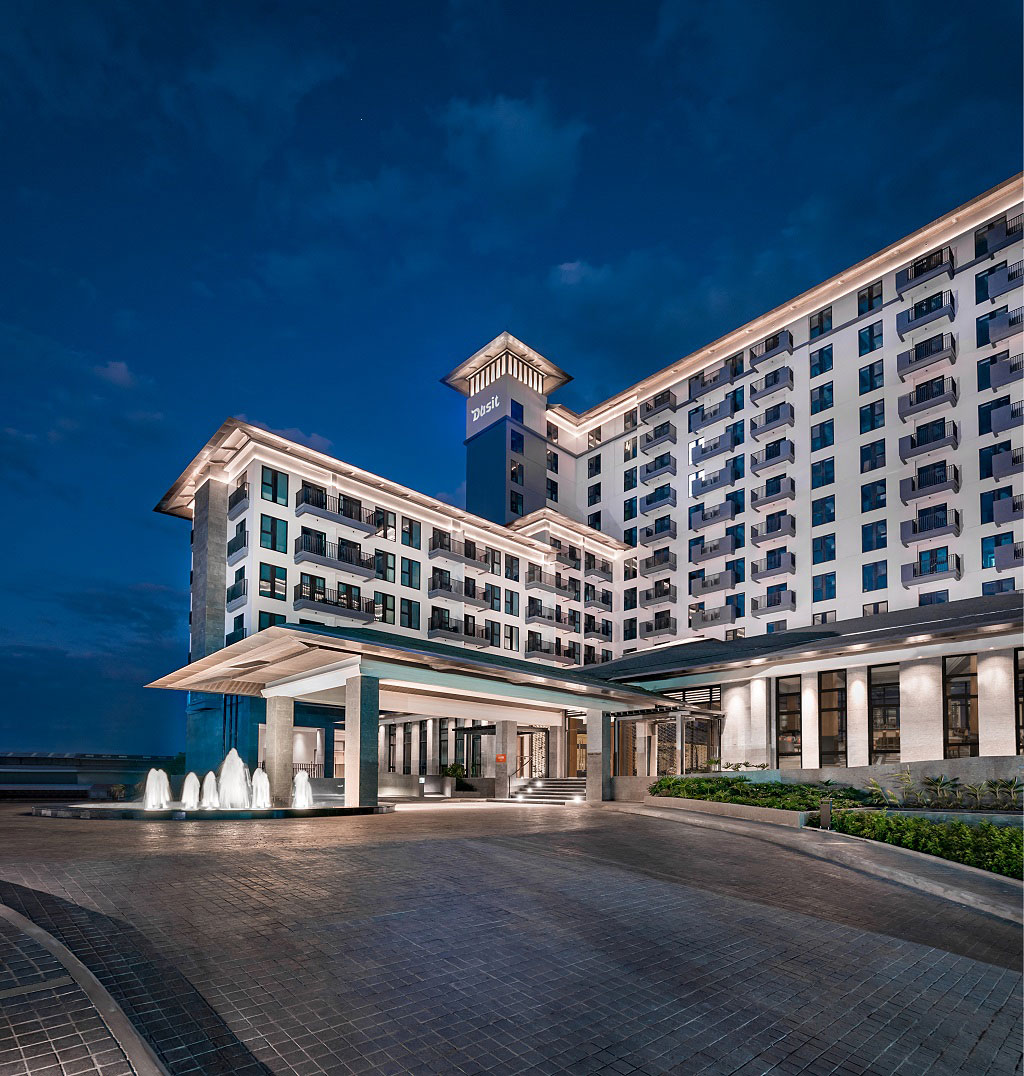
Located at the bustling economic and cultural capital of Mindanao, Dusit Thani Residence Davao has become a paragon in the region in how leisure and luxury can safely thrive in the middle of the pandemic.

Launched in 2019, the Dusit Thani Residence is part of a larger, mixed-use complex that has become one of Davao’s most exciting addresses. Combining well-appointed interiors with full-service amenities, Dusit Thani Residence Davao exudes the elegance and graciousness that the Dusit brand has come to be known for.

“We actually started our turnover this year, allowing our buyers and investors to safely occupy their new homes in line with health protocols,” notes Tomas Lorenzo, chief executive officer of Torre Lorenzo Development Corporation. The pioneer in student residences in the country, Torre Lorenzo has grown its portfolio to include leisure and mixed-use developments, including the Dusit Thani Residence Davao.

Hotel living


Lorenzo highlighted the company’s commitment to deliver elevated living experiences to its buyers and investors. “Our commitment, of course, does not stop with turnover of units, but continues with our topnotch property management that allows our residents to enjoy impeccable service and amenities, as well as a myriad of conveniences that come living close to a premium hotel.”

Dusit Thani Residence Davao is part of a complex that also features the dusitD2 Davao Hotel, allowing residents access to hotel-style services and amenities, thus elevating their living experiences.

Residents get to enjoy privacy with amenities exclusive to them, such as a dedicated building entry, residential lobby, swimming pool, and fitness center. Additionally, residents may accessdusitD2’s lap pool, spa, and fitness center at special rates. Residential units have self-contained kitchenettes and private balconies, some of which have sweeping views of the expansive Davao gulf.

Just an elevator ride away too are some of Davao’s most noteworthy culinary attractions, all located at dusitD2 – Benjarong Bar and Restaurant serves authentic Thai cuisine, Madayaw Cafe provides flavor experiences from the world’s major cuisines, and the Siam Lounge transforms into a relaxing refuge for intimate gatherings over tea or drinks. A private jetty is also close to the hotel. This serves as an entry point for guests traveling to Dusit Thani Lubi PlantationResort, nestled just off the coast of the Davao Gulf.

Peace of mind


Perhaps the most essential requirement for any resident or guest at the moment is safety – and this is something the Dusit Thani Residence Davao management has prioritized.

Beyond adhering to government health protocols, all of the residences and hotel staff have been vaccinated, giving residents and guests peace of mind

“Safety is our utmost concern, and we aim to give our residents truly elevated living experiences without compromising security and safety,” underscores Lorenzo, who is optimistic about the region’s post-pandemic recovery.

Tough times, tougher entrepreneurs: 10 lessons during a pandemic

By: Robbie Antonio

As the coronavirus outbreak ravaged the world, people were locked down, hospitals got overcrowded, and the global economy shut down. 

Revolution Precrafted Philippines, Inc., my property tech firm that set out to democratize the ownership of designer homes, found itself in the middle of a supply chain disruption. This resulted in cross-default situations and forced my company to pivot back to our core business.

In this article, I take stock of lessons I learned and share them to aspiring and fellow entrepreneurs. I hope these will help inoculate businesses against threats in this volatile, uncertain, complex, and ambiguous world now under a COVID-19 siege.  

  1. An asset-light business model is not always a good model.

I have always envisioned Revolution Precrafted to be an asset-light, intellectual property-based company. Our exclusive designs are our primary assets. However, the downside of this is that you will have less control over other parts of the business. As you outsource some segments of your operations, you exercise less supervision over contractors compared to full-time employees. Since independent contractors have greater flexibility over what they can contribute, you are taking on a risk that they may be unreliable, may not fulfill your business requirements, or may not deliver the quality you expected.

With the disruptions to the housing and property sector, we at Revolution found our own operations as a builder-supplier of homes to partner-developers affected by the general economic downturn. 

The lesson is that we must never stray again into such aspects as building the homes ourselves, and instead concentrate on our core and high value-added work of promoting home designs and art creations. And so our pivot now involves going back to our core business which is to leverage on our intellectual property, our revolutionary home designs, and license them to any developer or end-user for their own homes or projects, using their own contractors.

  1. Practice constant communication.

I believe that empathetic and transparent communication is very important especially in times of a crisis when employees and consumers are confused and feeling vulnerable. 

During a pandemic, consumers generally understand that most companies are facing a difficult time and they are more tolerant of minor mistakes and delays, as long as we communicate with them in an honest and timely manner.

  1. Going global is very difficult.

My big idea was to make globally acclaimed designer homes affordable to a mass market by rolling them out using new prefab home technology. But I realized that an aggressive vision of going global immediately sometimes does not work. 

As international borders closed and the global economy shut down, vulnerabilities in Revolution’s supply chain were exposed. Temporary trade restrictions pushed economies to be self-reliant and placed domestic companies under immense pressure to look inward and reduce their reliance on global supply chains that are now perceived as risky. 

  1. Decentralization is the new normal.

The pandemic has compelled society to take action and seize the moment in many areas where we have dilly-dallied in the past — such as climate action and decongesting cities and even in providing connectivity for all. The push for decentralization is an irreversible trend given the government and private sector’s massive infrastructure build-up and reverse transmigration (e.g., Balik Probinsya) programs.

I believe that the new systems and protocols such as blended-distanced education and telecommuting or work-from-home will become permanent options for people and institutions. These have positive impacts on society, such as less traffic, and just better public health, order, and safety. Single-detached homes have become increasingly relevant in this New Normal. More and more people are moving out of the metropolis, supported by more robust digital infrastructure and they are again choosing single detached homes — on the ground.

  1. Adapt quickly.

With the pandemic, decision-makers are faced with a rapidly-changing business environment that gives us very little time to respond to threats. 

The key is to develop the ability to evaluate ongoing changes and react immediately and appropriately to disruptions, and to continuously repeat this cycle. 

We should practice new ways of problem-solving in an unpredictable environment and be prepared to reinvent ourselves in order to survive and cushion the impact of the crisis on our businesses.

  1. Leverage technology.  

With government-imposed lockdowns, we saw that companies with established online platforms are in a better position to take advantage of the rapid migration of consumers to online channels. Quick-thinking entrepreneurs accelerated their digital transformations — selling their products on social media and mobile applications, accepting online payments, and partnering with delivery services. 

I believe that physical distancing and the trend of in-home consumption are likely to continue even after the pandemic, and that businesses must embrace technology in order to connect to customers. Those that still do not have an online presence need to react fast and implement their long-overdue digital transformation.

  1. Associate your brand with the good.

In this time of crisis, consumers will not forget brands that displayed acts of kindness, especially if done with genuine generosity. 

These could be in the form of donations of medical supplies or assistance to the community, or by sharing messages that promote positivity despite the pandemic.

  1. Prepare an emergency plan. 

Micro-entrepreneurs without formal crisis management planning are among the hardest hit by the pandemic. This highlights the importance of a business continuity plan, which may include prevention, response, and recovery. 

A contingency plan will help leaders remain rational as we are guided by a planned set of tactics when responding to a crisis and making decisions, allowing our businesses to bounce back stronger after a disaster. 

  1. Know your customers’ needs. 

The pandemic and the resulting economic downturn resulted in changes in consumers’ buying behavior. These include prioritization of essential needs and sanitization products amid a tightening of household budgets. As a consequence, some products suffered from slowing demand. 

As entrepreneurs, we need to be flexible and to make the necessary adjustments to ensure the survival of our businesses.

  1. Coopetition is key.

Lastly, we can only defeat this crisis if we put aside our differences and present a unified front. Coopetition, which is simultaneous cooperation and competition, can help us overcome lack of resources. 

By looking at joint vaccination drives among local companies, we can see that strategic alliances may be a good option for businesses and may provide opportunities that are otherwise not available. Entrepreneurs must consider possible partnerships and start communicating with potential allies.


EDITOR’S NOTE:

Spotlight is BusinessWorld’s new sponsored section that allows advertisers to amplify their brand and connect with BusinessWorld’s audience by enabling them to publish their stories directly on the BusinessWorld Web site. For more information, send an email to online@bworldonline.com.


Join us on Viber to get more updates from BusinessWorld: https://bit.ly/3hv6bLA