Home Blog Page 7677

vivo introduces a new era of selfie phones with its latest V21 series

The vivo V21 series, a smartphone that allows connections as close as real life, comes in (L-R) Dusk Blue, Diamond Flare, and Sunset Dazzle colors.

Smartphones with high megapixels would likely capture the interest of people who love taking selfies and shooting vlogs. In time with the prevalence of these fascinations, vivo unveils the V21, the latest smartphone series that brings in a new era of selfie phones.

Expect fine-quality portraits of yourself with vivo V21 for having the world’s first 44MP Optical Image Stabilization (OIS) front camera technology. Also, look forward to picturing greater details with the astounding 64MP resolution of V21’s main rear camera.

In addition to its exciting photography capacities, users would also have a silky-smooth experience with V21. Its high refresh rate of 90 Hz provides ease in scrolling, playing games, or watching videos.

The vivo V21 models come in two variants: the V21 5G and the V21e 4G.

Stylish tech

Matching its ability in creating more beautiful photos, vivo styled the V21 with a fashionable look. Weighing 176 grams, this ultra-thin smartphone has an anti-glare matte glass that is both scratch-resistant and fingerprint-free. It is also ergonomically designed for users to have a smooth yet firm hold.

Models of this smartphone have an array of nature-inspired vibrant colors such as Dusk Blue and Sunset Dazzle for the V21 5G, and Roman Black and Diamond Flare for the V21e 4G.

Closer interactions

Video calls and photos will be better with the fashion-forward, camera-focused quality of vivo V21. With the world’s first OIS technology integrated into its front camera, users can capture their shine even in a high or low light scene.

Moreover, users can improve the way they vlog or film while walking and talking with the stability offered by V21. The smartphone also has a Dual-View Video feature that lets users simultaneously record two videos using both its front and rear cameras. They can also showcase crystal-clear photos with the V21’s high-definition 4K selfie videos.

Designed for power

The vivo V21 models boast an advanced 5G technology to complement fast-paced lifestyles. Hence, users can have faster speeds when downloading and uploading, videostreaming, real-time gaming, and more. Additionally, this smartphone allows its users to upgrade the memory by 3GB, on top of its built-in 8GB internal storage. Users can also experience the long-lasting power of this smartphone for its 4000 mAh battery.

Such features incorporated in vivo V21 respond to the needs of its users, especially when it comes to interacting. With its extraordinary selfie camera, people can count on this device to let them at least feel closer, clearer connections.

Enhance your selfie, vlogging, and video call experience with the new vivo V21 series. The vivo V21 5G is priced at P23,999, while the V21e 4G at P17,999. Pre-orders can be done from June 1 to 4. Availability of the V21 series in all vivo stores nationwide, as well as Lazada and Shopee sites, will be on June 5.

Visit https://www.vivoglobal.ph/phone/vivo-V21e/ for more information.

What you need to know about the coronavirus right now

PIXABAY

Here’s what you need to know about the coronavirus right now. 

Vietnam detects hybrid of Indian and UK COVID-19 variants 

Authorities in Vietnam have detected a new coronavirus strain that is a combination of the Indian and UK coronavirus disease 2019 (COVID-19) variants and spreads quickly by air, the health minister said on Saturday. Health Minister Nguyen Thanh Long said Vietnam would soon publish genome data of the newly identified variant, which he said was more transmissible than the previously known types. 

Vietnam’s business hub Ho Chi Minh City will begin social distancing measures for 15 days starting from May 31 in an effort to curb the spread of COVID-19, the government said on Sunday. State-run Vietnam News Agency (VNA) reported Ho Chi Minh City authorities would conduct COVID-19 tests city-wide with testing capacity at 100,000 samples per day. 

Victoria cluster swells to 51 

Australia’s second most populous state of Victoria, epicenter of the country’s latest coronavirus hotspot, reported 11 new cases of community transmission on Monday, taking the current cluster to 51. The swelling numbers have raised questions over whether the lockdown will be extended beyond the seven days announced initially. 

Authorities are also concerned about the prospect of a larger outbreak in aged care homes after two workers and one resident at the Arcare facility in Melbourne tested positive, the home operator said in a statement. 

Japan considers asking Olympic fans for negative COVID tests 

Japan is considering requiring negative COVID-19 test results or vaccination records from fans attending the Tokyo Olympics, the Yomiuri newspaper reported on Monday, as a new poll showed public opposition to the Games remained strong. Foreign spectators have already been banned and game organizers are expected to make a decision next month on whether Japanese fans will be able to attend and under what conditions. 

The report was met with outrage among some social media users, with thousands of tweets criticizing the country’s continued push to host the Olympics in the middle of a pandemic. The term “negative test certificate” was trending on Twitter in Japan, garnering over 8,000 tweets on Monday morning. 

UK vaccine passport plans to be scrapped  The Telegraph 

Britain plans to drop COVID-19 passports as a legal requirement for large events, The Daily Telegraph reported on Sunday. The UK officials reviewing COVID-19 status certificates believe there is no chance the law will be changed to mandate their use within the UK, the report added. 

A government spokesman said in an emailed statement to Reuters that the COVID-19 vaccine certification review is still in process and no decision has yet been made. 

Automakers in India’s Detroit allowed to operate 

Carmakers in the Indian automobile hub of Chennai will be allowed to keep operating, the state government said on Saturday, amid protests by workers who fear catching COVID-19 in one of the country’s hardest-hit states. 

Hundreds of workers in and around Chennai  often dubbed India’s Detroit  have fallen ill with COVID-19 and dozens have died, labor unions say. Union sources at Hyundai, Ford and Renault-Nissan said they were continuing to talk with the companies. Global carmakers operating in Chennai have said they will prioritize worker safety and social-distancing protocols. — Reuters 

Four seismic climate wins show Big Oil, Gas, and Coal are running out of places to hide

Image via Photographic Services, Shell International Limited/Stuart Conway

By Jacqueline Peel, Ben Neville, and Rebekkah Markey-Towler 

Three global fossil fuel giants have just suffered embarrassing rebukes over their inadequate action on climate change. Collectively, the developments show how courts, and frustrated investors, are increasingly willing to force companies to reduce their carbon dioxide pollution quickly. 

 A Dutch court ordered Royal Dutch Shell to slash its greenhouse emissions, and 61% of Chevron shareholders backed a resolution to force that company to do the same. And in an upset at Exxon Mobil, an activist hedge fund won two seats on the company’s board. 

 The string of wins was followed in Australia on Thursday by a court ruling that the federal environment minister, when deciding whether or not to approve a new coal mine, owes a duty of care to young people to avoid causing them personal injury from climate change. 

The court rulings are particularly significant. Courts have often been reluctant to interfere in what is viewed as an issue best left to policymakers. These recent judgements, and others, suggest courts are more prepared to scrutinize emissions reduction by businesses and  in the case of the Dutch court  order them to do more. 

In a world-first ruling, a Hague court ordered oil and gas giant Shell to reduce CO₂ emissions by 45% by 2030, relative to 2019 levels. The court noted Shell had no emissions-reduction targets to 2030, and its policies to 2050 were “rather intangible, undefined and non-binding.” 

The case was brought by climate activist and human rights groups. The court found climate change due to CO₂ emissions “has serious and irreversible consequences” and threatened the human “right to life.” It also found Shell was responsible for so-called “Scope 3” emissions generated by its customers and suppliers. 

The Chevron upset involved an investor revolt. Some 61% of shareholders supported a resolution calling for Chevron to substantially reduce Scope 3 emissions generated by the use of its oil and gas. 

And last week, shareholders of ExxonMobil, one of the world’s biggest corporate greenhouse gas emitters, forced a dramatic management shakeup. An activist hedge fund, Engine No. 1, won two, and potentially three, places on the company’s 12-person board. 

Engine No. 1 explicitly links Exxon’s patchy economic performance to a failure to invest in low-carbon technologies. 

As human activity causes Earth’s atmosphere to warm, large fossil fuel companies are under increasing pressure to act. 

A mere 20 companies have contributed 493 billion tonnes of CO₂ and methane to the atmosphere, primarily from the burning of their oil, coal and gas. This equates to 35% of all global greenhouse gas emissions since 1965. 

Shareholders  many concerned by the financial risks of climate change  are leading the corporate accountability push. The Climate Action 100+ initiative is a leading example. 

It involves more than 400 investors with more than A$35 trillion in assets under management, who work with companies to reduce emissions, and improve governance and climate-related financial disclosures. Similar movements are emerging worldwide. 

Shareholders in Australia are also stepping up engagement with companies over climate change. 

Last year, shareholder resolutions on climate change were put to Santos and Woodside. While neither resolution achieved the 75% support needed to pass, both received unprecedented levels of support  43.39% and 50.16% of the vote, respectively. 

And in May 2021, Rio Tinto became the first Australian board to publicly back shareholder resolutions on climate change, which subsequently passed with 99% support. 

To date, the question of whether corporate polluters can be legally forced to reduce greenhouse emissions has remained unanswered. While fossil fuel companies have faced a string of climate lawsuits in the United States and Europe, courts have often dismissed the claims on procedural grounds. 

Cases brought against governments have been more successful. In 2019, for example, the Dutch Supreme Court affirmed the government has a legal duty to prevent dangerous climate change. 

The decision against Shell is significant, and sends a clear signal that corporations can be held legally responsible for greenhouse pollution. 

Shell has previously argued it can only reduce its absolute emissions by shrinking its business. The recent case highlights how such companies may have to quickly find new forms of revenue, or face legal liability. 

It’s unlikely we’ll see identical litigation in Australia, because our laws are different to those in the Netherlands. But the Shell case is emblematic of a broader trend of climate litigation being brought to challenge corporate polluters. 

This includes the case decided on Thursday involving young people opposed to a company’s coal mine expansion, and Australian cases arguing for greater disclosure of climate risk by corporations, banks and super funds. 

Oil and gas companies often argue Scope 3 emissions are not their responsibility, because they don’t control how customers use their products. The Shell finding and shareholder action against Chevron suggest this claim may hold little sway with courts or shareholders in future. 

The Shell case may also set off a global avalanche of copycat litigation. In Australia, legal experts have noted the turning tide, and warned is it’s only a matter of time before directors who fail to act on climate change face litigation. 

Clearly, a seismic shift is looming, in which corporations will be forced to take greater responsibility for climate harms. These recent developments should act as a wake-up call for oil, gas and coal companies, in Australia and around the world. — The Conversation 


Jacqueline Peel is Professor of Environmental and Climate Law at the University of Melbourne; Ben Neville is senior lecturer and program director of the Master of Commerce at the University of Melbourne; and Rebekkah Markey-Towler is a research fellow, Melbourne Climate Futures, at the University of Melbourne. 


This article is republished from The Conversation  under a Creative Commons license. Read the original article. 

Netanyahu’s grip on power loosens as rival moves to unseat him

Image via Wikipedia

JERUSALEM  Far-right party leader Naftali Bennett threw his crucial support on Sunday behind a “unity government” in Israel to unseat Prime Minister Benjamin Netanyahu, in what would be the end of a political era. 

Mr. Bennett’s decision, which he announced in a televised address, could enable opposition chief Yair Lapid to put together a coalition of right-wing, centrist and leftist parties and hand Mr. Netanyahu his first election defeat since 1999. 

 Yair Lapid, head of the centrist Yesh Atid party that finished second to Mr. Netanyahu’s right-wing Likud in an inconclusive March 23 national ballot, faces a Wednesday deadline from Israel’s president to announce a new government. 

Mr. Lapid’s chances of success have rested largely with Mr. Bennett, a former defense chief and a high-tech millionaire whose Yamina party’s six seats in the 120-member parliament are enough to give him the status of kingmaker. 

Under a prospective power-sharing deal, Mr. Bennett would replace Mr. Netanyahu, the 71-year-old head of the Likud party, as prime minister and later give way to centrist Mr. Lapid in a rotation agreement. 

“I am announcing today that I intend to work with all my might towards establishing a unity government with Yesh Atid chairman Yair Lapid,” Mr. Bennett said in his speech. “It’s either a fifth election, or a unity government.” 

Responding on television to Mr. Bennett’s announcement, Mr. Netanyahu accused him of perpetrating “the fraud of the century,” citing past public promises Mr. Bennett made not to join up with Mr. Lapid. He said a right-wing government was still a possibility. 

Israel has held four elections since April 2019 that ended with no clear winner and left Mr. Netanyahu and his rivals short of a parliamentary majority, with the veteran leader remaining in office as head of a caretaker government. 

The new prospective coalition’s diverse members would have little in common apart from the desire to end the 12-year run of Mr. Netanyahu, Israel’s longest-serving leader, now on trial over corruption charges that he denies. 

An anti-Netanyahu alliance would be fragile and require outside backing by Arab members of parliament who oppose much of Mr. Bennett’s agenda, which includes more settlement building in the occupied West Bank and its partial annexation. 

It would be expected to focus on the economic recovery from the COVID-19 pandemic, while setting aside issues on which members disagree, such as the role of religion in society and Palestinian aspirations for statehood. 

Mr. Netanyahu said such a coalition was a danger to Israel’s security and future. 

“What will it do for Israel’s deterrence? How will we look in the eyes of our enemies,” he said. “What will they do in Iran and in Gaza? What will they say in the halls of government in Washington?” 

A Bennett-Lapid agreement had already been reported to be close when violence broke out between Israel and Gaza militants on May 10 and Bennett suspended the discussions. The fighting ended with a ceasefire after 11 days. 

A Palestine Liberation Organization official said after Bennett’s speech that the prospective government would be “extreme rightist” and no different than administrations headed by Netanyahu. 

COUNTER-OFFER 

Trying to scupper an opposition deal, Mr. Netanyahu made a three-way counter-offer on Sunday to stand aside in favor of another right-wing politician, Gideon Saar. 

Under that blueprint, Mr. Saar would serve as prime minister for 15 months, Mr. Netanyahu would return for two years, and Mr. Bennett would then take over for the rest of the government’s term. 

However, Mr. Saar, a former Likud cabinet minister, swiftly rejected the offer. 

Mr. Netanyahu’s rivals have cited his corruption case as a main reason why Israel needs a new leader, arguing that he might use a new term to legislate immunity to shield himself. 

If Mr. Lapid, 57, fails to announce a government by Wednesday, at the end of a 28-day period to build a coalition, a new election is likely.  Jeffrey Heller/Reuters 

‘Real compromise’ on US infrastructure bill possible — Republican senator

Image via Mark Hogan/Flickr/CC BY-SA 2.0

WASHINGTON  Negotiations with US President Joseph R. Biden, Jr., over a potentially massive infrastructure investment package are inching forward even though disagreements remain over the size and scope of such legislation, Republican Senator Shelley Moore Capito said on Sunday. 

“I think we can get to real compromise, absolutely, because we’re both still in the game,” Ms. Capito said in an interview with Fox News Sunday. 

Ms. Capito leads a group of six Senate Republicans who have been in regular contact with Mr. Biden and White House aides over a bill the administration wants to move through Congress promptly. 

The Republican senators have proposed $928 billion to improve roads, bridges and other traditional infrastructure projects. Much of the funding would come from money already enacted into law for other purposes that they argue is unused. 

The Biden administration’s latest offer in negotiations is for $1.7 trillion and would include federal spending on projects that go beyond traditional infrastructure, such as home care for the elderly. 

Transportation Secretary Pete Buttigieg, speaking on ABC’s This Week, said of the latest Republican counteroffer: “There’s movement in the right direction, but a lot of concern.” 

Mr. Buttigieg added, “We need to make investments over and above what would have happened anyway.” He also highlighted the need for using the infrastructure bill to address climate change and signaled opposition to shifting coronavirus disease 2019 (COVID-19) relief money to infrastructure accounts. 

Ms. Capito said that following a White House meeting, which Republicans viewed as productive, Mr. Biden aides stepped away from some of the ideas Republicans pushed. 

“We have had some back and forth with the staff that sort of pulled back a little bit but I think we’re smoothing out those edges,” said the West Virginia senator whose state stands to benefit significantly from new infrastructure investments. 

Nonetheless, Republicans continued to balk at raising taxes on the wealthy and corporations to help finance the projects. 

“I’m not going to vote to overturn those,” Ms. Capito said when asked about rolling back some of the Republican tax cuts enacted during the Trump administration. 

She also held the line against including new funding for projects that go beyond physical infrastructure, saying those could be considered in other measures percolating in Congress. 

The talks were expected to continue this week even though Congress is on a break, with the Senate returning on June 7. 

When lawmakers return to Washington, Mr. Biden will be under pressure from many of his fellow Democrats in Congress to sidestep Republicans and cut off negotiations if they do not show signs of significant progress. 

 Mr. Buttigieg told CNN there needs to be a clear direction on the infrastructure bill. “The president keeps saying, ‘inaction is not an option’ and time is not unlimited here.” 

Meanwhile, Democratic Senator Kirsten Gillibrand, also interviewed on CNN, said, “I think waiting any longer for Republicans to do the right thing is a misstep.” She added, “I would go forward.” 

Congress could use a special “reconciliation” process that requires only a simple majority of the 100-member Senate to advance legislation, instead of the 60-vote threshold usually required. The Senate is currently evenly split, 50-50, with Democratic Vice-President Kamala Harris having the power to break deadlocks. 

It is not clear, however, whether all Democrats would go along with such a process.  Richard Cowan/Reuters 

Japan to consider sharing COVID-19 vaccines amid calls to help Taiwan 

TOKYO  Japan said on Friday it would consider sharing its coronavirus disease 2019 (COVID-19) vaccines with other countries as a ruling party committee urged it to provide a portion of its AstraZeneca Plc vaccine stock to Taiwan. 

Taiwan is battling a spike in domestic infections and has vaccinated only about 1% of its population, while Japan has secured more than 400 million doses, double what it needs for its adult population. 

“We think it’s important to ensure fair access to safe and effective vaccines in every country and region towards achieving universal health coverage,” Japan’s Chief Cabinet Secretary Katsunobu Kato told a news conference. 

“We will swiftly consider and look into a concrete course of policy with regard to how we provide other countries and regions with vaccines that exceed the amount for those needed at home.” 

Masahisa Sato, the head of a Japanese ruling party committee on Taiwan relations, said earlier on Friday the government should provide Taiwan with vaccines as soon as possible, adding “when Japan was in need Taiwan sent us 2 million masks.” 

Mr. Kato declined to comment whether Tokyo had received supply requests from specific countries. 

Taiwan’s Foreign Ministry said the government was working hard to obtain vaccines either via manufacturers or the COVAX global sharing scheme. 

Taipei was also seeking “like-minded countries to help obtain vaccines, and efforts have not ceased,” it added. 

Japan approved AstraZeneca’s vaccine last week and has contracted to buy 120 million doses. But there are no immediate plans to use the shots in the country, amid lingering concerns raised internationally over blood clots. 

AstraZeneca’s local partner Daiichi Sankyo Co. started bottling the vaccine in March and the stockpile is currently estimated at around 30 million doses which will expire by September if not used. 

The amount is set to increase as AstraZeneca added Nipro Corp. this week as its third local partner to conduct filling and packaging of the vaccine. 

Japan started its inoculation drive in mid-February, later than most major economies and using imported doses of the shot developed by Pfizer Inc. and BioNTech SE. 

A vaccine developed by Moderna also went into use this week with the opening of mass vaccination centers. 

Japan has administered 10.6 million doses through Wednesday, about a sixth of the vaccine it’s imported so far, based on government data and schedules. By September, the projected supply will reach 414 million doses, double what the country needs for its adult population. 

Prime Minister Yoshihide Suga will host a summit on June 2 about ensuring vaccine supply to needy nations through the World Health Organization’s COVAX program. So far, Japan has pledged money to the effort but no vaccines. 

Japan will likely keep some of AstraZeneca’s adenovirus-type shots for people with allergies to mRNA-type vaccines from Pfizer or Moderna, and give away the rest, said Haruka Sakamoto, a physician and researcher at Keio University in Tokyo. 

“Japan will probably announce that they will donate the AZ vaccine that they already have a contract with and supply COVAX with the AZ vaccine they will produce in Japan,” she said. 

An AstraZeneca spokeswoman said it was up to the Japanese government how the doses were used.  Chang-Ran Kim and Rocky Swift/Reuters 

Suzuki Philippines unveils new Vitara AllGrip

A modern take to a classic — express yourself with the newest Suzuki subcompact SUV

Suzuki Philippines, Inc. (SPH), the country’s pioneer compact car distributor, launches the new Vitara AllGrip. Back in a modernized yet classic silhouette, Suzuki’s beloved SUV offers unprecedented value not found across other competitors in the market. The new subcompact SUV will be made available in the Philippines to cater to the evolving needs of young and dynamic professionals as a reliable companion in exciting drives with family, friends, and the like.

“Ever since the new look of Vitara was launched in the Philippine market, we have seen enormous support for the model. One of the iconic models of the brand, this newest 4×4 vehicle provides individuality, stylish looks and added confidence on the road. This car will definitely encourage people to drive and bring more fun into their lives,” says Suzuki Philippines Vice-President and General Manager for Automobile Division Keiichi Suzuki.

Product concept
The new Vitara AllGrip is an update to a Suzuki classic that was first launched in 1988, integrating new concepts and today’s advance technologies all while inheriting Suzuki’s SUV lineage. The new model, manufactured in Suzuki Hungary, now has ALLGRIP technology, infotainment system equipped with Clinometer function and a range of personalization options that will give each Vitara AllGrip a unique personality. As close to a living, breathing thing as an automobile can be — the new Vitara. It lives and it’s time to play!

Expressive exterior
Get ready for an appearance beaming with strength and energy, characterized by the Vitara’s bold and sporty styling. Keeping with the Vitara’s authentic design, Suzuki chose to keep the traditional clamshell bonnet in the front. While from the rear, the new Vitara is stout and stable with trapezoidal lines toward the ground and a minimum ground clearance of 185mm. From the side, it has smooth roof lines for better aerodynamics, and a kicked-up character line that hints at the flared fenders. Some upgrades to the Vitara’s body include front and rear skid plates, a front lower bumper garnish, chrome and black grained accents on the body’s side, and an improved rear edge spoiler. This model also comes with an energy-saving LED headlamps for low-beam, uniquely designed DRLs and a vertical chrome grille for a more modernized look suitable for the current times.

Superior interior
Feel right at home with the new Vitara’s refined interior as well, with advanced features and quality craftsmanship sure to deliver comfort and driving satisfaction, on and off the road. The interior arrangement of the new model is a combination of Suzuki’s muscular contours and sporty design. The Vitara AllGrip’s instrument panel features a muscular console that includes a round clock and a round air outlet that give the panel a more youthful design. The U-shape of the shift knob supports the rugged look of most SUVs.

Additionally, the interior comes with the iconic panoramic sunroof consisting of two glass panels that can both slid to open. Following the theme of Suzuki’s subcompact SUVs, it comes with spacious luggage space of 375 liters. Even when the rear seats are not folded, there’s enough space to store a golf bag, and folding the rear seats gives even more space to store larger items.

Accompanying its promise of elevated comfort and functionality, the Vitara AllGrip is also equipped with a 10” infotainment system with smartphone linkage function. It’s equipped with a clinometer that tells the driver the vehicle’s position in terms of pitch and roll angles, and additionally, an automatic wiper, light system and dimming rear view mirrors, rear camera and parking sensors, and a keyless Push-Start System.

Safety and performance
Under the hood, the new Vitara AllGrip does not disappoint with its 1.6-liter engine and 6-speed automatic transmission with manual mode and paddle shift. Alongside this is the ALLGRIP technology, an ideal concept of 4WD, enabling all types of users to feel assured in any driving situation. The driver can switch between the four modes of Auto, Sport, Snow, and Lock depending on the road conditions and driving scenarios.

This new Vitara also focuses on safety with its other safety features. The subcompact SUV has six (6) SRS air bags, hill descent and hill hold control, and brake assist function. It is also equipped with Electronic Stability Program which detects over- and under-steering to help the driver maintain directional control.

Adding to the already extensive safety features mentioned, the new Vitara also comes with pedestrian protection. The exterior parts of the unit have impact-absorbing structures that mitigate the extent of injuries in the event that the car comes into contact with pedestrians.

Driving is a breeze with the new Vitara’s Cruise Control system with speed limiter that provides comfort especially on long drives.

Color variants
The new Vitara AllGrip comes in a choice of several colors that customers can pick from. It comes in two-tone — Prime Solar Yellow with Cosmic Black Pearl Metallic, and Solid Bright Red with Cosmic Black Pearl Metallic; and in monotone — Galactic Gray Metallic and Cool White Pearl.

Suzuki customers get to pick and choose their new Vitara AllGrip for P1,458,000 for the monotone variant and P1,468,000 for the two-tone variant at their nearest Suzuki dealerships starting today!

For more information about Suzuki visit http://suzuki.com.ph/auto/, like it on https://twitter.com/SuzukiAutoPH and follow on Instagram at @suzukiautoph.

Premium Leisure Corp. announces virtual stockholders’ meeting in June

Premium Leisure Corp. will hold its virtual annual stockholders’ meeting on June 25, 2021.

Gaming investments company Premium Leisure Corp. will hold its annual stockholders’ meeting virtually on June 25, 2021.

Please see the notice of the annual stockholders’ meeting below:

TO ALL STOCKHOLDERS:

The annual meeting of the stockholders of Premium Leisure Corp. (the “Company”) will be held on June 25, 2021, Friday, at 10:00 a.m. Given the current circumstances, the meeting will be conducted virtually and voting conducted in absentia through the Corporation’s secure online voting facility.

AGENDA

  1. Call to Order
  2. Proof of Notice of Meeting and Quorum
  3. Approval of the Minutes of the Annual Meeting of Stockholders held on June 22, 2020
  4. Approval of 2020 Operations and Results
  5. Ratification of all Acts of the Board of Directors and Management during their term of office
  6. Election of Directors for 2021-2022
  7. Appointment of External Auditors
  8. Other Matters
  9. Adjournment

The Board of Directors (Board) has fixed the end of trading hours of the Philippine Stock Exchange on May 27, 2021, as the record date for the determination of stockholders entitled to the notice of, participation via remote communication, and voting in absentia at such meeting and any adjournment thereof.

The conduct of the meeting will be streamed live, and stockholders may attend the meeting by registering via https://asmregister.premiumleisurecorp.com and submitting the supporting documents listed there until June 22, 2021 (Tuesday). All information submitted shall be verified and validated by the Corporate Secretary.

Stockholders who wish to cast votes through a proxy may accomplish the proxy form (which need not be notarized) and submit the same on or before June 22, 2021. In view of the community quarantine, scanned forms will be accepted. Paper copies shall be sent to the office of the Corporate Secretary at the 33rd Floor, The Orient Square, F. Ortigas Jr. Road, Ortigas Center, Pasig City once the community quarantine is lifted.

Stockholders who successfully registered can cast their votes in absentia through the Corporation’s secure online voting facility for this meeting. In order to participate remotely, they will also be provided with access to the meeting that will be held virtually. The “Guidelines for Participation via Remote Communication and Voting in Absentia” as appended to the Definitive Information Statement labeled as Schedule A will be posted on the Corporation’s website: https://www.premiumleisurecorp.com/ASM2021 and PSE Edge.

Thank you.

Pasig City, May 12, 2021.

(Sgd.)
Elmer B. Serrano
Corporate Secretary

Belle to hold virtual stockholders’ meeting in June

The annual stockholders’ meeting of Belle Corporation will be held virtually on June 25, 2021.

Premium tourism and leisure properties and destinations developer Belle Corporation will hold its annual stockholders’ meeting virtually on June 25, 2021.

Please see the notice of the annual stockholders’ meeting below:

TO ALL STOCKHOLDERS:

The annual meeting of the stockholders of Belle Corporation (the “Company”) will be held on June 25, 2021, Friday, at 2 p.m. Given the current circumstances, the meeting will be conducted virtually and voting conducted in absentia through the Company’s secure online voting facility.

AGENDA

    1. Call to Order
    2. Proof of Notice of Meeting and Quorum
    3. Approval of the Minutes of the Annual Meeting of Stockholders held on June 22, 2020
    4. Approval of 2020 Operations and Results
    5. Ratification of all Acts of the Board of Directors and Management during their term of office
    6. Amendment of the Articles on Incorporation
    a. to adopt the perpetual corporate term for the Company
    b. to reduce the membership of the Board of Directors from eleven (11) to nine (9)
    1. Election of Directors for 2021-2022
    2. Appointment of External Auditors
    3. Other Matters
    4. Adjournment

    The Board of Directors has fixed the end of trading hours of the Philippine Stock Exchange on May 27, 2021, as the record date for the determination of stockholders entitled to the notice of, participation via remote communication, and voting in absentia at such meeting, and any adjournment thereof.

    The conduct of the meeting will be streamed live, and stockholders may attend the meeting by registering via asmregister.bellecorp.com and submitting the supporting documents listed there until June 22, 2021. All information submitted shall be verified and validated by the Corporate Secretary.

    Stockholders who wish to cast votes through a proxy may accomplish the corresponding proxy form (which need not be notarized) and submit the same on or before June 16, 2021. In view of the community quarantine, scanned forms will be accepted. Paper copies shall be sent to the office of the Corporate Secretary at 2704 East Tower, Philippine Stock Exchange Centre, Exchange Road, Ortigas Center, Pasig City once the community quarantine is lifted.

    Stockholders who successfully registered can cast their votes in absentia through the Company’s secure online voting facility for this meeting. In order to participate remotely, they will also be provided with access to the meeting that will be held virtually. The “Guidelines for Participation via Remote Communication and Voting in Absentiaas appended to the Definitive Information Statement labeled as Schedule A will be posted in the Company’s website: (bellecorp.com/ASM2021) and PSE Edge.

    Thank you.

    Pasig City, May 12, 2021.

    (Sgd.)
    Jason C. Nalupta
    Corporate Secretary

May inflation likely steady at 4.5%  — poll

PHILIPPINE STAR/ MICHAEL VARCAS
Inflation was expected to have remained steady in May, as food prices eased. — PHILIPPINE STAR/ MICHAEL VARCAS

By Luz Wendy T. Noble, Reporter

INFLATION likely remained unchanged for a third straight month in May, as food prices generally stabilized amid the lockdown in the Philippine capital and nearby provinces, economists said.

A BusinessWorld poll of 17 analysts last week yielded a median estimate of 4.5% for May inflation.

If realized, this would mark the third straight month of steady inflation. However, it is still beyond the Bangko Sentral ng Pilipinas’ (BSP) annual 2-4% target and is much quicker than the 2.1% print a year earlier.

The BSP will release its inflation forecast range for the month today (May 31), while the Philippine Statistics Authority will release the official data on June 4.

Analysts’ May Inflation Estimates (2021)-New

Analysts noted that food prices have generally stabilized, although prices of pork products remain elevated.

“We are not expecting any easing from meat prices, but we think that other CPI food components have continued to eased month on month due to ample supply from good weather,” UnionBank of the Philippines, Inc. Chief Economist Ruben Carlo O. Asuncion said.

“The impact of the lower tariffs on imported pork will only be reflected in consumer price from June onwards,” said Alvin Joseph A. Arogo, Head of Research at the Philippine National Bank.

Executive Order 134 signed earlier this month temporarily lowered the tariffs for pork products to 10% for three months under the current minimum access volume and 20% for the first three months for imports outside the quota. By the fourth to 12th month, applicable tariffs will be at 15% and 25% for in-quota and out-quota pork products, respectively.

With lockdown restrictions still in place, the upside risks from demand also subsided, said HSBC Global Research economist Noelan Arbis.

“Prices have stabilized domestically, driven in large part by ongoing lockdown restrictions in the country. The lockdown has resulted in reduced demand-side pressures as reflected in recent CPI (consumer price index) prints,” Mr. Arbis said.

Metro Manila and surrounding provinces Bulacan, Cavite, Laguna, and Rizal are under general community quarantine with heightened restrictions until today (May 31).

The Health department reported 7,058 new coronavirus disease 2019 (COVID-19) cases as of Sunday, bringing the number of active cases to 53,757.

On the other hand, the uptick in the prices of oil and utilities may have caused quicker inflation, analysts said.

“High fuel prices adding to transport inflation will continue to be a point of concern,” ANZ Research Analyst Rini Sen said.

“We note a probable pickup in transport prices owing to higher public transport fares (tricycles in particular) due to adherence to social distancing guidelines as well as the year-on-year surge in domestic pump prices due to base effects after last year’s oil price swoon,” ING Bank N.V. Manila Senior Economist Nicholas Antonio T. Mapa said.

Global oil prices continue to edge up as demand recovers due to reopening of many economies.

In the local market, data from the Department of Energy showed gasoline, diesel, and kerosene prices rose by P8.50, P7.20, and P5.85 per liter year to date as of May 25, respectively.

“There is also a slight pickup from utilities and/or electricity costs that we anticipate,” Mr. Asuncion said.

Manila Electric Co. said the overall power rate for May increased to P8.5920 per kilowatt-hour (kWh) from the P8.4067 per kWh in April.

In its May policy review, the central bank lowered its inflation forecast for the year to 3.9% from 4.2%, already within its target albeit still much higher than the 2.6% in 2020.

BSP Deputy Governor Francisco G. Dakila, Jr. had said they considered the impact of the lower tariffs on pork prices, slower-than-expected inflation from March to April, the first quarter gross domestic product (GDP) data and its impact on the economy, and the appreciation of the peso.

Most analysts believe the BSP will continue to remain accommodative to support the economy still stuck in recession.

“I still maintain BSP to lean either on a rate cut in June or a RRR (reserve requirement ratio) cut to support the weak economic conditions,” Sun Life Financial economist Patrick M. Ella said.

“Any expectations for a reversal or recalibration of monetary policy at this stage would be detrimental to the growth outlook and could threaten to derail the already fragile recovery prospects,” Mr. Mapa said.

The economy shrank by 4.2% in the January to March period. The government expects GDP to grow by 6-7% this year following the 9.6% contraction in 2020.

Mr. Arbis said the relatively tamer inflation also eases the pressure on the central bank to respond.

“With inflation easing, the pressure on the BSP to act against it has also dissipated. We expect the BSP to keep its policy rate unchanged at 2% for the remainder of the year,” Mr. Arbis said.

Meanwhile, Bank of the Philippine Islands Lead Economist Emilio S. Neri, Jr. said the window for a rate hike is possible to bridge the gap between the current policy rate and the inflation trajectory.

“A still elevated May 2021 inflation print combined with new indicators that may point to sustained increases in global commodity prices, better domestic employment statistics and a slight weakening of the peso may increase the chances of the BSP carrying on their June meeting their first policy rate hike since 2018,” Mr. Neri said.

“This may be necessary to slightly narrow the gap between the policy rate and economy’s medium term inflation trajectory of about 3.5%,” he added.

To recall, the central bank raised the policy rates by a total of 175 basis points in 2018 when inflation spiked.

The BSP in May key policy rate unchanged at 2% to provide continued support for economic recovery from the pandemic.

The Monetary Board will have its next policy-setting meeting on June 24.

Business groups press Congress to urgently approve priority bills

PHILIPPINE STAR/ MICHAEL VARCAS

By Jenina P. Ibañez, Reporter

BUSINESS GROUPS are calling for the urgent passage of pending economic bills before Congress’ sine die adjournment this week.

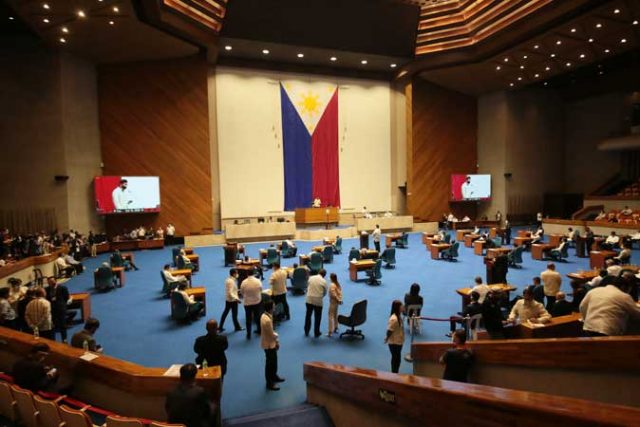
However, the House of Representatives said it will fast-track the approval of priority bills, but particularly the Bayanihan to Arise as One Act (Bayanihan III) and the economic Charter change resolution, before adjournment on June 4.

“We resume session on Monday with a full plate of priority bills scheduled for plenary deliberation before we adjourn sine die this week,” Leyte Representative and chairman of the House Committee on Rules, Martin G. Romualdez, said in a news release on Sunday.

“Speaker Lord Allan Velasco wants to place in the front burner the passage of the proposed Bayanihan to Arise as One Act or the Bayanihan III and the economic Charter change under Resolution of Both Houses (RBH) No. 2 on third and final reading,” he added.

Business leaders, on the other hand, want Congress to approve key economic measures this week.

Certified urgent by President Rodrigo R. Duterte, proposals to amend the Public Service Act (PSA), the Foreign Investments Act of 1991, and the Retail Trade Liberalization Act of 2020 (RTLA) have yet to hurdle Congress.

The House versions of the bills have been approved on third reading, while the Senate is still deliberating its own versions of bills seeking to amend the PSA and the Foreign Investments Act.

The three bills are seen as tools to aid recovery from the effects of the pandemic on the economy by attracting investments and jobs.

“This is the right time to pass the economic bills because we strongly believe that this would lead to increased foreign investment. That would be obviously a help and support to accelerating the economy,” British Chamber of Commerce of the Philippines Executive Director Chris Nelson said in an interview by phone on Saturday.

“Time is of the urgency… what we want to see is for them to be passed as soon as possible so we can communicate to investors — here is a very progressive move. We’re competing with other countries and it’s great to try and promote the Philippines and the Philippine advantages of the people and skills backed up by these laws.”

The Senate last week approved a measure that would set foreign retailers’ minimum paid-up capital at P50 million or around $1 million should they seek to enter the market, lower than the current requirement of $2.5 million.

The two chambers will convene a Bicameral Conference Committee to reconcile their versions that could amend the RTLA. While foreign business groups support the House version setting a lower minimum paid-up capital of $200,000, local retailers support the Senate version, which they said would keep smaller businesses from losing out.

John Forbes, senior advisor of the American Chamber of Commerce of the Philippines, said that the group is hoping for the passage of amendments to the RTLA.

“(The amendment) would allow more foreign retail firms to invest as they are doing in Vietnam, for example, where Korean-owned shops and restaurants supported over four million Korean tourists in 2019,” he said in a mobile message on Friday.

“Allowing the same here could eventually double the two million Korean tourists to the Philippines in 2019.”

Several business groups on Saturday released a statement urging Congress to immediately pass bill that would amend the PSA, which would change the definition of public utilities to allow more foreign investment in telecoms.

“It will put in place a legal framework that will encourage more foreign investments in the Philippines and will foster strong competition that will benefit the consumers, boost job creation, and expand our economy while at the same time safeguarding our national interests against foreign domination of critical infrastructure,” the groups said.

But the business groups — which include the Financial Executive of the Philippines, the Management Association of the Philippines, and Makati Business Club — expressed concerns about some provisions in the PSA bill, including a reciprocity clause requiring similar treatment by the home country of the foreign investor before it can be allowed to own more than 40% of the capital of public services engaged in critical infrastructure.

It also criticized a provision that oversees investments by foreign-state owned enterprises, which the groups said can be interpreted as “prohibiting sovereign wealth funds from investing in public service classified as critical infrastructure.”

Nabil Francis, president of the European Chamber of Commerce of the Philippines, said that the chamber is calling for the swift passage of the three bills.

“The speedy implementation of these reforms, particularly the House-proposed versions, will usher in foreign direct investments, spur economic growth and generate jobs which are crucial to improve the overall competitiveness and economic health of the country,” he said in a mobile message on Friday.

Foreign business groups in a statement on Sunday also supported the passage of House Bill 8910 or the Open Access in Data Transmission Act.

“The Open Access Act will provide a competitive policy and regulatory framework that lowers the barriers and cost to enter the data transmission market. This will significantly improve the data transmission services,” the groups said.

Represented by foreign chambers including the United States, Canada, Japan, and Europe, the groups, however, asked Congress to reconsider the retention of the franchise requirement for international cable landing stations, which they consider to be a barrier to entry of more players in the broadband sector.

“This will delay lowering the cost of broadband and providing a fuller range of digital access for consumers and citizens throughout the country,” the groups said. — with Bianca Angelica D. Añago

Big Philippine banks lend less amid rising bad loans

REUTERS

By Lourdes O. Pilar, Researcher

THE FIRST three months of the year saw the country’s biggest banks issuing even fewer loans as soured loans piled up amid the coronavirus pandemic.

The first-quarter edition of BusinessWorld’s Quarterly Banking Report showed the aggregate loans of 46 universal and commercial banks (U/KBs) declined by 5.98% year on year to P9.351 trillion in the January-March period, sharper than the 3.96% contraction posted in the preceding quarter.

The reduction in loans in the first quarter marked the sharpest since the first quarter of 2003 when loans lent by U/KBs fell by 9.84%. The latest reading brought the losing streak in loans to three consecutive quarters.

Big banks continue to issue fewer loans, incur more NPLs in Q1

The quarter also saw bad loans, also known as nonperforming loans (NPL), rise by 17.2% year on year to P361.892 billion from P308.832 billion in the fourth quarter of 2020. Compared with the same period last year, soured loans grew by almost 70%.

This brought the NPL ratio — or the bad loans as a portion of the total loan portfolio — to 4.12% in the first quarter, surpassing the record-high NPL ratio of 3.68% in the fourth quarter of 2020 based on new reporting standards introduced by the Bangko Sentral ng Pilipinas (BSP) in the first quarter of 2013.

Loans are classified as nonperforming when they are left unpaid at least 30 days beyond the due date. They are considered as a risk to the lenders’ asset quality as borrowers are likely to default on these debts.

Meanwhile, the combined assets of big banks grew by 5.84% to P18.878 trillion in the first quarter, from P17.837 trillion in the same three months last year. This was slightly faster than the 5.6% expansion in the fourth quarter of 2020, but still slower compared with the 7.06% in the same period last year.

Profitability in the first quarter improved from the preceding quarter as the median return on equity (RoE) was tallied at 3.89% from 3.66%. However, this was still lower than the RoE of 5.17% in the first quarter of 2020.

The RoE ratio measures the amount that shareholders make on every peso they invest in a firm and is calculated by dividing the net profit to average capital. It also measures how well a firm makes use of the money from shareholders to generate income.

BDO Unibank, Inc. remained the biggest bank in terms of assets with P3.334 trillion. State-owned Land Bank of the Philippines (LANDBANK) came in at second with P2.409 trillion, overtaking Metropolitan Bank & Trust Co.’s (Metrobank) P2.374 trillion and the Bank of the Philippine Islands’ (BPI) P2.151 trillion.

BDO remained on top in terms of loans issued with P2.144 trillion, followed by BPI’s P1.359 trillion and Metrobank’s P1.134 trillion.

Among banks with assets of at least P100 billion, the Development Bank of the Philippines (DBP) once again posted the fastest year-on-year asset growth with 44.33%. It was followed by the Bank of Commerce and Robinsons Bank Corp. with 29.39% and 27.73% growth, respectively.

DBP likewise saw the fastest growth in loans, with a year-on-year expansion of 11.93%, followed by Robinsons Bank (10.71%) and Rizal Commercial Banking Corp. (5.70%).

BDO had the most deposits with P2.633 trillion, followed by LANDBANK with P2.124 trillion and Metrobank with P1.739 trillion.

ASSET QUALITY DECLINES
Latest figures show a deterioration in asset quality in the first quarter. For instance, the nonperforming asset ratio — or the NPLs and foreclosed properties in proportion to total assets — worsened to 1.38% in the first quarter from 1.17% in the fourth quarter.

Relative to total assets, foreclosed real and other properties remained unchanged at 0.28% in the first quarter compared with the previous quarter.

Total loan loss reserves among U/KBs reached P325.228 billion in the first quarter, bigger than the P322.568 billion in the fourth quarter.

While the banks’ median capital adequacy ratio (CAR) of 19.78% in the first quarter remained above the required minimum of 10% set by the BSP and the international standard of 8%, this was a tad lower than the 20.14% logged in the previous quarter. CAR measures the ability of banks to absorb losses from risk-weighted assets.

BusinessWorld Research has been tracking the financial performance of the country’s big banks on a quarterly basis since the late 1980s using banks’ published statements.

The full version of BusinessWorld’s quarterly banking report will soon be available for download on www.bworldonline.com.