Home Blog Page 7678

Financial regulators wary of ‘unconventional interventions’ sparking future crises

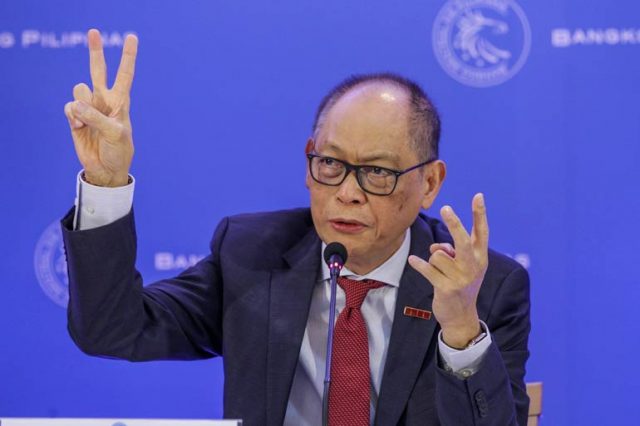
Bangko Sentral ng Pilipinas (BSP) Governor Benjamin E. Diokno — PHILSTAR/GEREMY PINTOLO

Regional financial regulators believe the economic downturn resulting from the pandemic could warrant “unconventional interventions” from governments beyond the normal toolkit for dealing with crises, which in themselves could also be sources of future financial instability. 

Benjamin E. Diokno, governor of the Bangko Sentral ng Pilipinas (BSP), co-chaired a meeting Tuesday of the Regional Consultative Group for Asia (RCGA), during which participants sought to map out likely scenarios for the economic crisis moving forward.  

The participants recognized the need for “unconventional interventions” that could affect market conditions over time.  

“What is clear is that there remain systemic risks, both risks to the financial system and risks by the financial system itself,” Mr. Diokno said in a statement, without elaborating. 

Regulators typically deal with crises with monetary and fiscal tools that raise the supply of money in the system through various means of policy easing, or else make life easier for businesses by relaxing the tax regime to stimulate growth. The danger of excessive easing is that too much money could end up circulating in the financial system, generating asset bubbles and stoking inflation. An overly lax tax regime could impact government revenue and make it less capable of meeting obligations. 

The RCGA members said a balance needs to be struck between the response to the current needs of the market while guarding against any possible longer-term implications.   

“The questions have sharpened as we now see clearer, but apparently more divergent paths in front of us,” Mr. Diokno said.   

“Knowing how these different paths affect each one of us will require a lot of discussion to fully appreciate its holistic interactions,” he added.   

The meeting was attended by representatives from 17 Asian economies.   

The FSB was established in 2009 to organize the reform of the financial system after the 2007-2009 global financial crisis. The RCGA is one of six regional committees created by the FSB in 2011. Isabel B. Celis 

House panel agrees to adopt Senate two-year estate tax amnesty

The House committee on ways and means has recommended that the chamber House approve the Senate’s amendments to House Bill 7068, which extends the estate tax amnesty application period by two years from the original deadline of June 14. 

June 14 is the deadline stipulated in Republic Act 11213 or the Estate Tax Amnesty Act.   

On Sept. 15, 2020, the chamber approved on third reading House Bill 7068, which also called for a two-year extension of RA 11213.  

The House later sought to extend it by a further two years, amending the tax amnesty deadline to four years from the original “two years from the effectivity of the Implementing Rules and Regulations of this Act.”  

On Thursday, however, the Senate approved on third reading its version of the bill under Senate Bill 2208 which set the new deadline at June 14, 2023.  

This representation poses no objection significant enough to merit the constitution of a bicameral conference committee,” House Committee on ways and means chairman Jose Ma. Clemente S. Salceda wrote in anaide memoire to Speaker Lord Allan Jay Q. Velasco and Majority Leader Ferdinand Martin G. Romualdez, dated May 20 and made public Friday.   

Mr. Salceda said the extension is a “vital piece of our COVID-19 bounce back puzzle. The estate tax amnesty will be critical to economic recovery, as it would allow property owners with unsettled estates to access bank financing or to liquidate their property to finance other needs.”   

“Having estates settled will unlock the value of such properties and allow credit arising from them to be used to finance economic activities. COVID-19 quarantines also took away significant filing time from potential filers for estate taxes, such that availers did not have full opportunity to complete the estate tax amnesty process for the entire period allowed by the law.,” he added.  

The House version of the bill reinstated the provision that only one return may be filed for estates involving multiple generations of decedents, which had been vetoed by President Rodrigo R. Duterte when he signed the act.  

The Senate version deleted the provision, but “the President is likely to veto the same provision again if it were kept,” Mr. Salceda said.  

The Senate also removed the requirement for heirs to submit “proof of settlement,” which Mr. Salceda said “is immaterial, as the Bureau of Internal Revenue can simply require such proof to be presented if so needed.” – Bianca Angelica D. Anago 

DoE asked to detail plans for after end of Shell role in Malampaya

THE DEPARTMENT of Energy (DOE) needs to reveal its plans to maintain energy continuity after the contract of Malampaya gas field operator Shell Philippines Exploration B.V. (SPEx) ends in 2024, a legislator said. 

Senator Sherwin T. Gatchalian said in a statement that he filed Senate Resolution No. 724 on May 18 directing the Senate Committee on Energy to conduct an inquiry on the DoE’s plans with the approach of the end of the Shell service contract. 

“Given the significant role that the Malampaya project plays in the Philippines’ energy security, it is imperative that the DoE apprise the Filipino public on Malampaya’s operations — the remaining natural gas reserves and the government’s plans for continuous energy supply, likewise on the pending request for the extension of Service Contract (SC) No. 38,” Mr. Gatchalian said. 

“The inquiry will also look into the status of the sale of the stake of SPEx and the basis for the DoE’s decision if it approves the sale,” he added. 

On Thursday, Shell Petroleum N.V. announced that it signed an agreement with Malampaya Energy XP Pte. Ltd., for the sale of its 100% stake in SPEx.  

Malampaya Energy XP Pte. Ltd. is a subsidiary of Udenna Corp. led by Dennis A. Uy.  

SPEx holds a 45% interest in SC 38, which covers the Malampaya gas field. Other companies that have an interest in the contract are UC 38 LLC – another Udenna Corp. subsidiary – with 45%, and the Philippine National Oil Co. Exploration Corp., with 10%. 

According to Shell, the consideration of the sale is $380 million with additional payments of up to $80 million between 2022 to 2024 contingent on asset performance and commodity prices.  

The transaction is targeted for completion by the end of the year, subject to agreement by the parties and regulatory approval 

Mr. Gatchalian said the DoE should also review and evaluate the transfer of interests of the consortium members to comply with Presidential Decree No. 87. 

“It is critical for the DoE to ensure that whoever gets hold of Shell’s interest should have, not just similar experience or capacity, but more so the technical, financial and legal capability to operate the Malampaya project or to be a service contractor,” Mr. Gatchalian said.  

Mr. Gatchalian said the Malampaya project is the country’s most significant oil and gas development, accounting for 19.16% of the Philippines’ electricity in 2020. – Revin Mikhael D. Ochave   

“It has also provided a crucial source of income for the government with a total net national government share amounting to P261.68 billion since it began commercial operations in 2002 until 2019,” Mr. Gatchalian said.   

BusinessWorldsought the comment of DOE on the matter but has not responded as of deadline time.   

Bill creating Philippine CDC approved by House panel 

PHILIPPINE STAR/MICHAEL VARCAS

The House committee on appropriations approved on Friday House Bill 6096 or the Center for Disease Control and Prevention (CDC) Act, which seeks to establish an agency that will take the lead in handling infectious diseases such as coronavirus disease 2019 (COVID-19).

The proposed CDC Act, listed as priority legislation in the 2020 State of the Nation Address of President Rodrigo R. Duterte, was also approved by the House committee on health on March 5.

The Department of Health expressed its support for the bill earlier this month.

The bill was filed in January 2020, before the COVID-19 outbreak in the Philippines.

Its author, Representative Jose Ma. Clemente S. Salceda, who also chairs the ways and means committee, said in a statement that he expects the bill to be signed this year as “the Senate has begun committee discussions on the bill…(and) (w)ith plenary approval looming in the House.”

The CDC is proposed as a separate agency supervised by the Health Emergency Coordinating Council, with the health secretary as its chair.

Mr. Salceda said the mandate of the Philippine CDC must be focused on fighting infectious diseases as health crises are “not just a doctor’s specialty anymore.”

“There are health crises where cases have the potential to escalate in numbers and scope very quickly, and where coordinated efforts at containment and treatment are required immediately. That will often include law enforcement, community management, and a whole swathe of other disciplines. So, we need a more holistic public health preparedness and response framework,” he said. – Bianca Angelica D. Anago

RCEF-backed farm machinery distribution tops 10,000 units at end ofApril 

THE Philippine Center for Postharvest Development and Mechanization (PhilMech) said it has distributed 10,030 units of farm machinery to qualified cooperatives and associations as of the end of April, in line with the increase in mechanization contemplated by the Rice Tariffication Law. 

PhilMech Director Baldwin G. Jallorina said in a virtual briefing Friday that the agency distributed an additional 2,520 units beyond the 7,510 that had been distributed at the end of February. 

Qualified farmers are entitled to mechanization assistance under the Rice Competitiveness Enhancement Fund (RCEF), created under Republic Act No. 11203 or the Rice Tariffication Law, which was signed on Feb. 14, 2019. 

Since 2019, PhilMech said farm machinery distributed includes 2,398 four-wheel tractors; 2,896 hand tractors; 714 floating tillers; 111 precision seeders; 610 walk-behind transplanters; 348 riding type transplanters; 1,275 reapers; 1,562 combine harvesters; 45 mobile rice mills; and 71 axial flow threshers. 

“Averaging about 1,260 units of farm machinery distributed in March and April was no easy task as we had to deal with coronavirus disease 2019 (COVID-19) restrictions,” Mr. Jallorina said.  

Mr. Jallorina said the distribution process had been delayed due to the quarantine. 

Relative to target, “we will be delayed by a bit due to the COVID-19 pandemic that caused lockdowns in some areas. I hope we catch up before the end of the month,” Mr. Jallorina said. 

The Rice Tariffication Law allocates P10 billion a year from rice import tariffs to the RCEF until 2024 to help rice farmers better compete with imported rice. 

Some P5 billion is meant to fund farm mechanization; P3 billion for seed; P1 billion for training; and P1 billion for credit support.  

“Without the Rice Tariffication Law, there would be no program to distribute at no cost various machinery to rice farmers. We also make sure that the farmers cooperatives are trained and capable of operating the equipment given to them,” Mr. Jallorina said. – Revin Mikhael D. Ochave 


First Philippine Holdings sets P50-B capex; First Gen corners majority

Lopez-led First Philippine Holdings Corp. (FPH) said on Friday that it is allocating P50 billion for its capital expenditures (capex) this year, 72% higher than last year’s P29 billion as its business units pursue their planned projects.

“Majority of the capex for this year will be for the energy group, First Gen [Corp.], [with] P26 billion,” FPH Chief Financial Officer Emmanuel Antonio P. Singson said during the company’s virtual stockholders’ meeting.

First Gen will be using the budget to pursue the development of its liquefied natural gas (LNG) terminal.

FPH allotted P14 billion for Rockwell Land Corp. while First Philippine Industrial Park, Inc. will get P1 billion.

“The balance is allocated for the construction sector in big businesses in healthcare and education, and was also used for FPH investments earlier this year,” Mr. Singson said.

FPH said First Balflour Inc.’s projects will also continue its planned projects this year.

The Cebu-Cordova Link Expressway is said to be 60% complete, while the Novaliches-to-Balara Aqueduct tunneling project is 70% done. The company is eyeing to complete both in the first half of next year.

On Friday, shares of FPH at the stock exchange went up by 0.07% or five centavos to close at P70.05 each. — Keren Concepcion G. Valmonte

D.M. Wenceslao’s income up 24% to P552M due to tax credits

Real estate developer D.M. Wenceslao (DMW) finished the first quarter with P552.03 million in net income attributable to parent equity holders, up by 24% from last year’s P445.38 million due to the tax credit it recognized from the Corporate Recovery and Tax Incentives for Enterprise (CREATE) law.

The company’s tax credit amounted to P91.7 million in 2021 — from a P146.8-million tax expense incurred last year — after the CREATE law was passed, decreasing the corporate tax rate to 25% from 30%.

However, DMW posted a 32% topline fall to P692.53 million from P1.03 billion a year ago.

Revenues from the company’s residential segment totaled P194 million, a 61% drop from P498.06 million because of “revenue recognition timing.”

DMW said only P44 million revenues were accounted for Pixel Residences during the period, compared with P480 million in the first quarter of last year.

“Note that Pixel Residences is already near completion, a phase where construction progress and revenue booking are generally slower,” the company said.

Meanwhile, revenues from the company’s MidPark towers improved by over seven-fold to around P150 million from P18 million in the same period last year.

DMW’s recurring income, which includes rentals from land, building, and other revenues, declined by three percent to P497 million from P512.7 million. The segment accounted for 72% of the total revenues in the first quarter and it was able to maintain an occupancy rate of 90% despite the pandemic.

The company said it will continue to face the pandemic with “undeterred optimism,” now that a vaccination program is in place.

“Time and again, our recurring income-focused business model, complemented by residential sales has proven effective through different stages of the economic cycle, including a pandemic-induced downturn,” DMW Chief Executive Officer

Delfin Angelo C. Wenceslao said in a statement on Friday.

DMW added that its leasing business will “receive a shot in the arm” as it completes its 8912 Asean Ave. project in the second quarter, which will boost the company’s gross leasable area by over 69,000 square meters.

Stocks of DMW at the local bourse went up by 1.02% on Friday, closing at P6.95 each from P6.88. — Keren Concepcion G. Valmonte

Cebu Landmasters’ CDO project sells 75% of units in a month

Cebu Landmasters, Inc.’s (CLI) P983-million project Velmiro Heights in Cagayan de Oro City has sold 75% of its 518 house-and-lot units a month after its market introduction.

The project is expected to generate P1.78 billion in sales.

“COVID-19 (coronavirus disease 2019) heightened the need for homes offering safety and security not only among wage earners but also among mid-market executives and entrepreneurs in key cities in the South,” Cebu Landmasters Chief Operating Officer Jose Franco B. Soberano said in a statement on Friday.

It is the property developer’s second horizontal project of the same brand in Cagayan de Oro, spanning 12.2 hectares on a hilltop with views of Macajalar Bay and the Bukidnon mountain range. It is said to be accessible to major destinations.

Velmiro Heights also recorded high sales in its five locations within the Visayas-Mindanao (Vis-Min) region, including Tagbilaran City, Bacolod City, and Cebu City.

Cebu Landmasters has so far launched 1,800 units under the brand, with house-and-lot units having floor areas from 48 square meters (sq.m.) to 140 sq.m. These are priced within the P2.3 million to P7 million range.

The project offers a variety of house models. Its Cita townhouse, one-story single attached Dara unit, and the two-story single-detached Zuri model targets young families, with sizes from 48.3 sq.m. to 53 sq.m.

Cebu Landmasters said growing families may choose between the two-story single attached Asha unit and the two-story single-detached Geila unit, with models ranging from 60 sq.m. to 140 sq.m.

“The units have been designed to offer clean, contemporary architecture and an uncluttered frontage,” the company said.

In the January-to-March period, Cebu Landmasters reported a 17% growth year

on year in reservation sales to P3.3 billion. Sales from its mid-market “Garden Series,” which includes Velmiro Heights, accounted for around 66% of the total.

The Vis-Min property developer ended the quarter with P713.8 million in net income attributable to parent, 25% higher from its P572.23 million seen a year ago.

“CLI’s growth momentum is highly likely to speed up even more as the year progresses with more projects getting launched and sold out and as constructions continue,” the company said.

On Friday, shares of Cebu Landmasters at the stock exchange improved by 0.67% or four centavos to close at P6.03 each. — Keren Concepcion G. Valmonte

Filinvest real estate leader passes away

Filinvest Land-logo

Andrew “Bibot” T. Gotianun, Jr., vice chairman of Filinvest Land, Inc. and director of Filinvest Development Corp., passed away on Friday. He was 69 years old.

In a statement, the Gotianun family said his passing came “after a short bout with a non-COVID (coronavirus disease 2019) malignant illness.”

“He was instrumental in growing the Filinvest group into the multi-faceted corporation it is today and was a leader in the real estate field,” the family said.

Further information on his virtual memorial service will be announced soon.

The Gotianun family has asked for privacy. — KCGV

PHL shares inch up on bargain-hunting, lower US jobless claims

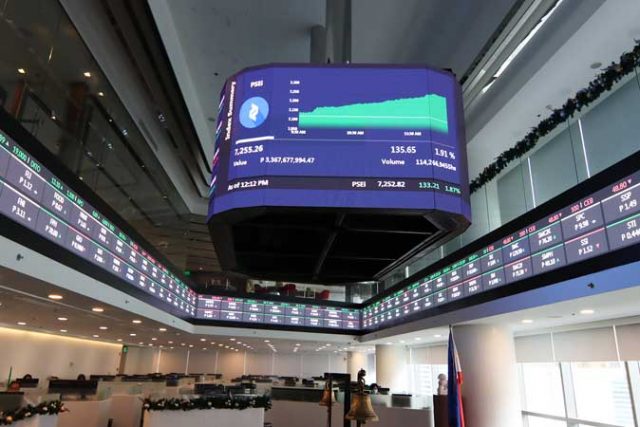
COURTESY OF PHILIPPINE STOCK EXCHANGE, INC.

Philippine shares closed the week in the green as investors went bargain-hunting amid the local bourse’s intraday low and after the US released data showing lower initial jobless claims.

The benchmark Philippine Stock Exchange index (PSEi) inched up by 1.61 points or 0.02% to close at 6,199.25 on Friday, while the broader all shares index increased by 2.42 points or 0.06% to 3,842.73.

“The local bourse managed to close in the green territory this Friday as bargain hunters took advantage of its intra-day dip,” Philstocks Financial, Inc. Senior Research Analyst Japhet Louis O. Tantiangco said in a Viber message on Friday.

“The positive cues from Wall Street’s overnight rally caused by the decline in the US’ initial jobless claims also helped in the local market’s performance today,” Mr. Tantiangco added.

The PSEi dropped to an intraday low of 6,172.18, while the all shares index went down to 3,828.05.

Over in the US, the initial number of people filing for unemployment claims reached 444,000 for the week ending May 15, the lowest level since March of last year.

Most sectoral indices closed in the green on Friday except for financials, which declined by four points or 0.29% to 1,372.47, and services lost 3.49 points or 0.24% to end at 1,453.69.

Meanwhile, property gained 10.61 points or 0.35% to 3,000.93; mining and oil improved by 24.34 points or 0.26% to 9,311.23; holding firms climbed 7.83 points or 0.12% to finish at 6,144.54; and industrials went up by 5.88 points or 0.06% to 8,578.12.

Value turnover inched down to P5.03 billion on Friday with 1.63 billion shares switching hands, from P5.52 billion with 2.97 billion issues traded in the previous session.

Advancers bested decliners, 103 to 95, while 47 names closed unchanged. Net foreign selling went decreased to P512.74 million on Friday from the P731.23 million in net outflows logged on Thursday.

“The index downtrend remains intact and we may continue to test new lows for next week as MSCI rebalancing deadline will be on May 27, and we don’t see any significant positive catalyst to reverse sentiment for now,” AB Capital Securities, Inc. Junior Equity Analyst Lance U. Soledad said in a separate Viber message. — Keren Concepcion G. Valmonte

TikTok and geopolitics: how ‘digital nationalism’ threatens to entrench big tech

The massive digital platform market has until recently been dominated by a handful of US-based companies such as Facebook and Google. However, as foreign governments and competing platforms try to erode this domination, platforms are becoming a new sphere of geopolitical maneuvering. 

The European Union wants to gain more control over international tech companies and achieve more independence in the digital arena. India has banned 177 Chinese apps on the grounds they are “prejudicial to the sovereignty and integrity of India.” 

And in 2020, the then US President Donald J. Trump spent months attempting to ban the Chinese-made video-sharing platform TikTok or force its sale to an American owner. While some claimed Trump was piqued by a supposed prank against him by teenage TikTok users, a look at statements from US government officials over the course of the year shows geopolitical concerns were the main driver. 

If governments are continue to be driven by “digital nationalism”, the US-based big tech companies are likely to continue to dominate. 

TIKTOK IS THE FIRST MAJOR NON-US PLATFORM 

TikTok is the first social media platform born outside the United States to become a significant rival to Silicon Valley incumbents such as Facebook and Instagram. The short-form video platform rose to prominence in 2019 and, by early 2020, was the most downloaded app globally. 

Since its rise, TikTok has come under intense criticism from governments around the world, who question whether ByteDance, the company that owns TikTok, sufficiently protects users’ data against access by the Chinese state. 

However, the way TikTok treats user data is not very different from what its US counterparts do. There is little to suggest the platform poses any singular national security threat. 

The company releases transparency reports similar to those of Google and Facebook. A Central Intelligence Agency (CIA) assessment reportedly concluded there was no evidence the Chinese government had intercepted TikTok data. 

TikTok’s Chinese origins can be used to oversimplify the platform’s actual territorial connection to China. ByteDance was founded in China but it is incorporated in the Cayman Islands and operates as a multinational with subsidiaries in Australia, the US, the UK, and Singapore. 

PLATFORM GEOPOLITICS 

The backdrop to Trump’s stance towards TikTok was an intensifying contest between the US and China over the strategic value of the digital environment. Who gets to extract economic value from the platform economy? Who gets to exert ideological influence through vast sociotechnical systems? Who enjoys strategic advantages from control over and access to data and infrastructure? 

As today’s global tech platforms have developed, they have largely mirrored the shape of classical geopolitics: the US has dominated. Recently, however, Chinese technology firms have flourished, expanding China’s economic and strategic capacities. 

TRUMP’S TIKTOK CHALLENGE 

TikTok teens may have successfully pranked Trump, but his actions and rhetoric fit within a geopolitical agenda articulated by others within the administration. 

On June 24, 2020, US national security advisor Robert O’Brien spoke publicly on the topic of the Chinese government’s “ideology and global ambitions.” He warned China posed a threat to US citizens and explicitly implicated TikTok. 

Two weeks later, on July 6, US Secretary of State Mike Pompeo suggested TikTok should be treated like Huawei, the Chinese telecommunications company that is effectively banned in the US. 

On July 31, 2020, Trump announced he was planning to ban TikTok. 

Several days later, Microsoft released a statement explaining that its representatives had spoken to Trump directly regarding the acquisition of TikTok. When questioned about his talks with Microsoft, Trump stated: 

[…] it can’t be controlled, for security reasons, by China. Too big, too invasive, and it can’t be. 

On August 5, 2020, the US Department of State announced an expansion of its Clean Network program, which has the stated objective of “guarding our citizens’ privacy and our companies’ most sensitive information from aggressive intrusions by malign actors, such as the Chinese Communist Party. 

Expansions to the program included five policies aimed at reducing the presence of China in the US. These policies limited the use of Chinese telecommunication carriers, applications sold in app stores and pre-installed on devices, cloud services and undersea cables. 

The following day, Trump issued an executive order forcing the sale of TikTok to a US company on the grounds that TikTok posed a threat to “the national security, foreign policy, and economy of the United States. 

Ultimately Trump’s executive orders were blocked in the courts and the ban and forced sale never implemented. 

THE RISE OF DIGITAL NATIONALISM 

TikTok provides welcome competition to the platform incumbents. If real competition in the sector were to increase, requiring the incumbent platforms to compete for users, we might see further innovations in the platform market and a less concentrated tech sector. 

So far, however, the US government has explicitly focused on the geopolitical implications of the rise of a Chinese platform. Whether the Biden administration will continue this approach remains to be seen. 

Both the US and China have a long history of shielding strategically important industries. For those concerned with increasing competition and diluting the concentrated power of the dominant technology firms, the rise of digital nationalism is a new obstacle. 

Moving forward, policymakers may need to overcome nationalistic impulses if they are to increase global competition in the international platform market. And both US and Chinese rule must be rejected if we are to decentralize power within the digital environment. — Joanne Gray/The Conversation 

Joanne Gray is a lecturer in the School of Communications and chief investigator of the Digital Media Research Centre at Queensland University of Technology, Australia. 

This article is republished from The Conversation under a Creative Commons license. Read the original article. 

How dogs are helping us cope with the pandemic

When you scroll through social media, you’ll probably see a friend or two with a dog. The pandemic is a time where everyone is staying at home, so it explains why many people seek companionship through adopting or buying new dogs.

A dog has always been man’s best friend. However, it wasn’t until quarantine when many people fully embraced a dog’s love and companionship.

An article in The Washington Post reported that the surge of adoptions and sales began as early as March 2020. Similarly, the Industrial Association of Pet Care Producers in Germany stated that the number of pets in households rose to nearly 35 million.

Aside from groceries and e-commerce platforms, pet stores, animal rescue shelters, and private breeders witnessed the rise in customers as the pandemic continued.

In the Philippines, veterinary clinics also experience a sudden surge in the number of customers as dog owners hope to provide their fur babies with proper care.

Since it’s uncertain when human interactions will return to normal, our fur babies are considered as our best friend or trusted companion during this time. They communicate differently yet there’s something about a dog’s love that’s pure and unchanging.

Dogs cannot express their love through words or gifts. But in their own way, they’re always there to remind you how much you mean to them.

Some of a dog’s love languages include giving hugs, leaning on your leg, jumping excitedly when you arrive home or following you wherever you go. You can also share your inner thoughts or personal dreams with them. Behind their adorable faces are open hearts for their hoomans, always.

Getting a dog is the easiest part of being a fur parent. But owning a fur baby doesn’t stop with posting their cutest photos on social media or leaving them alone when you’re too busy. It’s a responsibility that fur parents should embrace wholeheartedly.

Being a responsible fur parent starts with giving your dogs nutritious food. It’s not enough to grab the first dog food that you see in the store. Before deciding on which dog food to buy, you must take note of its nutrients and health benefits. In addition, it’s important to be aware of your dog’s allergies and preferences.

Canis Prime Adult Dog Food is a budget-friendly diet that comes with health benefits for your fur baby’s needs. It prioritizes your doggo’s health by providing the right amount of nutrition in every meal.

Canis Prime is packed with Prime Tech that comes in an easy-to-digest formula for your fur babies. It is enriched with probiotics for better nutrient absorption and stronger immune system, Omega 3 and 6 to nourish their skin and coat, and Yucca extracts to reduce stool odors.

Of course, Canis Prime does not just focus on giving your dog the nutrients it needs. It also protects their dental hygiene by reducing cavity buildup on their teeth and gums.

Canis Prime is a trustworthy companion in protecting your fur baby’s health and well-being. It’s a favorite product of Manila City Mayor Isko Moreno for his lovable companion “Yorme” the dog.

Being a responsible pet owner starts with giving your dog yummy and healthy food. Canis Prime Adult Dog Food is the best way to start. It is made with outstanding nutrition and taste to ensure your dog’s prime condition.

Canis Prime Adult Dog Food comes in a 20 kg pack and will soon be available in 1.5 kg.

For more details about Canis Prime Dog Food, visit https://excelfeedsph.lafilgroup.com/ or follow @CanisPrimeAndYuri on Facebook. Canis Prime Dog Food is available on Lazada, Shopee, and its online store Excel Feeds.