Home Blog Page 7657

Vista Land income up 9% amid strong demand

VISTA LAND & Lifescapes, Inc. recorded 9% increase in its net income for the first half to P3.8 billion as demand from overseas Filipinos remained strong amid the coronavirus disease 2019 (COVID-19) pandemic.

Vista Land said in a statement on Thursday that its real estate revenues during the period fell 13% to P11.1 billion as a result of slower construction activities in provincial areas, while its leasing income rose 6% to P3.6 billion.

“The company’s newly opened commercial centers, where the majority of the tenants are essential (i.e., home store and supermarket), contributed to the topline growth,” it said.

Vista Land Chairman Manuel B. Villar, Jr. said the strong demand from overseas Filipinos continued during the period, which resulted in a 14% growth in the company’s reservation sales to P29.4 billion.

Mr. Villar said the COVID-19 pandemic also gave a venue for the company to revisit its strategies and implement various operational efficiency measures that resulted in better margins.

“We remain optimistic with the industry especially with the performance of overseas Filipino remittances, which registered two consecutive months of double-digit growth and are currently at 6.6% growth for the first five months of the year,” Mr. Villar said.

Vista Land’s total assets as of end-June reached P301.1 billion, while its capital expenditure for the first half amounted to P11.3 billion used for construction and land development.

“Land acquisitions remained muted as the company disclosed that they are looking at maximizing its existing land bank. The company had 2,953 hectares of land as of end-June 2021. A total of P5-billion worth of projects were launched during the period, comprising 1 high end project, 3 affordable projects and 2 mid-rise buildings,” it said.

Vista Land President and Chief Executive Officer Manuel Paolo A. Villar said the company’s various digital initiatives such as an online reservation system, expanded online payment options, virtual property tours, and social media platforms are yielding positive results.

“But we have just started, and we are working on more initiatives all aimed at better serving our clients as well as expand our reach,” Mr. Villar said.

On Thursday, shares of Vista Land at the stock exchange fell 3.65% or 13 centavos to finish at P3.43 each. — Revin Mikhael D. Ochave

RCBC targets to grow SME loans by P11.3 billion

BW FILE PHOTO

RIZAL COMMERCIAL Banking Corp. is targeting to grow its loans to small businesses by P11.3 billion this year as it expands its presence in selected provinces.

“For this year, the incremental target is to grow the SME (small- and medium-sized enterprises) portfolio by P11.289 billion. The strategy to increase footprint in areas where we have limited presence is part of the plan for SME to account for 20% of the bank’s total portfolio,” the bank said in an e-mail. Last year, RCBC’s SME loans climbed by 7.8% or by P5.7 billion.

The Yuchengco-led lender said it is looking to extend credit to cooperatives as well as savings and loans associations.

The bank will also set up additional SME satellite offices in provinces such as Bohol, Palawan, Nueva Ecija, and several areas in Calabarzon (Cavite, Laguna, Batangas, Rizal, Quezon) to capture more of the market.

“These areas are a possible growth market for SME loans where RCBC may introduce financing options to clients who may otherwise have limited access to credit or have been accustomed to more traditional credit lines,” RCBC said.

The bank said Metro Manila accounts for the biggest share of micro-, small- and medium-sized enterprises (MSMEs) in the country as it is home to about 20% of MSME establishments.

Meanwhile, Calabarzon and Central Luzon are at second and third as they have 15% and 12%, respectively, of the country’s small businesses,

RCBC also provides digital payment and collection solutions for MSMEs.

RCBC First Senior Vice-President and SME Group Head Ma. Angela V. Tinio in July said they are also eyeing to create an end-to-end platform for small businesses to give them easier access to banking services.

The platform is set to include features such as online application, loans processing, and account management, where clients can pay their loans and avail of products and solutions from the bank.

Meanwhile, in a filing with the local bourse on Thursday, RCBC said it sold 101.85 million Treasury shares at P44 apiece to Sumitomo Mitsui Banking Corp. (SMBC) on July 23. This is equivalent to a 5% stake in the local bank.

The P4.48-billion capital infusion transaction was announced in June.

“The strategic investment by SMBC, which raises P4.48 billion of new core equity Tier 1 capital for the bank, is part of the bank’s capital raising plan to support long-term asset growth and digital investments,” RCBC said.

RCBC’s net earnings fell 31.55% to P1.58 billion in the first quarter from P2.308 billion a year ago. This was mainly due to trading losses and lower foreign exchange gains.

Its shares closed at P19.20 apiece on Wednesday, up by eight centavos or 0.42%. — L.W.T. Noble

BHP edging closer to deal with unions at Escondida copper mine, world’s largest

REUTERS

BHP GROUP and union leaders at the Escondida complex in Chile are getting closer to a wage deal that would avert a strike at the world’s biggest copper mine.

Negotiators asked labor authorities for a one-day extension in a mediation process to continue working toward an agreement that could be put to workers Tuesday. According to the union, the breakthrough came after BHP acceded to some demands. On Friday, the Melbourne-based company warned that it wouldn’t improve the offer during a strike.

“During the course of the night, conversations between the parties will continue to close an agreement that will then be presented by Union No. 1 to its members,” BHP said in a statement late Monday.

Avoiding a stoppage at a mine that accounts for about 5% of global copper production would ease tensions over tightening supplies at a time when trillions of dollars in government stimulus fuel demand for industrial metals. In 2017, the same union staged a 44-day stoppage.

A deal at Escondida would also ease labor tensions in Chile after workers at a mine owned by JX Nippon Mining & Metals opted to walk off the job Tuesday when their talks with management collapsed.

At a third copper mine in Chile, Codelco’s Andina, the two sides agreed to extend talks to allow workers to vote on a new proposal, the result of which will be known Wednesday.

Surging producer profits are emboldening mine workers, with host nations also looking at ratcheting up taxes to help resolve inequalities exacerbated by the pandemic. At the same time, companies are striving to keep labor costs in check in a cyclical business and as ore quality deteriorates and input prices start to rise. — Bloomberg

Entertainment News (08/13/21)

Hip-hop group Shockra returns

AFTER taking a hiatus to focus on their booming individual careers, Filipino hip-hop group Shockra returns with an banger inspired by heist-themed films. Member rappers Abaddon, Crazymix, Flict-G, Tuglaks, Kial, Numerhus, Smugglaz, and Inozent One hop on a track called “Operation 10-90,” which blends their collective music influences with hard-hitting beats from Jan-C and Tha Black G. “It took us two years to find the perfect beat for our comeback single,” Flict-G said in a statement. “After finally deciding on the overall direction for this particular song, we decided to discuss and go ahead with our plan. We’re inspired by ’90s action films, and somehow, we wanted to incorporate that vibe in our brand of provocative hip-hop sound.” Released under Sony Music Philippines, Shockra’s “Operation 10-90” comes with a music video directed by Aya Reika Mayani. The 10-minute film features the individual members of Shockra as a gang of robbers trying to outwit the authorities in their bid to escape poverty and start a new life. 

Anne-Marie releases new album, Therapy 

SINGER Anne-Marie released her new album, Therapy, and the official video for her new single, Kiss My (Uh Oh)” with Little Mix. Inspired by the singers’ joint love of the movie Bridesmaids, the official video for the song sees Anne-Marie in character as a bride-to-be who embarks on her bachelorette party overseas alongside her bridesmaids, including Little Mix’s Perrie, Leigh-Anne and Jade. Therapy is available to stream on all music streaming platforms (https://lnk.to/AM-Therapy).

Squid Game on Netflix

NETFLIX has released the first poster and teaser trailer for its new show Squid Game, an imaginative, unorthodox story in which 456 contestants risk their lives in a mysterious survival game for a chance to win 45.6 billion won. Driven to desperation and gathered at an unknown location, the participants play one game each day as they race towards the prize. The price of failure is death. How did this diverse group of people end up here, and who is the mastermind behind these games? Directed by Hwang Dong-hyuk, Squid Game stars Lee Jung-jae, Park Hae-soo, Oh Young-soo, Wi Ha-Jun, Jung Ho-yeon, Heo Sung-tae, Anupam, and Kim Joo-ryoung. Squid Game premiers on Sept. 17 on Netflix. Watch the teaser trailer at www.facebook.com/netflixph/posts/1548779428806651.

ASEAN Music Showcase Festival 2021

THE ASEAN Music Showcase Festival (AMS) has announced its 2021 artist slate, representing some of the region’s best up-and-coming and established music acts from the seven participating countries: Indonesia, Malaysia, the Philippines, Singapore, Thailand, Cambodia, and Vietnam. Joining the Indonesian showcase are indie-math rock quartet eleventwelfth, disco synth pop band Guernica Club, tropical pop duo Irama Pantai Selatan, and indie pop act Sunwich. Malaysia leans in towards guitar- and electronica-heavy ensembles with two-piece experimental indie rock act LUST, punk band NO GOOD, neo-psychedelic pop/rock outfit Ramayan, and multihyphenate artist Shelhiel. The Philippines’ performers are instrumental rock solo artist Gabba, indie rock act Oh, Flamingo!, DJ-producer Pamcy, and live electronic music duo Tarsius. From Singapore are pop-alternative R&B trio brb., indie pop-rock band M1LDL1FE, and electronica duo .gif spotlight, with one more to be announced soon. Thailand’s line-up includes soul-R&B singer-songwriter Alec Orachi, Thai folk and pop fusion act ASIA7, hip-hop artist Réjizz, and “rave n’ roll” band S.O.L.E. Cambodia’s lineup features multi-instrumentalist Vanthan and singer-songwriter Laura Mam, electronic solo act Daniel Omens, soul-R&B singer-songwriter Sophia Kao, and local hip-hop star VannDa. Joining from Vietnam are Ca Trù-centered electronic act Limebócx, indie electronica quartet Ngam, ethereal/ambient electronic duo Tiny Giant, and rock band Nhung Đua Tre (The Children). AMS 2021 will be held virtually via YouTube on Sept. 11 to 12. For more information, visit https://aseanmusicshowcasefestival.com/.

The Conjuring: The Devil Made Me Do It premieres on HBO GO

BASED on one of the most sensational cases from the files of real-life paranormal investigators Ed and Lorraine Warren, The Conjuring: The Devil Made Me Do It scares its way onto HBO GO from Aug. 27. The case marks the first time in US history that a murder suspect would claim demonic possession as a legal defense. Under the direction of Michael Chaves, Vera Farmiga and Patrick Wilson return to star as Lorraine and Ed Warren. The film also stars Ruairi O’Connor, Sarah Catherine Hook, and Julian Hilliard.

Prudential, SuperM host virtual concert,fan meet

PRUDENTIAL Corp. Asia, the regional headquarter of Pru Life UK, and K-pop super group SuperM presented PrudentialxSuperM We DO Virtual Concert & Fan Meet for fans across Asia on Aug. 7. The event was exclusive to the winners of Prudential’s “We DO” campaign and Dance Challenges, as well as users of Pulse by Prudential, the company’s all-in-one health and wellness app, across the region. Since the announcement of the Prudential x SuperM partnership in January, the collaboration has encompassed various ways to inspire Filipinos to attain a healthier lifestyle, including the #WeDoDanceChallengePH for a chance to win tickets to the virtual concert and fan meet as well as exclusive SuperM merchandise. K-pop fans from Prudential’s 11 markets in Asia tuned in to the virtual concert and fan meet from the comfort of their homes. The fan meet activity was followed by SuperM’s performance of the fan-favorite songs. Although Baekhyun and Taemin were not physically present having been enlisted in military services, they sent pre-recorded messages shown during the fan meet and participated in pre-recorded performances.  Meanwhile, Kai recently tested negative for coronavirus disease 2019 (COVID-19) and could not attend the event due to the two-week self-quarantine required by Korean health regulations. He sent his apologies for not being able to attend the event at the last minute.

ACE Enexor’s losses widen in second quarter

THE Ayalas’ oil and gas exploration unit reported a total attributable comprehensive loss to equity holders of P3.22 million in the second quarter, more than twice its losses of P1.32 million incurred in the same period last year, after registering higher expenses.

In its quarterly report filed with the local bourse on Thursday, ACE Enexor, Inc. said that its expenses reached P4.05 million from April to June, up by more than threefold from its year-on-year figure of P1.25 million.

The line item “management and professional fees” made up 90% or P3.66 million of the firm’s total expenses incurred in the second quarter.

Meanwhile, the company registered a total comprehensive loss of P4.06 million in the three months ending June, more than three times the previous level of P1.26 million in the same period last year.

ACE Enexor is majority-owned by the Ayala-led AC Energy Corp.

In the same disclosure, the exploration company said that well planning and drilling preparations are currently ongoing in-service contract (SC) 55 located in west Palawan.

“On 14 May 2021, the (SC 55) consortium submitted the CINCO-1 (exploration well) drilling proposal to the DOE (Department of Energy). The document is currently being evaluated by Petroleum Resources and Development Division,” ACE Enexor said.

ACE Enexor’s subsidiary Palawan55 Exploration & Production Corp., which holds a 75% participating interest in SC 55, is its operator.

Shares in ACE Enexor in the local bourse shed 2.33% or 40 centavos to finish at P16.80 apiece on Thursday. — Angelica Y. Yang

Principles for positive impact finance

As former Chief Development Officer at the Development Bank of the Philippines, this writer had the privilege of representing the bank, and the country, at the United Nations Environment Program Finance Initiatives or UNEP-FI. It is a partnership between UN Environment and the global finance sector with a mission to promote sustainable finance. Over 200 financial institutions, including banks, work with UN Environment to understand today’s environmental challenges, why they matter to finance and how to actively participate in addressing them. During my stint, DBP was the only active Philippine member included in UNEP-FI activities.

Sometime in April 2020, the Bangko Sentral ng Pilipinas issued the country’s first Sustainable Finance Framework in recognition of climate change and other environmental and social risks that may pose financial stability concerns. Banks are expected “to embed sustainability principles, including those covering environmental and social risks areas, in their corporate governance framework, risk management systems and the strategic objectives consistent with their size, risk profile and complexity of operations.” The BSP set a three-year timeline for compliance per its Circular No. 1085.

Allow me to share the UNEP-FI Principles for Positive Impact Finance which was developed to guide financiers and investors in their efforts to increase their positive impact on the economy, society, and the environment. The principles are to help make connection between the estimated $5-7 trillion a year needed to fund the Sustainable Development Goals (SDG) until 2030 and the implementors. The principles are applicable to all forms of financial institutions and financial instruments.

Principle One is the definition. Positive Impact Finance is that which serve to finance Positive Impact Business. Its intention is to deliver a positive contribution to one or more of the three pillars of sustainable development (economic, environmental, and social), once any potential negative inputs to any of the pillars have been duly identified and mitigated.

Principle Two is framework. To promote the delivery of Positive Impact Finance, entities (financial or nonfinancial) need adequate processes, methodologies, and tools, to identify and monitor the positive impact of the activities, projects, programs and/or entities to be financed or invested on.

Principle Three tackles transparency. Entities (financial or nonfinancial) providing Positive Impact Finance should provide transparency and disclosure on: (1) the activities, projects, programs and/or entities financed intended positive impact; (2) the processes they have in place to determine eligibility, and to monitor and verify impacts; and (3) the impacts achieved.

Principle Four is assessment. The assessment should be based on actual impacts achieved. The delivery is reliant on the integration of impact analysis in the financial institutions’ existing business processes. These processes can be the object of external assessments leading to qualified third-party certification.

These principles are designed to help shift business and finance away from harmful activity and create more positive impact, as opposed to just identifying and communicating existing impact. A roadmap will be developed that will focus on solution–building and business model development. The principles provide flexibility for market dynamics to develop and white at the same time they carry the necessary checks and balances to ensure that they serve the end goals for the attainments of SDGs.

Framers of the Principles assert that financial returns will not be compromised. Their proposition is that sustainability objectives and the business constraints on risk and return need not be opposition. It is based on the view that societies and the planet’s needs can be met within commercial boundaries by developing new business models that are directly based on impacts and thereby create efficiencies and reduce cost to beneficiaries. It is in no way synonymous to concessionary finance and is not positioned in opposition with the quest for good returns.

Competitive advantage will be a function of the capacity and skills of the businesses, leaders and investors to develop and deliver new solutions. Increased transparency and disclosure is not meant to diminish competitiveness. More transparent players are expected to be more competitive in the market.

The local banking community faces a big challenge in addressing the requirements of BSP Circular 1085 by 2023. The UNEP-FI Principles are designed to propose a holistic approach to the sustainability issue by providing a common language to the finance community and for a broader set of stakeholders.

The information shared here is widely disseminated by its presence in various social media platforms. Based on my experience, the UNEP-FI is open to queries and consultations. It has published a number of guidelines and framework useful to practitioners. Interested parties can easily check its website for more details. We need not reinvent our process change.  We should check on published best practices.


Benel Dela Paz Lagua was previously Executive Vice-President and Chief Development Officer at the Development Bank of the Philippines.  He is an active FINEX member and an advocate of risk-based lending for SMEs. The views expressed herein are his own and does not necessarily reflect the opinion of his office as well as FINEX.

A diligent but absentee worker

Carlo (not his real name) has been my executive assistant for close to five years now. He’s diligent, hard-working, and reliable, until one month ago when he absented himself for several days. Most of Carlo’s absences were one-day emergency leaves because of a family problem which he refuses to discuss. While we can’t exactly declare him absent without official leave, Carlo is causing many operational issues. How do we solve a problem like this? — Rainbow Connection.

A man was driving alone in the countryside when his car stopped running. He pulled over and lifted the hood just as a horse was trotting by. The horse never slowed down, but glanced at the man and said: “Check the gas!”

Shocked at encountering a talking horse, the man ran to a nearby farmhouse and knocked on the door. A farmer opened the door and heard the man’s story. “Was this a brown horse with floppy ears?” the farmer asked. “Yes!” the man replied.

“Oh, well,” the farmer sighed. “Don’t believe everything he says. He doesn’t know anything about cars.”

It’s the same advice I would give you. Don’t believe in everything that your habitually-absent worker tells you. It could be something else. But even if it is a family problem, then the next step is to arrange face-to-face meeting with him right away. Explore all possible issues he may be encountering. If he’s on a work-from-home arrangement, invite him to be physically present in the office under the pretext of a department meeting where all workers are also present.

Arrange the department meeting early in the morning, say at 9 a.m. Then in the late afternoon when everybody has settled down to their work and you’ve completed many of your tasks, “surprise” Carlo with a one-on-one meeting, one hour before closing time. This is to ensure that the issue is settled before everyone goes home for the day.

ENGAGEMENT QUESTIONS
When preparing for an engagement dialogue with Carlo, anticipate all the possible issues that may come up and be hopeful as well. Prepare a list of questions that you’ll explore and anticipate all of Carlo’s answers. Commit the questions to memory, or list them down on your computer screen.

But first, you need to establish rapport with Carlo, who may have an inkling of what you’re trying to do. You have to open with an accommodating gesture, starting with being friendly. Then, take up the most important project he is working on and ask for an update. Here are some suggested questions:

One, how are you doing with Project XYZ? What resources you want from me, if any? What are the causes of delay? Whatever questions you ask, don’t be accusatory; instead, offer as much assistance you can. If he’s not too forthcoming with his answers, follow up by reformulating your questions in more palatable form.

Two, would you like to explore other tasks? If you think Project XYZ is making Carlo miserable, offer to take it away from him. Give him other tasks. If not, prepare to hear his suggestions on how to make his work on Project XYZ easy. Sometimes, people don’t want to admit they can’t accomplish something despite clear signs that they’re in trouble. If that’s the case, give Carlo a reasonable timeline within which to get the project over the line.

Three, would you like to be assigned to a location near home? The word “home” may make him more willing to open up on his “family problems.” Try to explore how such a geographical reassignment might help him adjust and deal better with his problems than taking one-day emergency leave. This may help Carlo level with you on the real reason behind his absences.

POSITIVE FEEDBACK
People management is an act of kindness. Let Carlo know that you’re sincere in helping him resolve his “family problems.” Praise him whenever you can and recall all the good things he has done for the organization. Even people with personal problems will respond positively when they are assured that the boss recognizes their efforts.

Trust Carlo’s promises to improve his attendance. Workers who are similarly situated are more likely to make you aware of their problems if they know it won’t result in management disapproval, as long as the infractions are not excessive.

Whatever you do, don’t come in with negative assumptions. Just because Carlo isn’t keeping up with attendance doesn’t mean he’s lazy or incompetent. All workplace problems can be solved easily if you’re accessible to Carlo and other employees. People are reassured when they feel free to approach you with their problems (personal or otherwise) at any time.


Have a consulting chat with Rey Elbo on Facebook, LinkedIn, or Twitter or you can send anonymous questions to

elbonomics@gmail.com or via https://reyelbo.consulting

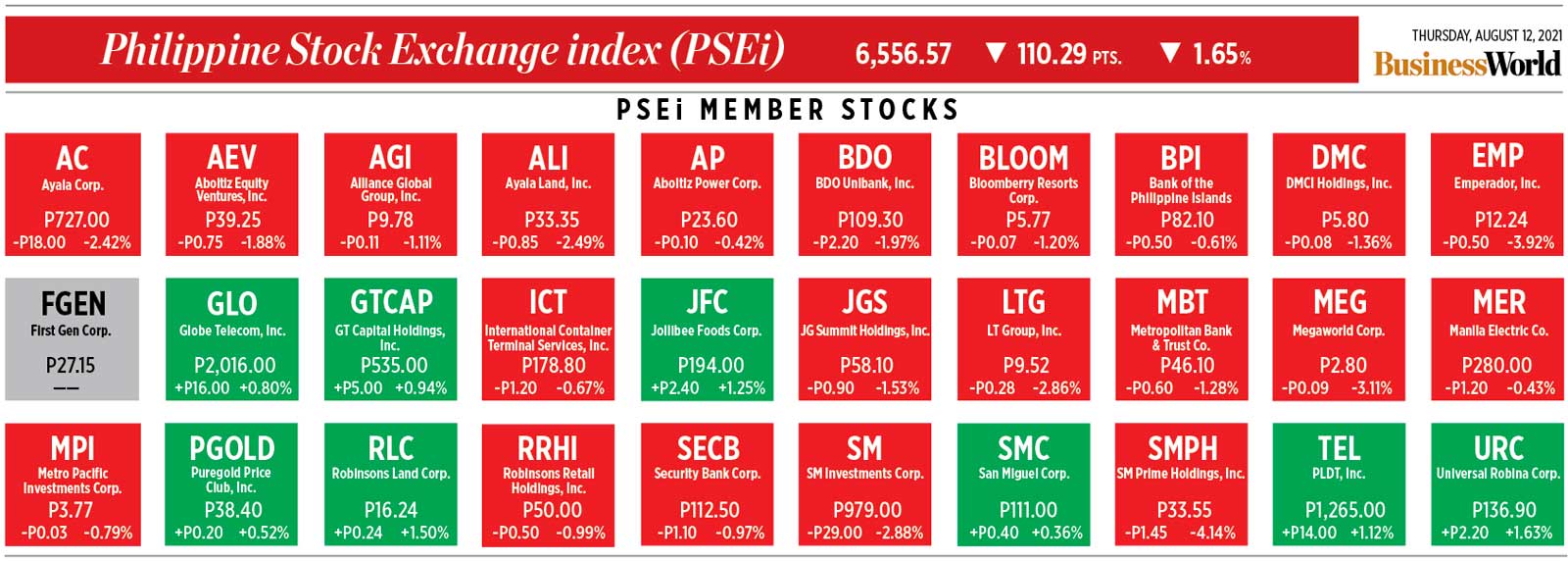
How PSEi member stocks performed — August 12, 2021

Here’s a quick glance at how PSEi stocks fared on Thursday, August 12, 2021.


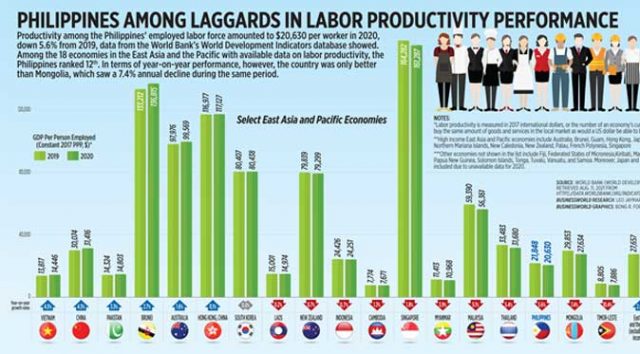
Philippines among laggards in labor productivity performance

Productivity among the Philippines’ employed labor force amounted to $20,630 per worker in 2020, down 5.6% from 2019, data from the World Bank’s World Development Indicators database showed. Among the 18 economies in the East Asia and the Pacific with available data on labor productivity, the Philippines ranked 12th. In terms of year-on-year performance, however, the country was only better than Mongolia, which saw a 7.4% annual decline during the same period.

Philippines among laggards in labor productivity performance

PSE index sinks on lockdown fears, rebalancing

REUTERS

PHILIPPINE shares sank on Thursday as the country’s coronavirus disease 2019 (COVID-19) situation affected sentiment and as investors adjusted their portfolios to prepare for the index’s rebalancing.

The Philippine Stock Exchange index (PSEi) shed 110.29 points or 1.65% to close at 6,556.57 on Thursday, while the broader all shares index went down by 51.68 points or 1.25% to end at 4,059.93.

“The local bourse plunged this Thursday… as COVID-19 cases in the country continue to surge,” Philstocks Financial, Inc. Senior Research Analyst Japhet Louis O. Tantiangco said in a Viber message.

“The surge in cases raises the risk of extending the strict quarantine measures implemented in selected areas in the Philippines, and expanding it to other areas. Trading weakened,” he added.

On Wednesday, the country logged 12,021 new infections, bringing the total to 1,688,040, Health department data showed. Active cases stood at 81,399.

“Philippine shares fell after the latest announcement of the MSCI rebalancing results influences active funds to make the necessary adjustments before the close of August,” Regina Capital Development Corp. Head of Sales Luis A. Limlingan said in a separate Viber message.

“[Others] decided to keep in cash ahead of the PSEi rebalancing,” Mr. Limlingan said.

The Philippine Stock Exchange recently conducted its regular review of the 30-member index and sectoral indices. As a result, AC Energy Corp. and Converge Information and Communications Technology Solutions, Inc. will be joining the benchmark index, replacing DMCI Holdings, Inc. and Emperador, Inc.

These changes will take effect on Monday, Aug. 16.

Majority of sectoral indices closed lower except for mining and oil, which gained 141.93 points or 1.47% to end at 9,781.80.

Meanwhile, property dropped 98.90 points or 3.13% to 3,055.03; holding firms shaved off 142.90 points or 2.14% to 6,529.01; financials went down by 18.51 points or 1.28% to finish at 1,419.40; industrials declined by 52.95 points or 0.56% to close at 9,328.30; and services inched down by 2.75 points or 0.17% to 1,614.28.

Value turnover tripled to P18.23 billion with 4.16 billion shares switching hands on Thursday, from the P6.83 billion with 1.82 billion issues logged the previous day.

Decliners outnumbered advancers, 133 against 66, while 51 names closed unchanged.

Net foreign buying slowed to P50 million on Thursday from the P513.87 million logged on Wednesday.

“The bourse may have also hit a technical resistance area around the 6,680 area,” Timson Securities, Inc. Trader Darren Blaine T. Pangan said in a separate Viber message.

“Support may be placed at the 6,270 level,” he added. — Keren Concepcion G. Valmonte

Peso slips ahead of BSP meeting

THE PESO inched down against the greenback on Thursday ahead of the central bank’s policy review.

The local unit ended at P50.39 per dollar, shedding one centavo from Wednesday’s close of P50.38, based on Bankers Association of the Philippines data.

The local currency opened the session at P50.35 versus the dollar. Its weakest point was at P50.46, while its intraday best was at P50.34 against the greenback.

Dollars traded on Thursday fell to $723.3 million from $896.6 million on Wednesday.

Rizal Commercial Banking Corp. Chief Economist Michael L. Ricafort said the peso ended weaker versus the greenback during the final trading hour ahead of the central bank’s rate-setting meeting later in the day.

A trader likewise said the peso weakened as investors were cautious ahead of the Monetary Board’s meeting.

The Bangko Sentral ng Pilipinas (BSP) kept benchmark interest rates steady for the six straight meeting on Thursday to support the economy’s recovery. The rate on the BSP’s overnight reverse repurchase facility was kept at 2%. The yields on the overnight deposit and lending facilities were also unchanged at 1.5% and 2.5%, respectively.

“Peso weaker after the latest decline in the local stock market, more dovish signals from most [US Federal Reserve] officials recently on possible tapering of Fed bond purchases as early as later this year after stronger US jobs data,” Mr. Ricafort added.

The Philippine Stock Exchange index fell by 110.29 points or 1.65% to close at 6,556.57 on Thursday, while the all shares index went down by 51.68 points or 1.25% to close at 4,059.93.

“The local currency might weaken [on Friday] after the central bank revised up its inflation projections citing various upward price pressures,” the trader added.

The trader expects the peso to move between P50.30 and P50.50 per dollar on Friday, while Mr. Ricafort gave a narrower forecast range of P50.35-50.45 against the greenback. — BML

More FDI seen needed to plug current account deficit by 2022

PHILIPPINE STAR/ MICHAEL VARCAS

THE CURRENT account deficit is likely to widen starting in 2022, pressing home the need for reforms to attract more foreign direct investment (FDI) rather than more transitory forms of inflows, Fitch Solutions Country Risk and Industry Research said.

“Policymakers will have to manage the economy’s external financing needs over the long term, with a need for foreign direct investment (FDI) over ‘hot money’ inflows for economic stability,” it said in a note Thursday.

Hot money or foreign portfolio investment tends to enter and leave an economy with fewer constraints, unlike FDI, which results in the establishment of fixed assets, which are not easily abandoned.

Fitch Solutions said it expects the current account to remain in surplus this year equivalent to 1.3% of gross domestic product (GDP), much less than the 3.6% surplus last year. The thinning of the surplus this year will be due to the moderate recovery in import demand.

The central bank expects the current to post a $10-billion surplus this year, equivalent to 2.5% of GDP.

The current account was in surplus by $12.979 billion in 2020, a turnaround from the $3.047-billion deficit in 2019.

Last year’s surplus was the highest since at least 2005 mainly due to the import slump as restrictions hampered the movement of goods during the pandemic.

“However, as the economy gradually climbs back to pre-pandemic output levels in 2022, we anticipate the current account to slip back into deficit,” Fitch Solutions said.

“Over the coming years we forecast this deficit to widen as demand for goods imports rebound, driven in particular for a rising need for commodity imports as the country’s infrastructure needs to grow,” it added.

For 2021, the government is targeting infrastructure spending of P1.02 trillion. It expects spending on the sector of P1.29 trillion and P1.28 trillion in the next two years, respectively.

Remittance flows and exports could be offsetting factors. Fitch Solutions noted that how much exports will mitigate any deficits will depend on how industry is spurred by expected improvements in infrastructure and the effectiveness of reforms.

The report noted that remittances are expected to be buoyed by heightened demand for healthcare workers and caregivers for the elderly. It added that “high domestic unemployment rates” may also spur migration.

With the country likely to run a wider current account deficit due to imports for the infrastructure program, Fitch Solutions said the reliance on external financing will be greater. The report noted how the government is already pushing for reforms to relax foreign ownership restrictions and attract more FDI.

The amendments to the Public Service Act and the Foreign Investment Act are still pending in the Senate, while the Bicameral Conference Committee has not yet finalized the revised Retail Trade Liberalization Act. These bills are expected to drive foreign investment growth.

Meanwhile, Fitch Solutions noted the low level of foreign ownership in peso-denominated government bonds.

“Low foreign ownership of local-currency government bonds — at an estimated 2.9% as of end-2020, compared to 13.6% in Thailand and 9.7% in China — could increase over time, as the Philippines’ growth outperforms regional peers over the next decade,” it said.

Fitch Solutions on Wednesday reduced its GDP growth forecast for the Philippines this year to 4.2% from 5.3% previously. It said the emergence of more infectious coronavirus variants and muted consumption due to the Metro Manila lockdown could hinder the recovery. — Luz Wendy T. Noble