Home Blog Page 7647

Forget massive seawalls, coastal wetlands offer the best storm protection money can buy

WIRESTOCK-FREEPIK

Coastal communities around the world are facing increasing threats from tropical cyclones. Climate change is causing rising sea levels and bigger, more frequent storms.

Many coastal communities are pondering what to do. Should they build massive seawalls in a bid to protect existing infrastructure? Do they give up on their current coastal locations and retreat inland? Or is there another way?

In the US, the US Army Corps of Engineers has proposed building a 20-foot-high giant seawall to protect Miami, the third most populous metropolis on the US east coast. The $6-billion proposal is tentative and at least five years off, but sure to be among many proposals in the coming years to protect coastal communities from storms.

But seawalls are expensive to build, require constant maintenance and provide limited protection.

Consider China, which already has a huge number of seawalls built for storm protection. A 2019 study analyzed the impact of 127 storms on China between 1989 and 2016.

Coastal wetlands were far more cost effective in preventing storm damages. They also provided many other ecosystem services that seawalls do not.

Coastal wetlands reduce the damaging effects of tropical cyclones on coastal communities by absorbing storm energy in ways that neither solid land nor open water can.

The mechanisms involved include decreasing the area of open water (fetch) for wind to form waves, increasing drag on water motion and hence the amplitude of a storm surge, reducing direct wind effects on the water surface, and directly absorbing wave energy.

Wetland vegetation contributes by decreasing surges and waves and maintaining shallow water depths that have the same effect. Wetlands also reduce flood damage by absorbing flood waters caused by rain and moderating their effects on built-up areas.

In 2008, colleagues and I estimated that coastal wetlands in the US provided storm protection services worth $23 billion a year.

Our new study estimates the global value of coastal wetlands to storm protection services is $450 billion a year (calculated at 2015 value) with 4,600 lives saved annually.

To make this calculation, we used the records of more than 1,000 tropical cyclones since 1902 that caused property damage and/or human casualties in 71 countries. Our study took advantage of improved storm tracking, better global land-use mapping and damage-assessment databases, along with improved computational capabilities to model the relationships between coastal wetlands and avoided damage and deaths from tropical cyclones.

The 40 million hectares of coastal wetlands in storm-prone areas provided an average of $11,000 per hectare a year in avoided storm damage.

The degree to which coastal wetlands provide storm protection varies between countries (and within countries). Key factors are storm probability, amount of built infrastructure in storm-prone areas, if wetlands are in storm-prone areas, and coastal conditions.

The top five countries in terms of annual avoided damage (all in 2015 US dollar values) are the United States ($200 billion), China ($157 billion), the Philippines ($47 billion), Japan ($24 billion), and Mexico ($15 billion).

In terms of lives saved annually, the top five are: China (1,309), the Philippines (976); the United States (469), India (414), and Bangladesh (360).

Coastal wetlands also provide other valuable ecosystem services. They provide nursery habitat for many commercially important marine species, recreational opportunities, carbon sequestration, management of sediment and nutrient run-off, and many other valuable services.

In 2014, my colleagues and I estimated the value of other ecosystem services provided by wetlands (over and above storm protection) at about $135,000 a hectare a year.

But land-use changes, including the loss of coastal wetlands, has been eroding both services. Since 1900 the world has lost up to 70% of its wetlands (Davidson, 2014).

Preserving and restoring coastal wetlands is a very cost-effective strategy for society, and can significantly increase well-being for humans and the rest of nature.

With the frequency and intensity of tropical cyclones and other extreme weather events projected to further increase, the value of coastal wetlands will increase in the future. This justifies investing much more in their conservation and restoration.


Robert Costanza is a Professor and VC’s Chair, Crawford School of Public Policy, Australian National University.
Evacuations resume as Biden defends Afghanistan pullout

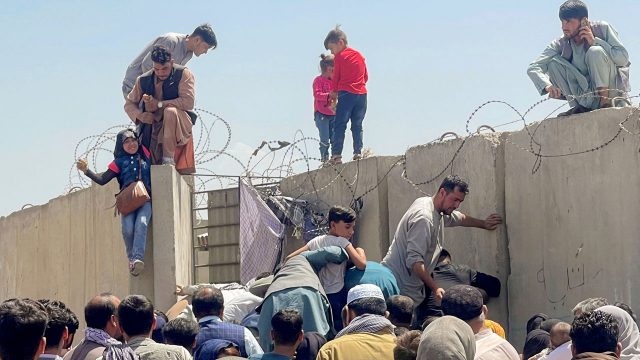
A MAN pulls a girl to get inside Hamid Karzai International Airport in Kabul, Afghanistan, Aug. 16. — REUTERS

MILITARY FLIGHTS evacuating diplomats and civilians from Afghanistan restarted early on Tuesday after the runway at Kabul airport was cleared of thousands of people desperate to flee after the Taliban seized the capital.

The number of civilians at the airport had thinned out, a Western security official at the facility told Reuters, a day after chaotic scenes in which US police fired gunshots to disperse crowds and people clung to a US military transport plane as it taxied for take-off.

“Many people who were here yesterday have gone home,” the official said. Reuters witnesses, however, could still hear occasional shots coming from the direction of the airport, while streets elsewhere in Kabul appeared calm.

US forces took charge of the airport, the only remaining exit point from Afghanistan as the Taliban held control of all ground routes following their dramatic advances across the country during the past week, which climaxed on Sunday when the insurgents streamed triumphantly into Kabul, capturing the capital without a fight.

Flights were suspended for much of Monday, when at least five people were reportedly killed, although it was unclear whether they had been shot or crushed in a stampede. A US official told Reuters two gunmen who had appeared to have fired into the crowd were killed by US troops.

Against the scenes of panic and confusion in Kabul, US President Joseph R. Biden defended his country’s decision to withdraw US forces after 20 years of war — the nation’s longest — that he described as costing more than $1 trillion.

But the video on Monday of hundreds of desperate Afghans trying to clamber onto a US military plane as it was about to take-off could haunt the United States, just as a photograph in 1975 of people scrambling to get on a helicopter on the roof of the US embassy in Saigon became emblematic of the humiliating withdrawal from Vietnam.

The speed at which Afghan cities fell, in days rather than the months predicted by US intelligence, and fear of a Taliban crackdown on freedom of speech and human rights, especially women’s rights, have sparked criticism.

Mr. Biden insisted he had to decide between asking US forces to fight endlessly in what he called Afghanistan’s civil war or follow through on an agreement to depart negotiated by Republican former President Donald Trump.

“I stand squarely behind my decision,” Mr. Biden said. “After 20 years I’ve learned the hard way that there was never a good time to withdraw US forces. That’s why we’re still there.”

Facing a barrage of criticism, from even his own diplomats, he blamed the Taliban’s takeover on Afghan political leaders who fled the country and the Afghan army’s unwillingness to fight.

Chinese Foreign Minister Wang Yi told US Secretary of State Antony Blinken that the hasty pullout of US troops had a “serious negative impact, “China’s state broadcaster CCTV reported, adding that Mr. Wang pledged to work with Washington to promote stability.

Mr. Blinken also spoke on Monday with counterparts in Pakistan, Russia, Britain, the European Union, Turkey and NATO about ensuring regional stability, the State Department said.

NEW REGIME
Afghan President Ashraf Ghani fled the country on Sunday as the Islamist militants entered Kabul, saying he wanted to avoid bloodshed.

The capitulation of the government forces, trained for years and equipped by the United States and others, was a major factor behind the Taliban’s victory.

The U.N. Security Council called for talks to create a new government in Afghanistan after Secretary General Antonio Guterres warned of “chilling” curbs on human rights and violations against women and girls.

Nobel Peace Prize winner Malala Yousafzai said she was “deeply concerned” about the situation, and called for world leaders to take urgent action. She urged Pakistani Prime Minister Imran Khan to open his country to refugees.

Former Afghan Prime Minister Gulbuddin Hekmatyar said he was headed to Doha to meet with a Taliban delegation on Tuesday, accompanied by former President Hamid Karzai and the head of the High Council for National Reconciliation, Al Jazeera TV reported.

Envoys from the United States, China and other nations had been meeting with Afghan government negotiators and Taliban representatives in Qatar for peace talks in the days leading up to the Taliban’s capture of Kabul.

Many Afghans fear the Taliban will return to past harsh practices. During their 1996-2001 rule, women could not work and punishments such as public stoning, whipping and hanging were administered.

Taliban spokesman Suhail Shaheen told Dunya News that the group would improve the security of Kabul and “respect the rights of women and minorities as per Afghan norms and Islamic values.”

Mr. Shaheen added the new regime would ensure representation of all ethnicities and that the Taliban were keen to work with the international community to reconstruct the country. Mr. Shaheen said on Twitter that the group’s fighters were under strict orders not to harm anyone.

“Life, property and honor of no one shall be harmed but must be protected by the mujahideen,” he said. — Reuters

US plans COVID-19 booster shots in September

REUTERS

THE BIDEN administration plans to begin administering coronavirus disease 2019 (COVID-19) booster shots to Americans as early as mid or late September, pending authorization from the US Food and Drug Administration, a source familiar with the discussions told Reuters late on Monday.

Health officials in US President Joseph R. Biden’s administration gathered round the view that most people should get a booster shot eight months after they completed their initial vaccination, the source said.

According to the New York Times, which earlier reported the development, officials are planning to announce the administration’s decision as early as this week, with the first boosters likely to go to nursing home residents and health care workers, followed by other older people.

Last week, US regulators authorized a third dose of COVID-19 vaccines by Pfizer, Inc. and its German partner BioNTech SE and Moderna, Inc. for people with compromised immune systems who are likely to have weaker protection from the two-dose regimens.

The administration’s goal is to let those who received the Pfizer-BioNTech or Moderna vaccines know that they will need additional protection against the Delta variant of the coronavirus, NYT said.

The newspaper added that officials also expect recipients of the vaccine from Johnson & Johnson, which was authorized as a one-dose regimen, will also require an additional dose. — Reuters

Singapore may test business travel from some nations next month

A VIEW of the city skyline in Singapore, Dec. 31, 2020 — REUTERS

SINGAPORE plans to set up pilot programs next month to allow vaccinated business travelers from some countries to enter on carefully controlled itineraries as it takes steps to reopen its borders.

Singapore is in talks with Germany, Australia, Canada and South Korea to be the first batch of countries for such arrangements, though it is also looking at the possibility of leisure travel, trade minister Gan Kim Yong told Bloomberg News in an interview Tuesday. He said factors like infections, vaccination rates and the ability to control outbreaks will be considered in these discussions.

“In the pilot, we are likely to focus more on business travel, but beyond business travel, we are also looking at the possibility of leisure travel, particularly to those safer countries, those with a lower infection rate,” he said. “We will need to pilot-run some of this with an organized itinerary, probably with organized tour groups, to be able to find ways to bubble-wrap them for the journey and with specific designated places that they can visit.”

Singapore, with a vaccination rate that is among the world’s best according to Bloomberg’s Vaccine Tracker, is aiming to reopen to the world and emerge from the pandemic relatively unscathed by high hospitalizations and death tolls. At the current 76% full inoculation, the country is on track to be ahead of its schedule to reach 80% by early September, a milestone where officials have pledged to ease more measures, particularly on border reopening.

Still, such relaxation will be done in a careful manner and local rules on gathering sizes could still be intact for a while as more people enter the country, Mr. Gan said. “The two are interlinked,” Mr. Gan said. “If we continue to keep our borders closed and just among ourselves, I think we will be quite ready to open up domestically, but because we are going to open up the border, which is a major effort, and potentially a higher-risk measure, therefore we will need to ensure that domestically within the community we continue to have reasonable basic safe management measures in place.”

EASING OF LOCAL MEASURES
Singapore earlier this month approved some easing of virus-related restrictions for vaccinated persons, including dining at restaurants in groups of five for those fully inoculated. The government is also set to announce a loosening of work-from-home rules this week.

Mr. Gan said further easing of these rules in the community will hinge on authorities managing the reopening of borders well, without any “explosion” of infections. This refers to how transmissible the virus is, rather than the absolute number of cases, he said. Already, the country is loosening controls to allow vaccinated foreign workers to enter the country, as well as plans to bring in much-needed laborers in the construction sector.

“We may be the first country who has a high vaccination rate, and yet taking a step-by-step approach to reopening,” Mr. Gan said. “We are seeing whether this approach in fact is a better approach to allow a safe opening, yet at the same time allow more activities to happen.” He added such an approach may ultimately prevent a reversion to lockdown measures, which have frustrated businesses and residents.

Singapore’s easing of restrictions comes at a turbulent time for a region battling the Delta variant. For instance, Hong Kong will now no longer recognize anti-body test results as a basis to cut quarantine period for arrivals. Also a raft of disappointing Chinese economic data Monday — on top of another port closure there last week following a positive virus test — added to signs that Asian trade powerhouses could be losing one of their economic lifelines.

Singapore last week upgraded its 2021 GDP forecast to 6%-7%, predicated on a stable global recovery and further easing of border and domestic restrictions through year-end. Mr. Gan said he is confident Singapore would achieve these projections. — Bloomberg

Filipino Paralympians raring to compete at Tokyo Games

THE six Filipino Paralympians set to compete at the Paralympic Games in Tokyo are all raring to showcase what they are capable of, Team Philippines Chef de Mission Francis Carlos B. Diaz said. — PHILIPPINE SPORTS COMMISSION

By Michael Angelo S. Murillo, Senior Reporter

AFTER the able-bodied Olympians, it is now the para-athletes’ turn to represent the country on the international stage.

Six Filipino Paralympians are set to compete at the Paralympic Games in Tokyo from Aug. 24 to Sept. 5, and all are raring to showcase what they are capable of, Team Philippines Chef de Mission Francis Carlos B. Diaz said.

“All of them are committed to maximizing the opportunity given to them. This is an important event for the athletes. Each one of them knows the significance of their participation in the Paralympics much like our able-bodied Olympians,” said Mr. Diaz in a Zoom interview with BusinessWorld.

Team Philippines is bannered by two athletes for para-athletics (Jerrold Mangliwan/wheelchair racing and Jeanette Aceveda/discus throw), two for para-swimming (Ernie Gawilan and Gary Bejino), and one each for para-taekwondo (Allain Ganapin) and powerlifting (Achelle Guion).

Mr. Diaz, also the dean of the College of Human Kinetics at the University of the Philippines, said all the para-athletes are doing well in their respective training “bubbles” and keeping themselves safe and healthy before they leave for Tokyo on Aug. 22.

He also gave credit to the Philippine Sports Commission (PSC) for having their back since the start, providing what they needed as the athletes vied for spots in this year’s Paralympics.

“PSC has been magnificent in supporting the athletes. It has been providing provisions for their bubble training and making it possible for our athletes to compete in qualifying events,” Mr. Diaz said.

Recently, the PSC gave an additional P100,000 allowance for the para-athletes competing in Tokyo, hiking the total to P150,000 each.

Filipino para-athletes also stand to receive cash incentives if they win a medal, something Mr. Diaz said only serves as added motivation for them.

“Apart from representing the country there, the possibility of being able to change their lives if they win a medal is something at the back of their mind. Of course, they know it is output-based. They have to win first. But at least, it is there for them,” the sports official said.

Under Republic Act 10699, or the incentives act, a Paralympic gold medalist will receive P5 million from the government while a silver medalist will get P2.5 million. The bronze medalist will be rewarded with P1 million.

The Manuel V. Pangilinan (MVP) Sports Foundation, meanwhile, has pledged to give the same amount as incentives.

Mr. Diaz said that while the athletes are ready to compete, they recognize that it would not be easy since they are going up against fellow world-class para-athletes. But they remain determined to do well “for the country, their families and God.”

“I am a believer that they can win.”

The athletes and coaches are part of a 20-man contingent for Team Philippines, which also includes Mr. Diaz and other officials like Philippine Paralympic Committee President Michael I. Barredo and PSC Commissioner Arnold G. Agustin.

Mr. Mangliwan is designated to carry the country’s colors in the opening ceremony while Mr. Gawilan will have the same responsibility in the closing.

Dream over for Afghan athletes trapped in Kabul

LONDON — Zakia Khudadadi would have been the first woman to represent Afghanistan at a Paralympic Games when they start in Tokyo this month, but her dream has been shattered amid the country’s turmoil.

The Afghanistan Paralympic Committee’s London-based Chef de Mission Arian Sadiqi told Reuters on Monday that the country’s two athletes would not be able to attend the Games that will commence on Aug. 24.

“Unfortunately, due to the current upheaval going on in Afghanistan, the team could not leave Kabul in time,” he said.

US forces have taken over air traffic control at Kabul airport, where five died on Monday in chaotic scenes with reports of firing in the air and a stampede.

Taliban insurgents have overrun major cities and now control most of Afghanistan. The hardline Islamist movement was ousted in 2001, but has made sweeping military gains in recent months as foreign forces, led by the United States, withdrew.

Sadiqi said he had been due to fly to Japan on Monday while the team — Khudadadi and track athlete Hossain Rasouli — had been scheduled to arrive in Tokyo on Aug. 17. Taekwondo athlete Khudadadi was profiled on the Paralympic website www.paralympic.org last week talking about her hopes for the Games.

“I was thrilled after I received the news that I have got a wild card to compete at the Games,” said the 23-year-old from Herat.

“This is the first time that a female athlete will be representing Afghanistan at the Games and I’m so happy,” she had said then.

Sadiqi said the athletes had been trying to secure flights, but prices soared as the Taliban took over a string of cities.

Then it became impossible.

“They were really excited prior to the situation. They were training wherever they could, in the parks and back gardens,” he said.

Afghan athletes first competed at the 1996 Paralympic Games but have never won a medal.

Rohullah Nikpai became Afghanistan’s first Olympic medalist in any sport when he won bronze in taekwondo at the 2008 Beijing Games, repeating the feat at London 2012.

Sadiqi said the future for Afghan athletes looked bleak, if the past was anything to go by.

“There was a lot of progress, both in the Olympics and the Paralympics,” he said of recent decades. “At the national level, there was a lot of participants, a lot of athletes… but we can only predict from what happened in the past.”

“Previously during the Taliban era, people couldn’t compete, couldn’t participate, especially female athletes.

“For me, it’s heartbreaking,” he said. “This would have been the first female Afghan taekwondo player to take part. This was history in the making. She was excited to take part. She was very passionate to compete.”

“Zakia would have been a great role model for the rest of the females in the country.” — Reuters

Tearful Naomi Osaka briefly leaves press conference

NAOMI Osaka briefly left a press conference in Cincinnati on Monday after she appeared to get upset with a line of questioning about her relationship with the media, leading her agent to describe a reporter as a “bully.” — NAOMI OSAKA FB PAGE

NAOMI Osaka briefly left a press conference in Cincinnati on Monday after she appeared to get upset with a line of questioning about her relationship with the media, leading her agent to describe a reporter as a “bully.”

Osaka withdrew from the French Open earlier this year after being punished for refusing to do media conferences, saying her mental health was adversely impacted by certain lines of questioning.

On Monday, a reporter from a Cincinnati newspaper asked the 23-year-old: “You’re not crazy about dealing with us, especially in this format. Yet you have a lot of outside interests that are served by having a media platform. How do you balance the two?”

Osaka twice asked the reporter to clarify his question and turned down an offer from the moderator to “move on to the next question” before giving a full reply.

“Ever since I was younger, I have had a lot of media interest on me, and I think it’s because of my background as well,” said Osaka, who is of Japanese-Haitian heritage but grew up mainly in the United States.

“I can’t really help that there are some things that I tweet or some things that I say that kind of create a lot of news articles or things like that… but I would also say I’m not really sure how to balance the two. Like, I’m figuring it out at the same time as you are, I would say.”

When another reporter began to ask about her preparations for the summer hard-court season and her pledge to donate her prize money from this week’s Western & Southern Open to Haitian earthquake relief efforts, Osaka appeared to wipe away tears.

The moderator called for a pause to the proceedings and Osaka left the room for a few minutes but returned to complete the news conference.

Osaka’s French Open withdrawal not only led to her revealing that she has struggled to cope with depression for a number of years, but it also prompted her to pull out from Roland Garros and Wimbledon for the sake of her mental well-being.

After losing early at the Tokyo Games, where she was given the honor of lighting the Olympic flame at the opening ceremony, she said she struggled to cope with the huge pressure and expectation placed on her.

Osaka’s agent, Stuart Duguid, condemned the reporter’s line of questioning on Monday in a statement provided to Reuters.

“The bully at the Cincinnati Enquirer is the epitome of why player/media relations are so fraught right now,” said Duguid. “Everyone on that Zoom will agree that his tone was all wrong and his sole purpose was to intimidate. Really appalling behavior.

“And this insinuation that Naomi owes her off-court success to the media is a myth — don’t be so self-indulgent.”

The reporter did not immediately respond to a request for comment.

Osaka has used her platform to call attention to mental health issues and she said at the news conference she felt supported by her fellow athletes.

“The biggest eye-opener was going to the Olympics and having other athletes come up to me and say they were really glad that I did what I did,” she added.

“I’m proud of what I did and I think that it was something that needed to be done.” — Reuters

Falcons say they are first in league to reach 100% vaccination rate

ALL players on the Atlanta Falcons have received the coronavirus disease 2019 (COVID-19) vaccine, the team said on Monday, adding that it was the first National Football League (NFL) club to see all of its players inoculated.

The players’ vaccination status means they will not be subject to daily testing and will not have to wear masks around the team’s facilities.

The COVID-19 vaccines have been a source of contention for some in the league, as a handful of top players have bristled at publicly disclosing their status.

The NFL informed clubs last month that COVID-19 outbreaks among non-vaccinated players during the 2021 season could lead to forfeits and loss of pay if games cannot be rescheduled, after juggling multiple schedule changes last season to carry out its full slate of games.

Earlier this month, head coach Bruce Arians of the reigning Super Bowl champion Tampa Bay Buccaneers told reporters he expects the team to be close to 100% vaccinated for its season opener against the Dallas Cowboys on Sept. 9. — Reuters

US soccer great Lloyd calls time on storied career

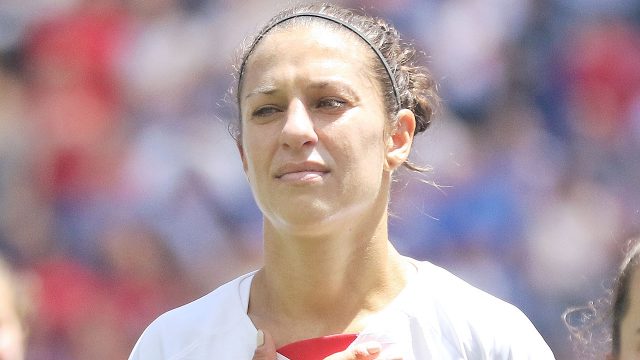
CARLI LLOYD — JAMIE SMED

CARLI Lloyd, one of the greatest women’s soccer players to ever grace the game, has announced her retirement, US Soccer said on Monday.

The 39-year-old Lloyd, who was twice named the International Federation of Association Football (FIFA) Women’s Player of the Year, became the second-most capped player in world soccer history (312) during a career that includes two Women’s World Cups and two Olympic gold medals.

“When I first started out with the national team in 2005, my two main goals were to be the most complete soccer player I could be and to help the team win championships,” said Lloyd.

“Every single day I stepped out onto the field, I played as if it was my last game. I never wanted to take anything for granted, especially knowing how hard it is to get to the top, but even harder to stay at the top for so long.”

US Soccer will soon announce four friendly matches for the women’s national team — two in September and two in October — which will serve as Lloyd’s final games in a US shirt.

Lloyd will also play the remainder of the National Women’s Soccer League 2021 season with NJ/NY Gotham FC before calling time on her professional club career, which has spanned 12 years and six teams. — Reuters

Taaramäe claims surprise win in stage three of Vuelta

ESTONIA’S Rein Taaramäe clinched a surprise victory in stage three of the Vuelta a Espana on Monday and took possession of the red jersey as the race entered the mountains for the first time with a 202km ride from Santo Domingo de Silos to Espinosa de los Monteros.

The 34-year-old veteran broke away from the eight-man leading pack and hit the front with 2 kms to go in a grueling summit finish, winning the second Vuelta stage of his career — a decade on from his first — in five hours, 16 minutes, 57 seconds.

American Joe Dombrowski finished 21 seconds behind in second with France’s Kenny Elissonde third at 36 seconds.

Defending champion Primož Roglič, who won the individual time trial on Saturday, finished a minute and 48 seconds back.

It was a disappointing day for some of the other favorites, with Olympic road race champion Richard Carapaz struggling and losing a minute, while Sepp Kuss suffered similar agony, being left behind with 3 kms to go and losing two minutes.

Taaramäe’s win gave him a 25-second advantage over Elissonde in the general classification, with overnight leader Roglič 30 seconds down in third.

The Vuelta will continue on Tuesday with a flat 163.6km course from El Burgo de Osma to Molina de Aragón. — Reuters

No one is untradable. No one is safe.

THE Clippers said goodbye to yet another part of its past when it agreed to swap nine-year veteran Patrick Beverley with the Grizzlies’ Eric Bledsoe. For all his susceptibility to injury, Beverley embodied and epitomized the scrappy culture of the red and blue. Acquired from the Rockets in 2017 as part of a contingent exchanged for future Hall of Famer Chris Paul, he quickly won a spot on the regular rotation in the face of his relentless mind-set. His was the kind of character beloved at home and despised on the road, thereby making him all but indispensable.

That the Clippers saw fit to deal Beverley speaks of his diminished standing in recent memory. In part, it’s due to his frequent — if forced — absences from the lineup; the very style of play that made him invaluable to the cause likewise wound up being his handicap. In larger measure, his departure is an offshoot of the franchise’s less-than-prudent spending; he was shipped along with supposed cog Rajon Rondo and trade add-on Daniel Oturu to enable it to save a whopping $30 million in luxury tax payments, not to mention use — should it so desire — of an $8.3-million traded player exception.

To be sure, the move became a no-brainer for the Clippers given Bledsoe’s defensive predilections. And he comes at a relative bargain, as well as providing flexibility next offseason; by then, he will be in the last year of a contract that, on paper, will pay him $19.3 million, but that guarantees him only $3.9 million. Meanwhile, Beverley, whose role he is slated to take over, is two years older at 33 and fresh off a campaign spent half the time on the sidelines.

If the arrangement takes on a “What have you done for me lately?” complexion, it’s because reality has long trumped sentiment. Three and a half years ago, the Clippers parted ways with supposed cornerstone Blake Griffin in order to claim a brighter future. Even as they have remained snakebitten since then, there can be no doubting the front office’s capacity to explore all opportunities. No one is untradable. No one is safe.

Beverley will be missed, but not for long. And the Clippers don’t figure to go deep in the playoffs even with the more reliable Bledsoe suiting up for them. That said, the turn of events was inevitable, especially in a year sans top dog Kawhi Leonard. The hardware comes off as impossible. The savings come off as prudent.


Anthony L. Cuaycong has been writing Courtside since BusinessWorld introduced a Sports section in 1994. He is a consultant on strategic planning, operations and Human Resources management, corporate communications, and business development.

‘Weird’ and ‘necessary’ — social media influencers on the BIR memo  

PIXABAY

Social media influencers said that the Bureau of Internal Revenue’s (BIR) memorandum reminding them to pay taxes comes at a suspicious time, days after the Commission on Audit (CoA) flagged “various deficiencies” in the Department of Health’s (DoH) funds worth P67.3 billion — but that the memo was also necessary. 

Isabela Maria D.P. Borres, an actor who has more than 400,000 followers in her monetized Instagram account, said that it was “weird” that the BIR released a clarificatory memo following the DoH’s budgeting issue: “It’s weird na ni-release yung ganyan after nag-release na yung DoH na may budget na ’di na-pu-put into use nang maayos.”  

“I’m sure that I’m paying taxes,” she said over the phone, adding that she has a personal accountant to handle her tax affairs and that it’s important to pay taxes regardless of where they go. “Kung ayaw makulong, kailangan magbayad ng tax.”  

Social media influencers can make P30,000 per post — or much more depending on their clout. 

Nicole Alba, a Generation-Z YouTuber with 287,000 subscribers, acknowledged that the BIR had reason to release the memo. 

“Unfortunately, I don’t think most influencers pay their taxes, so I thought the reminder was necessary on BIR’s end,” she said. “I personally am registered and pay my taxes on my social media earnings,” she added. 

The personal finance enthusiast told BusinessWorld that she pays her taxes through Taxumo, an online tax compliance tool. 

CLARIFICATIONS NEEDED

An expatriate vlogger with over 100,000 subscribers on YouTube, meanwhile, said it is interesting how the BIR declared that content created in the Philippines is now considered “Philippine-derived income.”  

“I’m speaking with my attorney now about the implications of this Memorandum on my tax liability,” he said.

While he welcomes the affirmation that vlogging and social media influencing is a legitimate occupation for resident aliens, he also wants a clarification on the correct process of being registered with the BIR and/or the Department of Trade and Industry (DTI). 

“Can a foreigner be the 100% owner of a sole proprietorship related to social media? Or should I register as a profession?” he asked in an email to BusinessWorld. “I want to comply with the laws of the country, but it is difficult when one government department says one thing, and another is not on the same page! I really hope that the BIR and DTI can clarify that.” 

In a statement released Aug. 19, the Creator and Influencer Council of the Philippines (CICP) similarly welcomed the Circular, as it gave a general overview of all the tax rules and regulations applicable to the organization’s members.

CICP, founded by digital veteran Donald Lim, is composed of more than a hundred influencers, including Erwann A. Heussaff, Carlo Ople, and JJ M. Disini, Jr.

“It is imperative among us, as citizens, to do our part by paying proper taxes. We view the Circular as an opportunity to exemplify the importance we give to paying taxes, and show others that we view it as a patriotic duty that any responsible citizen should fulfill,” the CICP said.

CICP added that it hopes the BIR introduces mechanisms to ease the burden of tax compliance for influencers, as well as everyone else who conducts their business digitally.

In addition to welcoming dialogue with BIR, the CICP also said it is creating a Code of Ethics “centered around content standards, fair dealing, transparency, social responsibility, and compliance with law.”

PROFESSIONAL CATEGORY

Social media influencers can earn on platforms such as TikTok, YouTube, and Instagram, where revenues are proportional to an influencer’s followers and views. To be accepted into YouTube’s Partner Program, influencers need at least 1,000 subscribers and 4,000 watch hours in the last 12 months. 

Influencer Marketing Hub’s YouTube calculator estimates that the average YouTuber generates $7.60 per 1,000 views with 45% of that revenue going to Google. 

If the earnings qualify to pay taxes, it is only right to start paying for them, said Lisa Marie M. Sicad, who runs the vlog Pinay Travelista. “Influencers fall under the professional category, like doctors, real estate brokers, etc.,” she told BusinessWorld in a Facebook message. 

She also pointed out the practical aspect of being registered with the BIR: “Most big brands work with those who can issue receipts din, mas madali [as it’s easier] for them to do the accounting. It’s a win-win-win for everyone if the influencer wants to earn more through brand deals.” 

 — Patricia B. Mirasol and Brontë H. Lacsamana

ADVERTISEMENT
ADVERTISEMENT