Home Blog Page 7599

Campaign aims to alleviate vaccine fears

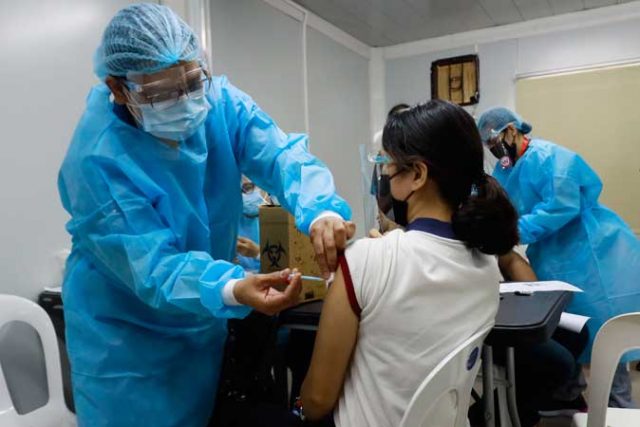
PHILIPPINE STAR/ MICHAEL VARCAS

A CAMPAIGN launched by the Philippine Alliance of Patient Organizations (PAPO) addresses vaccine hesitancy and coronavirus disease 2019 (COVID-19) misinformation among seniors and persons with co-morbidities.   

“Patients either refuse vaccination outright due to lack of trust in the vaccine or provider, or they’re lenient and don’t see the need to get vaccinated right away,” said Karen Alparce-Villanueva, treasurer of PAPO and campaign project head of “Bakuna, Now Na.”

A survey conducted by the Social Weather Stations (SWS) from April 28 to May 2 revealed that only 3 out of 10 Filipinos are willing to get vaccinated. The top reason cited by those not willing was fear over possible side effects.

In response, PAPO is producing a vaccination webinar series called “Kwentong Bakuna.” The upcoming episode, to be streamed on June 23, speaks to the concerns of patients with liver disease or hepatitis. “There’s a high rate of hesitancy from these groups with good reason they are sickly, so they have deeper fears,” said Ms. Alparce-Villanueva.

Seniors (priority group A2) and persons with co-morbidities (priority group A3) are also easy targets of misinformation. “Sometimes, we don’t vet the information that we see, or we see that since it comes from family and friends, it’s reliable,” said Ms. Alparce-Villanueva, “Often, false information is spread accidentally or out of genuine concern.”

PAPO is countering the spread of misinformation with a social media campaign that uses common language and non-intimidating visuals. As a coalition of 39 disease-specific patient organizations, PAPO also has the advantage of having as its members people who know the deep-seated fears that come with illness.

Reynaldo “Rey” Sarmenta of the Hemophilia Association of the Philippines for Love and Service (HAPLOS) shared his vaccination journey from the perspective of an individual who initially had reservations about getting vaccinated himself.

As a senior citizen in a house full of people with co-morbidities including himself with hypertension, his wife who was a stroke victim, and his child with hemophilia he realized getting COVID-19 would be disastrous for his high-risk family. “Mas malaki ang takot ko sa virus kaysa sa vaccine [I am more scared of the virus than the vaccine],” he said.

To expound on reservations that patients usually have regarding the vaccine, Ara Lonorio, President of the Neurofibromatosis Friends Philippines, added, “Marami kaming agam-agam sa epekto ng bakuna sa aming katawan kaya malaking tulong na nabibigyan kami ng mas malawak na kaalaman [We have a lot of worries about the effect of the vaccine on our bodies, so it’s a great help to have access to a lot of information].”

According to the US Centers for Diseases Control and Prevention (CDC), adults of any age with certain underlying medical conditions are at increased risk for severe illness from the virus that causes COVID-19. Thus, they recommend COVID-19 vaccines for such people.

A2 AND A3 STILL A PRIORITY
Dr. Nina G. Gloriani, head of the Department of Science and Technology’s (DoST) vaccine development panel, acknowledged during the launch that even though essential workers belonging to the A4 priority group are now being vaccinated, there are still many from the A2 and A3 groups who have to yet to get their shots.

She added that 5 million Filipinos have already gotten a first dose, and by the end of June, some 9 to 10 million additional doses will be available. As for concerns regarding the availability of second doses for patients who have already received a first dose, Dr. Beverly Lorraine C. Ho, head of DoH’s health promotion bureau, assured there are mechanisms put in place.

“Every morning, NCR [National Capital Region] representatives meet with the vaccine cluster operations team to check on each one’s available stocks,” she said, “We made sure that the succeeding doses that arrived will be reserved for whichever cities or populations needed them.”

Despite the reservations of many Filipinos, people like Ms. Lonorio of Neurofibromatosis Friends Philippines are looking forward to their appointment for a first dose. Mr. Sarmenta of HAPLOS, another person with co-morbidities, expressed that their refusal to get vaccinated would add to the transferability of the virus.

As of June 13, more than 5.9 million coronavirus vaccines have been administered, about 1.5 million of which were second shots. Brontë H. Lacsamana

SEC clears San Miguel’s P50-B bond offering

THE Securities and Exchange Commission (SEC) has given its nod on San Miguel Corp.’s (SMC) offering of up P50-billion fixed-rate bonds in one or more tranches over a three-year period.

For the first tranche, the firm plans to offer P20-billion worth of six-year fixed-rate bonds due 2027, with an oversubscription option of up to P10 billion.

SMC hopes to net P19.74 billion from the base offer, with an additional P9.88 billion if shares are oversubscribed.

“Proceeds will be used to re-dominate existing dollar-denominated obligations of SMC,” the regulator said.

SMC plans to offer the bonds at face value, and will list and trade them on the Philippine Dealing & Exchange Corp.

PETRON TO PLANT 50,000 SEEDLINGS
Separately, SMC said its subsidiary Petron Corp. is looking to plant at least 50,000 seedlings in the Sarangani Bay protected seascape over 10 years and regularly clean up the area in a bid to rehabilitate the site.

SMC said in an e-mailed statement that Petron’s proposed projects for the Sarangani Bay’s seascape include the rehabilitation of coral reefs, sustained shoreline clean-up activities along the bay, and the regular cleanup initiatives in Changco Creek.

The Sarangani Bay protected seascape, which is under the National Integrated Protected Areas System, is made up of Sarangani Bay and a portion of the municipal waters of Maitum, Kiamba, and Maasim.

SMC President Ramon S. Ang said the company remains committed in pursuing its environmental programs despite the limitations brought about by the pandemic.

Some of the listed firm’s other environmental programs are its P1-billion Tullahan River clean-up, and the P2-billion Pasig River rehabilitation project.

Last month, SMC’s unit San Miguel Global Power Holdings also made a commitment to plant 1.1 million trees across eight provinces this year.

“The longevity and success of these programs are a testament to their soundness and the importance of promoting environmental stewardship. This also emphasizes our culture of ‘malasakit’ (concern) as shown by the dedication of our employees to see these projects through,” Mr. Ang said.

SMC shares at the local bourse inched down by 0.25% or 30 centavos to finish at P117.70 apiece on Tuesday. Petron shares improved by 1.18% or four centavos to close at P3.43 apiece. — Angelica Y. Yang

Gov’t fully awards 10-year bonds as rate drops

BW FILE PHOTO
THE GOVERNMENT fully awarded its offer of reissued 10-year Treasury bonds on Tuesday as the rate of the tenor dropped. — BW FILE PHOTO

THE government fully awarded the reissued Treasury bonds (T-bonds) it offered on Tuesday at a lower rate as the financial system remains liquid and on expectations of supportive monetary policy here and abroad.

The Bureau of the Treasury (BTr) borrowed P35 billion as planned via the reissued 10-year T-bonds it offered on Tuesday as the offering was 2.4 times oversubscribed, with bids reaching P84.24 billion.

The debt papers, which have a remaining life of nine years and 24 days, fetched an average rate of 3.719%, down by 89.5 basis points (bps) from the 4.614% quoted when the bond series was last offered on March 23.

The rate fetched on Tuesday was also lower by 1.47 bps compared with the 3.866% quoted for the 10-year papers at the secondary market before the auction on Tuesday, based on PHL Bloomberg Valuation Reference Rates published on the Philippine Dealing System’s website.

The low rate and strong demand caused the Treasury to open its tap facility to raise another P10 billion from the reissued 10-year papers.

National Treasurer Rosalia V. de Leon said high liquidity in the market caused the 10-year bond’s rate to go down as players were looking to reinvest their extra cash following the recent maturity of P131 billion worth of retail Treasury bonds (RTB).

Meanwhile, a trader attributed the lower T-bond rate to market expectations that central banks here and abroad will keep borrowing costs low to support economic recovery.

“The market picked up where it left off following the strong bond auction last week. Investors continue to reach for yields amid a relatively low interest rate backdrop, with both the Fed (US Federal Reserve) and BSP (Bangko Sentral ng Pilipinas) seen to keep their monetary policy settings steady to support the economic rebound,” a trader said in a Viber message.

The US central bank’s Federal Open Market Committee is meeting on June 15-16 to review its policy stance and is expected to keep its rates at near zero as the world’s largest economy continues to recover.

Fed officials, led by Chair Jerome Powell, have stressed that rising inflationary pressures are transitory and ultra-easy monetary settings will stay in place for some time to come but recent economic data has raised concerns that price pressure could force an earlier stimulus withdrawal, Reuters reported.

Meanwhile, at home, BSP officials have said they would keep borrowing costs steady until the economy’s recovery becomes more solid. Benchmark interest rates have been at record lows since November.

The BSP Monetary Board will meet to review its own policy stance on June 24.

The BTr wants to raise P215 billion from the local debt market this month: P75 billion via weekly offers of Treasury bills and P140 billion from weekly auctions of T-bonds.

The government is looking to borrow P3 trillion from domestic and external sources this year to help fund a budget deficit seen to hit 9.4% of gross domestic product. — L.W.T. Noble with Reuters

Christie’s to sell teenager’s NFT art about gender transition

It Hurts To Hide, single-channel video (non-fungible token) — CHRISTIES.COM

LONDON — Christie’s is to auction artwork by 18-year-old trans artist FEWOCiOUS in the form of non-fungible tokens (NFTs) it said on Monday, as the world’s major auction houses ramp up their sales of NFTs. An NFT is a form of crypto asset, which records ownership of a digital object such as an image, video, or text. While anyone can view the item, only the buyer of an NFT has the official status of being the owner. FEWOCiOUS — real name Victor Langlois — has five lots going on sale with each one representing a year of his life as he discovered his gender identity between the ages of 14 and 18. They will be sold at Christie’s from June 23-30, in an online auction called “Hello, I’m Victor (FEWOCiOUS) and This Is My Life,” which coincides with Pride month. Each lot consists of a video artwork which exists in digital form only, sold as an NFT, a set of doodles, drawings, and journal entries from the corresponding year in both physical and NFT form, as well as a physical-only painting. FEWOCiOUS, who first started making art aged 13, said digital art was a refuge and escape from his conservative household where he had to hide his true self. His NFT sales to date have fetched more than $18 million, Christie’s said. He sold his first NFT in 2020 for just $1,000. NFT sales gave FEWOCiOUS the funds to move out of his childhood home in Las Vegas, he said. He now lives in Seattle. — Reuters

Yemen’s museums struggle to preserve its past

Museum staffers walk at the yard of the National Museum in Sanaa, Yemen, June 2. — REUTERS/KHALED ABDULLAH

SANAA — A bronze statue of the main god of the kingdom of Saba, located in what is now the Yemeni province of Marib, lies in a dark and fortified room of the Sanaa National Museum. The piece was made by a man named Hawtar Athat in the first half of the sixth century BC. It has been lucky enough to survive the latest war in Yemen. Many other artefacts have not. The Sanaa museum miraculously escaped years of bombing by Saudi Arabia and the United Arab Emirates in their war against the Houthi group. “Other areas around the museum were targeted and that led to the destruction of some artefacts and to cracks in the walls of the building itself,” said Ibrahim al-Hadi, the museum’s director. Most of the collection was moved to safe rooms in the museum when the Saudi-led coalition intervened in Yemen in 2015. Collections of Arabian swords, rifles and helmets, some decorated with gold, are packed in boxes and covered with sheets. Two bronze lions from the pagan kingdom of Qataban, restored at the Louvre in 2008, are snarling at the dark. “This storeroom is a model,” said Abdullah Ishaq, an expert working with the museum. “It has been set up with scientific, modern and international standards.” But Yemen’s museums, the richest in the Arabian peninsula, are a reminder of the toll that war has taken on the country’s cultural heritage, often eclipsed by civilian casualties and the dire humanitarian situation. In the disputed city of Taiz, nature has combined with conflict to leave the historic National Museum building in ruins. Charred manuscripts, burned shelves and shattered glass are scattered inside. Acacia trees have taken root and helped to tear down the walls. “Selling destroyed the buildings… the collection was looted and fires burned down storerooms,” said Ramzi al-Damini, the Taiz museum director. The Yemeni General Authority for Antiquities and Museums has started working with the World Monuments Fund to restore parts of the buildings. But the museum has already lost around 70% of its collection, even though some stolen artefacts have been recovered from local markets and volunteers have brought back other pieces. “We know that many of those articles have been smuggled outside Taiz and even abroad. It is not easy to get them out of Yemen, only powerful people with international connections can do that,” said Ahmed Jassar, director of antiquities in the Taiz museum. — Reuters

Sustaining immunization services during the pandemic

THE DEPARTMENT of Health (DoH) recently announced the end of the polio outbreak in the Philippines. Both the World Health Organization and UNICEF confirmed the virus has not been detected in a child or in the environment in the past 16 months. Polio is a highly infectious disease that mostly affects children under the age of five. If polio is eradicated in Afghanistan and Pakistan, it will only be the second disease ever to be completely eradicated after smallpox.

While this is good news, we should not let our guard down. The number of fully immunized Filipino children decreased to 62% in 2020 from 69% in 2019, according to Dr. Kim Patrick Tejano, program manager of the Department of Health’s National Immunization Program (NIP), who cited the coronavirus disease 2019 (COVID-19) pandemic as the reason for this dip.

“Many parents did not go out to have their children vaccinated because they were afraid of getting COVID-19. Also, many health workers on the ground were re-deployed to care for COVID-19 patients and to serve as contact tracers and [COVID-19 test] swabbers,” said Dr. Tejano during the Health Connect webinar in time for the observance of World Immunization Week 2021 in April.

To address outbreaks, the DoH in partnership with local government units (LGUs) conducted the “Chikiting Ligtas” campaign, a nationwide measles, rubella and polio supplemental immunization activity. Phase 1 was conducted from October to Nov. 2020 in the Mindanao Regions, Cordillera Administrative Region (CAR), Ilocos Region, Cagayan Valley Region, Mimaropa (Mindoro, Marinduque, Romblon and Palawan) Region, and Bicol Region. Phase 2 began in Feb. 2021 in the Visayas Regions, National Capital Region, Central Luzon, and Calabarzon (Cavite, Laguna, Batangas, Rizal, and Quezon).

According to Dr. Tejano, the “Chikiting Ligtas” campaign achieved 90% immunization coverage for measles and rubella, covering about 8.5 million children age 9–59 months. For oral polio vaccine, 87% immunization coverage was achieved, corresponding to around 6 million children age 0–59 months.

“As the pandemic continues to challenge access to essential healthcare services, the need to provide people with life-saving vaccines becomes more critical. As our way forward, we want to focus on routine catch-up immunization, especially of children who missed their doses due to the COVID-19 pandemic and other reasons such as vaccine hesitancy and accessibility issues,” said Dr. Tejano.

The NIP will issue guidelines to help health workers in reaching the target population of the routine catch-up immunization. It will also implement outbreak response immunization to equip health workers with the knowledge and resources necessary for timely and adequate actions to outbreaks of polio, measles and other vaccine-preventable diseases. Dr. Tejano assured the general public that safety protocols are in place in immunization sites to minimize the risk of COVID-19 transmission.

The DOH underscored the importance of engaging all stakeholders to advocate immunization, especially among children.

In June 2020, the World Health Organization (WHO) and other global health authorities warned that the COVID-19 pandemic was disrupting life-saving immunization services around the world, putting millions of children in both poor and rich countries at risk of vaccine-preventable diseases like diphtheria, measles, and polio.

In 2020, approximately 125 mass vaccination campaigns in lower-middle income countries against polio, measles, meningitis A, yellow fever, typhoid, cholera, and tetanus were postponed, according to the US Centers for Disease Control and Prevention (CDC).

Other pandemic-related factors that disrupted immunization services in many countries include lack of personal protective equipment (PPE) to conduct immunization activities, healthcare workers’ fear of contracting COVID-19, and lack of vaccines due to closure of country borders, according to the CDC.

We appreciate all our health workers who work tirelessly in vaccinating adults and children which is crucial in controlling the COVID-19 pandemic and preventing outbreaks of vaccine-preventable diseases. We also commend local government units that ensure the effective implementation of the NIP in their areas of jurisdiction.

We reiterate that vaccination saves lives. Efforts must be sustained and strengthened so that all of us, including our children, would be protected from debilitating and potentially fatal vaccine-preventable diseases.


Teodoro B. Padilla is the executive director of the Pharmaceutical and Healthcare Association of the Philippines (PHAP). PHAP represents the biopharmaceutical medicines and vaccines industry in the country. Its Members are in the forefront of research and development efforts for COVID-19 and other diseases that affect Filipinos.   

Filinvest group spends P100M for pandemic aid

THE Filinvest group has helped put up a data dashboard as aid in tracking the extent of the health crisis in the country, showing the importance of private-public partnerships in trying times.

“Filinvest and the Gotianun Foundation set aside a P100-million war chest for this effort,” Filinvest Land, Inc. President and Chief Executive Officer Josephine Gotianun-Yap said in a virtual forum hosted by the Economic Journalists Association of the Philippines on Tuesday.

The group’s information technology team has also created a repository system to record laboratory data, Ms. Gotianun-Yap said.

The conglomerate stressed that there is a need for constant learning and agility during a crisis, such as being open to reinvention and adopting prudential measures.

“Our business plans have taken a shorter and more agile approach in anticipation of possible curve falls,” Ms. Gotianun-Yap said. “While we have been more selective in new property launches, we have accelerated the new facet of our business on environmentally sustainable investments.”

Meanwhile, Filinvest said it is looking forward to the listing of its real estate investment trust (REIT), Filinvest REIT Corp. The company said it will “unlock the value” of its office leasing business.

The company’s REIT portfolio includes 16 office towers in Metro Manila and one in Cebu. Ms. Gotianun-Yap said the unit is looking to infuse more properties into the portfolio once it reaches the criteria under REIT guidelines.

Shares of Filinvest Development Corp. went down by 0.74% or six centavos to close at P8.08 each, while Filinvest Land improved by one centavo to P1.11 apiece. — Keren Concepcion G. Valmonte

WorldRemit partners with LBC to expand locations in country

INTERNATIONAL payments company WorldRemit has partnered with Philippine-based logistics and remittance services provider LBC Express for the expansion of its remittance locations in the country, it said on Tuesday.

“The partnership will allow recipients of money transfers from WorldRemit to enjoy a seamless remittance experience at more than 1,500 LBC branches across the Philippines,” WorldRemit said in an e-mailed statement.

WorldRemit currently has 29,000 cash pickup locations in the Philippines.

Its services include transfer to all major bank accounts, payments to mobile wallets, and airtime top-ups on local mobile networks.

“With an extensive network of physical locations in the Philippines, our partnership with LBC will expand access to cross-border remittance services for Filipino WorldRemit customers, further ensuring a seamless digital money transfer experience,” WorldRemit Country Director Earl Melivo said.

WorldRemit sends money to up to 130 countries and operates in more than 5,000 money transfer corridors globally. The company’s main office is in London and it has regional offices in the United States, Canada, Australia, Hong Kong, Singapore, Malaysia, the Philippines, South Africa, Somaliland, Uganda,Kenya, Rwanda, Tanzania, Zimbabwe, and Belgium. — A.L. Balinbin

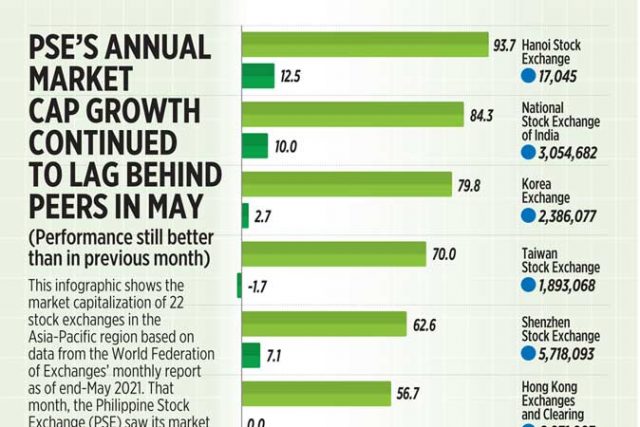
PSE’s annual market cap growth continued to lag behind peers in May

PSE’s annual market cap growth continued to lag behind peers in May

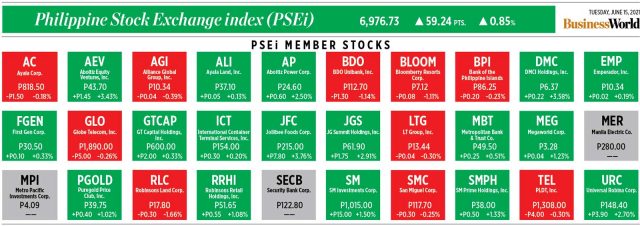
How PSEi member stocks performed — June 15, 2021

Here’s a quick glance at how PSEi stocks fared on Tuesday, June 15, 2021.


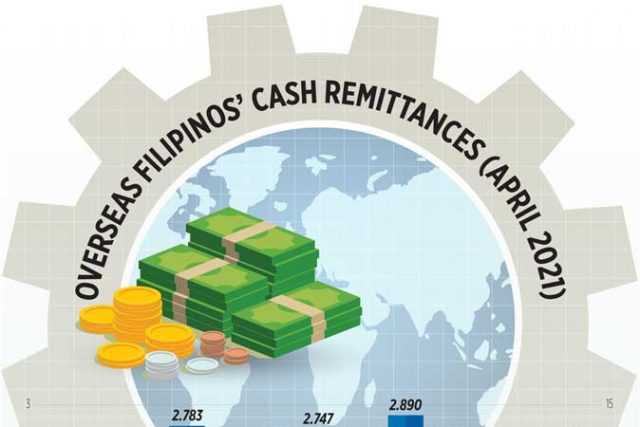
Overseas Filipinos’ Cash Remittances (Apr. 2021)

MONEY SENT HOME by migrant Filipino workers jumped by 12.7% in April, the fastest since November 2016 and reflecting the global economic recovery amid a coronavirus pandemic, according to the Philippine central bank. Read the full story.

Overseas Filipinos’ Cash Remittances (Apr. 2021)

Arts & Culture (06/16/21)

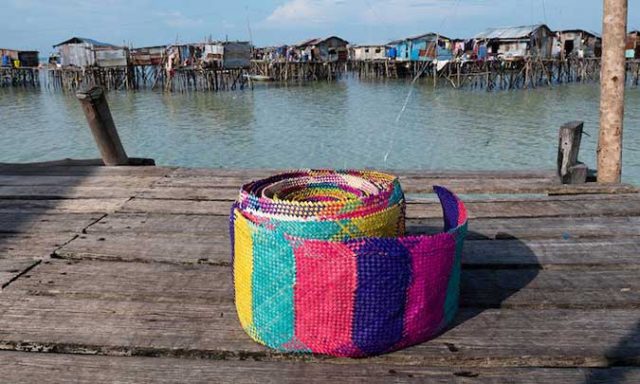
YEE I-Lann, with weaving by Kak Roziah, Kak Sanah, Kak Kinnuhong, Kak Koddil, Tikar Reben, 2020, Bajau Sama DiLaut Pandanus weave with commercial chemical dye.

Silverlens participates in Art Basel’s Online Viewing Room

SILVERLENS is participating in Art Basel’s first curator-led “Online Viewing Room: Portals.” Leading this edition are curators Christina Li, Magali Arriola, and Larry Osseih-Mensah. Opening from June 16 through 19, “OVR: Portals” will spotlight artistic practices that tackle the parameters that have shaped our contemporary condition, both through current and historical lenses. For this occasion, the gallery will be presenting selected works by YEE I-Lann, from her exhibition, “Borneo Heart.” This interdisciplinary show took place in the Sabahan artist’s home region, and was only very recently concluded. The exhibit will be on view at the Silverlen’s website from June 16-19.

Online discussion on the state and future of theater

SEVERAL La Salle theater guilds, their professors, mentors and students will discuss the current state of theater and its possible future in an online discussion entitled “Playing the Pandemic.” The forum will delve into the trials and triumphs of online theater and its nature despite the lack of traditional elements such as live performances with live audiences. It will also touch on the impact of coronavirus disease 2019 (COVID-19) as a driving force for the possible redefinition of the art form. It emphasizes the role and contribution of the arts in alleviating the emotional crises brought upon by the pandemic.  Hosted by the Arts and Culture Cluster of De La Salle-College of Saint Benilde, the event is curated and moderated by instructor, consultant and former Associate Dean for Benilde Arts and Culture Cluster Dr. Sunita Mukhi, the Artistic Director of DeviDiva Productions. “Playing the Pandemic” will be held on June 17, 3-5 p.m. It is free and open to the public and will be held via Zoom with a livestream on the official Facebook page of Benilde Arts and Culture Cluster (https://www.facebook.com/benildearts). Interested participants may register at https://forms.gle/Eap9y4D6EYucUtmB8.

Ayala Museum holds virtual field trip for kids

COMMEMORATE Jose Rizal’s birthday on June 19 with Ayala Museum’s RIZAL@160 Virtual Field Trip via Zoom for children ages nine to 12 years old. Join Ayala Museum and celebrate Jose Rizal’s 160th birth anniversary by going on an adventure around the world. Follow his footsteps and visit places from his childhood and the countries he travelled. Finally, learn about his life and legacy that we celebrate to this day. Part 1: Rizal’s Childhood and Early Education (June 19, 10 to 11:30 a.m.) and Part 2: Rizal’s Travels and Legacy (June 19, 4 to 5:30 p.m.). Tickets are priced at P1,300 for a Season Pass (for two tours); P750 for regular, and P600 for AGC employees, Ayala Museum members and ARC cardholders). To register, visit bit.ly/Rizal160VirtualFieldTrips.  For more information and instructions, visit www.ayalamuseum.org/events or e-mail education@ayalamuseum.org

Instituto Cervantes pays tribute to filmmaker Berlanga

TO CELEBRATE the birth centenary of Spanish filmmaker Luis García Berlanga (1921-2010) this June, Instituto Cervantes is presenting the online film series Berlanga Turns 100. The films are shown through the Instituto Cervantes channel on the Vimeo platform (vimeo.com/institutocervantes) and are freely accessible for 48 hours from their start date and time. The film cycle continues on June 19 and 20 with the third movie, the comedy Plácido (1961), a sarcastic Christmas story about a motorbike driver hired in a sordid advertising promotion campaign called “Let a Poor Man Sit at Your Table.” The movie will be accessible through this link: https://vimeo.com/548754638.

Ortigas Foundation releases new edition of church architecture book

IN RECOGNITION of historian Benito J. Legarda, Jr.’s major contribution to the history of Hispanic Church architecture in the Philippines, the Ortigas Foundation has published a memorial edition of his essay on early churches Hispanic Philippine Churches: An Architectural Study. The book includes photographs by Betty Lalana and Lino Arboleda. To order, e-mail ortigasfoundation@ortigas.cm.ph. For more information, visit https://www.facebook.com/Ortigas.Foundation.

Dance training webinar to discuss benefits, importance

ARTISTIC director, choreographer and coach Mycs Villoso will discuss the impact of dance training and its positive benefits beyond being a performance art in a free public webinar. Ms. Villoso will elaborate on scientific and academic theories, backed up by real-life testimonies of coaches, trainees and students, which assists trainers to effectively mentor dance majors. Interviews will likewise showcase the values earned from this discipline, such as mindfulness, initiative and culture-sensitivity. Director of the 2016 and 2017 Hip-Hop Dance Convention and co-producer of the 2019 and 2020 Street Styles Summit, she is instructor at the De La Salle-College of Saint Benilde (DLS-CSB) Dance Program. Hosted by the Arts and Culture Cluster of DLS-CSB, the webinar will be moderated by Nina Anonas, professor and Chairperson of the Benilde Dance Program. The webinar will be conducted via Zoom on June 19, 3 p.m. Interested participants may register through https://bit.ly/3poBvOf.

Showcase of experimental short films

TEN students from Mapúa University’s Digital Film and Multimedia Arts programs have collaborated with 10 creators from the Ontario College of Art & Design University (OCAD U) for the Narratives Through Global Space 2021, a showcase of experimental films to be held on June 21 to 25 through OCAD U’s screening events at www.ocadu.ca/live. Twenty emerging artists from nine countries — the Philippines, Canada, Portugal, Mexico, Iran, India, Hong Kong, China, and South Korea — produced materials that give a refreshing take on art due to their diverse and varying cultures and perspectives. It brings together filmmakers, visual artists, digital artists, animators, photographers, writers, and musicians with different experiences to respond to issues of gender, sexuality, religion, language, and identity, among others. The screening events by OCAD U will include a behind-the-scenes process and panel talks from the creators, mentors, and university faculty. The films will also be featured in the Reel Asian International Film Festival in July.

British Council launches weaving project

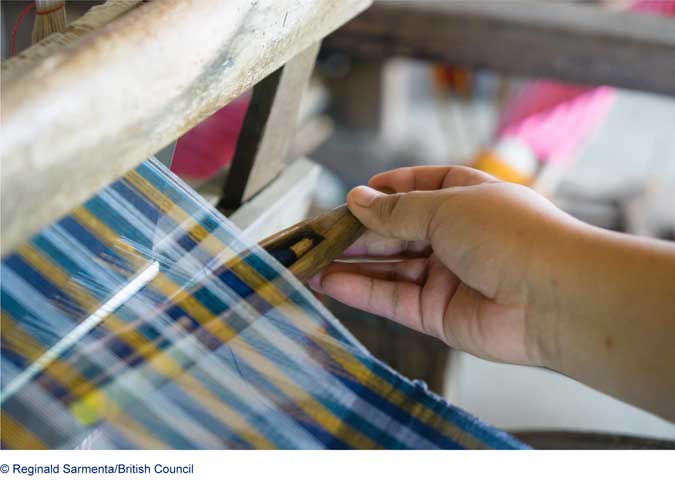
THE BRITISH Council announces the launch of Weaving Futures — Cultural Exchanges and Design Collaboration, an action research project led by the Prince’s Foundation School of Traditional Arts, in partnership with the Enrique Zobel Foundation and Philippine Women’s University. Through a series of consultations, Weaving Futures will map the communities’ distinct cultural heritage, relationship with nature, indigenous knowledge, and vision for the future. The result will be a new design process to help broaden perspectives on artisanship and design, as well as renew and refresh weaving practices. This initiative will also open up opportunities for working collaboratively across communities with designers, artisans and makers in the UK and the Philippines. The research project will engage four weaving communities in the Philippines: the Kiyangan Weavers Association in Kiyangan, Ifugao; the Kulibanbang Weavers Association of Bontoc women now residing in La Trinidad, Benguet; the Serukadang Menuvu Tribal Organization of Bukidnon; and the Sunrise Weaving Association of Ibaan, Batangas. Weaving Futures responds to findings of a British Council study, Crafting Futures — sustaining handloom weaving in the Philippines. The report described craft as a “sunset industry” despite its contributions to women empowerment, cultural expression and sustainable development. The British Council’s Pilar Aramayo-Prudencio and the Prince’s School of Traditional Arts, Dr Khaled Azzam, among others, will grace the digital launch event on June 16. For inquiries, contact arts@britishcouncil.org.ph.

4 shows at West Gallery

THERE are four exhibits currently running at the West Gallery until June 26. These are Dex Fernandez’sSynchrodelic Hybrid Fractals Screenshots” featuring works which use photographic medium, pigments, and threads; Gino Bueza’sMt. Synonym”; Veronica Peralejo’s “new holes,” in which she plays with the nature of translucent materials and its different levels of opacity; and, Indya Gokita’ “This Is How We Walk On The Moon.” Visitors are welcome by appointment only. To make an appointment, call 3411-0336.

Jürg Casserini has new show at Artologist Gallery

FROM June 12-30, mixed media artist Jürg Casserini presents his “Bangka” art assemblage and driftwood art pieces at The Artologist Gallery at the Art Plaza Level 4, Main Wing, EDSA Shangri-la Plaza. The Swiss-born artist has been collecting bits and pieces of wooden boats that wash ashore in Bohol. What others might see as trash or even kindling for fire, Mr. Casserini sees as elements for his found objects collages. Mr. Casserini, a former diplomat and his wife have fallen in love with the Philippines and have decided to make the country their retirement haven. They spend time between their place in the business district and their leisure apartment in Bohol. The exhibit features 20 Bangka collages and seven driftwood pieces. The Artologist Gallery is open daily from 11 a.m.-8 p.m. Health protocols are strictly observed. For more information, call 8696-3244, 0945-5112568; e-mail artgallery@artologist.net; visit www.facebook.com/artologist or www.instagram.com/the_artologist or log on to www.theartologist.net.

BP releases dance video for Independence Day

BALLET Philippines (BP) celebrates the country’s 123rd Independence Day by taking part in Len Cabili’s campaign, “Dama ko Lahi ko,” which celebrates being Filipino by experiencing culture through each of the five senses, promoting Philippine culture as a collective soft power. BP’s contribution is a dance called “Dama Ko, Lahi Ko,” choreographed by Joseph Phillips, featuring music by Boy Yuchengco, “Imna Na” by the Pinikpikan band. The video can be seen on BP’s website, ballet.ph.