Home Blog Page 7588

Duterte ousted as party chairman by Pacquiao faction

A PDP-Laban faction led by Senator Emmanuel “Manny” D. Pacquiao has ousted President R. Duterte as chairman, according to a party official.

Mr. Duterte was voted out at a national council held on Sunday, Ronwald F. Munsayac, executive director of the PDP-Laban faction, said in a text message.

He said Senator Aquilino “Koko” L. Pimentel III replaced Mr. Duterte, who has supported the faction led by Energy Secretary Alfonso G. Cusi.

Former Eastern Samar Governor Lutgardo B. Barbo was elected vice chairman, he added.

Mr. Munsayac has yet to confirm media reports that Mr. Pacquiao, who is believed to be running for President next year, had been elected party president.

“It’s a comedy,” Melvin Matibag, secretary-general of the opposing faction, said in a statement.   

“Senator Koko Pimentel has no position in PDP-Laban,” he said. “He is irrelevant and he does not represent the party. His group are pretenders and are attention seekers.”

Mr. Duterte is the party chairman and would continue to be so, he added.

Mr. Duterte last week said he would run for vice president next year so he could continue his campaign against illegal drugs, criminality and insurgency.

PDP-Laban earlier said the President, who is barred by law from running for reelection, had agreed to “make the sacrifice and heed the clamor of the people” by running for vice-president.

In the Philippines, the President and vice-president are elected separately and may come from opposing political parties. The vice-president usually becomes powerless unless the President gives him a key post in his Cabinet. — Kyle Aristophere T. Atienza

Senator: Ex-Budget official in anomalous contract had backer

SENATE.GOV.PH

THE FORMER Budget official accused of awarding a multibillion-peso contract to a local contractor for overpriced face masks and shields probably had a backer, a senator said on Sunday.

Both ex-Budget Undersecretary Lloyd Christopher Lao and Pharmally Pharmaceutical Corp., which bagged the P8.68-billion supply contract despite being new and undercapitalized, both had a backer, Senator Franklin M. Drilon told DZBB radio.

“We will force Lao to tell us who his backer is,” he said. “It’s obvious because from the very beginning, he said no one recommended him for the Department of Budget and Management. From there, you can already observe that he’s covering for someone.”

Mr. Drilon last week cited several warning signs of potential corruption in the procurement of several medical supplies by the Budget department.

He said the plunder had been planned together with other officials. “This is treachery or fraud involving national coffers during a pandemic, when funds are short,” he said in Filipino.

Mr. Drilon earlier cited as anomalous the choice of contractors of questionable qualifications. Pharmally earned P284.9 million in 2020, from zero income in 2019 after bagging P8.68 billion worth of government contracts, he said. He accused the Budget department of having given the contractor “the sure ticket to wealth.”

Senator Panfilo M. Lacson during Friday’s hearing asked Mr. Lao what type of due diligence was done before the agency awarded billions of funds to Pharmally.

Mr. Lao said they did not have a copy of Pharmally’s general information sheet so they did not have an idea about bogus addresses that the company allegedly used in its registration documents.

Mr. Drilon said Mr. Lao faces the risk of contempt by the Senate blue ribbon committee if he refuses to tell the truth.

He also said the former chief of the Budget department’s procurement office was negligent at the very least for allowing the contract to proceed.

Senator Panfilo M. Lacson at the weekend said Mr. Lao, a lawyer had failed to conduct due diligence on Pharmally.  Alyssa Nicole O. Tan

Brunei seeks exemption from PHL deployment cap on healthcare workers

PHILIPPINE STAR/ MICHAEL VARCAS

THE BRUNEI government has requested for an exemption from the Philippine’s deployment cap on healthcare workers, citing its need for at least 200 nurses and 30 medical doctors.

In a news release on Sunday, Labor Attaché Melissa C. Mendizabal said while Brunei is trying to implement localization in employment, there is still a preference for Filipino workers for supervisory and managerial roles.

“They prefer Filipino workers, and some employers are very proud of our OFWs (overseas Filipino workers) because of their industry,” Ms. Mendizabal said.

Ms. Mendizabal added that aside from healthcare workers, about a thousand jobs in Brunei’s oil, gas, and household service sectors are also open for OFWs.

There are currently about 20,000 OFWs in Brunei.

The Labor department in a news briefing on Wednesday said it will recommend maintaining the current 6,500 deployment cap on healthcare workers, which has already been maximized.

“There is already a perceived supply gap (in the Philippines),” Labor Assistant Secretary Dominique R. Tutay, citing as one reason the postponement the 2020 board examinations for healthcare workers.

The cap does not include deployments to the United Kingdom and Germany due to government-to-government agreements with the two countries. — Bianca Angelica D. Añago

CoA flags PAGCOR for lapses in implementation of classroom building program

PAGCOR.PH

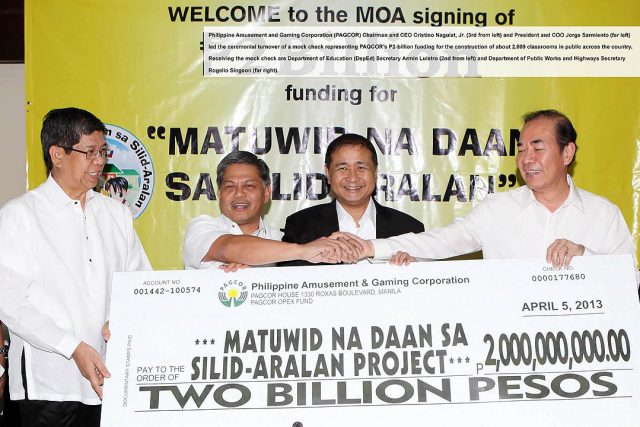
STATE AUDITORS flagged the Philippine Amusement and Gaming Corp.(PAGCOR) for lapses in the implementation of a program for building classrooms nationwide.

In its 2020 annual audit report, the Commission on Audit said that there was no update on the status of 398 classrooms with an estimated project cost of P1.005 billion, which were supposed to be completed by 2018.

PAGCOR’s Matuwid Na Daan Sa Silid Aralan program is in coordination with the Department of Education (DepEd), and the Department of Public Works and Highways (DPWH).

Based on the memorandum of agreement between PAGCOR and the two departments, the completion date of the project may be extended with mutual agreement of the implementing agencies.

Auditors noted that PAGCOR forwarded copies of extension agreements with DepEd and DPWH on Aug. 26, 2020 and was followed up on Dec. 23, 2020, but both agencies have yet to submit their concurrence on the extension.

It also notes that funds for the project worth P1.824 billion remain unliquidated by the implementing agencies despite the funds having lapsed for more than three years after the 2017 target completion date.

The DPWH has submitted liquidation reports of funds amounting to P613.43 million. However, DepEd has yet to submit its own reports despite follow-ups from PAGCOR.

CoA recommended in its rejoinder that PAGCOR consider taking alternative legal action against other implementing agencies for the possible return of unutilized funds if liquidation is not possible. — Russell Louis C. Ku

Women’s group calls on Senate to hasten approval of bill changing age of consent to 16

PHILSTAR

WOMEN’S ORGANIZATION Gabriela Philippines called on the Senate to “act double time” in approving the bill that will adjust the age of consent to 16 years old from the current 12.

Gabriela Secretary General Joms Salvador said the proposed revision to the country’s law on statutory rape and sexual violence will strengthen child protection.

“It is often more difficult to handle cases where a child is involved, because you know that often children are more psychologically and mentally fragile compared to adults,” Ms. Salvador told BusinessWorld on Saturday.

“Often the child would be conflicted, blame themselves, or even retreat from reality as it would be very difficult for them to face their perpetrator or the taxing process of reliving their experience before the court,” she added.

The measure, contained in Senate Bill No. 2332, was sponsored last Wednesday by Senator Richard J. Gordon, Sr., chair of the Committee on Justice and Human Rights, and Majority Leader Juan Miguel F. Zubiri.

Senator Ana Theresia N. Hontiveros-Baraquel, chair of the Committee on Women, Children, Family Relations and Gender Equality, said at the plenary session that there have been cases where minors were asked to prove in court that “they did not consent to the sexual act, with some even being asked if they enjoyed it. As a result, many victims opt to stay silent.”

“Our age of sexual consent is the lowest threshold in the world,” said Ms. Hontiveros in a statement. “Our current policies make this heinous crime permissible. When justice is sought out, our current law bars it from being served. Little can be done because the law stands in the way.”

From March to Nov. 2020, there were 13,923 reported cases of violence against women and their children, according to the Philippine Commission on Women. Of these, children were the victims in 4,747 cases.

The counterpart bill at the House of Representatives was passed in December last year. — Alyssa Nicole O. Tan

Gatchalian bill aims for ‘zero illiteracy’ in the Philippines

DEPED.GOV.PH

SENATOR Sherwin T. Gatchalian has filed a bill that seeks to achieve zero illiteracy in the country within three years by synchronizing existing programs under a council.

Reaching zero illiteracy is one of the first most important steps to ensure that we have no fellow compatriots being denied a good future,” Mr. Gatchalian, chair of the Senate Committee on Basic Education, Arts and Culture, said in Filipino in a statement on Sunday.

Senate Bill No. 2348 or the National Literacy Council Act filed last Monday renames and strengthens the Literacy Coordinating Council established through Republic Act No. 7165.

The proposed law will integrate the implementation of the Alternative Learning System (ALS) while mobilizing Local School Boards as the de facto local literacy councils.

“In our proposed measure, the role of both ALS and our local governments is of value in order to reach zero illiteracy in the country,” said Mr. Gatchalian.

The 2019 Functional Literacy, Education and Mass Media Survey (FLEMMS) showed that six out of 100 Filipinos, five-years-old and over, were illiterate. This means about six million Filipinos cannot properly read or write basic messages. — Alyssa Nicole O. Tan

Australia donates 100 oxygen concentrators to PHL

AUSTRALIAN EMBASSY

THE AUSTRALIAN government has donated 100 oxygen concentrators to the Philippines as part of a continuing assistance program on the coronavirus response and recovery.

“I am very pleased that the Australian Government is able to respond to the request of the Philippine Government… These critical medical supplies will help the Department of Health respond to the current increase in COVID-19 cases,” said Australian Ambassador Steven J. Robinson AO in a statement.

The donation, which was announced Monday by Australian Foreign Minister Marise Payne during the Philippines-Australia Ministerial Meeting, arrived on Saturday. — Alyssa Nicole O. Tan

Deputy ombudsmen to be deployed in graft-prone gov’t agencies by Sept.

PCOO

PROSECUTORS and state auditors will be deployed as resident ombudsmen to corruption-prone government agencies starting September, Justice Secretary Menardo I. Guevarra said on Sunday.

The move will be covered by a still unsigned memorandum of agreement between the Department of Justice (DoJ), Office of the Ombudsman, and the Commission on Audit (CoA) to help the national government in its anti-corruption drive.

“The implementation of the (Ombudsman)-CoA-DoJ memorandum of agreement on the deployment of prosecutors and auditors as deputy ombudsmen in various agencies is targeted to start in September,” Mr. Guevarra said.

Mr. Guevarra said “the CoA annual audit reports will indeed provide a good starting point” for the investigation of resident ombudsmen.

Senators and congressmen have called on the Ombudsman to probe the alleged irregularities in the use of funds by some government agencies as flagged by CoA in its 2020 annual audit reports. 

Mr. Guevarra said they “will take the cue from the Ombudsman” on the investigations.

“For now, we’ll let the government agencies called out by the CoA to comply with the latter’s recommendations, rectify any deficiencies found in their accounting records, and explain other audit observations made by the CoA on the use of government funds,” he said. — Bianca Angelica D. Añago

DHSUD issues over 200 notices to illegal subdivision projects in Davao

A DEPARTMENT of Human Settlement and Urban Development (DHSUD) official said there has been an increasing number of illegal residential subdivision projects in Davao Region with more than 200 violation notices issued this year.

DHSUD Regional Director Roberto T. Palma Gil said they have served 225 Notices of Alleged Violation (NOAVs), with the highest in Davao City at 89.

The others were in Davao de Oro, 42; Island Garden City of Samal, 38; Davao del Norte, 38; Davao Oriental, 12; and Davao del Sur, six.

“I noticed there was a sudden increase in illegal subdivision projects in Region 11,” Mr. Palma Gil said in mixed English and Filipino during Friday’s 8th General Membership Meeting of the Davao City Chamber of Commerce and Industry, Inc.

He said they are working on filing cases against the developers. He noted that many of them are selling lots within a supposed future subdivision, but “they are just selling and they are not developing.”

He reminded prospective buyers that a legal subdivision project should be on a titled parcel of land, partitioned with or without improvements, and sellers should be able to present a government-approved plan and corresponding certificated and permits.

“If there is no subdivision plan and development plan approved by the local government unit, and no certificate of registration from the DHSUD, that would be an illegal subdivision,” he said. — Maya M. Padillo

Police to assist local governments in granular lockdowns amid spike in COVID-19 cases

PHILIPPINE STAR/ MIGUEL DE GUZMAN

THE NATIONAL police has started preparing to help local officials implement granular lockdowns, a strategy that the national government is planning to use in place of more wide-scale quarantines that has taken a serious toll on the economy amid the coronavirus pandemic.

“I have tasked police commanders to start coordinating with local government officials and initiate discussions regarding the possible implementation of granular lockdown starting next month,” national police chief Guillermo T. Eleazar said in a news release on Sunday.

In granular lockdowns, restrictions will be imposed on a smaller community level such as residential subdivisions, streets, or a cluster of houses where there are a high number of coronavirus disease 2019 (COVID-19) cases.

Several local governments across the country have already been implementing this, with barangay and other local officers put in charge of monitoring the restricted area. 

Mr. Eleazar said while the nationwide adoption of the policy has yet to be approved, police officers must start coordination work to avoid confusion during enforcement.

The Department of Interior and Local Government announced on Thursday that the national government is considering replacing region or province-wide quarantine classifications with granular lockdowns. — Bianca Angelica D. Añago

Immortality

ONLYYOUQJ-FREEPIK

Today is the sixth death anniversary of my wife Mae. The time since then may have alleviated the pain of losing her. But the pain, doubtless, won’t go away. In fact, the pain takes new forms as we all continue to experience tragedies all around.

Since the pandemic’s outbreak, I have lost count of the number of relatives, friends, and acquaintances who died. Not all deaths could be attributed to COVID-19. The cause of death of some could not be ascertained — whether it was related to COVID-19 or not. But whatever the cause, the pandemic and the government’s mishandling of the pandemic have all the more caused affliction.

In light of social distancing and other quarantine rules, family and loved ones could not even grieve properly. Vigils and funeral services are discouraged, for they can become COVID-19’s spreader. We have our share of sad stories about family members getting sick and hospitalized, some even dying, as a result of contracting COVID-19 during such gatherings.

To avoid worse consequences, those grieving and orphaned are deprived of the intimacy and social bonding that would have given them comfort.

As a result, we have found new ways to mourn and remember the dead. Online masses, novenas, and memorials are held, with Zoom and Facebook as platforms. In eulogies and homilies, we pray for the eternal life of our dear departed. Having deeply ingrained Christian (or Muslim) beliefs, we beseech divine blessing for immortality.

One homily on eternity that struck me was what Fr. Tito Caluag delivered in a novena-mass for Tita Nini (Quezon Avanceña). In this homily, Fr. Caluag offered his answer to the question of how he would describe eternity. His response surprised me, for I didn’t expect that a priest’s definition of eternity would acquire a secular character. He defines eternity as an act of forever remembering the good that our dear departed had done and bequeathed to the living.

In the case of Tita Nini, I have many memories of her that I will forever keep. In fact, I had written a tribute to her many years ago (in 2005). Her comment upon reading it was: Ginawa akong santo ni Men sa lupa. (“Men made me a saint on earth.”)

Forever remembering a loved one and her deeds has to be shared with others, including the future generations. The Filipino’s oral tradition can serve the purpose of remembering. But the oral tradition has its deficiencies. Recalling through time may suffer from inexactness, subjectivity, or false memory. Hence, the written word is preferable.

To return to Tita Nini’s life, much has been said or written about her, but these have to be preserved or published. In truth, her family, without Tita Nini knowing about it, initiated a project to publish stories about her life.

Actually, Tita Nini would have been indifferent to its publication. She never sought public attention. But having the book about Tita Nini is consistent with what Fr. Caluag said about forever remembering the good she did.

Moreover, a book on Tita Nini’s life is also a recording of Philippine history. Tita Nini was part of it — a history covering the Commonwealth period, World War II, post-war elite democracy, the horrors of martial law, the restoration of a fragile democracy and the attendant pains, and the rise of inequality, populism, and illiberalism.

I have read family histories authored by recently deceased friends. One, which was published this year before the author’s death, is titled Orong (Dr. Isidoro Ongsiako de Santos): The Colorful Life of the Unsung Patriot. It was written by Maria Aurora de Santos-Escueta.

Bollie, the author’s nickname, wrote this book to honor her forbears. This was Bollie’s way of immortalizing them.

Bollie died on July 18 this year. But she left family and friends with a crowning achievement: the authorship and publication of a book about the De Santos family. Like her forbears, Bollie lived a meaningful, colorful, and pilyo (mischievous) life.

Another friend, Inez Silva Reyes, wrote a history of her ancestry. This is about the Gomba and Silva families of Lipa.

Inez completed her writing in 2018, but the work remains private. This history is for her future grandchildren, she said. In her introduction, she stated that written family stories “will never be lost to memory.”

Inez passed away on March 13.

So, my way of remembering Bollie and Inez is to share their stories on how they themselves honored their ancestors through writing.

Today, on Mae’s death anniversary, I remember her and express my love to her by announcing to readers the publication of a Kindle e-book of poems she composed. It is titled On Love and Life, a slim volume of poems.

I thank Mae’s sister Yeb Tayag for her initiative in curating the poems and negotiating with Kindle to publish the e-book. It is also Yeb’s way of immortalizing Mae.

In her foreword to the book, Yeb wrote: “Because her poems are so beautiful, so rich in love, life and feelings, I had decided that I had to share them with you. I hope Mae will forgive me, if she never wanted this.”

To Yeb, Mae would certainly be happy about her e-book. And proof of that was what she said to our friend, Babeth Lolarga, many years ago: “That launch [of the first book of Chit Roces Santos] made me think and dream again that maybe someday I, too, will write and get published.”

Mae has other poems, and the publication of her e-book stirs me to have a print version that will include her other poems. Again, this is for remembering. Is it for immortality?

I end by remembering someone whom Mae and I deeply admire and love: Gilda Cordero Fernando. Her first death anniversary was commemorated three days ago.

The last chapter of her book The Last Full Moon (2005) is titled “Immortality.” How Fr. Caluag defined eternity for Tita Nini is an echo of what Tita Gilda profoundly wrote.

Said Gilda: “Maybe immortality is not so much about a deathless identity as those impulses towards good that we leave behind. A courageous act. A discovery. A more equal way of life. An original style. A kindness. A lesson of truth. It is for others to be inspired, to pick up, to build on, modify, expand or detail, and pass on. Without necessarily knowing its source and not in their original space either but morphing forever and ever. Maybe the ever-flowing river of influences is the real immortality. And that’s anonymous.”

Amen.


Filomeno S. Sta. Ana III coordinates the Action for Economic Reforms.

www.aer.ph

Good governance is good economics

President Noynoy Aquino inherited a frail economy when he assumed office in 2010. The debt to GDP ratio was high at 54.4%; Gross International Reserves (GIR) was a paltry $44.2 billion; government’s revenue collection ratio stood at only 12% of GDP; merchandise exports were an anemic $38.4 billion; and foreign direct investments was just above $1 billion. Only OFW remittances kept the economy afloat. There were no funds left for infrastructure spending, let alone social development.

Despite scant resources, the Aquino administration succeeded in accelerating infrastructure spending five-fold and increasing social development budgets by 313%, over four years. All these while reducing the national debt to just 44% of GDP and maintaining the budget deficit at below 2%. How did he do it?

It was a combination of many factors. On the uses of funds, President Aquino embarked on a policy of fiscal discipline coupled with a strong anti-corruption campaign. On the sources of funds, he focused on attracting foreign direct investments (FDIs), increasing export earnings, boosting tourism, improving tax collection, and utilizing Private Public Partnerships (PPP) to help shoulder the infrastructure bill.

From day one, President Aquino insisted on zero based budgeting. This meant doing away with projects that yielded low social impacts, projects that were poorly planned and those prone to leakage (corruption). Leakage and fat were eliminated from the national budget, allowing more funds to be used productively. Slashing congressional pork barrel to its barest minimum generated enormous savings too.

He insisted on full transparency in all government transactions especially in public biddings. Public tenders were published in the agency’s websites and in national newspapers. Moreover, all transactions utilizing public funds were meticulously audited by the Commission on Audit. Those responsible for unaccounted discrepancies were made to face the Sandiganbayan.

President Aquino understood the importance of foreign direct investments. FDIs are vital for job generation and for capital formation. Trust and confidence were his tools to attract FDIs and this was achieved through good governance.

Good governance has many facets. Not only did it mean the judicious use of resources, it also meant installing the best and brightest technocrats in key positions in government; it meant regular consultations with the academe, socio-civic groups, and business groups in policy formulation; it meant making decision based on data and evidence-based reasoning rather than personal bias, conjecture, or impulse; it meant establishing measurable targets which are regularly evaluated against performance (President Aquino was known to personally review the key result areas of his cabinet against what was delivered); it meant benchmarking deliverables to global standards; and it meant leveraging on technology whenever possible.

President Aquino’s honesty, sincerity, and steadfastness produced exemplary results which was evident as early as the first year. This was enough to convince the international community that the Philippines was indeed a good country to invest in. It also helped that President Aquino, along with his economic team, regularly reached out to strategic foreign enterprises in international road shows. Good governance, rapidly improving fundamentals and an exceptional reputation abroad made investors come in droves. From just $1 billion in 2009, FDIs increased eight-fold to US$8.28 in 2016. Along with FDIs came jobs and export earnings.

Merchandise exports increased from $38.4 billion in 2009 to $56.31 billion in 2016. Add to this $31.2 billion in service exports, primarily from the IT-BPO industry. IT-BPO’s boomed in the Aquino years thanks to sensible industry development programs and a favorable investment climate.

President Aquino also understood the importance of rebuilding the country’s manufacturing base. A strong manufacturing sector would allow those in low paying jobs (subsistence farmers and minimum wagers) to migrate to higher paying jobs in factories. The Department of Trade and Industry formulated some 84 industry roadmaps to rapidly develop Philippine manufacturing capabilities. Only under the Aquino administration did the industrial sector grow faster that the service sector. Over his six-year term, industry grew by 7.58% versus a 6.51% growth in services. This has never happened in our post-war history. All these resulted in the lowest incidence of poverty ever recorded — just 469,000 families were below the poverty line by the time President Aquino’s term ended.

In tourism, foreign arrivals increased from 3.02 million visitors in 2009 to nearly 6 million by 2016. Thanks to strategic promotional spending and a brilliantly conceived campaign (“It’s more fun in the Philippines”), investments in tourism-related infrastructure helped bolster the industry.

On infrastructure development, the Aquino administration is often blamed for not spending enough for roads, bridges, and ports. Truth be told, it was the 11 years under Estrada and Arroyo that spending on infrastructure did not even exceed 2% of GDP.

Records show that infrastructure spending increased five-fold during President Aquino’s term, from P145.5 billion in 2011 (1.8% of GDP) to P759.6 billion in 2016 (5% of GDP). Ingeniously, he used Public Private Partnerships (PPP) to fund many of the projects. It was a clever move considering limited financial resources.

The Department of Public Works and Highways and the Department of Transportation and Communication re-wrote the country’s infrastructure masterplan. Many of its components were initiated between 2011 and 2016. Fortunately for President Duterte, most projects were completed during his term, allowing him to take credit for them.

On social development, the Aquino administration increased spending on social service by huge margins from 2009 to 2014. Healthcare spending increased from just P23.6 billion to P81.94 billion, a 247% increase; social welfare budgets jumped from only P13.26 billion to P78.87 billion, a 494.79% increase; the education department’s budget leapt from P177.47 billion to P337.95 billion, a 90.42% increase; spending on housing increased from P3.79 billion to P10.95 billion, a 189% increase.

Conditional cash transfers, the program that helped the poorest of the poor survive another day, also increased from P10 billion in 2011 to P62.7 billion in 2016, a 527% increase.

On the back of good governance and the judicious use of funds, the Philippines improved in all development indices including economic competitiveness, ease in doing business, economic freedom, corruption perception, innovation, rule of law, and gender equality. The economy experienced an accelerated average GDP growth rate never before seen since our independence.

The Philippines metamorphosed from being the sick man of Asia to Asia’s bright star during the Aquino years. Sadly, with feudal simple-minded governance under President Duterte and the mismanagement of the pandemic, the Philippines is back in intensive care.

Indeed, good governance is good economics. Let us remember this as we make our choice for 2022.


Andrew J. Masigan is an economist

andrew_rs6@yahoo.com

Facebook@AndrewJ. Masigan

Twitter @aj_masigan

ADVERTISEMENT
ADVERTISEMENT