



Dining In/Out (06/24/21)



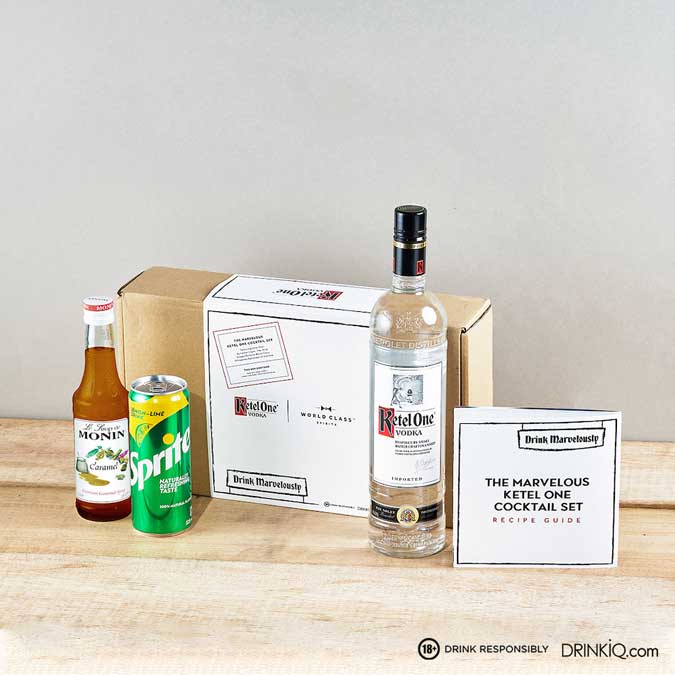





Diageo Reserve develops spirits cocktail kits
COSMOPOLITAN drinking used to mean heading out after work or during the weekend to a favorite cocktail bar, or a fine dining restaurant. But as the pandemic has everyone staying home, nights out have become few and far between. Diageo Reserve, the luxury portfolio including spirits such as Johnnie Walker, Tanqueray, and Ketel One, is bringing some of those elevated drinks home. Diageo Reserve and World Class — which are behind the World Class Bartender of the Year Competition — partner with Boozy.ph to offer the World Class Spirits Cocktail Kits. These specially curated kits come in four variants, all crafted by Diageo Philippines Brand Ambassador Rian Asiddao, and past Diageo Reserve World Class Philippine Bartenders of the Year David Abalayan (2019) and Lester Ligon (2018), to make sure that each kit delivers the most satisfying cocktails. The four kits are: the Johnnie Walker Black Label Highball Collection (P1,399), developed by Asiddao, containing Johnnie Walker Black Label (1 liter), Monin Caramel Syrup, and Sprite, and recipe cards to make three cocktails — a Johnnie & Lime, a Johnnie Caramel Highball, Caramel Whisky Sour; the Johnnie Walker Double Black Highball Collection (P2,099), containing a bottle of Johnnie Walker Double Black (1 liter), Monin Caramel Syrup, and Schweppes Tonic Water and a recipe card for making a Johnnie & Tonic, a Caramel & Tonic Highball, or a Smoky Caramel Old Fashioned; The Tanqueray & Tonic Sunset Kit (P1,099), developed by Abalayan featuring Tanqueray London Dry Gin, Monin Vanilla Syrup, and Schweppes Tonic Water and a recipe card for making a T&T (Tanqueray & Tonic), a Vanilla T&T, and a Tanqueray Vanilla Gimlet; and the Marvelous Ketel One Cocktail Set (P1,399), developed by Lester Ligon featuring Ketel One Vodka, Monin Almond Syrup, and Sprite, plus a recipe card for making a Ketel One Highbal, a Ketel One Almond Caipiroska, and a Black Russian Twist. The World Class Spirits Cocktail Kits, available for a limited time only at Boozy.ph (https://boozy.ph/collections/diageo-world-class-kits).
Jollibee releases new rewards card
JOLLIBEE has just launched its new Joy Rewards loyalty card, which offers exclusive promos aside from earning of points. The Joy Rewards card also lets the user earn points when they purchase food from participating stores of other brands like Chowking, Greenwich, Mang Inasal, and Red Ribbon. Every P50 spent earns a point that, when collected, can be used to purchase more food. Earn points as well when loading gas at participating Caltex stations. New members are entitled to a welcome gift of a free Jolly Spaghetti with a minimum purchase of P300 using the card upon card registration. Customers can use the Joy Rewards card for cashless transactions — they can top-up their cards at Jollibee stores and use it to pay for their food purchases for dine-in, take-out, drive-through transactions. The new Joy Rewards Cards is available in all participating Jollibee stores for P100. The customer can register for the card in two ways — via the website at www.happyplus.com.ph or via SMS.
Spam unveils food truck
THE SPAM Food Truck is back making the rounds, this time with a new menu that takes classic comfort food recipes to another level. Those who regularly visit Capitol Commons, Ortigas East, and Greenhills will soon have a taste of the Spam Rice Ball — a five-ingredient, three-step Spam Classic recipe — along with the Spam Creamy Spicy Musubi, Spam Cheeseburger, Spam Salpicao, Spamdesal Queso Blanco, Spam Takoyaki Bao, and an off-menu dish — Spam Kimchi Bao. The Spam brand collaborated with chef RJ Ramos, co-owner of neo-Filipino bistro Lampara, on the dishes, which are made with Spam Classic, Spam Lite, and Spam Less Sodium. Filipinos first got a sneak peek at one of the Spam Comfort Food menu items when the #SPAMRiceBallChallenge launched earlier this month on social media. Mall goers, grocery shoppers, and passerbys got a taste of the reinvented dishes from the comfort food-themed Spam Food Truck in ArcoVia from June 17-20. The Spam Food Truck will be coming to Capitol Commons from June 25-27, Ortigas East from July 2-4, and Greenhills from July 9-11.
‘Frozen Weekends’ at Robinsons Place Manila
ROBINSONS Place Manila is the place to chill with its Frozen Weekends until July 4. Done in partnership with Manila City Bureau’s Manila Restaurant Week, mall patrons can look forward to chilled food and beverages such as ice creams, gelatos, frappes, popular coolers from Tiger Sugar and Coffee Bean, and frozen ready-to-cook meats. Mall restaurants like Max’s, SNR, Mesa, Gerry’s Grill, Cabalen, Manam, Ramen Nagi, Yellow Cab, Pancake House, Chowking and Bonchon are on board too, with their latest promo and store offerings. Plus, Robinsons Place Manila has a sweet treat on June 26-27 and July 3-4: with a minimum purchase of P1,000, shoppers can avail of a free ice cream.
Red Ribbon opens online store and ReGALO e-Gift Card
RED Ribbon has two new ordering services: its new online store and new ReGALO e-gift cards. Through the new Red Ribbon Online Store redribbononline.com, customers can: order cakes and pastries from home for either delivery or pick-up on the same day or up to seven days in advance (delivery services are available in select stores in Metro Manila, Montalban, Canlubang, Imus, Silang, Trece Martires, Baliuag, Olongapo City, Cebu City, and Davao City, but ordering for pick-up is available in all stores nationwide); go cashless as the online store accepts online payment via Visa, Mastercard, JCB, and PayMaya; and exclusive deal. Meanwhile, the new Red Ribbon ReGALO eGift Card is an electronic gift card that is redeemable in all Red Ribbon stores nationwide. The eGift – which is available both in the Online Store and in Messenger — comes in the form of a redeemable code through SMS and/or e-mail which can be forwarded to one’s chosen recipient. When ordering through Messenger, one also has the option to customize each purchase by choosing from any of the design templates and by adding personalized message. The Red Ribbon eGift cards now come with a special discount. Get up to P100 off on all eGift Cards until June 30. Redemption of these discounted e-Gift Cards will be valid through Sept. 30. Visit redribbononline.com, or chat with RIA on messenger (m.me/redribbonbakeshop) for details. Orders can also be made through the Red Ribbon delivery hotline #87777 or order through Grab Food and Food Panda. For more information and the complete list of Red Ribbon stores, visit https://stores.jfc.com.ph/redribbon.php.
ShopeePay ₱1 Deals on comfort food
TREAT yourself to comfort food and satisfy your cravings with ShopeePay ₱1 Deals. Users can now purchase ShopeePay ₱1 Deals on Shopee and redeem discounts when they pay at Shopee’s partner merchants via in-store QR codes using ShopeePay. To avail of the promo, purchase the discount or cashback voucher on Shopee, pay via QR code in-store, and select which voucher to use before payment confirmation. Check out these ShopeePay ₱1 Deals, which give users a ₱30 discount at the following restaurants for no minimum spend: milk tea from Tiger Sugar, Dark Chocolate Frappe from Coffee Project, fries from Potato Corner, and chicken wings from the Wingman restaurant. For more information and the complete list of ShopeePay ₱1 Deals and partner merchants, including Puregold, Seaoil, Kuya J, and more, visit https://shopee.ph/m/deals-near-me.
Napocor names Ridulme OIC-president

THE National Power Corp. (Napocor) has named Melchor P. Ridulme as the officer-in-charge (OIC) of the government entity who will serve until President Rodrigo R. Duterte nominates a new chief executive officer.
Mr. Ridulme’s designation, which was announced on Wednesday, comes after the passing of Napocor’s former chief Pio J. Benavidez on Tuesday after a heart attack.
Mr. Duterte’s nominee will be formally elected by the board.
Before his appointment, Mr. Ridulme served as Napocor’s vice-president and legal counsel.
“As the OIC-President, Atty. Ridulme is authorized to act on and approve urgent matters concerning the operations of Napocor,” the government corporation said in an e-mailed statement.
The OIC-president has the authority to sign contracts related to procurement of goods and services; approve disbursements of the corporation’s legitimate financial transactions; release funds and approve payroll of employees and personnel; issue office orders and memoranda, and sign promotional appointments of employees, among others.
Mr. Ridulme is the youngest vice-president of the state-led corporation. He chaired Napocor’s anti-red tape and investigative committee and was the country coordinator for the heads of ASEAN power utilities and authorities.
In a statement posted on its Facebook page, Napocor announced the passing of the company’s former chief.
“Boss Pio, as he is fondly called by everyone, is a tough leader who braves through any challenge while still having the capacity to be compassionate for others. He paved new roads for his people to tread on, he generously shared and taught his knowledge and experience, and has devotedly loved public service since day one in 1974,” the statement read.
Mr. Benavidez helmed Napocor as its president and CEO from April 2017 to June 2021. — Angelica Y. Yang
Google likely to soon face antitrust claims over Play Store from some US states — sources

WASHINGTON — A group of state attorneys general may file a lawsuit against Alphabet, Inc.’s Google as early as next week, accusing the search and advertising giant of violating antitrust law in running its mobile app store, according to three sources familiar with the matter.
The anticipated lawsuit follows complaints from app developers about Google’s management of its Play Store for Android devices, according to one source. The lawsuit has been in the works since last year and has already been delayed, but seems close again, the sources said.
The investigation by the state attorneys general is being led by Utah, Tennessee, North Carolina and New York. It is unclear how many states will participate.
Two sources said the case is likely to be filed in federal court in Northern California, where related cases are being heard. These include a lawsuit that video game maker Epic Games, Inc. filed against Google last year, accusing it of having anti-competitive app store rules. It is expected to go to trial in 2022.
There also are two proposed class-action lawsuits over the Play Store before the same judge. If the states want to participate in depositions and other pre-trial activities, they would have to file fairly soon, one source said.
Apple, Inc. and Epic are awaiting the verdict in a similar California lawsuit after a trial that ended last month.
A Google spokesperson defended their app store as open.
“Android is the only major operating system that allows people to download apps from multiple app stores. In fact, most Android devices ship with two or more app stores preinstalled. They can also install additional app stores or apps directly from their browser if they choose,” the spokesperson said.
Google was originally seen as more open in how it ran its app store than Apple but has tightened rules recently and increased enforcement of those rules.
The lawsuit is expected to focus on Google’s requirement that some apps use the company’s payment tools to sell subscriptions and content and pay Google as much as 30% of sales, according to two sources.
App makers like music streaming service Spotify Technology SA and dating services giant Match Group, which owns the Tinder app, have long accused both Google, as well as Apple, of being anti-competitive in demanding mandatory revenue sharing.
This latest lawsuit is being planned at a time of unusually vigorous debate over whether federal antitrust enforcement is too lax. Many people, including Senator Amy Klobuchar who chairs the Senate Judiciary Committee’s antitrust panel, have pressed for tougher enforcement.
Google already faces a federal lawsuit brought by the Justice Department last year and related antitrust cases brought by two separate groups of attorneys general. One is led by Texas and focused on advertising while the other targets Google’s alleged efforts to extend its dominance in search to newer markets, like voice assistants. — Reuters
RCBC partners with RBAP on data sharing
RIZAL COMMERCIAL Banking Corp. has partnered with the Rural Bankers Association of the Philippines (RBAP) for a data-sharing project to help small lenders set up their own online platforms.
The project called SynerFi (Synergy in Finance) Open Finance Network will help RBAP members set up their own digital platforms to support financial inclusion, RCBC said in a statement on Tuesday.
Aside from rural banks, the project will, in the future, encourage cooperatives, microfinance institutions, and other industry players to join and share their own data, the lender said.
The partnership comes after the Monetary Board last week approved the open finance framework that allows financial institutions to share consumer data to improve their products and services.
This is likewise expected to help the central bank reach its goal to bring 70% of adults into the banked population and to have digital payments make up 50% of all transactions in terms of volume and value by 2023.
RCBC President and CEO Eugene S. Acevedo said open banking allows for cooperation rather than competition among various financial institutions.
“There is indeed a synergy in finance among like-minded industry players who share our goal of pushing for financial inclusion,” Mr. Acevedo said.
“This initiative levels the playing field where all participants, regardless of size, reach, and technology know-how will now be able to cope up with the pace of massive digitalization amid the pandemic,” RCBC Executive Vice-President and Chief Innovation and Inclusion Officer Angelito “Lito” M. Villanueva said.
“This untapped and underserved segment of the population forms the backbone of our country’s recovery from the pandemic, and we are excited to bring our expertise on this matter moving forward,” RBAP President Elizabeth Carlos-Timbol added.
The BSP’s 2019 Financial Inclusion Survey showed only 29% of Filipino adults have accounts with financial institutions, leaving about 51 million still unbanked. Account ownership in the so-called Class E or the poorest income group stood at 27%.
The study also found that three in five adults in urban areas own smartphones where they can do banking services, while only two in five in rural areas have access to these gadgets.
RCBC’s net income declined by 31.55% to P1.58 billion in the first quarter from P2.308 billion a year earlier due trading losses and lower foreign exchange gains.
Its shares closed at P17.50 apiece on Wednesday, down by 40 centavos or by 2.23% from the previous day’s finish. — L.W.T. Noble
Nat Re sees slower new business creation

THE National Reinsurance Corporation of the Philippines (Nat Re) expects slower creation of new business among its clients this year as the economy is still struggling to recover, its top official said, but noted the company could post “profitable growth” despite this.
“With intermittent surges in COVID-19 infections and delays in the arrival of the vaccines, the country’s economic recovery could be slower than initially expected. It is still too early to give any definitive statement, but we can expect a slowdown in the new business generation of our clients,” Nat Re President and CEO Allan R. Santos said during their annual stockholders meeting on Wednesday.
“At any rate, we continue to identify pockets of growth, such as opportunities resulting from the need for capital relief solutions, higher health insurance covers, partnerships with foreign reinsurers, and the development of reinsurance facilities,” Mr. Santos added.
Nat Re, the country’s national reinsurer, saw its net profit drop by 24% to P120 million in 2020 from P157 million in 2019 on lower investment income.
Around 60% of its P8.6-billion investment portfolio went to government bonds while the remaining 40% was invested in corporate bonds, equities, and short-term deposits.
The pandemic pulled down the reinsurer’s equity investments, but last year was a good one for its fixed-income assets, Mr. Santos said.
Meanwhile, the company’s underwriting earnings grew last year, Nat Re said. Its gross written premiums inched up by three percent to P4.4 billion, while its underwriting income jumped 151% to P342 million.
“As we face 2021, we assure you that we will continue to pursue profitable growth, as well as entrench Nat Re in its role of being a stable anchor and champion for the insurance industry,” Mr. Santos said.
Meanwhile, he said the company will be distributing software licenses for the first open access framework catastrophe model for floods in the Philippines. They will also run ad hoc model analyses for them, he said.
Nat Re is also working with the Insurance Commission and the Philippine Insurers and Reinsurers Association on the Philippine Catastrophe Insurance Facility, which will help the industry manage risks by pooling them.
Mr. Santos said this facility will provide improved access to protection against natural disasters as previously, local companies had to have these kinds of products reinsured overseas. — BML
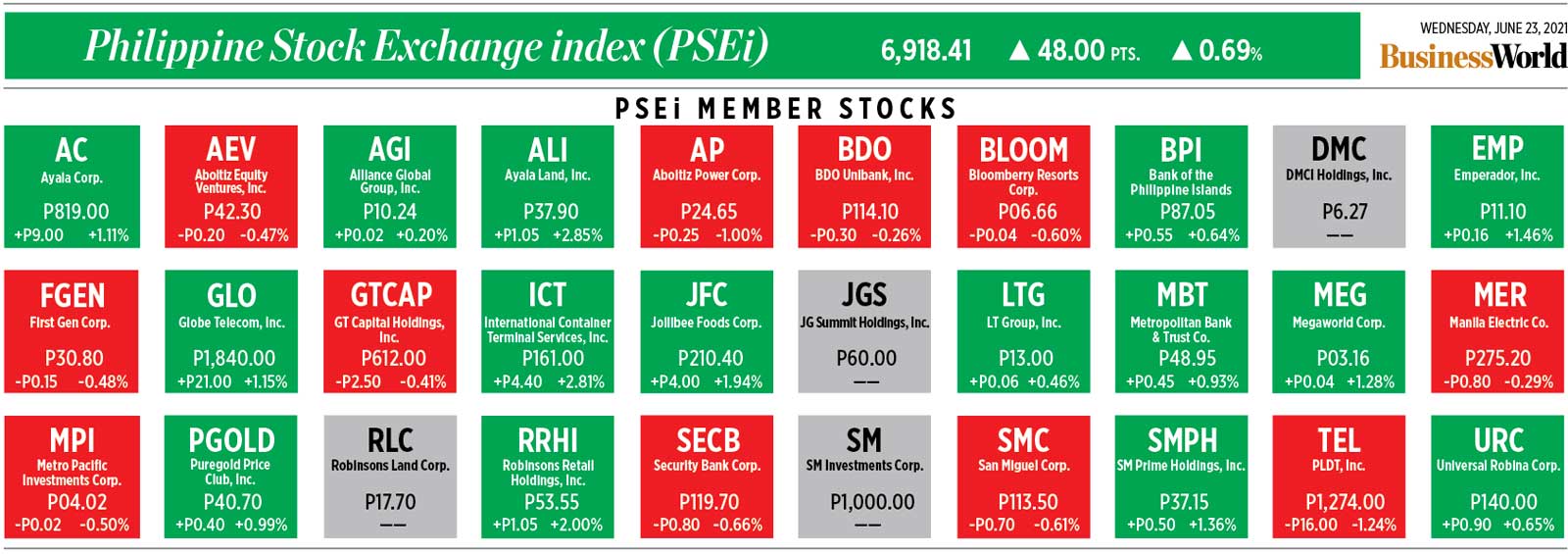
How PSEi member stocks performed — June 23, 2021
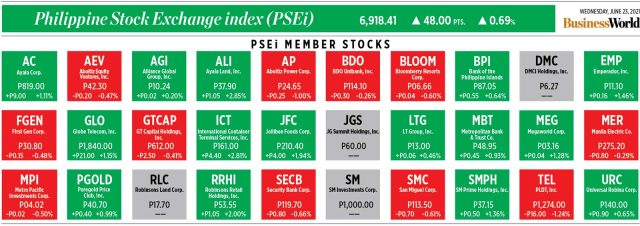
Here’s a quick glance at how PSEi stocks fared on Wednesday, June 23, 2021.

Despite living in third-most stressful city in the world, Manileños are happy — cannabis startup
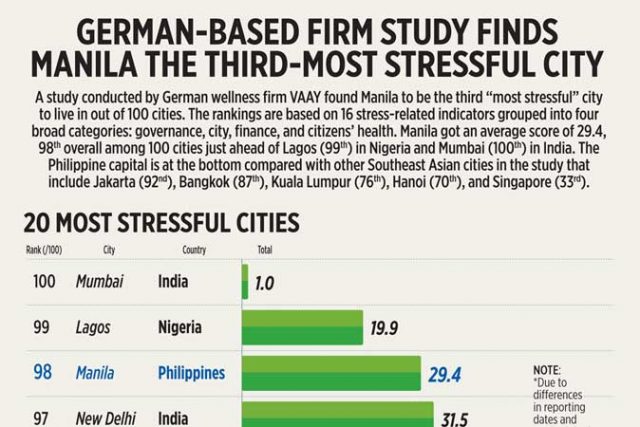
Manila is the third-most stressful city in the world, behind only Mumbai, India, and Lagos, Nigeria, according to a list compiled by Vaay, a Berlin-based wellness company focusing on cannabinoids and terpenes from the hemp plant.
Manila ranked 98th out of 100 cities in “The Least And Most Stressful Cities Index 2021,” faring worse than war-torn cities like Baghdad, Iraq (96), and Kabul, Afghanistan (95). Reykjavik, Iceland, was judged the least stressful city.
Vaay ranked cities according to four criteria: government factors (safety and security, gender and minority equality, and socio-political stability); physical environment (population density, pollution levels, weather patterns, and traffic congestion); financial stress (unemployment rates, social security structures, amount of disposable income); and health and wellbeing.
“The final results show which cities overall have the most stressful social, environmental and economic conditions, and which cities lead the way in reducing the stress levels of their inhabitants,” said Vaay. — Brontë H. Lacsamana

Mandanas says LGUs must have free hand on use of IRA agri funds

THE OFFICIAL who successfully petitioned the Supreme Court to expand the share local government units (LGUs) are entitled to from National Government revenue said LGUs need the freedom to decide how much they can spend on agriculture, rather than have quotas dictated to them by law.
Batangas Governor Hermilando I. Mandanas was speaking at a joint hearing of the Senate Committees on Local Government; Agriculture, Food, and Agrarian Reform; and Finance on Wednesday, noting that each LGU’s priorities are different, and cannot be set a one-size-fits-all rule in regard to their spending on agriculture.
“LGUs should be delegated with the power to decide on the minimum budget to be allocated to their agriculture sectors since their situations may vary. For example, there are barangays in Manila (which) do not need to allocate a budget for agriculture,” Mr. Mandanas said.
The hearing participants were discussing Senate Bill 1138 or the proposed Local Government Agriculture Development Act, filed by Senator Cynthia A. Villar in November 2019.
The bill if passed, will require LGUs to set aside 10% of their internal revenue allotment (IRA) from the National Government for agriculture and fisheries programs.
Mr. Mandanas petitioned the Supreme Court to expand the definition of “National Government revenue” as it relates to the funds that will go into the IRA pool, greatly expanding the funding that will be available to LGUs starting next year. In response, the National Government has decided to reduce its workforce by devolving many functions formerly carried out by its agencies to the LGU level.
President Rodrigo R. Duterte signed Executive Order No. 138 on June 1 which set the timetable for the devolution, which is to be completed by 2024.
Ms. Villar, who chairs the Senate Committee on Agriculture, Food, and Agrarian Reform, said during the hearing that the Supreme Court’s Mandanas-Garcia ruling set to take effect in 2022 will increase the IRA allotment of LGUs to P1.08 trillion.
She urged that a portion of the expanded funding be used for agriculture.
“It is important also that we have a minimum budget set for the agriculture (sector). After all, we are an agricultural country. We are not an industrial country. The poorest people in the Philippines are the farmers,” Ms. Villar said.
“If we do not invest in agriculture, we will have problems with our food security. Local governments should give importance to that especially now amid the coronavirus disease 2019 (COVID-19) pandemic. If we do not die from COVID-19, we will die of hunger,” she added.
Ms. Villar said she wants to legislate a minimum budget to be allocated by LGUs for their respective agriculture sectors.
She said a law is better that leaving LGUs with discretion on the matter to ensure that some LGUs do not underfund the sector.
“Not all LGUs are developmental in terms of thinking for their respective areas. LGUs should give more attention to agriculture because it is very important. Agriculture is the source of our food. It is very necessary for our food security,” Ms. Villar said.
“If we do not allot a minimum budget to the sector, the Philippines will not succeed as a middle-income country since we will not be able to improve the lives of our farmers,” she added. — Revin Mikhael D. Ochave
Spot market power prices decline in June

THE AVERAGE price for power on the wholesale electricity spot market (WESM) was P6.53 per kilowatt hour in June, down from P7.66 in May, the Independent Electricity Market Operator of the Philippines (IEMOP) said Wednesday.
In a virtual briefing, IEMOP Manager for Pricing Validation and Analysis John Paul S. Grayda said that the secondary price cap (SPC) was implemented during 103 trading intervals from the start of the month until June 20.
The SPC is a price mitigating mechanism designed to limit high prices in the spot market. Mr. Grayda said that the IEMOP “imposes the cap when it observes sustained high prices for the past five days.”
He said that the IEMOP started implementing the price cap last month.
“There are frequent high prices particularly at the start of May billing, triggering the SPC. On May 31 and June, (the Luzon grid) had yellow and red alerts so the system operator (National Grid Corp. of the Philippines) declared a market intervention as the grid experienced manual load dropping due to generation deficiencies,” Mr. Grayda said.
In May, the IEMOP imposed the SPC during 55 trading intervals.
Earlier this month, the grid operator placed the Luzon grid under red alert for three consecutive days due to thinning reserves, plant shutdowns and higher temperatures. Portions of Luzon experienced rotating brownouts during this time.
On Wednesday, the market operator also announced that it is ready to launch its enhanced WESM design and operations (EWDO) in Luzon and the Visayas by June 26.
The EWDO seeks reduce the time between scheduling and dispatch of power.
“We will be implementing the commercial operations which means that all five-minute dispatch schedules… shall be implemented from June 26, 2021 effectively at 12:05 in the morning,” IEMOP Manager of Operations Planning and Modeling Edward I. Olmedo said during the briefing.
He added that Luzon and the Visayas will undergo “relaxed dispatch operations” for up to three months where the market operator will observe the participants but will “not be very strict” about compliance during the period as long as they can provide valid reasons.
Mr. Olmedo said that Mindanao-based participants still had to complete their registration for the planned power spot market there, with the IEMOP allowing for a one-month extension.
“We are opting to start already — upon approval by the DoE — what we call WESM central scheduling. Now, this will only involve central scheduling (of) all contracted capacities in Mindanao but there will be no WESM settlement, WESM or spot market transactions,” he said. — Angelica Y. Yang
DoE to regulate reserve power procurement, require 5-year forecasts from NGCP

THE Department of Energy (DoE) said it will set a competitive process for the grid operator’s procurement of reserve power, known as ancillary services (AS), and also require it to submit five-year forecasts for power demand to help ensure that expected needs are sufficiently covered.
According to a draft department circular posted on its website, the DoE said AS providers must be engaged via a competitive selection process (CSP), after having flagged the National Grid Corp. of the Philippines (NGCP) earlier for not contracting enough firm contracts for the power grid’s needs at the end of 2020.
Last week, the NGCP announced that it will be holding a public auction to secure reserves in order to meet government requirements on reserve levels and ensure “best pricing” for customers.
In its draft rules, the DoE said that the CSP for AS must be transparent and non-discriminatory, promote competition and protect the interests of the general public by ensuring sufficient reserves at the least cost.
The department also proposed the presence of observers during the auction to ensure that the event is being conducted in an “open, transparent, effective, efficient, and equitable manner.” Observers may come from the DoE, Energy Regulatory Commission (ERC) and National Transmission Corp. (TransCo).
The proposed guidelines also require the submission of an annual AS agreement procurement plan (ASAPP) which must contain projections of reserve requirements for the next five years.
“The system operator (NGCP) shall develop and submit to the DoE its annual ASAPP not later than 31 March of every year,” according to the draft circular.
The DoE said that the ASAPP must contain the type of AS requirement per grid, existing ancillary service procurement agreements, and monthly levels of reserves needed per grid, among others.
If approved and implemented, the draft rules will cover various groups in the energy industry including NGCP, the market operator, the wholesale electricity spot market’s governance arm, all generating facilities, the TransCo, and ERC.
On its website, the DoE announced that it plans to hold a public consultation on the draft circular on June 24 between 1 and 4 p.m.
Around 400 participants from distribution utilities, generation companies, NGCP, civil society and consumer groups, and DoE-attached agencies including the ERC are expected to attend.
Comments and suggestions on the draft circular may be submitted on or before July 8 via e-mail to doe.csp@gmail.com. — Angelica Y. Yang
¥20-B loan funded subsidies, pandemic response — DoF
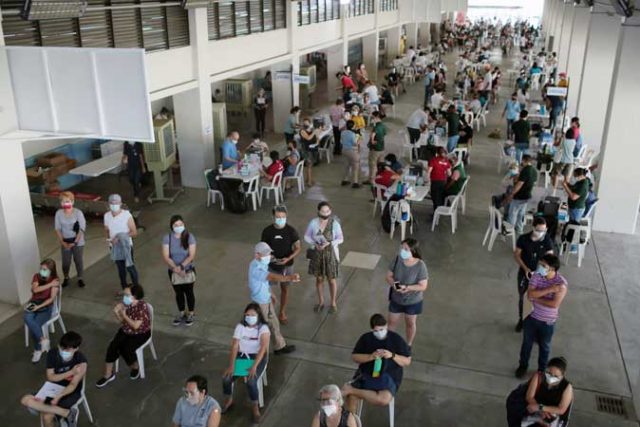
THE Department of Finance (DoF) said the government allocated the proceeds from Japan’s ¥20-billion loan — equivalent to around P8.71 billion — for emergency subsidies in April for people affected by the pandemic, as well as other spending items related to the public health crisis.
The enhanced community quarantine (ECQ) enforced in April served as the trigger for the Japan International Cooperation Agency (JICA) to release the third tranche of its standby loan to the Philippines, Finance Undersecretary Mark Dennis Y.C. Joven said Wednesday.
The loan helped fund the P23-billion emergency subsidy program that month, and also supported other items.
The government issued emergency cash aid worth P1,000 per person or up to P4,000 per household to poor families in Metro Manila and nearby provinces to help them deal with the two-week ECQ.
“We hope to utilize the amount to be disbursed under PDSL-2 (Post-Disaster Standby Loan 2) to support a portion of the total requirement for the implementation of the SAP (Social Amelioration Program) and other mechanisms necessary to properly implement COVID-19 (coronavirus disease 2019) response and recovery interventions in the country,” Finance Secretary Carlos G. Dominguez III said in his request to JICA Philippines Chief Representative Eigo Azukizawa on May 11.
Japan released ¥20 billion earlier this month as the third tranche of its ¥50-billion standby loan. This followed the ¥10 billion released in January and ¥10 billion in October.
An ECQ declaration was deemed a trigger event to disburse further tranches. Other conditions include the declaration of a state of calamity or of a state of public health emergency, natural disasters such as typhoons.
The credit line must be tapped within three years, subject to four extensions of the loan’s validity of three years each.
The loan charges a fixed interest rate of 0.01% and matures in 40 years, inclusive of a 10-year grace period.
In July 2020, the Philippines obtained a separate ¥50-billlion loan from JICA for its pandemic response.
Japan was the country’s top source of official development assistance with outstanding grants and loans equivalent to $8.537 billion at the end of March 2020, or 42.66% of the Philippines’ foreign aid. — Beatrice M. Laforga