Home Blog Page 7552

Steel sheet roofing quality norms put on hold by court order

THE COURTS have ordered a stay on the enforcement of product quality standards for steel sheet roofing, the Department of Trade and Industry (DTI) said.

“Unfortunately, the courts issued preliminary injunctions against the DTI so our hands are tied now. We cannot enforce the standards on glass and steel sheet roofing because of the injunction cases that we have,” DTI Undersecretary Ruth B. Castelo said in a webinar last week.

“And we actually appealed to the courts to please allow us to proceed with implementation or enforcement of these standards so that we can provide consumer protection, but these cases are still pending.”

The injunction on steel standards was issued earlier this year after a request from Galvaphil, Inc., she said in a mobile message Monday.

A DTI order that took effect in January placed galvanized steel sheet for roofing and general applications in the list of products that must be certified to have met quality standards, requiring all manufacturers to secure a Philippine Standard safety certification mark license before selling their products.

Ms. Castelo has said that the measure will ensure that construction materials are strong enough to withstand frequent storms.

The order was designed to improve the quality of both locally manufactured and imported products and ensure consumer safety, Trade Secretary Ramon M. Lopez said.

An injunction in 2019 also halted a DTI order on mandatory certification of flat glass products after importers filed a petition.

As part of a crackdown on substandard goods, plywood last year was also restored to the list of products that must be certified for quality. But the mandatory certification for imported plywood has been put on hold to 2022 after a request from an industry group to be given more time, citing pandemic-related restrictions. — Jenina P. Ibañez

Clarifying IAET exemption for PEZA entities

Prior to the effectivity of the Corporate Recovery and Tax Incentives for Enterprises (CREATE) Law, Philippine tax rules imposed a 10% tax on improperly accumulated taxable income of corporations. This improperly accumulated earnings tax (IAET) is imposed as a penalty on corporations which allow accumulation of earnings for the purpose of avoiding tax liability for their shareholders if they decide to distribute profits in the form of dividends.

Not all corporations, though, are subject to IAET. Revenue Regulation (RR) No. 2-2001 identifies corporate taxpayers who are exempt from IAET. These include:

a) banks and other non-bank financial intermediaries;

b) insurance companies;

c) publicly held corporations;

d) taxable partnerships;

e) general professional partnerships;

f) non-taxable joint ventures; and

g) enterprises duly registered with the Philippine Economic Zone Authority (PEZA) under R.A. 7916, and enterprises registered pursuant to the Bases Conversion and Development Act (BCDA) of 1992 under R.A. 7227, as well as other enterprises duly registered under special economic zones declared by law which enjoy payment of special tax rates on their registered operations or activities in lieu of other taxes, national or local.

There have been several instances during tax assessments or audits when PEZA-registered entities, especially those that are under income tax holiday (ITH), find themselves being assessed for IAET. Based on some examiners’ interpretations of the exception (g) cited above, PEZA-registered enterprises may enjoy exemption from IAET if they are under the 5% preferential tax regime. 

But just recently, the Supreme Court (SC) decided on a tax case where one of the issues involved is whether the respondent, a PEZA-registered entity, is subject to IAET on its accumulated income from registered activities enjoying the ITH incentive.

In that case, the Bureau of Internal Revenue (BIR) made a distinction between the respondent’s income from certain registered activities which have been granted ITH extension and its income from the rest of its registered activities which were subject to the preferential five percent (5%) tax rate. The tax authority argued that only the latter is exempt from IAET since the registered enterprises exempt under Sec. 4(g) of RR No. 2-2001 pertain only to those enjoying the special tax rate.

The SC concurred with the CTA en banc’s interpretation that the phrase “which enjoy payment of special tax rate on their registered operations or activities in lieu of other taxes, national or local” applies only to corporations belonging to the third group, that is, the other enterprises duly registered under special economic zones declared by law. The CTA explained that the use of comma in Section 4(g) of RR No. 2-2001 signifies independence of one thing from the others included in the enumeration, such that the particular portion contemplates three different groups excluded from the coverage of the imposition of the IAET.

In addition, the CTA en banc also noted that qualifying words restrict or modify only the words or phrases to which they are immediately associated, and not those distantly or remotely located. In this case, the court ruled that PEZA-registered enterprises and those registered pursuant to the BCDA are exempted from the imposition of the IAET without further qualification. Therefore, regardless of whether a corporation duly registered with the PEZA or registered pursuant to the BCDA enjoys an ITH or the special tax regime at a rate of 5% on its registered activities, it shall be exempt from IAET.

This interpretation now opens some concerns for taxpayers falling under the third group and are enjoying ITH incentive. With the repeal of the imposition of the IAET under the CREATE Law, the tax authority is left with only a few open taxable years to pursue assessments related to IAET. Thus, the BIR may be on the lookout for possible improperly accumulated earnings in its tax audits covering taxable years prior to the effectivity of the CREATE Law.

Nevertheless, taxpayers need not fret that much considering that IAET will only be imposed in case of failure to prove that the accumulation of profits is for reasonable business needs and not for the purpose of avoiding dividend tax liability upon corporate shareholders. Now that IAET is no longer imposed, companies are not compelled any longer to distribute profits to investors. This provides more potential for reinvestment for business expansion in the Philippines which would, in turn, generate more employment for our countrymen.

Let’s Talk Tax is a weekly newspaper column of P&A Grant Thornton that aims to keep the public informed of various developments in taxation. This article is not intended to be a substitute for competent professional advice.


Arianne Cyril L. Mandac is a manager of Tax Advisory & Compliance division of P&A Grant Thornton, the Philippine member firm of Grant Thornton International Ltd.

pagrantthornton@ph.gt.com

Manila lockdown eased as gov’t changes tack

PHILIPPINE STAR/ MICHAEL VARCAS

By Kyle Aristophere T. Atienza, Reporter

METRO MANILA will be placed under a more relaxed quarantine level starting Sept. 8 even as the Philippines logged another record-breaking number of coronavirus infections on Monday.

The Health department recorded 22,415 coronavirus infections on Sept. 6, bringing the total to 2.1 million.

The death toll rose to 34,337 after 103 more patients died, while recoveries increased by 20,109 to 1,909,361 million, the Department of Health (DoH) said in a bulletin.

There were 159,633 active cases, 92.1% of which were mild, 3.3% were asymptomatic, 1.4% were severe, 2.48% were moderate and 0.6% were critical.

The agency said 68 duplicates were removed from the tally, 53 of which were recoveries. Seven recoveries were tagged as deaths. Eight laboratories did not submit data on Sept. 4.

The National Capital Region would be placed under a regular general community quarantine, the least restrictive lockdown level, from Sept. 8 to 30, Palace Spokesman Herminio L. Roque, Jr. told a televised news briefing.

Under a general lockdown, limited dine-in services and religious gatherings will be allowed again, Mr. Roque said.

LOCALIZED LOCKDOWN
He also said President Rodrigo R. Duterte has already approved “in principle” a plan to pilot-test localized lockdowns in the capital region.

An inter-agency task force has yet to adopt a resolution that will set the guidelines for the localized lockdowns, Mr. Roque said. “The guidelines will be released, at the latest, tomorrow.”

The localized lockdowns will cover specific streets, villages or other granular areas that will be decided upon by local governments.

The national government has said the new lockdown strategy will give Metro Manila mayors more flexibility to contain virus contagion.

Health Undersecretary Maria Rosario S. Vergeire, in a briefing on Monday, said localized lockdowns will help the national government focus its pandemic efforts on high-risk areas.

The new lockdown strategy would help the government boost its active case finding, intensify testing, and enhance isolation of cases, she said.

The Health agency will include the potential impact of granular lockdowns in its coronavirus analysis, she added.

The OCTA Research Group, which has been tracking the coronavirus data in the country, however, raised concern over the new lockdown system, saying it may affect the country’s pandemic control.

“We’re concerned that if this does not work, at a point when we’re actually seeing that the curve might plateau soon in two to three weeks,” OCTA fellow Fredugusto P. David told ABS-CBN News Channel. “There’s a chance that we might lose effective control of the pandemic and it will become much worse than it is.”

Mr. David said there is not yet enough evidence to prove that granular lockdowns can address a widespread community transmission.

On vaccination, more doses will be given to workers in the construction and manufacturing sectors starting Wednesday, according to Labor Secretary Silvestre H. Bello III.

The initial rollout for those specific sectors will provide 2,000 jabs, which is part of the 452,000 doses allotted for the workers, Mr. Bello said in a news briefing on Monday.

The additional vaccines for workers in different industries is an initiative of the Employers Confederation of the Philippines, in coordination with the Labor department, under the 1 Million Jobs Project, which aims to create that many work opportunities by December 2021 as part of the economic recovery plan.

Meanwhile, the DoH on Monday reported 279 new cases of the Delta variant, bringing the total to 1,273. Of these, 245 were local cases, 21 were returning migrant Filipino workers, and 13 cases are still being verified.

On the other variants, the country’s record were: Alpha, 2,424, and Beta, 2,697. The DoH also reported that 13 more people have been infected with the P.3 variant first detected in the Philippines.

Ms. Vergeire also said a new peak in COVID-19 deaths was seen in the previous week.

“At the national level, deaths have been increasing since the last week of July and a new peak was seen during the previous week,” she told a virtual news briefing.

Ms. Vergeire warned of more fatalities ahead. “This number is still expected to increase.”

“The average deaths per day in August of 2021 is now at 131, nearing the deaths last April 2021,” Ms. Vergeire said. “Partial data for September data shows that we have an average of 40 deaths per day.”

Central Luzon, Calabarzon, and Central Visayas were among the regions that recorded the highest number of deaths, she said. — with a report from Bianca Angelica D. Añago


2 items in budget worth P38.1B are pork barrel in disguise — solons

DAVAO ORIENTAL PROVINCIAL GOVT FB PAGE

TWO ITEMS in the proposed 2022 budget have been questioned by lawmakers as potential pork barrel funds that could be used by the administration for its candidates in next year’s local and national elections.

The P28.1 billion allocated for the barangay development program (BDP) of the task force to end communist insurgency is pork barrel, Gabriela Party-list Rep. Arlene D. Brosas said in Filipino during Monday’s budget hearing covering the Department of the Interior and Local Government (DILG).

On Sunday, Ms. Brosas said in a statement that a P10-billion allocation labeled as Growth Equity Fund for local governments is another “variant” of the pork barrel, or public money used for projects intended to influence voters.

“We’re hesitant because there is no list of (barangays) that would be given P20 million each under the BDP. There’s no breakdown for the P28.1 billion. This is lump sum, this is pork barrel,” Ms. Brosas said.

She questioned the lack of specific projects placed under these funds after Interior Secretary Eduardo M. Año said that 1,406 barangays would benefit from the program.

“How can we make sure that the projects from the (National Task Force to End Local Communist Armed Conflict) are implementation-ready? The project of some lawmakers was blocked because they were not implementation-ready, but there is already an allotted (budget) in the case of the BDP,” she said.

The barangay development program would provide at least P20 million each to villages that would be deemed cleared of alleged communist influence by the police, military, and local government units.

In this year’s budget, P16.44 billion was allocated under the BDP program for 822 barangays which were identified as former communist strongholds.

These funds, 99% of which were already released as of July, were used for infrastructure projects such as farm-to-market roads and schools, electrification, and livelihood and medical assistance, among others, according to a DILG statement.

Kabataan Party-list Rep. Sarah Jane I. Elago, however, said a special audit should be conducted on the implementation of the BDP, citing “discrepancies” in how barangays are deemed cleared by the task force.

Ms. Brosas also said BDP funds could be easily misused since the task force has discretionary power over which areas would become beneficiaries.

Mr. Año said they would provide lawmakers a list of the 1,406 beneficiary barangays for next year before plenary deliberations begin for the proposed 2022 national budget.

EQUITY FUND
Presidential Spokesman Herminio L. Roque, Jr., meanwhile, defended the insertion of a P10-billion assistance fund for local government units (LGUs) that Ms. Brosas said looks more like “Greater Election Fund.”

In a televised news briefing, Mr. Roque said Ms. Brosas’ claim is just an “imagination.”

Despite the start of implementation next year of a court ruling that increased the share of local governments from national taxes, Mr. Roque said an additional support fund is still needed because “not all LGUs are as wealthy as Makati City.”

“This is why there’s an equity fund, (which) will go to fourth, fifth and sixth class municipalities,” he said.

The Supreme Court ruling named after Batangas Governor Hermilando I. Mandanas clarified that the share from the Internal Revenue Allotment (IRA) of local governments does not exclude other national taxes. The World Bank in June said the IRA are programmed to increase by 55% in the 2022 budget.

Mr. Roque earlier defended the national government’s plan to continue subsidizing the development projects of villages that have cleared their territories of Maoist rebels.

The multibillion BDP of the government’s anti-communist task force is still needed for municipalities that don’t have enough funds for development projects even if they will get a higher IRA next year, he said. — Russell Louis C. Ku and Kyle Aristophere T. Atienza

Tropical storm Jolina brings heavy rains as it heads over Luzon

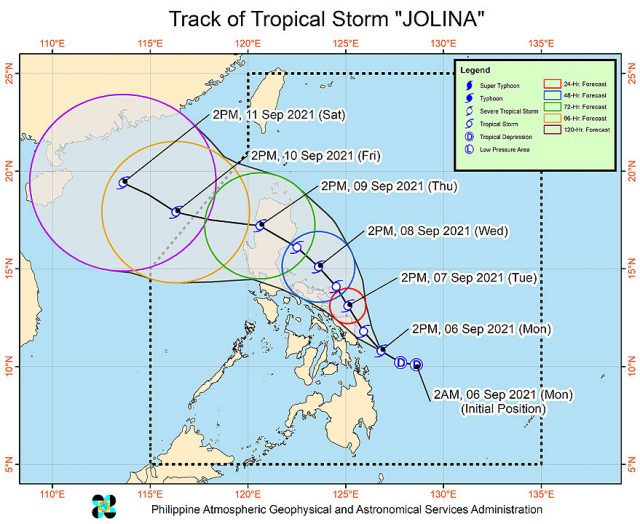
TROPICAL STORM Jolina, the 10th typhoon to enter the country this year, brought strong winds and heavy rains over the central-eastern part of the country on Monday as it headed over mainland Luzon.

State weather agency Philippine Atmospheric, Geophysical and Astronomical Services Administration (PAGASA), in its 5 p.m. bulletin on Monday, said Jolina was located 95 kilometers (km) east of Guiuan, Eastern Samar and moving northwestward with maximum sustained winds of 75 km per hour and gustiness of up to 90 km/h. Its tropical cyclone winds extend outwards up to 150 km from the center.

Storm signal #2 in a 5-level system was up in several parts of the Samar provinces. A lower signal #1 was up in southeastern portions of Luzon, parts of the Eastern Visayas Region, and the islands of Dinagat, Siargao, and Bucas Grande in Mindanao.

“In the next 24 hours, Tropical Storm Jolina may bring moderate to rough seas (1.2 to 2.8 meters) over the eastern seaboards of Visayas and Mindanao. Mariners of small seacrafts are advised to take precautionary measures when venturing out to sea. Inexperienced mariners should avoid navigating in these conditions,” PAGASA warned.

The tropical storm is forecasted to make landfall over the northern-central Luzon area by Thursday morning. However, PAGASA said a shift towards a more westward direction may move the landfall near Eastern or Northern Samar. — MSJ

Mussel, oyster farmers to lose livelihood in Manila Bay rehab

PHILIPPINE STAR/ MICHAEL VARCAS

AQUACULTURE FARMS for mussels and oysters are among the structures that will be dismantled by the government as part of the Manila Bay rehabilitation program, which would affect the livelihood of some 15,000 fishers and coastal residents, according to a fishers group.

“Rehabilitating Manila Bay should be to restore its marine resources for the benefit of small fisherfolk. But the Department of Environment and Natural Resources’ (DENR) thrust says otherwise,” said the head of the Pambansang Lakas ng Kilusang Mamamalakaya ang Pilipinas (PAMALAKAYA) group.

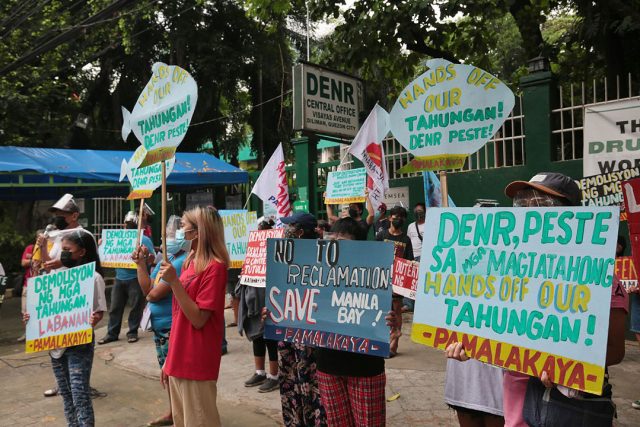
“The government’s rehabilitation program has brought fear among the fishing and coastal population because its aim is to actually destroy our livelihood and displace us from communities,” PAMALAKAYA National Chairperson Fernando L. Hicap said during a protest held at the DENR office in Quezon City on Monday.

The Cavite Task Force Group for Manila Bay previously announced that the dismantling of illegal fishing structures in the areas of Noveleta, Kawit, Cavite City, and Bacoor City will start on Sept. 7.

The task force said the dismantling is intended to regulate illegal fishing structures along Manila Bay and address the high number of bamboo poles from fish pens, fish cages, and baklads/sapras that were washed ashore during the southwest monsoon rains.

Mr. Hicap argued that the fishing structures established in Manila Bay do not pose any pollution or harm to marine biodiversity.

“The oyster and mussel aquaculture structures that will be dismantled contribute a lot to the country’s food security and fisheries production. Compared to the buildings established at reclaimed areas in Manila Bay, the mussel and oyster structures provided livelihood and supplied food to thousands of fishers,” Mr. Hicap said.

PAMALAKAYA also said the dismantling activities is but a prelude to the reclamation plan in Cavite.

“Truth be told, the government’s Manila Bay rehabilitation program is a sham and a sellout in disguise.” — Revin Mikhael D. Ochave

SMC draws up plans to protect birds visiting Manila Bay in line with airport project

PHILIPPINE STAR/KRIZ JOHN ROSALES

LISTED CONGLOMERATE San Miguel Corp. (SMC) said on Monday that it is coming up with plans to protect local and migratory bird populations that often visit Manila Bay as the firm gears up to build the New Manila International Airport project in Bulacan.

In an e-mailed statement, SMC said it has tapped Singapore-based avian researcher Frank E. Rheindt who suggested the development of new and protected coastal areas, which resemble mudflats and can provide food to migratory birds throughout the year.

Mudflats are areas covered during high tide.

Of the dozens of bird species visiting the area, few are deemed “critical” from a conservation standpoint, he noted. These critical species fall under the migratory shorebirds or waterbird category. They are attracted to tidal mudflats or coastal wetlands, which serve as their feeding ground.

“We are definitely committed to protecting bird species and supporting this advocacy. We’re considering and studying all [Mr. Rheindt’s] recommendations and will put together a plan that will align with the whole airport master plan,” SMC President Ramon S. Ang.

“Birds are always a safety concern for airports around the world. But our goal here is to protect them, and there are several ways we can do that, while also ensuring safety at the airport,” he added.

SMC’s airport project in Bulacan has yet to break ground, but Transportation Secretary Arthur P. Tugade said in June that work is already progressing. — Angelica Y. Yang

Bill prohibiting child marriage hurdles House on third and final reading

PHILSTAR

THE HOUSE of Representatives approved on Monday a bill that would prohibit child marriage in the Philippines.

In a vote of 197-0 with 2 abstentions, the congressional representatives approved House Bill 9943 that would protect children from abuse and other forms of exploitation.

Under the measure, people who arrange a child marriage will be jailed for up to 10 years, be fined at least P40,000, and lose parental authority if the person is an ascendant, parent, adoptive parent, stepparent, or guardian of the child.

Those who officiate a child marriage will also be jailed for 10 years, pay a fine of at least P50,000, and be disqualified from public office if the person works in government.

Those caught cohabiting with a child out of wedlock will also be jailed for 10 years, be fined at least P50,000, and will be disqualified from appointive or elective office.

The measure was approved by the House Committee on Women and Gender Equality on Aug. 7 and was approved on second reading on Aug. 31.

A counterpart measure was approved in the Senate on Nov. 9, 2020. — Russell Louis C. Ku

DoJ backs higher compensation for victims of wrong conviction, heinous crimes

BW FILE PHOTO

JUSTICE SECRETARY Menardo I. Guevarra on Monday said his department fully supports the proposed amendment to the law on claims that would increase the amount of compensation for those wrongfully convicted and for victims of heinous crimes.

“The DoJ (Department of Justice) will give its full support for the amendment of (Republic Act) 7309,” Mr. Guevarra told reporters in a group message on Viber.

RA 7309 is titled An Act Creating a Board of Claims under the Department Of Justice for Victims of Unjust Imprisonment or Detention and Victims of Violent Crimes.

“The law was enacted in 1992 and the value of the award has not kept up with the changing times,” he said.

On Sunday, House Deputy Speakers Michael L. Romero and Evelina G. Escudero called for the immediate consolidation of five similar bills to amend Republic Act 7309.

The bills allow victims of unjust conviction and imprisonment to file civil action and claim up to P5,000 per month of incarceration from the current P1,000. — Bianca Angelica D. Añago

Prisoners call amnesty grant a ‘sham’

KAPATID PHOTO RELEASE

PRISONERS slammed Proclamation 1093 granting amnesty to 715 prisoners who are allegedly self-confessed members of the communist movement, saying its conditions are a further form of political oppression.

“It is totally unjust that those foisted with false charges will own up to crimes they did not commit just to be able to leave prison,” the prisoners said in a statement on Monday released through human rights group Kapatid.

“Proclamation 1093 is a sham. This cannot be the means for the release of political prisoners. This is a proclamation of continuing oppression of political prisoners,” they added.

They said the other provisions of the proclamation that makes it “fake” and a “trap” are: amnesty will only be given to those who surrendered, prisoners must prove that their crime was committed only to fight for their political beliefs, and prisoners must not have been proscribed and charged and convicted under the Human Security Act of 2007 and the Anti-Terrorism Act of 2020.

Proclamation 1093 was signed by President Rodrigo R. Duterte on Feb. 16, 2021, along with three others granting amnesty to Moro rebel groups, and the Rebolusyonaryong Partido ng Manggagawa ng Pilipinas/Revolutionary Proletarian Army/Alex Boncayao Brigade.

The Philippine government has declared the Communist Party of the Philippines as a terrorist group. — Bianca Angelica D. Añago

Green power or coal power?

PIKISUPERSTAR-FREEPIK

The world has gone green. Tesla and even Porsche have electric cars. Yet, in a country like ours, green power is not getting enough of a push. Did you know it takes 200 permits to get a solar plant started? Now that’s real red tape.

We used to be number two in geothermal, now we slid to number three because Indonesia overtook us. This and other energy-related tidbits were shared with us by attorney Jay Layug, who used to work at the Department of Energy (DoE). I asked many questions related to shifting our little farm to solar power.

I asked a solar provider to give me a quotation to turn my coffee mill and cupping lab into a solar-powered facility. Alas, I need to spend AT COST almost P400,000, and it would take three years plus to recover the investment.

But I will still try to make a solar panel installation for my small house to at least provide for hot water and a few lights. Amadeo, Cavite is at a high elevation and we may not need air conditioning through most parts of the year. But we do need hot water and some lights. We need to run our electric water pump, etc.

The ideal scenario — given our green-related laws:

1. Use solar power if you consume at least 100 kilowatts (kW).

2. Sell your excess to government through Feed-in Tariff (FiT) which has been suspended for now. But which we hope will be reinstated in the next administration. Hello Mr. Secretary, what is the reason for suspending FiT?

3. We have the right and option to get power from green power providers. It’s supposed to be cheaper and better than coal, right?

(MAP had a general membership meeting on Aug. 10 where Mr. Layug was a guest and along with Sherwin Gatchalian and they explained to us the power situation.)

Now, what is happening to our green or renewable sector? Given that we already had a close brush with brownouts last summer, it’s time to prepare for next summer. Let’s use solar power whenever we can.

Besides being cost efficient and cheaper over the long haul, green power is something every household should consider. This is the future. Rommel, my nephew, turns on his air-conditioning which is powered by the sun. He installed solar panels and enjoys free aircon while conducting virtual meetings from his home. Rommel is also Mr. Electric Vehicle and started the EVs and electric jeeps many years ago.

So, where is this headed? Even Meralco has started its foray into green power. What about the other coal companies? When will you speed up towards going green?

The damage to the planet is being assessed as “irreversible,” but we are not losing hope. The first to go will be methane-producing cows and then, simultaneously, a conversion or transition to renewable energy.

Another investment will be solar plants or solar farms. We are looking for areas where the idle land can be converted into solar farms. Not every country has the gift of as much sun as ours —imagine the western countries who have the technology but do not have as much solar power as we have.

But again, 200 permits to put up a solar plant? Let’s think again. Where did we make a mistake? In any case, maybe this will be speeded up by the Anti-Red Tape Authority (ARTA) or, if enough netizens gave their opinion about it, maybe the DoE and other agencies will wake up to sun power, or wind power, or ocean power.

Like Congresswoman Loren Legarda says: “We have good laws. We just need to implement them well.” So, what are we waiting for? If each company or each village produced their own power through solar, it can even be a money-making activity for each town.

Let’s keep learning. Because power is something we all need. But we can shift to renewables. We can slowly get rid of coal or fossil fuels. But it has to start from the top. So, we are calling on our corporate heads to start green projects and the general investing public to choose renewable energy investments.

Why is it taking so long for corporate leaders to realize that this is the way of the future? Is it just profit even if it is not green profit? If one has to adjust to today’s pandemic, the heat upon us, the unprecedented power shortages, and the dire situation of our power plants, we must act now. Be the one who looks to the future. Be the one who looks at a sustainable tomorrow for your company while you are in charge.

It can be done if we all do it. If we see it.

However, only visionaries are seeing it. Are you one?

This article reflects the personal opinion of the author and does not reflect the official stand of the Management Association of the Philippines or MAP.


Chit U. Juan is a member of the MAP Diversity and Inclusion Committee, and Chair of the Philippine Coffee Board.

map@map.org.ph

pujuan29@gmail.com

map.org.ph

Pandemic statistics and public welfare

DCSTUDIO-FREEPIK

On Aug. 3, Deputy Speakers Bernadette Herrera and Kristine Singson-Meehan, Deputy Minority Leader Stella Quimbo, AAMBIS-OWA Representative Sharon Garin, and Quezon City 4th District Representative Bong Suntay filed House Resolution No. 2075 “Urging the House Committee on Good Government to Conduct an Inquiry, in Aid of Legislation, on the Qualifications, Research Methodologies, Partnerships, and Composition of OCTA Research Philippines.” Among the justifications given for the resolution is “the need to ensure the safety and security of the population… and that information being distributed is correct and are not irresponsibly and erroneously published.”

Many objected to the move of the legislators. Typical among the objections was that of UP sociology professor and columnist Randy David, who considers an inquiry “a misuse of congressional time” and notes that it could be taken as “a form of harassment, a muzzling of independent voices.”

I understand where the concerns are coming from, given the political temper of the times, but I think that the congressional probe is not only proper, but also necessary. I don’t necessarily doubt the COVID-19 projections of OCTA Research. Prof. Guido David and Fr. Nicanor Austriaco, the analysts of the firm who are the most often quoted by the media, seem more than qualified to conduct these kinds of projections. But people have the right to know how a private research group comes up with projections related to the pandemic, especially when these are actively disseminated by the media such that they affect public perceptions and behavior. Besides, scientists and data analysts have been increasingly called upon worldwide to practice transparency and accountability in their research and reporting activities, especially when these activities have impacts on people.

I looked for the methodology of the group in the OCTA Research website, but could not find it there. I have requested members of OCTA Research to share their methodology and look forward to studying it closely. Meanwhile, media outfits continue to report OCTA Research projections, with a recent one being the possibility of 30,000 cases across the country by the end of September.

To be fair, the congressional probe should not be limited to OCTA Research, but should include the projections of the Department of Health (DoH) as well. What is the department’s projection methodology? Why do DoH projections sometimes differ from those of OCTA Research when they are supposedly using common data? Which projections are ultimately used by the Inter-Agency Task Force for the Management of Emerging Infectious Diseases (IATF)? Why?

By knowing more about the methodologies behind COVD-19 projections, the public can be educated about the usefulness of such projections and understand the government’s basis for deciding to impose different levels of lockdowns.

The pandemic is literally a life and death matter. In addition, many among the poor think of the long lockdowns as a violation of their right to work and as a slow economic death. Hence, scientific analysis of the status and anticipated future of the pandemic is a matter of grave public interest. People should understand what terms like “reproduction number,” “surge,” “peak,” “positivity rates,” and “flattening the curve” mean for them in practical terms so that they can act responsibly to protect themselves and their communities.

While members of OCTA Research have welcomed the opportunity to explain their methodology to the legislators, Fr. Austriaco foresees the challenge of explaining the technical details of COVID-19 model-building to them. I wish them well in their presentations. I think their explanations on Pandemic Modeling 101 to the House representatives should be heard by all Filipinos in order to elevate scientific literacy in the country.

According to business history, the Japanese educated their managers and workers on statistical quality control after World War 2. Helped by the leading American statisticians of the day, such as W. Edwards Deming and Joseph Juran, Japan used the science of quality to achieve the most phenomenal post-war economic booms the world had ever seen.

Let’s face it. If there is one thing the pandemic has taught us, it is that we have to gear up as a nation to prove that we are collectively smarter than a virus. So far, we have not been doing so great. But if we can better understand the science and data analysis related to the pandemic, we will have a fighting chance.

In relation to the upcoming congressional probe, Ranjit Rye of OCTA Research said it well: “We will take the opportunity to explain our methodologies. … [Our] intent [is to] use science for public good. … This is the life of our nation. As citizens, we need to contribute.”


Dr. Benito “Ben” L. Teehankee is the Jose L. Cuisia, Sr. Professor of Business Ethics and Head of the Business for Human Development Network at De La Salle University.

benito.teehankee@dlsu.edu.ph

ADVERTISEMENT
ADVERTISEMENT