Home Blog Page 754

PHL insurance sector seen to sustain growth

JAKUB ZERDZICKI-UNSPLASH

THE PHILIPPINE insurance sector could post double-digit growth until next year as positive economic prospects could help drive spending and as the industry’s penetration rate remains low, the top official of East West Ageas Life Insurance Corp. (EastWest Ageas) said.

EastWest Ageas President and Chief Executive Officer Sjoerd Smeets said he expects the insurance market to grow around 11% this year despite declining interest rates and the weak performance of the stock market.

“But I still believe that next year will have a growth probably in the double digits. GDP (gross domestic product) growth in the Philippines still is expected to be around 6% next year, and you normally see the insurance market outpacing that a bit because the insurance sector in the Philippines is still under-benefited versus other Asian countries,” he said at an event on Tuesday.

“The total insurance spend [versus] GDP is something like 1.7%. And in mature markets, that’s close to 5%. So, that growth will still kick in. And with more Filipinos having higher earnings potential, we definitely expect the life insurance market to still grow.”

The sector recorded higher premiums in the first semester, according to data from the Insurance Commission (IC). Total premiums paid for life and nonlife insurance products grew by 12.98% to P242.842 billion at end-June from P214.941 billion in the same period last year.

As a result, insurance penetration, or the ratio of insurance premiums to the GDP, rose to 1.79% from 1.71% a year prior.

Insurance density, or the average spending of each individual on insurance, also increased by 12.07% to P2,137.32.

Life insurers saw a 12.01% increase in premiums collected to P195.05 billion in the period from P174.14 billion a year prior.

Philippine GDP growth averaged 5.4% in the first semester, slightly below the government’s 5.5 to 6.5% goal for the year.

Meanwhile, the Bangko Sentral ng Pilipinas has now cut benchmark interest rates by a total of 175 basis points since it kicked off its easing cycle in August 2024. It is expected to deliver further reductions until next year to help stimulate the economy as a widening corruption scandal involving state flood control and infrastructure projects is expected to affect both public and private investments.

These domestic governance concerns, along with worries over trade policies and the pace of monetary easing in developed countries, have caused Philippine stocks to decline in recent months. On Tuesday, the Philippine Stock Exchange index closed at 5,867.04, down by 10.14% or 661.75 points from its end-2024 finish of 6,528.79.

Mr. Smeets said financial literacy remains a challenge in the Philippines, contributing to low insurance penetration.

“I think the education system needs to be improved to make sure that young people start to learn to deal with money and also the unexpected things in life,” he said. “If you just see people on the streets, there’s not a lot of consciousness of savings.”

“We sometimes live too much in the day to day… In the insurance sector, we’re doing quite a lot of things to also improve that consciousness. We’re trying to make more people aware about insurance — get them to be aware of the things that will happen if something happens.”

The insurer’s PURPLE Report released at the event reflected Filipinos’ lack of consciousness about savings.

The study, which it commissioned to NielsenIQ, showed that only two out of 10 Filipinos have enough emergency funds lasting over three months, with most only having P50,000 in savings.

“This leaves the average middle-class Pinoy without the buffers needed to recover from unexpected challenges,” the company said.

It also showed that long-term financial planning is an afterthought for most Filipinos as 30% of their salaries go to their household expenses, such as for food, rent, transportation, and mortgage, making it difficult for them to set aside savings.

“Despite growing awareness to prepare for emergencies, getting started is far from easy, as Filipinos still need to plan around their current day-to-day needs,” EastWest Ageas said.

“However, Filipinos still recognize it is important to stay prepared, as it can ease their worries about unexpected situations. In fact, 52% are concerned about the health of their loved ones, and 24% worry about critical illnesses and the large medical expenses tied to them.”

The study showed that some Filipinos aged 40 and above said they have more than three months’ worth of emergency funds, reflecting an improved financial stability they age.

“However, the journey towards financial preparedness is often hampered by economic pressures like inflation and income instability. To get through emergencies, Filipinos would often rely on their personal savings, receive support from their families and communities, and take out loans from informal channels,” the insurer said.

“While these highlight Filipinos’ innate resilience, resourcefulness, and generosity, they also show their vulnerability when emergencies arise. Thus, Filipinos need the extra support to help them get through these struggles without compromising their goals.”

EastWest Ageas booked a premium income of P4.97 billion and a net income of P225.49 million in 2024, based on IC data.

East West Ageas Marketing Officer Greg Martin said at the same event that they continue to grow their presence nationwide following their expansion into Davao and Cebu.

“We’ll be expanding in the Bulacan area and in the Quezon City area as well. How we do that, though, is in a very careful and very commercially orientated fashion.” — Aubrey Rose A. Inosante


Peso rises to two-week high on divided Fed, inflation bets

BW FILE PHOTO

THE PESO continued to strengthen against the dollar on Tuesday, posting a two-week high, as several US Federal Reserve officials signaled that they are open to another rate cut next month despite the cautious tone adopted by its chief.

Bets of within-target Philippine headline inflation in October also supported the currency against the greenback.

The local unit closed at P58.515 per dollar, rising by 27.5 centavos from its finish of P58.79 on Monday, Bankers Association of the Philippines data showed.

This was its best finish in nearly two weeks or since it ended at P58.41 a dollar on Oct. 22.

The peso opened Tuesday’s session stronger at P58.70 against the greenback. Its intraday best was at P58.51, while its weakest showing was at P58.75 versus the dollar.

Dollars exchanged inched up to $1.327 billion on Tuesday from $1.326 billion on Monday.

“The peso continued to appreciate after several Federal Reserve officials expressed openness towards delivering a rate cut in the December Fed meeting,” a trader said in an e-mail on Tuesday.

Fed officials continued offering competing views of where the economy stands and the risks facing it in the absence of economic data suspended due to the shutdown, Reuters reported.

The Fed cut rates last week, but Chair Jerome H. Powell suggested that might be the last cut of the year. Traders are now pricing in a 65% chance of a rate cut in December, compared with 94% a week earlier, CME FedWatch showed.

On Monday, Fed Governor Lisa Cook portrayed a tug-of-war view of the policy debate, saying elevated risks to both the central bank’s employment and inflation mandates leave the Dec. 9-10 meeting “live” for a possible rate cut, but not a lock.

Speaking earlier in the day, San Francisco Fed chief Mary Daly offered a similarly even-handed perspective, saying she viewed last week’s cut as further “insurance” against labor market weakening and has an “open mind” about the need for a similar move in December.

The peso continued to correct ahead of the release of Philippine October inflation data on Wednesday (Nov. 5), Rizal Commercial Banking Corp. Chief Economist Michael L. Ricafort said in a Viber message.

He said the October consumer price index (CPI) “is expected to be slightly higher versus 1.7% in September 2025 but still considered benign or still below the BSP’s (Bangko Sentral ng Pilipinas) inflation target range of 2%-4% and could still support future local policy rate cuts.”

A BusinessWorld poll of 17 analysts yielded a median estimate of 1.8% for the October CPI, which would be up slightly from the 1.7% clip in September but slower than the 2.3% seen in the same month last year.

This would be within the BSP’s 1.4-2.2% forecast for the month and mark the eighth straight month that inflation was below its 2%-4% annual goal.

The trader said the peso may rise further on Wednesday on expectations of within-target Philippine inflation.

The trader sees the peso moving between P58.35 and P58.60 versus the greenback, while Mr. Ricafort said the local unit could trade from P58.40 to P58.65. — Aubrey Rose A. Inosante with Reuters

Netherlands to return 3,500-year-old sculpture to Egypt

THE Netherlands will return a 3,500-year-old sculpture that turned up at a Dutch art fair to Egypt, Prime Minister Dick Schoof said on Sunday during a visit to the country, where he met with President Abdel Fattah al-Sisi.

The artifact in question, which depicts a senior official from the 1479-1425 BC reign of Pharaoh Thutmose III, is believed to have been stolen and illegally exported, most likely during the unrest of the 2011 Arab Spring, before appearing on the international art market.

The “historic cultural artifact (was) confiscated at a Dutch art fair” in Maastricht in 2022, Mr. Schoof said, after someone anonymously tipped off the authorities about its illicit origin.

An investigation by Dutch police and the cultural heritage inspectorate confirmed that the sculpture had been plundered and unlawfully removed from Egypt. The dealer who had the piece voluntarily surrendered it following the inquiry.

The Dutch government said it expects to hand over the artifact to the Egyptian ambassador in the Netherlands by the end of this year, although no specific date has been set. — Reuters

The politics of nepotism: How ‘nepo babies’ rule the Philippines

THIS RESOURCE WAS GENERATED WITH AI./FREEPIK

(This piece was originally published in The Benildean, the official student publication of De La Salle-College of Saint Benilde. It received an Excellence Award at the 11th Philippine Student Quill Awards, the junior counterpart of the Philippine Quill Awards.)

Well-known personalities in the Philippines are often revealed to have ties or relations to other influential figures in certain industries, such as the Barretto clan in Filipino showbiz, the Filipino-Chinese Sy family of the SM Group, and even the lineage of the country’s current president — the Marcoses. There is nothing wrong with supporting family members and friends in their careers, but the problem arises when they’re marketed as an extension of each other’s success and given unfair advantages over more qualified candidates.

Stemming from the term “nepotism,” “nepo baby” is a Generation Z-born label referring to a person who is only successful due to their parents or familial connections. Despite the recent conception of the term, nepotism is not a new notion, especially in the Philippines. A classic example is the Padrino system, wherein favors, promotions, or political appointments are obtained through friendship or family ties rather than on the basis of merit.

Therefore, it is no surprise that Filipino society has always embraced nepo babies in various industries, as seen in political dynasties that dominate elections and relatives of successful celebrities seemingly hitting the jackpot on their first gig. Filipinos are quick to put familiar names on a pedestal while turning a blind eye toward their inadequacies and shortcomings, overestimating their abilities simply because their last name is tied to an already established one.

Society’s ignorance and complacency have led to a vicious cycle of unscrupulous governance and repetitive mishaps. As Filipinos continue to allow incompetent figures to be industry leaders, national representatives, and key persons in society, the unending cycle of nepotistic oligarchy will persist to corrupt the country.

FROM PRIVILEGE TO SUCCESS
Through their connections, nepo babies can bypass standard procedures, avoid corrupt higher-ups, and gain insider tips that give them an edge over non-nepo babies. The gap between the privileged and the less fortunate widens as it becomes more difficult for unprivileged Filipinos to penetrate an industry. Despite the unfair advantage of nepo babies, some Filipinos still fervently support them over no-name novices, forming a biased cultural perspective and reducing themselves to merely being observers of the rich and famous, rather than being a whole and balanced society.

In an interview with The Benildean, a Hotel, Restaurant, and Institution Management student, JR, commented on growing up as the grandson of one of the richest Filipino-Chinese tycoons in the country.

“I have to admit that when I was younger, I didn’t see my privilege as ‘privilege.’ I didn’t realize what was normal for me wasn’t the norm for everyone else.” He continued, “But as I got older, I was more exposed to the family business and began to understand how lucky and fortunate I am.”

While on the topic of privilege and advantages, JR shared how his parents always made sure he and his siblings worked for their success and never spoon-fed them unfair opportunities like college admissions or high-ranking company positions, forcing them to start from the bottom and work their way up. He also talked about the pressure he and his siblings face, saying, “Being the third generation, there’s a lot of expectations to do well in specific fields as my siblings and cousins, and myself included, are being prepared to take over different departments of the family business in the future.

“Yes, I’m a nepo baby by definition, but I was raised by my parents to strive for my success. Nevertheless, I’m always thankful to have a family who can celebrate my wins and support me if I fail,” he emphasized.

In another interview with The Benildean, Sign Language Interpretation student, Jiro, shared a different perspective, explaining her conflicts and struggles with being the niece of a well-known senator.

“His experience and career in politics greatly influenced my decision to rule out politics entirely as a future career path,” she explained. “Growing up hearing stories on the news of his clashes with other people was [enough] reason for me to look elsewhere for a career.”

Having been exposed to this kind of lifestyle, Jiro also disclosed her frustrations with opportunities being handed to her despite her refusal. “I almost got a scholarship slot unfairly. My uncle went as far as to contact one of the higher-ups of the school I wanted to go to and asked [them] to save me a slot. He is still under the impression that I got in because of him.

“It’s maddening enough that a lot of people with privilege shrug when confronted with the reality that many do not get these benefits. There’s indeed little that can be done immediately, but defeatist attitudes definitely do not contribute to eventual change,” she continued saying on her dissatisfaction with the system, pleading for greater change.

HISTORY REPEATS ITSELF
As elite dynasties manage to keep their success amongst themselves, the privilege, status, and wealth only circulate among the upper echelons as they compete with one another for complete domination of specific industries, while the majority can only fend for themselves to make ends meet — a recurring tale of how the rich get richer and the poor get poorer.

Today’s national leaders still carry the same family names as the powerful aristocratic Filipinos in history. A study by Oxfam International and Development Finance News showed that the top 1% of Philippine billionaires hold about 25% of Asia’s wealth as of 2022.

To exacerbate things further, nepotism and cronyism — the unfair practice of giving jobs and other favors to friends — have trickled down from the top and infiltrated every industry and sector, becoming common occurrences that Filipinos have complacently accepted. Consequently, the majority who suffer from the system have now also begun to practice it with those below them in the capitalist pyramid — creating an endless loop of power struggle and internal strife, while slowly destroying the essence of community-building and instead embodying the philosophy of “Every man for himself.”

HOPE DOWN THE ROAD
How are we meant to progress if we are unable to break free from our dishonest actions and realize the truth behind our biased society?

Regardless of the norm we’re accustomed to, it’s time to rid ourselves of our ignorance and rise above spoon-feeding government positions and give opportunities to regular individuals.

It’s easy to get caught up in glamorizing our parasocial relationships with nepo babies, but we must remember that these are only symptoms of a much more prevalent societal issue. Beyond them is a system that allows only the privileged to enter doors without lifting a single finger, while the majority work themselves to the bone simply to have a quarter of the same advantages they do.

As Filipinos, it’s our responsibility to support and appoint the best people to lead our country in the right direction. The disastrous domino effect of the Padrino system has been going on for generations as people slowly accepted a dull future as reality, complacently resigning themselves to the downturned fate of the country. However, is this truly the way we want it to end — a series of unfortunate events and poor decisions that led the country to its demise? We are battling nobody but ourselves and the system we have created.

Change can only start from the bottom, from the people, to overhaul a centuries-old system from the roots.


Maxine Cheung is a student of De La Salle-College of Saint Benilde.

Bacolod’s Merzci markets its way to nationwide success

MERZCI WEBSITE

By Edg Adrian A. Eva, Reporter

MERZCI, a household name in Bacolod City’s pasalubong (souvenir) food scene, credits its nationwide success to a relentless marketing push that transformed it from a small bakery into a multi-branch enterprise.

Founded in 1995 by Jonathan Manuel T. Lo, a marketing specialist turned entrepreneur, Merzci has grown from a single stall in Bacolod’s Libertad Market into a 73-branch brand recognized across the Philippines.

Its signature product, piaya — a local flatbread filled with muscovado — remains a bestseller, with daily production reaching 150,000 pieces thanks to heavy investments in automation.

“Our goal is not to be No. 1, but to be top of mind,” Neslie Anne L. Sibayan, the company’s public relations and event coordinator, told BusinessWorld in Filipino during a recent site visit to their Bacolod City factory. “When people think of pasalubong, we want them to think of Merzci.”

Ms. Sibayan said the brand’s marketing playbook is built on consistency and visibility. “We’re aggressive. We invest in advertisements, re-run ads on Facebook and other social media platforms, and stay active in business conventions,” she said.

That strategy has paid off in an increasingly competitive market dominated by heritage brands and regional players. Even during the pandemic, Merzci kept brand recall through digital engagement and community initiatives.

The company also extends its presence beyond traditional retail. It recently joined the Department of Science and Technology’s Disaster Preparedness Visayas Leg event in Bacolod as one of the featured exhibitors — part of its broader effort to align with government and institutional programs.

Apart from breads, Merzci expanded into nutritious food production in 2023, making fortified food products for schools and local government clients, Maria Alicia M. Beba, the company’s research and development manager, told BusinessWorld.

“Since they saw that we had the capacity, facilities and resources, they decided to invest in us to make products like fortified rice,” she said, referring to their supply partnership with the Department of Education.

One of its Bacolod factories now produces iron-fortified rice, fit bars and cheese curls designed to support school feeding programs.

For the 2025–2026 school year, the company is set to produce five million fit bars, with three million more to be completed by March.

Aboitiz Group Q3 profit hits P8.9B

TARI Estate, Tarlac City, Tarlac — ABOITIZINFRACAPITAL.COM

ABOITIZ EQUITY VENTURES, INC. (AEV) reported a consolidated net income of P8.9 billion in the third quarter, driven by stronger performance from its energy and food units.

“AEV’s results this quarter reflect the resilience of our portfolio and the dedication of our teams across all our businesses,” President and Chief Executive Officer Sabin M. Aboitiz said in a statement on Tuesday.

For the first nine months of 2025, AEV posted a net income of P17.3 billion, down 7.97% from a year earlier, as robust third-quarter earnings were offset by a softer first half. The company did not disclose comparative figures.

Its power arm, Aboitiz Power Corp., accounted for 60% of group earnings, contributing P12.5 billion for the nine-month period. The company attributed the gains to higher generation margins, improved hydropower inflows and the addition of solar capacity.

The food and beverage segment, operated under Aboitiz Foods Pte. Ltd., contributed P5.2 billion or a quarter of total earnings, bolstered by flour, farms and trading operations as well as contributions from Coca-Cola Europacific Aboitiz Philippines.

Union Bank of the Philippines added P3.2 billion, while Aboitiz Land, Inc. and Aboitiz InfraCapital, Inc. posted earnings of P879 million and P137 million, respectively.

“AEV remains well-positioned for growth as we advance our transformation into the Philippines’ first ‘techglomerate,’” Mr. Aboitiz said, referring to the group’s digital and operational modernization program across its core businesses.

The group reported a gross revenue of P141.69 billion in the first half, according to its most recent financial statement.

Aboitiz Power remains the biggest contributor to group income, accounting for almost a quarter of the country’s generation capacity as of mid-2025. The unit has been expanding its renewable energy portfolio through hydro and solar investments, in line with the group’s goal of reaching 4,600 megawatts of renewables by 2030.

AEV shares rose 0.36% or 10 centavos to close at P28.25 apiece at the local bourse. — Ashley Erika O. Jose

Worker trapped under collapsed medieval tower in Rome dies, media says

COMMONS.WIKIMEDIA.ORG

ROME — A Romanian worker trapped for hours under rubble in Rome on Monday following the partial collapse of a medieval tower near the Colosseum has died, local media said.

The man was rescued by emergency services late on Monday and taken to hospital in a serious condition, Rome police chief Lamberto Giannini had previously said.

Parts of the 29-meter Torre dei Conti crashed to the ground on at least two occasions, videos posted on social media and Reuters video showed. The first collapse took place at around 1030 GMT, the second about 90 minutes later.

Clouds of dust came billowing out of the windows, along with the sound of collapsing masonry. The second incident took place while firefighters were working on the structure with aerial ladders.

A second worker, also Romanian, was pulled out almost immediately and hospitalized with serious but not life-threatening head injuries, while two more workers suffered minor injuries and declined hospital treatment.

None of the firefighters was injured.

Authorities have seized the construction site, Italian daily Corriere della Sera reported.

TOWER BUILT BY 13TH CENTURY POPE
The tower, which was due to be converted into a museum and conference space, is located halfway along the Via dei Fori Imperiali, the broad avenue that leads from central Piazza Venezia to the Colosseum.

The building was still standing, but showing significant internal damage.

It once hosted city hall offices but has not been in use since 2006 and was being worked on as part of a four-year renovation project due to end next year, according to Rome city authorities.

Due to the European Union-funded restoration work, the area around the tower was closed off to pedestrians.

The building was erected by Pope Innocent III for his family in the early 13th century, and was originally twice as high, but was scaled down after damage from earthquakes in the 14th and 17th centuries. — Reuters

Determining stockholder status in a corporation

STOCK PHOTO | Image by Pressfoto from Freepik

One of the common disputes within corporations is the matter of stock ownership, which is material to determine quorum, voting rights, right to dividends, right to inspect corporate records, and preemptive rights, among others.

In determining stockholder status, the stock and transfer book still remains as the primary basis. This is the pronouncement of the Supreme Court in the recent case of Lopez v. Lopez, et al. (Lopez).1

STOCK AND TRANSFER BOOK VS GENERAL INFORMATION SHEET
In Lopez, the petitioner, together with her children, filed two separate complaints for election contest before separate lower courts to nullify the convening of special stockholders’ meetings and the elections of board of directors for several corporations, for being tainted with legal infirmities.

The petitioner and her children claimed that they were excluded from participating in the meeting and elections. Further, despite the petitioner’s children being recorded as stockholders in the General Information Sheet (GIS), their proxies were prevented from attending and participating in the special stockholders’ meeting and elections of the board of directors by the respondents. The petitioner claimed that she walked out of the venue since she was not allowed to have her lawyer present during the meetings. Thus, they alleged that their exclusion resulted in the failure to reach a quorum, and thus made the resulting meeting and elections null and void.

The respondents countered that the petitioner’s children were not considered stockholders since their names were not listed in the stock and transfer book. As such, their presence and participation were not required to attain quorum.

The lower courts ruled in favor of the petitioner and held that the special stockholders’ meetings and elections for the subject corporations were null and void. The petitioner and her children are considered stockholders considering that they appeared and are listed as such in the GIS submitted to the Securities and Exchange Commission (SEC), notwithstanding the fact that their names are not listed in the stock and transfer book.

Upon appeal, however, the Court of Appeals reversed and set aside the lower courts’ rulings and upheld the validity of the meetings and the elections conducted.

When the case reached the Supreme Court, it initially reversed the Court of Appeals’ ruling through its Decision dated June 15, 20222 and held that the subject corporations should have referred to the GIS, instead of the stock and transfer book, as the latest GIS would have given a “more accurate representation of the actual stockholdings” to determine whether or not quorum was constituted during the meeting and in view of the “undisputed findings of the court a quo that the entries [in the stock and transfer book] were of doubtful veracity.”

On motion for reconsideration and after reexamination of the records and the factual backdrop of the case, the Supreme Court, through its Resolution dated April 21, 2025 reversed its 2022 Decision and ruled that the stockholders’ meetings and resultant elections of the board of directors of the subject corporations were validly conducted and must be upheld.

In reversing itself and upholding the validity of the stockholders’ meetings and resultant elections of the board of directors, the Supreme Court reiterated the rule that the stock and transfer book of a corporation is the primary basis for determining the stockholders of a corporation, as it is only when the transfer of shares has been recorded in the stock and transfer book that a corporation may rightfully regard the transferee as one of its stockholders.

Such Resolution aligns with previous pronouncements of the Supreme Court in F & S Velasco, Co., Inc. v. Madrid3 and Lao v. Lao,4 where it consistently held that the stock and transfer book should be the primary basis in determining the shareholders of a corporation. The Supreme Court likewise emphasized that between the stock and transfer book and the corporation’s GIS, the former is controlling. The mere inclusion as a shareholder in the GIS of a corporation is, by itself, insufficient proof that such a person is a shareholder.

STOCK AND TRANSFER BOOK — NOT CONCLUSIVE
In Lao, the Supreme Court notably identified other evidence that may be presented to prove that one is a stockholder of a corporation in order to overcome corporate records: a certificate of stock issued in the stockholder’s name is prima facie evidence that the holder is a stockholder of a corporation, and, in the absence thereof, other documentary evidence, such as a deed of assignment, or any similar instrument, may be presented to establish how the alleged stockholder acquired or came into ownership of the shares of stock. Hence, while courts may give strong weight to entries recorded in a corporation’s stock and transfer book, it is not conclusive and can still be overcome by parol evidence to supply omissions, explain ambiguities, or to impugn the corporate records.

In Lopez, the Supreme Court held that, unless otherwise proven to be irregular, the general rule that the stock and transfer book is considered as the primary basis to determine stock ownership, applies. In the same case, however, the petitioner’s children failed to establish their status as stockholders by mere presentation of the subject corporations’ GIS. Likewise, they did not possess any certificates of stock issued in their names, nor did they show any document to prove their ownership of shares therein. Further, they failed to explain how they came to acquire the subject shares. Accordingly, their exclusion from the special stockholders’ meetings and the resulting elections had no effect and cannot serve as a ground to nullify the same.

DUTY OF STOCKHOLDERS AND THE CORPORATION
In light of the foregoing, it is the stockholder’s burden to prove their stockholder status in a corporation.

The stockholder must ensure that (i) his ownership is recorded in the corporation’s stock and transfer book, (ii) he is in possession of supporting documents, including but not limited to: certificate of stock, transfer documents evincing proof of purchase or acquisition, and/or proof of payment of transfer taxes.

Corollarily, it is the corporation’s duty to align and update its corporate records with actual stock ownership and to safekeep supporting documents to avoid disputes involving stockholder status.

1G.R. Nos. 254957-58, April 21, 2025 (RESOLUTION).

2G.R. Nos. 254957-58, June 15, 2022.

3G.R. No. 208844, Nov. 10, 2015.

4G.R. No. 170585, Oct. 6, 2008.

The views and opinions expressed in this article are those of the author. This article is for general informational and educational purposes only and not offered as and does not constitute legal advice or opinion.


Ry Jordane V. Reyes is an associate of ACCRA Cebu.

rvreyes@accralaw.com

(032) 231-1449 / (032) 231-4223

Women startup founders face capital, gender barriers

FREEPIK

By Beatriz Marie D. Cruz, Reporter

WOMEN-LED startups in the Philippines continue to face systemic barriers to growth — from limited access to funding to persistent gender bias — despite their growing influence in the country’s innovation economy, industry representatives said.

“Filipina founders and leaders are not short on ideas or grit,” Celina Francia R. Durante, head of communications at Kickstart Ventures, said in an e-mailed reply to questions. “What needs to improve are the pathways — access to investors, mentors and networks that turn their vision into reality.”

A 2025 DealStreetAsia report found that all-women founding teams in Southeast Asia raised just $94.5 million in equity funding, equivalent to only 2.1% of the region’s total — a stark reflection of how female entrepreneurs remain underfunded.

In the Philippines, women founders have made strides in industries like financial technology, health technology, sustainability and education, and many also serve as investors and mentors themselves.

Some of the country’s most successful startups are female-led: Globe Fintech Innovations, Inc. (Mynt), the operator of GCash, is headed by Chief Executive Officer (CEO) Martha Sazon, while parenting platform Edamama was co-founded by Bela Gupta D’Souza, and HR technology firm Sprout Solutions by Alex Gentry.

However, beyond these success stories, most female founders struggle with limited financing and mentorship opportunities. Niña L. Terol, co-founder and CEO at FoundHer, a platform for Filipina-led startups, said many women face a “gender capital gap.”

“There are many factors for the gender capital gap, but one big reason is the privilege gap that exists between the ‘tech bros’ and women — whether startup founders or operators — who do not come from privileged backgrounds and who lack the network to open doors for them in the tech world,” she said in a Facebook Messenger chat.

She added that women-led startups are often missing from data tracking and investment studies, making it harder for institutions to understand and support their needs.

Jessica de Mesa Lim, founder and CEO at health startup Kindred Health, Inc., said gender bias remains a quiet but persistent force that shapes how women are perceived in boardrooms and investor meetings.

“Gender bias, whether subtle or overt, still influences how women are perceived in boardrooms and investor pitches,” she said in an e-mailed reply to questions.

To close these gaps, Ms. Durante said startups should diversify their leadership teams to reflect the markets they serve, while government and private institutions can integrate gender inclusion in policies and mentorship programs.

“When women have equal access to capital, mentorship and opportunity, it doesn’t just serve them as founders or leaders,” she said. “It also elevates the entire startup ecosystem to its potential.”

Divided Fed policymakers stake out positions ahead of December meeting

REUTERS

WASHINGTON — US Federal Reserve officials on Monday continued pressing competing views of where the economy stands and the risks facing it, a debate set to intensify ahead of the US central bank’s next policy meeting and in the absence of data suspended due to the federal government shutdown.

In her first public remarks since President Donald J. Trump launched a so-far unsuccessful attempt to remove her from her position, Fed Governor Lisa Cook portrayed a tug-of-war view of the policy debate, saying elevated risks to both the central bank’s employment and inflation mandates leave the Dec. 9-10 meeting “live” for a possible rate cut, but not a lock.

“Keeping rates too high increases the likelihood that the labor market will deteriorate sharply,” though for now the labor market is “still solid,” she said during an event at the Brookings Institution.

On the other hand, Ms. Cook said, “lowering rates too much would increase the likelihood that inflation expectations will become unanchored,” though at this juncture “it is encouraging that most long-run inflation expectations… are low and stable.”

“The dual mandate is in tension… so I’m attentive to both sets of risks,” said Ms. Cook, who is embroiled in a legal battle with Mr. Trump over his effort to remove her as a Fed governor. The US Supreme Court is due to hear arguments in the case early next year.

SHARP SPLIT, DOVISH ANXIETY
Speaking earlier in the day San Francisco Fed chief Mary Daly offered a similarly even-handed perspective, saying she viewed last week’s cut as further “insurance” against labor market weakening and has an “open mind” about the need for a similar move in December.

“It would be an unfortunate outcome, one that we would absolutely want to avoid, if we get inflation to 2% at the cost of millions of jobs,” she said. At the same time, she said, inflation remains too high and the Fed must make a decision that “balances those risks.”

The remarks, from two policymakers often aligned with the views of Fed Chair Jerome H. Powell, “give no indication the Fed is trying to socialize a planned December skip, but confirm sentiment on the Committee broadly has shifted in the direction of viewing a cut at that meeting as less clear-cut and less certain,” wrote Evercore ISI’s Krishna Guha.

The pair’s “lingering dovish labor anxiety,” he said, suggest the Fed is still about twice as likely to cut in December as not to cut. That’s about the same odds currently priced into interest-rate futures markets.

MIRAN SAYS FINANCIAL MARKET BUOYANCY NO BAR TO RATE CUTS
The 10-2 policy vote at the central bank’s Oct. 28-29 meeting to lower the benchmark interest rate by a quarter of a percentage point to the 3.75%-4% range was only the third time since 1990 that dissents were cast in favor of both tighter and looser monetary policy at the same meeting.

Mr. Powell, speaking after the decision Wednesday, indicated an even deeper divide as he noted the “strongly differing views about how to proceed” at the December meeting and said another rate cut then “is not a foregone conclusion — far from it.”

In an appearance on the Bloomberg television program, Fed Governor Stephen Miran restated the case for deep interest rate cuts that he has voted for since joining the central bank’s Board of Governors in September. He argued buoyant stock and corporate credit markets are no reasons to think monetary policy is too loose.

“Financial markets are driven by a lot of things, not just monetary policy,” said Mr. Miran, who is on leave from his job as a top economic adviser in the White House, in explaining why he dissented last week against the Fed’s decision in favor of a bigger half-percentage-point reduction.

Mr. Miran’s preference for steep rate cuts remains an outlier, though others at the central bank, including Fed Governor Christopher Waller, have similarly indicated they feel short-term borrowing costs are restraining the economy, which allows room for further rate cuts.

Rising equity prices, narrow corporate credit spreads, and other factors don’t “necessarily tell you anything about the stance of monetary policy” at a moment when interest-sensitive sectors like housing are less buoyant and some parts of the private credit market appear under stress, Mt. Miran said.

He added that he is more sanguine than his colleagues about inflation, and feels that by keeping policy too restrictive the Fed is heightening the risk of a downturn.

GOOLSBEE NERVOUS ABOUT INFLATION
Kansas City Fed President Jeffrey Schmid, who dissented last week in favor of no rate cut because inflation remains too high, had argued that high equity prices and elevated high-yield bond issuance showed policy was only modestly restrictive.

Two non-voting Fed bank presidents — Dallas Fed’s Lorie Logan and Cleveland Fed President Beth Hammack — late last week said they too had opposed the rate cut, while Atlanta Fed President Raphael Bostic indicated discomfort at the prospect of more cuts.

Chicago Fed President Austan Goolsbee, who voted for last week’s rate cut, told Yahoo Finance Monday that he was leery of further rate cuts while inflation remains significantly above the central bank’s 2% target and is expected to accelerate through the rest of 2025.

“I’m not decided going into the December meeting,” he said. “I am nervous about the inflation side of the ledger, where you’ve seen inflation above the target for four and a half years, and it’s trending the wrong way.” — Reuters

Mitsui unit buys 40% stake in Arthaland’s Makati condo project

ARTHALAND CENTURY PACIFIC TOWER — ARTHALAND.COM

ARTHALAND CORP. on Tuesday said SEAI Metro Manila One, Inc. (SEAIMMO), a wholly owned unit of Mitsui Fudosan (Asia) Pte. Ltd., is acquiring a 40% stake in Zileya Land Development Corp. for P724.83 million.

In a stock exchange disclosure, the property developer said its board approved the joint venture and investment agreement between its subsidiary Zileya and SEAIMMO.

The partnership covers the development, construction and sale of a residential condominium project along Arnaiz Avenue in Legaspi Village, Makati City.

Arthaland said the transaction is still subject to the fulfillment of closing conditions under the definitive agreement.

SEAIMMO’s parent, Mitsui Fudosan Co., Ltd., is one of Japan’s biggest real estate developers and is listed on the Tokyo Stock Exchange.

Arthaland, a boutique property developer, focuses on sustainable residential, commercial and leisure projects.

The company posted an attributable net income of P210.05 million in the first half, down 23% year on year, as gross revenue slipped 14% to P2.21 billion. — Ashley Erika O. Jose

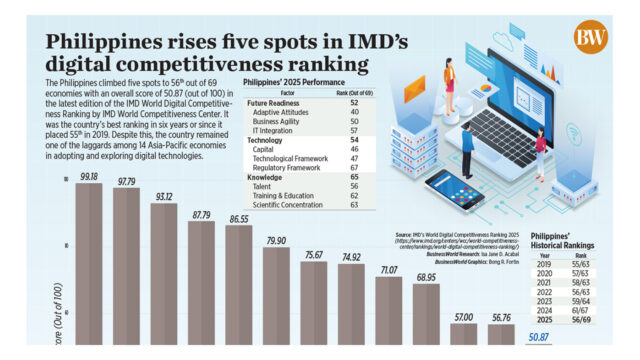
Philippines rises five spots in IMD’s digital competitiveness ranking

THE PHILIPPINES improved five spots in the World Digital Competitiveness Ranking by the International Institute for Management Development (IMD), but remained a laggard in the Asia-Pacific region. Read the full story.

Philippines rises five spots in IMD’s digital competitiveness ranking

ADVERTISEMENT
ADVERTISEMENT