Home Blog Page 7519

Deutsche Bank expands debt products with green repo

REUTERS

DEUTSCHE BANK AG has just completed its first green repurchase agreement (repo), marking another foray into a world of increasingly complex environmental, social and governance (ESG) instruments.

It’s the latest example of product proliferation in a market that’s moving much faster than regulators. JPMorgan Chase & Co. has already said it plans to attach ESG labels to all forms of finance, as ESG derivatives start to become a market fixture. Deutsche says it intends to continue expanding its offering of ESG instruments.

Regulators have yet to decide what a green repo is. The European Repo and Collateral Council has been consulting market participants on how best to define a sustainable repo deal, with a variety of different approaches emerging. In the meantime, the addition of more exotic products to the ESG market means an asset universe that already reached $35 trillion last year is set to grow at an even faster pace.

For its green repo, Deutsche transferred securities to London-based asset manager M&G Investments. In return, the German bank received cash to fund its green asset pool, which includes renewable energy projects such as wind and solar power plants, as well as the improvement of energy efficiency in commercial buildings.

Deutsche says the transaction is the first of its kind in Europe. BNP Paribas SA has completed a similar deal with Agricultural Bank of China Ltd.

Claire Coustar, Deutsche Bank’s global head of ESG for fixed-income and currencies, said the hope is that the green repo “will encourage more activity so that a new source of green finance can be developed for the industry, as well as a new asset class for investors.”

The multitrillion-dollar repo market is grappling with how best to adapt to the sustainable finance revolution. There are broadly three different approaches: using the proceeds from the cash leg of the transaction on green projects; using sustainable collateral, such as green bonds; and tying the repo rate to the achievement of sustainability goals.

The Deutsche-M&G repo uses the first of these. The bank completed a deal with Akbank TAS last month that tied the repo rate to the achievement of goals concerning gender balance, renewable energy use and avoidance of funding to coal power plants.

Chief Executive Officer Christian Sewing has made clear he intends for Deutsche Bank to gain a solid foothold in the rapidly expanding market for ESG, which Bloomberg Intelligence estimates will exceed $50 trillion by 2025. Overall, Deutsche Bank has set itself targets to facilitate €200 billion ($260 billion) in sustainable finance and investments by the end of 2023, and has also linked top executives’ pay to those targets.

Meanwhile, Deutsche’s asset management arm, DWS Group, is being investigated for allegedly inflating the value of its ESG holdings. The unit has vehemently rejected the claims, but the industry has taken note of the change in tone as regulators start to crack down on greenwashing.

Deutsche’s plan to introduce more ESG financial products in the coming months rests on its ambition “to be a market leader in ESG fixed income,” said Ms. Coustar. Given the bank’s experience “across the product spectrum,” the intention is “to leverage that expertise to help develop the sustainable finance market,” she said.

“Through this transaction, both parties have for the first time actively targeted ESG outcomes,” said Nina Moylett, Managing Director of Cash and Currency at M&G. “This demonstrates how capital can be allocated to drive innovation in markets that will open up new sustainable opportunities for investors over time.” — Bloomberg

Pueblo de Oro sees strong sales in Pampanga

PUEBLO DE ORO Development Corporation (PDO) is expanding its residential projects in Pampanga province, as the developer seeks to take advantage of strong demand.

“The real estate market in Pampanga has been performing well. Over the past year, we’ve experienced positive sales despite the pandemic,” PDO Senior Vice-President Leonardo B. Dayao, Jr. said in a statement.

Mr. Dayao pointed to the province’s economic development, supported by information technology and transportation infrastructure, that has made it an ideal place to do business.

“Ongoing projects such as the new passenger terminal at the Clark International Airport, the Metro Rail Transit (MRT) 7, the Central Luzon Link Expressway Phase I and II, and the Philippine National Rail North 1 and 2 are expected to further boost employment and growth in the province,” he said.

PDO launched the second phase of its Horizon Residences in Barangay Del Carmen, San Fernando, Pampanga. There are only 90 units within the three-hectare property. The developer is offering a single detached unit with floor area of 70 square meters (sq.m.) and single attached unit with 81 sq.m.

Also located within the same barangay is La Aldea Fernandina II Blue Series. The project has 181 three-storey units and 96 two-storey units.

Eton Centris gets ‘safety seal’

THE Quezon City local government recently granted a “safety seal” to the Eton Centris complex, reflecting Eton Properties’ efforts to maintain health and safety standards.

In a statement, Eton Properties said the safety seals were given to the commercial areas and office buildings within the Eton Centris complex, including Centris Walk, Centris Station, and Centris Cyberpods 1, 2, 3, and 5.

“We are committed to making sure that our customers are secure within Eton Centris’ premises.  With these Safety Seals, Eton Centris guarantees that we are following all the health and safety protocols and that they are strictly implemented,” Eton Properties Chief Operating Officer Karlu Tan Say said.

Having a safety seal means the establishment was inspected by the local government and deemed compliant with the minimum public health standards. The safety seal is valid for six months, but renewable as long as the establishment continues to comply with the standards.

Britney Spears announces engagement to boyfriend Sam Asghari 

LOS ANGELES  Pop superstar Britney Spears, who has been fighting a conservatorship that governs her personal life and finances, announced on Sunday that she is engaged to longtime boyfriend Sam Asghari. 

The “Stronger” singer posted a video of herself standing next to Mr. Asghari and showing off a shiny ring on her hand. “I can’t f***ing believe it,” she said in the caption, next to ring emojis. 

Mr. Asghari separately posted a photo of the pair kissing and Ms. Spears extending the finger with the ring. Mr. Asghari’s manager Brandon Cohen confirmed that the pair were engaged. 

 “The couple made their long-standing relationship official today and are deeply touched by the support, dedication and love expressed to them,” Mr. Cohen said via e-mail. 

Ms. Spears, 39, has been married twice before. She wed childhood friend Jason Alexander in Las Vegas in 2004, but that marriage was annulled a few days later. Later that year, she married dancer Kevin Federline, with whom she had two children, before the marriage ended in divorce in 2007. 

Iranian-born Mr. Asghari, 27, is a personal trainer and actor who has appeared on the Showtime series Black Monday. He and Ms. Spears began dating in 2016. 

In June, Ms. Spears told a Los Angeles court that the 13-year-old conservatorship partially controled by her father was abusive, saying “I just want my life back.” She said she hoped to marry and to have more children. 

Last week, Ms. Spears’ father, Jamie Spears said circumstances had changed and he filed a petition asking for the conservatorship to be ended. The next court hearing in the case is scheduled for Sept. 29.  Reuters 

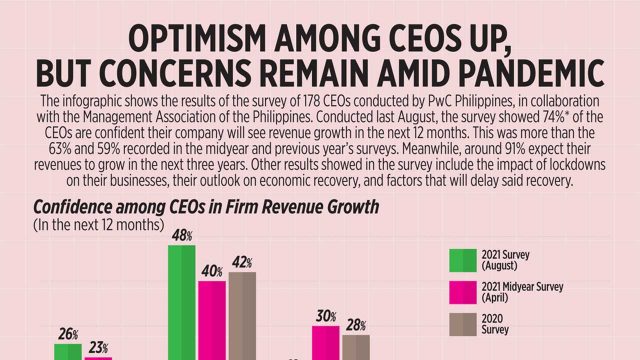
Optimism among CEOs up, but concerns remain amid pandemic

ALMOST three-quarters of chief executive officers (CEOs) are confident about their organizations’ revenue growth over the next year, reflecting an improvement in their outlook even as the pandemic drags on, according to results of the PwC Philippines-Management Association of the Philippines survey. Read the full story.

Optimism among CEOs up, but concerns remain amid pandemic

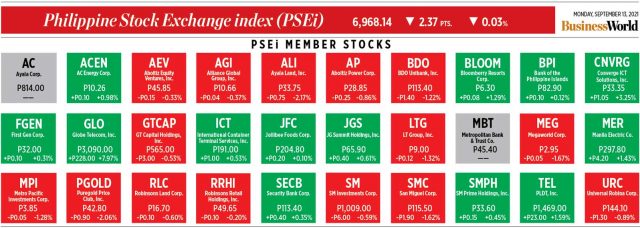
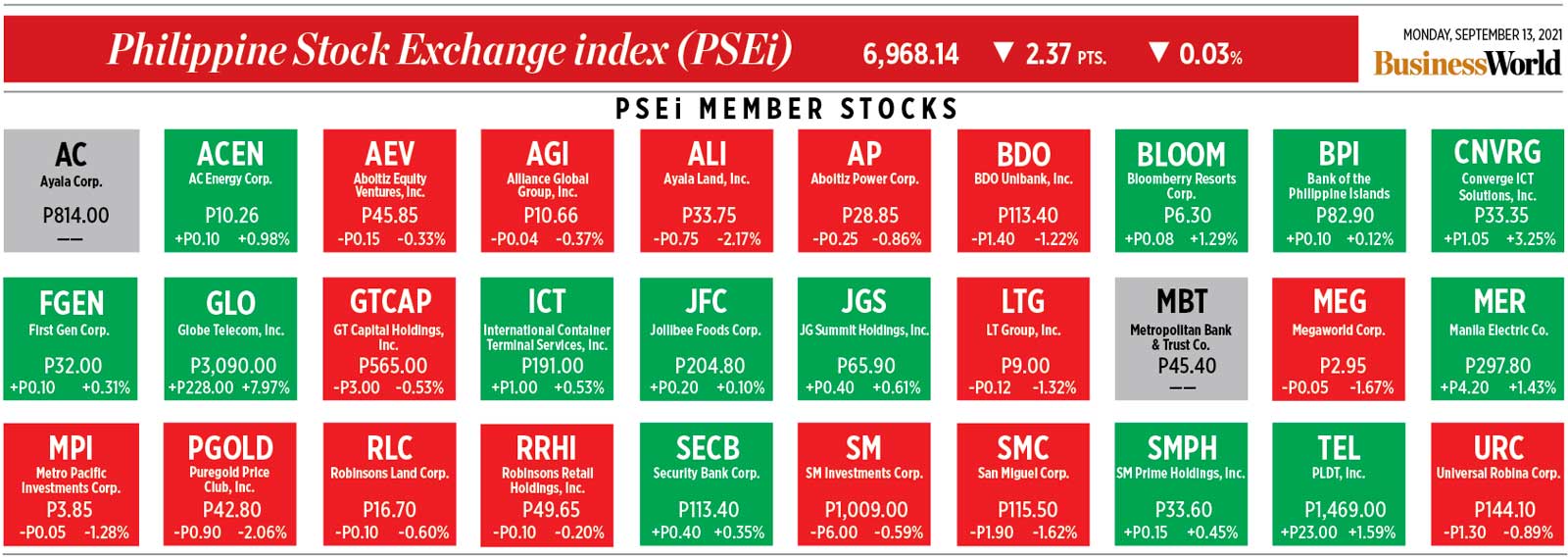
How PSEi member stocks performed — September 13, 2021

Here’s a quick glance at how PSEi stocks fared on Monday, September 13, 2021.


Peso retreats on higher oil prices

BW FILE PHOTO
THE PESO dropped versus the dollar due to higher oil prices. — BW FILE PHOTO

THE PESO weakened versus the greenback on Monday due to cautious sentiment amid higher oil prices and faster US producer inflation.

The local closed at P49.975 per dollar on Monday, shedding 11 centavos from its P49.865 finish on Friday, based on data from the Bankers Association of the Philippines.

The peso opened Monday’s session at P49.97 per dollar. Its weakest showing was at P50.07, while its intraday best was at P49.95 against the greenback.

Dollars traded increased to $843.45 million on Monday from $774.19 million on Friday.

The peso weakened due to safe-haven demand for the dollar as oil prices rose, Rizal Commercial Banking Corp. Chief Economist Michael L. Ricafort said.

Reuters reported that oil prices increased for a second session on Monday due to market concerns on reduced output amid the impact of Hurricane Ida in the US. Both the Brent crude and the US West Texas Intermediate (WTI) markets were at their highest since Sept. 3 earlier in the session.

Brent crude rose 67 cents or 0.9% to $73.59 a barrel, the US WTI crude increased 66 cents or 1% to $70.38 per barrel at 0633 GMT.

Meanwhile, a trader said faster-than-expected US producer inflation also caused risk-off sentiment and affected peso-dollar trading.

The producer price index (PPI) for final demand increased 0.7% in August after two straight monthly increases of 1%, the US Labor department said. In the 12 months through August, the index rose 8.3%, which is its fastest year-on-year rise since November 2010 when the series was revamped.

Both the monthly and year-on-year increase in the PPI are faster than estimates of economists in a Reuters poll at 0.6% and 8.2%, respectively.

For Tuesday, Mr. Ricafort gave a forecast range of P49.90 to P50.10 per dollar, while the trader expects the local unit to move within P49.85 to P50.10. — L.W.T. Noble with Reuters

PSEi drops as investors await gov’t guidelines

PHILIPPINE STAR/KRIZ JOHN ROSALES

STOCKS closed in the red on Monday as investors waited for the final guidelines for the government’s plan to implement localized coronavirus disease 2019 (COVID-19) lockdowns in the capital.

The Philippine Stock Exchange index (PSEi) went down by 2.37 points or 0.03% to close at 6,968.14 on Monday, while the all shares index inched up by 2.07 points or 0.04% to end at 4,304.86.

“Local market moved sideways as it awaits how effective the government will contain the… virus going forward,” Diversified Securities, Inc. Equity Trader Aniceto K. Pangan said in a text message.

First Metro Investment Corp. Head of Research Cristina S. Ulang said the market struggled to reach 7,000 due to cautiousness over the government’s plans.

“The question specifically is whether the shift to granular lockdown on uniform alert system of say 3 and 4 will enable ‘safe’ and ‘greater’ reopening of the economy,” Ms. Ulang said in a Viber message.

“For the most part of the day, the local bourse was in the negative territory as investors took a cautious stance while waiting for the final decision on the National Capital Region’s social restriction measures starting Sept. 16,” Philstocks Financial, Inc. Senior Research Analyst Japhet Louis O. Tantiangco said in a separate Viber message.

Metro Manila is under the modified enhanced community quarantine until Sept. 15 and will shift to granular lockdowns beginning Sept. 16 until the end of the month.

The region will be under either an enhanced community quarantine or a general community quarantine, while areas will have specific alert levels depending on their exposure to COVID-19 cases. The government’s pandemic task force was expected to finalize guidelines for the pilot implementation of targeted lockdowns on Monday.

Philstocks Financial’s Mr. Tantiangco added that trading was “lethargic,” moving below the year-to-date average of P7.11 billion.

“This shows that many investors are staying out of the market due to the lingering uncertainties on the future of our social restriction measures, and on the overall COVID-19 and economic situation of the country,” he said.

Value turnover on Monday inched up to P5 billion with 1.75 billion shares switching hands from the P4.88 billion with 864.83 million issues traded on Friday.

Majority of sectoral indices started the week in the red except for services, which gained 28.35 points or 1.55% to finish at 1,848.21.

Meanwhile, property dipped 22.49 points or 0.72% to 3,085.50; mining and oil shaved off 49.55 points or 0.5% to 9,756.39; holding firms went down by 26.04 points or 0.37% to close at 7,014.02; financials inched down by 5.18 points or 0.35% to 1,442.48; and industrials lost 14.94 points or 0.14% to end at 10,208.37.

Decliners beat advancers, 119 against 76, while 49 names closed unchanged.

Net foreign selling surged to P164.38 million on Monday from the P53.32 million seen in the previous trading day. — K.C.G. Valmonte

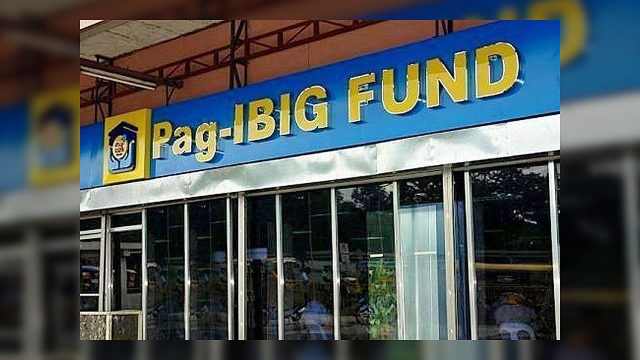
Business associations seeking penalty waiver from Pag-IBIG

PHILSTAR

BUSINESS GROUPS are asking the Home Development Mutual Fund (Pag-IBIG Fund) to waive penalties for companies that were not able to remit employee savings within the past two years.

Three business groups wrote a letter to Pag-IBIG Chief Executive Officer Acmad Rizaldy P. Moti to ask for a “penalty condonation” to help industries recover from the effects of the pandemic.

The Philippine Chamber of Commerce and Industry (PCCI), Employers Confederation of the Philippines (ECoP) and the Philippine Exporters Confederation, Inc. (Philexport) in the letter dated Sept. 9 also asked for a longer payment plan to settle outstanding obligations.

The groups said they are hoping for assistance following a “myriad of burdens” they are facing during the public health crisis. They said 35,049 establishments have filed for closure since 2020, displacing over 700,000 workers.

“While we also recognize that majority of business owners were affected in the recent years, we humbly ask consideration from your office to extend the same to businesses who may still have outstanding penalties due for payment to Pag-IBIG prior 2020,” they said.

“Doing so may help keep our businesses afloat during these trying times.”

Pag-IBIG in a statement said that it “values feedback from its stakeholders, including employer-groups like ECoP.”

“We shall take their requests under serious consideration in our further study and review of our policies on penalty condonation. ECoP and the community of Filipino employers can rely on Pag-IBIG Fund for support.”

Pag-IBIG Fund last year gave employers more time to remit employee contributions and short-term loans due during the first lockdowns.

The state-run organization also offered grace periods on loan payments last year, and then initiated a loan restructuring program deferring and lowering payments for housing loan borrowers.

The letter was signed by PCCI Acting President Edgardo G. Lacson, ECoP President Sergio R. Ortiz-Luis, Jr., and Philexport Chairman George T. Barcelon. — Jenina P. Ibañez

Sept. inflation could rise to 5% led by food, fuel

HEADLINE INFLATION may breach the 5% mark in September with food and fuel prices remaining high and typhoons possibly adding upward pressure on prices, an economist said.

“Inflation which recently peaked at 4.9% last month will likely see price pressures heat up anew in September. We expect inflation to move past 5% as recent and approaching storm systems will undoubtedly figure into this month’s fruit and vegetable inflation numbers,” ING Bank Senior Economist Nicholas Antonio T. Mapa said in a note Monday.

Mr. Mapa said fish and meat products will likely remain expensive this month, while power costs will continue to rise with crude oil at around $70 per barrel, and as utility companies and fuel retailers announce price hikes.

Manila Electric Co. (Meralco) said last week that it will raise power rates by 10.55 centavos from August levels to P9.1091 per kilowatt-hour (kWh). Meanwhile, the Energy department said fuel companies have increased their prices by 50 centavos per liter for gasoline, 95 centavos per liter for diesel and 60 centavos per liter for kerosene.

“Although the pickup in imports may be a sign of renewed demand, it also reflects an improvement in domestic production that could help increase the supply of basic goods and services. Despite this, the price pressures appear to be accelerating at the worst possible time with base effects unfavorable in September,” he added.

Headline inflation came in at 4.9% in August after a 4% reading in July. August represented a 32-month high.

This brought the average inflation to 4.4% in the first eight months, which was above the 2-4% target band set by the central bank.

Mr. Mapa said the Bangko Sentral ng Pilipinas (BSP) is facing a “dilemma” in responding to inflationary pressures as it still needs to support the economy as it bounces back from the pandemic.

Monetary authorities have been aggressive in shielding the economy from the impact of the pandemic, lowering interest rates to record lows.

“A rate hike at this point would increase the likelihood that the ongoing economic (downturn) devolves into a full-blown depression as higher borrowing costs result in an acceleration in NPLs (non-performing loans) while simultaneously snuffing out whatever gains have been made on the lending front,” he added.

While bank lending remained muted despite lower interest rates, Mr. Mapa warned increasing the cost of borrowing could further choke off much-needed credit to small companies.

“All in all, monetary tightening will have no impact on pricier vegetables or the cost of gasoline but it will surely scuttle the recovery momentum,” he added.

BSP Governor Benjamin E. Diokno has reassured a number of times that monetary authorities will continue to support the economy for “as long as necessary until the economic recovery gets underway.”

During its rate-setting meeting last month, the Monetary Board (MB) kept its key policy rate at a record low 2% for a sixth consecutive meeting.

The MB will hold its sixth policy meeting for the year on Sept. 23.

“A rate hike at this very delicate stage of recovery could be enough to push the economy into the tailspin that sends the Philippines deeper into recession and ultimately into a full-blown depression,” he said.

He estimated that the economy will recover its pre-pandemic performance by early 2023.

BusinessWorld asked the Department of Finance’s chief economist to comment but he had not replied at the deadline. — Beatrice M. Laforga

Aquaculture industry says fish supply ‘sufficient’ after recent typhoons 

THE AQUACULTURE industry estimates that the supply of fish will be adequate despite disruptions caused by typhoons Jolina (international name: Conson) and Kiko (Chanthu).

Mario G. Balazon, Taal Lake Aquaculture Alliance, Inc. director, said Monday in a virtual briefing organized by food security advocacy group Tugon Kabuhayan that the two recent typhoons damaged more than 1,000 fish cages. 

However, Mr. Balazon said the escaped fish will add to the supply.  

“We are now in the process of getting the fish back to their cages. Those that can’t be recaptured will surely be caught by other fishermen and consumed by nearby communities,” Mr. Balazon said.

Mr. Balazon estimated that it will take one to two months before tilapia supply in Taal Lake can recover from the impact of the typhoons.

“The daily harvest before the typhoons was 200 metric tons (MT) consisting of milkfish (bangus) and tilapia. In terms of percentage, 10% of the daily harvest is bangus, while the rest is tilapia,” Mr. Balazon said.

“After the typhoons, 80% of the production is still here in Taal,” Mr. Balazon said.

Jon G. Juico, Philippine Tilapia Stakeholders Association president, said tilapia farmers in Pampanga can readily supply consumers.  

Mr. Juico said however that demand has dropped and farmgate prices have fallen due to the pandemic.

He said the current farmgate price of tilapia is P70 per kilogram against a production cost of P60 to P65 per kilogram. An “ideal” farmgate price, he said, would be P80 to P85 per kilogram, to allow aquaculturists to recover their costs and earn a return.

“Before the pandemic, we have two cycles of harvest a year. Unfortunately, we experienced a dramatic drop in demand for tilapia during the pandemic which forced us to limit our harvest to one cycle a year,” Mr. Juico said.

“We are not affected by typhoons since we have improved the infrastructure of our fishponds. No matter the weather, production is continuous,” he added.  

“The tilapia in our ponds are already oversized because of the long wait for stronger demand. We’re more than ready and eager to answer government’s call for more fish supply,” Mr. Juico said.

Tugon Kabuhayan urged consumers to patronize domestically-produced fish after the Department of Agriculture (DA) approved the issuance of certificates of necessity to import for 60,000 MT of fish to compensate for the closed season in various fisheries.

Bangus and tilapia are much more affordable than round scad (galunggong). Retail prices of these aquaculture species are more stable as tilapia currently retails in our wet markets at P120 and bangus at P160 while galunggong sells at P240,” the group said.

“The DA’s decision to allow 60,000 MT of fish imports is excessive. There is sufficient local production to cover projected supply shortfalls during the forthcoming closed fishing season,” it added. — Revin Mikhael D. Ochave 

PSALM transfers over P4B to Napocor to settle retrenched workers’ claims

PHILSTAR FILE PHOTO

THE POWER Sector Assets and Liabilities Management Corp. (PSALM) has transferred P4.31 billion to the National Power Corp. (Napocor) to cover the back pay and benefits of 1,958 former employees retrenched nearly two decades ago, the Department of Finance (DoF) said.

Citing a report from PSALM, the DoF said in a statement Monday that the payouts will go towards settling claims by 1,958 former workers who were retrenched in 2003 due to the downsizing program authorized by Republic Act No. 9136 or the Electric Power Industry Reform Act (EPIRA).

PSALM, which manages the assets and liabilities of Napocor, started transferring the funds from November 2020, according to PSALM President and CEO Irene Joy J. Besido-Garcia.

However, Ms. Garcia said official records show only 893 beneficiaries have received their payouts, while the rest have yet to submit the complete requirements to process the claims. 

“There are delays in the compliance with the basic documentary requirements by some claimants. Furthermore, due to the COVID-19 pandemic and with some claimants residing outside Metro Manila or outside the country, there are mobility restrictions preventing them from submitting the required documentation especially considering that most claimants are in their old age,” she was quoted as saying.

For 2022, she estimated another P4.8 billion is needed to service all the claims of the Drivers and Mechanics Association (DAMA) formerly employed by Napocor’s former employees. DAMA members contested their termination before the Supreme Court.

“The P4.8-billion cash requirement will be covered by the balance of the 2021 approved supplemental budget amounting to P1 billion more or less, and prospectively by a P3.8-billion proposed DAMA budget for 2022,” Ms. Garcia said.

EPIRA was enacted in 2001 to reform the power sector and privatize the assets of Napocor. In the ensuing reorganization, Napocor laid off workers while rehiring some to work for PSALM or the National Transmission Corp.

The Supreme Court ruled in 2008 that the retrenched employees were entitled to either reinstatement or separation pay, back pay and other benefits. The court issued a resolution in 2017 to order Napocor to settle these overdue benefits and asked terminated workers to file their claims before the Commission on Audit.

The commission cleared Napocor to pay the claims in 2019. — Beatrice M. Laforga

ADVERTISEMENT
ADVERTISEMENT