Home Blog Page 751

Anker’s soundcore R60i NC wireless earbuds now available in PHL

ANKER INNOVATIONS

ANKER INNOVATIONS’ premium audio brand soundcore has launched the R60i NC true wireless earbuds in the Philippines.

The earphones are priced at P1,795 and are now available exclusively on its Shopee store. They will be sold across all platforms starting Nov. 8.

The brand said the new earbuds feature significant upgrades from their predecessor, the R50i NC.

“As the first R-Series earphones with Hi-Res Audio certification and LDAC (Lossless Digital Audio Codec) support, the R60i NC sets a new benchmark for affordable premium sound with tons of new and improved features,” it said.

The R60i NC promises up to 40 hours of battery life with active noise cancelling (ANC), and up to 50 hours when the ANC is turned off.

“Its ANC also jumps from -42dB to -52dB ANC, raising the bar and making it one of the strongest in its category. Using Helmholtz resonance chambers and four high-precision microphones, its intelligent algorithm dynamically analyzes your environment every 0.007 seconds to maintain uninterrupted calm wherever life takes you,” Anker said.

“It also features an 11mm titanium-coated driver with a 0.2mm magnetic gap, so you can enjoy deep bass, delivering a rich and immersive listening experience.”

The earphones also have artificial intelligence (AI) translation support for over 100 languages and dialects and can translate real-time and face-to-face conversations via its AI assistant feature called Anka.

“With its 6-mic AI Clear Call system that optimizes voice pickup and its multi-point connection, the R60i NC is also a perfect companion for busy students who attend online classes and remote workers who jump into video calls, who need to seamlessly change devices,” the brand added. — BVR

EastWest Bank launches debit card for SMEs

EAST WEST Banking Corp. (EastWest Bank) has launched a debit card for small and medium enterprises (SMEs) powered by Visa as it looks to expand its offerings for the segment.

The EastWest BizAccess Visa Debit card unveiled on Tuesday comes with a checking account and an online platform where SME owners can manage funds for their business.

The checking account has a minimum maintaining balance of P25,000. Meanwhile, the EasyBiz Online Business Banking platform allows business owners to view balances, monitor transactions, pay suppliers, and manage their cash flow, including processing government payments via eGov, paying corporate bills, and other transactions.

“A lot of our business banking clients are already SMEs. What this gives us right now is really a step-up in offering. With Visa’s capability, EasyBiz in terms of online, we can offer extra value-added services and offers that a small business would normally need, not only in order to start, but also to thrive… So, the real fight is really to go more into this area because they’re really the backbone of the economy at the end of the day,” EastWest Bank Chief Executive Officer Jerry G. Ngo said at a media briefing.

As of end-2023, the Philippines had about 1.2 million micro, small and medium enterprises that accounted for more than 99% of business establishments and about 66% of total employment in the country.

“We’ve already realized that a lot of our customers are already using our services for their own businesses… What we’re hoping to do is through this initiative — through this new set of products, services, and value proposition — is to formalize that,” Mr. Ngo said.

He said they want to help provide financing to SMEs that want to expand their business.

“You’ve been running your business for three to five years, but you want to scale up. At that point, you really need funds. You need capital. You need access to credit — access to the ability to scale up. And in many instances, if you haven’t kept your data clean or you’ve mixed it, it’s difficult for the bank to assess it. It’s hard to approve. And so that’s what we were trying to encourage right now, to get that conversation going, because if you need to start and to scale up, that’s the time that you really need access to the formal banking sector.”

Business owners may issue up to ten EastWest BizAccess Visa Debit cards to their staff.

It also features travel accident insurance, transaction notifications, and access to exclusive Visa promos and rewards for SME clients.

EastWest Bank is also offering welcome deals and waived over-the-counter fees for deposits and withdrawals for the card.

The online business banking platform also allows cardholders to lock and unlock their cards.

EastWest Bank’s attributable net income rose by 28.51% year on year to P2.297 billion in the second quarter, driven by its consumer segment.

This brought its first-semester profit to P4.13 billion, up by 18.51% from the same period last year.

The bank’s shares edged up by two centavos or 0.18% to close at P11.42 apiece on Wednesday. — A.M.C. Sy

Governance by blockchain

STOCK PHOTO | Image by Archistella from Freepik

Governance by blockchain is becoming institutionalized in public administration. Within weeks of each other, the Department of Public Works and Highways (DPWH), the Securities and Exchange Commission (SEC), and the Supreme Court (SC) have all announced their respective blockchain initiatives.

I am concerned, however, that this government use of blockchain technology is creating expectations that don’t consider the potential for failure if baseline infrastructure is weak. And by baseline, I refer to the policy and regulatory environment, as well as the pillars of law, audit, energy, and human capacity.

Blockchain technology is a digital system for recording and verifying information shared across multiple computers linked together, instead of being stored in a single location. Every new record, called a block, is linked to the previous one, forming a chain that cannot be easily changed.

In short, blockchain is a “public notebook” that everyone can view and verify, and that no one can secretly erase or rewrite. Each page or block is filled, signed, and time-stamped before the next one is added. And any attempt to tamper with the record leaves visible evidence.

Current government documentation, recording, audit, and legal processes remain largely analog, with information written on physical documents that cannot be easily accessed and may be lost, altered, or destroyed. It is logical to migrate government documentation from paper to digital systems.

Blockchain promises unchangeable records, time-stamped transactions, and public visibility. These are features seemingly designed to deter manipulation and corruption. But like every reform that weds technology to bureaucracy, success will depend on compliance. And the more crucial question is whether blockchain in governance can stand the test of law, audit, and sustainability.

DPWH’s Integrity Chain initiative aims to use blockchain to document and track infrastructure projects, from budgeting and procurement to construction milestones. SEC’s VERITAS system will authenticate corporate filings such as articles of incorporation and financial statements, giving digital documents the same legal force as notarized papers. The SC will secure court records through a blockchain-backed records management system.

All three initiatives seek to address an enduring weakness in governance: the vulnerability of records to manipulation. Blockchain, once a tech buzzword, is now entering the bureaucratic bloodstream. And this, to me, raises the stakes, especially since these programs will affect millions of people.

For DPWH, blockchain promises tamper-proof project ledgers to deter ghost projects, falsified inspections, or duplicate or fraudulent payments. For SEC, it ensures that corporate filings are verifiable, resistant to forgery, and traceable to their legitimate origin. For SC, it means that court orders, pleadings, and decisions can be authenticated digitally without fear of alteration.

These efforts share a common goal: to create an immutable chain of trust in how government handles documents. But they also share a common challenge: blockchain records must be legally recognized as official, audit-admissible, and court-admissible documents, not merely digital copies of written ones.

Until that recognition becomes explicit, with a clear basis in law, these ledgers may not have legal weight. If a dispute arises between a contractor and the DPWH, or if a litigant challenges a court record, it remains uncertain whether the blockchain entry itself constitutes the “official record” or merely a certified digital copy. Without formal recognition, the technology may promise integrity while still relying on paper for legitimacy.

Legally, some foundation already exists. The Electronic Commerce Act of 2000 (RA 8792) recognizes electronic records and signatures, granting agencies authority to digitize official transactions. However, the law predates blockchain. It validates only the data message, but not the distributed ledger (blockchain) that intends to store it.

In effect, RA 8792 opens the door, but agencies like DPWH, SEC, and the Supreme Court must still cross the threshold by formally declaring blockchain entries as official government records that are audit-admissible, court-admissible, and covered by public-sector accountability laws. To be safe, I believe we should codify the use of blockchain ledgers for government records.

RA 8792 can serve as the starting point for legal recognition of blockchain-based systems. It may be the legal key that unlocks digital transformation, but I don’t think it can be the definitive framework that governs it. The law did not anticipate decentralized validation or consensus mechanisms involving networked computers as data repositories.

Also, it doesn’t seem like RA 8792 automatically confers “official record” status on blockchain entries for audit or evidentiary purposes. And while RA 8792 authorizes e-transactions, it does not create a central body to coordinate blockchain deployments across agencies. It also lacks provisions for energy resilience, cybersecurity, and continuous availability of connectivity and power for digital operations.

For blockchain in governance to work, there must be formal recognition of blockchain entries as government records under evidence, audit, and records-retention laws. SEC appears to be asserting this principle by giving blockchain-verified documents the same effect as notarized filings. A dedicated national law could institutionalize this approach so that agencies need not rely on piecemeal circulars for different agencies.

Legal recognition through legislation will protect agencies and assure citizens and investors that what they see on any official blockchain ledger is binding, admissible, and enforceable. Without that, blockchain risks becoming a transparency showcase rather than a true governance system.

Another concern is that blockchain systems demand reliable electricity, secure data centers, and consistent network access. Yet many regional government offices still suffer from unstable power and poor connectivity. Do we have the dependable infrastructure required to effectively and efficiently employ blockchain technology in public administration?

A blockchain-based filing system or project ledger cannot function if the servers hosting it go dark during brownouts, or if provincial data centers fail to synchronize data due to limited bandwidth. In the private sector, downtime is a nuisance. But in government, it can halt transactions, delay payments, or even stall justice.

The great risk is that we may be building critical digital platforms on fragile physical foundations. Blockchain may promise incorruptible records, but only if electricity and connectivity are equally dependable. The ledger may secure the data, but who secures the grid?

Every aspect of blockchain operations depends on uninterrupted power. As more government functions move online, from procurement to business registration to court records management, public-sector performance will increasingly depend on the reliability of the energy sector and the strength of the digital backbone. Energy and IT security are prerequisites to governance integrity.

I also worry that the DPWH, SEC, and SC and possibly other agencies are all adopting blockchain independently, without a unifying plan. This risks creating individual chains that cannot communicate with each other, or that operate in parallel but with inconsistent standards. A law on blockchain governance should therefore provide a national framework with unified standards and clear public oversight.

Such a framework should include a needs assessment to determine where blockchain genuinely adds value; standards for validation, interoperability, cybersecurity, and data sovereignty; compliance with procurement and privacy laws; legal bases for recognizing blockchain-recorded data as official and enforceable; promotion of more investments in energy capacity, data centers, and reliable networks to complement blockchain adoption; and, integration and interoperability among agencies, with a single point of oversight for governance, audit, and maintenance.

The use of blockchain-secured records points toward a digital republic that can make corruption harder and accountability easier. But policymakers must first understand what the technology truly does. Without clear legal authority, blockchain records are merely digital references. And without reliable electricity and connectivity, they will remain government electronic filing systems that are, ironically, often offline.


Marvin Tort is a former managing editor of BusinessWorld, and a former chairman of the Philippine Press Council

matort@yahoo.com

PLDT taps Ciena’s optical tech to boost PHL digital infrastructure

WIKIMEDIA COMMONS/PATRICKROQUE01

PLDT INC. hopes to enhance the Philippines’ domestic backhaul infrastructure through a partnership with US-based Ciena Corp., which will deploy advanced optical technology to improve data transmission from the Asia Direct Cable (ADC) system to local end users.

“PLDT is committed to strengthening the country’s digital backbone by ensuring that the international capacity carried by the ADC system translates into world-class connectivity for users nationwide,” PLDT Senior Vice-President and Enterprise Business Head Patricio S. Pineda III said in a media release on Wednesday.

By utilizing Ciena’s optical technology, PLDT can provide faster and more reliable services boosting the country’s digital economy from individual users to enterprises and even hyperscalers, Mr. Pineda said.

“The Philippines is a key destination for many global cloud providers and enterprises seeking to expand their presence in Asia… Ciena’s market-leading optical technology provides a seamless connectivity link to advance international trade and digital transformation within the Philippines,” said Ciena Vice-President for Asia Pacific Matt Vesperman.

Ciena focuses on optical network, data transmission, and network management.

ADC is a low latency subsea cable utilizing emerging technology and offering access to PLDT’s hyperscale data center like its VITRO Sta. Rosa.

ADC also complements trans-Pacific cables like Jupiter Cable System, which links the Philippines to Japan and the United States.

PLDT is deploying Ciena’s WL5e coherent optical technology to support multi-terabit traffic, enabling low-latency, high-capacity connectivity from the ADC landing station to its backbone network.

Ciena’s navigator network control suite will also enhance operational efficiencies for PLDT’s network by accelerating and simplifying network planning, it said.

PLDT through its corporate arm PLDT Enterprise will continue to ramp up its digital investments to optimize enterprise operations.

At the stock exchange on Wednesday, PLDT shares rose by P2, or 0.18%, to end at P1,112 apiece.

Hastings Holdings Inc., a unit of PLDT Beneficial Trust Fund subsidiary MediaQuest Holdings Inc., holds a majority stake in BusinessWorld through the Philippine Star Group. — Ashley Erika O. Jose

Garmin announces Venu 4 smartwatch

GARMIN PHILIPPINES

GARMIN’S latest Venu smartwatch, the Venu 4, is now available in the Philippines.

It has a suggested retail price starting at P33,290 and can be purchased at all Garmin Brand Stores and online through the brand’s official online stores in Kinetic, Shopee, and Lazada.

The Venu 4 is equipped with new health, fitness and accessibility features to help users track health trends and lifestyle changes.

“We designed Venu 4 to be a personal on-wrist fitness and wellness coach. This premium smartwatch helps users learn even more about their body, provides data-driven insights into how their choices are affecting their health and holds them accountable so they can reach their goals with greater ease,” Garmin Vice-President of Consumer Sales and Marketing Susan Lyman said.

Among the new features of the watch are advanced sleep metrics monitoring and the ability to log and track behaviors to see how they impact health metrics.

Meanwhile, the new Garmin Fitness Coach also provides personalized workouts for over 25 different fitness activities.

“These heart rate and duration-based workouts will adjust daily based on activity history, sleep and recovery. Users can set up a Garmin Fitness Coach plan to receive tailored workouts and track their progress in the Garmin Connect app. If users don’t set up a plan, they will still get daily suggested workouts for different fitness activities,” the brand said.

“For those doing several activities in one workout, the mixed session activity profile tracks multiple activities in one session rather than saving separate activities.”

The Venu 4, which is available in 41mm and 45mm sizes and several colorways, also features a metal design. Users can use leather or silicone bands.

“Both sizes feature a built-in LED flashlight for greater visibility in the dark, plus a speaker and microphone to make and take calls from the watch when it’s paired with a compatible iPhone or Android smartphone and use the phone’s voice assistant to respond to text messages. Certain voice commands, like “start a running activity” and “set timer for 5 minutes” can also be activated right from the watch — no phone connected required,” Garmin said.

It has up to 12 days of battery life in smartwatch mode. — BVR

UK Fawlty Towers actress Prunella Scales, 93

PRUNELLA SCALES (R) and John Cleese in a scene from Fawlty Towers.

LONDON — British actress Prunella Scales, best known for playing the formidable Sybil Fawlty in comedy show Fawlty Towers, has died age 93, her sons said in a statement on Tuesday.

Sybil was the wife of John Cleese’s Basil Fawlty, in the show’s two series made in 1975 and 1979. Set in a dysfunctional hotel in the seaside resort of Torquay, it became one of Britain’s best-known comedies and was shown around the world.

It continues to be broadcast and referenced in popular culture now.

“Our darling mother Prunella Scales died peacefully at home in London yesterday,” her two sons said in a statement.

“She was watching Fawlty Towers the day before she died.”

Ms. Scales was married to actor Timothy West for 61 years. He died last November. She had been suffering from dementia.

Fawlty Towers was named as the greatest ever British TV sitcom by the Radio Times magazine in 2019. It was developed into a theater production in Australia in 2016, and it moved to London’s West End in 2024.

In the show, Sybil was often on the phone saying “oooh I knoooow,” her braying laugh described by Basil’s character as akin to “someone machine-gunning a seal.”

Her seven-decade acting career included multiple roles from the 1950s, including in 1960s sitcom Marriage Lines. She starred in the 1992 Oscar-winning film Howards End alongside her son, the actor Samuel West.

In the 2010s, Ms. Scales and her husband traveled on their narrowboat in the Great Canal Journeys TV series.

She was born in Surrey in 1932 and started her acting career at The Old Vic Theatre School in Bristol. — Reuters

Salmon Bank to boost capital as it targets to apply for thrift bank license by next year

SALMON BANK (Rural Bank), Inc., owned by financial technology company Salmon Group Ltd, is looking to increase its capitalization to fund its growth as it seeks to apply for a thrift banking license next year.

“So, we continue to be preparing ourselves to apply for a thrift bank next year. In terms of capital, we’re already there. We meet the minimum capital required for a thrift bank. But we want to make sure we complete the key investments in people and in technology before we apply,” Salmon Co-founder and Director and Salmon Bank Chairperson Raffy Montemayor said at a briefing on Wednesday.

The bank plans to inject an additional P600 million in fresh funding before the year ends and another P600 million next year, which would bring its total equity to P2 billion from P1.4 billion as of end-September.

“And if the bank grows faster, then we’ll inject more. So, it’s really dependent on the growth we’re seeing,” Mr. Montemayor said.

This will be used to fund the bank’s aggressive expansion, he said.

Salmon Co-Founder Pavel Fedorov said he expects the bank to double its key financial metrics every six to nine months.

“I don’t know how long we’re gonna stick with that, but the reality is that we’ll be doubling every six to nine months, and we expect to keep on doubling every six to nine months in terms of key financing and operating methods for the foreseeable future,” he said, adding that this includes the bank’s profitability.

Mr. Montemayor said the bank booked a net income of P189 million in the first eight months of 2025.

They expect strong growth in both deposits and loans, he said.

“There’s so much room for growth. I think just to give you a sense, there’s a rough estimate of 175,000 retail stores in the Philippines. And our product loan, which is roughly 60% of our loan portfolio, we’re present at 5,000 stores. We expect to roughly double that by next year.”

Salmon Bank had P1.6 billion in loans at end-September, more than double the P691 million booked in the same period last year.

Meanwhile, deposits were at P1.77 billion in deposits, surging from P522.1 million a year ago.

Deposit growth will be driven by its customer base expansion as the rural lender plans to launch more products and online services and open new branches next year, Mr. Montemayor said.

He added that Salmon Bank applied for an advanced Electronic Payment and Financial Services (EPFS) license from the Bangko Sentral ng Pilipinas in August.

Financial institutions must get an EPFS license to offer products and services via digital channels. An advanced license allows them to enable fund transfers and bills payment, among others, in addition to basic functions like balance inquiry. — A.M.C. Sy

Reducing spending and public debt, raising credit ratings

Last Monday, Oct. 27, I attended the 2025 Fiscal Policy Conference organized by the Department of Budget and Management (DBM), held at the UP College of Law. In the afternoon there were simultaneous panel sessions. I attended the panels on “Digitalization and Process Innovations” with three speakers: Department of Finance (DoF) Undersecretary Renato Reside, Jr., Ateneo de Manila University Professor Albert Matthew Alejo, and Department of Economy, Planning and Development (DEPDev) Undersecretary Joseph Capuno.

In the second set of simultaneous discussions, I attended the panel on “Fiscal Stability and Sustainability,” also with three speakers: Ateneo Professor Elvira de Lara-Tuprio, Congressional Policy and Budget Research Department (CPBRD) Director Ricardo Mira, and Bangko Sentral Director John Michael Hallig.

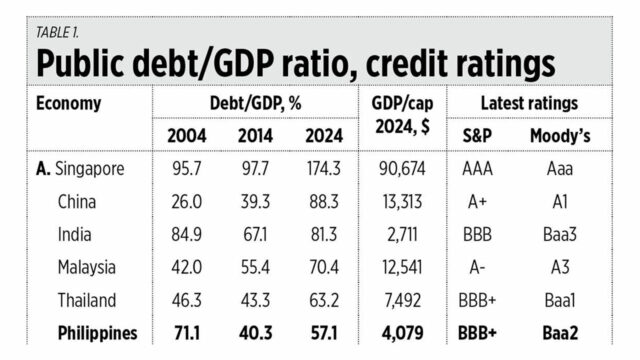
Among the topics discussed in the two sets of panels was why countries with high Public Debt/GDP ratios of above 100% (like Singapore, Japan, the US, France) have high credit ratings of A+ to AAA and hence, can borrow at lower interest rates, while countries with Debt/GDP ratios below 90% (like India, Thailand, and the Philippines) have lower credit ratings of BBB.

One explanation given is that high ratings countries have higher GDP per capita income, of $30,000 or higher, while those with BBB have GDP per capita of below $8,000. But there are exceptions here. There are economies with low Debt/GDP ratios and per capita income and high ratings — Taiwan and Hong Kong (see Table 1).

The Philippine economic team — the secretaries of the DoF, DBM, DEPDev, and the Special Assistant to the President for Investment and Economic Affairs — continue to aspire and hope that we reach credit ratings of A before the end of the Marcos Jr. administration. And rightly so because our annual borrowings are not declining despite the absence of any economic or virus-caused crisis like the lockdowns of 2020-2021.

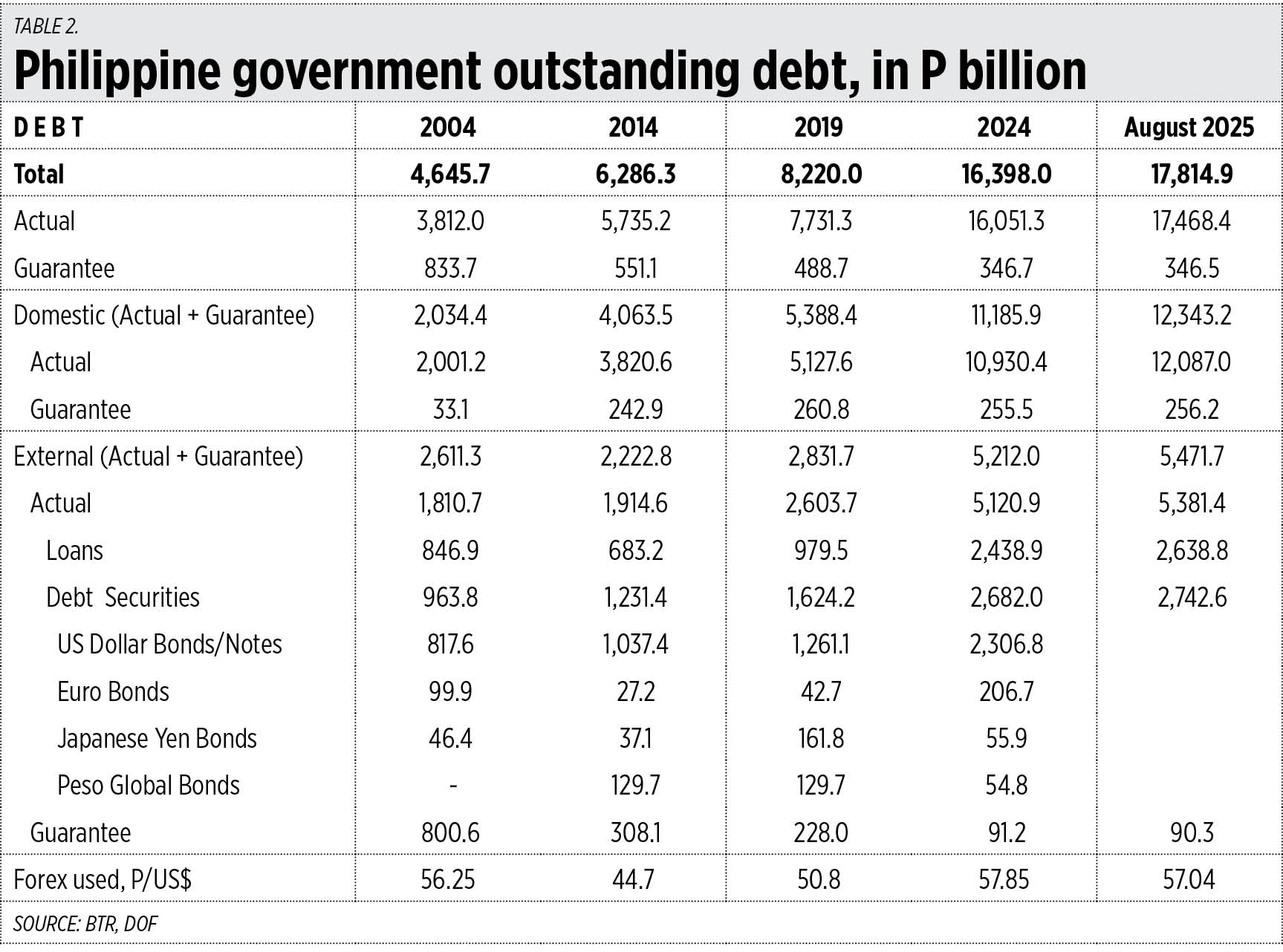
Before the lockdown, the Philippines’ outstanding debt (actual plus guaranteed) was only P8.22 trillion in 2019. Then it jumped to P10.25 trillion in 2020, P12.15 trillion in 2021, P13.82 trillion in 2022, P14.97 trillion in 2023, P16.40 trillion in 2024, and P17.81 trillion in August 2025. In other words, public debt was rising by an average of P1.64 trillion/year, which is roughly the budget deficit of around P1.55 trillion/year over the same period.

Guaranteed debt is generally flat below P400 billion, it is the actual debt that keeps rising — P17.47 trillion as of last August (see Table 2).

One thing I noticed on Monday, was that in order to reduce public debt, there were few or no proposals from the speakers to make significant spending cuts, to reign in expenditures at least to balance with projected revenues.

Perhaps that is one reason why the DBM invited me to participate in the forum, to inject this point of view. But I chose not to ask questions during the panels as there was little time. I preferred to listen and understand the concepts and methodologies that the academics and speakers from government presented, including their complicated Greek mathematical and regression equations.

One thing I notice among the agencies — if they see that new sources of revenue or borrowing are available next year, they quickly invent new ways of spending and new subsidies or expand existing ones. High Debt/GDP ratios and high interest payments (an average of around P2.6 billion/day in 2025) do not seem to bother them. They just focus on asking for even higher budgets every single year despite the absence of a clear economic or social crisis which are the basis of raising subsidies in the first place, like the lockdowns of 2020-2021.

Finally, that military and uniformed personnel (MUP) pensions, from an average of about P110 billion/year until 2024, jumped to P144 billion this year and are proposed to increase to P198 billion next year. That is one clear example of wasteful and abusive spending that will penalize taxpayers today and tomorrow. Congress and the President should rein in that spending. Better yet, if active MUP officials were more sensitive to taxpayers and admit the public finance burden of the scheme, they themselves volunteer to contribute to their own pension someday. And stop the injustice of pension indexation to the salaries of active MUPs.


Bienvenido S. Oplas, Jr. is the president of Bienvenido S. Oplas, Jr. Research Consultancy Services, and Minimal Government Thinkers. He is an international fellow of the Tholos Foundation.

minimalgovernment@gmail.com

GCash says no user data compromised

BW FILE PHOTO

ELECTRONIC WALLET platform GCash on Wednesday said no user data was leaked or compromised, assuring customers their accounts remain secure despite reports of information being sold on the dark web.

“GCash assures the public that there has been no breach, no leak, and no compromise in its systems,” the company said in a statement.

Information and Communications Technology Secretary Henry Rhoel R. Aguda said the agency has been monitoring the issue and reminded the public to remain vigilant against online scams and misinformation.

“If you see data allegedly being sold online, do not panic or share personal information. Always verify through legitimate sources and be cautious about what you post or click,” he said.

GCash also urged the public to refrain from reposting unverified information and to rely solely on official channels for accurate updates.

The company warned that it would pursue legal action against individuals or groups spreading false or malicious claims that cause public confusion and undermine user trust.

On Tuesday, the Department of Information and Communications Technology (DICT), through its Cybercrime Investigation and Coordinating Center (CICC), said the alleged data leak involving G-Xchange, Inc., the operator of GCash, did not originate from the company’s systems. — Ashley Erika O. Jose

Fintechs edge closer to banks’ payments privilege

FREEPIK

IN A POTENTIALLY far-reaching shift, the US Federal Reserve is weighing whether to redraw the perimeter of the US financial system. A proposal under consideration would grant financial technology (fintech) giants like Circle Internet Group, Inc. and Stripe, Inc. a form of direct access to the central bank’s core payment infrastructure — a privilege historically reserved for banks.

Fed Governor Christopher Waller has asked staff to explore a model for so-called “skinny” master accounts available to legally eligible entities: stripped-down versions of the accounts banks use to move trillions through Fed systems daily. These accounts would exclude access to interest, overdraft privileges and discount window borrowing among other potential restrictions, but would still give select fintechs a direct line into the heart of the system.

“He’s trying to give these novel charters access to the payment rails without also implicitly or explicitly putting the Fed on the hook to bail them out,” said Roman Goldstein, senior director at Klaros Group and former lead innovation policy analyst for the Federal Reserve Board.

For companies like Circle, it could mean holding customer reserves directly at the Fed and managing flows without relying on commercial banks — a shift that cuts costs, reduces counterparty risk, and offers tighter control over funds.

“The upshot is that, in my view, the payments landscape, as well as the types of providers, has evolved dramatically in recent years, and, accordingly, a new payments account could better reflect this new reality,” Mr. Waller said at a conference in Washington, DC, on Oct. 21. Waller is one of five candidates to succeed Jerome H. Powell when his term as Fed chair expires in May, according to Treasury Secretary Scott Bessent.

The implications go beyond plumbing. Sponsor banks — many of which have built profitable businesses by acting as fintechs’ backend providers — stand to lose a key revenue stream.

“The business model for a lot of sponsor banks is basically serving as a gatekeeper to the payment system,” Mr. Goldstein said. “With these skinny master accounts, a fintech doesn’t need to go through one of these gatekeepers anymore.”

But their role isn’t merely transactional: they provide compliance infrastructure, including anti-money-laundering monitoring and account reconciliation. Fintechs would likely need to replicate or outsource those functions to go it alone.

“Typically, we’re not solving just for payments with these partnerships,” said Sean Willet, chief executive of Lincoln Savings Bank, a Reinbeck, Iowa-based lender that partners with fintechs like Qapital and Acorns. “As long as we stick to our knitting in terms of what we deliver, we should be OK.”

For that reason, some sponsor banks strike a sanguine tone, for now. Yet the Fed’s move would mark a quiet but consequential step toward treating fintechs more like regulated banks, at a time when their business models are converging fast.

Beyond sponsor banks, firms have long pursued alternative ways to plug into the Fed’s infrastructure — chief among them: specialty banking charters. But so far they have struggled to get payment systems up and running.

For example, Wyoming’s Special Purpose Depository Institution (SPDI) charter was designed for digital asset firms. But when Custodia Bank, one of its earliest holders, sued both the Federal Reserve Board and the Kansas City Fed for “a patently unlawful delay,” the case was dismissed in court. Custodia has appealed the decision and the litigation is ongoing at the appellate level.

In response to mounting legal and industry pressure, the Fed introduced a tiered review system for account approvals. Anchorage Digital Bank, a crypto custodian with a national trust charter, recently applied under a “tier 3” designation which generally comes with the strictest level of review. Its application is widely seen as a bellwether for other firms that may want to apply, including Circle and Stripe’s Bridge platform.

Meanwhile, in Europe, fintechs already access payment infrastructure via Electronic Money Institution licenses — a model that offers payments access without lending rights. Governor Waller’s plan would echo this structure, narrowing privileges to core rails and excluding bailout protections.

“This is a new era for the Federal Reserve in payments,” Mr. Waller said at the conference. — Bloomberg

Adobe reworks its apps for AI assistants, pursues ChatGPT integration

SAN FRANCISCO — Adobe said on Tuesday its video and image editing tools can be controlled by chatting with them, adding that it is working with ChatGPT creator OpenAI to let users directly control one of its apps with the popular chatbot service.

Adobe is the creator of Photoshop and Premiere, widely used tools in the photography and film industries. In 2023, it rolled out Firefly, a service for generating images and other content with text prompts.

On Tuesday, Adobe executives said the company overhauled its apps to work with artificial intelligence (AI) assistants that can create and edit content by having a conversation. Behind the scenes, multiple AI “agents” would tap buttons and move sliders in the app to make those changes happen, similar to how a human assistant would carry out requests.

But human users will still also be able to take hold of those sliders and buttons to make edits, rather than relying solely on a text chat.

Now that Adobe has revamped its apps to work with AI assistants, it can more easily integrate them with third-party services, said Ely Greenfield, Adobe’s chief technology officer for its digital media business. The company is working to integrate its Adobe Express app with OpenAI’s ChatGPT, which will let users start a conversation in the chatbot to start a project there. It can then be edited in ChatGPT or finished in Adobe’s apps.

“You can adjust the edits that the agent in ChatGPT is making, so you can do a little bit of direct manipulation there,” Mr. Greenfield said. “And then, if you want, you can bring it into the Express app, where you can continue to have a conversation with it using the design agent that’s built into Express now, and you have access to the full suite of editing capabilities and tools that are part of Express.”

On Tuesday, Adobe said the AI assistant in Express is available now, but did not give a timeline for when the ChatGPT integration would become available. — Reuters

Dining In/Out (10/30/25)


inDrive releases list of Halloween parties

TO HELP Halloween partygoers plan their night out, inDrive shares a guide to some upcoming Halloween events this week – plus a reminder that getting around before and after the spooky festivities need not be scary. On Oct. 30, there’s Ghostbusters: Hidden Nights at Las Casas Quezon City. The heritage homes turn into haunted houses for one night only, with a blend of mystery and live music. The same day sees the Madhouse Halloween Party and Night Market at Stratosphere Events Place in Makati, featuring live music, costumes, and merch. Oct. 31 sees EDM performers &Friends at The Cove in Okada Manila for a Halloween rave. Finally, there’s Greenbelt After Dark, where Greenbelt 3’s bars turn into a scary extravaganza. Download the inDrive app via the App Store or Google Play for rides on Halloween night.


Magic nights at Discovery Samal

ON OCT. 31, the island transforms into a magical playground for kids and adults alike with “Black Magic.” Guests are invited to kick off their Halloween adventure with a lunch at Morning Catch where they can indulge in a feast of flavors and be entertained with a special Halloween program. As the afternoon unfolds, the magic continues with Halloween Trick or Treat where guests can explore the resort and collect sweet surprises. Rates are at P2,800 net for one child under seven and one guardian, P1,400 net for kids seven to 11 years old, and extra charges for each additional child or guardian. Guests 12 and above are charged adult rates. Other activities include a magic show and a bubbly spectacle, a human claw machine, and a themed photo booth. Each pass includes round‑trip boat transfers from the Davao Welcome Center, a lunch buffet with one round of drinks, full access to the Halloween party and activities, photobooth use, and loot bags for kids, plus access to the Magic Show, Bubble Show, and the Human Claw Machine. Other fun activities include face painting, a meet‑and‑greet with Discover Samal mascots Coco and Pearl, parlor and trivia games, a costume parade, and a resort‑wide trick‑or‑treat activity. The festivities will end with an awarding of guests who arrive in their best costume. Five standouts will win Best in Costume and receive plush bears and F&B buffet gift certificates. One guest will win the Best in Character award and receive a Junior Suite stay. The festivities will run from 2 to 5 p.m., with snack buffet service within the window. For more information and for reservations, contact Discovery Samal at +6308-4308-2998 or e-mail fb@discoverysamal.com.


Upgraded spooky monster cookie-do

CHEF Lovely Jiao, the baker behind Sugarplum Pastries’ innovative desserts, has brought back the Boo!-Do Kit. The season-inspired package has been around for years, encouraging kids — and kids at heart — to unleash their creativity. The set features a selection of wacky monsters: sugar cookies in various shapes and sizes. It comes with a watercolor palette complete with a piping bag of frosting and a paintbrush. Ms. Jiao assures that the watercolors are, of course, edible. Each box also comes with candies and chocolates for the youngsters to share and enjoy. For more information, visit facebook.com/sugarplumpastriesph.


Araneta City’s Oktoberfest

UNTIL OCT. 31, try the Double the Cheers Around the World offer at World Kitchens. Order any featured appetizer with two bottles of San Miguel Pale Pilsen or San Mig Light, and enjoy two extra beers on the house, plus a chance to win a set meal for six, all for P599. The menu features familiar favorites and a few unexpected bites, like crispy calamares, deep-fried karaage, mozzarella dynamite, pizza margherita, and spicy frog legs. Meanwhile, Farmers Plaza’s Food Plaza offers the Happy Hour Promo until Oct. 31. Drop by from 2 to 5 p.m. and enjoy a buy-one-get-one deal on San Miguel Pale Pilsen (P100 per mug) or San Mig Light (P110 per mug). For a Spanish twist on Oktoberfest, Novotel Manila Araneta City invites the public to España en tu Mesa: Olé to Spanish Fiesta Feasts at Food Exchange Manila. Ongoing until Nov. 30, enjoy a weekend buffet with the rustic flavors of Spain. There are free-flowing local beers alongside paellas, tapas, and desserts. Families are welcome, with kids aged eight and below dining for free, and special offers available through My Novotel Manila Boutique. Visit www.aranetacity.com for more details.