Home Blog Page 75

Lopez, Inc. majority voted to remove CEO, court order blocks move

STOCK PHOTO | Image by Pressfoto from Freepik

A MAJORITY of shareholders in Lopez, Inc. said they had voted to remove Federico “Piki” R. Lopez as president and chief executive officer (CEO), but a court order has temporarily blocked the move.

In a statement on Tuesday, the group, representing a 71% stake in the family holding company, said the board voted 5-2 on Feb. 27 to remove Mr. Lopez, with him and his brother, Benjamin, dissenting.

It said the company’s by-laws allow the removal of any corporate officer by a majority vote, even without cause.

The statement said the court order temporarily allowed Mr. Lopez to remain in his post.

Lawyers representing the majority said they had filed a motion to dissolve the court order, citing the company’s by-laws, according to the statement.

Lopez, Inc. is the Lopez Group’s private holding company and parent of businesses including Lopez Holdings Corp. and First Gen Corp.

BusinessWorld has yet to receive a response from the camp of Mr. Lopez after seeking comment through First Gen. — Ashley Erika O. Jose

Paintings by Renoir, Cezanne and Matisse stolen from Italian museum

CEZANNE’S Tasse et Plat de Cerises (Cup and plate of cherries) — MAGNANIROCCA.IT

ROME — Three paintings by French masters Pierre-Auguste Renoir, Paul Cezanne, and Henri Matisse, reportedly worth an estimated $10 million in total, have been stolen from a museum in northern Italy, police said on Monday.

The theft took place at the Fondazione Magnani Rocca, on the outskirts of the city of Parma, during the night of March 22-23, the Carabinieri police said in a statement.

Thieves broke into the building’s main entrance and took Mr. Cezanne’s Tasse et Plat de Cerises (Cup and plate of cherries), Mr. Renoir’s Les Poissons (The fish), and Mr. Matisse’s Odalisque sur la Terrasse (Odalisque on the terrace), the police added.

Italian public broadcaster Rai reported the stolen works were worth €9 million ($10.34 million), a figure that was not confirmed by the Carabinieri.

The museum, home to a private collection compiled by the late music critic and musicologist Luigi Magnani, said separately that the theft took less than three minutes.

The Fondazione Magnani Rocca’s collection also includes works by Titian, Francisco Goya, Giovanni Battista Tiepolo, Claude Monet, Peter Paul Rubens and Giorgio Morandi, according to its website. — Reuters

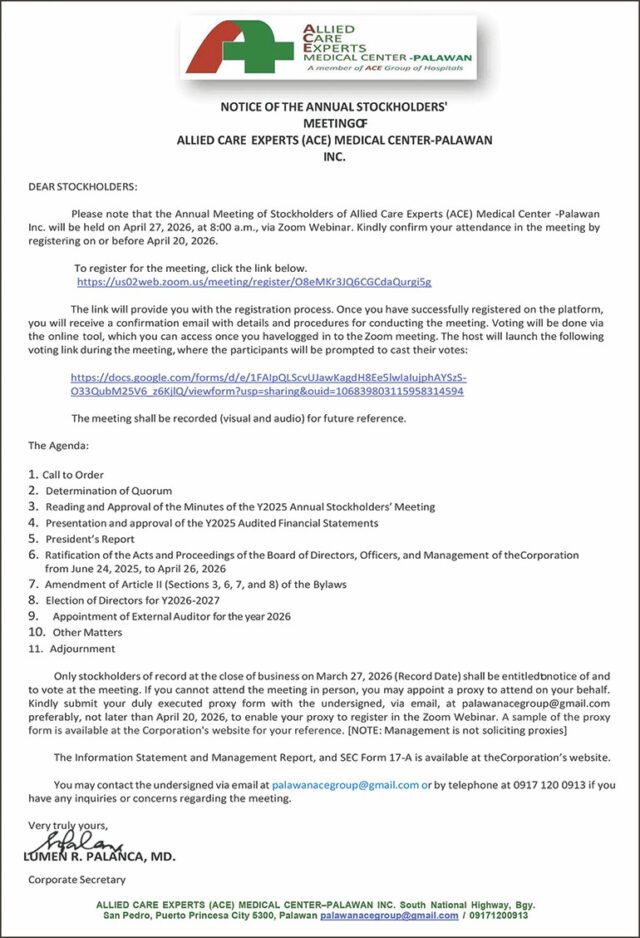
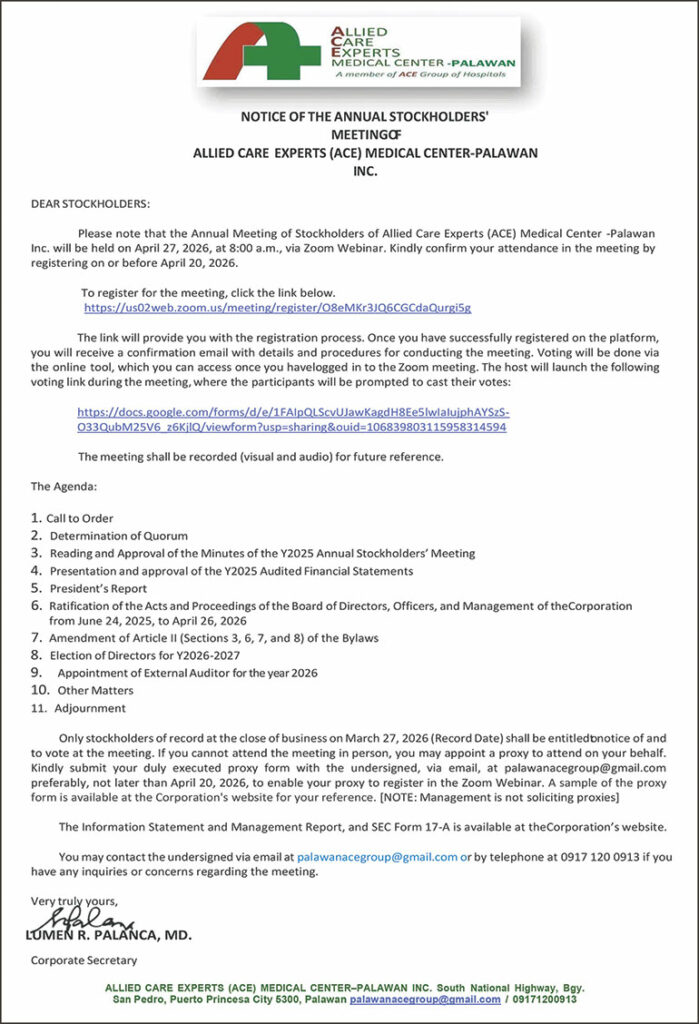
ACE Medical Center – Palawan to hold Annual Stockholders’ Meeting on April 27 via Zoom


Spotlight is BusinessWorld’s sponsored section that allows advertisers to amplify their brand and connect with BusinessWorld’s audience by publishing their stories on the BusinessWorld Web site. For more information, send an email to online@bworldonline.com.

Join us on Viber at https://bit.ly/3hv6bLA to get more updates and subscribe to BusinessWorld’s titles and get exclusive content through www.bworld-x.com.

D.M. Wenceslao stays in ATRAM SDG fund for fourth year

DMWAI.COM

D.M. WENCESLao and Associates, Inc. (DMW) has been included in the ATRAM Philippine Sustainable Development and Growth Fund for 2026, marking its fourth consecutive year in the fund’s portfolio.

“Inclusion in the ATRAM SDG Fund for the fourth consecutive year affirms that sustainability is not peripheral to DMW’s strategy, it is integral to how we create value,” DMW Chief Executive Officer Delfin Angelo “Buds” Wenceslao said in a statement on Tuesday.

The ATRAM Philippine Sustainable Development and Growth Fund selects 20 Philippine Stock Exchange-listed firms based on their alignment with the United Nations’ Sustainable Development Goals after screening about 100 companies through an internal evaluation process.

The fund has outperformed the benchmark Philippine Stock Exchange index (PSEi) since its launch, reflecting investor interest in sustainability-linked investments.

By the end of 2025, when the PSEi declined by 7.3%, the fund posted a 3% return, outperforming the benchmark by 10.3%.

DMW’s inclusion was attributed to its renewable energy use, labor practices, and governance policies. The company is the master developer and primary owner of Aseana City, a mixed-use development in Metro Manila.

“Aseana City was built with long-term resilience and responsible development at its core. As capital markets increasingly recognize the link between sustainability and performance, DMW remains committed to raising standards across governance, environmental stewardship, and inclusive growth,” Mr. Wenceslao said.

The company said its sustainability efforts focus on five areas: quality of life, environmental management, governance and ethics, labor practices, and economic development.

Shares in D.M. Wenceslao & Associates fell by 4.62% to close at P4.95 each on Tuesday. — Alexandria Grace C. Magno

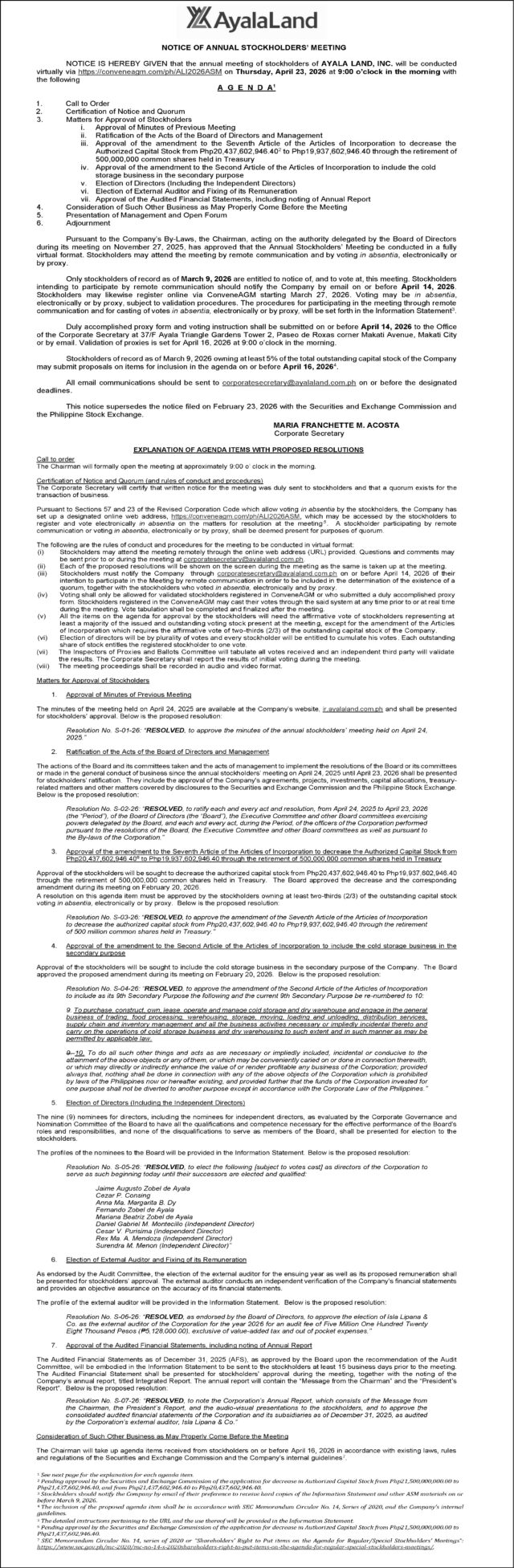
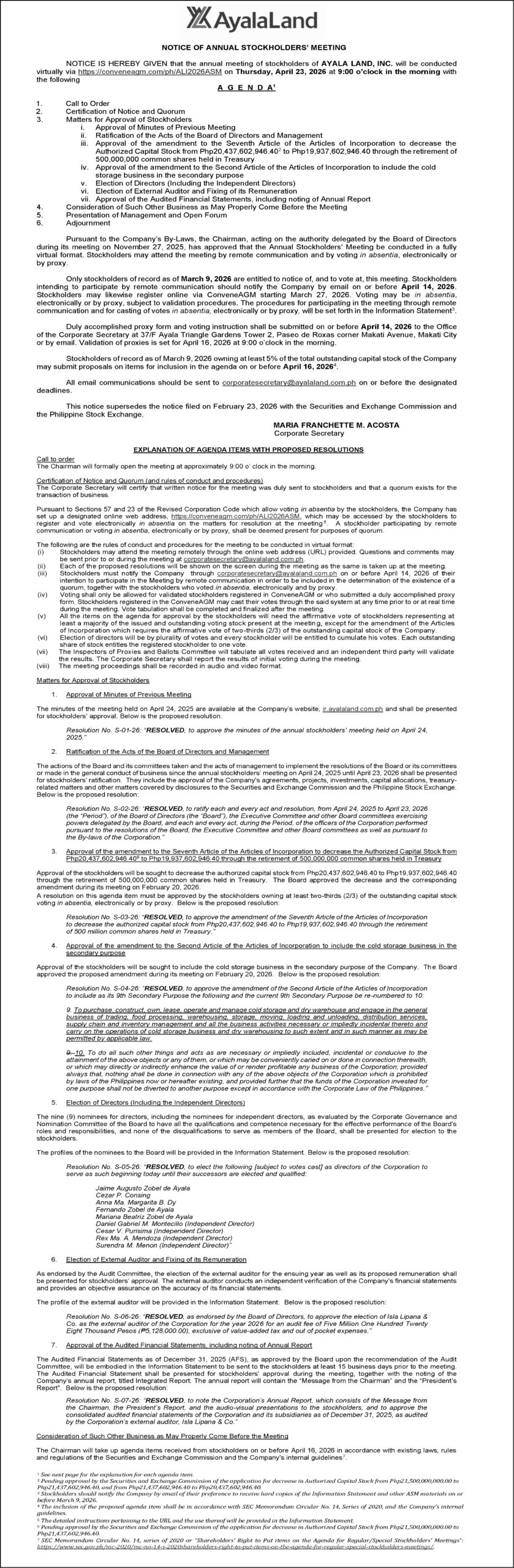
Ayala Land, Inc. to conduct virtual Annual Meeting of Stockholders on April 23

Click to enlarge


Spotlight is BusinessWorld’s sponsored section that allows advertisers to amplify their brand and connect with BusinessWorld’s audience by publishing their stories on the BusinessWorld Web site. For more information, send an email to online@bworldonline.com.

Join us on Viber at https://bit.ly/3hv6bLA to get more updates and subscribe to BusinessWorld’s titles and get exclusive content through www.bworld-x.com.

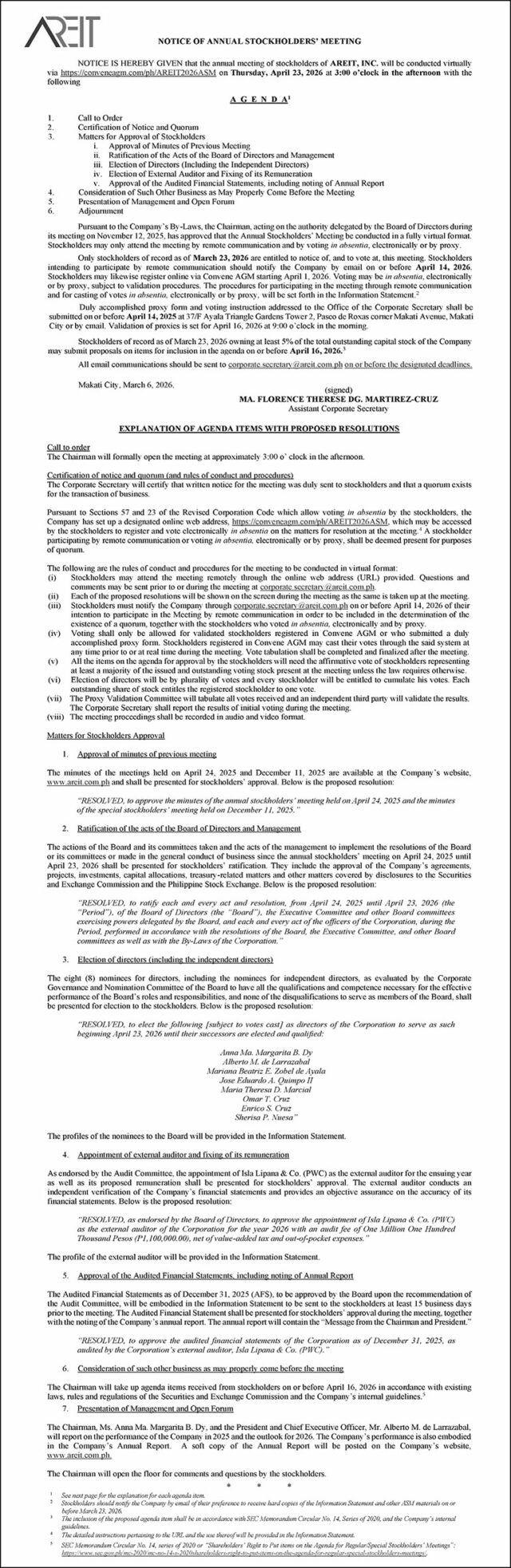
AREIT, Inc.’s Annual Stockholders’ Meeting to be held virtually on April 23


Spotlight is BusinessWorld’s sponsored section that allows advertisers to amplify their brand and connect with BusinessWorld’s audience by publishing their stories on the BusinessWorld Web site. For more information, send an email to online@bworldonline.com.

Join us on Viber at https://bit.ly/3hv6bLA to get more updates and subscribe to BusinessWorld’s titles and get exclusive content through www.bworld-x.com.

Filipinos likely cut down on non-essential spending amid looming inflation — BCG

STOCK PHOTO | Image by Standret from Freepik

AMID higher projected inflation due to volatile oil prices, Filipinos are likely to cut down on non-essential spending while seeking cheaper options for essential items, according to global management consulting firm Boston Consulting Group (BCG).

The statement was made in response to BusinessWorld’s questions regarding online shopping platform Shopee’s aggregated consumer behavior data from its March 3.3 sale.

Shopee’s report showed that while Filipinos’ top searches on the platform are for fashion-related items, their actual checkout behavior prioritizes everyday essentials, leaving limited room for discretionary purchases.

According to the Bangko Sentral ng Pilipinas on Tuesday, the inflation rate in March may accelerate to between 3.1% and 3.9%, faster than the 1.8% posted a year ago and 2.4% in February.

The higher rate is driven by costlier fuel, electricity, rice, and the peso’s dip against the US dollar.

Last year, BCG asked whether Filipinos are likely to continue their spending behavior amid impending higher inflation. It said that a majority of survey respondents, or 77%, expressed that they would cut overall discretionary spending if prices increased. The survey was released in June.

“For everyday essentials, especially fresh food, consumers tend to find cheaper options,” Lance Katigbak, principal of BCG, said in an e-mail interview with BusinessWorld.

“Filipinos tend to cut down on indulgences like alcohol, packaged snacks, and dining out, and delay big-ticket items such as furniture or appliances,” he added.

As financial security remains the number one priority for Filipino households, Mr. Katigbak said this behavior stems from the fact that inflation has been growing faster than wages, prompting families to be more financially prudent.

“So, in some ways, they have no choice but to prioritize essentials over wants,” he said.

However, not all spending is limited to essentials, as Filipinos may still make small personal purchases, BCG said.

In the recent March sale, Shopee said that alongside essential items, some of the top purchases from Shopee Mall stores included personal items such as lip tints, snack packs, and long-wear lipsticks.

Based on its report, Shopee said Filipino buyers are generally not impulsive and often stick to shopping lists focused on necessary items. — Edg Adrian A. Eva

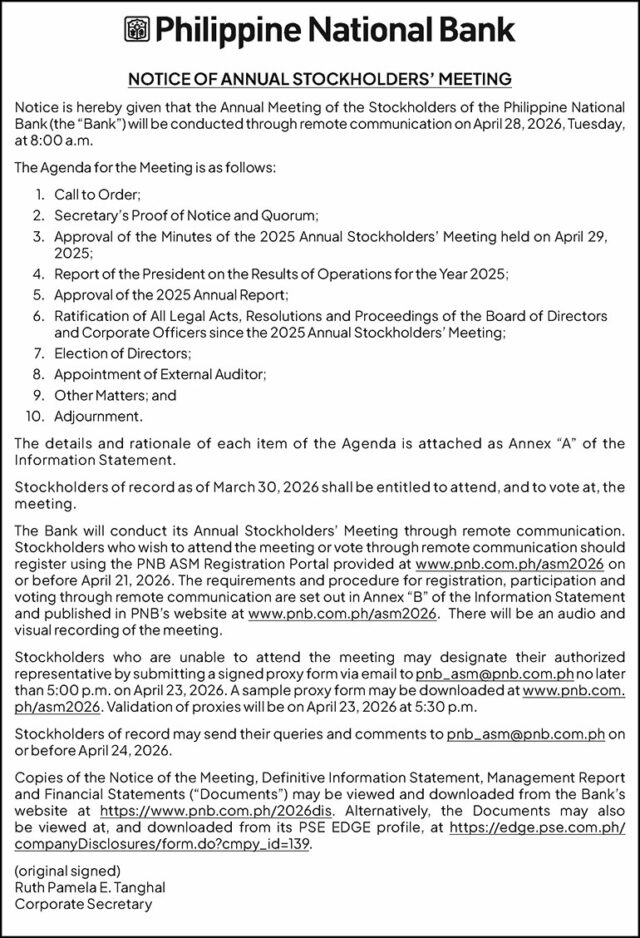
Philippine National Bank’s Annual Stockholders’ Meeting to be held on April 28 via remote communication


Spotlight is BusinessWorld’s sponsored section that allows advertisers to amplify their brand and connect with BusinessWorld’s audience by publishing their stories on the BusinessWorld Web site. For more information, send an email to online@bworldonline.com.

Join us on Viber at https://bit.ly/3hv6bLA to get more updates and subscribe to BusinessWorld’s titles and get exclusive content through www.bworld-x.com.

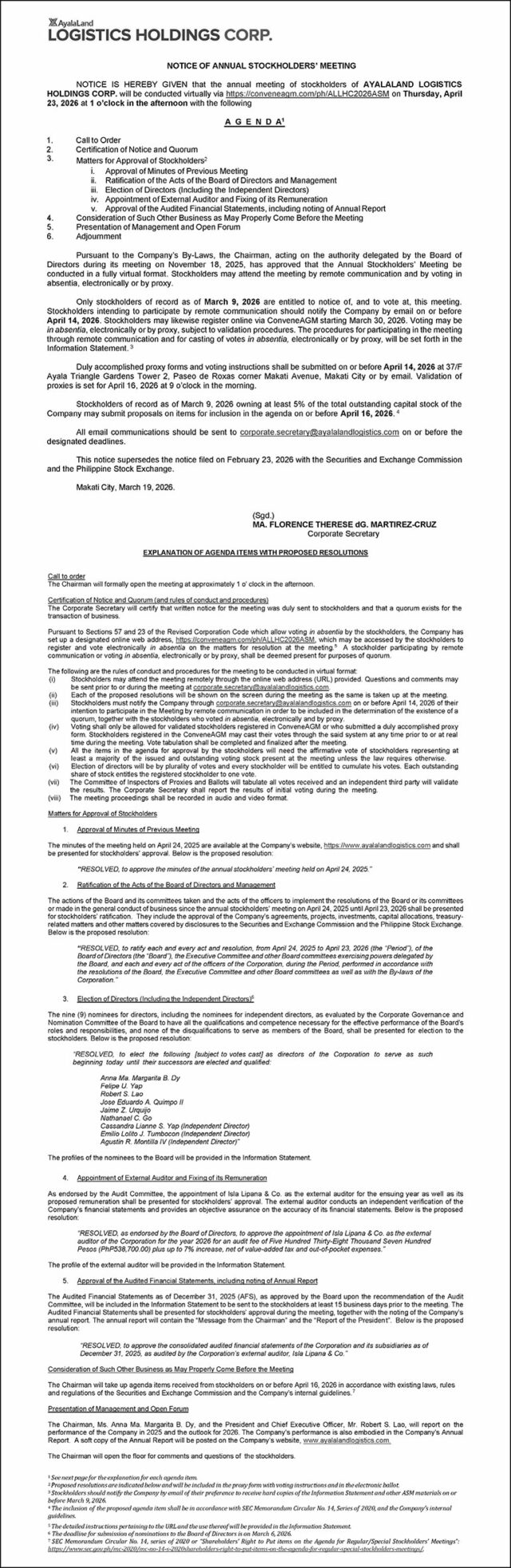
AyalaLand Logistics Holdings Corp. to hold virtual Annual Stockholders’ Meeting on April 23

Click to enlarge


Spotlight is BusinessWorld’s sponsored section that allows advertisers to amplify their brand and connect with BusinessWorld’s audience by publishing their stories on the BusinessWorld Web site. For more information, send an email to online@bworldonline.com.

Join us on Viber at https://bit.ly/3hv6bLA to get more updates and subscribe to BusinessWorld’s titles and get exclusive content through www.bworld-x.com.

Peso hits new record low as war risks spook traders

BW FILE PHOTO

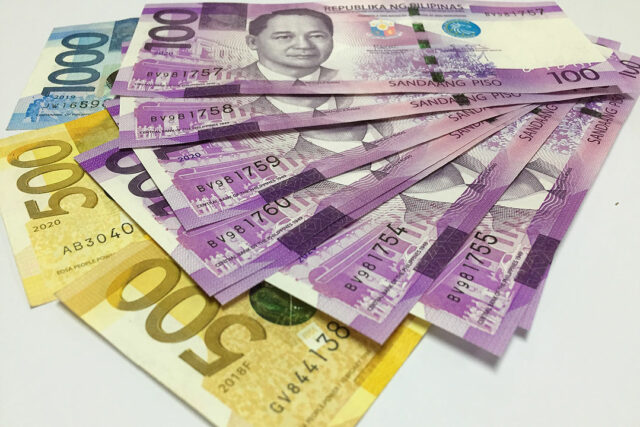
THE PESO on Tuesday ended at a new all-time low for the eighth time this month as the widening Middle East war caused investors to flock to the safe-haven dollar as oil supply risks threaten to push up inflation.

The local unit fell by 5.8 centavos to close at P60.748 against the greenback from its previous record-low P60.69 finish on Monday, data from the Bankers Association of the Philippines showed.

The peso has ended at historic lows for the last three trading days. Tuesday’s close also marks its eighth record-low finish since the United States and Israel launched their attacks on Iran on Feb. 28.

Year to date, the peso has now depreciated by P1.958 or 3.2232% from its P58.79 finish on Dec. 29, 2025.

The currency opened Tuesday’s trading session slightly stronger at P60.65. It climbed to an intraday best of P60.58, while its weakest showing was at P60.75 against the greenback.

Dollars traded went down to $1.587 billion from $2.007 billion on Monday.

“The pair closed higher at P60.748 as the dollar remained well-bid amid escalating tensions in the Middle East, fueling safe-haven demand for the dollar,” the first trader said in a phone interview.

The peso slumped due to the latest rise in global oil prices, which threatens domestic inflation, Rizal Commercial Banking Corp. Chief Economist Michael L. Ricafort said in a Viber message.

The Philippines is a net importer of oil and Middle East crude accounts for roughly 98% of its imports.

The Bangko Sentral ng Pilipinas (BSP) said last week that it now expects headline inflation to average 5.1% this year as the Iran war continues to throttle global energy trade — well above its 2%-4% tolerance band. Annual inflation last breached the BSP’s target in 2023.

A second trader said in a Viber message that the peso’s slide to new records seems to be a knee-jerk reaction to the fast-changing situation in the Middle East and “not a new trend.”

“Higher crude oil prices widen the trade gap, and risk-off sentiment lifts the dollar. In the near term, we expect the peso to trade at P60-61 while shocks persist. If oil stabilizes, the peso retraces.”

The first trader said the market remains cautious as the conflict remains a key source of volatility.

“For now, we’re looking at the possibility of testing the P61 resistance as fuel prices continue to advance and in the absence of any resolution in the Middle East conflict,” the trader said.

“Everything is uncertain. We are still on a wait-and-see approach. But in the meantime, in the absence of any clear resolution to the oil crisis and the war, we expect the dollar to remain steady above the P60 figure.”

For Wednesday, Mr. Ricafort sees the local unit ranging from P60.60 to P60.85 against the greenback.

The dollar headed for its biggest monthly gain since July on Tuesday and stands out as the strongest so-called safe asset, as war in the Middle East has set oil prices surging, nearly everything else sinking and raised the risk of global recession, Reuters reported.

Developed market currencies were broadly steady on the day, with the Japanese yen unchanged at ¥159.62 per dollar, the euro flat at $1.1472 and the pound 0.14% higher at $1.3202.

But still all three were set for March falls of more than 2%. For the euro and pound, that is the largest drop since July, and since October for the yen.

The dollar has been supported by the US status as an energy exporter and by investors’ flight to cash over the past month of conflict.

The latest news from the war, including a Wall Street Journal report that US President Donald J. Trump was willing to end attacks on Iran without forcing open the Strait of Hormuz, did little for currencies on Tuesday, but did underscore their monthly moves.

Asian currencies have suffered some of the largest losses and, on Tuesday, the dollar pushed 1% higher against South Korea’s won to 1,534 won, levels touched only in the wake of the global financial crisis in 2009 and the Asian financial crisis in 1997 and 1998.

The dollar index, which tracks the unit against six main peers, touched its highest since last May at 100.64 and, last sitting at 100.47, is up 2.8% through March.

Also top of mind for currency markets were renewed threats of intervention from Tokyo, which served to spare extra selling pressure on the yen, currently at its weakest since July 2024. — Aaron Michael C. Sy with Reuters


Assessing the first half of the Marcos Jr. administration: Agriculture

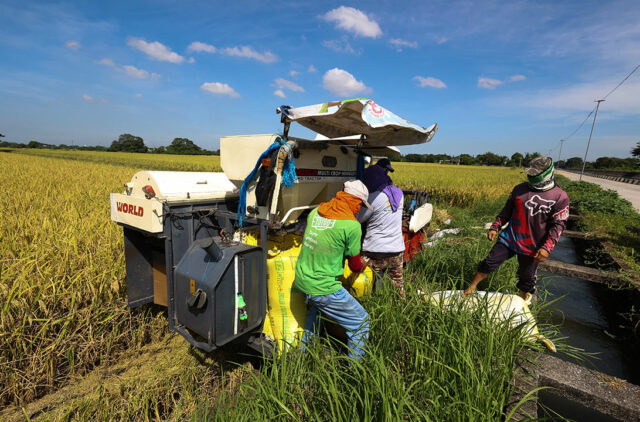
FARMERS use a rice harvesting machine at a rice field in Bustos, Bulacan Province. — PHILIPPINE STAR FILE PHOTO/KJ ROSALES

(Part 2)

Let us start with agriculture. At the very outset, let me state that it is in this sector where we can give a relatively high rating to the performance of the current administration. The required 3-4% annual growth in this sector was actually achieved in an otherwise disastrous 2025 when GDP grew the slowest in 15 years (excluding the abnormal period of the COVID-19 pandemic).

This good performance can be attributed to more enlightened policy and more efficient management by the government of this very important sector. It must be pointed out that the Marcos Jr. administration started in mid-2022 when agriculture was under great strain, shaped by lingering post-pandemic disruptions that led to elevated input costs, not to mention the increasingly volatile weather conditions.

As regards the growth in agriculture during the opening quarters of the past three administrations, that of the Marcos Jr. administration suffered in comparison with the previous two, with year-on-year growth slipping to around -0.3% in late 2022 and sinking even further through mid-2023 to roughly -2.3% to -2.7%. These declines coincided with episodes of flooding and typhoon damage in key producing regions, which disrupted planting and harvesting cycles, particularly for rice and other staples (although the term of President Benigno “Noynoy” Aquino suffered even worse natural calamities).

Nonetheless, what is commendable is how the sector did not remain in decline. By late 2023, contractions had moderated and by early 2024, growth had returned to positive territory (around 2.2%). This recovery strengthened further in 2024-2025, culminating in a sharp rebound at nearly 7% in the second quarter of 2025, contributing to a respectable 2.6% of agricultural growth for the entire year of 2025, the highest in eight years (which included most of the term of the Rodrigo Duterte administration).

The positive pattern points not to the disappearance of climate stress, but to an improving capacity to absorb shocks and to recover, indicating emerging resilience that can be reinforced through sustained investment in irrigation (a sector led by a very competent head of the National Irrigation Administration in the person of Director Ed Guillen), logistics, and climate adaptation.

In contrast, the Duterte administration followed a different trajectory. The early quarters were marked by initial weaknesses, including a pronounced contraction of agricultural production at the start of the period (a decrease of around -4%). Thanks to President Duterte’s pioneering Build, Build, Build program (his greatest economic accomplishment), agricultural growth strengthened during the middle years of his term, with several quarters exceeding 5-6%, with improved logistics, helped by some favorable production cycles. Over time, however, growth moderated and flattened, settling largely at the 1-3% range, with occasional near-zero readings, as agriculture increasingly encountered harsh climate conditions and animal diseases.

As regards the Aquino administration, the early years had robust growth of as high as 5-6% during several quarters. Unfortunately, over time, growth decelerated steadily, easing toward low single-digit and near-zero rates. This trajectory underscores the limits of rebound-led growth when deeper productivity and resilience investments have not been fully embedded.

Philippine agriculture has become increasingly exposed to climate volatility. Earlier administrations benefited from more benign conditions that supported stronger rebounds. The recovery of agriculture towards the end of the first half of the Marcos Jr. administration has occurred amid more frequent and intense climate shocks. This lends the rebound particular significance and underscores a forward-looking policy opportunity to embed climate resilience, disaster preparedness, and adaptive technologies into the agricultural growth strategy so that future expansions will be sustainable.

For this reason, the failure in good governance that resulted in the flood control corruption scandal is doubly tragic because of its negative influence on the efforts to reduce the impact of natural disasters on agricultural production.

(To be continued.)


Bernardo M. Villegas has a Ph.D. in Economics from Harvard, is professor emeritus at the University of Asia and the Pacific, and a visiting professor at the IESE Business School in Barcelona, Spain. He was a member of the 1986 Constitutional Commission.

bernardo.villegas@uap.asia

Ayala Land to launch P10-B buyback after share price drop

AYALALAND.COM.PH

AYALA LAND, Inc. (ALI) said its executive committee approved a share buyback program of up to P10 billion to commence on April 1.

“The Executive Committee of Ayala Land, Inc. approved today, a share buyback program of up to P10 billion to commence 01 April 2026,” the company said in a disclosure on Tuesday.

“The program will be implemented through open market purchases executed via trading facilities of the Philippine Stock Exchange (PSE),” it added.

Analysts said the buyback may indicate that the company views its shares as undervalued and could provide near-term support to its stock price.

“This could be because from the company’s perspective, the market is not reflecting the true value of ALI,” Philstocks Financial, Inc. Research Manager Japhet Louis O. Tantiangco said in a Viber message.

“The share buyback would serve as a support to the company’s performance in the stock market,” he said.

“Ayala Land’s 29% year-to-date decline reflects persistent pressure from elevated interest rates, softer property demand, and cautious sector sentiment while the P10B share buyback signals management’s confidence in current valuations and provides near-term support,” Unicapital Securities, Inc. Research Head Wendy B. Estacio-Cruz said in a separate Viber message.

She added that any sustained rebound would hinge on lower interest rates and a pickup in demand.

At the local bourse on Tuesday, ALI shares fell by 0.74% to close at P16.14 each, their lowest level since Jan. 9, 2012, when they closed at P16.06. — Alexandria Grace C. Magno

ADVERTISEMENT
ADVERTISEMENT