Home Blog Page 7467

Groups cite scant pandemic funds

CIVIC groups on Wednesday hit the government for inadequate funds against the coronavirus pandemic under next year’s national budget.

“Anyone who looks at the 2022 budget will immediately see that it does not respond enough to the country’s most urgent issues of COVID-19 and poverty alleviation,” Liza Maza, spokesperson of the Council for People’s Development and Governance, said in a statement.

The Coalition for People’s Right to Health compared the P13-billion allocation for health infrastructure to the total infrastructure budget worth P1.2 trillion.

“We are almost two years into the world’s longest lockdown, yet the administration is still desperately failing to see where its priorities should lie,” group convenor Joshua San Pedro said in the statement.

IBON Foundation earlier said the disproportionate allotment for infrastructure, military and police, and debt servicing should be used to address health and economic concerns. — Alyssa Nicole O. Tan

House bill bars troops from UP

SEAN DUNCAN S. REYES

CONGRESSMEN on Tuesday approved a bill that seeks to institutionalize the agreement between the University of the Philippines (UP) and Department of National Defense (DND) banning state troops from the state university’s campuses nationwide.

House Bill 10171 will include the 1989 deal between UP and the Defense department in the UP charter of 2008.

It will ban police, soldiers and other law enforcement authorities from UP premises, except in cases of hot pursuit or emergencies.

It will also require state forces to notify the university president, campus chancellor or dean of a regional unit before conducting any activities at any UP campus nationwide.

The bill will prohibit state forces from interfering with peaceful protest actions by people within the UP campus. — Russell Louis C. Ku

5,000 workers get aid 

ABOUT 5,000 informal sector workers in the National Capital Region received livelihood grants, bicycles, mobile phones with load cards, and cash-for-work wages worth P59.18 million from the Labor department on Tuesday, the agency said in a statement.

Bicycles and mobile phones worth P21.18 million were given to beneficiaries from 16 cities and a municipality to help them start a food delivery business.

Labor Secretary Silvestre H. Bello III said the beneficiaries were workers under the A4 category who have completed their vaccine shots. “This is one incentive to encourage our workers to get vaccinated and to help in the country’s fight against this pandemic,” he said in an e-mailed statement.

The agency said 3,551 informal sector workers from Marikina, Pateros, Mandaluyong, San Juan, Pasig, and Manila City were also given temporary jobs and wages worth P35.44 million under its cash-for-work program.

Livelihood grants worth P2.57 million were also awarded to 330 beneficiaries in the capital. — Bianca Angelica D. Añago

Deadline for petroleum reserve feasibility study set at 18 months

REUTERS

THE DEPARTMENT of Energy (DoE) said Wednesday that it has allotted 18 months for a feasibility study on the proposed Strategic Petroleum Reserve (SPR).

In a statement, the DoE said it issued a department circular on Sept. 16 detailing the steps for setting up the SPR.

The circular, which has yet to be published on the DoE website, has identified the DoE and Philippine National Oil Co. (PNOC) as the lead agencies for setting up a government-owned reserve of crude oil, finished petroleum products and biofuels, which will insulate the Philippines from volatile fuel prices and supply disruptions.

Apart from the feasibility study, the lead agencies’ other deliverables include the creation of standards for signing supply deals for the reserves; maintaining the storage facilities, and managing the inventory, according to Energy Undersecretary Felix William B. Fuentebella.

“This circular (establishing the national SPR) will help bring the country closer to attaining energy security by decreasing our dependence on the importation of crude oil and finished petroleum products to meet our fuel requirements,” Secretary Alfonso G. Cusi said.

In March, the PNOC announced the revision of the terms of reference for engaging the project advisor, which will be preparing the detailed feasibility study. 

The PNOC’s other task was to prepare to operate a mobile distribution system for the reserves if warranted by an emergency. — Angelica Y. Yang

PHL, Vietnam could be among top RCEP beneficiaries — PIDS

THE PHILIPPINES and Vietnam could be the top gainers in terms of real gross domestic product (GDP) growth under a new 15-country Asia-Pacific trade deal, mainly due to lower trade costs, according to a preliminary analysis from the Philippine Institute for Development Studies (PIDS).

The benefit to both countries was quantified as a 2.14% gain in real GDP for Vietnam and a 2.02% gain for the Philippines, according to a presentation delivered by PIDS Senior Research Fellow Francis Mark A. Quimba.

The two countries were identified as among those with the greatest potential to benefit from lower trade costs. Mr. Quimba’s presentation singled out Singapore and South Korea as the top gainers from lower trade costs, followed by Vietnam and the Philippines.

He was speaking at a virtual event organized by the Trade department on Wednesday.

The Regional Comprehensive Economic Partnership (RCEP) signed last year is a trade pact among China, Australia, New Zealand, Japan, South Korea and all 10 member countries of the Association of Southeast Asian Nations (ASEAN), accounting for about a third of the world’s trade and economy.

Mr. Quimba said his modelling indicates that Philippine producers will be able to realize higher factory gate prices under the new set-up, which will flow on to higher real GDP.

“The success of any trade agreement depends on utilization,” he said. “The companies will need to internalize the reduction in trade and increase factory gate prices.”

George N. Manzano, University of Asia and the Pacific economist and former tariff commissioner, said the RCEP can be key to improving trade among member countries.

“We hope that RCEP can increase the resilience of global value chains by making it more established and providing a more secure framework with rules-based approach to the global value chains crisscrossing Asia and the Pacific region,” he said.

“To the extent that RCEP can lower trade costs, it allows member economies to participate more fully and plug in more securely in the global value chain.”

But RCEP could also cause trade vulnerabilities.

The Philippines already benefits from lower tariffs when it exports to Japan, South Korea, and China. But the mega-trade deal will also allow the three economies to have preferential access to each other’s markets.

“There’s always the threat that our preference might be eroded. And this is at the moment something that we need to consider moving forward. We don’t know yet how significant it is,” Mr. Manzano said.

Mr. Quimba also noted concerns surrounding the RCEP centering on the widening of the development gap among members, with more potential benefits flowing to South Korea and Japan. — Jenina P. Ibañez

Legislator says taxing golf courses, subdivisions preferable to wealth tax

A SENIOR LEGISLATOR proposed Wednesday to tax the inefficient use of land, including golf courses and low-density subdivisions.

Albay Rep. Jose Maria Clemente S. Salceda, chairman of the House Ways and Means Committee, was responding to a proposal for a wealth tax on individuals with taxable assets exceeding P1 billion.

“The best way to tax wealth is to tax the inefficient and dysfunctional use of land in this country. The easiest and fairest way to do that is to tax low-density use of land in very high-density areas,” Mr. Salceda said.

He said subdivisions and golf courses leave the working class with relatively little living space, introducing inefficiencies to their working and living arrangements.

“Imagine, in the world’s densest Metropolis, we have golf courses. They create traffic, are an inefficient use of land and water, and prevent a lot of fair development such as socialized housing from having space in the city,” Mr. Salceda said.

He also said that taxing net worth could harm the economy as wealthy individuals can easily transfer assets to friendlier tax jurisdictions.

Legislators from the minority Makabayan bloc filed House Bill 10253 or the proposed Super-Rich Tax Act of 2021 that will impose a tax of 1-3%, depending on the extent the assets exceed P1 billion.

As drafted, the bill proposes a 1% rate on taxable assets exceeding P1 billion; a 2% rate on assets above P2 billion; and a 3% rate on assets above P3 billion.

The bill proposes an effectivity date for the tax of Jan. 1, 2022, if passed.

Revenue from the tax is to be used for medical assistance and investment in education, employment, social protection, and housing for poor families.

Makabayan legislators said that the proposed tax could raise P236.7 billion in government revenue a year from just the top 50 richest Filipinos.

However, Finance Secretary Carlos G. Dominguez III told reporters that the proposed tax will drive capital out of the Philippines. — Russell Louis C. Ku

Private school tax relief bill passes Senate on 2nd reading

PHILIPPINE STAR/ MIGUEL DE GUZMAN

A BILL which makes explicit the eligibility of private schools for tax relief during the pandemic has passed in the Senate on second reading.

Senator Pilar Juliana S. Cayetano, who chairs the Senate Committee on Ways and Means, on Tuesday sponsored Senate Bill No. 2407, as reported out from committee with some minor modifications. The measure amends Section 27(B) of the National Internal Revenue Code.

The amendment specifically makes private schools qualified to pay a temporarily lower tax rate to help them survive the economic crisis.

Their eligibility had initially been questioned by the Bureau of Internal Revenue, which ruled that only non-profit private schools were entitled to tax relief. This BIR ruling has since been withdrawn.

Senate President Pro Tempore Ralph G. Recto, a co-sponsor of the bill, noted that it was important to ensure that private schools, which have been severely affected by the pandemic, do not shut down permanently.

“The type of bailout through tax relief is more economical on the part of the government than letting private schools close, as the latter would trigger a migration of refugees to public schools whose education must now be shouldered by taxpayers,” he said.

The Corporate Recovery and Tax Incentives for Enterprises (CREATE) Act had provided for a concessionary tax rate of 1% for enterprises hit hard by the pandemic between July 2020 and June 2023. The withdrawn BIR ruling would have forced public schools to pay the regular corporate tax rate of 25%.

“This bill (removes) the vagueness caused by a missing comma,” Mr. Recto told the plenary. “Another reminder that when crafting tax laws, syntax matters.”

“When the language of a tax provision can be subjected to multiple interpretations, citizens and common sense always lose to collections,” he added.

Meanwhile, private schools released a joint statement backing the Senate’s waiver of the period of interpellation and hoped for expedited approval of the measure.

“Help has finally come; we need this more than ever,” the Coordinating Council of Private Educational Associations (COCOPEA) said.

COCOPEA represents over 2,500 private educational institutions with over 300,000 employees.

“With our enrolment numbers that continue to go down because of the pandemic, this economic and policy intervention from our Senators empowers and uplifts our institutions in taking on the challenges in education particularly the current learning crisis of our students; preparations for reopening of schools to in-person classes; and the need to continuously strengthen our country’s human capital development in response to the fast-evolving digital economy,” it added. — Alyssa Nicole O. Tan

Bids sought for 15-year Negros Occidental port management contract

THE Philippine Ports Authority has started soliciting bids for a port terminal management contract in Negros Occidental.

The contract is for the port of Pulupandan in Negros Occidental.

“The concession period will be for a period of 15 years,” the agency said in its bid invitation.

The project consists of ancillary and other related services, stevedoring services, bagging services, RORO (roll-on/roll-off) cargo services, store management, waste and shore reception facility management, water distribution services, and weigh-bridge facility operations.

The agency said the minimum concession fee for the duration of the concession period is P597.07 million, exclusive of all taxes.

Meanwhile, the minimum concession fee for the first year is P27.67 million, exclusive of all taxes.

Bid documents were issued on Sept. 21. The deadline for submission of bids is Oct. 18. Bid opening will take place on the same day.

“A prospective bidder must not be engaged in any business activity, whether primarily or otherwise, which will prevent it from properly and sufficiently discharging its contractual obligations under any port terminal management contract to be awarded,” the agency said. The prohibition covers entities engaged in maritime transportation.

The agency requires bidders who have experience in cargo handling, passenger terminal building operations, and RORO operations of at least two years.

The bid format is open competitive bidding using non-discretionary pass/fail criterion. — Arjay L. Balinbin

Construction materials Aug. price growth in NCR at 31-month high 

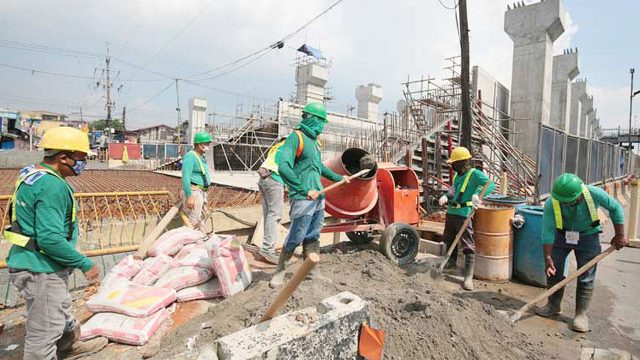
Workers are seen mixing cement at a construction site in Quezon City, May 19, 2020. — PHILIPPINE STAR/ MICHAEL VARCAS

WHOLESALE PRICES of construction materials in Metro Manila rose 4.3% in August, the highest rate in 31 months, the Philippine Statistics Authority (PSA) said Wednesday.

Preliminary PSA data indicated that the rise in the August construction materials wholesale price index (CMWPI) accelerated from 2.3% in July and 1% a year earlier.

The 4.3% result was the highest since January 2019, when wholesale construction materials prices grew 4.4%.

Year to date, the CMWPI rose 2.4%, up from the 1.5% expansion posted a year earlier.

The August growth was led by the price of galvanized iron sheets, which rose 11.5% year on year compared with 2.3% in July; reinforcing and structural steel (7.6% from 3.6%); electrical works (5.6% from 4.1%); plywood (2.2% from 1.9%); lumber (2.2% from 2%); doors, jambs, and steel casements (2.2% from 1.9%); painting works (1.9% from 1.7%); and concrete products and cement (0.7% from 0.6%).

The year-on-year growth in wholesale prices of fuels and lubricants remained elevated at 17.4%, though easing from the 18% rise in July. Meanwhile, glass and glass products grew 14.4%, unchanged from July.

Wholesale prices of sand and gravel grew 3.4%, retreating from the 3.6% growth rate in July.

“This could be the result of increasing bottlenecks brought by new lockdowns in August. It should also be noted that construction growth had been on an upswing the previous period and there is momentum in the recovery of demand, particularly for construction materials,” UnionBank of the Philippines, Inc. Chief Economist Ruben Carlo O. Asuncion said in an e-mail.

“We’ve seen (first-quarter) gross domestic product (GDP) growth supported by both manufacturing and construction recovery, and this same momentum might have pushed prices higher as restrictions went up in August,” Mr. Asuncion added.

The NCR (National Capital Region) and the surrounding areas were under general community quarantine between May 15 and Aug. 5, albeit with local variations. This was elevated to a stricter setting of enhanced community quarantine (ECQ) between Aug. 6 and 20 in order to curb the spread of the more infectious Delta variant of coronavirus disease 2019 (COVID-19) and later eased to modified ECQ.

The government implemented on Sept. 16 a new lockdown system in Metro Manila. Under the new guidelines, lockdowns will be localized at the city level depending on case transmission rates and healthcare utilization rates. The new alert system will consist of five levels, with level 5 equivalent to ECQ.

Mr. Asuncion said the “granular” lockdowns may ease the pressure on prices.

“This would open certain parts of the economy not directly ‘locked down’ because of rising infections. The shift, in general, I believe is a better option as the government strives to open the economy further,” Mr. Asuncion said.

“If implemented effectively, I think prices of construction materials will ease as supplies and consumers can move more freely,” he added. — Bernadette Therese M. Gadon

Volumes landed at fish ports rise despite typhoons — PFDA  

PHILSTAR FILE PHOTO

VOLUMES unloaded at fish ports rose 5.85% week on week to 10,065.42 metric tons (MT) in the week to Sept. 12, despite recent typhoons, the Philippine Fisheries Development Authority (PFDA) said.

The PFDA said in a report that volume gains were led by the General Santos Fish Port Complex, which posted a week-on-week increase of 17.27% to 6,248.74 MT, followed by Navotas Fish Port Complex, up 7.77% at 2,405.33 MT, and Sual Fish Port, up 2.50% at 74.55 MT.

The Philippines was recently hit by typhoons Jolina (international name: Conson) and Kiko (international name: Chanthu).

Meanwhile, the PFDA said landed volumes at Davao Fish Port Complex fell 75.58% week on week to 9.94 MT.

Bulan Fish Port Complex fell 40% to 359.11 MT. Also declining were volumes at Lucena Fish Port Complex (down 31.99% at 272.85 MT), Zamboanga Fish Port Complex (down 23.17% at 273.82 MT), and Iloilo Fish Port Complex (down 12.18% at 421.09 MT).

“As of Sept. 12, all PFDA regional fish ports have unloaded a total of 832,245.16 MT of fish since the start of the pandemic in March 2020,” it said. — Revin Mikhael D. Ochave

ERC orders PEMC to halt collection of congestion fees associated with Cebu-Negros cable outage

THE ENERGY Regulatory Commission (ERC) has directed the Philippine Electricity Market Corp. (PEMC) to suspend the collection of congestion charges and other fees triggered by an outage at a high-voltage submarine cable connecting Cebu and Negros.

“The Commission is of the view that the congestion and other charges that are attributable to the damage of the Cebu-Negros Submarine Cable, which was not caused by the consumers, should not be charged to them,” ERC Chairperson and Chief Executive Officer Agnes VST Devanadera said in a statement Wednesday.

The line had been severed in June by dredging works.

The commission also required PEMC to refund congestion and other fees collected between June and August within “a period equivalent to the number of months covered by the subject collections.”

The ERC added that it ordered PEMC to defer congestion payments and other applicable charges to generation companies affected by the incident.

The commission’s directives will take effect until the transmission line is completely restored or until the ERC comes up with a pricing solution and settlement.

In mid-June, the 138-kiloVolt Cebu Negros Line 1 was damaged by dredging carried out by the Department of Public Works and Highways on the Bio-os River in Negros Oriental.

“The damage to the line has consequently resulted in decreased transfer capacity of the Cebu Negros Submarine Cable, thus resulting in congestion that limits the available supply. Consequently, costlier diesel plants have been tapped to compensate for the load required, ultimately setting the marginal costs that define the current pricing in Negros and Panay,” the ERC said.

“As reported to the commission, significant increases in the electricity rates of consumers in the subject areas have been observed beginning in their June billing. The significant increases in electricity billings have been decried by many stakeholders in Panay and Negros as an unreasonable burden on consumers and businesses,” the ERC said. — Angelica Y. Yang

Pork industry seeks relief from imports amid low farmgate prices 

REUTERS

THE GOVERNMENT needs to review its pork import policy due to the dampening effect imports have had on farmgate prices and amid increasing production costs, the pork industry said.

Rolando E. Tambago, Pork Producers Federation of the Philippines, Inc. president, said by phone that growers are facing dual pressures from the low price of live hogs and higher feed costs.

“(The government) needs to revisit its expansion of pork imports,” Mr. Tambago said.

He said the current average farmgate price for live hogs in Luzon is P160 per kilogram (/kg), while the average farmgate price in the Visayas and Mindanao is P130/kg.

He also estimated that the current cost of production in Luzon is P165/kg; in the Visayas and Mindanao the cost is P140/kg.

“It is higher in Luzon because of the higher biosecurity costs resulting from African Swine Fever (ASF),” Mr. Tambago said.

“Feed corn also increased from P14/kg earlier this year to the current price of P23/kg,” he added.

Mr. Tambago said some hog raisers have been selling their hogs at below cost due to weak demand and the arrival of imported pork at lower tariff rates.

“The demand is down since the purchasing capacity of people is low… imported pork is also competing with local pork,” Mr. Tambago said.

“While the government is asking us to increase production capacity — to which we responded even with low demand — it still opted for massive importation. Definitely, the swine industry’s confidence to further repopulate is affected,” he added.

In May, President Rodrigo R. Duterte signed two executive orders that expanded the minimum access volume allocation for pork imports by 200,000 metric tons (MT); and lowered the tariff rates of in-quota and out-of-quota pork imports to increase supply and control prices.

The Bureau of Animal Industry (BAI) estimates that meat imports in the eight months to August rose 44.8% year on year to 800,152.24 MT, led by pork.

Pork imports during the period increased 184.1% to 389,556.86 MT.

The BAI also tallied sanitary and phytosanitary import clearances (SPSICs) for meat imports covering 1.72 million MT as of the end of August, an increase of 107% year on year.

Approved SPSICs for pork imports as of Aug. 31 is 837,955.34 MT, against 276,424.23 MT a year earlier. — Revin Mikhael D. Ochave