Home Blog Page 719

Puregold pays tribute to sari-sari stores, launches video series

For centuries, Philippine streets have been dominated by sari-sari stores. Traced back to pre-colonial barter trade, it has evolved into the neighborhood tindahan we know today: a lifeline to Filipino families and a source of everyday needs.

But more than selling household goods, sari-sari stores have come to play a key role in Filipino communities: they are social hubs where everyone could meet and hang out, ask for directions, or just simply unwind.

Puregold, the country’s leading supermarket chain, is saying “thank you” to these sari-sari stores through a four-part video series that honors their crucial role as neighborhood hubs and economic driver.

“As a long-time supporter of Filipino MSMEs, we want to highlight the importance of sari-sari stores in our communities. We want to share these videos that capture the many ways that sari-sari stores have become a vital part of our daily lives and serve as pillars in our communities,” said Vincent Co, Puregold’s president.

The first episode of the four-part series will premiere this November, with succeeding episodes to follow in the coming months. Each installment captures the everyday realities and enduring charm of neighborhood sari-sari stores, telling stories that evoke both nostalgia and pride in Filipino enterprise.

The series will also feature special appearances from well-loved personalities, celebrating the vital role these community stores play in connecting people across generations.

For nearly three decades, Puregold has grown from a supplier of consumer goods for sari-sari stores into a trusted retail partner and business enabler. Beyond providing affordable and high-quality products, the company continues to support micro-entrepreneurs through training programs, exclusive incentives, and creative initiatives such as concerts, films, and digital series. This commitment reinforces Puregold’s position as the country’s most progressive retail ally.


Spotlight is BusinessWorld’s sponsored section that allows advertisers to amplify their brand and connect with BusinessWorld’s audience by publishing their stories on the BusinessWorld Web site. For more information, send an email to online@bworldonline.com.

Join us on Viber at https://bit.ly/3hv6bLA to get more updates and subscribe to BusinessWorld’s titles and get exclusive content through www.bworld-x.com.

Uwan exits PAR, may re-enter on Wednesday

DOST-PAGASA FB PAGE 

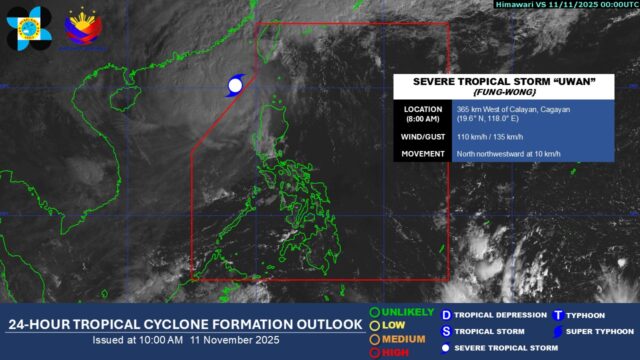
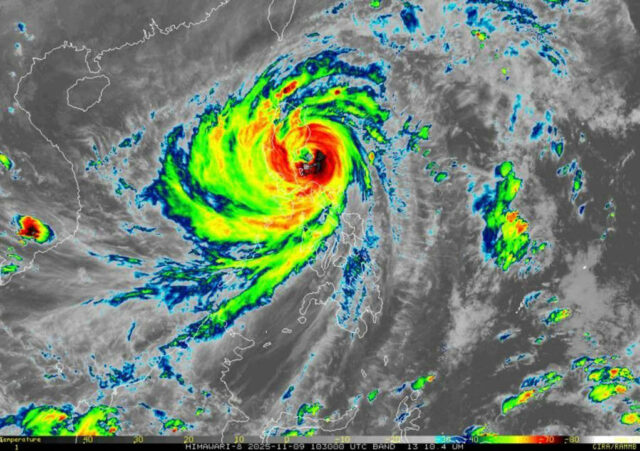
A weakened severe tropical storm, Fung-wong, locally known Uwan, has exited the Philippine Area of Responsibility (PAR) but may re-enter again on Wednesday, according to the Philippine Atmospheric, Geophysical and Astronomical Services Administration (PAGASA).

Fung-wong, packing sustained winds of 110 kilometers per hour (kph) and gusts of up to 135 kph, was last located 365 kilometers west of Calayan, Cagayan, moving north-northwestward at 10 kph, PAGASA said in its 8:00 a.m. advisory.

In an earlier advisory, PAGASA said the cyclone is expected to re-enter PAR on Wednesday as it moves toward the southwestern coast of Taiwan, where it is likely to make landfall and further weaken.

While traversing Taiwan, PAGASA said that areas in the northern part of Luzon are expected to experience gusty winds due to the typhoon’s broad circulation, particularly over Batanes and the Babuyan Islands. However, most parts of the country are no longer expected to be affected.

Fung-wong is then expected to emerge over the waters near the Ryukyu Islands, located northeast of Taiwan, and further weaken into a low-pressure area by Friday.—Edg Adrian A. Eva

SHAPE Asia Policy Lab sparks multi-sector push for healthier food retail and marketing in the Philippines

Government agencies, researchers, civil society leaders, and global partners met last Oct. 14, 2025, at Seda Manila Bay for the SHAPE Asia Policy Lab, a landmark gathering focused on transforming how food is sold and marketed in the Philippines.

Hosted by SHAPE Asia (Shaping Healthy Asian Food Systems and Policy Environments), the high-level policy dialogue, entitled “Shaping Food Environments: Policy Dialogues on Food Retail and Marketing in the Philippines,” brought together key actors to chart a path toward healthier food environments, especially in the face of rising obesity, undernutrition, and diet-related diseases in the country.

Moving Beyond Talk to Targeted Action

“This is a rare opportunity for a direct, solutions-focused dialogue between researchers, government agencies, and advocates,” said Dr. Elaine Borazon, SHAPE Asia project lead. “We want to shift the conversation toward meaningful policy change.”

Dr. Borazon emphasized that SHAPE Asia’s mission is to amplify and support the ongoing work of Philippine agencies, especially in food retail and marketing policy. “Our focus for the first two years is to collaborate with the local government and stakeholders on evidence-based solutions that can be scaled nationally,” she added.

The Policy Lab featured representatives from the Department of Health (DoH), National Nutrition Council (NNC), FNRI-DoST, UNICEF, Philippine Commission on Women (PCW), Pasay and Quezon City Local Government Units, the Nutritionist-Dietitian Association of the Philippines, PhilRice, UN-World Food Programme, and other stakeholders.

Dr. Elaine Borazon in discussion with key participants

Shared Vision Across Agencies

The participants rallied around a shared goal: creating a healthy, well-nourished nation. The DoH highlighted its work on improving health outcomes through enabling environments and technical assistance to local government units. FNRI-DoST shared updates on tools like the Philippine Dietary Guidelines, which are aligned with SHAPE Asia’s vision.

One key takeaway from Quezon City’s presentation was their openness to policy expansion: “We are integrating nutrition standards with local farmer support. We are open to more regulation of food retail,” said Jai Sideco from the Quezon City Health Department. “We need research on how food marketing affects consumption, especially among children.”

Gender and Equity in the Food Environment

The Philippine Commission on Women (PCW) raised concerns about the gendered impact of healthy food policies. “The impact of making food healthier affects women. In the retail industry, most vendors are women. Based on the Philippine Statistics Authority, 60% of new business name registrations are in women’s names,” a PCW representative stated. They urged policymakers to ensure that reforms support women-led small businesses.

Lessons from Across the Region

International insights were provided by Madiha Ahmed, Senior Program Specialist at Canada’s International Development Research Centre (IDRC). “The challenges you’re discussing today echo what we’re hearing across Southeast Asia, South Asia, even Africa and Latin America,” she noted. “It’s both a little worrying and a little reassuring that we’re facing many of the same obstacles, but at the same time, we know from our experience in other regions, change is possible when we come together.”

Ms. Ahmed commended the diversity of voices in the room from barangay nutrition scholars and city councils to researchers and development partners, saying this range of perspectives is crucial for meaningful and lasting policy change.

Concrete Commitments and Next Steps

Participants also discussed ongoing and planned initiatives: direct procurement agreements with farmers, nutrition education in schools, and embedding dietitians in LGU programs.

One proposal that drew support was the harmonization of existing policies across departments to make them more accessible to implementers on the ground. “We don’t necessarily need to create new policies,” one participant said. “We need to disseminate, consolidate, and monitor the ones we already have.”

SHAPE Asia is committed to following up with partner agencies and local government units for pilot projects in 2026, including collaborative research, technical support, and advocacy campaigns.

A Platform for Shared Progress

SHAPE Asia, led by Dr. Elaine Borazon, a faculty member of the National Sun Yat-sen University in Taiwan, is active in Indonesia, Malaysia, Thailand, Sri Lanka, and the Philippines. It promotes double-duty actions, policies that address both undernutrition and non-communicable diseases through better food systems and smarter governance.

“Our role is to be a platform and amplifier,” said Dr. Borazon in closing. “We want to harmonize and support what each of you is already doing. We can build food environments that are equitable, sustainable, and healthy for all Filipinos together.”


Spotlight is BusinessWorld’s sponsored section that allows advertisers to amplify their brand and connect with BusinessWorld’s audience by publishing their stories on the BusinessWorld Web site. For more information, send an email to online@bworldonline.com.

Join us on Viber at https://bit.ly/3hv6bLA to get more updates and subscribe to BusinessWorld’s titles and get exclusive content through www.bworld-x.com.

Taiwan evacuates 3,000 ahead of arrival of Typhoon Fung-wong

JOHNSON HUNG-UNSPLASH

TAIPEI — Taiwan issued a land warning on Tuesday and evacuated more than 3,000 people ahead of the arrival of Typhoon Fung-wong which, while weakening, is expected to dump large amounts of rain on the island’s mountainous east coast.

Fung-wong is forecast to make landfall on Taiwan’s southwestern coast around the major port city of Kaohsiung on Wednesday, after powering through the Philippines as a much stronger system and killing six people.

It is then expected to cross the bottom part of Taiwan and enter the Pacific Ocean along the coast of the sparsely populated eastern counties of Taitung and Hualien.

Taiwan President Lai Ching-te, writing on his Facebook page, said people should not head into the mountains or go to the coast or other potentially dangerous areas.

In September, 18 people died in Hualien in flooding unleashed by an earlier typhoon.

The government has already ordered evacuations in the town of Guangfu, the scene of those deadly floods, and said a total of 3,337 people in four counties and cites had been moved to safer areas.

Hualien closed schools and offices on Tuesday, as did the neighboring county of Yilan.

The typhoon will not directly affect the northern city of Hsinchu, home to TSMC, the world’s largest contract chipmaker. — Reuters

King Felipe heads to China for more Spanish courtship

PEXELS

MADRID — King Felipe VI will start the first state visit to China by a Spanish monarch in 18 years on Tuesday as Madrid pursues the most active courtship of Beijing within the European Union.

The four-day trip, coinciding with the 20th anniversary of high-level bilateral relations, should further cement business and political interests with China at a time when Spain’s ties with the world’s other superpower, the US, are souring.

Felipe, accompanied by Foreign Minister Jose Maria Albares, Economy Minister Carlos Cuerpo and a phalanx of Spanish businesspeople, will spend Tuesday in the city of Chengdu before meetings in Beijing on Wednesday with President Xi Jinping, Premier Li Qiang and top legislator Zhao Leji.

The king’s visit follows three trips by Socialist Prime Minister Pedro Sanchez in as many years in a strategy by Madrid to rebalance trade relations skewed in favor of Beijing.

Spain imported 45 billion euros ($52.5 billion) of goods from China in 2024 while it exported just 7.5 billion euros, according to state trade agency ICEX.

China has reciprocated the courtship.

In December, Madrid hosted the first overseas edition of the Imperial Springs International Forum (ISIF) – a Chinese equivalent of the Davos World Economic Forum or Allen & Company’s Sun Valley Conference.

That was seen by China-watchers as a reflection of China’s growing confidence in its new best friend in Europe, where other nations are cautious about engagement given trade imbalances, Beijing’s relations with Russia and its dominance of critical minerals’ supply.

Mr. Xi made a state visit to Spain in November 2018, at the start of Sanchez’s time in office.

Spanish pork exporters say closer ties have helped boost sales. Pork exports to China rose 8% to 700 million euros ($780 million) in January-July from a year earlier, even as exports from Denmark and the Netherlands fell and US shipments also declined, data by ICEX show.

Spain sent about half of the 682,000 tons of pork sold to China during that period, according to the Spanish association of meat industries, Anice.

Spain has a product China wants but the pork trade is also “now shaped by a series of geostrategic and geopolitical factors,” Grupo Tello Alimentacion export director Javier Briones told Reuters.

“We are in China’s hands… but we couldn’t ask for a better ambassador than the king of Spain to defend our interests.”

TANGIBLE BENEFITS OF WARMER TIES
The warming relationship is not only helping pork exports.

Chinese businesses such as CATL, Envision, and Chery are investing in EV battery factories and car plants. Envision and Hygreen have pledged to open electrolyzer manufacturing plants while three Chinese energy firms have signed deals to invest in a potassium mine in northeastern Spain.

Spain is also thought to be a frontrunner to host the Chinese carmaker BYD’s third European plant, as the firm quadrupled its dealership network there without the competition of a strong local carmaker, analysts said.

The presidents of Spain’s regional powerhouses Catalonia and Andalucia have made their own visits to China in the past year.

The left-wing Spanish government’s closer relations with China are a tactical hedge against souring relations with the US, Bruegel Senior Fellow Alicia Garcia-Herrero told Reuters.

President Donald Trump has threatened to apply sanctions to Spain for its failure to meet NATO spending targets and differences over Gaza.

“China could provide an alternative in terms of greenfield and other investment,” she said. “It made sense on the investment side but it’s very political, it’s Spain betting no on Trump.”

Questions remain, however, about the potential use of Huawei technology by Spanish ministries to handle sensitive data. One project, between the digital transformation ministry and Telefonica to strengthen fiber optic networks using Huawei technology, was cancelled earlier this year over security concerns.

US politicians in July called on Director of National Intelligence Tulsi Gabbard to limit intelligence sharing with Spain after it renewed a contract with Huawei to use its storage servers for its judicial wiretapping system.

The contract “can potentially create a dependency on a high-risk supplier in a critical and sensitive sector that would increase the risk of foreign interference,” EU tech commissioner Henna Virkkunen said in a written response to an EU lawmaker’s question.—Reuters

Typhoons’ impact on farming in fourth quarter may be minor

RAMMB/PHILSTAR FILE PHOTO

By Vonn Andrei E. Villamiel

THE typhoons that struck in October and early November are expected to result in only minor disruptions to agriculture, analysts said.

“All sectors of Philippine agriculture will surely be affected by the series of typhoons and will have an impact on agriculture output. However, except for high-value crops, the typhoons are not expected to significantly affect overall output, and production for the year is likely to be better than in previous years,” Danilo V. Fausto, president of the Philippine Chamber of Agriculture and Food, Inc., told BusinessWorld via Viber.

Raul Q. Montemayor, national manager of the Federation of Free Farmers, said that while agriculture is still in “recovery mode” after a decline in 2024, recent storms are unlikely to derail growth.

“Typhoons are a normal occurrence in the fourth quarter. They will affect output, but not by much compared to levels in 2023, which was the last normal year,” he told BusinessWorld via Viber.

Mr. Montemayor said palay (unmilled rice) was largely at the harvest stage when the typhoons hit, so most losses were avoided. He added that while vegetables and other high-value crops could be affected, recovery times for such crops are generally short.

Poultry, which expanded 10.6% year on year in the third quarter, is also expected to sustain growth in the final quarter though, demand-side factors may temper expansion.

“There will be growth,” Elias Jose M. Inciong, chairman of the United Broiler Raisers Association, told BusinessWorld via Viber. “The main threat will be the demand side. If it’s weak compared to last year, the industry will adjust and reduce production. (Or) it may not expand substantially despite the normal boost provided by the holiday season,” he said.

Analysts are also not overly concerned about the fisheries sector, which recorded a year-on-year decline of 2.7% in the third quarter.

“Any storm negatively affects fisheries. But the sector is quick to recover. Right now, those with damaged fish cages and fishponds are preparing to repair, purchase what’s needed to restart, and keep producing,” Norberto Chingcuanco, co-convenor of Tugon Kabuhayan, told BusinessWorld via messenger.

Six storms have so far traversed the Philippines this quarter.

Typhoons Matmo (known in the Philippines as Paolo) and Fengshen (Ramil), which struck in October, caused combined agricultural losses valued at over P180 million, affecting 10,000 metric tons of crops, based on Department of Agriculture (DA) estimates.

Typhoon Matmo particularly affected rice and high-value crops in the Cagayan Valley, while Typhoon Fenshen affected rice, high-value crops, and poultry in Central Luzon, Calabarzon, Mimaropa, and the Western Visayas.

According to preliminary data from the DA Typhoon Kalmaegi (Tino), which recently crossed the Visayas and parts of Mindanao, inflicted P160 million in agricultural losses, affecting almost 6,000 farmers and about 3,500 hectares of farmland. The DA reported damage and losses in rice, corn, high-value crops, cassava, livestock, and poultry.

Damage to agriculture caused by Typhoon Fung-wong (Uwan), which recently crossed Luzon, have yet to be determined.

Maynilad to raise storage capacity to 960 million liters by next year

MAYNILAD/PHILSTAR FILE PHOTO

WEST ZONE concessionaire Maynilad Water Services, Inc. is building three new reservoirs, which are expected to expand its water storage capacity to 960 million liters by 2026.

In a statement on Monday, the utility said the facilities — two in Quezon City and one in Valenzuela — will enhance supply and help maintain water pressure during peak demand periods.

“By building more strategically located reservoirs, we are strengthening our distribution system and ensuring better service for customers, especially in areas that experience low pressure during peak demand,” Maynilad President and Chief Executive Officer Ramoncito S. Fernandez said.

The new builds form part of Maynilad’s P31.9-billion capital expenditure plan for operations support programs from 2025 to 2029.

As of June 30, Maynilad operated eight water treatment plants, 39 operational reservoirs, 41 pumping stations, and a 7,886-kilometer distribution network.

The concessionaire also maintains 21 serviceable deep wells that may be activated as backup during supply interruptions.

The water company made its stock market debut last week, raising P34.34 billion from the offering — the second-largest initial public offering in the bourse’s history.

Maynilad is an integrated primary provider of sustainable water and wastewater services for the West Zone, which spans 11 cities in Metro Manila, three of which have partial coverage, as well as portions of Cavite province.

Metro Pacific Investments Corp., which holds a majority stake in Maynilad, is one of three Philippine units of Hong Kong-based First Pacific Co. Ltd., the others being Philex Mining Corp. and PLDT Inc. 

Hastings Holdings, Inc., a unit of PLDT Beneficial Trust Fund subsidiary MediaQuest Holdings, Inc., has an interest in BusinessWorld through the Philippine Star Group, which it controls.

Maynilad shares shed 0.13% to close at P14.98. Sheldeen Joy Talavera

Grid expansion, electrification seen sustaining wire and cable demand

STOCK PHOTO | Image by Natsuki from Unsplash

By Justine Irish D. Tabile, Reporter

THE wire and cable industry, which has had to weather a slowdown in construction, volatile raw material prices, and competition from imports, could be propped up by growing demand from the power sector due to grid expansion and electrification, American Wire and Cable Co., Inc. (AmWire) said.

AmWire President Samuel Craig Awad said the industry continues to face challenging conditions, making growth in the mid-single digits difficult to achieve.

“There are challenges such as the slowdown in construction characterized by the glut in unsold condos and high vacancies in office space. There is high volatility in raw materials such as copper, aluminum and insulation materials,” he told BusinessWorld

“Also, the market has been besieged by imported low-cost but substandard construction materials. The expected medium-term 6% to 7% growth rate that industry research points to may be more difficult to achieve,” he added.

He said the main opportunity lies in “technology-driven products, including cables that support renewable energy projects and (making manufacturing) more sustainable.”

“This can also moderate the influx of imports of finished goods, which are usually non-compliant with Philippine standards,” he added.

In particular, he said the power industry has been a source of growth, partly offsetting soft demand from construction.

“This growth is driven by the expansion of the power grid and electrification, including the integration of renewables. So there is a significant demand for cables for transmission lines, substations, and inter-island connections,” he said.

He said electric vehicle infrastructure remains underdeveloped and is not having much impact at this point.

To remain competitive, he said that the company has been investing in new machinery and technology.

“We have invested in new, more efficient machines that are more advanced than what the other wire and cable companies have,” he said.

“We have also invested in intelligent systems to enable us to operate with greater precision and insight, resulting in even higher quality and sustainable growth across our manufacturing footprint. This is part of our progress towards adopting standards in Industry 4.0,” he added.

To help offset high costs and address water use, he said the company also invested in solar powered water systems and a wastewater treatment plant. 

Asked about the company’s plans to expand, he said that the company’s capacity “is more than adequate to meet present and future demand.”

“The high-speed automated lines and streamlined plant operations allow us to produce diversified products and have equipped us to meet any expected demand increase,” he said.

“Ultimately, our goal is not just to produce more cable, but to produce smarter — scaling sustainably while delivering higher value and performance to our customers,” he added.

Established in 1954, AmWire pioneered wire and cable manufacturing in the Philippines.

P379-million aid package readied for farmers, fisherfolk affected by Uwan

PHILIPPINE STAR/KRIZ JOHN ROSALES/PPA POOL

THE Department of Agriculture (DA) said it has prepared over P379 million worth of assistance for farmers and fisherfolk affected by Super Typhoon Fung-wong (Philippine name: Uwan), which traversed Luzon this week.

In a typhoon bulletin, the DA said it prepared P379.31 million worth of farm inputs, including seed for rice, corn, and high-value crops, for distribution once conditions allow.

Other items in the package were P1.24 million worth of animal feed and supplements, and P771,620 worth of bangus and tilapia fingerlings, which are in position in affected provinces to help livestock and aquaculture producers recover.

The National Food Authority (NFA) also prepared 2.57 million bags of rice for release to local governments and relief agencies engaged in emergency operations. The DA’s Quick Response Fund is also available to finance rehabilitation work in areas hardest hit by the typhoon.

Farmers whose livelihoods have been destroyed may apply for zero-interest loans of up to P25,000 under the Survival and Recovery (SURE) Program of the Agricultural Credit Policy Council, payable in three years.

Meanwhile, insured farmers are set to receive indemnification through the Philippine Crop Insurance Corp. once validation of losses is completed.

Based on the latest consolidated reports from DA regional offices, 732,574 hectares of standing crops were affected across Regions CAR, I, II, III, IVA, and V.

Of these, 637,698 hectares were planted to rice and 94,876 hectares to corn. For rice, 94,657 hectares (14.84%) were in the seedling and vegetative stages, 172,896 hectares (27.11%) were in the reproductive stage, and 370,145 hectares (50.04%) were in the maturity stage.

Some 18,135 hectares (19.14%) of corn were in the seedling and vegetative stages, 4,989 hectares (5.25%) in the reproductive stage, and 71,752 hectares (75.56%) in the maturity stage.

The DA said it continues to monitor prices of rice, corn, and vegetables to stabilize markets as recovery begins.

Fung-wong struck only days after Typhoon Kalmaegi (Tino) traversed the Visayas and parts of Mindanao, inflicting P160 million in agricultural losses and affecting almost 6,000 farmers and 3,500 hectares of farmland. — Vonn Andrei E. Villamiel

Used-car financing platform raises $3.3M

REUTERS

A FINANCING PLATFORM for used car dealers has raised $3.3 million in seed funding, OneLot said in a statement over the weekend.

OneLot said the fund-raising exercise exceeded the initial target of $1.5 million. It was co-led by Accion Ventures and 468 Capital, with new participation from Everywhere Ventures and Seedstars.

“The fresh capital will accelerate OneLot’s mission to empower used-car entrepreneurs with faster access to credit, artificial intelligence-driven underwriting, and technology solutions that help them grow their businesses,” it said.

The used-car industry, currently valued at $15 billion, is currently dominated by family-owned dealerships.

“Overall, we expect a continued growth of the used car market of approximately 10% per year, driven by demand in convenient yet affordable transportation,” the company said.

“This will be mostly captured by the family used car dealerships,” it added.

However, 90% of used car dealers still lack reliable bank financing, with only 12% of Filipinos having access to formal loans.

“OneLot’s mission is to remove capital barriers, provide access to affordable capital, and enable dealers to buy and sell more cars,” the company said.

So far, the company said it has issued over $7 million in loans and supports more than 150 dealers on its platforms.

“With this new funding round, we’re doubling down on our mission to become the leading financing platform for used car dealers,” according to Harm-Julian Schumacher, chief executive officer and co-founder of OneLot.

Moving forward, OneLot aims to accelerate growth across the used car dealership market in the Philippines.

“The company will continue expanding its dealer network, extending more credit to existing partners, and broadening its product suite with new software tools and financing solutions that support dealers from sourcing to sales,” it said.

“Together, these initiatives will further strengthen OneLot’s position as the trusted partner for used car dealers nationwide,” it added.

According to the company, it is planing to grow its network to up to 400 dealerships in the next few years. — Justine Irish D. Table

FDI net inflows slump by 40.5% in August

US DOLLAR and euro banknotes are seen in this illustration taken on July 17, 2022. — REUTERS/DADO RUVIC/ILLUSTRATION

By Katherine K. Chan

NET INFLOWS of foreign direct investments (FDI) into the Philippines slumped by 40.5% in August, amid a drop in net investments in debt instruments, the Bangko Sentral ng Pilipinas (BSP) reported on Monday.

Preliminary central bank data showed that net inflows declined by 40.5% year on year to $494 million from $830 million in the same month in 2024.

This was the lowest amount in two months or since the $376 million recorded in June. 

Foreign investments slip to 2-month low in August

Month on month, FDIs plunged by 61% from $1.268 billion in July.

“Net foreign direct investments into the Philippines remained positive in August 2025, with inflows from Japan and into manufacturing taking the lead,” the BSP said in a statement on Monday.

Net investments in debt instruments slumped by 73.8% to $145 million in August from $553 million a year ago.

These consisted mainly of intercompany borrowing or lending between foreign direct investors and their subsidiaries or affiliates in the Philippines, according to the central bank.

Meanwhile, investments in equity and investment fund shares rose by 26.1% to $349 million in August from $276 million in the same month last year.

Nonresidents’ net investments in equity capital, excluding reinvestment of earnings, more than doubled to $146 million from $66 million last year.

Equity placements grew by 53.2% to $158 million from $103 million a year ago, while withdrawals declined by 66.2% to $13 million from $37 million a year earlier.

Reinvestment of earnings also slipped by 3.6% to $203 million in August from $210 million a year ago.

Union Bank of the Philippines (UnionBank) Chief Economist Ruben Carlo O. Asuncion said in a Viber message the lower FDI inflows reflect the impact of external headwinds and domestic investor sentiment.

“The sharp decline in nonresidents’ net investments in debt instruments… was the main drag, suggesting reduced intercompany lending and financing activity amid cautious global conditions,” he added.

Mr. Asuncion said the main factors that contributed to the August slowdown include softening global trade, high US tariffs, geopolitical uncertainty, and tighter global financial conditions.

Meanwhile, Rizal Commercial Banking Corp. Chief Economist Michael L. Ricafort said the US tariffs and other protectionist policies as well as the flood control controversy may have weighed on investor sentiment.

“The series of typhoons from July (to) August could have also weighed on many local economic data, including FDIs, in view of reduced business days caused by these weather-related disruptions on the local economy,” he added in a Viber message.

EIGHT-MONTH FDI DOWN
In the first eight months of the year, FDI net inflows declined by 22.5% to $5.179 billion from $6.686 billion in the same period in 2024.

This came as investments in equity and investment fund shares fell by 18.7% to $1.786 billion from $2.195 billion a year earlier.

Net foreign investments in equity capital other than the reinvestment of earnings likewise dropped by 35.5% to $870 million from $1.349 billion a year ago.

Placements went down 20.1% to $1.364 billion, while withdrawals climbed by 37.6% to $494 million.

Nonresidents’ net investments in debt instruments declined by 24.4% to $3.393 billion in the eight-month period from $4.49 billion the previous year.

“For the first eight months of 2025, equity capital placements were sourced primarily from Japan, the United States, Singapore, and South Korea,” the central bank said.

Most foreign investments went into manufacturing, wholesale and retail trade, and real estate, it added.

“Domestically, while equity placements from Japan, the US, Singapore, and South Korea remained positive — particularly in manufacturing, retail, and real estate — the overall investment climate still faces challenges related to policy clarity, logistical bottlenecks, and execution gaps,” Mr. Asuncion said.

He said FDI net inflows are likely to pick up in the last quarter of the year.

“While this is below trend, we believe the BSP’s $7.5-billion full-year target remains achievable, albeit with downside risks,” he said. “The recent uptick in equity placements and reinvested earnings in July and August is encouraging, and we expect some recovery in (the fourth quarter) as sentiment stabilizes and seasonal investment flows pick up.”

Mr. Ricafort also noted that further easing by the central bank could help attract more FDIs into the country.

“Further rate cuts by the Fed and the BSP in the coming months would also make borrowing costs cheaper from the point of view of foreign investors, would helping increase demand for loans to finance more FDIs into the country, both new and expansion projects,” he said.

Since it began its easing cycle in August last year, the central bank has reduced its benchmark policy rate by 175 basis points to a three-year low of 4.75%.

BSP Governor Eli M. Remolona, Jr. earlier said they could deliver another cut later this year and into 2026. The Monetary Board’s last rate-setting meeting this year is on Dec. 11.

DBM chief optimistic holiday spending will lift Q4

People shop for Christmas decorations along Carriedo Street in Quiapo, Manila. — PHILIPPINE STAR/RYAN BALDEMOR

By Aubrey Rose A. Inosante, Reporter

THE PHILIPPINE economy is expected to accelerate in the fourth quarter, driven by holiday spending, exports, and a rebound in investment activity, Budget Secretary Amenah F. Pangandaman said, but flagged risks from natural disasters.

However, some analysts are skeptical of a fourth-quarter boost as state spending and household consumption are dampened by the corruption scandal.

Ms. Pangandaman, who also chairs the Development Budget Coordination Committee, said the government sees gross domestic product (GDP) growth picking up in the final stretch of 2025.

“(This will be) driven by private holiday spending and supported by government programs, as well as growth in exports and capital outlays,” she told BusinessWorld in a Viber message on Monday.

The economy slowed to 4% in the third quarter from the 5.5% expansion in the second quarter and 5.2% a year ago. This came as the corruption scandal stalled public construction and dampened consumer and investor sentiment.

For the first nine months of the year, GDP growth averaged 5%, slower than 5.9% in the same period last year.

Ms. Pangandaman said she anticipates a rebound in gross capital formation, the investment component of the economy, in the fourth quarter, after it contracted by 2.8% in the third quarter.

“Private investments would be supported by favorable market conditions given lower interest rates, greater liquidity and availability of credit, and seasonal increases in demand for goods and services during the holidays,” the Department of Budget and Management (DBM) chief said.

Since August 2024, the Bangko Sentral ng Pilipinas has reduced its benchmark rate by 175 basis points (bps), bringing it to a three-year low of 4.75%.

At the same time, Fitch Solutions’ BMI said fourth-quarter growth may be driven by remittances and recovery from the recent spate of typhoons.

“We expect the recovery from storm season and strong remittances to drive faster growth in Q4, although tariff-related headwinds will drag on growth,” it said on Monday.

BMI also expects household consumption to pick up in the October-to-December period thanks to stronger remittances driven by a weaker peso and the frontloading of transfers ahead of the US 1% remittance tax starting January 2026.

The US will start imposing on Jan. 1, 2026 a 1% excise tax on cash-based remittances from US senders to recipients abroad.

However, BMI said this boost in remittances is expected to be temporary and will likely lead to a slowdown in 2026.

“Academic research has found that [for] every 1% increase in the cost of sending remittances, the amount remitted falls by around 1.6%. Remittances, therefore, are likely to drag on consumption growth into 2026, diminishing the positive effects of easier monetary policy,” it said.

BMI lowered its GDP growth forecast to 4.9% for 2025, but kept its 5.2% projection in 2026.

“The risks to our forecasts are tilted to the downside. The drag on government spending from the corruption probe could last beyond Q1 2026, particularly if sectors other than flood control are implicated,” it said, adding that slow remittance growth and tariff uncertainty will also remain key headwinds in 2026.

Meanwhile, Nomura Global Markets Research said it expects Philippine GDP growth to slide below 4% in the fourth quarter, citing “still-weak sequential momentum.”

“We believe the drag from the graft scandal in Q3 is just the start, with fiscal spending likely to worsen in the next three to four months. In addition, we continue to incorporate some spillovers on other components of domestic demand… broadening from household consumption to private investment spending,” Nomura said in a report on Monday.

“Our forecasts also continue to take into account the impact of the US tariffs, which pose significant headwinds to goods exports.”

Economy Secretary Arsenio M. Balisacan earlier said the economy must grow by at least 6.9% to hit the low end of the government’s 5.5%-6.5% full-year goal.

Nomura kept its full-year growth forecast at 4.7%, down from last year’s 5.7% and below the government’s target range. If realized, this would mark the slowest pace since the pandemic and trail regional peers like Indonesia.

For his part, IBON Foundation Executive Director Jose Enrique “Sonny” A. Africa said there’s “little reason” to expect the economy to grow by nearly 7% in the fourth quarter, citing weak consumption, exports, and restrained public spending.

“There are no possible sources of any spending spurges — since 2023, household consumption has been weakening since the waning of the post-long lockdown rebound and likewise with exports because of high global uncertainty,” he told BusinessWorld in a Viber message.

“Government infrastructure spending is also unlikely to spike in the last quarter as officials avoid creating further paper trails from corruption-ridden and -vulnerable projects,” he added.

Mr. Africa said the government should stop obsessing with GDP growth targets and instead give “genuine attention to the quality of growth and whether this creates decent employment, raises wages, reduces poverty, reflects improving food security, and improves ecological resilience.”


ADVERTISEMENT
ADVERTISEMENT