Home Blog Page 7169

Innovation policy must push ‘appropriate’ tech amid lack of online access — UN ESCAP


INCLUSIVENESS AND APPROPRIATE, cost-effective technology must be core features of any innovation policy because of the uneven nature of access to online resources, a United Nations expert said.

“Putting inclusivity at the heart of STI (science, technology and innovation) policy in a post-pandemic world will be absolutely vital,” according to Jonathan Wong, chief of technology and innovation of the United Nations Economic and Social Commission for Asia and the Pacific (UN ESCAP).

Speaking at the BusinessWorld Virtual Economic Forum on Thursday, he said there are over 2 billion people in the Asia Pacific — or around half of the region’s population — without internet access, pointing to deep inequality.

Countries that lag in STI capability, said Mr. Wong, should spend on cost-effective appropriate technology with proven results instead of investing valuable resources in new frontier technologies.

“It’s natural for people like me who work in technology and innovation to get carried away with new frontier technologies like AI (artificial intelligence) or blockchain,” he said, “but there are many technologies that are already out there that could have a huge impact now and not in the future.”

In the Philippines, the Science for Change Program bill proposes to increase the allocation of research and development to 2% of gross domestic product within the next five years.

While this sends a good signal, Mr. Wong said that the government should think carefully about where these investments go, and recommended improving science, technology, engineering, and mathematics education in order to develop human capital.

Another way to push “mission-oriented” STI is to tap the private sector, which has been a source of economic dynamism and innovation in the region.

“Governments can really … incentivize businesses to develop innovations that are more inclusive, that benefit the very poorest people, that engage more women and girls, that look at addressing social and environmental challenges as well as addressing profit,” Mr. Wong said.

The Association for Southeast Asian Nations signed off on guidelines for the promotion of inclusive business in 2020. The framework is meant to guide institutions and governments that aim to support inclusive businesses.

Thailand has the Social Enterprise Promotion act, which gives special provisions to businesses or enterprises that both make profit and have social purpose.

Mr. Wong added: “I advise governments … to put inclusion at the heart of innovation policy. It’s as simple as that. That’s what we need to do if we are to leave no one behind.” — Brontë H. Lacsamana

NGO alliance calls waste-to-energy systems ‘incinerators in disguise’

REUTERS

THE Global Alliance for Incinerator Alternatives (GAIA) Asia Pacific said waste-to-energy (WTE) facilities proposed for the Philippines are effectively incinerators, fueled by municipal waste, that release toxic chemicals into their immediate surroundings.

“WTE is simply waste incineration in disguise. It burns tons of municipal wastes to generate a small amount of net energy while emitting massive amounts of toxic pollutants and greenhouse gases,” Jorge Agustin O. Emmanuel, a Silliman University expert on managing waste, said at a GAIA briefing.

GAIA is a network of over 800 environment groups in over 90 countries.

“Continuous monitoring of the state-of-the-art waste-to-energy plant in Harlingen, Netherlands revealed dioxin levels exceeding legal limits so much so that grass and eggs in farms up to 10 km away had high amounts of dioxins,” Mr. Emmanuel said.

He added that although governments have adopted international emissions standards, these are no guarantees against the release of dangerous emissions.

The Philippines is the first and only country so far to ban incineration under Republic Act No. 8749, or the Philippine Clean Air Act.

In September 2020, Senator Sherwin T. Gatchalian backed (Senate Bill No. 1789 or the proposed Waste-to-Energy Act that allows the use of waste-to-energy facilities for the management and disposal of household waste.

Mr. Gatchalian has said that “contrary to arguments that the operation of a WTE plant poses a threat to public health and the environment, such facilities will require air pollution control systems to ensure emissions are within the standards of the Philippine Clean Air Act.”

In January, Speaker Lord Allan Jay Q. Velasco passed a version of the bill in the House as a proposed amendment to Republic Act 8749 or the Clean Air Act of 1999.

If enacted, the bill would allow the use of any WTE technology, including incineration, that does not produce poisonous or toxic fumes.

“There are several waste incinerator proposals in the Philippines and all proposals claim that incinerators are clean and safe. What they don’t tell is that even in Europe, where standards are high, waste incinerators have been recorded to emit highly toxic pollutants… and release immense amounts of carbon dioxide,” GAIA Asia Pacific Climate and Clean Energy Campaign Associate Yobel Novian Putra said in a statement.

Emissions such as dioxins, the World Health organization has found, can cause reproductive and developmental problems, damage the immune system, interfere with hormones and cause cancer.

“In truth, waste incinerators would add fuel to (the problem of) toxic waste, air pollution, and climate change,” Mr. Putra said, adding that Zero Waste is still the preferred option. — Marielle C. Lucenio

DA insists on beneficial impact of rice tariffication

THE Rice Tariffication Law has benefited consumers while raising farmers’ incomes, the Department of Agriculture (DA) said, dismissing claims that the main benefit of cheap rice is based on misleading data.

Rice tariffication, as authorized by Republic Act No. 11203, signed in March 2019, has brought down the retail price of rice compared to prices before the law came into force, with farmers also increasing their output and income, Agriculture Secretary William D. Dar said in a statement Thursday.

“In particular, regular-milled rice is now cheaper, at P36 to P38 per kilogram (/kg), which is P2 to P8 less than in 2018; well-milled rice is also cheaper by P2 to P5; and premium and special rice are sold P1 to P6/kg less than in 2018,” Mr. Dar said, citing data compiled by the Philippine Statistics Authority (PSA) and DA’s Agribusiness and Marketing Assistance Service.

“Despite the blabber and noise by detractors, we see the (law and its Rice Competitiveness Enhancement Fund (RCEF) as) testaments to what a sustainable policy can do to help ensure food security for more than 100 million Filipinos,” he added.

Mr. Dar said the law is a “transformative reform” that helped the industry’s stakeholders.

“It liberalizes rice trade by imposing tariffs on imports in lieu of quantitative restrictions, and provides a yearly P10-billion budget to the RCEF for six years to empower Filipino rice farmers and enable them to compete with their ASEAN counterparts,” Mr. Dar said.

Of the P10-billion RCEF budget, P5 billion goes to farm machinery and equipment, P3 billion to inbred seed, P1 billion to farm credit, and P1 billion to training.

According to the DA, RCEF raised the output of palay, or unmilled rice, while lowering production costs.

“Average palay production has increased by 17% to 4.26 metric tons (MT) per hectare (/ha), from 3.64 MT/ha in 42 RCEF provinces. Average production cost was reduced by P1, from P12.52/kg to P11.52/kg; and seed requirement per hectare using mechanical seeders decreased by 67%, from 90 kilograms to 30 kilograms; and by 33% to 60 kilograms via manual method,” the DA said.

RCEF seeks to increase average palay output to 5 MT/ha, lower production cost by P2/kg to P3/kg, reduce postharvest losses by 2%-3%, and improve farmer income by 30%.

The Federation of Free Farmers (FFF) has expressed its opposition to the DA’s claims that the performance of the rice sector is improving as a result of tariffication.

FFF National Manager Raul Q. Montemayor said the DA’s claims on production costs and prices are misleading and erroneous.

“The DA is hiding the fact that rice prices after the RTL enactment were actually the same or slightly higher than prices in 2017, which was a more normal year. Official data from the PSA show that (the law) has actually been a flop in terms of lowering rice prices, particularly for poor consumers,” Mr. Montemayor said. — Revin Mikhael D. Ochave

PHL rice inventory declines 26.2% at start of October

THE rice inventory on Oct. 1 fell 26.2% year on year to 1.95 million metric tons (MT), according to the Philippine Statistics Authority (PSA).

The PSA said in its rice inventory report that all holders of stock saw their holdings decline across the board.

Rice held by households as of Oct. 1 fell 26.9% to 1.06 million MT while inventory in commercial warehouses fell 23.9% to 728,690 MT.

Holdings recorded by the National Food Authority (NFA) also fell 30.7% to 166,340 MT.

The PSA reported that the rice inventory rose 46.7% compared to the 1.33 million MT recorded in Sept. 1.

Month on month, household rice stocks, commercial inventories, and NFA depositories increased 66.1%, 34.2%, and 10%, respectively.

“About 54.2% of this month’s total rice stocks were held in households, 37.3% were in commercial warehouses/wholesalers/retailers, and 8.5% were at NFA depositories,” the PSA said.

The PSA said corn stocks as of Oct. 1 fell 47.9% year on year to 513,930 MT.

Household corn stocks fell 49.3% to 213,160 MT while commercial corn inventory fell 46.8% to 300,770 MT.

Month on month, the PSA said the corn stocks fell 8.3% compared to the 560,610 MT posted on Sept. 1.

Compared to the previous month, household corn stocks as of Oct. 1 rose 13.8% while commercial inventories fell 19.4%.

“As of Oct. 1, about 41.5% of the total corn stocks were from households, and 58.5% were from the commercial warehouses/wholesalers/retailers,” the PSA said. — Revin Mikhael D. Ochave

Optimized manufacturing seen as striking balance of automation, labor

Human use computer to control the robot arms working in procuction convoyed in the smart factory industry 4.0, high tech machinery, isolated flat illustration

MANUFACTURERS need to find an optimal balance between automation and labor during the ongoing digital transformation, according to a World Economic Forum advanced manufacturing specialist.

Francisco Betti, the World Economic Forum’s head of shaping the future of advanced manufacturing and value chains, said the future of manufacturing will involve finding such a balance.

“It is all about finding the right level that will deliver the most optimal level of adaptability, flexibility, and agility,” Mr. Betti said during the second day of the BusinessWorld Virtual Economic Forum Thursday.

Mr. Betti also said companies must have the ability to combine technology with human-driven tasks and activities.

“The highest levels of flexibility and agility were achieved by those companies that were able to develop and find a new balance in automation and worker augmentation,” Mr. Betti said.

“Through digital transformation, companies are able to deliver solid results when it comes to reducing energy consumption, water consumption, material consumption, and optimizing waste management,” he added.

Mr. Betti said he has seen many companies looking into the development of a decentralized networks of manufacturing ecosystems in response to the effects of climate change.

He added that this trend can become a major opportunity for the Philippines.

“As global companies rethink their strategies, one of the opportunities for National Governments is to further strengthen and build a more attractive manufacturing sector and become one of the sources of these broader value chains,” Mr. Betti said.

Mr. Betti said companies are putting people at the center of their strategies and is one of the catalysts for their success.

“Most digital-successful companies have massively invested in upskilling and reskilling. That is one of the key drivers of success,” Mr. Betti said.

Mr. Betti added that companies need to be careful in approaching technology, as they will face the risk of overspending.

“We need to be very careful… that we don’t end up wasting resources,” Mr. Betti said.

“Technology is not a goal on its own. Technology is a tool that can help us overcome specific production and business problems,” he added.

Mr. Betti also said retraining the workforce should not be left to the hands of a single entity.

“We need governments, academia, civil society groups, and workers to work together with companies to design the next generation of upskilling and reskilling programs, specifically with an eye on the future needs of manufacturing,” Mr. Betti said.

“If you take the manufacturing ecosystem of any given nation, small- and medium-sized enterprises (SMEs) make up to 98% or 99% of the ecosystem. The large manufacturing companies are the few. What is the process through which we’re going to help SMEs to stay competitive and adopt technology to be able to train people? That is a major challenge,” he added. — Revin Mikhael D. Ochave

Legislator pushing for investigation into text scam offering fake jobs

A LEGISLATOR has called for an investigation by various government agencies into text message scams offering high-paying jobs.

Quezon City Rep. Alfred D. Vargas filed House Resolution 2378 urging the Department of Information and Communications, National Telecommunications Commission (NTC), and the National Privacy Commission (NPC) to investigate and take legal action following the proliferation of the text messages.

“There have been growing concern and reports of spam, scam, and phishing attempts through circulating text messages which have caused inconvenience and problems to telecommunications customers,” according to a copy of the resolution.

Mr. Vargas also said that these messages violate Republic Act 10173 or the Data Privacy Act and also points to the possible illegal sale of data.

He noted that the Anti-Money Laundering Council has found an increased vulnerability to financial scams during the pandemic after it recorded a 57% increase in reports of suspicious transactions in the first eight months of 2020.

The NPC has said the groups behind the text scams might belong to an international crime syndicate and called data privacy officers from telecommunication companies to a meeting to address the growing problem.

The President’s acting spokesman Karlo Alexei B. Nograles also said Monday that the messages are a “cause of concern,” but added that the NTC is investigating the matter.

Senators also said that the spam messages could hinder the government’s pandemic response by encouraging a reluctance to share personal information for contact tracing. — Russell Louis C. Ku

Peso weakens as Fed policy makers flag inflation risks

The peso weakened versus the greenback on Thursday as the minutes of the US Federal Reserve’s latest meeting showed policy makers are concerned over elevated inflation.

The local unit closed at P50.39 per dollar on Thursday, shedding five centavos from its P50.34 finish on Wednesday, based on data from the Bankers Association of the Philippines.

The peso opened Thursday’s session slightly weaker from its previous close at P50.35 per dollar. Its worst showing was at P50.545, while its intraday best was at P50.33 versus the greenback.

Dollars exchanged increased to $1.209 billion on Thursday from $909.4 million on Wednesday.

A trader said in an e-mail that the peso weakened as Fed officials flagged the possibility of continued elevated inflation.

The minutes of the Fed’s Nov. 2-3 meeting released Wednesday showed many central bankers were of the view that elevated prices could become more persistent, according to Reuters.

Based on the statement, many officials said the Fed should be prepared for a quicker tapering of asset purchases if inflation remains elevated.

Market participants also preferred the dollar over the peso following the release of data showing improvements in the US job market, Rizal Commercial Banking Corp. Chief Economist Michael L. Ricafort said in a Viber message.

Data from the US Labor department showed initial jobless claims dropped to 52-year low of 199,000 for the week ended Nov. 20. This is the lowest level since mid-November 1969.

For Friday, both Mr. Ricafort and the trader gave a forecast range of P50.30 to P50.50 per dollar. — L.W.T. Noble with Reuters

PHL stocks drop on profit taking, hawkish Fed

COURTESY OF PHILIPPINE STOCK EXCHANGE, INC.

PHILIPPINE SHARES closed in the red on Thursday on profit taking and as investors stayed on the sidelines on expectations that the US Federal Reserve would raise interest rates earlier than expected.

The 30-member Philippine Stock Exchange index (PSEi) went down by 49.83 points or 0.67% to end at 7,369.27. The all shares index also dropped 22.27 points or 0.56% to 3,913.27.

“Investors may have chosen to take profits off the table after the past few days of positive performance of the market,” Darren Blaine T. Pangan, trader at Timson Securities Inc., said in a Viber message.

Mr. Pangan said some Asian markets also dropped due to cautiousness following Fed officials’ hawkish comments.

Asian tech stocks rose on Thursday, following their US-listed peers, though broader gains were capped by the strength of the US dollar as investors bet on interest rates rising more quickly in the United States than other major economies, Reuters reported.

Japan’s Nikkei rose 0.8%, helped by gains in tech stocks such as Sony, which rose 1.5%, while Hong Kong’s bruised tech index snapped six sessions of losses to gain 0.85%, versus a 0.25% gain in the local benchmark.

Other share moves were more muted however. MSCI’s broadest index of Asia-Pacific shares outside Japan traded either side of flat, and was last 0.06% higher.

“Philippine shares succumbed to profit taking ahead of the US holiday and after the release of the recently published US Federal Reserve’s minutes, which showed that central bankers were open to speed up the tapering amid inflation worries,” Luis A. Limlingan, head of sales at Regina Capital Development Corp. said in a Viber message.

Minutes of the US central bank’s Nov. 2-3 policy meeting showed on Wednesday that various policy makers said they would be open to speeding up the taper of their bond-buying program if high inflation held, and move more quickly to raise interest rates.

Back home, majority of sectoral indices closed in the red on Thursday except for mining and oil, which jumped 57.58 points or 0.60% to 9,587.32; and industrials, which added 11.30 points or 0.10% to finish at 10,704.90.

Meanwhile, holding firms fell 80.59 points or 1.12% to 7,085.13; financials decreased 12.21 points or 0.75% to 1,608.80; services lost 9.70 points or 0.48% to 2,009.78; and property dropped 13.41 points or 0.39% to 3,387.68.

Value turnover decreased to P8 billion on Thursday with 1.31 billion issues switching hands from the P8.62 billion with 1.47 billion shares traded on Wednesday.

Decliners bested advancers, 126 against 62, while 51 remained unchanged. Foreigners turned sellers, posting P542.81 million in net outflows on Thursday versus the P36.98 million in net purchases seen on Wednesday.

“[Friday] being the last trading day of the week, we’ll have to see if support at 7,060 holds, otherwise, resistance may be pegged at 7,454.50,” Timson Securities’ Mr. Pangan said. — M.C. Lucenio with Reuter

Petro Gazz Angels secure third place in defeating Tuguegarao

PETRO Gazz Angels beat Tuguegarao Perlas in four sets, 25-11, 26-24, 19-25, 25-20 to win the bronze medal. -- pnvf

By John Bryan Ulanday

LIPA CITY — Vengeful Petro Gazz vented its ire on Tuguegarao Perlas with a 25-11, 26-24, 19-25, 25-20 victory to salvage the bronze medal in the inaugural Philippine National Volleyball Federation (PNVF) Champions League yesterday at the Aquamarine Recreational Center Gym here.

Reeling on a sorry five-setter loss to high school team California Precision Sports (CPS), the Angels made sure to take care of business this time behind a balanced attack led by Ria Meneses.

Ms. Meneses, a national team stalwart, scattered 19 points on 18 kills while Ces Molina (14), Grethcel Soltones (11) and Jessey De Leon (10) threw in solid help for their triumphant rebound victory.

Kath Arado provided floor coverage with 19 digs and 17 receptions while Chie Saet tallied 25 excellent sets for the wards of coach Arnold Laniog.

“All of us just really wanted to bounce back. We wanted to redeem ourselves in this match,” said Ms. Meneses as Petro Gazz ended their campaign with a 3-2 card.

Petro Gazz’s third-place finish here served as its second this year after also bagging the bronze medal in the first pro season of the Premier Volleyball League in Ilocos Norte.

The Angels once again banked on a 2-0 start and though they dropped the third frame, there was no succumbing to another collapse this time with a clincher in the fourth set.

Petro Gazz also led 2-0 against the Antipolo-based CPS the other day but ran out of steam en route to absorbing a massive upset in five thrilling sets.

Heather Anne Guino-o put up 16 markers while Mich Morente and Nicole Tiamson had 13 each for Tuguegarao Perlas, which settled for fourth place with 2-3 slate.

CPS (2-3) and Baguio (0-5) wound up at fifth and sixth, respectively, while unbeaten F2 Logistics (4-0) and Chery Tiggo (3-1) were still disputing the title at press time.

The Champions League is backed by Rebisco, Pitmaster Foundation, Inc., Top Speed, 1Pacman Partylist, Philippine Sports Commission and Philippine Olympic Committee as platinum sponsors; F2 Logistics, Asics, PLDT, MVP Sports Foundation and Mikasa as gold sponsors; and BCDA, Philippine Red Cross, Lipa City, Davis Paint and Emerald PVC Pipes, Fittings and Doors as silver sponsors with PNVF godfather, Taguig Rep. Alan Peter S. Cayetano, chairman of the Champions League, giving his full support.

PSC starts mediation process of PATAFA row

THE Philippine Sports Commission (PSC) has officially started mediation procedures to resolve the impasse between Filipino pole vault ace Ernest John “EJ” Obiena and the Philippine Athletics Track and Field Association (PATAFA) yesterday.

But both parties would have to sign the paper the PSC called “mediation submission agreement” before the process could even progress.

If Mr. Obiena and the PATAFA sign the agreement, the next step will be the appointment of a mediator like PSC Chairman William Ramirez, who has volunteered for the job.

“The role of the mediator is merely to facilitate communication, identify issues and help the parties arrive at a settlement,” said Mr. Ramirez. “My role as mediator is not to decide who is right or wrong.

“We are after a win-win solution for both sides. The goal is to preserve relationships of the disputing parties,” he added.

The agreement contains the rules to be observed, the language and where the mediation will be held.

It also stated that the issue will be resolved via arbitration should it remain unsolved within 30 calendar days from the start of the mediation.

But the PSC will do everything within its powers to put an end to the controversy that started when PATAFA accused Mr. Obiena of allegedly falsifying liquidations regarding the coach’s fee of Vitaly Petrov.

The Tokyo Olympian vehemently denied it.

Mr. Ramirez expresses his worry over both Mr. Obiena and PATAFA and hopes it will be settled soon.

“I am worried about them both. EJ is carrying this burden all alone overseas, away from family and friends. I am concerned about (PATAFA President) Mr. (Philip Ella) Juico’s health. The earlier we can sit down and talk, the earlier we can resolve this,” he said. — Joey Villar

Gabriel Jesus strike sinks PSG as Manchester City tops group

Paris St.-Germain’s Presnel Kimpembe in action with Manchester City’s Gabriel Jesus.

MANCHESTER, England — Gabriel Jesus scored a 76th-minute winner as Manchester City beat Paris Saint-Germain (PSG) (2-1) at the Etihad Stadium on Wednesday to take their place in the Champions League knockout stages as Group A winners.

PSG also advanced to the last 16 thanks to Leipzig’s win over Club Brugge, but the loss highlighted their continued problems in finding an effective way to harness their star-studded attack.

For the opening 45 minutes, City dominated playing with their usual invention and verve while PSG’s front three of Lionel Messi, Neymar and Kylian Mbappé too often watched on from afar.

It remains a major question as to whether PSG coach Mauricio Pochettino can build a team capable of winning the Champions League when his side is so lop-sided and with his three big-name forwards reluctant to work back and assist off the ball.

City has no such problems with Pep Guardiola’s well-drilled machine combining the technique and class with a high work ethic.

Iklay Gundogan hit the post in the 32nd minute and Riyad Mahrez twice went close while the most Paris managed before the interval was a breakaway which ended with Mbappé curling a shot over the bar.

Four minutes after the break, however, PSG grabbed the lead, Mbappé drilling the ball home at the back post after Messi’s cross had deflected off Kyle Walker into the French forward’s path.

City drew level when Raheem Sterling poked home after a lovely ball from Rodri had set up Walker for a trademark low cross. — Reuter

Booker scores 35 as Suns win 14th straight 120-115 over Cavaliers

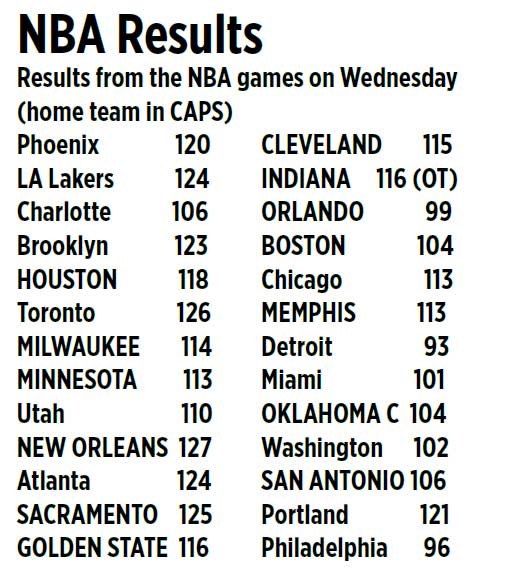
DEVIN Booker scored 24 of his 35 points in the first half to propel the visiting Phoenix Suns to their 14th straight victory, courtesy of a 120-115 win over the Cleveland Cavaliers on Wednesday.

Booker made 14 of 21 shots from the floor to help the Suns match the third-longest win streak in franchise history. They sit three victories shy of equaling their franchise record, set in the 2006-2007 season.

Booker also tormented the Cavaliers in the teams’ first meeting this season. He celebrated his 25th birthday by collecting 27 points and nine assists in Phoenix’s 101-92 win on Oct. 30. That victory ignited the Suns’ current win streak.

Chris Paul recorded 17 points and 12 assists, Deandre Ayton had 16 points and nine rebounds and JaVale McGee added 13 points and 12 boards for Phoenix.

Cleveland’s Jarrett Allen collected 25 points and 11 rebounds to record his second straight double-double and seventh in nine games. Cedi Osman had 23 points, Darius Garland contributed 19 points and seven assists and Ricky Rubio added 15 points for the Cavaliers, whose skid reached a season-high five games.

Paul drained a midrange jumper to give Phoenix a 111-109 lead with 1:45 to play. Paul drew the sixth personal foul by Garland on the next possession before joining Jae Crowder in sinking a pair of free throws to run the Suns’ advantage to six points. — Reuters

ADVERTISEMENT
ADVERTISEMENT