Home Blog Page 7137

Insurance going places, bike lanes

THE collective hope of mankind is that we will never again face a pandemic of similar proportions to COVID-19, a health crisis that quickly turned into a financial calamity, with its ramifications far-reaching. The Philippine economy contracted by 9.5% last year and it was sad to see establishments struggle even shut down altogether — restaurants, retail stores, travel agencies, manufacturing companies, even schools. Such closures led to lost jobs and broken dreams.

There are, however, reasons to be optimistic given the promise that higher vaccination rates brings. Being an environmentalist, I am pleased to witness that plantitos and plantitas are sprouting everywhere. It is a welcome devel-opment to have greater awareness and appreciation for green spaces and clean air, among others. These also have the positive effect of increasing the importance of sustainability, which then result to further action.

Perhaps among the best examples of such positive progress is how there are more cycling related investments all over the metropolis, like bike lane bollards in San Juan, artistic racks in Manila, and rest and repair stops in BGC. Do you now that there are bike lanes along Ayala Avenue, Macapagal Boulevard, C5, and EDSA? Filipinos have embraced the more environment-friendly two wheeled option in order to get to work, hang out with friends, or focus on their physical well-being. In fact, both our drivers Bong and Eddie bike to get to work.

During the recent governments National Bike Day, Bike Lane Awards recognized LGUs for being bicycle friendly. Iloilo City got the gold, Pasig won silver and Quezon City in 3rd place. Thankfully, both public and private sectors collaborated more closely to meet cyclists’ demands for better, ride safe worthy conditions.

The life insurance industry is also an excellent illustration of one that adjusted to changes brought about by the pandemic and responded to opportunities appropriately. The life insurance penetration rate in the country is less than 2% and among the lowest in the world even among peers in South East Asia. It is an ongoing imperative for life insurers, in partnership with the Insurance Commission under the leadership of Commissioner Funa, to bridge the very significant gap.

After the struggles of 2020, the industry rebounded and grew by 15% in terms of new business in the first half of 2021 relative to the same period last year. This was achieved by supplementing the traditional method of selling face to face with virtual solutions. Agents and financial advisors embraced online training and maximized the benefits of online tools in helping their customers address their investment and insurance needs. COVID-19 put a spotlight on the importance of having adequate protection and health coverage, especially given all too common anecdotes of hospital confinement costing in the millions when requiring intensive care.

It is under this context that the top growth players for the first half are worthy of commendation: Allianz PNB Life (145.9% and fastest growing for a second year in a row), BDO Life (57.3%), AXA (10.3%), Sun Life (9.9%), and FWD Life (6.4%). They demonstrated that there is no resting from the noble purpose of addressing the financial welfare of Filipino families especially at a time when they need guidance and advice the most.

A post-pandemic world with lush gardens, more cyclists on the road, and a greater number of Filipinos insured is certainly one to look forward to. May sustainability and financial inclusion advocacies live!

Meanwhile, do you know that vanilla is the 2nd most expensive spice in the world next to saffron? Price per kilo of a vanilla beans reached P30,000 a kilo in 2018 although now down to P13,000. Vanilla seem to adapt and grow well in the Philippines — thus, a group of professionals turned farmers led by Dr. Reynaldo Lantin, Basil Bolinao, Pabs Villegas, Maila Viela, Milette Omoyon, Babie Atanacio, Frat Amarra, Cris Fabriga and others would like to develop vanilla as a high-value crop in the Philippines.

In a recent meeting with Department of Agriculture High Value Crop Undersecretary Evelyn La Viña, she was very supportive and looking forward for a progressive Philippine agriculture sector.


The views expressed herein do not necessarily reflect the opinion of these institutions.

MS. FLOR G. TARRIELA was the first chairwoman of the Philippine National Bank. She was the first and only independent director/chairwoman in the commercial banking industry. She is a former undersecretary of Finance and the first Filipina vice-president of Citibank N.A. She is a trustee of FINEX and an Institute of Corporate Directors fellow. A gardener and an environmentalist, she established Flor’s Garden in Antipolo, an ATI Accredited National Extension Service Provider and a DoT Accredited Agri Tourism Site.

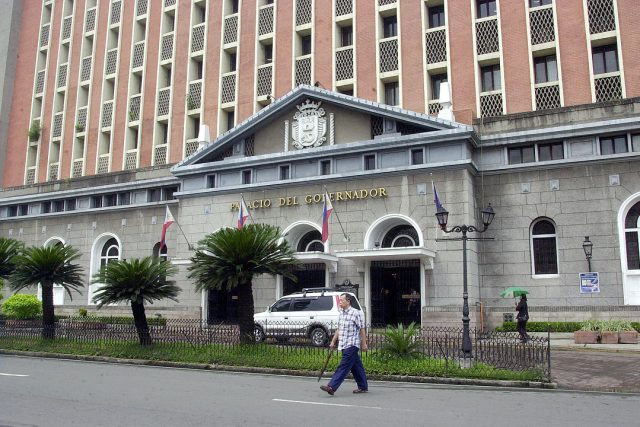
Meralco, PEZA sign deal to streamline power setup process

THE Manila Electric Co. (Meralco) said it has reached an agreement with the Philippine Economic Zone Authority (PEZA) to streamline the process of inspecting locators’ power facilities, thereby allowing them to start operations faster.

The agreement involves the issuance of electronic Certificates of Final Electrical Inspection (eCFEI) to economic zone locators.

“Recognizing the crucial role of businesses in generating jobs and supporting economic recovery, (we have) partnered with the PEZA to assist customers applying for electrical connections and promote ease of doing business,” Meralco said in a statement Thursday.

In July, Meralco entered into similar agreements with 27 local government units in Luzon including Metro Manila and neighboring provinces, to digitalize processing the household consumers’ Certificate of Final Electri-cal Inspection (CFEI).

CFEI is considered proof that electrical wiring has been inspected and is compliant with the Philippine Electrical Code.

The eCFEI program was intended to save power consumers the trouble of going back and forth between municipal agencies and Meralco business centers during the pandemic.

On Wednesday, the eCFEI program was piloted within the Cavite Economic Zone with electricity supplied by Meralco Ecozone Power.

The pilot test will run for three months, while full implementation is scheduled for March 1, covering all PEZA-accredited businesses within the Meralco franchise area.

“This indeed is a very timely initiative, as we sign to become partners in providing the eCFEI service in our various economic zones. PEZA is now embarking on very aggressive and dynamic programs spelled out by our transformation roadmap, where we have to address and enhance the ease of doing business in the Philippines and enhance the efficiency factors needed by our present and future investors,” PEZA Director General Charito B. Plaza said during the signing on Nov. 24.

The Philippines has 413 economic zones. — Marielle C. Lucenio

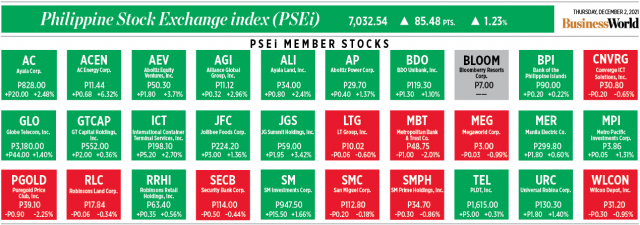
How PSEi member stocks performed — December 2, 2021

Here’s a quick glance at how PSEi stocks fared on Thursday, December 2, 2021.


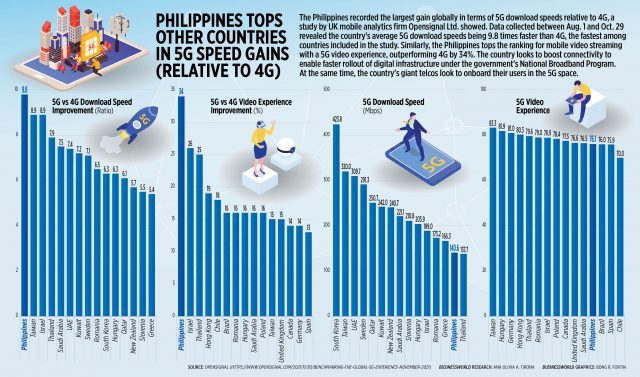
Philippines tops other countries in 5G speed gains (Relative to 4G)

THE Philippines has shown the biggest improvement in download speeds globally, with average fifth-generation (5G) wireless technology download speeds nearly 10 times faster than the older 4G technology, according to the latest report by independent mobile analytics company Opensignal. Read the full story.

Facebook expands protection program for high-risk accounts

REUTERS

Social media platform Facebook is expanding its enhanced security program, which protects high-risk accounts from malicious hackers, to more than 50 countries by the end of the year. 

“Human rights defenders, activists, journalists, and elected government officials are at the center of public discourse,” said Nathaniel Gleicher, global head of cybersecurity policy at Meta, Facebook’s parent company, in a Dec. 2 briefing. “As such, the consequence for society is high if their [Facebook] accounts are compromised.”   

Called Facebook Protect, the program is designed to enhance two-factor authentication (2FA), increase automated defenses in the backend, and flag accounts in the social media platform’s internal system. It was first tested in 2018 ahead of the 2020 US elections. It went live in the Philippines on Oct. 27. 

Despite being one of the best available tools against account compromise, 2FA is historically underutilized, said Mr. Gleicher. Only 4% of Facebook’s monthly active users worldwide have adopted it as of November.   

“We are investing to make 2FA as easy to use as possible,” he said. “At the end of the day, reducing security friction for users will always be essential.”  

Accounts deemed high-risk by the platform will receive a prompt to enroll in Facebook Protect. 2FA is mandatory for accounts that are most likely to be targeted by bad actors 

As of this month, more than 1.5 million accounts have enabled Facebook Protect, with about 950,000 newly enrolled in 2FA as a result of this prompt.  

Those that do not get a prompt but are part of the aforementioned communities can register for the program voluntarily.  

Facebook Protect will be available in more than 50 countries — including the US, Portugal, Australia, India, and Thailand — by the end of 2021.  — Patricia B. Mirasol 

Vaccination drive widened amid Omicron threat

Philippinestar -- Michael Varcas

THE PHILIPPINES has extended its special three-day vaccination drive against the coronavirus after the government failed to reach its target due to logistical hurdles, according to an inter-agency task force, as the threat from a potentially more contagious Omicron variant looms.

In an advisory, the task force said local governments may extend the campaign to “sustain the momentum.” Local governments may extend the vaccination drive’s first run until Dec. 2.

There will also be a second run from Dec. 15 to 17, Health Undersecretary Myrna C. Cabotaje told a televised news briefing on Thursday.

The government vaccinated 7.6 million Filipinos during its three-day vaccination drive that ended on Wednesday, short of its nine-million goal. Still, this was two times the usual daily vaccinate rate, she said.

The Philippines is boosting its vaccination program amid the threat of the latest coronavirus variant first detected in South Africa.

The variant has yet to be detected in the Philippines, but health experts have said that it is only a matter of time before it enters the Southeast Asian country.

The Department of Health (DoH) logged 564 coronavirus infections on Thursday, bringing the total to 2.83 million.

The death toll hit 48,752 after 40 more patients died, while recoveries increased by 694 to 2.77 million, it said in a bulletin.

There were 15,188 active cases, 715 of which did not show symptoms, 7,126 were mild, 3,817 were moderate, 2,463 were severe and 1,067 were critical.

Six duplicates were removed from the tally, five of which were reclassified as recoveries, while 32 recoveries were relisted as deaths, the agency said. It added that 123 patients were found to be negative and have been removed from the tally.

Two laboratories did not operate on Nov. 30, while three laboratories failed to submit data.

DoH said 27% of intensive care units in the Philippines were occupied, while the rate for Metro Manila was 27%.

The Philippines has suspended inbound flights from South Africa, Botswana, Namibia, Zimbabwe, Lesotho, Eswatini and Mozambique, Austria, Czech Republic, Hungary, The Netherlands, Switzerland, Belgium, and Italy over the Omicron variant, which has a large number of mutations. It also suspended a plan to admit fully vaccinated foreign travelers from Dec. 1-15.

The Philippines might include more countries in its so-called red travel list, Health Undersecretary Maria Rosario S. Vergeire told CNN Philippines.

“We are going to propose additional countries based on the detection of this Omicron variant but as I said, we will need to balance it with the case trends,” she added.

The Quarantine bureau was monitoring 64 travelers who recently arrived in the country before the government banned flights from the countries they came from.

Ms. Vergeire said the Philippine Genome Center was still processing the latest batch of samples for sequencing. The results may be out by Dec. 3.

More than 2.71 million Filipinos were vaccinated on Monday, followed by 2.46 million on Tuesday and 2.45 million on Wednesday under the National COVID-19 Vaccination Days program, Ms. Cabotaje said.

The top performing regions during the National Vaccination Days were Calabarzon, Central Luzon and Central Visayas, she said.

The regions that exceeded their targets were Ilocos, Metro Manila, the Cordillera Administrative Region, Mimaropa and Cagayan Valley.

Meanwhile, fully vaccinated Filipino adults may receive their booster shots against the coronavirus as early as Friday, the Department of Health said.

In a statement, the agency said the booster shots would cover all Filipinos aged 18 and above. “All fully vaccinated adults are eligible to receive COVID-19 booster shots starting tomorrow, Dec. 3.”

They may get injected with vaccine brands from Sinovac Biotech Ltd., AstraZeneca Plc, Moderna Inc. and Pfizer, Inc. regardless of which vaccines were taken for the first two doses, it said.

Also on Thursday, the Education department said 177 more public schools, including 28 from the capital region would join the pilot enforcement of physical classes.

Last month, 100 public and 18 private schools resumed face-to-face classes as part of the dry run after almost two years of online classes amid a coronavirus pandemic.

The schools in Metro Manila will start their classes on Dec. 6, while most schools from the other regions began theirs this week, Education Director June Arvin Gudoy told ABS-CBN News.

The pilot run is the first in the government’s three-phased plan to resume face-to-face classes in basic education. The second phase, which will allow more schools to participate, will start next year. The pilot limits physical classes to kindergarten to Grade 3 and senior high school. — Norman P. Aquino and K.A.T. Atienza

Marcos faces another disqualification case on presidential run

THE ONLY son and namesake of the late Philippine dictator Ferdinand E. Marcos is facing another suit seeking to disqualify him from the presidential race.

In a 13-page document, members of Akbayan Party-list and various sectoral groups told the Commission on Elections (Comelec) Ferdinand “Bongbong” R. Marcos, Jr. should be disqualified after a trial court convicted him in 1995 for tax evasion.

The arguments in the sixth petition were similar to earlier lawsuits seeking the disqualification of the former senator, who lost by a hair in the 2016 vice-presidential race. Mr. Marcos topped a Social Weather Stations poll in October on top presidential candidates.

The plaintiffs cited a 1997 Internal Revenue Code that penalizes offenders with dismissal from public service and perpetual disqualification from public office.

They noted that Mr. Marcos’s tax conviction for failing to file his income tax returns in the early 1980s became final in 2001.

“His final conviction necessarily carried with it the penalty of perpetual disqualification from holding any public office, voting and participating in any election,” they said.

Mr. Marcos committed crimes of moral turpitude — a ground for disqualification under the country’s election code — when he failed to pay the taxes, they added.

“When the respondent decided to evade his duty of filing his income tax returns for the years 1982 to 1985, he was robbing the government of the opportunity to ascertain the correct income taxes due from him,” they said.

“Worse, the respondent refused to file his income tax returns while sitting as a public officer, no less than the governor of Ilocos Norte,” they added. “His continued refusal was a betrayal of the very government that he swore to serve.”

Citing jurisprudence, the plaintiffs also said it is the Comelec’s duty to enforce all elections laws, including disqualifying unfit candidates.

They noted that under the Omnibus Election Code, anyone sentenced to a jail term of more than 18 months by final conviction will be disqualified from holding any government posts.

The Court of Appeals in 1997 upheld Mr. Marcos’ conviction but it did not impose a jail term.

The plaintiffs said the appellate court had erred when it excluded the penalty of imprisonment against Mr. Marcos.

The late dictator’s son filed his candidacy papers for president in October, angering activists and victims of his father’s two-decade rule.

He is facing five other petitions at the election body, one of which seeks to have him declared as a nuisance candidate.

Mr. Marcos, who has said lawsuits seeking his disqualification were nothing but trash, is running in tandem with President Rodrigo R. Duterte daughter, Davao City Mayor Sara Duterte-Carpio.

The tandem has received the backing of ex-President Gloria Macapagal Arroyo’s Lakas-CMD. Ms. Arroyo, who was jailed under the administration of Benigno S.C. Aquino III, joined them at a campaign gathering on Dec. 1.

Mr. Marcos’ Partido Federal ng Pilipinas and Ms. Caprio’s Lakas-CMD have sealed an alliance with the political party founded by ex-President Joseph E. Estrada, who was toppled by a popular uprising in 2001. He spent years in prison before he was convicted for corruption and later pardoned by Ms. Arroyo.

Political analysts have said next year’s elections are still dominated by political dynasties and celebrities who are banking on their popularity to win. The next Philippine president would probably fail again to get majority votes, they added. — Kyle Aristophere T. Atienza

DILG appeals to candidates to hold off political rallies amid Omicron threat

INTERIOR and Local Government Secretary Eduardo M. Año on Thursday appealed to candidates for the May 2022 elections to refrain from holding political rallies amid the threat of a new coronavirus variant.

Political rallies are prohibited as the campaign period has yet to start, he said in a statement, but did not cite any penalties that violators may face.

Under existing laws, the Commission on Elections cannot penalize campaign violations outside the official period, which starts Feb. 8 for national posts and March 25 for local candidates.

“We have been seeing candidates, both national and local, staging political rallies here and there which gather hundreds if not thousands of people. The pandemic is not over yet. The Omicron variant is just about to come,” Mr. Año said in a mix of English and Filipino.

“We cannot put our guard down. The Omicron variant has already reached many countries and it’s only a matter of time before it reaches us,” he added.

Mr. Año also said that caravans and motorcades are allowed because physical distancing can be observed and such activities are held outdoors and for a limited period.

“There is a time for everything and now is not the time to gather a huge number of people. Let’s wait for the campaign period… this is not the time to push our luck,” he said. — MSJ

Lacson-Sotto tandem commits free COVID-19 testing

PRESIDENTIAL aspirant and Senator Panfilo M. Lacson, Sr., and his running mate Senate President Vicente C. Sotto III, assured continued free vaccines, including booster shots, and testing for coronavirus disease 2019 (COVID-19) if they win next year.

The tandem told the media during a weekly online briefing that they are also against a policy of mandatory vaccination, but will push for programs that will “encourage vaccinations.”

“I will go to the extent of convincing or inspiring our countrymen to do it rather than forcing (them),” said Mr. Sotto. “Right now, that’s how I look at it, I have yet to be convinced otherwise.”

Mr. Lacson agreed, noting that mandated vaccinations are a human rights issue.

“It is probably better to balance the incentives being given versus the disincentives,” he said in a mix of English and Filipino, citing a large company that accepted non-vaccinated workers, in exchange they will only work from home and receive less pay.

Effective Dec. 1, a national government order allows businesses to require inoculation for employees working on-site. Restaurants and government agencies will also be allowed to refuse entry or deny service to individuals who remain partly or totally unvaccinated.

Unvaccinated on-site employees are now required to undergo regular RT-PCR or antigen screenings at their own expense to be able to work.

Mr. Lacson aims to achieve the provision of free vaccinations and testing by first clamping down on corruption. “Without corruption, many of the government’s problems will disappear.”

Meanwhile, Mr. Sotto said the Health department and the government’s pandemic task force should conduct a “full-blown research” on the highly mutated Omicron variant first detected in South Africa. He claimed to have read research saying the symptoms of the new variant were mild so far.

The World Health Organization has said it was not yet clear whether Omicron is more transmissible than other variants, or if it causes more severe symptoms. It said understanding the level of its severity “will take days to several weeks.”

Senator Pilar Juliana “Pia” S. Cayetano, who chairs the Senate Committee on Sustainable Development Goals, Innovation, and Futures Thinking, on Monday said that vaccine equity is a must, joining the call of African countries on behalf of the Philippine Senate.

During the panel discussion on United Nations affairs organized by the Inter-Parliamentary Union Standing Committee in Madrid, Spain, she noted the importance of a proper healthcare system, while promoting the welfare and financial protection of healthcare workers.

During the discussion, she cited the Philippines’ initiatives on the procurement and delivery of vaccines, and supporting proposals made for a patent waiver on COVID-19 vaccines.

Vaccines should be considered a global public good, Ms. Cayetano said, hence, exempt from the application of patents and copyrights. — Alyssa Nicole O. Tan

House bill seeks to document and develop Philippine’s culinary heritage

FACEBOOK.COM-FILIPINOFOODMONTHOFFICIAL

A BILL has been filed at the House of Representatives that seeks to preserve and develop the country’s culinary heritage through systematic mapping and documentation.

“The United Nations Educational, Scientific and Cultural Organization (UNESCO) considers cultural mapping as a vital tool and technique in providing the society with an overall framework in the preservation of its cultural heritage,” reads part of House Bill 10551 filed by Antique Rep. Loren B. Legarda.

If passed into law, the departments on education, agriculture, and tourism would lead programs for documenting different food cultures, cooking techniques, and economic viability through the use of geographic tools.

It would also establish a Committee on Philippine Gastronomy and Culinary Heritage that will be led by the National Commission for Culture and the Arts (NCCA).

The new committee would be in charge of formulating policies to develop and promote Filipino cuisine.

The measure would also provide a P10-million budget from the national treasury for the initial implementation of the proposed law. Future allocations would be placed under the NCCA’s annual budget as a separate line item. — Russell Louis C. Ku

Senate bill filed on system to combat hunger

PHILSTAR EDDGUMBAN

A BILL seeking to provide a framework to systematically eliminate hunger in the country was filed in the Senate as the hunger crisis worsens with the continued pandemic.

Senator Leila M. de Lima, who chairs the Senate Committee on Social Justice, Welfare, and Rural Development, on Wednesday filed Senate Bill 2458, which targets a zero incidence of hunger within a 10-year period.

Every person has the right to live in conditions that enable free acquisition of food directly from natural resources, sufficient quantity and quality of food, and without risk of losing access to food, Ms. De Lima said in a statement on Thursday.

“Adequate food is not a matter of charity, but a basic human right and a prerequisite for total well-being.”

According to a survey conducted by the Social Weather Stations in May this year, 16.8% or 4.8 million Filipino families nationwide have experienced hunger due to lack of food at least once in the previous three months.

Under the proposed measure, a Commission on the Right to Adequate Food will be created under the Office of the President. It will become the primary policy-making and coordinating body to guarantee full exercise of the right to adequate food.

This measure is a counterpart of House Bill 8242, which was approved on final reading at the lower chamber in February. — Alyssa Nicole O. Tan

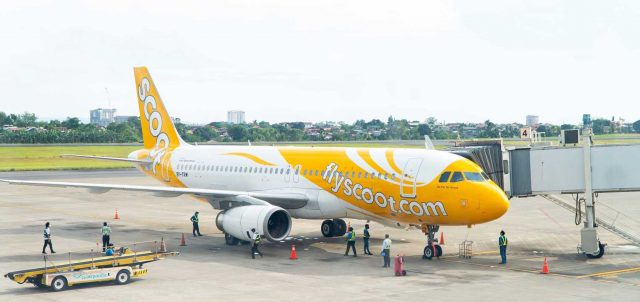
Singapore-Davao flights resume through Scoot airline

SCOOT Tigerair Pte Ltd., the low-cost subsidiary of Singapore Airlines, landed its first flight to Davao on Dec. 1, resuming the route previously served by Silk Air.

Davao City Tourism Operations Officer Regina Rosa B. Tecson said there were 102 passengers on the maiden flight using an Airbus A320 plane.

The Singapore-Davao flights are included in the carrier’s “northern winter” schedule from end-October to March 6, 2022.

Scoot will fly thrice a week, on Sunday, Wednesday, and Friday.

Ms. Tecson earlier said local tour operators and hotels were preparing “staycation” packages for visitors, who will be required to undergo a quarantine period based on the national travel guidelines.

Under Singapore’s current category as a moderate risk country, or within the yellow list, arriving passengers who are fully vaccinated will have to present a

negative RT-PCR test conducted within 72 hrs. prior to departure from the country of origin, and undergo facility-based quarantine with a 3rd day RT-PCR test.

Travelers who are unvaccinated, partially vaccinated, or whose vaccination status cannot be independently validated will undergo facility-based quarantine with an RT-PCR test done on the 7th day. — MSJ

ADVERTISEMENT
ADVERTISEMENT