Home Blog Page 712

What AI earbuds can’t replace: The value of learning another language

FREEPIK

YOUR HOST in Osaka, Japan, slips on a pair of headphones and suddenly hears your words transformed into flawless Kansai Japanese. Even better, their reply in their native tongue comes through perfectly clear to you.

Thanks to artificial intelligence (AI), neither of you is lost in translation. What once seemed like science fiction is now marketed as a quick fix for cross-cultural communication.

Such AI-powered tools will be useful for many people, especially for tourists or in any purely transactional situation, even if seamless automatic interpretation remains at an experimental stage.

Does this mean the process of learning another language will soon be a thing of the past?

As scholars of computer-assisted language learning and linguistics, we disagree and see language learning as vital in other ways. We have devoted our careers to this field because we deeply believe in the lasting and transformative value of learning and speaking languages beyond one’s mother tongue.

LESSONS FROM PAST LANGUAGE ‘DISRUPTIONS’
This isn’t the first time a new technology has promised massive disruption to learning languages.

In recent years, language learning startups such as Duolingo aimed to make acquiring a language easier than ever, in part by gamifying language. While these apps have certainly made learning more accessible to more people, our research shows most platforms and apps have failed to fully replicate the inherently social process of learning a language.

One thing’s clear: The massive popularity of language apps shows there’s still strong demand for language learning, despite a sharp decline in formal education settings. Duolingo alone had 113.1 million monthly active users around the world at the end of 2024, a 36% increase over the prior year. This is about 10 times more than the number of students who take languages other than English in US schools.

THE MEANING OF LEARNING A LANGUAGE
Numbers aside, the gold standard of language learning is the ability to follow and contribute to a live group conversation.

Since World War II, government departments and education programs recognized that text-centered grammar-translation methods did little to support real interaction. Interpersonal conversational competence gradually became the main goal of language classes. While technologies you can put in your ear or wear on your face now promise to revolutionize interpersonal interaction, their usefulness in such conversations actually falls along a spectrum.

At one end, you have simple tasks you have to navigate while visiting a city where they speak a different language, like checking out of a hotel, buying a ticket at a kiosk, or finding your way around town. That is, people from different backgrounds working together to achieve a goal — a successful checkout, a ticket purchase, or getting to the famous museum you want to visit. Any mix of languages, gestures or tools — even AI tools — can help in this context. In such cases, where the goal is clear and both parties are patient, shared English or automated interpretation can get the job done while bypassing the hard work of language learning.

At the other end, identity matters as much as content. Meeting your in-laws, introducing yourself at work, welcoming a delegation, or presenting to a skeptical audience all involve trust and social capital. Humor, idioms, levels of formality, tone, timing, and body language shape not just what you say but who you are.

The effort of learning a language communicates respect, trust, and a willingness to see the world through someone else’s eyes. We believe language learning is one of the most demanding and rewarding forms of deep work, building cognitive resilience, empathy, identity, and community in ways technology struggles to replicate.

The 2003 movie Lost in Translation, which depicts an older American man falling in love with a much younger American woman, was not about getting lost in the language but delved into issues of interculturality and finding yourself while exposed to the other.

Indeed, accelerating mobility due to climate migration, remote work, and retirement abroad all increase the need to learn languages — not just translate them. Even those staying in place often seek deeper connections through language as learners with familial and historical ties.

WHERE AI FALLS SHORT
The latest AI technologies, such as those used by Apple’s newest AirPods to instantly interpret and translate, certainly are powerful tools that will help a lot of people interact with anyone who speaks a different language in ways previously only possible for someone who spent a year or two studying it. It’s like having your own personal interpreter.

Yet relying on interpretation carries hidden costs: distortion of meaning, loss of interactive nuance, and diminished interpersonal trust.

An ethnography of American learners with strong motivation and near limitless support found that falling back on speaking English and using technology to aid translation may be easier in the short term, but this undercuts long-term language and integration goals. Language learners constantly face this choice between short-term ease and long-term impact.

Some AI tools help accomplish immediate tasks, and generative AI apps can support acquisition but can take away the negotiations of meaning from which durable skills emerge.

AI interpretation may suffice for one-on-one conversations, but learners usually aspire to join ongoing conversations already being had among speakers of another language. Long-term language learning, while necessarily friction-filled, is nevertheless beneficial on many fronts.

Interpersonally, using another’s language fosters both cultural and cognitive empathy.

In addition, the cognitive benefits of multilingualism are equally well documented: resistance to dementia, divergent thinking, flexibility in shifting attention, acceptance of multiple perspectives and explanations, and reduced bias in reasoning.

The very attributes companies seek in the AI age — resilience, lifelong learning, analytical and creative thinking, active listening — are all cultivated through language learning.

RETHINKING LANGUAGE EDUCATION IN THE AGE OF AI
So why, in the increasingly multilingual UK and US, are fewer students choosing to learn another language in high school and at university?

The reasons are complex.

Too often, institutions have struggled to demonstrate the relevance of language studies. Yet innovative approaches abound, from integrating language in the contexts of other subjects and linking it to service and volunteering to connecting students with others through virtual exchanges or community partners via project-based language learning, all while developing intercultural skills.

So, again, what’s the value of learning another language when AI can handle tourism phrases, casual conversation, and city navigation?

The answer, in our view, lies not in fleeting encounters but in cultivating enduring capacities: curiosity, empathy, deeper understanding of others, the reshaping of identity, and the promise of lasting cognitive growth.

For educators, the call is clear. Generative AI can take on rote and transactional tasks while excelling at error correction, adapting input, and vocabulary support. That frees classroom time for multiparty, culturally rich, and nuanced conversation.

Teaching approaches grounded in interculturality, embodied communication, play, and relationship building will thrive. Learning this way enables learners to critically evaluate what AI earbuds or chatbots create, to join authentic conversations and to experience the full benefits of long-term language learning. — The Conversation via Reuters Connect


Gabriel Guillén is a Professor of Language Studies at Middlebury College. Thor Sawin is a Professor of Linguistics at Middlebury College. He has received funding for teacher development projects through the State Department Fulbright Specialist and English Language Specialist program, as well as the US Air Force and LCC International University in Lithuania.


Prime Infra appoints new leaders for gas, water businesses

JOSE VICTOR EMMANUEL A. DE DIOS

RAZON-LED Prime Infrastructure Capital, Inc. (Prime Infra) has named Jose Victor Emmanuel “Jocot” A. de Dios as president and chief executive officer (CEO) of its gas unit Prime CoreGen, effective Jan. 1, 2026, as the company expands its footprint in the energy sector.

Mr. De Dios will retire as president and CEO of east zone concessionaire Manila Water Co., Inc. on Dec. 31. He will be succeeded by Roberto Jose “Boj” R. Locsin, currently Prime Infra’s chief administrative officer and chief operating officer for international business.

Before joining Manila Water, Mr. De Dios served as undersecretary of the Department of Energy from 2001 to 2004.

He later chaired the Philippine National Oil Company – Exploration Corp. and led Australian oil exploration company Nido Petroleum Ltd. He was also CEO of GE Philippines, managing businesses in power generation, industrial solutions, and aviation.

At Prime CoreGen, Mr. De Dios will oversee the company’s recently acquired gas assets, following Prime Infra’s P50-billion purchase of stakes in several power plants from Lopez-led First Gen Corp. The portfolio includes a 60% stake in the 1,000-MW Santa Rita Power Plant, 500-MW San Lorenzo Power Plant, 450-MW San Gabriel Power Plant, 97-MW Avion Plant, and the proposed 1,200-MW Santa Maria Power Plant.

Mr. Locsin will handle corporate administration and Manila Water’s global expansion strategy.

Prior to joining the water utility, he served as CEO of Philippine Growth Terminals under global ports operator International Container Terminal Services, Inc., managing operations in Subic and Cagayan de Oro.

“These strategic leadership changes ensure we have the right team in place to drive growth across our water and gas portfolio. Our focus remains on running strong operations and delivering essential infrastructure that supports the country’s development,” said Prime Infra President and CEO Guillaume Lucci. — Sheldeen Joy Talavera

Arts & Culture (11/19/25)


SinagLarawan’s top prizes for 2025 photo contest

SINAGLARAWAN has concluded its 2025 photo contest with the Isa sa Isla photo exhibit opening and awarding ceremony. The annual nationwide photo competition had over 480 entries this year by photographers from all over the Philippines. An initiative of JTI Philippines Community Investment, it awarded the grand prize to the evocative image Patron Saint of the Mariners by Kurt Austin Garcia of photo club Raw and Untitled PH. He took home P150,000 and a trophy, as well as P30,000 and a certificate for his photo club. Jessie Eno’s Harvest from the Crown Jewel was named first runner-up, receiving P120,000 and a trophy, with P25,000 and a certificate for their photo club Putowalkers. The Current’s Common Ground by Missy Keith Acbang was second runner-up, with a P100,000 cash prize and trophy, and with the photo club Samahan ng mga Litratista sa Rizal receiving P20,000 and a certificate.


News anchor guidebook released

THE BOOK On Air Na! Pinoy News Anchors Live!, the first comprehensive guidebook on news anchoring in the country, has been released by its publisher, the University of Santo Tomas (UST). Written by Jose Maria G. Carlos, former Assistant Vice-President for News at CNN Philippines, the book traces the evolution of news anchoring in Philippine media, delving into the ethical, editorial, and production challenges that news anchors face today. It also examines the critical success factors behind building an effective and credible career in news broadcasting, drawing from over 40 years of experience in broadcast journalism and insights from 31 past and present news anchors representing leading networks. More information can be found on the UST Publishing House’s pages.


National Poetry Challenge runs this week

A DAILY national poetry challenge is ongoing until Nov. 20, giving writers a chance to win cash prizes and get published. Now on its fourth year, the competition, spearheaded by the poets’ organization Linangan sa Imahen, Retorika at Anyo, book publisher San Anselmo Publications, Inc., and the Quezon City Local Government, is open to all Filipino poets and poetry-lovers. The 2025 edition runs until Nov. 20, two days before the birthday of Jose Corazon de Jesus, or Huseng Batute, king of the balagtasan (poetry joust). To join, visit the Facebook page of San Anselmo Publications, Inc., and look for the daily poetry prompt and guidelines. Poems can be commented on the post. Five shortlisted winners can win P1,000 each. For more information about the National Poetry Challenge, visit https://www.facebook.com/sananselmopress.


Modified Signals concert at The M

AS PART of the experimental sound scene, Jigger Cruz, Seething Mass (Arvin Nogueras + Maia Reyes), and Pow Martinez are converging for a night of original compositions and improvised collisions on Nov. 22 at The Metropolitan Museum of the Philippines (also known as The M), at 30th St., BGC, Taguig. Through a hybrid mix of synthesizers, drum machines, and analog tools, the artists will “sculpt an atmosphere that slips between clarity and distortion, with interplay between machine-driven precision and human expression.” The night begins at 6 p.m. Ticket details can be found at The Metropolitan Museum of Manila’s site and pages. The concert coincides with Jigger Cruz’s ongoing mid-career exhibit, Hail Holy Eyes at The M.


Filipinas Heritage Library hosts book hunt challenge

THE FILIPINAS Heritage Library is holding a book hunt challenge until next month. It invites visitors to pick a question from their display to become a book detective. Answers to the questions can be hunted down in the library’s featured books section. The hunt is open to anyone at the Ayala Museum Lobby. No admission fee is required. It runs until Dec. 20. The Ayala Museum is at Greenbelt at Makati Ave., Makati.


2 exhibits opening at Silverlens

SILVERLENS MANILA is presenting lumalalim sa kababawan, lumulutang sa kalaliman (deep in the shallows, afloat in the depths), Poklong Anading’s solo exhibition, and Eight Views From The Border, Carina Santos’ solo exhibition. Both open on Nov. 20. Mr. Anading’s show features the intermingling of upcycled materials with new art expressions, combining discoveries from his diving forays with initiatives to restore coral reefs and their habitats, and his own exploration of materials — objects, video, photographs, and drawings. Meanwhile, Ms. Santos’ show features eight of her “pour paintings,” or abstract paintings that conjure up memories of terrains and skies, echoing her background as a graphic designer with a collage-like approach to magazine layout and as a visual communicator that delved into oil painting. Both exhibitions run until Dec. 20 at Silverlens Manila, 2263 Chino Roces Ave., Makati City.


Manila House mounts concert for HearLife-Verein

ON Dec. 1, Manila House Private Members Club will host A Christmas Overture, a fundraising concert in support of HearLife-Verein. Featured artists are singers Evangeline Ng Lao, Lucia Caterina J. Boschi, Tara Bahukhandi, Mavis Jane Tan, Sherine Ann Koa, and pianist Sharlene Morta, a MED-EL Cochlear implant user. Accompanying them are violinist Mary Joyce San Juan, viola player Lauro Valentino Cad, cellist Irvin Roie So, flutist Raymundo O. Sison, and international concert pianist Dr. Abelardo Galang II. Proceeds will benefit HearLife-Verein, a nonprofit organization supporting the hearing and speech rehabilitation of children with cochlear implants, as well as deaf and hard-of-hearing individuals, through professional development offerings to their medical carers and comprehensive support to their families. Tickets are priced at P2,700 for members and P3,000 for guests. For reservations, e-mail reservations@manilahouseinc.com.


Sandbox reveals cast of Spring Awakening

OPENING in February 2026, Spring Awakening will mark The Sandbox Collective’s first production under Sab Jose-Gregorio’s leadership. With book and lyrics by Steven Sater, music by Duncan Sheik, and based on the play by Frank Wedekind, this adaptation will mix Philippine theater veterans and rising stars, 20 years after the play’s first premiere on Broadway. Menchu Lauchengco-Yulo and Ana Abad Santos will share the role of Adult Woman. Audie Gemora will step into the role of Adult Man. Taking the stage alongside them are Nacho Tambunting and Alex Diaz who share the role of Melchior Gabor; Nic Chien and Omar Uddin who alternate as Moritz Stiefel; and Sheena Belarmino who will play Wendla Bergmann. The creative team includes director Andrei Nikolai Pamintuan, musical director Ejay Yatco, and choreographer Nunoy Van Den Burgh. Spring Awakening is set to be the inaugural show of The Black Box at The Proscenium Theater in Rockwell, Makati. The show will run from Feb. 13 until March 22. Tickets are now available on Ticket2Me (tinyurl.com/SandboxSpring2026).

Treasury fully awards dual-tenor T-bonds at mixed yields at auction

MARI GIMENEZ-UNSPLASH

THE PHILIPPINE government fully awarded its dual-tranche Treasury bonds on Tuesday, raising P35 billion as total bids hit P107.6 billion, almost three times the offer, amid concerns that the peso’s extended weakness could fuel inflation.

The Bureau of the Treasury (BTr) sold the programmed P20 billion in reissued 10-year bonds with a remaining maturity of six years and 10 months. Demand reached P70.7 billion, or 3.5 times the allotment.

The bonds carried an average yield of 5.74%, ranging from 5.72% to 5.758%, slightly below 5.798% at the auction on Oct. 21 and about a percentage point below the original 6.75% coupon.

The 10-year yield was 3.6 basis points (bps) higher than the closest benchmark seven-year bond and 2.4 bps above the pre-auction secondary market rate, according to PHP Bloomberg Valuation (BVAL) service data provided by the BTr. The sale increased the outstanding volume of the series to P525.6 billion.

Meanwhile, the government raised the planned P15 billion from 20-year T-bonds, with 18 years and six months remaining to maturity. Total bids reached P36.86 billion, 2.46 times the offer.

The bonds were awarded at an average rate of 6.51%, with accepted yields from 6.4% to 6.6%, up 8.9 bps from the auction on Sept. 23 and 36.5 bps below the original 6.875% coupon. The issuance brought the outstanding stock of the series to P244.6 billion.

A trader said demand was concentrated on the shorter to mid-maturity tenors.

“Lower yield on the seven-year bonds reflects generally lower yields across the board last month,” the trader said. “The 20-year yields were largely unchanged due to weaker interest at the long end.”

Yields finished mixed, with the long end anchored by investor caution amid inflation concerns linked to the peso’s sustained depreciation, Rizal Commercial Banking Corp. Chief Economist Michael Ricafort said in a Viber message.

The Treasury plans to tap the domestic market for P158 billion this month — P88 billion in T-bills and P70 billion in bonds — to fund a budget deficit capped at P1.56 trillion or 5.5% of gross domestic product. — A.M.C. Sy

AirAsia X opens Kuala Lumpur-Istanbul route for travelers from Manila, Cebu

NEWSROOM.AIRASIA.COM

FILIPINO TRAVELERS can now reach Istanbul with a single stop in Kuala Lumpur following AirAsia X’s (AAX) launch of its new Malaysia-Türkiye service.

The medium-to-long-haul carrier of Capital A said the route provides seamless connectivity for passengers flying from Manila and Cebu.

“The launch of our inaugural service to Istanbul is a bold, yet long awaited step in AirAsia X’s long-haul growth strategy. Türkiye represents a strong and dynamic market with immense potential for both leisure and business travel,” Capital A Executive Chairman Datuk Kamarudin Meranun said in a statement on Tuesday.

“With this new connection, Filipino travelers can now conveniently fly via Kuala Lumpur to explore Istanbul, a dynamic metropolis bridging Europe and Asia,” the Malaysian carrier noted.

AAX will operate the Kuala Lumpur-Istanbul flights four times weekly, every Monday, Wednesday, Friday, and Saturday. The service is part of AirAsia X’s broader expansion in long-haul routes, aimed at strengthening network connectivity between Southeast Asia and Europe.

“This new route not only enhances our network connectivity between Southeast Asia and Eurasia but also reinforces our position as a key player in affordable long-haul travel, as demand for international travel to major cities in Europe continues to grow,” Mr. Meranun said.

AirAsia X Chief Executive Officer Benyamin Ismail said: “With this new direct service, we are not just launching a route; we are opening a vital bridge between Southeast Asia and Europe.”

The launch comes amid Capital A Berhad’s restructuring plan, which focuses on non-aviation businesses while retaining an 18% stake in its aviation operations. AAX continues to manage the group’s medium-to-long-haul flights under this new structure. — Ashley Erika O. Jose

France’s Louvre Museum closes gallery due to structural weakness

LOUVRE Museum — WIKIPEDIA

PARIS — France’s Louvre Museum on Monday closed a gallery hosting Greek vases and office spaces as its structures designed in the 1930s are in a dire state, the world’s most visited museum said, less than a month after a daring heist exposed its vulnerabilities.

A new technical report showed weakness in the beams under the second floor of the Sully wing, making it necessary to close the Campana gallery on the first floor and relocate 65 museum staff from the second, the Louvre said in a statement.

The Campana gallery is adjacent to the Apollo gallery, home to the French crown jewels which were targeted in last month’s heist.

“Staff representatives have been warning about the condition of the building for years, because it affects working conditions and visitors,” said Valerie Baud of the CFDT union.

“But we didn’t realize it was this bad,” she said. “It is a major deterioration in the situation.”

After a heist carried out with relative ease, the closure of the gallery is another sign of the museum’s dereliction as highlighted by a state auditor’s report which said the management had neglected security and infrastructure in favor of artwork acquisitions and post-pandemic relaunch projects.

On Oct. 19, two men parked a movers’ lift outside the building, rode up to the second story, smashed a window, cracked open display cases with angle grinders, and drove away on motorbikes with historical jewels worth $102 million.

The jewels have not yet been recovered, though four suspects are being investigated.

Originally built in Paris in the late 12th century, the Louvre Palace was for centuries the official residence of the kings of France, until Louis XIV — weary of rebellious crowds in Paris — abandoned it for Versailles, after which it became a museum for the royal art collection in 1793. — Reuters

Santolan Town Plaza shines bright for the holidays

The Christmas season officially began at Santolan Town Plaza on Nov. 17, 2025, as the community came together at The Pavilions for its annual Tree Lighting Ceremony. Now in its fifth year, this well-loved tradition has become a favorite for San Juan residents, bringing families, friends, and neighbors together to celebrate the joy of the holidays.

Rockwell executives — Mike Lopez, Senior Vice-President for Office Commercial Development; Christine Coqueiro, Vice-President for Retail Development; Tracey Castillo, Vice-President and Chief Marketing Officer; and Jesse Tan, Vice-President for Office Commercial Development — were joined by local officials including Mayor Francis Zamora, Vice-Mayor Angelo Agcaoili, along with members of the San Juan City Council and valued tenants who helped make the event possible.

The evening opened with a performance by Serenade Society, filling the air with festive melodies that set the tone for the night.

Mayor Francis Zamora brought words of appreciation and seasonal cheer to the celebration.

Before the countdown, Mayor Zamora shared a few words of gratitude and holiday cheer. Soon after, the much-awaited moment arrived — the lighting of the 25-foot Christmas tree, adorned with 250 ornaments and 45,000 LED lights, all completed in just two nights. As the tree lit up, the plaza sparkled with warmth and color, a truly memorable start to the season at Santolan.

From L-R: Vice-Mayor Angelo Agcaoili; Mike Lopez, Senior Vice-President for Office Commercial Development; and Mayor Francis Zamora

The evening also celebrated Santolan Town Plaza’s milestones and new openings this year, with exciting additions such as as Wahunomi, a café and bar; Mid Kid, serving hearty sandwiches; Café Mary Grace, known for its comforting classics; A1 Family Shabu Shabu, perfect for shared meals; Lulou Wellness, a space for older adults to stay active; Babymama, a trusted stop for new parents; and Browza, offering expert beauty services.

Looking ahead, a range of new wellness concepts is set to open soon, bringing more experience-led offerings to the town. These additions promise even more to discover at the retail hub, offering fresh ways for patrons and visitors alike to connect, dine, and unwind.

From everyone at Santolan Town Plaza, here’s to a joyful season filled with light, love, and holiday cheer — right here in the heart of San Juan.



For more updates and holiday happenings, visit Santolan Town Plaza’s Facebook and Instagram pages.


Spotlight is BusinessWorld’s sponsored section that allows advertisers to amplify their brand and connect with BusinessWorld’s audience by publishing their stories on the BusinessWorld Web site. For more information, send an email to online@bworldonline.com.

Join us on Viber at https://bit.ly/3hv6bLA to get more updates and subscribe to BusinessWorld’s titles and get exclusive content through www.bworld-x.com.

The Philippines’ expanding mall experience

Freepik | Pressfoto

By Jomarc Angelo M. Corpuz, Special Features and Content Writer

Malls are undeniably a deeply embedded part of the Philippine social and cultural fabric. What’s supposed to be a place to shop has been transformed by Filipinos into a place of leisure, entertainment, and bonding. Aside from the usual branded stores, malls in the country can contain meeting halls, churches, and even government satellite offices, making the properties truly complete institutions by themselves.

Despite the dominance of e-commerce and the digital economy, Filipinos are still in love with the mall. According to the Philippine Retailers Association (PRA), the growth of the country’s retail industry is expected to reach up to 15% in revenue this year to around P5.4 trillion, driven by healthy remittances and a growing population.

“They say that people won’t come to malls anymore [because of AI], but Filipinos as a whole are still very social creatures. We’re all social citizens, and we go to malls to truly interact with one another. Although some purchases may shift online, we believe malls will continue to be places where people will still congregate,” PRA President Alice T. Liu was quoted as saying in a BusinessWorld report.

This powerful counter-narrative of malls as a societal place, rather than their often-considered consumer-driven nature, has allowed the retail scene to develop a batch of community-driven establishments in the midst of Metro Manila’s urban ecosystem. This new breed places its focus on experiences and interactions compared to profit and transactions in usual malls.

“Today’s mall-goers gravitate toward spaces that feel purposeful, interactive, and emotionally engaging. They’re no longer just looking for places to shop — they’re looking for places that add value to their day. Dining continues to be a major draw, but it’s the concepts with strong identity, thoughtful design, and a sense of discovery that resonate most. People want to ‘feel’ the brand the moment they step in,” Rockwell Land Vice-President for Retail Development Tin Coqueiro said in an email interview with BusinessWorld.

Colliers, an international real estate services firm, also notes that community-driven malls have the potential to redefine urban spaces in the Philippines by prioritizing community, creativity, and authentic experiences.

“The Philippine urban landscape is experiencing a vibrant transformation, with the rise of new concept community malls injecting fresh energy into the bustling commercial business districts (CBDs). Spaces like The Corner House in San Juan, Comuna PH, and Karrivin Plaza in Makati, and First United Building in Escolta are at the forefront of this evolution, redefining the very essence of the commercial experience,” the report said.

Aside from redefining the way consumers shop, malls are rapidly transitioning to become vibrant hubs for young, trend-conscious creatives. More and more malls serve as dynamic platforms where emerging artists, designers, and entrepreneurs can showcase their work, supported by flexible pop-up spaces and incubators for independent brands and startups.

Recent examples of these initiatives include Rockwell’s occasional exhibitions at the Power Plant Mall and a recent month-long “Art for Everyone” celebration across SM Supermalls.

These new developments show how malls in the Philippines are evolving into spaces that reflect the country’s social nature and creative energy. By supporting local talent and fostering community interaction, they rode the escalator to go beyond commerce and arrive at a new purpose as centers of culture, connection, and everyday life.

“There’s a growing demand for experiential concepts — boutique fitness, wellness clinics, specialty dining, concept stores, and immersive entertainment, that offer something you simply cannot replicate online,” Ms. Coqueiro said.

Retail in 2025

The Philippine retail sector took a huge blow both in revenue and in the number of visitors in 2020, mostly due to the effects brought by the pandemic. However, results from services firm Leechiu Property Consultants, Inc. show that the retail industry is gaining momentum, led by strong growth in the food and beverage (F&B) segment.

Current data shows F&B revenues are now 11% higher than pre-pandemic levels, outperforming other retail categories and reinforcing the sector’s position as a main driver of recovery in retail real estate. Similarly, Leechiu reports that the nation’s three largest mall operators reported a 19% rise in total revenues compared to 2019.

One possible rationale for this growth is the sector’s ability to foster ambiance, social connection, and lifestyle experiences that may be difficult to do online. Additionally, cashless payments, online reservations, loyalty apps, and integrated delivery platforms have become standard features, streamlining operations while improving customer engagement.

“The Filipino consumer has become significantly more sophisticated and globally attuned in recent years. You see this clearly in F&B — Filipinos are more adventurous, more discerning, and more willing to spend for elevated concepts. The arrival of the Michelin Guide has further validated the country’s culinary landscape and raised the bar for both local and international operators, proving that Filipino dining can compete on the world stage,” Ms. Coqueiro said.

As of early 2025, around 105 new malls are being developed nationwide, many featuring larger F&B components in their layouts and tenant plans. These areas are also benefiting from population growth, better infrastructure, and rising consumer spending.

“The continued expansion of malls into provincial areas is driven by the growth of the middle class, strong OFW-driven income, and increasingly sophisticated consumers who want access to the same quality of retail, dining, and lifestyle experiences found in major urban centers. These markets are no longer secondary — they have the spending power and lifestyle aspirations to support well-curated developments,” Ms. Coqueiro said.

While Metro Manila remains the primary hub for flagship dining concepts, developers are increasingly introducing food-focused areas in emerging regions such as Central Luzon, CALABARZON, Visayas, and Davao. According to Ms. Coqueiro, Rockwell studies how people live, socialize, and move within a city to understand whether the market is ready for a Rockwell development and what kind of experience would feel authentic to them.

“In Angeles, Pampanga, for example, we saw a vibrant community with a strong appreciation for good food, elevated environments, and quality retail. This insight guided how we designed Rockwell Center Nepo and shaped the retail concepts we’re introducing to ensure that what we build enhances and complements the Kapampangans’ lifestyle,” Ms. Coqueiro added.

All these indicators point to a retail landscape that is not just recovering, but actively expanding, signaling renewed consumer confidence and a strong return to physical shopping and dining experiences.

“But Philippine consumers are coming out. The malls are full again. The average purchasing amount may be lower, but people are coming out. So, we see a retail industry that will continue to grow, especially over the next two years,” PRA Chairman Roberto S. Claudio, Sr. said in a report.

Another strong statistic that shows how retail is doing concerns the occupancy levels of malls in the country. As with every other aspect of retail, vacancy rates plummeted during the pandemic, dipping to as low as 9.7% in the first quarter of 2020. However, recent numbers by Colliers show that the vacancy rate of malls in Metro Manila currently stands at 11.4%.

Despite this telling result, the firm still forecasts that mall vacancy in Metro Manila will decline to 9.5% by the third quarter of 2026. By the first quarter of 2027, the vacancy rate is projected to further drop to 8.2%, improving on the 9.3% level recorded in the third quarter of 2019.

“The Philippine retail scene continues to innovate, effectively exciting mallgoers and foreign brands. With retail spaces becoming more experiential, more Filipinos now go to brick-and-mortar malls and are enticed to stay longer and spend more,” Colliers Philippines Director and Head of Research Joey Roi H. Bondoc previously said.

Aside from this, Colliers notes that easing inflation, policy rate cuts, and the fast-approaching holiday season should support faster consumer spending in malls and other areas of the economy.

“In our view, the lower-than-expected inflation, holiday-induced spending, slightly improving consumer outlook, and the projected rise in remittances should support retail demand growth,” Colliers said.

Overall, the Philippine retail sector is entering a new phase of steady growth, driven by resilient consumer activity, expanding F&B developments, and a renewed enthusiasm for in-person experiences.

Smart rolls out robotic arms in cell towers for real-time network optimization

PHILSTAR FILE PHOTO

SMART COMMUNICATIONS, INC., the wireless unit of PLDT Inc., has deployed remote-controlled robotic arms in its cell site towers to enable real-time network optimization and improve coverage in underserved areas.

“By leading the adoption of advanced technologies like Optical Compass and Robot Arm (OCRA), we are shaping a future where every Filipino has access to reliable, high-quality connectivity, wherever they are,” PLDT Chief Operating Officer and Network Head Menardo G. Jimenez said in a media release on Tuesday.

The system allows operators to move and control antennas remotely, enabling real-time adjustments.

Through its collaboration with OCRA manufacturer HUMAX Networks and system integrator Telkha, PLDT and Smart launched a proof-of-concept trial to test how the technology can boost coverage in target areas while lowering costs and enhancing network performance.

For the pilot, OCRA was installed on existing cell sites targeting two locations, with initial results highlighting the need for smarter, more flexible antenna solutions.

“Enabling remote antenna adjustments also reduces the need for physical site visits and helps telcos avoid unnecessary base station installations, saving time and expense. These efficiencies allow Smart to reinvest in expanding and enhancing its network,” PLDT and Smart Head of Network Quality Radames Vittorio B. Zalameda said.

At the Philippine Stock Exchange on Tuesday, PLDT shares rose P16, or 1.25%, closing at P1,294 apiece. — Ashley Erika O. Jose

China suspends Japanese film releases as diplomatic crisis deepens

BEIJING — Film distributors have suspended the screening of at least two Japanese films in China amid a deepening dispute between Tokyo and Beijing, in what state broadcaster CCTV said was a “prudent decision” that took into account souring domestic audience sentiment.

The postponement comes barely two weeks after remarks about Taiwan by Japanese Prime Minister Sanae Takaichi sparked a heated response from China and kicked off the most serious diplomatic clash between the two East Asian powers in years.

Some Japanese films, including the animated Crayon Shin-chan the Movie: Super Hot! Scorching Kasukabe Dancers and manga-turned-movie Cells at Work!, originally slated for release in the coming weeks, will not begin screening in mainland China as scheduled, CCTV said, citing checks with film importers and distributors.

Animated film Demon Slayer: Infinity Castle was initially well received but has seen its box office performance decline after Ms. Takaichi’s remarks due to “strong dissatisfaction from Chinese audiences,” according to CCTV late Monday.

Film importers and distributors have chosen to heed the market’s response, respect audience sentiment, and postpone the releases of upcoming films, CCTV said.

Japan has sought to tamp down the escalating dispute with China that came after Ms. Takaichi told Japanese lawmakers this month that a Chinese attack on Taiwan threatening Japan’s survival could trigger a military response.

Beijing has since urged citizens to halt travel to Japan, and China’s Premier Li Qiang has no plans to meet Ms. Takaichi on the sidelines of this week’s G20 summit in South Africa.

The heads of Japan’s three business federations met with Ms. Takaichi late on Monday and urged dialogue to resolve the diplomatic tensions.

“Political stability is a prerequisite for economic exchange,” Yoshinobu Tsutsui, chairman of Japan’s biggest business lobby Keidanren, told reporters after the meeting, according to media reports. — Reuters

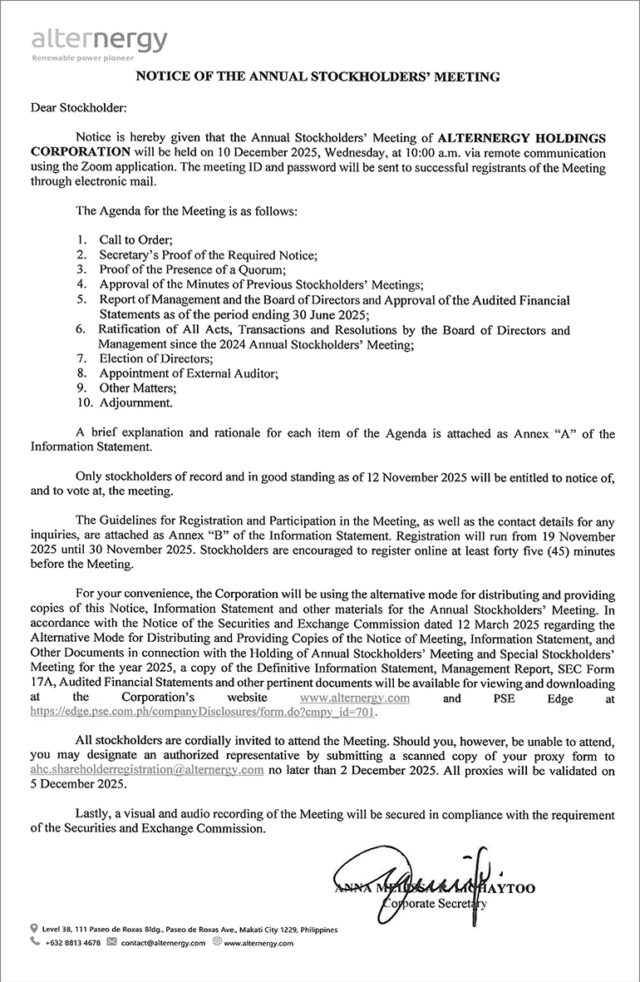
Alternergy Holdings Corp. to hold Annual Stockholders’ Meeting on Dec. 10 via Zoom


Spotlight is BusinessWorld’s sponsored section that allows advertisers to amplify their brand and connect with BusinessWorld’s audience by publishing their stories on the BusinessWorld Web site. For more information, send an email to online@bworldonline.com.

Join us on Viber at https://bit.ly/3hv6bLA to get more updates and subscribe to BusinessWorld’s titles and get exclusive content through www.bworld-x.com.

InstaPay, PESONet payments hit P19.7T

STOCK PHOTO | Image Jannoon028 from Freepik

By Katherine K. Chan

DIGITAL PAYMENTS in the Philippines continued their rapid climb, with transactions through InstaPay and PESONet reaching a combined P19.749 trillion in the 10 months to October.

The transaction value grew 41.2% from P13.989 trillion a year earlier, while the volume of payments nearly tripled to 3.467 billion, according to data from the Bangko Sentral ng Pilipinas (BSP).

InstaPay, the central bank’s real-time, low-value electronic fund transfer facility, accounted for P9.069 trillion in value, up 55.8% from a year earlier. The number of InstaPay transactions more than tripled to 3.371 billion.

Meanwhile, PESONet, used primarily for high-value transfers and as an electronic alternative to checks, processed P10.68 trillion, up 30.7% from a year earlier. Transaction volume increased 16.1% to 96.288 million.

“The sustained double-digit growth for both reflects increased use of digital banking and payment solutions as alternatives to checks and other over-the-counter transactions,” Michael L. Ricafort, chief economist at Rizal Commercial Banking Corp., said in a Viber message.

He said the rise in digital payments is being driven by both businesses integrating online payment systems and consumers using e-wallets linked to digital banking platforms.

“This also enhances financial inclusion, particularly in areas with limited access to physical bank branches but with mobile connectivity for online banking and payment solutions,” he added.

The BSP has set a target for digital payments to account for 60-70% of retail transaction volume by 2028, in line with the Philippine Development Plan.

In 2024, online payments made up 57.4% of retail transactions by volume and 59% by value, up from 52.8% and 55.3%, respectively, in 2023, according to a central bank report.

Analysts expect the growth trajectory to continue as more Filipinos and enterprises embrace digital payments, drawn by their convenience and round-the-clock accessibility compared with traditional banking hours.