Home Blog Page 713

Figurine of a woman and a goose offers peek at prehistoric beliefs
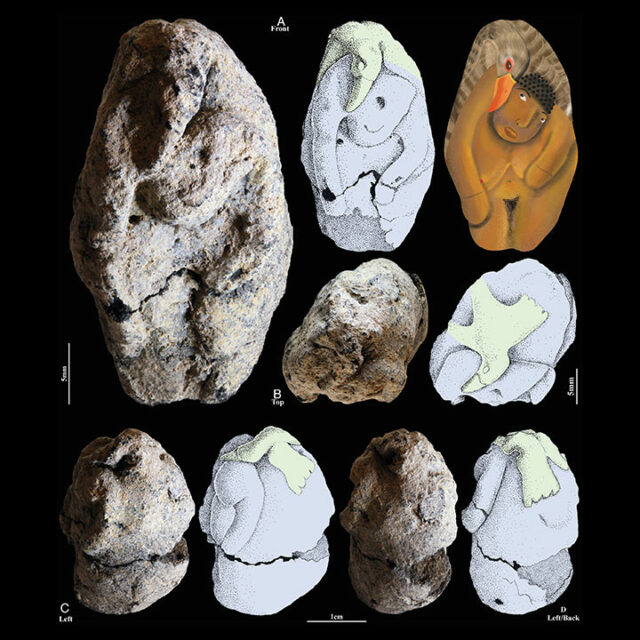
THE woman-goose figurine photographed and drawn from a 45° angle (i.e. looking at the figurine from above) with a light source coming from the right (woman in blue and goose in green on the technical drawing). (A) Front view and Artist render. (B) Top zenithal view. (C) Left view.(D) Left/Back view — LAURENT DAVIN, DASHA LOKSHIN, VIC OH /PNAS.ORG

A CLAY figurine about 12,000 years old that was unearthed at the site of a prehistoric village overlooking the Sea of Galilee in northern Israel depicts a woman and a goose in what may be one of the world’s oldest renderings of a mythological scene.

Researchers said the figurine, about 1.5 inches (3.7 cm) tall, was discovered inside a semicircular stone structure about 16 feet (5 meters) in diameter at a site called Nahal Ein Gev II. The village was part of the Natufian culture of Southwest Asia, which straddled the prehistoric transition between nomadic hunter-gatherers and settled agriculturally based communities.

It is the earliest-known figurine worldwide showing human interaction with an animal, according to Laurent Davin, a postdoctoral researcher in archaeology at the Hebrew University of Jerusalem and lead author of the study published on Monday in the journal Proceedings of the National Academy of Sciences. It is also the oldest-known naturalistic, rather than stylized, portrayal of a woman in art from Southwest Asia, Mr. Davin said.

The goose is positioned on the crouching woman’s back with its wings spread in a typical mating posture. The scene offers insight into this prehistoric culture’s belief system, Hebrew University archaeologist and study co-author Leore Grosman said.

“We interpreted the interaction scene as the depiction of the imagined mating between an animal spirit and a human. This theme is very common in animistic societies across the world in specific situations such as erotic dreams, shamanistic visions and myths,” Mr. Grosman said.

Animism is a belief system holding that natural things — living organisms such as plants and animals and inanimate objects like rocks and rivers — possess a spiritual essence.

“The scene itself — depicting a sexualized interaction between a human and an animal — is part of a long tradition in myth. Such imagery is rarely meant to be literal. Instead, it often symbolizes fertility, spiritual beliefs or the sacredness of life,” University of Connecticut anthropologist and study co-author Natalie Munro said.

“In many myths across history and cultures, gods or beings take on hybrid human-animal forms to convey symbolic meanings, not actual sexual activity,” Ms. Munro said.

The figurine appears to be the oldest example of a mythological scene in Southwest Asia and one of the oldest worldwide, but is younger, for example, than an apparent mythological scene among the Lascaux Cave paintings in France dating to roughly 18,000 years ago, the researchers said.

The figurine was sculpted from clay that was allowed to dry before being fired to make it durable, and later was colored with a red pigment, traces of which survive. A fingerprint of the sculptor can be seen on the figurine.

The object showcases new artistic innovations for its time. The sculptor used light and shadow to create a sense of depth and perspective, methods that would fully flourish much later.

“Given the way it was modeled, with an emphasis on its left profile, we know that this figurine was probably displayed in a particular spot to receive light, from the sun or a fireplace, on its left profile to reveal the play of light and shadows that brings to life the interaction between the goose and the woman,” Mr. Davin said.

Such figurines may have served as ornaments, amulets with magical or protective properties, or as props to tell stories. This one may have been part of a staged installation that village inhabitants would come to observe, Mr. Davin said.

At some point, it was buried in the fill of the structure where the researchers found it along with other objects possessing ritual meaning such as a cache of human teeth and the remains of a child.

The Natufian culture’s people were the first hunter-gatherers in Southwest Asia to adopt a sedentary lifestyle, a dramatic transformation that predated the embrace of farming. This village’s inhabitants hunted gazelles, practiced elaborate crafts including weaving, and collected raw materials nearby such as flint and limestone.

The site bore remains of geese, with evidence of hunting, butchering and feather use. Notably, the figurine’s scene was unrelated to hunting.

“The implication of this discovery,” Mr. Grosman said, “is that the sedentary lifestyle generated major transformations in social structures — both between humans and between humans and their surrounding environment — which then led to major transformations in storytelling, symbolic expression and artistic techniques.” — Reuters

Industrial policy for the Philippines: GCCs are a bright spot

STOCK PHOTO | Image by Rawpixel.Com from Freepik

(Part 5)

Instead of focusing immediately on potential “star” industries in the formulation of an industrial policy, it is wiser to identify those economic sectors which are conditio sine qua non for the growth of other industries.

For example, it is a no brainer that the hospitality industry (tourism) has tremendous growth potentials in the Philippines. The country is well known as the best beach destination in the world. Palawan has been rated by international tourism bodies as “the best island resort” in the world. The widespread use of English and the generally pleasant disposition of the Filipino are also positive factors for attracting foreign tourists to the archipelago.

The large inflow of foreign tourists to some of our ASEAN neighbors like Thailand, Vietnam, or Malaysia (with tourist arrivals recently numbering 15 to 30 million, compared to our less than 10 million) is evidence that the market demand is there. The harsh fact that the Philippines is struggling to go beyond 10 million foreign tourists annually can only be attributed to the severe lack of modern infrastructure such as world class international airports, railways, subways, etc., as exist not only in the four Tigers but also in our peer countries like Vietnam, Thailand, and Malayia.

That is why an industrial policy must give the highest importance to the building of infrastructure, especially in the countryside. There should be no letup in investing 6% of the GDP annually in infrastructure building which, in turn, will need a serious re-orientation of tertiary education towards the technical training of construction workers. Needless to say, the primordial importance of efficient and abundant infrastructure should be greater reason to aggressively pursue the present efforts to rid our government of corrupt legislators, Department of Public Works and Highways (DPWH) officials, and dishonest private contractors (going all the way to sending them to jail if convicted).

INFRASTRUCTURE DEVELOPMENT
From our review of the policy mistakes in the past that led to high rates of poverty, we saw that one of the major ones was that of limiting foreign equity in major capital-intensive investments to 40%. We may consider it providential that this policy error was corrected during the Duterte Administration when there was legislation that redefined public utilities to exclude major infrastructure like airports, railways, and subways. Thus, without amending the Constitution, this obstacle to attracting much-needed foreign direct investments (FDIs), has been removed.

Unfortunately, however, FDIs are not yet pouring in, as they are in Vietnam, because of regulatory complexity, red tape, and policy uncertainty. There continue to be delays in permits, layers of bureaucracy, and inconsistent requirements across jurisdictions (national vs local) which make it hard for investors to plan or estimate costs/time. There are frequent regulatory changes or unclear interpretation of existing laws which add to risk. Investors prefer stable, predictable regulatory regimes.

As we saw above in the case of the tourism sector not being able to achieve its full potential, FDIs continue to be low because of the high costs of infrastructure and outright deficiencies. Energy costs continue to be highest in the region. There are transport bottlenecks resulting from congestion in cities, slow or inefficient port operations, and weak logistical connections. There are serious gaps in digital infrastructure/ICT connectivity, especially in remote areas.

As regards human resources, there is a lack of sufficiently skilled or specialized workers in certain high-tech or advanced industries. This limits sectors that require technical labor or R&D.

As the whole nation recently experienced during the flood control corruption cases involving top legislators and officers of DPWH, non-transparent government processes increase transaction costs and risk perceptions. To make matters worse, other countries in the ASEAN (Vietnam, Thailand, and Indonesia) are getting more reforms going, improving incentives, and lowering entry barriers. The Philippines is perceived to be lagging in reducing costs of doing business, especially those tied to utilities, logistics, permitting, and import-export procedures.

IT-BPM INDUSTRY
Assuming that there will be serious efforts to address these obstacles to both foreign and domestic investments, can we with some reasonable amount of confidence, identify some of the “star” industries in which the Philippines attain above-average growth given both domestic and global developments?

The first on my list is the IT-BPM industry. It may be too late in the day for us to be a major exporter of manufactured products, but we can still aspire to be one of the leading exporters of services that cater to the industrial sector. The IT-BPM industry is clearly one in which we can aspire to be a global leader, with India as a close competitor.

As recently announced by Jack Madrid, President and CEO of the IT-BPM Association of the Philippines, despite the expected slowdown of the global economy resulting from the tariff wars being waged today, his sector is quite bullish in its growth expectation, with a projection of $42 billion in export revenues and increase in headcount to 1.97 million workers in 2026 (see BusinessWorld, Sept. 24).

Our competitive advantage in the IT-BPM sector still lies in the core segments of banking, financial services, and healthcare. For some time now, close to 60% of the earnings of the IT-BPM sector are accounted for by call centers. Considering that this segment is the most vulnerable to being replaced by Artificial Intelligence, it is providential that global capability centers (GCCs) have been growing faster in recent years than contact centers.

GCCs are offshore units established by multinational corporations to provide specialized services such as finance, IT and customer support to their global operations. There has been increased interest in GCCs in the Philippines from prospective clients in the US, Australia, and Europe. The recent move of the Trump Administration to impose a $100,000 “tax-like charge” on H-1B visas for foreign (highly skilled) workers could actually accelerate the move of US firms to put up more GCCs in the Philippines.

As Mr. Madrid recently reported, globally GCCs are reshaping the IT-BPM industry, with its market expected to grow to $155 billion by 2027. To date, there are 170 GCCs in the Philippines, growing by around 10 each year. It is important that the IT-BPM industry implement “enterprise-based” learning, in cooperation with universities and technical schools, to upskill, reskill and retool the hundreds of thousands of contact center workers so that they can shift from their call center services to higher-value knowledge-intensive work that will be in great demand in these GCCs.

Fortunately, despite all the handwringing about the poor quality of our tertiary education, it is my experience as a long-time educator and mentor that a large number of our college graduates, given the right and adequate attention by cooperating business enterprises, can improve their skills and acquire new skills to take on higher-value jobs. One only has to examine the success stories of such private educational institutions as the PHINMA schools, the National University, and Far Eastern University, among others. Private universities have been more successful in producing job-ready graduates with the appropriate skills demanded by industry than the majority of state colleges and universities, whose growth should be controlled. If the Government has more resources for education, the focus should be to improve the quality of basic education, from K to 12.

This sector of the Philippine economy has grown by leaps and bounds with little help from Government. IT-BPM officials, however, are requesting a little assistance from Government through a law that is similar to the Regional Operating Headquarters (ROHQ) law which provides incentives to multinational companies establishing ROHQs and area headquarters in the Philippines. Under the law, companies that do not derive income from the country are not subject to income tax, while ROHQs and area headquarters are exempt from value-added tax, local taxes, and import tax on training materials, equipment, and motor vehicles.

(To be continued.)


Bernardo M. Villegas has a Ph.D. in Economics from Harvard, is professor emeritus at the University of Asia and the Pacific, and a visiting professor at the IESE Business School in Barcelona, Spain. He was a member of the 1986 Constitutional Commission.

bernardo.villegas@uap.asia

Peso slips as traders wait for US economic data, Fed policy cues

BW FILE PHOTO

THE PESO weakened against the dollar on Tuesday as markets looked to delayed US economic releases for direction on the US Federal Reserve’s policy path.

It closed at P58.985 a dollar, slipping 5.4 centavos from P58.931 on Monday, based on Bankers Association of the Philippines data posted on its website.

It opened at P59 and moved from P58.888 and P59.08. Turnover reached $1.464 billion, up from $1.316 billion on Monday.

A broadly firmer dollar reflected investor caution ahead of US labor indicators that might guide the Fed’s next steps, Michael L. Ricafort, chief economist at Rizal Commercial Banking Corp., said in a Viber message.

“The dollar-peso pair held near P59 as market players await Fed cues and the release of US job data, coupled with the ongoing political crisis in the Philippines,” a trader said by telephone.

Political uncertainty has intensified after President Ferdinand R. Marcos, Jr. tapped Finance Secretary Ralph G. Recto to serve as executive secretary, while Frederick D. Go moved to the Finance department.

The reshuffle follows the resignations of Executive Secretary Lucas P. Bersamin and Budget Secretary Amenah F. Pangandaman amid investigations into alleged irregularities in public spending tied to flood control and infrastructure projects.

The trader expects the peso to trade from P58.80 to P59.10 on Wednesday. Mr. Ricafort forecasts a range of P58.85 to P59.05. — A.M.C. Sy

Chelsea trims Q3 net loss on cargo, passenger volumes

CHELSEALOGISTICS.PH

CHELSEA Logistics and Infrastructure Holdings Corp. narrowed its attributable net loss for the third quarter to P76.03 million, supported by a sustained recovery in cargo and passenger volumes.

For the three months ending September, the listed logistics and shipping firm reduced its net loss by 70.69% from P259.39 million in the same period last year.

The company reported gross revenues of P2.21 billion, up 9.95% from P2.01 billion a year ago.

“This period’s performance reflects the resilience and agility of our organization. Supported by our dedicated employees, we’ve not only rebounded from last year’s challenges but have laid a stronger foundation for sustainable growth,” Chelsea Logistics President and Chief Executive Officer Chryss Alfonsus V. Damuy said in a media release on Tuesday.

For the nine months ending September, Chelsea Logistics posted an attributable net income of P155.33 million, reversing a P340.02 million net loss a year earlier.

Despite a 10.18% rise in gross expenses to P6.06 billion from P5.50 billion, combined revenues for the nine-month period grew 14.86% to P6.88 billion from P5.99 billion previously.

“This period’s financial turnaround underscores our disciplined approach to cost management and strategic asset utilization. By maintaining stable operating expenses and executing a successful loan restructuring that lowered finance costs, we’ve fundamentally strengthened our bottom line,” Chelsea Logistics Chief Financial Officer Darlene S. Agus-Binay said.

The company attributed its growth to strong performance across its freight, chartering, logistics, and food-and-beverage segments.

Segment-wise, freight revenues rose 12.59% to P3.13 billion from P2.78 billion, while the passenger segment posted P2.06 billion, charter fees reached P685.18 million, tugboat fees amounted to P261.67 million, and other services generated P484.39 million.

Chelsea Logistics said the growth was fueled by sustained recovery in cargo and passenger volumes, increased vessel deployment, and disciplined cost management and asset utilization.

“Our year-to-date September 2025 performance highlights not only consistent revenue growth but also our commitment to capital efficiency, laying the foundation for sustainable, long-term profitability,” Ms. Agus-Binay added.

At the Philippine Stock Exchange on Tuesday, Chelsea Logistics shares rose P0.07, or 7.53%, to close at P1 apiece. — Ashley Erika O. Jose

Tom Cruise touts the power of cinema as he accepts honorary Oscar

TOM CRUISE in a scene from the first Mission: Impossible film in 1996.

LOS ANGELES — How does a person summarize the 45-year career of Tom Cruise in a four-minute speech? “Mission impossible,” said director Alejandro Inarritu on Sunday as Hollywood celebrated the movie star with an honorary Oscar.

Mr. Inarritu, who directed Mr. Cruise in an untitled film set for release next October, introduced the Top Gun star and said his talent extended beyond the dangerous stunts he has become famous for.

“It is not how far he runs or how high he jumps,” Mr. Inarritu said. “It’s how precisely he decides to move, those tiny calibrations.”

Honorary Oscar statuettes were handed out to Mr. Cruise and three others selected by the Board of Governors of the Academy of Motion Picture Arts & Sciences.

The 63-year-old Mr. Cruise, a four-time Oscar nominee who has never won the award, was chosen for work in films from Risky Business to two Top Gun movies and the Mission: Impossible franchise. He also has become a prominent champion for the movie business as it faces competition from streaming and social media.

Accepting his award, Mr. Cruise talked about how seeing movies in a theater impressed him as a child. “Suddenly the world was so much larger than the one that I knew,” he told a crowd of luminaries that included Steven Spielberg, Leonardo DiCaprio, and Ariana Grande. He said he worked every job he could to earn money for movie tickets.

“I will always do everything I can to support this art form and to champion new voices, to protect what makes cinema powerful, hopefully without too many more broken bones,” he said to laughter. Mr. Cruise broke his ankle while filming a stunt in 2017.

“Making films is not what I do. It’s who I am,” Mr. Cruise added.

The gala also honored Dolly Parton with the Jean Hersholt Humanitarian Award for her charitable efforts, including founding a library that has provided more than 300 million books to children. She accepted her award via video.

Other honorees were actor and choreographer Debbie Allen and production designer Wynn Thomas. — Reuters

Cybersecurity as the defining challenge of our time: Security at home, cooperation outside

STOCK PHOTO | Image by Vectorjuice from Freepik

Cybersecurity breaches occur at every level with alarming frequency and increasing sophistication.

At the most basic level, we hear about breaches in individuals’ personal communication, endangering their privacy and financial security. How many cautionary tales have we heard about people falling prey to phishing attacks or similar moves, just because they carelessly let their guard down or were not aware of the risks?

Breaches on the organizational or institutional level are likewise prevalent. Different sets of actors are behind these attacks, from mere thrill seekers to competitors and advocacy/propaganda groups.

Most dangerous of all are attacks on critical infrastructure like telecommunication, transportation, utilities, and other large-scale industries that fuel the economic life of a nation. A breakdown in these systems would not only translate to personal loss but to chaos, resulting in massive disruptions, economic losses, even physical harm to citizenry. Rogue states and other elements are usually responsible for these breaches.

It is also a certainty that cybersecurity attackers will continue to find new, unprecedented ways to use their expertise for personal, financial, and political gain. While we cannot yet imagine the specific details or forms of these future attacks, we can be sure that these tech-savvy malign actors will always try to be a step — or numerous steps — ahead of any attempts to quash them.

Ultimately, cybersecurity is not merely an issue of technology. The casualties are not just networks or data or other digital assets. Instead, what is affected are public trust and national confidence in our systems and institutions.

As societies become more reliant on technologies for their personal and professional lives, and as industries and governments increasingly depend on digital solutions, our everyday routines, the stability of our institutions, the integrity of information, and the resilience of economies all face great opportunities and tremendous risk. The interconnectedness of our systems also grows more complex by the day so that we cannot really say we are ever completely protected from attacks even in other industries.

Thus, cyber resilience is not only a technical necessity but a strategic responsibility as we build our nation and work toward a higher quality of life for all Filipinos.

And because technology hardly recognizes national borders, cybersecurity is not merely a national issue. The consequences of rising threats like artificial intelligence-driven attacks, ransomware, and infrastructure breaches have to be addressed not by piecemeal or siloed actions. Instead, what is needed is coordinated action and consistent cooperation among nations that acknowledge the indispensability of technology and the attendant risks. Remember: hackers and attackers become more sophisticated and acquire more tools.

Partnerships, whether among government agencies, private industries, academic institutions, or international partners and allies, form the backbone of effective cybersecurity. These relationships facilitate the exchange of knowledge, advance technical capability, and build the collective capacity needed to anticipate, mitigate, and recover from cyberattacks.

A shared response that brings together expertise, capabilities, and different perspectives across different sectors and nations is imperative. After all, a digitally secure and resilient digital environment will benefit not just one nation, but the Indo-Pacific region and the larger international context.

Economic blocs have acknowledged this shared challenge and have undertaken steps toward better cybersecurity. Under the QUAD Foreign Ministers’ Meeting Joint Statement in 2024, QUAD countries — the United States, Japan, India, and Australia — committed to deepening cooperation on regional cyber capacity-building, enhancing the protection of critical infrastructure including subsea cables, advancing secure and trusted digital technologies, and aligning standards such as the mutual recognition of IoT cybersecurity labeling. This reflects a shared approach to strengthening cyber resilience across the Indo-Pacific.

Japan, in particular, passed the Cyber Response Capability Strengthening Law on May 16. This move highlights Japan’s commitment to fortifying its own cybersecurity posture while advancing cyber resilience internationally. It marks a significant step in Japan’s cybersecurity diplomacy and its proactive support for regional efforts to secure the digital domain.

For our part, the Philippines knows that by engaging with like-minded countries, we can enhance access to threat intelligence, strengthen incident response coordination, and participate in shaping norms that promote responsible behavior in cyberspace.

Against this backdrop, the Stratbase Institute will hold its annual Pilipinas Conference with the theme “Enhancing Cyber Resilience: Approach, Responses and Practical Actions.”

Now on its 10th year, the conference, slated to begin tomorrow, Nov. 20, has established itself as a leading platform for thought leadership that brings together government officials, the diplomatic community, business leaders, academics, and civil society to address urgent national and regional issues.

Three panels will explore this theme in greater depth. The first panel will be on cyber-initiatives and cooperation as we collaborate for a secure Indo-Pacific region. The next will discuss cybersecurity and its strategic role in an era of cross-border threats. The third panel will talk about the legal, political, and technical framework and measures in building cyber resilience. There will also be scenario-based discussions on policy implications.

The digital environment offers groundbreaking possibilities, but it also carries risks that may derail our progress or undermine our people’s trust in our systems and institutions. Strengthening cyber resilience and deepening international cooperation will be essential to securing a stable and prosperous future.


Victor Andres “Dindo” C. Manhit is the president of the Stratbase ADR Institute.

Visa, Google launch Google Pay, Wallet in PHL

VISA.COM.SG

VISA, in collaboration with FinTech Alliance.ph and Google, on Tuesday launched Google Wallet and Google Pay in the Philippines, allowing cardholders to tap their Android devices for contactless payments.

In a statement, Visa said its cardholders could now add their Visa debit or credit cards to Google Wallet and pay using Google Pay.

The service supports Visa debit and credit cards from seven partner issuers: China Bank, EastWest, GoTyme, Maya, RCBC, UnionBank and Wise. Payments can be made in-store, online, or in-app without a physical card.

“Google Pay amplifies the benefits of Visa for consumers, businesses and our banking partners,” Jeffrey Navarro, Visa country manager for the Philippines, said in the statement, adding that the service brings speed and security to every transaction.

“Each payment is protected by Visa’s network token — a unique, one-time digital code that can help prevent fraud while ensuring a seamless experience,” he added.

Under the Bangko Sentral ng Pilipinas (BSP) guidance, Google Pay is classified as a technology service provider since it does not hold consumer funds but links to Visa credit, debit or prepaid cards.

In a speech, Mr. Navarro said Visa has partnered with 7-Eleven to roll out Google Pay at 11 pilot branches, with full deployment across all stores targeted next year.

Fintech Alliance.PH Chairman Angelito M. Villanueva said the feature is also set for use on the Metro Rail Transit and Light Rail Transit Lines 1 and 2.

Information and Communications Technology Secretary Henry Rhoel R. Aguda said his agency would push tap-to-pay adoption among delivery drivers and taxis under its oversight.

He added that the agency and Fintech Alliance.PH plan to launch a program to make it easier for tech startups and fintech firms to pursue public listings, supporting the central bank’s effort to deepen local capital markets.

Bangko Sentral ng Pilipinas Deputy Governor Mamerto E. Tangonan said in a panel discussion at Tuesday’s launch that the central bank is studying tokenized assets and tokenized money — including tokenized deposits — along with stablecoins as a possible payment tool.

“We are exploring an environment with tokenized money and tokenized assets in a unified measure,” he said. “Stablecoins are an option. We’re still looking into it to be used as a payment instrument, not as an asset. But we’re seriously looking into those options.” — Aaron Michael C. Sy

Salesforce expands Philippine presence with new Makati office

GAVIN BARFIELD

AMERICAN cloud software company Salesforce officially opened its main office in Makati City on Tuesday, aiming to support more Philippine businesses in adopting agentic artificial intelligence (AI).

At a briefing, Salesforce Vice-President and Chief Technology Officer, Solutions for ASEAN Gavin Barfield said agentic technology can help Philippine businesses serve a larger customer base at speed.

“We all know that some companies in the Philippines are struggling with millions of customers. With agent and agentic technology, you can offer that level of customer service to a wide variety,” he said.

The new Philippine office is located at Ayala Triangle Gardens Tower 2 within the Makati central business district.

“With our new office in the Philippines, we are better positioned to empower Filipino businesses to transform into agentic enterprises while also supporting the local ecosystem by equipping Filipino workers with the critical AI skills needed for the future economy,” said Abraham Cuevas, regional vice-president and country manager of Salesforce Philippines.

AI technologies have the potential to boost the Philippine economy by P1.8 trillion, according to a report by Google Philippines and consulting firm Public First. However, many local companies may face challenges in adopting agentic AI amid fragmented data and skills gaps.

“Salesforce is uniquely positioned to lead customers through this transformation by enabling them to become ‘agentic enterprises,’ a new model of work where AI elevates people rather than replacing them,” the company said.

Among Salesforce’s key products is Agentforce 360, which integrates apps, data, metadata, and agents on a unified platform to help clients automate routine tasks. The company also announced that its Agentforce for Service and Employee Agent platforms are now available in Tagalog, enabling more local businesses to serve customers in their native language. 

Looking ahead, Salesforce plans to train 12,000 Filipino workers over the next five years in AI and customer relationship management skills.

“We want to invest in the talent that’s here not just to serve the Philippine market, but potentially our Southeast Asian markets as well,” Mr. Cuevas said. — Beatriz Marie D. Cruz

Bridget Jones gets her own statue in London’s Leicester Square

THE BRIDGET JONES: Scenes in the square statue after its unveiling at Leicester Square, London — PA VIA REUTERS

LONDON — Bridget Jones has joined the likes of Mary Poppins, Harry Potter and other beloved film characters with her own statue in London’s Leicester Square.

Oscar winner Renee Zellweger, who has played the titular character in all four Bridget Jones films, attended Monday’s unveiling of the statue which celebrates 25 years since the first movie, Bridget Jones’s Diary, was released.

“It’s pretty crazy. It’s kind of strange. It’s not something that you… ever expect… it’s quite a surprise,” Ms. Zellweger told Reuters.

Asked what she made of the statue, which depicts Bridget with her hair tied back, dressed in a mini skirt and holding a pen and diary, she said: “I mean, she’s adorable… she’s really cute. Looks like Bridget to me.”

Author Helen Fielding created the character of Bridget Jones more than 30 years ago for a newspaper column that detailed Bridget’s love life. Her first book Bridget Jones’s Diary was published in 1996 and three more followed.

Bridget Jones’s Diary was turned into a 2001 film with Hugh Grant and Colin Firth starring alongside Ms. Zellweger.

Movies Bridget Jones: The Edge of Reason and Bridget Jones’s Baby followed in 2004 and 2016 respectively. Bridget Jones: Mad About the Boy was released in February.

“My daughter’s generation now like Bridget, and that means a huge amount to me because it hardly ever happens,” Ms. Fielding said of the character’s enduring popularity. “So I feel very, very lucky, and yeah, I’m proud of Bridget.”

The Bridget Jones statue is part of the Scenes in the Square trail of sculptures of film characters in Leicester Square, where many movie premieres are held. The trail was launched in 2020 and also includes statues of Laurel and Hardy as well as Batman among others. — Reuters

Transparency by design: The promise of the CADENA Act

STOCK PHOTO | Image by Jcomp from Freepik

In a political environment repeatedly shaken by allegations of misuse of funds, overpriced procurements, and questionable projects, a reform bill has emerged that deserves far greater public attention: Senator Bam Aquino’s Citizens’ Access and Disclosure of Expenditures for National Accountability (CADENA) Act.

While many legislative proposals focus on adding new agencies, increasing budgets, or introducing new programs, the CADENA Act aims to do something far more fundamental: to finally give Filipinos a full, structured, real-time view of how government actually spends public money. And as simple as that may sound, it has the power to change the country.

I laud Mr. Aquino for pushing this measure. It could not have come at a more urgent time, when corruption, both petty and large-scale, continues to drain national resources and erode public trust.

Although the name sounds technical, the principle behind CADENA is very straightforward: every peso of taxpayer money must be visible, traceable, and publicly disclosed. The bill directs the government to create a single, unified digital platform where all National Government agencies must upload expenditure-related documents. This includes the National Expenditure Program, the Budget of Expenditures and Sources of Financing, the General Appropriations Act, all procurement documents, contractor information, project details, and progress reports. The goal is not merely to post scanned files online, but to ensure that data is shared in structured, machine-readable formats so that the public, media, civil society, and independent analysts can easily review and cross-check information.

The measure also requires agencies to upload documents within seven days of issuance, release, or payment. This near real-time disclosure prevents irregularities from being hidden until long after the damage is done.

To preserve the integrity of data, the bill requires that uploaded documents be tamper-resistant and traceable. This means that once a document is published, any modification will leave a permanent audit trail, with previous versions remaining accessible. While the bill does not specify which technology should be used, its language clearly points to the adoption of systems that can ensure verifiability, immutability, and long-term data protection.

It is worth noting that there should be a transition from a tamper-evident system to a truly tamper-resistant one. Tamper-evident simply means one can detect if something has been altered, while tamper-resistant means altering it in the first place is close to impossible. This shift demands not only secure digital infrastructure but also strict governance protocols and oversight.

It is here that the CADENA Act’s future-proofing must be taken seriously. The bill’s intention is strong, but its success will depend on execution — how data will be stored, verified, and protected in the long run.

Future-proofing the CADENA framework means thinking beyond the technology of today. The platform must be designed to accommodate emerging innovations, from advanced data analytics to AI-powered anomaly detection, while remaining resilient against evolving cybersecurity threats. The system’s architecture should allow for upgrades without disrupting continuity, and its policies should mandate regular independent audits to ensure that it continues to serve the public interest.

The government must also establish a clear governance framework to define ownership, accountability, and access. Which agency will operate the portal? Who verifies data quality? How will privacy and national security be balanced with transparency? These are not technical questions but policy ones. A multi-stakeholder oversight board that includes government, civil society, and private sector representatives could help guarantee both transparency and accountability in implementation.

Another crucial element will be the establishment of a pilot program. Before full-scale rollout, a limited pilot involving select agencies — such as the Department of Budget and Management, the Department of Public Works and Highways, and the Department of Education — should be undertaken to test interoperability, user experience, and data consistency. This approach allows lessons to be learned early, avoiding costly errors when scaling nationally. It will also help identify gaps in staff training, process alignment, and infrastructure readiness across different departments.

In addition, issues related to data sovereignty must be clearly defined. With the growing involvement of cloud computing and third-party vendors in government digital infrastructure, it is essential that data generated under CADENA remains within Philippine jurisdiction and subject to Philippine law. National expenditure data cannot be stored or processed in a way that exposes it to external manipulation or foreign access. The policy must explicitly state where data is hosted, how backups are handled, and who has ultimate control over the information.

Equally important, CADENA should not just be about uploading data but about making that data usable. Structured formats and open APIs will allow journalists, researchers, and watchdog groups to develop their own tools to monitor projects and spending. A transparency portal is only as good as its ability to generate citizen engagement. It must therefore be intuitive, searchable, and accessible even to ordinary Filipinos who may not be experts in data analysis.

This is why the CADENA Act matters now more than ever. For decades, Filipinos have witnessed corruption in many forms: delayed projects, overpriced deals, ghost deliveries, substandard infrastructure, and billions of pesos in leakages. Each scandal follows a familiar pattern, with documents surfacing too late, audits happening long after the fact, and accountability fading as the news cycle moves on. CADENA breaks this pattern by shifting the fight against corruption from after-the-fact investigation to real-time exposure. Corruption thrives when information is hidden. Transparency, on the other hand, acts as a disinfectant. When expenditure data is public, accurate, and searchable, irregularities become much harder to conceal.

It is also important for citizens to understand that even well-intentioned reforms take time. The legislative process in the Philippines requires committee hearings, multiple readings, and reconciliation between the Senate and House versions before the President can sign or allow a bill to lapse into law. Even with strong public and legislative support, a reform like CADENA could take one to two years before implementation begins. But every great reform starts with persistence and vigilance, and CADENA is worth that effort.

At a time when frustration with corruption runs deep, the CADENA Act represents a rare and tangible opportunity to rebuild trust in government. It will not eliminate corruption overnight, but it will make it far more difficult to hide. It will not solve all problems, but it will create the conditions for accountability to thrive.

If we want a Philippines where transparency is automatic, where citizens have the right to know how their money is spent, and where public office truly means public trust, then CADENA deserves our collective and vocal support. The fight for accountability does not begin when the law is passed. It begins now with understanding, advocacy, and the courage to demand that our leaders finally turn transparency from a promise into practice.


Dr. Donald Patrick Lim is the founding president of the Global AI Council Philippines and the Blockchain Council of the Philippines, and the founding chair of the Cybersecurity Council, whose mission is to advocate the right use of emerging technologies to propel business organizations forward. He is currently the president and COO of DITO CME Holdings Corp.

Product standard law to boost MSME competitiveness

PHILIPPINE STAR/MIGUEL DE GUZMAN

By Beatriz Marie D. Cruz, Reporter

A PROPOSED LAW to create a unified framework for product standards and testing should prioritize micro, small and medium enterprises (MSMEs) to ensure smaller firms can meet global market requirements, analysts said.

“Normally, micro and small companies may not have the kind of quality control setup that larger firms possess, but we don’t want them left behind,” Philippine Chamber of Commerce and Industry Chairman George T. Barcelon said by telephone. “The law must be simple to understand and easy to apply.”

The National Quality Infrastructure (NQI) bill, under consideration in both the House of Representatives and Senate, seeks to consolidate standards, metrology, accreditation and conformity assessment across industries.

It aims to align Philippine practices with international norms, potentially opening access for domestic products to foreign markets.

Teddy G. Monroy, Philippine representative for the United Nations Industrial Development Organization (UNIDO), said the framework should address challenges faced by MSMEs, including fragmented regulations, unclear standards and limited access to accredited testing laboratories.

The NQI framework should equip smaller enterprises with the tools and guidance to participate more effectively in global markets, he said in an e-mailed reply to questions.

Mr. Barcelon noted that existing compliance rules tend to favor larger producers such as electronics manufacturers.

“The law has to be crafted in a way that is understandable and practical so that smaller companies can comply,” he said.

UNIDO said a well-drafted NQI Development Act could streamline regulatory processes, reduce duplicative procedures and expand access to reliable certification services.

A national framework that consistently applies standards “will help MSMEs gain the trust of consumers and buyers, build reputations for quality and participate in higher-value supply chains,” Mr. Monroy said.

The measure will also support small firms in upgrading production capabilities and accessing government support programs, complementing the Tatak Pinoy Act, which provides financing and incentives to domestic producers.

UNIDO is offering technical assistance to lawmakers and agencies in implementing the measure.

MSMEs, which account for more than 99% of Philippine businesses and contribute roughly 40% to the nation’s gross domestic product, are widely regarded as a key driver of economic growth.

By establishing a modernized, integrated system for standardization and quality assessment, the NQI Act could provide a critical boost to smaller enterprises, helping them compete abroad while enhancing domestic product quality and market trust.

Philippine assets feeling strain from Cabinet shakeup — analysts

Philippine President Ferdinand Marcos Jr. meets with US President Donald Trump (not pictured), in the Oval Office at the White House in Washington, DC, July 22, 2025. — REUTERS/KENT NISHIMURA

PHILIPPINE ASSETS are under pressure after a Cabinet revamp by President Ferdinand R. Marcos, Jr. to stem a corruption scandal rocking his government, adding another layer of uncertainty.

Most of the country’s dollar bonds fell, with the note maturing in 2035 sliding to the lowest since Sept. 5, according to data compiled by Bloomberg. The peso on Tuesday slipped 5.4 centavos to close at P58.985 against the dollar, while the benchmark stock index, already trading at multi-year lows, dropped 0.38% or 22.46 points to 5,756.66.

The Cabinet reshuffle comes as two Cabinet secretaries resigned amid allegations of corruption, marking the first direct hit on Mr. Marcos’ government from the multibillion-dollar flood graft scandal.

Finance Secretary Ralph G. Recto will become executive secretary, replacing one of the departing secretaries. Frederick D. Go will be the nation’s finance chief. Budget Undersecretary Rolando U. Toledo will step up to become officer-in-charge of the agency. It’s the second major reshuffle in Marcos’ Cabinet since he took office in 2022.

This is what analysts and economists say:

Miguel Chanco, chief emerging Asia economist at Pantheon Macroeconomics:

“It sounds from the reporting of this reshuffle that it was instigated by more heads rolling over from the fallout of the ICI’s (Independent Commission for Infrastructure ) anti-corruption drive, which will continue to keep political event risk fairly elevated in the short run, impinging on market sentiment with regards to Philippine assets.

“It’s obviously far too soon to say what the new Finance secretary will bring to the role vis-a-vis his predecessor, who remains in government in another capacity. What’s undeniable, though, is that the post-Covid fiscal consolidation plan continued to slip behind schedule under Recto’s stewardship, so any change — at all — would be welcome, as the status quo clearly wasn’t working.”

Philip McNicholas, Asia sovereign strategist at Robeco in Singapore:

“The reshuffle is interesting. It is unlikely to help sentiment, and the Philippines is a market that is running sizeable twin deficits. In that light, a negative response makes sense. President Marcos may be trying to minimize disruption to his broader macro agenda beyond the resignations by keeping key personnel within his inner circle. It is worth noting that the President initiated these investigations to investigate the misuse of public funds. So, at the margin, one could see it as a positive for governance.

“The market reaction strikes me as a knee-jerk response to the injection of uncertainty over who the possible replacements might be.”

Wee Khoon Chong, senior APAC market strategist at BNY:

“The reshuffling of cabinet is likely to add an additional layer of uncertainties and likely to exert downward pressure on the Philippine peso in the near-term.

“It raises the probability of a more aggressive rate cut by the central bank at December’s meeting. We are looking for 25 bps and won’t rule out for a possible 50 bps for a strong boost to stabilize sentiment.”

Matthew Ryan, head of market strategy at Ebury Partners Ltd:

“In the near term, we suspect that the ensuing uncertainty stemming from the re-shuffle could provide a mild drag on growth, particularly should it trigger a loss of investor and business confidence and weaker government spending. We could see an improvement in medium-term growth, however, should Go’s emphasis on business reforms and deficit reduction lead to increased FDI flows, lower borrowing costs and an improvement in the country’s credit ratings.

“Going forward, we may see a mild appreciation in the peso should Frederick Go maintain his track record of attracting foreign direct investment and improving trade corridors, while bringing down inflation and bolstering the Philippines’ credit position. This will, however, depend on the success of his reforms, and his ability to detract attention away from the recent corruption controversies.”

Toby Allan Arce, analyst at Globalinks Securities & Stocks:

“The latest Cabinet reshuffle in the Marcos administration, set against the backdrop of a widening corruption scandal tied to the flood control anomaly, underscores a moment of heightened uncertainty for the Philippine stock market. Investor sentiment typically weakens when political risk rises, particularly when issues touch the core of governance, transparency, and fiscal accountability.”

“The appointment of Frederick Go as Finance Secretary and the repositioning of Ralph Recto may help steady the leadership structure, but transitions of this magnitude often take time to dissipate uncertainty, especially when they occur amid an active investigation with significant public scrutiny. The peso’s weakness, sluggish third-quarter growth, and the stock market’s decline all reflect how investors are already pricing in governance-related risks.”

Jash Matthew Baylon, analyst at First Resources Management and Securities

“We think that the recent Cabinet reshuffle may affect the market as it may bring uncertainty on possible imposition of new policies affecting our economy as the reshuffling affects the Department of Finance.

“Investors may also remain on the sidelines while volume will still be subdued due to current political risk and instability, implying weak confidence.”

SB Equities, Inc.:

“The Philippines’ benchmark stock index may see a relief rally if selling pressure remains tepid.” — Bloomberg News