Home Blog Page 7000

Face-to-face classes in metro suspended on rising infections

PHILSTAR/ MICHAEL VARCAS

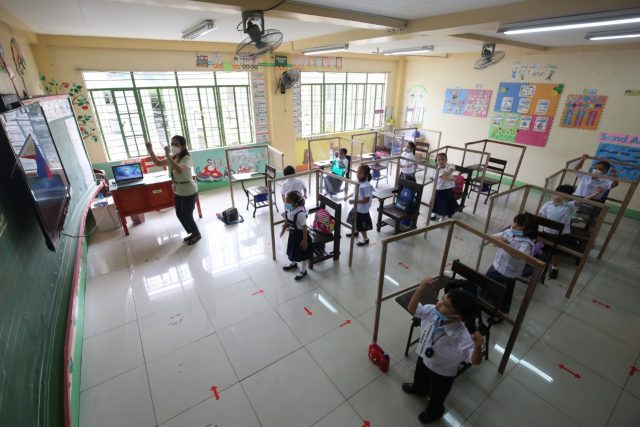
THE EDUCATION department has suspended pilot face-to-face classes in Metro Manila after President Rodrigo R. Duterte tightened the lockdown level in the capital region amid rising coronavirus infections. 

The suspension stands until the coronavirus alert level returns to Level 2, it said in an advisory on Sunday night. It announced the decision weeks after almost 30 public schools in the capital region started holding limited face-to-face classes. 

Physical classes in areas under Alert Levels 1 and 2 will continue, the agency said. 

The government raised the alert level in the capital region as the country faces threats from the heavily mutated Omicron variant. 

Senator Sherwin T. Gatchalian, who heads the basic education committee, urged the government to fast-track vaccine rollout for children aged 12 to 17 to protect students from infections. 

In a statement, Mr. Gatchalian said teachers should be tested regularly for the coronavirus “especially because they continue to report for work despite the lack of face-to-face classes.” 

He said schools in areas under Alert Level 2 should follow protocols such as contact tracing and install adequate sanitation facilities. 

Education officials earlier told a Senate hearing 7.1 million out of 12.7 million minors aged 12 to 17 have received at least their first vaccine dose, while 2.7 million got fully vaccinated. — Kyle Aristophere T. Atienza 

WWF-Philippines calls on presidential candidates bring climate crisis to the table

AN ENVIRONMENTAL group on Monday urged Philippine presidential candidates to include the climate crisis in the 2022 national elections agenda.

Candidates must explain to the public how the Philippines under the next administration “will implement the proper actions in line with our international commitments,” WWF-Philippines said in an e-mailed statement. 

“The climate, nature, and environment should be on the agenda of candidates along with our advocacies on climate justice and equity,” said Angela Consuelo Ibay, WWF-Philippines’ head of Climate and Energy. 

In the UN Climate Change Conference (COP26) in Glasgow from Oct. 31 to Nov.12, the Philippines signed commitments to halt deforestation and restore forest land, pursue a clean energy transition, and take voluntary actions to reduce methane emissions. 

The group called on candidates and government officials to ensure that the agreements signed in the international conference with hundreds of other countries will “become institutionalized and continue to be implemented by the next administration.”

“Beholden dapat yung next administration to keep up with our international commitments and international agreements,” Ms. Ibay said. “We will have to be accountable to those international commitments.” — Kyle Aristophere T. Atienza 

Higher budget starting this year will boost local governments’ calamity, pandemic response — senators 

DILG.GOV.PH

LOCAL governments’ ability to manage calamities and the continuing coronavirus pandemic will get a boost starting this year with the higher allocation from national taxes, but only with continued support from the national government, two senators said on Monday.

“Constantly faced with huge challenges primarily brought about by calamities and disasters, the significant revenue increases for LGUs (local government units) will certainly be a big boost for them, and hopefully usher in an era of energized and more empowered LGUs,” Senator Leila M. de Lima said in a statement.

“With greater autonomy comes greater responsibility, and resources are key to LGU empowerment and rural progress,” she added.

The LGUs will be receiving P959.04 billion this year from the signed P5.024-trillion 2022 General Appropriations Act. The amount represents 40% of the P2.4 trillion tax base computed by the Department of Finance.

“Doubts being expressed on their spending capacity should serve as a challenge for LGUs to work harder and more efficiently as (the) government braces itself for the start of the implementation of the Mandanas ruling,” Ms. De Lima said.

The national government, she added, “should do all it can to assist and support LGUs in achieving genuine and effective autonomy that is beneficial to all.” 

The Mandanas ruling refers to a 2018 Supreme Court decision that recognizes LGUs’ entitlement to a 40% share of all national taxes and not just those collected by the Bureau of Internal Revenue. 

President Rodrigo R. Duterte signed Executive Order 138 last year containing guidelines to ensure that the decentralization process and the increase in the LGU’s just share in national taxes will be carried out systematically and smoothly.

Senator Maria Imelda “Imee” R. Marcos, meanwhile, called for the immediate release of the increased funding for LGUs this year. 

“Our LGUs are the frontliners, and they urgently need the long-denied Mandanas-Garcia ruling realized in this year’s national budget,” said Ms. Marcos, chair of the Senate economic affairs committee.

At the same time, she said national government assistance “will still be needed, especially in fourth- to sixth-class municipalities where public hospitals are not ready for a full transfer of functions.” — Alyssa Nicole O. Tan 

Election commissioner warns against disorder during Marcos disqualification hearing

PHILIPPINE STAR/KRIZ JOHN ROSALES

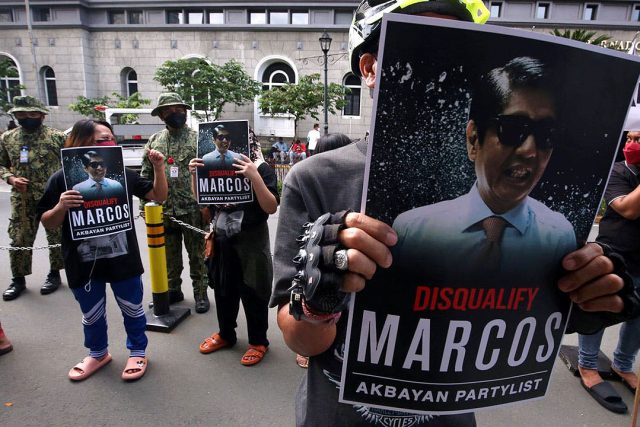
A COMMISSION on Elections (Comelec) official warned parties involved in a disqualification hearing against presidential candidate Ferdinand “Bongbong” R. Marcos Jr. of being held in contempt and thrown in jail if they “disturb” the proceedings.

“Anyone who will disturb the proceeding on Jan. 7 or interrupt me or a Commissioner will be declared in contempt and sent to Manila Jail for 48 hours,” Comelec Commissioner Ma. Rowena Amelia V. Guanzon, who is part of the division handling the case, said on Twitter on Monday. 

Ms. Guanzon had informally reprimanded lawyers involved in the cases in previous tweets in December.

She also gave a reminder on strict adherence to health protocols and other Comelec regulations.

“Bring vax cards and be ready for antigen test upon entry in the 8th floor lobby. No mask no entry. No bodyguards, no weapons,” she said.

The preliminary conference on the Akbayan Citizen Action Party’s petition against Mr. Marcos will be the first hearing among seven cases filed against the late dictator’s son and namesake. 

Two other cases led by Bonifacio P. Ilagan and Abubakar Mangelen will also be taken up on that day.

Akbayan submitted a disqualification petition on Dec. 2, citing that Mr. Marcos should be banned from seeking the presidency because of his conviction in a tax-related case, which carries a penalty of perpetual disqualification to hold public office.

The other petitions assert similar arguments, while Mr. Mangelen claims that he is the duly-elected chairman of Partido Federal ng Pilipinas and that Mr. Marcos’ certificate of nomination and acceptance by the party is “unauthorized, defective, invalid, and void.” 

Pending cases against election candidates handled by the Comelec’s Second Division will begin their hearings on Jan. 14.

Meanwhile, the Marcos camp announced Monday that more than 20 staff of their headquarters in Mandaluyong City tested positive for coronavirus. 

The office will be temporary closed until further notice and all activities will be deferred until Jan. 15. — Jaspearl Emerald G. Tan

Iloilo City ready to test inbound travelers to mitigate Omicron risk

MAYOR JERRY TREÑAS FB PAGE

THE ILOILO City government is ready to conduct testing of inbound travelers as part of measures to reduce the threat of the more transmissible coronavirus Omicron variant. 

In a statement on Monday following a meeting of the local task force managing the pandemic response, the city government said testing will be done for those arriving from Metro Manila, Cebu, and Boracay.

Mayor Jerry P. Treñas said local cases could surge in the coming weeks following the holiday season and the influx of travelers.

An executive order will be issued on new testing requirements and other protocols for those entering the city.

There are three public and one private accredited laboratories in Iloilo City for RT-PCR testing.

VACCINATION
Mr. Treñas also reiterated the appeal for residents to get vaccinated, and have the booster shot for those already qualified. 

“Cases are rising based on the reports of DoH (Department of Health). The NCR (National Capital Region) is now under Alert Level 3 and cases continue to go up. We need to protect ourselves and our families,” he said. “I am asking everyone to get their booster shots three months after their second dose. We need to have additional protection against Omicron.”

The mayor also said he will be requesting for more Pfizer and Moderna vaccines to ensure sufficient supply.

He also directed preparations for the reopening of isolation and quarantine facilities, most of which have been temporarily closed as cases dropped late last year. 

“While we still do not have any confirmed case of Omicron in the city, we need to be pro-active about it,” he said.

“I am asking everyone to stop gatherings with persons not from the same household in the meantime while we are in the alert for cases of Omicron,” he added.

As of Jan. 2, data from the DoH-Western Visayas regional office show Iloilo City had 69 active cases out of the total 21,941 recorded since the start of the pandemic. There were 21,237 recoveries 626 deaths. — MSJ 

Mabini agri cooperative receives solar irrigation system

DAR

A P1-MILLION solar-powered irrigation system has been turned over to the Barlo Agrarian Reform Cooperative in Mabini, Pangasinan, the Department of Agrarian Reform (DAR) announced Monday.

The facility can irrigate three to five hectares of agricultural land, benefiting around 30 farmers in the area.

DAR Assistant Regional Director for Administration Maria B. Francisco said the irrigation system “will address the water problem” of the town’s rice farmers, both agrarian reform beneficiaries and non-beneficiaries. 

The department said farmers used to spend an average of P20,000 on irrigation, including rent, labor, and crude oil.

“With the help of the SPIS, the production cost of the farmers will be reduced,” it said.

Farmers, who used to plant only during the rainy season, would also now be able to more than once a year. — Luisa Maria Jacinta C. Jocson

Unvaccinated banned from Dolomite Beach

DENR

ONLY fully-vaccinated individuals will be allowed entry at the Dolomite Beach along Manila Bay, the Department of Environment and Natural Resources (DENR) announced Monday.  

The ban on unvaccinated individuals is part of the new guidelines for the reopening of the rehabilitated area.

Children up to 11 years old are also still not permitted to enter, DENR said in a press release.

Those intending to visit will have to pre-register online at least one day before the intended date. Walk-ins will be accommodated if there are available slots within the 300 persons per hour limit.

“We advise successful online registrants to come on time for their scheduled batch as everyone in a given batch will be required to leave the beach area upon the lapse of the one-hour period for the next batch,” DENR-Environmental Law Enforcement and Protection Service Director Reuel N. Sorilla said.

All visitors must present a vaccination card, wear face mask, and observe physical distancing.

Eating, drinking, and swimming at the beach are still prohibited.

During the Dec. 28 reopening, there were 1,245 visitors at the beach, of which 89% were walk-in guests while 11% were online registrants, according to the DENR. — Luisa Maria Jacinta C. Jocson

Legal implications of ‘fiduciary duty of extraordinary diligence’

JCOMP-FREEPIK

(Part 2)

In its 2018 Resolution, Virata v. Ng Wee, affirmed in toto the foregoing rulings in dismissing the motions for reconsideration filed by the petitioning directors and officers of Wincorp, and thereby solidifying the doctrine that when it comes to corporations vested with public interests, such as financial intermediaries, directors, trustees, and officers do owe a fiduciary duty of diligence not only to the shareholders, but to creditors and other stakeholders, who rely upon the Board and its officers to exercise their fiduciary duty of diligence in the management of the corporate business enterprise to protect their legitimate interests in the corporate assets.

The Revised Corporation Code, although retaining the same language on the liability of directors, trustees, or officers under its Section 30, nevertheless instituted under Section 22 the special category of “corporations vested with public interests,” and thus imports the existing jurisprudence defining the obligation of such corporation to act with extraordinary diligence. In other words, all corporations classified as being vested with public interests pursuant to Section 22 of the Revised Corporation Code must necessarily come under the rule that they are expected to exercise the highest degree of diligence with the public they deal with or for whose interests they operate their business enterprise.

Under the fiduciary duty to exercise extraordinary diligence rule, an injured stakeholder need only to prove the amount of damages sustained from the acts, contracts, or business transactions or operations of a corporation vested with public interests, and the burden to show that it has exercised extraordinary diligence would be on the part of the said corporation.

The doctrine is taken from statutory and jurisprudential rules embodying another industry vested with public interest, namely common carriers. Under Article 1733 of the Civil Code, “Common carriers, from the nature of their business and for reasons of public policy, are bound to observe extraordinary diligence in the vigilance over the goods and for the safety of the passengers transported by them, according to all the circumstances of each case.”

In turn, Article 1755 defines “extraordinary diligence” as the obligation of the common carried to carry its passengers safely as far as human care and foresight can provide, using the utmost diligence of a very cautious person, with due regard for all the circumstances. By reason therefore, Article 1756 provides that “In case of death of or injuries to passengers, common carriers are presumed to have been at fault or to have negligently, unless they prove that they observed extraordinary diligence.”

The underlying statutory rules imposing the duty to exercise extraordinary diligence on the part of common carriers have given rise to the rule of liability of common carriers well-expressed in Tiu v. Arriesgado, 437 SCRA 426 (2004), thus:

“Upon happening of the accident, presumption of negligence arises at once, and it becomes the duty of a common carrier to prove that he observed extraordinary diligence in the case of his passengers. To overcome such presumption of negligence, the carrier must show: (a) The utmost diligence of very cautious persons as far as human care and foresight can provide; or (b) That the accident was caused by fortuitous event.

“The negligence of employee gives rise to the presumption of negligence on the part of employer, the purpose of which is primarily intended to provide compensation for the death or bodily injuries suffered by innocent third parties or passengers as a result of negligent operation and use of motor vehicles.”

The Supreme Court has defined “extraordinary diligence” as that extreme measure of care and caution which persons of unusual prudence and circumspection observe for securing or preserving their own property or rights. This exacting standard imposed is intended to tilt the scales in favor of the shipper who is at the mercy of the common carrier once the goods have been lodged for shipment. When employee’s negligence causes damage or injury, there arises presumption juris tantum that employer failed to exercise diligentissimi patris families in selection or supervision of employees.

Presumption of Negligence When Passengers Die or Injured — In carriage of passengers, by reason that the common carrier is bound by duty to observe extraordinary diligence in pursuit of its business, it is presumed that common carrier was at fault/negligent if passenger dies or is injured. Unless presumption is rebutted, courts need not make an express finding of fault or negligence on the part of the common carrier.

It should then follow that for all corporation vested with public interests under or pursuant to Section 22 of the Revised Corporation Code, they are deemed to be bound to exercise extraordinary diligence in considering and protecting the interests of stakeholders who are affected directly by the nature of their business enterprise; and the moment they suffer any injury due to the act, contract, or pursuit of such business enterprise, then the corporation is ipso jure deemed negligent and liable unless it can prove that it has exercised extraordinary diligence in the selection and supervision of its employees and representatives. In the same manner, the Board of Directors, as the repository of all corporate powers is deemed to have failed to exercise extraordinary diligence in pursuing the affairs of the corporation and in the selection and supervision of its acting officers and employees, become solidarily liable with the corporation for the damages sustained by the injured stakeholders.

This article reflects the personal opinion of the author and does not reflect the official stand of the Management Association of the Philippines or the MAP.


Atty. Cesar L. Villanueva is chair of MAP Corporate Governance Committee, trustee of the Institute of Corporate Directors (ICD), the first chair of the Governance Commission for GOCCs (GCG — August 2011 to June 2016), dean of the Ateneo Law School (April 2004 to September 2011), and founding partner of Villanueva Gabionza & Dy Law Offices.

map@map.org.ph

cvillanueva@vgslaw.com

http://map.org.ph

It ain’t over ’til it’s over

PIKISUPERSTAR-FREEPIK

When Bongbong Marcos and Sara Duterte teamed up as the presidential and vice-presidential running mates for the 2022 elections, their rabid followers cockily said, “Race is over,” implying the tandem will be sure winners in the 2022 elections. After all, Pulse Asia surveys prior to the formal filing of certificates of candidacies in October last year showed the two as the most preferred among the probable candidates for president.

When the results of the Pulse Asia survey conducted in the first week of December showed that presidential candidate Marcos and vice-presidential aspirant Duterte are the top choices, their followers crowed, “We told you so.” The results showed Marcos as the preferred candidate of 53% of the 2,500 respondents. Leni Robredo came in a poor second with only 20% preferring her. Isko Moreno Domagoso, Manny Pacquiao, and Panfilo Lacson scored less than 10% each.

Among the vice-presidential candidates, Duterte is preferred by 45% while Lacson’s running mate Tito Sotto is the preference of 31%. Robredo’s running mate Kiko Pangilinan, Moreno’s Willie Ong, and Pacquiao’s Lito Atienza garnered less than 15% each.

The rankings reflect the sentiments of the voters at the time the survey was conducted. The question Pulse Asia asked the respondents between Dec. 1 and 6 was: “If elections were held today, who would you vote for?” As Bongbong’s spokesperson, Vic Rodriguez, said, “It is clear for Bongbong that we have not won anything yet, because the election is on May 9, 2022.” Bongbong’s own sister Imee Marcos acknowledged the fact that the early frontrunner in the polls has not always emerged as the eventual winning candidate.

The survey rankings change over the campaign period. That is because a lot of things can happen between now and Election Day, which is four months from now. Not only that, the campaign strategists of the different candidates will make things happen, either to boost their candidate’s political stock or to erode his opponents’ standing.

That is what crafty and experienced campaign managers and strategists do about voter preference surveys. They do not dismiss them. They react to them. They try to influence the sentiments of the voters (represented by the respondents of the survey) by making over the image of the party’s candidate to jibe with the persona preferred by the voters.

When Jejomar Binay ran for president in 2016, his campaign slogan was “Gaganda ang buhay kay Binay” (life will get better under Binay) citing his governance of the City of Makati, the financial capital of the Philippines, as the basis of that claim. The slogan worked for him as he topped the polls for a long time. But then the strategists of his political opponents twisted the slogan into something like “Gumanda ang buhay ng mga Binay nung namuno sila sa Makati” (the life of the Binays became better when they led Makati).

Grace Poe, campaigning with the slogan “Ipagpapatuloy ko ang nasimulan ni FPJ” (I will continue what FPJ [her adoptive father Fernando Poe, Jr.] had started) replaced Binay as the leading presidential candidate in the polls. But she slid from the top of the rankings when her slogan proved to be empty as she could not give a satisfactory answer to her detractors’ question of what exactly FPJ had started.

Mar Roxas never topped the polls in 2016. So, his rivals never bothered to give his slogan of “Following the Straight Path” a negative meaning. None of the other candidates could find fault in Rodrigo Duterte’s “Change is coming.”

Greg Macabenta, an icon in Philippine Advertising and elder of the many advertising consultants of politicians, wrote somewhere that “Babangon muli” may eventually work against Bongbong.

The message being delivered by the slogan “Babangon Muli” (Will rise again) seems to be that Bongbong’s father will be resurrected, reviving the reign of Ferdinand Marcos, Sr. Greg wrote that the slogan can also be twisted into “Ba-Balic Multo” (The ghost will return) or “Ba-Balic si Meldy” and “Ba-Balic si Ma’am” along with connotations of extravagance and splurging on the people’s money.

I discern the intention behind the slogan “Babangon Muli” is to imply the revival of the supposed Golden Age that the reign of Marcos Senior was. As political analysts say, the majority of voters now were born after the EDSA Event of 1986. They do not know what the Marcos reign was really like.

Maybe the acronym BBM can do Bongbong’s campaign more damage than good if it were made to mean “Balic Batas Militar” (Re-imposition of Martial Law). The young voters of today have acquired a pretty good idea of what martial law is like. President Rodrigo Duterte’s drug war and his punitive reaction to detractors have given the youth an insight into it if not a foretaste of it. The specter of the revival of Martial Law could be scarier than “Ba-Balic Multo” or “Ba-Balic Meldy.”

Regarding Leni Robredo’s campaign, my friend Manolo Quezon wrote in his Dec. 15 column in the Inquirer that “the overarching heat and soul of her candidacy in the public mind still does not exist because it has not been communicated.”

The commercials of Moreno and Lacson do not set them apart from the lot of candidates, including those running for senator. Pacquiao must be waiting for the start of the official campaign season before he launches his commercial.

True, the race is far from over for presidential candidates Robredo, Moreno, Pacquiao, and Lacson and for their respective running mates. But they have to change their game plans if they want to surge ahead in the polls and emerge winner on May 9. They can take heart from a quote from Baseball Hall of Fame resident Lawrence “Yogi” Berra.

By the middle of the 1973 American baseball season, the New York Mets were in last place in the National League. A reporter asked the team’s manager, Yogi Berra, if the season was over for his team. He replied, “It ain’t over ’til it’s over.” Soon after, the Mets went on a long winning streak and rose rapidly in the league standings, and eventually won the National League championship. Yogi Berra’s “never-say-die” quote became an inspirational reminder to all those who enter any contest, be it sports or politics.


Oscar P. Lagman, Jr. is a retired corporate executive, business consultant, and management professor. He has been a politicized citizen since his college days in the late 1950s.


Top 10 economic news of 2021

This column is a list of the significant economic events of last year.

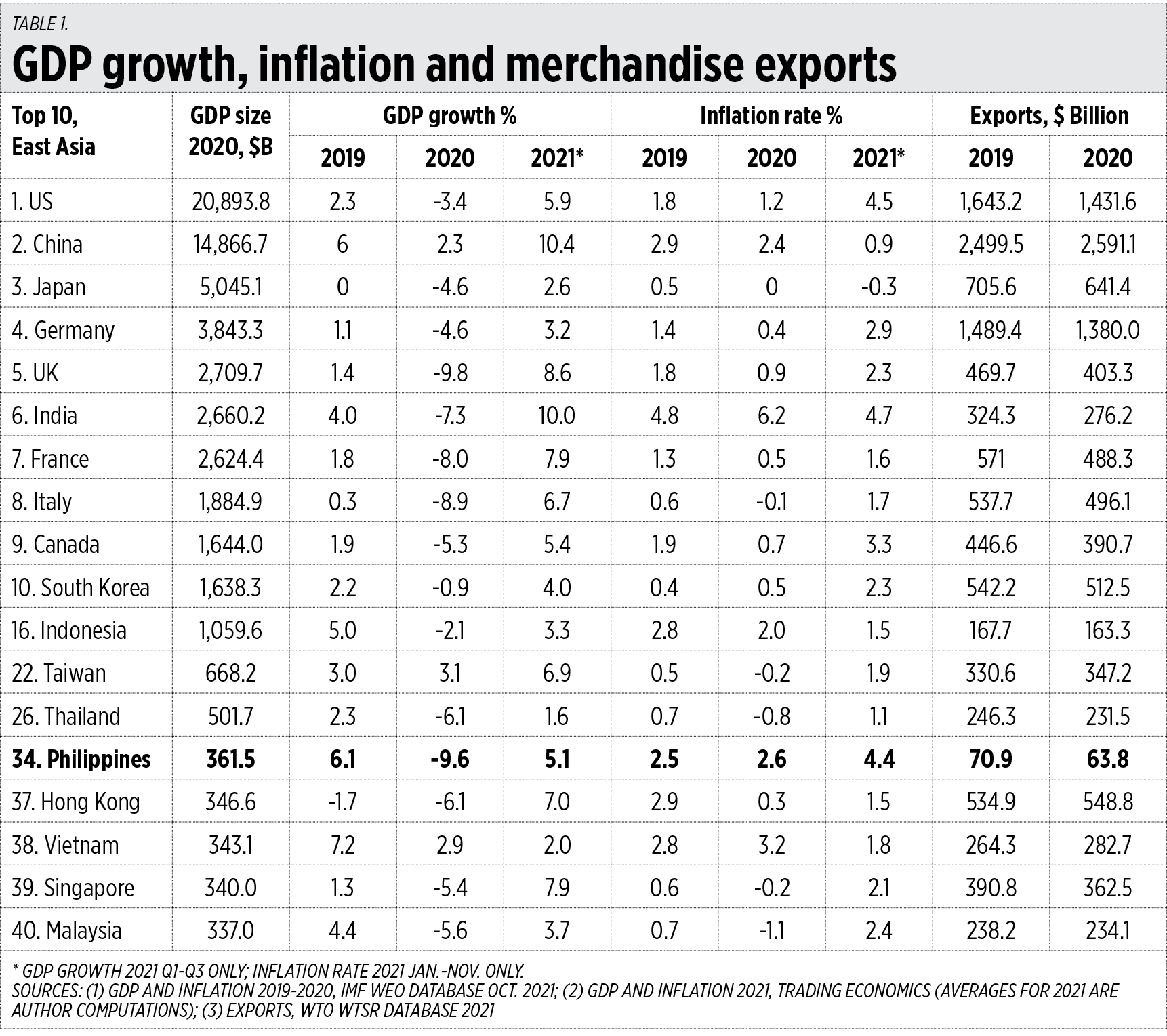
1. In the top 50 largest economies in the world by GDP size, the five worst performing and deepest GDP contractions in 2020 were: Spain with -10.8%, followed by Argentina -9.9%, the UK -9.8%, the Philippines -9.6%, and Italy -8.9%. Final 2020 data with projections for 2021-2025 were released by the IMF World Economic Outlook (WEO) in October 2021.

2. Of the top 50, only seven countries managed to grow and escape contraction in 2020, four of which are in South and East Asia: Bangladesh with 3.5%, Taiwan 3.1%, Vietnam 2.9%, and China 2.3%. The Philippines was the 34th largest economy in the world in 2020 but may have been the 32nd if it shrank only by around -8% or lower and not -9.6%.

3. There was GDP growth in the first to third quarters of 2021. Almost all countries managed to grow but largely due to “base effect” — their 2020 GDP levels were low so any marginal increase above that low base would translate to growth. The Philippines grew 5.1% in the first three quarters of 2021, but that would be equivalent only to the GDP level of 2018. It will reach the 2019 level around the second or third quarter of 2022.

4. Inflation in 2020. Most countries experienced lower consumer prices compared to 2019. The Philippines and Vietnam though experienced slight increases in inflation. Strict lockdowns in the Philippines resulted in some supply disruptions and delays (goods, repairs and spare parts for tractors, trucks, boats, etc.) due to the many checkpoints and barriers between provinces — even between cities of the same province — which contributed to higher inflation.

5. Inflation in 2021 was double or triple the 2020 levels for many countries — the US, the UK, Germany, France, Italy, etc. Free money from governments distributed to people who spent it even if they did not contribute to the production of goods and services, logistical delays in big seaports, later the spikes in energy prices, contributed to this. In East Asia, the Philippines has the highest inflation rate — this is not good.

6. Merchandise exports in 2020 declined in many countries except China, Taiwan, and Vietnam. These three Asians also escaped GDP contractions that year. All G7 member countries experienced significant declines in exports. Closure of many manufacturing plants for several weeks, and strict and slow inspections in ports contributed to this. Global exports data were released by the World Trade Organization (WTO) World Trade Statistical Review (WTSR) 2021 on July 30.

7. Philippine exports remain the smallest among emerging and developed East Asia at only $64 billion in 2020. Our neighbors — Malaysia, Thailand and Vietnam — have about four times that level while Singapore has nearly six times that level (see Table 1).

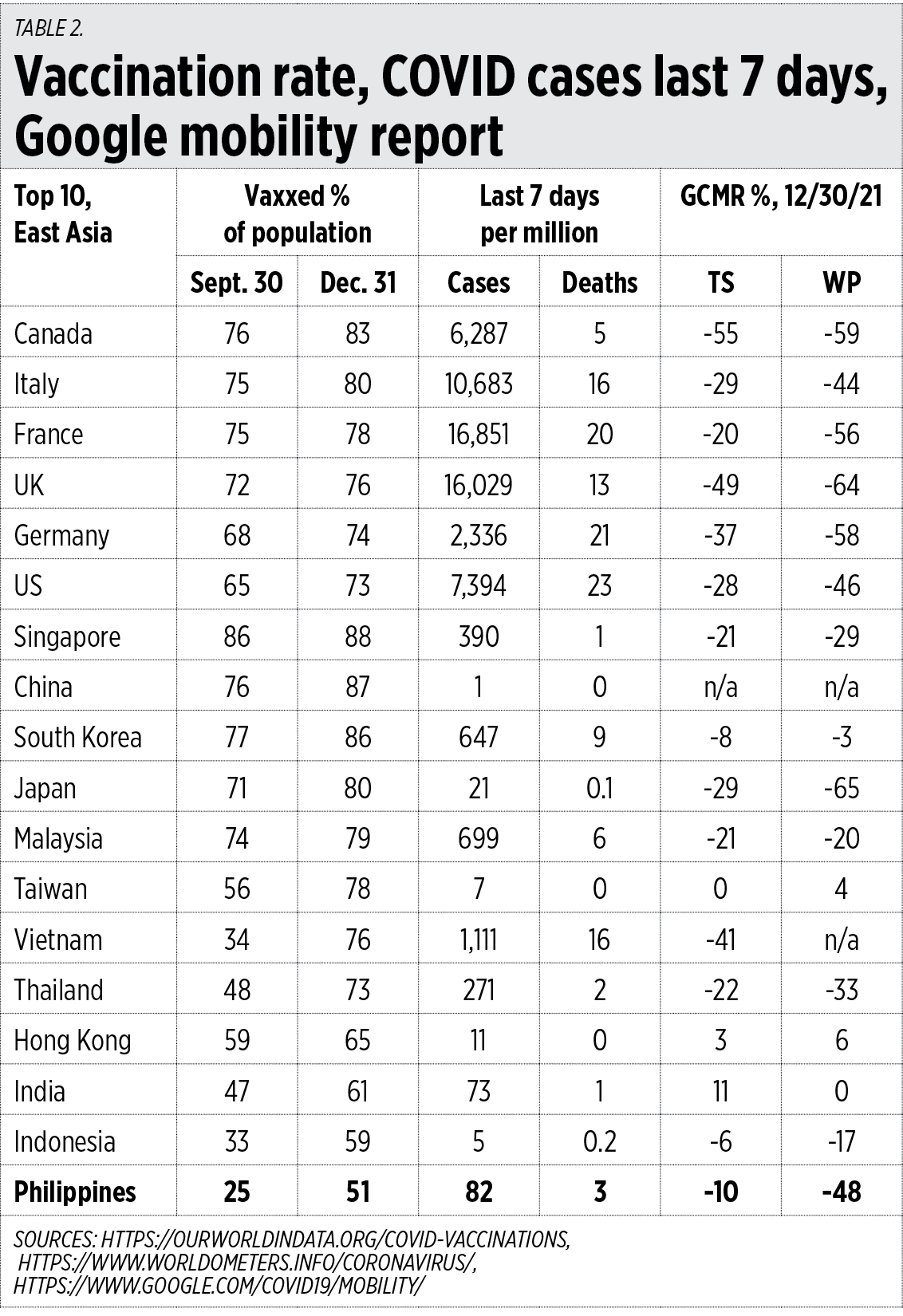
8. Vaccine discrimination or implicit mandatory vaccination as a business and economic policy by many governments in rich countries went on a wild roll. By the end of the third quarter 2021, many of them have vaccination rates 65-86% of their total population already. By end-2021, this went up to 73-88% of their populations. The Philippines had a slow start but rushed towards 51% by end-2021.

9. Infections from the COVID-19 Omicron variant seemed to be higher in rich countries with high vaccination rates, their seven-days average cases per million population last week ranged from 2,300+ (Germany) to 16,800+ (France) but deaths from Omicron seem low, and seem even lower in countries with lower vaccination rates like the Philippines, Indonesia, and India.

10. Lockdowns and restrictions on the mobility of people continued until end-2021. Looking at the weekly Google Community Mobility Reports (GCMR) show how visitors to (or time spent in) categorized places change (in percent) compared to baseline days, using the median value from the five‑week period between Jan. 3 to Feb. 6, 2020. As of Dec. 30, 2021, mobility in Transit Stations (TS) and Work places (WP) remained high. The Philippines, for instance, has -48% in WP (see Table 2).

Anemic GDP growth and high inflation in 2021, plus high public debt, continued mobility restrictions and lockdowns, vaccine discrimination, all these point to a non-bright early 2022. We hope that governments, multilaterals, most NGOs and media, pharma, etc. will temper the scare and hysteria. Viruses will keep mutating and evolving 100%, and humans and other living creatures will also keep evolving 100% naturally. The sooner that we realize we need to live with evolving viruses, the better.

This is the sixth in this column’s annual series “Top 10 news of the year,” the others being:

1. “Top 10 news of 2016,” https://www.bworldonline.com/are-the-people-satisfied-or-disappointed-with-more-government-the-top-10-news-of-2016/.

2. Trends in global and national trade (2017), https://www.bworldonline.com/trends-global-national-trade-prospects-near-future/.

3. Top 10 economic news of 2018, https://www.bworldonline.com/top-10-economic-news-of-2018/.

4. Top 10 economic news of 2019, https://www.bworldonline.com/top-10-economic-news-stories-of-2019/.

5. Top 10 economic news of 2020, https://funwithgovernment.blogspot.com/2020/12/bworld-468-top-10-economic-news-of-2020.html.


Bienvenido S. Oplas, Jr. is the president of Minimal Government Thinkers.

minimalgovernment@gmail.com

Christian achievers for God and country

UPKLYAK-FREEPIK

Religio, mores, cultura. These three values are fundamental to the Lasallian identity: the spirit of faith, zeal for service, and communion in mission. The university instills in its students the right values and attributes that follow the path of the Lord. Mores represent the proper ways of conduct in society. Culture asserts that a good Lasallian has great and deep love for the country.

These may appear as simple slogans but, in my career, I have been blessed to have had Lasallians as bosses and superiors who embodied these principles. Allow me to share my experience with Lasallian leaders who have made an impact on the lives of many.

Eduardo “Danding” Lucero was one of the appointees of former President Cory Aquino. He had a short stint in rehabilitating the Processing Center Authority and invigorating the then Guarantee Fund for Small and Medium Enterprises. He is one of only three individuals to have been given the DLSAA President’s Alumni Award. He was a tough boss, but a dedicated one. He served as the editor of the official English student newspaper, The La Sallian, and as DLSAA President for at least four years. When he passed away a few years ago, it was with little fanfare, despite his consistent, dedicated volunteer service for decades.

Dr. Philip Ella Juico was my dean at the then DLSU Professional Schools, which used to manage the MBA program. He was a strong leader and was relentless about improving the quality of cases used in the business school. Years ago, I assisted him in an ASEAN project that bore fruit because of his assiduous work. He has also served the country in various ways — Secretary of the Department of Agrarian Reform, Chairman of the Philippine Sports Commission, and, presently, President of the Philippine Athletics Track and Field Association. A TOYM awardee for government service, Juico knows that advocating for good governance isn’t easy.

At the Development Bank of the Philippines (DBP), another Lasallian was my boss, Gil Buenaventura. From being as senior executive at BPI, he served the government as President and CEO of DBP, which he successfully steered from its treasury orientation to its real mandate of being a development financial institution. Another tough act followed as CEO of RCBC when it was recovering its footing from the Bangladesh fiasco. Buenaventura preferred to simply do his job without being in the limelight. He was results-oriented, and he was an empowering superior.

Another Lasallian took over DBP in the person of Emmanuel “Manny” Herbosa. His vision was to do more for Mindanao, for farmers, and for small entrepreneurs. Despite his private banking roots, he embraced the need to make sure DBP fulfilled its mission for God and country. Fittingly, the Association of Development Financing Institutions in Asia and the Pacific (ADFIAP) presented the Outstanding CEO Award to him in 2021 for his “singular leadership, vision and achievement.”

I continue to meet Lasallians who are making a difference. The Bangko ng Kabuhayan (BNK) is a small rural bank based in Pasig. Its chairman is former Energy and then Finance Secretary, Jose Isidro “Lito” Camacho. While he serves as Vice-Chairman of Credit Suisse of Asia-Pacific and is its Singapore Country CEO, he also ensures that micro and small loans are extended to budding entrepreneurs.

At the Philippine Business Bank (PBB), serving as Vice-Chairman and CEO is Rolando Avante, who holds a marketing degree from DLSU. Avante is on top of one of the country’s busiest and most aggressive savings banks whose operations are already close to those of a regular commercial bank. PBB aims to be the bank of choice of the SME market segment, growing from two branches in 1997 to 165 branches today. Started by the visionary Chairman Emeritus Alfred Yao, PBB has just implement its new core banking system and is aiming to further its reach through both traditional and digital solutions for its target clientele.

The senior management team of PBB is peppered with Lasallian talent. Consuelo Dantes, head of HR, took MBA units at DLSU. Jose Maria Valdes, who is overseeing the new core banking solution, has degrees in Behavioral Science and MFI. The head of the Corporate Banking Group, Eduardo Que, is an MFI graduate. Liza Jane Yao, head of General Services, is a BS Accountancy graduate. She is also a key board member of the AMY Foundation, which helps send to college deserving children from the underprivileged sector.

DLSU aims to develop technically competent, humanistic, and socially responsible managers and leaders. The country needs more of these as we recover from this pandemic.


Benel D. Lagua is former executive vice-president at the Development Bank of the Philippines. With AIM-MBM and Harvard-MPA degrees, he is a part-time faculty member of the Ramon V. Del Rosario College of Business of De La Salle University.

benellagua@alumni.ksg.harvard.edu

South Korea’s Moon promises final push for North Korea peace

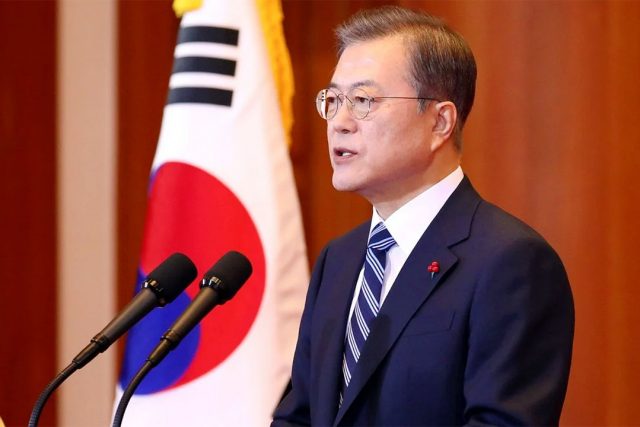
SOUTH KOREAN PRESIDENT MOON JAE-IN — REUTERS

SEOUL — South Korean President Moon Jae-in vowed on Monday to use his last months in office to press for a diplomatic breakthrough with North Korea, despite public silence from Pyongyang over his attempts for a declaration of peace between the two sides.

“The government will pursue normalization of inter-Korean relations and an irreversible path to peace until the end,” Mr. Moon said in his final New Year’s address before his five-year term ends in May. “I hope efforts for dialogue will continue in the next administration too.”

In his own address on New Year’s Eve, North Korean leader Kim Jong Un made no mention of Mr. Moon’s calls for a declaration officially ending the 1950-1953 Korean War, or of stalled denuclearization talks with the United States.

Mr. Moon held multiple summits with Mr. Kim, including once in Pyongyang, during a flurry of negotiations in 2018 and 2019, before talks stalled amid disagreements over international demands that the North surrender its arsenal of nuclear weapons, and Pyongyang’s call for Washington and Seoul to ease sanctions and drop other “hostile policies.”

Mr. Moon is pushing an “end of war declaration” as a way to jumpstart those stalled negotiations and his administration has hinted at backchannel discussions.

But North Korea has not publicly responded to the latest push, and the United States has said it supports the idea but may disagree with the South over its timing.

“It is true that there is still a long way to go,” Mr. Moon acknowledged, but argued that if inter-Korean relations improve, the international community will follow.

Mr. Moon said his outreach to North Korea had been enabled by a large military buildup that helped make South Korea safer. “Peace is possible on strong security,” he said.

The coronavirus disease 2019 (COVID-19) pandemic overshadowed the standoff with North Korea, as Pyongyang put the country into an unprecedented lockdown and Mr. Moon faced domestic pressure to tamp down the first major coronavirus outbreak outside of China in early 2020.

Since then, South Korea used aggressive tracking and tracing, as well as social distancing rules and a belated but thorough vaccination campaign to keep overall cases and deaths relatively low by global standards. — Reuters

ADVERTISEMENT
ADVERTISEMENT