Home Blog Page 6920

No Exit

PHILIPPINE STAR/ MICHAEL VARCAS
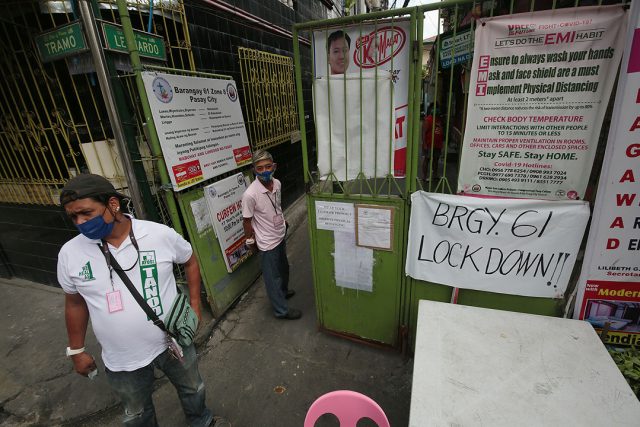
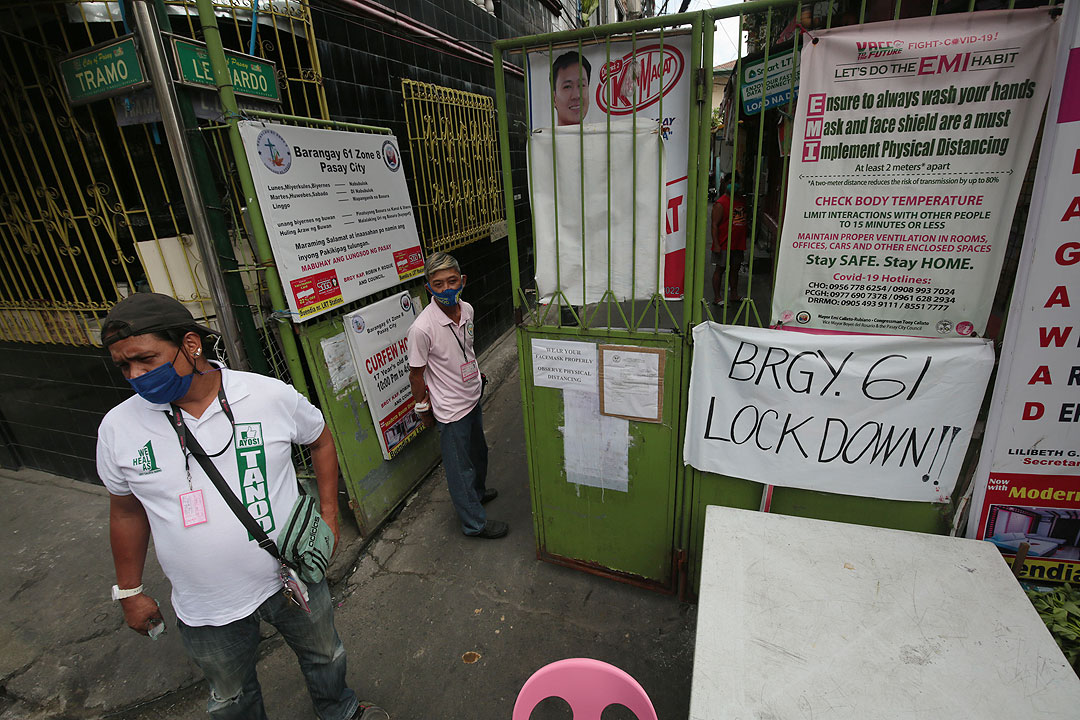
BARANGAY WATCHMEN in Pasay City man an outpost at Brgy. 61 after 23 individuals in the area were reported as positive COVID-19 cases. — PHILIPPINE STAR/ MICHAEL VARCAS

The record-breaking surge in the number of daily COVID-19 cases and its devastating impact on business operations and workers’ livelihoods are among the more visible consequences of the government’s pre-holiday rush to seeming normalcy as the year 2021 was ending.

The rush began in late October as the number of daily cases declined. It was apparently meant to convince the populace that the government had contained the pandemic that had confined many to virtual house arrest, and that everyone could then head for the exits.

The Duterte regime could have welcomed the decline with cautious optimism and with a reminder to the citizenry that the pandemic is still a threat, and everyone should continue to observe established health protocols. Instead, it relaxed domestic and foreign travel restrictions, allowed cinemas to operate, and opened resorts and tourist destinations to the public. Almost daily did its spokespersons issue glowing statements about the country’s celebrating “a better 2021 Christmas” which much of the populace interpreted as indications that things were nearly back to normal.

The reservations of the medical community were, as usual, ignored. Public transport vehicles — jeepneys and buses as well the MRT and LRT lines in the National Capital Region (NCR) — were ferrying passengers at almost full capacity in late October and in November, while shoppers thronged the malls and markets, in many instances without social distancing. Christmas and New Year’s eves contributed to the surge in cases as celebrators partied and made merry, assured as they had been that the Philippines was at low risk of further infections.

But scientists in Africa had discovered the Omicron variant of COVID-19 in travelers from Europe in early November. Following the lead of other jurisdictions, the Philippine government banned visitors and travelers from countries where Omicron cases had been reported, but exempted Filipino nationals. A few cases of Omicron in returning overseas Filipino workers (OFWs) were eventually found in the Philippines, with the numbers spiking as the year was ending. By the second week of the new year, the Omicron variant had become the dominant COVID strain in the country.

From its late 2021 policy of relaxing practically all restrictions, in reaction to the new year surge the Duterte regime has gone to the other extreme of imposing more restrictions on public mobility. But the policies are replete with exemptions and contradictions, and particularly disadvantageous to the poorer sectors of the population.

The “no vaccination, no ride” policy would make sense only if most of the populace were fully vaccinated. But only some 54% of the targeted 70 million have been. The policy has led to a rush to vaccination centers by the unvaccinated, but the first shot will not protect one and one’s fellow passengers in a bus or jeepney from infection.

Because it won’t — most of the vaccines require two shots, and need some time to take effect — the impact of the policy on public safety is thus limited only to those who have been fully vaccinated, and whose shots have had the time to develop the antibodies that would protect them.

The same policy assumes that the unvaccinated are against vaccinations. Some indeed are; but most are not. A number of other reasons make getting vaccinated problematic even if one wants to for such sectors as workers who are paid on a daily basis. For them, losing a day’s wages — there are long lines in most of the vaccination centers, where one has to wait for hours — can mean their family’s missing a meal. In belated awareness of that fact, the government now says workers are exempted from the “no vaccination, no ride” policy. Since most of those who take public transport are workers, the policy makes even less sense.

At the same time that it is supposedly being enforced, the checkpoints that have once again sprouted on major thoroughfares are stopping motorcycles, buses, and jeepneys in implementation of its sister policy of keeping the unvaccinated at home and arresting those who defy that rule. But they were not checking privately-owned and -driven vehicles, whose occupants, whether vaccinated or not, could come and go as they please.

The policy swing to what amounts to a lockdown by another name is contradicted by the Inter-Agency Task Force’s (IATF) approval, despite the protest of health and medical professionals, of shorter isolation and quarantine periods for asymptomatic and fully vaccinated persons.

Part of the reason for the policy seems to be the shortfall in nurses and other hospital personnel, many of whom have tested positive for COVID-19 as the surge in cases threatens to overwhelm the health system. The shortage is a problem of long-standing primarily because of the pittance in wages and benefits such personnel receive, to augment which they are still fighting for, two years into the pandemic.

In further contradiction of the swing to a veritable lockdown, the Department of Health (DoH) has proposed a stop to the testing and tracing of the close contacts of those found to be COVID positive as long as they are asymptomatic. Healthcare workers, senior citizens, and persons with other health problems would instead be prioritized for testing.

The argument is that because “many, many” Filipinos have been vaccinated, the chances of recovery of the COVID-positives’ contacts are supposedly higher and their hospitalization less likely. But the policy is in effect a gamble that most or all of those so exposed to the disease are fully vaccinated. Omicron is also a new coronavirus variant about which not enough information is currently available. Whether this policy makes sense will be determined only by future data on the extent to which it helped reduce the number of cases. The DoH proposal incidentally contradicts Mr. Duterte’s order to improve the healthcare system’s testing capacity.

In the midst of the confusion, distress, and anguish the government response to the COVID-19 surge has generated came an attempt to hype up the Omicron threat as a blessing rather than a curse.

A priest/molecular biologist with a number of involvements in government agencies and activities described the variant as “a blessing” because those infected with it would supposedly develop antibodies that would protect them from other coronavirus variants.

Octa Research fellow Nicanor Austriaco’s optimism was widely reported, but was repudiated by analysts, epidemiologists, and medical doctors for glossing over the crisis in the medical workforce and the resulting strain on the hospital system. It did seem to be based more on politics — was he throwing the rabble a bone so they’ll continue to support the administration? —  rather than on science. But in their desire for some good news to hold on to, any number of Filipinos could have taken Fr. Austriaco’s claims for Bible truth.

Accurate, relevant, and verifiable information rather than lockdowns by some other name and other restrictions is in fact what is most needed for the country to survive its present predicament. Without it, no exit is possible from the hole the citizenry is in, and from further restrictions, immobility, discrimination, and mass confusion.

Well thought-out, pro-active policies based on informed and rigorous analysis could have helped the country navigate the treacherous waters of the pandemic from its very onset in 2020. The need for them was especially evident during the last quarter of 2021, as well as at the present time. But they are precisely what were and are still missing in the far from strategic and purely reactive government response to the pandemic.


Luis V. Teodoro is on Facebook and Twitter

(@luisteodoro).

www.luisteodoro.com

Sunset thoughts and Nature

GINO/UNSPLASH

The sunsets of our country are among the most spectacular in the world. The spellbinding and marvelous colors splashed against the sky are unique and difficult to capture on canvas.

One can compare the contrast of sunsets when viewed from a mountain peak amidst the clouds and the pine trees or on a windswept cliff above the merging, clashing waters of the azure West Philippine Sea and the ultramarine Pacific Ocean.

The sun’s farewell is awesome and inspiring.

The shades of the sunset became more stunning and startling after the eruption of the long dormant volcano, Pinatubo. After six centuries, it roared into an explosion of fiery fury. It was the giant whose rage knew no bounds, spewing tons of fine mineral dust, tiny silica sand particles into the atmosphere. The spectacle was an apocalyptic preview beyond our imagination. The towering black clouds stained the sky for thousands of miles as winds carried its dust to distant Pacific islands.

Since that eruption, our sunsets have become more intense, more magnificent. On a color spectrum, the luminous light of Provence and the golden colors of Hawaii’s sunsets are so lovely, but they are pale in comparison to our own.

The wondrous spectacle of light has a dark side, a shadow.

Pollution.

This environmental issue needs urgent attention from the National Government and the private sector.

Smog stings the eyes, causing chronic soreness.

The foul atmosphere threatens not only our natural resources but also public health. It triggers pulmonary ailments, asthma, and allergies particularly among the children and the elderly. The toxic factory fumes and garbage bonfires aggravate respiratory ailments and infections.

Smoke-belching public utility vehicles choke people who are exposed to hazardous fumes that poison the air and the clouds. The particles that linger in the atmosphere become a hazy blanket trapped in humidity.

Many decades ago, rainwater was pure and sweet to drink and bathe in. It did not require complicated filtration, ionization, or distillation. Streams, rivers, lakes, and deep wells had clean water for the fish to thrive in and for irrigation. The vast fields, hills and gardens had a verdant sheen.

Now all we get is acid rain that stains, corrodes and contaminates.

Manila Bay’s famous sunset is the ultimate postcard-perfect spectacle. The seascape is a palette of burnished gold, copper, and tangerine on a cobalt blue sea and indigo violet sky, streaked with vermilion and magenta. The color combinations vary with the many moods of nature.

Gazing at the natural wonders of creation, one wonders why such perfection is being destroyed by man’s callousness to nature. The cavalier attitude is “who cares!” The careless, destructive habits are destroying the rich environmental resources.

Floating debris and waste make the Pasig River so filthy and smelly. It pours out into the bay. The fish resemble distorted gargoyles and shellfish have become toxic. The toxic red tide used to come every summer. Now it seems the scourge is all year round. It is a symptom of our dying ecosystem and the ailing seas. It is nature’s karmic revenge for the abuse of the sea and the environment.

How can we resolve the problem? Through political will and discipline.

The government should intensify the campaign to protect and save the environment through education on all levels, a massive media campaign (next to the overwhelming health crisis management).

Public buses, jeepneys, and tricycles that emit fumes should be grounded. Permits and licenses should be revoked. Their owners and drivers should be fined heavily. Government should enforce laws that protect the environment and penalize the culprits who pollute the air and savage the marine life. Many cops turn a blind eye despite the trail of smoke coming from offensive vehicles.

Factories that spew noxious fumes into the air and disgorge solid and liquid waste into our rivers and lakes should be closed for rehabilitation. These are major crimes against nature.

Informal dwellers who live along the canals and rivers should be relocated and given adequate housing with sanitary facilities.

Fishermen who use dynamite and cyanide should be caught and jailed. Does the Coast Guard catch the offenders?

Passenger ships and inter-island ferries should be inspected (by the port authorities) before the vessels leave port. When these ships arrive at their destination, the authorities should inspect the garbage bins to verify proper garbage disposal procedures. An empty bin means that the garbage was surreptitiously tossed into the sea at night.

Over the past several years, we have written about this problem. There have been suggestions to impose a hauling fee on all sea vessels to cover the expense of garbage disposal whether the bin is full or empty. The official fees with receipts would discourage the ship captains from throwing garbage overboard. Shipping companies have a responsibility to keep our seas clean and safe. The severe penalties would make owners comply.

As good citizens, we can do our share by teaching our families, the staff and community the value of discipline and respect.

We should go green. We should use unleaded gas and conserve fuel. We should recycle, repurpose, reuse, reduce.

Ecotourism is one of our best assets. We should save the powder white beaches, the coral reefs, the emerald isles and turquoise blue waters where the dolphins and whales swim, and the fabled rice terraces.

As we begin the New Year, let us resolve to love and protect Mother Earth. It is our only chance to survive.


Maria Victoria Rufino is an artist, writer and businesswoman. She is president and executive producer of Maverick Productions.

mavrufino@gmail.com

US Supreme Court rejects mandatory vaccination

PHILIPPINE STAR/ MICHAEL VARCAS
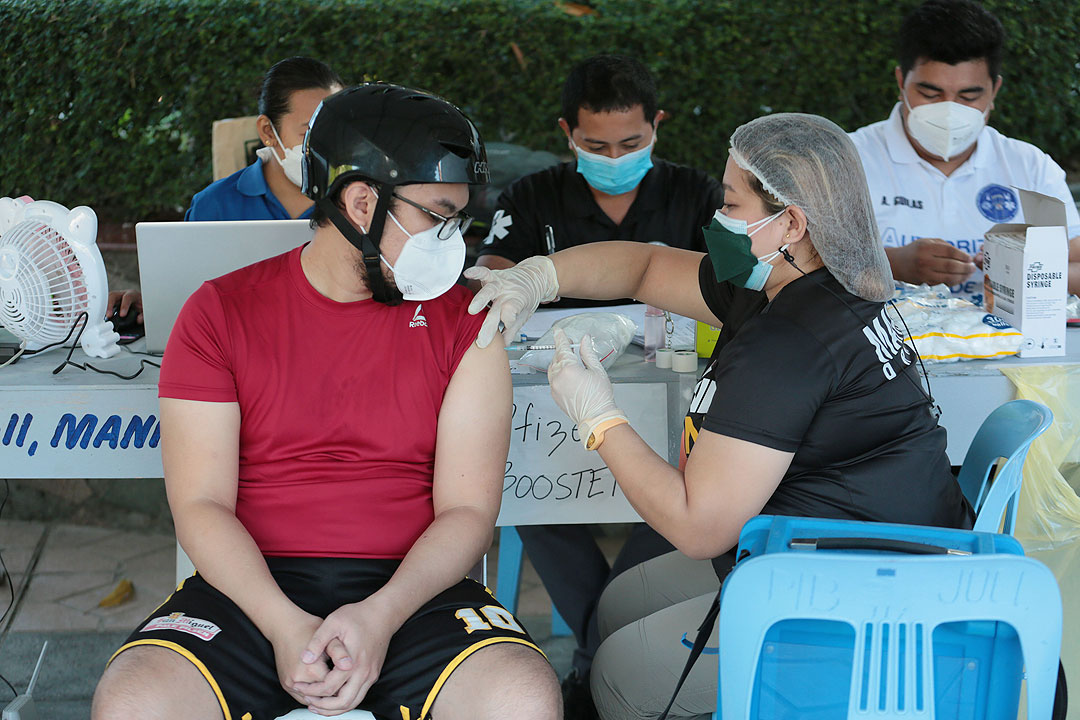
BIKERS line up at a COVID-19 booster shot drive-through at the Kartilya ng Katipunan in Lawton, Manila. — PHILIPPINE STAR/ MICHAEL VARCAS

Last week the US Supreme Court came out with a decision of huge importance to the rule of law and civil liberties. In National Federation of Independent Business vs. Department of Labor, the Supreme Court reiterated the principle proclaimed in 2020’s Agudath Israel v. Cuomo and Roman Catholic Diocese of Brooklyn v. Cuomo that “even in a pandemic, the Constitution cannot be put away and forgotten.”

The present case arose from the US Secretary of Labor’s actions “through the Occupational Safety and Health Administration” (or OSHA), by which mandatory vaccination was imposed for much of the US workforce. “The mandate, which employers must enforce, applies to roughly 84 million workers, covering virtually all employers with at least 100 employees. It requires that covered workers receive a COVID-19 vaccine, and it pre-empts contrary state laws.”

The US Supreme Court eventually ruled that the petitioners (i.e., those against mandatory vaccination) “are likely to succeed on the merits of their claim that the Secretary lacked authority to impose the mandate.”

This was incredibly significant as the US Supreme Court essentially signaled to the lower courts that the arguments against mandatory vaccination are “likely to prevail,” hence preventing the vaccine mandate from taking effect. It represents also the first time since 1970 that the US Supreme Court heard a case for a “stay” petition. Thus:

“OSHA … is stayed pending disposition of the applicants’ petitions for review in the United States Court of Appeals for the Sixth Circuit and disposition of the applicants’ petitions for writs of certiorari, if such writs are timely sought. Should the petitions for writs of certiorari be denied, this order shall terminate automatically. In the event the petitions for writs of certiorari are granted, the order shall terminate upon the sending down of the judgment of this Court.”

Granted, federal government healthcare employees working at institutions accepting Medicaid and Medicare funding are still covered by the Biden administration’s mandatory vaccination requirements. Nevertheless, private employers, representing “roughly 84 million workers” nationwide, won’t be.

In an attempt to downplay the importance of this case within the Philippine context and its nightmarish COVID-19 policy, some legal commentators pointed out that the US Supreme Court’s ruling had nothing to do with the power of government to impose mandatory vaccination, but rather with the ongoing tussle between Federal and State authority. That’s not an entirely accurate representation and the case remains an utterly helpful guide to our jurisdiction.

Justice Neil Gorsuch, in his concurring opinion, gave out the reasons for the overturning of the vaccine mandate: “The question before us is not how to respond to the pandemic, but who holds the power to do so. The answer is clear: Under the law as it stands today, that power rests with the States and Congress.”

The ruling itself expounds on that reasoning: the US Congress “has never before adopted a broad public health regulation of this kind — addressing a threat that is untethered, in any causal sense, from the workplace.

“It is not our [the US Supreme Court’s] role to weigh such tradeoffs. In our system of government, that is the responsibility of those chosen by the people through democratic processes. Although Congress has indisputably given OSHA the power to regulate occupational dangers, it has not given that agency the power to regulate public health more broadly. Requiring the vaccination of 84 million Americans, selected simply because they work for employers with more than 100 employees, certainly falls in the latter category.”

Accordingly, any interference with civil liberties in response to public health issues must come from the elected legislative branch of government: Congress. The Executive Branch, of which the IATF (Inter-Agency Task Force for the Management of Emerging Infectious Diseases) is under, and local government units, whose power is derived essentially from Congress’ Local Government Code, simply cannot demand mandatory vaccination. It goes against the Bill of Rights and the tripartite, equal branches of government principles of our Constitution.

Another important point which Philippine lawyers should take note of, is that the judiciary “is not a public health authority. But it is charged with resolving disputes about which authorities possess the power to make the laws that govern us under the Constitution and the laws of the land.”

In this regard, Justice Gorsuch relies on the “major questions doctrine,” which “ensures that the national government’s power to make the laws that govern us remains where Article I of the Constitution [which is Article VI in the Philippine Constitution] says it belongs — with the people’s elected representatives. If administrative agencies seek to regulate the daily lives and liberties of millions of Americans, the doctrine says, they must at least be able to trace that power to a clear grant of authority from Congress. In this respect, the major questions doctrine is closely related to what is sometimes called the nondelegation doctrine.”

Hopefully, more Filipinos can be encouraged to stand up for their rights against the present unconstitutional measures of the IATF and many local government units


Jemy Gatdula is a senior fellow of the Philippine Council for Foreign Relations and a Philippine Judicial Academy law lecturer for constitutional philosophy and jurisprudence

https://www.facebook.com/jigatdula/

Twitter@jemygatdula

Biden predicts Russia will make a move on Ukraine

PHOTO FROM JOE BIDEN FACEBOOK PAGE

WASHINGTON/KYIV — US President Joseph R. Biden predicted on Wednesday that Russia will make a move on Ukraine, saying Russia would pay dearly for a full-scale invasion but suggesting there could be a lower cost for a “minor incursion.”

Mr. Biden’s comments at a White House news conference injected uncertainty into how the West would respond should Russian President Vladimir Putin order an invasion of Ukraine, prompting the White House later to seek to clarify what Mr. Biden meant.

“My guess is he will move in,” Mr. Biden said of Mr. Putin at a news conference. “He has to do something.”

“Russia will be held accountable if it invades — and it depends on what it does. It’s one thing if it’s a minor incursion and we end up having to fight about what to do and what to not do, et cetera,” Mr. Biden said. “But if they actually do what they’re capable of doing … it is going to be a disaster for Russia if they further invade Ukraine.”

Russian officials have repeatedly denied planning to invade, but the Kremlin has massed some 100,000 troops near Ukraine’s borders, a buildup the West says is preparation for a war to prevent Ukraine from ever joining the NATO Western security alliance.

Shortly after the nearly two-hour news conference ended, the White House stressed any Russian military move into Ukraine would elicit a tough response.

“If any Russian military forces move across the Ukrainian border, that’s a renewed invasion, and it will be met with a swift, severe, and united response from the United States and our allies,” said White House press secretary Jen Psaki.

But cyberattacks and paramilitary tactics by Russia “will be met with “a decisive, reciprocal, and united response,” she said.

Mr. Biden said a third summit with Mr. Putin “is still a possibility” after the two leaders met twice last year. He said he was concerned that a Ukraine conflict could have broader implications and “could get out of hand.”

Speaking to reporters at length about the crisis threatening to engulf his presidency, Mr. Biden said he believed Mr. Putin would test Western leaders. The response to any Russian invasion, he said, would depend on the scale of Moscow’s actions and whether US allies squabbled over how to react.

Mr. Biden and his team have prepared a broad set of sanctions and other economic penalties to impose on Russia in the event of an invasion and the US president said Russian companies could lose the ability to use the US dollar.

Pressed on what he meant by a “minor incursion,” Mr. Biden said NATO allies are not united on how to respond depending on what exactly Mr. Putin does, saying “there are differences” among them and that he was trying to make sure that “everybody’s on the same page.”

“Big nations can’t bluff, number one. Number two, the idea that we would do anything to split NATO … would be a big mistake. So the question is, if it’s something significantly short of a significant invasion or … just major military forces coming across. For example, it’s one thing to determine if they continue to use cyber efforts; well, we can respond the same way,” Mr. Biden said.

Mr. Biden said Mr. Putin had asked him for guarantees on two issues: that Ukraine would never join NATO and that “strategic” or nuclear weapons never be stationed on Ukrainian soil.

US officials see limiting NATO expansion as a non-starter, but Mr. Biden noted there was little chance of Ukraine joining the alliance soon and he suggested there could be a deal under which the West might not station nuclear forces in Ukraine.

“We can work out something on the second piece,” depending on Russia’s own posture, Mr. Biden said.

Visiting Kyiv in a show of support, US Secretary of State Antony Blinken said Russia could launch a new attack on Ukraine at “very short notice” but Washington would pursue diplomacy as long as it could, even though it was unsure what Moscow really wanted.

The Kremlin said tension around Ukraine was increasing and it still awaited a written US response to its sweeping demands for security guarantees from the West, including a halt to further NATO expansion and a withdrawal of alliance forces from central and eastern European nations that joined it after 1997. — Reuters

Prior COVID infection more protective than vaccination during Delta surge — study

PEOPLE who had previously been infected with COVID-19 were better protected against the Delta variant than those who were vaccinated alone, suggesting that natural immunity was a more potent shield than vaccines against that variant, California and New York health officials reported on Wednesday.

Protection against Delta was highest, however, among people who were both vaccinated and had survived a previous COVID infection, and lowest among those who had never been infected or vaccinated, the study found.

Nevertheless, vaccination remains the safest strategy against COVID-19, according to the report published in U.S. Centers for Disease Control and Prevention (CDC) Morbidity and Mortality Weekly Report.

The results do not apply to the Omicron variant of the virus, which now accounts for 99.5% of COVID-19 cases in the United States.

“The evidence in this report does not change our vaccination recommendations,” Dr. Ben Silk of the CDC and one of the study’s authors told a media briefing.

“We know that vaccination is still the safest way to protect yourself against COVID-19,” he said.

For the study, health officials in California and New York gathered data from May through November, which included the period when the Delta variant was dominant.

It showed that people who survived a previous infection had lower rates of COVID-19 than people who were vaccinated alone.

That represented a change from the period when the Alpha variant was dominant, Silk told the briefing.

“Before the Delta variant, COVID-19 vaccination resulted in better protection against a subsequent infection than surviving a previous infection,” he said.

In the summer and fall of 2021, however, when Delta became the predominant circulating iteration of the virus in the United States, “surviving a previous infection now provided greater protection against the subsequent infection than vaccination,” he said.

But acquiring immunity through natural infection carries significant risks. According to the study, by November 30, 2021, roughly 130,781 residents of California and New York had died from COVID-19.

The analysis did not include information on the severity of initial infection, nor does it account for the full range of illness caused by prior infection.

One important limitation to the study was that it ended before administration of vaccine booster doses was widespread.

Dr. Erica Pan, state epidemiologist for the California Department of Public Health, said in an email that the study “clearly shows” that vaccines provide the safest protection against COVID-19 and they offer added protection for those with prior infections.

“Outside of this study, recent data on the highly contagious Omicron variant shows that getting a booster provides significant additional protection against infection, hospitalization and death,” Pan said.

Silk said the CDC is studying the impact of vaccination, boosters and prior infection during the Omicron surge and expects to issue further reports when that data becomes available. — Reuters

Chicago Bulls end skid, stop Cavaliers’ winning streak

DEMAR DEROZAN (11)

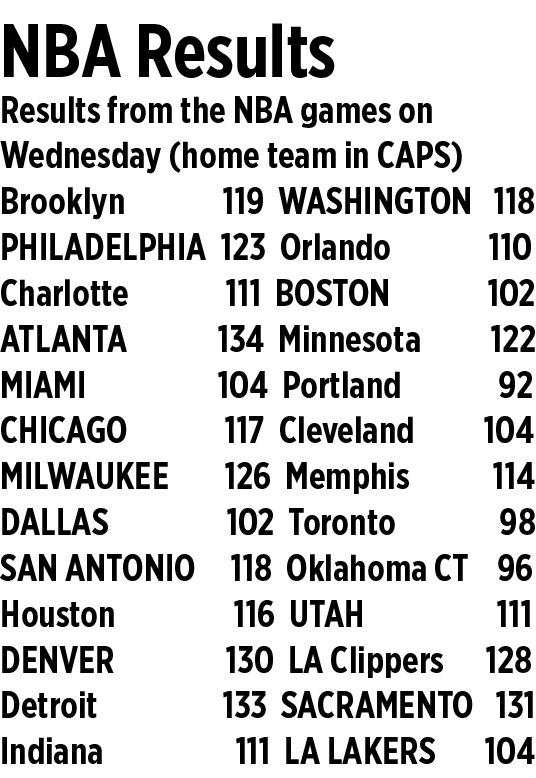
DEMAR DeRozan scored 30 points and Nikola Vučević contributed 24 points and 12 rebounds as the host Chicago Bulls stopped a four-game losing streak by cooling off the Cleveland Cavaliers with a 117-104 victory on Wednesday.

Ayo Dosunmu had 18 points and eight assists and Coby White chipped in 16 points as the Bulls snapped the Cavaliers’ five-game winning streak.

Chicago withstood a sparkling effort from Cleveland’s Lauri Markkanen, a former Bull, who scored a season-high 28 points on 9-of-14 shooting.

After trailing by 11 points in the fourth quarter, the Cavaliers whittled the deficit to 103-102 with 4:18 to go. However, the Bulls surged ahead once more, responding with a 14-2 run to close the game.

Darius Garland notched 20 points and 12 assists for Cleveland, while Evan Mobley (18 points) and Kevin Love (13) followed in double figures. Jarrett Allen snagged 10 boards for the Cavaliers.

Alex Caruso returned to the Chicago lineup for the first time since Dec. 20. He was set to come back earlier this month upon recovering from a left foot sprain but tested positive for coronavirus disease 2019 (COVID-19) shortly thereafter.

Caruso, who was playing under a team-imposed minutes restriction, scored nine points in 22:55. With Cleveland keeping things close late in the third quarter, Caruso drained a 3-pointer at the 3:01 mark and added a layup 29 seconds later to help the Bulls open an 11-point edge.

The Bulls led 58-49 at half time, overcoming 2-for-9 struggles from 3-point range to shoot 55.8% from the field overall.

After Markkanen hit a trey to put the Cavaliers on top 49-48 with 3:33 to go in the second quarter, Chicago closed the half on a 10-0 run. DeRozan led all scorers with 18 at the break. He finished the night with seven assists.

Bulls starters Zach LaVine and Lonzo Ball remain out, both with left knee injuries.

Chicago evened the season series after losing by 23 points in Cleveland on Dec. 8. The teams are set to meet twice in March to close the regular-season series. — Reuters

Sabalenka survives service meltdown to avoid seed exodus

MELBOURNE — World number two Aryna Sabalenka survived a complete service meltdown to rally for a 1-6, 6-4, 6-2 victory over Wang Xinyu and avoid joining an exodus of top women’s seeds early on Thursday at the Australian Open.

Taking to court just after third seed Garbine Muguruza and sixth seed Anett Kontaveit had crashed out of the second round, Sabalenka looked to be going the same way when she double-faulted six times in her opening service game.

Her 12th double fault handed Chinese world number 100 Wang the opening set but even though the services errors continued, the Belarussian battled back to even up the contest on Rod Laver Arena.

Sabalenka had to rely on the rest of her game to keep her out of trouble as the double faults kept coming — there were 19 in all over the match — but ultimately progressed when Wang went long with a forehand.

“I already had a lot of experience playing without the serve so I was just telling myself ‘you have enough shots to still win the match even if you cannot serve,’” Sabalenka said.

“This kind of mentality helped me to stay in the game and actually find my serve.”

Sabalenka, who served up 12 double faults as she came from a set down in her first round match against local wild card Storm Sanders on Tuesday, will face 2019 French Open finalist Marketa Vondrousova in the third round.

“It’s another tough opponent, I’ve played great matches against her,” said Sabalenka.

Iga Świątek will be waiting for Sabalenka in the quarterfinals if they both get that far and she was the only one of the top seeds in early action on Thursday to come through her match without any issues.

The seventh-seeded former French Open champion confirmed her strong form by swatting aside Rebecca Peterson (6-2, 6-2) on John Cain Arena.

“Just starting the match with a confidence was pretty important for me,” the Pole said.

“I felt like I was dominating from the beginning. After getting few breaks, it was much, much easier to go forward.” — Reuters

Atletico Madrid slump continues with Cup loss at Sociedad

LALIGA champion Atletico Madrid was knocked out of the Copa del Rey after a 2-0 defeat at Real Sociedad in the last 16 on Wednesday.

Sociedad took the lead in the 33rd minute from a superb header by Adnan Januzaj, who jumped between three defenders to nod the ball into the bottom-left corner of Jan Oblak’s goal.

The hosts extended their lead after a defensive mistake, when Mikel Oyarzabal robbed the ball from Felipe and freed Alexander Sorloth to run into the box and rifle a shot home from close range.

The Basque side joined Valencia, Real Betis, Rayo Vallecano, Mallorca and Cadiz in the quarter-finals while Real Madrid faces Elche and Athletic Bilbao hosts Barcelona in the last two round-of-16 games on Thursday.

It was the second disappointing loss in a week for Atletico after they fell 2-1 to Athletic Bilbao in the semifinals of the Spanish Super Cup in Saudi Arabia.

Fourth in the LaLiga standings, 16 points behind leader Real Madrid, Atletico is in a slump and pressure is mounting on their manager Diego Simeone.

“This is Atletico and we’re going to give everything that we have to recover. We’ll be back. We’ll keep fighting. It’s a bad situation but we’ll get up for sure,” defender Mario Hermoso told reporters.

It was a frantic first half, with both teams attacking and creating opportunities. Before scoring the opener, Januzaj sent a curling cross-shot against the post. — Reuters

Rangnick slams United first-half display, plays down Ronaldo rant

LONDON — Manchester United interim manager Ralf Rangnick slammed his side’s shoddy first-half performance after a flattering 3-1 victory away to Brentford in the Premier League on Wednesday.

The German also had to deal with a Cristiano Ronaldo tantrum after substituting the Portuguese forward in the second half.

Lackluster United were outplayed by Brentford in the first half and were indebted to keeper David De Gea but goals by Anthony Elanga, Mason Greenwood and Marcus Rashford capped a much-improved second-half display.

It was a vital win for United and keeps them in the thick of the battle for a top-four finish, but Rangnick was not impressed by what he saw in the opening 45 minutes.

“You have to be honest, without David and his brilliant saves it would have been difficult,” Rangnick told reporters.

“We were sloppy in our passing, not strong enough in the tackles, losing the 50-50 challenges and didn’t win a single second ball. When we did counterattack, we were too nervous.

“Brentford were aggressive and brave and they were all the aspects we spoke about at half time.”

Whatever Rangnick said at half time, it clearly worked as United were a different proposition after the break — even if the scoreline was scarcely credible.

Yet the win that lifted United to within two points of fourth-placed West Ham United with a game in hand, was overshadowed by Ronaldo’s reaction to being hauled off and replaced with defender Harry Maguire when the score was 2-0.

Ronaldo, who missed the last two games because of a niggling injury, took an age to walk off the pitch, scowling at United’s coaching staff and throwing his jacket down in anger, before continuing his debate from his seat.

“His reaction was ‘why me?’ … I said to him I have to take a decision in the interests of the club because we had a situation at Villa where we were 2-0 up and drew 2-2 and I was angry at myself for not switching to a back five.

“I decided to switch to a back five with Harry Maguire. He was not happy, he is a goalscorer and wanted to stay on and score a goal himself. But it was important to be compact.

“I said to him I understand, but maybe in a couple of years when you are a head coach you will take the same decision.

“I didn’t expect him to hug me… but I have no issue with him whatsoever.”

His opposite number Thomas Frank was understandably frustrated at the outcome, saying his team had “destroyed” Manchester United in the first half.

Rangnick had some sympathy, praising Brentford’s display and saying his players should learn from them.

“I want us to play like Brentford in the second half, I have great respect for what they have done here,” he said.

“You wouldn’t see that in Germany where a team not in the top five or eight would play that kind of football. We have to develop in that direction and if we do we can play the whole game like that, not just 45 minutes.” — Reuters

Patrick Mahomes, Chiefs look to settle score vs Josh Allen, Bills

THE debate about who is the better American Football Conference (AFC) quarterback, Josh Allen or Patrick Mahomes, plays out on Sunday with another duel in the divisional round of the playoffs.

The Buffalo Bills claimed a convincing 38-20 victory over the Kansas City Chiefs in Week 5 and return to the scene Sunday at Kansas City, Mo., where the Chiefs have won five straight postseason games.

Mahomes ascended quickly to elite status by leading the Chiefs into the AFC championship game each of his first three seasons as a starter and split two Super Bowl outcomes the last two years.

His motivation surfaced in the wild card round last week when Mahomes directed Kansas City on six straight touchdown drives, including five scoring strikes, in toppling Pittsburgh 42-21.

“I really like winning,” Mahomes said when asked if he can summon a special gear. “That’s the end of it.”

His 404-yard passing performance was tops for any National Football League (NFL) quarterback in the wild card round but now he faces a talented Buffalo back end that features Micah Hyde and Jordan Poyer.

“They’ve done everything that we’ve asked and they’ve gone above and beyond, really,” Buffalo coach Sean McDermott said of his talented safeties.

Allen also fired five scoring strikes and drove Buffalo to touchdowns on all seven of its non-kneeling possessions as it walloped New England (47-17). Yet Allen, despite the victory in Kansas City in Week 5, knows what’s at stake in another showdown against Mahomes and the Chiefs.

“They’re what we aspire to be,” Allen said, mindful the Bills fell to the Chiefs, 38-24, in last year’s AFC championship game at Kansas City.

The Kansas City defense Allen opposes has improved dramatically since the Week 5 mismatch, when the Chiefs played without starters Chris Jones and Charvarius Ward and had not nabbed key midseason acquisition Melvin Ingram. Since then, the defense has sparkled.

“I wouldn’t say we owe them one,” Ingram said. “We’re just going to try to win a playoff game and I’m only trying to be a piece to the puzzle.”

After an abysmal start that found the Chiefs ranked 30th or worse against the run and pass during a 3-4 start, they transformed to win 10 of their last 11. They have not been as careless with the ball, though they did allow the Steelers a touchdown return last week by fumbling a sloppy handoff.

Allen poses a complete threat whether throwing the football or taking on tacklers, either by design or improvisation. He completed 21 of 25 passes in the rout of the Patriots while adding 66 yards on just six carries. Yet he understands the Chiefs will offer wrinkles different from Week 5.

“They’re throwing so many looks at quarterbacks right now and bringing pressure from everywhere imaginable,” Allen said.

Allen noted the difficulty in playing on the road before a Kansas City fan base accustomed to postseason success, but the taste of falling short of a Super Bowl bid a year ago remains bitter.

“We don’t want to have that feeling that we had there last year,” Allen said. “We know our season ended there last year and now we have to do everything in our power to put our foot forward and make sure it doesn’t end there this year.”

Buffalo finished as the NFL’s top-rated pass defense while also securing 30 takeaways. Yet the Bills are without Tre’Davious White, who has been out since Week 12. Mario Addison is dealing with a shoulder strain suffered against the Patriots.

Kansas City continues to assess Clyde Edwards-Helaire (shoulder), though he is practicing. Jerick McKinnon stepped up against Pittsburgh and provided 142 yards on 18 touches. McKinnon’s impact could be critical again with Darrel Williams nursing a sore toe. — Reuters

The Shot

Pablo Carreño Busta isn’t one of the favorites in the Australian Open. He isn’t even the best Spaniard on the men’s draw; that distinction belongs to living legend Rafael Nadal. Yet, he wound up hogging headlines Down Under because of a single moment in his second-round match yesterday. At one set all and tied six games into the third set, he found himself needing to execute a remarkable return in order to gain a break of serve. That he did speaks volumes about his unique combination of talent, speed, and anticipation, not to mention make the most of the opportunity before him.

Indeed, Carreño Busta could have simply given up on the point. Opponent Tallon Griekspoor hit an overhead smash, albeit with the racket frame, resulting in the ball barely going over the net, and slowly. Moreover, the errant shot produced such English that the ball reversed direction and traveled back over the net anew. As he himself pointed out in the aftermath, “I tried to run because I could see that it might go in and that it would be difficult for me. I actually had a lot of time because the ball went very high and bounced close to the net. As I was running, I could see that it would bounce back, because when you hit a smash like that with the frame of the racket, it normally does.”

As thing turned out, Carreño Busta produced a highlight-reel return that required him make sure he did not hit the net as he ran past it to flick the ball in play. In hindsight, it proved to be the turning point in the five-set triumph. He noted that he was fortunate to have been in the right place at the right time; “otherwise, I would have had to jump over the net,” he said, “and I’m not [Gael] Monfils.”

Whether Carreño Busta can improve on his third-round showings in the last two years remains to be seen. Up next is Sebastian Korda, whom he will meet for the first time in his career. And while he’s favored against the unseeded competition, there is, as his immediate past experience highlighted, luck to be considered. In any case, he will always have The Shot.


Anthony L. Cuaycong has been writing Courtside since BusinessWorld introduced a Sports section in 1994. He is a consultant on strategic planning, operations and Human Resources management, corporate communications, and business development.

Peso rebounds vs dollar

THE PESO strengthened versus the greenback on Thursday as the central bank said the local unit is seen to remain stable despite its recent depreciation and as coronavirus infections ease slightly.

The local unit closed at P51.34 per dollar on Thursday, appreciating by 16 centavos from its P51.50 finish on Wednesday, data from the Bankers Association of the Philippines showed.

The peso opened Thursday’s session stronger at P51.45 versus the dollar. Its weakest showing was at P51.485, while its intraday best was at its close of P51.34 against the greenback.

Dollars exchanged increased to $858.95 billion on Thursday from $754.2 million on Wednesday.

The peso strengthened versus the greenback on Thursday after the Bangko Sentral ng Pilipinas (BSP) said the local unit is expected to remain stable, a trader said.

The peso was also boosted by profit-taking after consecutive days of depreciation, the trader added.

BSP Governor Benjamin E. Diokno said the peso will continue to be supported by steady inflows from overseas remittances, receipts from business process outsourcing and foreign direct investments.

“The peso will remain to be market driven. We expect it to continue to reflect the economy’s macroeconomic fundamentals, meaning manageable inflation environment, strong and resilient banking system, a prudent fiscal position and an ample level of international reserve buffer,” Mr. Diokno said in an online briefing on Thursday.

Meanwhile, Rizal Commercial Banking Corp. Chief Economist Michael L. Ricafort said the peso appreciated as local infections were relatively lower in the past days.

Active coronavirus disease 2019 infections rose by 31,173 to 275,364 on Thursday, based on data from the Department of Health. In the previous days, infections rose by around 20,000, much lower than the record 39,004 seen on Jan. 15.

For Friday, Mr. Ricafort gave a forecast range of P51.23 to P51.48 per dollar, while the trader expects the local unit to move within P51.15 to P51.40. — L.W.T. Noble